Relationship between Organizational Justice and Organizational Citizenship Behavior in Iran
Hassan Rangriz (Assistant Professor, Faculty of Management, University of Economic Sciences)
587 Author (s)
Hassan Rangriz
Assistant Professor, Faculty of Management, University of Economic Sciences.
E-mail:[email protected]
Relationship between Organizational Justice and Organizational Citizenship Behavior in Iran
Abstract
Purpose – The purpose of this paper is to examine the, relationship between organizational justice and organizational citizenship behavior among 186 experts of Ministry of
Economic Affairs and Finance (MEAF) in Iran.
Design/methodology/approach – The papers develops a research model based on current literature and then test this model in MEAF selected from 18 Ministry, public sector in Iran. Statistics society consists of 186 experts include assistant of general managers in both personnel affairs and welfare and domestic payments department, and also professionals, managers and deputy of personnel affair and department of organization and methods in MEAF. The sample size provided based on "Cohan- Morgan- Korjsay" is 186 experts which has been determined with descriptive methods. For data analyzing we used analysis of Kolmogorov-Smirnov's, analysis of correlation, and analysis of variance test. Findings – The results indicate that we found that there is positive relationship
between organizational justice and OCB. Research
limitations/implications – This study could benefit from a large sample from public sector and replication in more Ministries. Practical implications – The paper offers practical suggestions to the public sector and management in general on how to manage the organizational justice effects on OCB. Originality/value – This paper has tried to provide an inclusive understanding about the relationship between organizational justice and OCB in the MEAF in Iran. Since there was a lack of such research in an Iranian context, this paper can provide theoretical basis for future researches as well as practical implications for managers and the professionals.
Keyword: Organizational Justice, Organizational Citizenship Behavior, Iran Introduction
According to Sloat (1999) governmental organizations are often seen as strong and non-profitable institutions. The organizations are now demanding employees who are “good
citizens”--individuals willing to extend
themselves to help employers. In order to be competitive, this organizations need to ensure that their employees are sensitive, thoughtful,
588 1994) because they are purported to improve
organizational efficiency, effectiveness,
productivity, and adaptability (Organ, 1988a). Doing jobs beyond what is required without expecting to be rewarded is referred to in this
study as “Organizational Citizenship
Behavior” (OCB).
Although there have been many studies of OCB in organizations, no known studies have examined the effects of organizational justice on OCB in governmental organization in Iran. Given this lack of information, attempts are
made to answer one question. Does
organizational justice influence his or her OCB?
Review of Literature
Organizational Citizenship Behavior
In recent years, much importance in OCB has been shown. OCB has been said to enhance organizational performance because they lubricate the social machinery of the organization, reduce friction, and increase efficiency (Bateman & Organ, 1983; Smith, Organ, & Near, 1983). OCB represents individual behavior that is discretionary, not directly or explicitly recognized by the formal reward system, and that in the aggregate promotes the effective functioning of the organization (Organ, 1988a). Most OCB actions, taken singly, would not make a dent in the overall performance of the organization (Organ, 1988b). The effect will be seen with the aggregate summation of OCB performed across time and across persons in the group, department, and organization. The most critical element is that these behaviors are defined at face value. OCB are behaviors that are clearly observable by peers, supervisors, or researchers.
Organ (1988a) identified five categories of OCB, namely: altruism, conscientiousness, courtesy, sportsmanship, and civic virtue.
Williams and Anderson (1991) suggested that
the interpretation of OCB has been
troublesome because it has failed to clearly differentiate between OCB and in-role performance (Moorman, Niehoff & Organ, 1993). In-role behaviors involve supporting the technical core of the business in the organizations whereas OCB does not. Contrary to these confusions, we will adopt the perspective taken from the voluminous theoretical and empirical work on OCB which gives the impression that the boundary between in-role and OCB is agreed upon and clearly defined and that OCB is the same for all employees (Niehoff & Moorman, 1993;
Organ, 1988a; Podsakoff, MacKenzie,
Moorman & Fetter, 1990).
Organizational Justice and Organizational Citizenship Behavior
Justice perceptions may influence OCB by prompting an employee to define his or her relationship with the organization as one of social exchange. In a social exchange process, employees perceiving fair treatment and trust
in managers go beyond formal job
requirements and voluntarily perform acts which benefit the organization (Deluga, 1994).
Although organizational justice and
589
distributive justice, procedural justice,
interpersonal justice, and informational
justice–are correlated (Colquitt, 2001), but they are distinct aspects of organizational justice and have been shown to have independent effects (Greenberg, 1993, 1994).
Organizational justice refers to the overall fairness of the organization reward system and the perceived fairness of the actions of individuals responsible for implementing the rewards allocation system (Cropanzano &
Greenberg, 1997; Leventhal, 1976).
Distributive justice refers to the degree to which rewards are allocated in an equitable manner (Niehoff & Moorman, 1993). The study of procedural justice expanded the study of distributive justice, since findings showed that the distribution of rewards was not always as important as the process by which they were allocated (Lind & Tyler, 1988). Procedural justice refers to the degree to which those affected by allocation decisions perceive them to have been made according to fair methods and guidelines (Folger & Konovsky, 1989; Greenberg, 1990; Thibaut & Walker, 1975). Interpersonal justice is referred to as those social interactions that take place between individuals and others in the organizations. Relationships give people the opportunity to validate correctness of their beliefs and behaviors and to feel accepted (Beugre, 1998). Informational justice, on the other hand, refers to the social determinants of procedural justice and how information regarding decisions is disseminated and explained to others. When people are being informed about procedures, they are likely to perceive they are being fairly treated (Beugre, 1998).
Proposed Research Model and Hypotheses In light of the above, Figure No. 1 presents a detailed framework for the examination of the relationship between organizational justice and OCB in MEAF of Iran. This study consists of one main hypothesis and four subordinate
ones. The main hypothesis is as follows:
1. There is a significant relationship between organizational justice and OCB.
The subordinate hypotheses include the following:
1.
There is a significant relationship between distributive justice and OCB.2.
There is a significant relationship between procedural justice and OCB.3.
There is a significant relationshipbetween informational justice and OCB.
4.
There is a significant relationship between interpersonal justice and OCB.The variables of this study are also organizational justice (distributive justice, procedural justice, informational justice, and interpersonal justice) is the independent variable and OCB is dependent variable.
Methodology Purpose
This research is designed to investigate the relationship between organizational justice and OCB in MEAF of Iran. No studies currently
exist on the relationship between
organizational justice and OCB in MEAF of Iran. The results of this study should help Iranian managers determine whether tight
personnel should be expended on
organizational justice and OCB or if the finding could be better utilized elsewhere within the Iran.
Sample and Data Collection
590 deputy of personnel affair, and department of
organization and methods.
The sample size provided based on "Cohan- Morgan- Korjsay" is 186 persons which has been determined with descriptive methods. To analyze the statistical data, descriptive statistics techniques (including: adjusting descriptive tables, mean, standard deviation) and inferential (analysis of correlation, analysis of variance, and Kolmogorov-Smirnov's test) have been used.
The Procedure and Measure
The research instrument is questionnaire, which contained two parts. The first part seeks demographic information. The second part was measured on a five point Likert-
type scale, measuring two concepts:
organizational justice and OCB.
Validity and Reliability
This research is designed to investigate the relationship between organizational justice and OCB in MEAF of Iran. A quantitative research methodology was applied in the study, specifically to assist in finding answers to the research question. After an examination of the
literature and the empirically tested
questionnaires available to the researchers, the Niehoff, & Moorman (1993) questionnaire for organizational justice, and Podsakoff et al. (1991) questionnaire for OCB were chosen for use in this research. Niehoff, & Moorman (1993), and Podsakoff et al. (1993) showed that organizational justice and OCB measures were more valid than pointed out in prior research. The Cronbach’s alpha for this scale was 0.87.
Analysis and Results
Demographic Characteristics of the Respondents
In the descriptive analysis, the data obtained from the statistical sample, has been divided
with regard to such indices as gender, education certificate, age, and service age. The results of this analysis are shown in (Table No.1.)
Inference Statistics
Kolmogorov-Smirnov's Test
In analyzing the inferential data, first the normalization of data with Kolmogorov-Smirnov's test was examined. The results of which are shown in Table No.2. Given the results of table No. 2 and the level of significance, it can be said that obtained sample data from normal distribution has the probability of 95% certainty.
Pearson’s Correlations Test
In order to test any of the hypotheses, first the opinions of the statistical community were
explored through calculating Pearson's
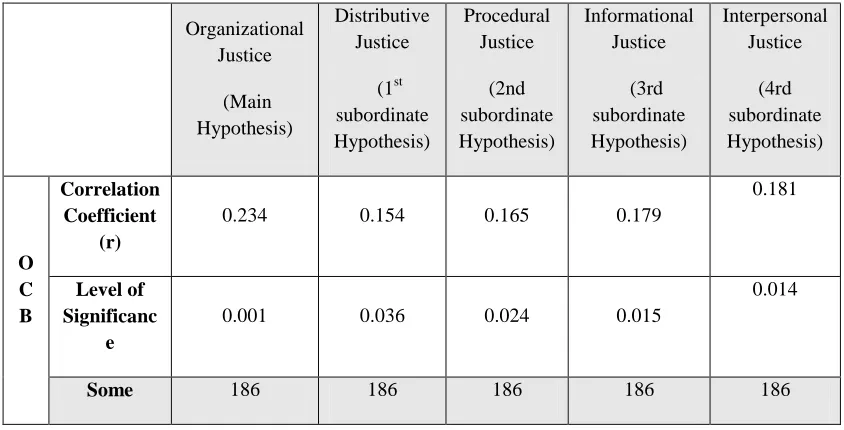
coefficient correlation and then to be sure of the response, the test of meaningfulness of the coefficient of correlation was utilized for any of the hypotheses. Also, analysis of variance was used to compare the difference of average between several different groups in a community, and finally hypotheses were ranked in order of their average. Regarding the results of the Table No. 3 and the values of coefficient of correlation, it can be noticed that there is a correlation and a significant relation between the variables of organizational Justice and OCB. Thus, all the hypotheses are confirmed. On the other hand, the probability 0.01 in significance level (sig.) indicates that the coefficient of correlation between two variables in every hypothesis is significant.
One- Way ANOVA Test
591 reasonable relation has been found between
the organizational Justice dimensions, OCB, ages and sex, educational level, and age service of the personnel.
Conclusion
To sum up, one main hypothesis and four subordinate ones, using descriptive and inferential statistics procedures were analyzed in this research. Given the obtained results with the 99% probability, the primary hypothesis was confirmed, on the basis that there is a significant relationship between organizational Justice and OCB. The results obtained from the first, second, third, and fourth subordinate hypothesis indicate its confirmation and that there is a significant relationship between its variables. In fact, the
99% probability shows a significant
relationship between the variables of
hypothesizes. Above findings were all
consistent with the other studies (Colquitt, 2001, and Greenberg, 1993, 1994).
Limitations
Some limitations of the research need to be recognized. The sample is relatively small (186), comparable to others studies that have looked at the mangers level within the public sector within the Iranian context, as such it is representative and the findings presented are general to a wider population of in the MEAF in Iran.
Future Research
592
Figure No-1 Proposed Research Model
Table No-1 Demographic Characteristics of the Respondents
Gender Males
117 (63%)
Females 69 (37%) Education
Certificate
Diplomas 13 (7%)
Post diplomas 15 (8.1%)
Bachelor 109 (58.6%)
Master& PhD. 32 (17.2%)
Age
25-30 yrs old 42 (22.6%)
30-35 yrs old 42 (22.6%)
35-40 yrs old 37(19.9%)
Above 40 yrs old 53 (28.5%) Service
Age
1-5 yrs old 47 (26.2%)
5-10 yrs old 43 (24.1%)
10-15 yrs old 39 (21%)
15-20 yrs old 29 (14.6%)
Above 20 yrs old 26 (13%)
Table No- 2 Kolmogorov-Smirnov's Test
Variables Kolmogorov-Smirnov's (Z) Level of Significance Organizational
Justice 0.774 0.587
OCB 0.658 0.658
Organizational Justice:
Distributive Justice
Procedural Justice
Informational Justice
Interpersonal Justice
593 Table No-3 Pearson’s Correlations Test
Organizational Justice
(Main Hypothesis)
Distributive Justice
(1st subordinate Hypothesis)
Procedural Justice
(2nd subordinate Hypothesis)
Informational Justice
(3rd subordinate Hypothesis)
Interpersonal Justice
(4rd subordinate Hypothesis)
O C B
Correlation Coefficient
(r)
0.234 0.154 0.165 0.179
0.181
Level of Significanc
e
0.001 0.036 0.024 0.015
0.014
Some 186 186 186 186 186
Table No- 4One- Way ANOVA Test
Variables F P Variables F P
Sex
Organizational Justice
0.103 0.74 Age Organizational
Justice
3.179 0.025
OCB 0.348 0.56 OCB 4.137 0.007
Educational level
Organizational Justice
1.949 0.105 Age
Servi ce
Organizational Justice
2.163 0.075
OCB 0.097 0.983 OCB 1.793 0.132
References
Adams, J. A. (1965) Inequity in social exchange. In L. Berkowitz (Ed.), Advances in experimental social psychology (pp. 267-299). New York: Academic Press.
Alexander, S., & Ruderman, M. (1987)”The role of procedural and distributive justice in
organizational behavior.” Social Justice
Research, 1, pp.177-198.
Baron, R. M., & Kenny, D. A. (1986). “Moderator-mediator variable distinction in social psychological research: Conceptual, strategic, and statistical considerations”. Journal of Personality and Social Psychology, Vol. 6, pp.1173-1182.
Bateman, T. S., & Organ, D. W. (1983) “Job
satisfaction and the good soldier: The
594 Beugre, C. D. (1998) Managing fairness in
organizations. Westport, CT: Quorum Books. Blau, P. M. (1964) Exchange and power in social life. New York: John Wiley.
Colquitt, J. A. (2001) “On the dimensionality of organizational justice: A construct validation of a measure.” Journal of Applied Psychology, Vol. 86, pp. 384-400.
Colquitt, J. A., Conlon, D. E., Wesson, M. J., Porter, O. L. H., & Ng. K. Y. (2001) “Justice at the millennium: A meta-analytic review of 25 years of organizational research”. Journal of Applied Psychology, Vol. 86, pp.425-445. Cropanzano, R., & Greenberg, J. (1997) “Progress in organizational justice: Tunnelling through maze. In C. L. Cooper., & I. T. Robertson (Eds.),” International Review of Industrial and Organizational Psychology, Vol. 12, pp.317-372. Chichester: John Wiley & Sons. Deluga, R. J. (1994)” Supervision trust building, leader-member exchange and OCB.” Journal of Occupational and Organizational Psychology, Vol. 67, pp.315-326.
Folger, R., & Konovsky, M. A. (1989) “Effects of procedural and distributive justice on reactions to pay raise decisions.” Academy of Management Journal, Vol. 32, pp.115-130. Greenberg, J. (1990)” Employee theft as a reaction to underpayment inequity: The hidden costs of pay cuts”. Journal of Applied Psychology, Vol. 75, pp.561-568.
Greenberg, J. (1993)” Stealing in the name of
justice: Informational and interpersonal
moderators of theft reactions to underpayment
inequity.” Organizational Behavior and
Human Decision Processes, Vol. 54, pp.81-103.
Greenberg, J. (1994)” Using socially fair treatment to promote acceptance of a work site smoking ban.” Journal of Applied Psychology, Vol. 79, pp.288-297.
Hair, Jr. J. F., Anderson, R. E., Tatham, R. L., & Black, W. C. (1998)” Multivariate data analysis. Upper Saddle River, NJ: Prentice Hall.”Homans, G. C. (1968). Social behavior: Its elementary forms (3rd Ed.). London: Routledge & Kegan Paul. Ishak, N. A., & Alam, S. S., The Effects of Leader-Member Exchange on Organizational Justice and
Organizational Citizenship Behavior:
Empirical Study, European Journal of Social Sciences, Vol. 8, N. 2, 2009.
Katz, D., & Kahn, R. L. (1978) The social psychology of organizations. New York: John Wiley.
Konovsky, M. A., & Pugh, S. D. (1994) “Citizenship behavior and social exchange”. Academy of Management Journal Vol.37, pp.656-669.
Leventhal, G. S. (1976)” The distribution of
rewards and resources in groups and
organizations. “Advances in Experimental
Social Psychology, Vol. 9, pp.91-131.
Liden, R. C., & Maslyn, J. M. (1998)
“Multidimensionality of leader-member
exchange: An empirical assessment through scale development”. Journal of Management, Vol.24, pp.43-73.
Lind, E. A., & Tyler, T. R. (1988) The social psychology of procedural justice. New York: Plenum.
Manogran, P., Stauffer, J., & Conlon, E. J. (1994)” Leader-member exchange as a key
mediating variable between employee’s
perceptions of fairness and organizational citizenship behavior.” National Academy of Management Meeting Proceedings, Dallas, Texas. European Journal of Social Sciences – Volume 8, Number 2 (2009)
Masterson, S. S., Lewis, K., Goldman, B. M., & Taylor, M. S. (2000)”Integrating justice and social exchange: The differing effects of fair
procedures and treatment on work
relationships”. Academy of Management
Journal, Vol. 43, pp.738-748.
Moorman, R. H. (1991)” Relationship between
organizational justice and organizational
citizenship behaviors: Do fairness perceptions influence employee citizenship”? Journal of Applied Psychology, Vol. 76, pp.845-855. Moorman, R. H., Niehoff, B. P., & Organ, D. W. (1993)” Treating employees fairly and organizational citizenship behaviors: Sorting the effects of job satisfaction, organizational commitment, and procedural justice.” Employee Responsibilities and Rights Journal, Vol. 6, pp.209- 225.
Niehoff, B. P., & Moorman, R. H. (1993) “Justice as a mediator of the relationship
between methods of monitoring and
595 Organ, D. W. (1988b) “A restatement of the
satisfaction-performance hypothesis.” Journal of Management, Vol. 14, pp. 547-557.
Podsakoff, P. M., Mackenzie, S. B., Moorman, R. H., & Fetter, R. (1993) “Transformational leader behaviors and their
effects on followers' trust in leader,
satisfaction, and organizational citizenship behaviors.” Leadership Quarterly, Vol. 1, pp.107-142.
Rousseau, D. M., & Parks, J. M. (1993)
“The contracts of individuals and
organizations. In B.M. Staw & L. L. Cummings (eds.), Research in organizational behavior”. Greenwich, CT: JAI Press. Vol. 15, pp. 1-43.
Sloat, K. C. M. (1999)” Organizational citizenship”. Professional Safety, Vol. 44, pp. 20-23.
Smith, C. A., Organ, D. W., & Near, J. P. (1983)” Organizational citizenship behavior: Its nature and antecedents.” Journal of Applied Psychology, Vol. 68, pp.653-663.
Tansky, J. W. (1993)” Justice and organizational citizenship behavior: What is the relationship”? Employee Responsibilities and Rights Journal, Vol. 6, pp.195-208. Thibaut, J., & Walker, L. (1975) Procedural justice: A psychological analysis. New York: John Wiley.
Van Dyne, L., Graham, J. W., & Dienesch, R. M. (1994)” Organizational citizenship behavior: Construct redefinition, measurement and validation.” Academy of Management Journal, Vol. 37, pp.765-802.
Williams, L. J., & Anderson, S. E. (1991)
“Job satisfaction and organizational