MASSIVE MIMO: CHANNEL MEASUREMENTS AND
THEIR MODELS & FORTHCOMING ASPECTS
Amar Prakash Jyoti
1, Dr. Sumita Mishra
21, 2
Department of Electronics and Comm. Engg., Amity University, Uttar Pradesh
ABSTRACT
Massive MIMO is also known as very-large MIMO (VLMIMO) and large scale antenna systems (LSAS), Hyper
MIMO (HMIMO), Full dimension MIMO (FDMIMO) is advance techniques that potentially can offered the
large network capacities in multi-user circumstances. With a massive MIMO system, we consider the case
where a base station equipped with a large number of antennas elements instantaneously serves the multiple
single-antenna users in the same time and frequency source. A massive MIMO system equipped with tens or
several hundreds of an antennas which is capable of providing significant improvements to an energy efficiency
and robustness of the system. While for the design, performance evaluation and an optimization of massive
MIMO wireless systems, realistic channel measurement and their models are indispensable. An emerging the
next generation wireless communication systems raises the new requirements on a spectral efficiency and an
energy efficiency.
Keyboard: 5G, massive MIMO, channel measurement, channel models, energy efficiency.
I. INTRODUCTION
An increasing the high speed reliable communication with improved a user’s may drives the development of the
fifth generation wireless communication networks.
It has been commonly accepted the capacities of the wireless communication would achieving several of
hundreds times of that of 4G long term evolution advanced (LTE-A) and wireless communication networks.
Whileit is more required to reach 3-5 times w.r.t recent 4G LTE-A system over 5G systems for spectral
efficiency and an energy efficiency, In accumulation to conventional spectral efficiency necessitiesmust be
considered in the design of 5G wireless communication networks in contrast to 4G networks. In these networks,
to allow longer battery lifetime for devices, energy efficiency that measures the transmitted desires to
improve by ten times. Moreover, high speed communication would be supported in fifth generation (5G).
Advanced technologies such as millimetre wave (mmWave) techniques, denser small cells, soft distinct air
interface (SDAI), and high-efficiency various antenna techniques would be vital components of 5G wireless
communication networks. It consists of three kind of spectrum which is:-
It was recommended in that under-utilized allocated spectrum would be better explored.
Spectrum edibility may be improved by authorized shared access (ASA), which is optimal for small cells,
Higher frequency bands such as mmWave bands are capable to provide large BWs for 5G wireless
communication systems.
A massive MIMO system may be made with low-cost components because the linear necessity of the antenna
amplifiers is small when each antenna is assigned with less power. By appropriately using multi-user MIMO
(MU-MIMO) in massive MIMO systems, the multiple access control (MAC) layer design can be simplified by
avoiding complex scheduling algorithms. So, these main benefits enable the massive MIMO technique to be a
capable candidate for the 5G wireless communication networks.
II. CHANNEL MEASUREMENTSOF MASSIVE MIMO FOR FUTURE
It depends on several limitations which are used in the measurements on benefits and effects produced by the
increasing number of antennas. The limitations are:-
Capability: -The low density linear processing algorithms were capable to provide suitably very performance in
terms of capacity due to high inter-channel orthogonally of massive MIMO. By the same time, High complexity
processing algorithms were accomplished of providing quite small gains but with considerable higher
computational complexity. Essentially, it was validated via measurement that massive MIMO systems may
significantly advance spectral efficiency.
Eigen value distribution: - Eigen value of massive MIMO channels was measured, and showing that massive
MIMO increases channel orthogonality between terminals by increasing the number of transmitted antennas.
Spherical wave front and non-stationarity: - Amounts on massive MIMO channels in established that the
channel can’t be observed as wide sense stationary (WSS) over the large antenna array. First, the far field
assumption, which is equivalent to plane wave front estimate, is violated because the distances between the
transmitter and receiver (scattered) may not be elsewhere the Rayleigh distance. Second, certain clusters are not
observable over the entire array. That is to say that, respectively antenna element on the large array may have its
own set of clusters. Third, power disparity and Rician K-factor variation over the antenna array are seen as well.
These three factors of massive MIMO channels specify that the conventional modelling method of MIMO
channels desires to be extended.
Channel characteristics
Additional channel features such as angle probability density function (PDF), root mean square (RMS) delay
spread, power delay profile (PDP), angular power spectrum (APS), and correlation between sub-channels were
similarlydeliberate. It is alsomeasured practical outdoor-to-indoor transmissions and observed that the
correlation between sub-channels reduces with the increasing number of antennas. As a result, there is hardly
any extra gain for more than 20 antennas.
Future directions for massive mimo channel measurements
Currently, many published measurement results were obtained via virtual antenna arrays.
To acquire more realistic channel characteristics, a large physical antenna array is required. In this case, the
MIMO channels are less investigated in the literature. The impact of receiver location within the building on
measurements is still an open problem to study.
Another future direction will be the measurement of massive MIMO in high-speed train (HST), M2M, and
mmWave channels. Since HST, M2M, and mm Wave communications are key technologies in 5G wireless
networks, massive MIMO can be applied to these technologies to boost their performance. In this case, massive
MIMO channel characteristics with these technologies will be essential to the system design.
III. CHANNEL MODELS OF MASSIVE MIMO FOR FUTURE
Usually, the stochastic channel models may be classified into following types which is:-
Correlation based models
Geometry based models
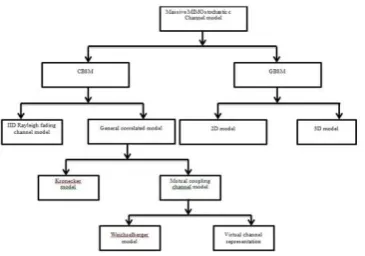
Furthermore, CBSMs can be categorized into two types known as classic IID. Rayleigh fading channel model
and correlated channel models. Correlated channel models contain the Kronecker-based stochastic model
(KBSM), the Weichsel Berger model, and the virtual channel representation (VCR). For KBSM, the
three-dimensional correlation matrices transmitter (Tx) and receiver (Rx) are expected independent. Equally, mutual
coupling effects between spatial correlation matrices at the transmitter and receiver are modelled in the
Weichsel Berger model and VCR. CBSMs are widely used tothe evaluateabstract capacity and performance of
massive MIMO System because they are of lower implementation complexity and mathematically controllable.
Figure 1 Classification of massive MIMO stochastic channel models
IV. CORRELATION-BASED STOCHASTIC MODELS
In classic IID Rayleigh fading channel procedures was utilized as the channel model for massive MIMO
systems. Meanwhile the channel coefficients are IID, the central limit theory as well as the random matrix
theory can be simply applied to the analysis of huge MIMO channel matrices. Though, the IID, Rayleigh
channel model ignores the correlation between antennas. Consequently, they are additionalappropriate for
widely separated antennas such as massive MIMO systems with scattered antennas than co-located antenna
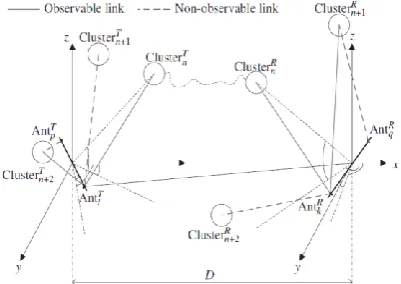
Figure 2: A 3-D wideband twin-cluster massive MIMO channel model
V. GEOMETRY-BASED STOCHASTIC MODELS
A GBSM for narrowband fading channels is used to perfect massive MIMO channel. It supposed that there were
almost no scatters around a highlyraised base station and an infinite number of nativescatters were randomly
distributed on a ring around the mobile station (MS). The APS observed the von Mises distribution and the
correlation between angle of arrival (AOA) and angle of departure (AOD) was changing.
In above figure, examples of non-stationary properties of clusters on the array axis are assumed. The cluster
can be observed by both the transmit antenna and the receive antenna
However, is observable to but not observable to or , and is
observable to but not observable to or . These effects remained all modelledin the birth-death
process framework.
VI. CHALLENGES AND FUTURE ASPECTS FOR MASSIVE MIMO CHANNEL
MODELING
The mm Wave communication, which is capable of operating very large bandwidth , occurs as a
key combination of 5G wireless communication networks.
The arrangement of massive MIMO and mm Wave techniques is accomplished of compensating the huge
path loss and atmosphere absorptions of mm Wave with huge beamforming gain. The design and
optimization of forthcoming mm Wave massive MIMO communication systems is highly subjective by the
characteristics of the wireless channel.
An array-time evolution of clusters is exhibited by birth-death processes. Applying other stochastic methods
to modelling array-time evolution would be challenging. At the similar time, replacing stochastic processes
VII. CONCLUSION
In this paper, latest advances, challenges, and future aspects of channel measurements and channel models for
massive MIMO communication systems have been analysed. Measurementsshownthat certain benefits and
effects of channel models for conventional MIMO systems aren’t effective for massive MIMO channels.
Massive MIMO channel features such as the spherical wave front effect and non-stationary properties on the
antenna array have significant impacts on channel models.
Consequently, they must be taken into account in massive MIMO channel model developments. Modern
CBSMs and GBSMsfor very large MIMO channels must be comparedand challenges and future aspects for
massive MIMO channel modelling.
REFERENCES
[1] Li J, Zhao Y. Channel characterization and modelling for large-scale antenna systems. In: Proceedings of
14th International Symposium on Communications and Information Technologies (ISCIT), Incheio,
2014. 559
[2] Gao X, Edfors O, Rusek F, et al. Linear pre-coding performance in measured very-large MIMO channels.
In: Proceedings of IEEE Vehicular Technology Conference (VTC Fall), San Francisco, 2011. 1-5
[3] Hoydis J, Hoek C, Wild T, et al. Channel measurements for large antenna arrays. In: Proceedings of
International Symposium on Wireless Communication Systems (ISWCS), Paris, 2012. 811
[4] Shepard C, Yu H, Anand N, et al. Argos: practical many-antenna base stations. In: Proceedings of 18th
Annual International Conference on Mobile Computing and Networking, Istanbul, 2012. 55-60
[5] Bernland A, Gustafsson M. Estimation of spherical wave coe_cients from 3-D positioner channel
measurements. IEEE Antenna WirelPropag Lett, 2012, 11: 608{611
[6] Rusek F, Edfors O, Tufvesson F. Indoor multi-user MIMO: measured user orthogonality and its impact
on the choice of coding. In: Proceedings of 6th European Conference on Antennas and Propagation
(EUCAP), Prague, 2012. 2290-2292
[7] Payami S, Tufvesson F. Delay spread properties in a measured massive MIMO system at 2.6 GHz. In:
Proceedings of IEEE 24th International Symposium on Personal Indoor and Mobile Radio
Communications (PIMRC), London, 2013. 55-57
[8] Gao X, Edfors O, Rusek F, et al. Massive MIMO in real propagation environments. IEEE Trans
WirelCommun, in press
[9] Gao X, Tufvesson F, Edfors O, et al. Measured propagation characteristics for very-large MIMO at 2.6
GHz. In: Conference Record of 46th Asilomar Conference on Signals, Systems and Computers
(ASILOMAR), Pacific Grove, 2012. 296-298
[10] Ozcelik H, Czink N, Bonek E. What Makes a Good MIMO Channel Model? In: Proceedings of IEEE