United Kingdom ISSN 2348 0386 Vol. VIII, Issue 4, April 2020
Licensed under Creative Common Page 523
http://ijecm.co.uk/
EVALUATING THE IMPACT OF MAN POWER TRAINING ON
LABOUR PRODUCTIVITY IN THE NIGERIAN BANKING SECTOR
Nasir Sulaiman
Faculty of Management and Social Sciences
Department of Accounting and Finance, Federal University Gusau, Nigeria
Muhammad Usaini
Faculty of Management and Social Sciences
Department of Accounting and Finance, Federal University Gusau, Nigeria [email protected]
Abstract
The research work was conducted mainly to evaluate the impact of man power training on labor
productivity in the banking industry its significant objective is to find out the relationship between
training and productivity in the banking industry. The research used primary and secondary data
obtained from the issue of questionnaires and the interview. The research administered a
self-designed 30 questionnaire to the staff of union bank out of which 25 were answered and
returned , the result is based on the outcome from the questionnaires collected and the
analyses as well is based on the impact of training on labor productivity. In other to analyzed
some parameters and the variable relating to the role of training development, the research find
out that the training is very important in the banking industry. Nigerian banks do not bother or
tend to give the appropriate training in order to achieve its maximum potential that it deserved.
Therefore the research recommended that the training and development in the banking industry
are very necessary. Finally the research recommended that the NDIC should establishes
policies and procedures that provide reasonable assurance and reliable protection of depositors
money that will give them confidence for continue transaction with the banks.
Licensed under Creative Common Page 524 INTRODUCTION
Licensed under Creative Common Page 525 skill an asset that can be taken a ways only by the complex elimination of the need for that skill. Skill valuable to the employee in terms of better security and greatest opportunity for advancement within or without the present organization untrained job applicants should be as much as interested in a training programme as he/she is in the starting salary. For this reason that the lower –paying job offer a greater training opportunity and it would discovered to the sound choice in the large run. Training is a productivity improvement schemes that reduced cast, improves organizational productivity and other performances criteria. It has substantial effect on the quality of work and safely in the work place. Many organizations are yet to realize these effects because when are in the period of recession, the first action they will take is to close down the training center in order to reduce costs of institution. Over the years the federal and the state government have supported training development apprenticeship programme like the establishment of the industry training funds (ITF), the administrative staff college of Nigeria also known as (ASCON) and the national directorate of employment (NDE) and lot of others training institutions. Apparently an increase or desirable level of productivity and better performance of labour no doubt it depends on proper training and development where as a poor level of productivity or performance can also be raised from in experienced and lack of required knowledge for the job on ground (1981); office management, (Burgay Suffalk 1981). This explains the importance of manpower training and development. In the light of the numerous advantage of manpower training development and in relation to the banking industry in an economy, the employers in the banking sector must therefore, endeavor to encourage staff by given them necessary incentive by way of providing training facilities and promotions as it when due. Therefore, it is absolutely necessary for every category of staff in an organization particularly in the bank to the trained and development so as to enhance the quality of performance and increase the productivity of labour in the sector.
Research Problems
The banking sector particularly union bank plc playing very importance role in the economic well being of Nigeria therefore, their staff training and development programme is an issue to be taken seriously. It is generally acknowledgement that the task of training has become a major managerial problem all over the world that no organization has sought to achieve success can afford to get – rid of it. However, the research work wants to look into the contribution of labour
Licensed under Creative Common Page 526 LITERATURE REVIEW
Exiting literature on manpower development and training usually place more emphasis on method or techniques of training and development rather than application of training manpower development. Scheme and effect, it has on employee and organization while this study recognized the importance methods of training and development special attention will also be placed on the impact it has an employee performance in achieving greater productivity (in terms of efficiency, services and maximum patronage) in union bank plc organization to day offer some kind of training for their employee with the aim of developing the employees performance toward achieving co-operation objectives and maximum utilization of both available human and materials resources at their disposal. Looking at the work of hall revised (2009) He argued that the purpose of training is to supplement the trainees academic education or training him to under taken work of a higher grade he stressed the difficultly of deciding where education end and training beginnings according to him training should suit the type of work and grade at which the trainees are fit. He believes that each organization should provide the type of training needs and progarmme peculiar to it. Koonts, O. Donnell and Weih Rich (1980) used the term manager development as progress a manager makes in learning how to manage. In their view, training and development must involve manager at all levels. They stressed that training only for those at lower levels top management may recognized the training needs of first line supervision they believe that top level manager should be training first to serve as an exemplary for their commitments to the continuing development of all people in the enterprise according to them, for training to be completed identification of training needs of the next job in terms of present is necessary. They also stressed that the systematic preparation for a new assignment certainly is more professional approach that a simple trusting a person into a new situation without training programmes but to consider the training needs of the present job derived a comparison of actual performance and behaviors with required perform and behaviors. wyn raillery( 1979) in his our view perceived a kind of differed element into a union bank between the concept of education and training when he stated that both education and training are closely related in certain circumstance, almost in distinguishable. Most training programme, he said contain substantial element of education and most education course include some training as” the development of person” knowledge, skill and attitude or vocational purpose” Wyn Reilly
Licensed under Creative Common Page 527 Section Of Assessment
Assessing Training Needs
Under this categories we should be looking at
i. Training needs of an organization ii Training needs of an individuals
Training Needs Of An Organization
The training needs of an organization must to its objectives to work and training programmed the training needs of the organization has to be assessed by knowing the present manpower requirement of the organization. It is also necessary to know what the present skill are and what types of training is required to meet the development of the necessary skill needed for the purpose of achieving the organizational objectives. Hence, the needs to give answerer are to the following question.
Training Needs Of An Individuals
To know the training needs of an individual’s, the job to be assigned to such individual must first
and foremost be necessary skill required by the job and this will entail doing job analysis and description through which the various task and responsibility involve in the job will be brought to focus. In a nutshell it will also require.
Types Of Training And Development Programme
Here we should look at the two level normally operative training and management development.
Operative Training
• the development of operative training on specific increases in skill and knowledge of
performing a particular job, there are primarily four basic method in used normally • On the job training, Entrance training, Apprenticeship and Special course
Licensed under Creative Common Page 528 risk of potential lasses as a result of learning errors. Beside the rate of production many slow down and some time quality may be scarified.
Ii Entrance training:- under this method trainees are taken through a short course under working condition that approximate actual condition. Vestibule training has the advantage of training a relative’s large number of people within a short period of time without distribution
the flow of work, shop office routine. Also the trainees can adjust to actual condition guided supervision and gradually speed up the rate of performance as he gain confidence in himself. A good example of vestibule training is that applies to pilot in aviation school misfit poor practices could be eliminated before actual production conditions are the encountered. Vestibule training however required the duplication of shop or office facilities and this makes it relatively more expensive in addition, the trainees may not be required to contribute to overall output of their department.
Section Of Development
Management Development
The management job is open ended, programmed interpersonal verbal and active. The complex and essential nature of managerial risk required that conscious and systematic attention be given to the development of manager’s skill. The particular approach adopted for management
development. Reflex the favored philosophy of training and the specific objective been purpose. Below is an outline of the basic training and educational method categories by the development needs to which they are directed.
• Decision making skill • Interpersonal skill • Job knowledge
• Specific individual need • Organization knowledge • General knowledge
• Making. The decision making skill can be developed by utilized method involving
stimulation of managerial or executive environment. The Decision making skill:- the essence of managerial or executive job is basically decision he following method are adopted for this purpose;
Licensed under Creative Common Page 529 rates and delegating tasks with limited periods of times. Since not all the items are of the some importance, the trainees must relate one items to another by making his own judgment. Among the ability than can develop using this method are situational judgment to be able to recall detail, established priority, interred items to determiners the need for the more information.
ii. Social sensitively:- in displaying courtesy in written notes scheduling meetings, which involves personal and justifying action taken. Willingness to make decision and taken action.
iii. Business Games :- here terms of trainees are formed to meet decision and arrived at decision with respect to such subject as production quantity, research and development, inventory, sale personals recruitment and selection, several others activities for stimulated company. Business game can be relatively simple allowing rapid decision making to be effected or extremely complicated involving long and detail analysis of trends in cost inventory and sales. The requirement that decision can be make as term provide trainees experience be made as term provides trainees experience in co-operative group process. Business game may involve the use of computers. As it is the case in the in basket planning business games provides practice in sticking one’s rock out and makes a decision. The
method also has the advantage of promoting managerial ability, financial quickness of thinking and the ability to adopt under stress.
iv. Case – study:- the case study approach of management makes use of action examples obtained from organization for diagnosis purpose’s. the trainees is required among other
things to identify the major and minor problems in the case isolated the significant feet from the significant analysis the issue and applying logic to fill the gap in the facts. Work-up some means for swooning the identifiable problems. Lara up discussion of case enable the trainees to see that other candidate differs from himself regarding what is importance and what is actions should be taken.
v. Inter- personal skill:- the importance of interpersonal skills is the facts that the quantity of decision does not necessarily implies its acceptance. At this point there is need for the manager to develop interpersonal competence. among the method used in developing interpersonal competence are:
Licensed under Creative Common Page 530 change whether change is good or bad. While the role playing is in progress, no do dialogues are provided and the trainees attempt to pay themselves in the roles and structural. Roles playing can be recorded such that the play back of the provided opportunity for the trainees to examine his or her performance with the additional insights of participants and experience observer.
Behaviors modeling;-It should not be confused with roles play specifically is represents a more structure approach to teaching specific supervisory skill, the trainees is conformed a head of time of the consequence of engaging in the types of behaviors e.g honest modeling training .
Evaluating Of Training
Basically, this involves determining where changes in skills, knowledge and attitude have taken place as a result of training. The process also involves the determination of how far the skills and knowledge acquired and the change in attitude have helped the individual employee to contribute more effectively toward the attainment of organization objectives. However, achievement of the objective by an individual has been as a result of many factors, training received being one of them. Evaluation of training therefore has two aspects, the first assessment of whether or not training result in behaviors that further the achievement of organizational of various goals secondly, it has to do with comparison possible means of teaching of technique of training to determine if any one or a combination of techniques is superior for the purpose of achieving the desired results. Training could thus be viewed as being concerned with increase knowledge and skill in doing a particular job where is located. Tailored toward job requirement.
Appraisal Of Literature Reviewed
Licensed under Creative Common Page 531 previous experience. In addition to motivation factors, there should be facilities for further education and training to develop staff for higher pools. According to Bects (1975) in addition to social or national responsibilities there many advantage attached to sound training programme among which are:-
vi. Staff flexibility improvement, which help considerable with staff turnover problems and during staff shortage period.
vii. Improved motivation through the encouragement of personal development.
viii. Improved staff proficient in a shortage time.
ix. Staff may become more versatile and so assist in overcoming the peak leaders that may in certain section.
x. The latest development in technologies will be known and practiced by staff and this will enhance labour productivity. Likewise training can be said to be a crucial factors that contribute to the growth and development of labour and consequently to that of an organization. Finally training is a veritable tool that enhances skills proficiently of employee. I am an employee of an organization needs to continue to adequately meet the demands and a challenges of his or her assigned responsibilities, his knowledge, skill and attitudes or competencies must be up dated through training and developed scheme.
Empirical Studies
A number of studies have examined the role of strategic human resource system and training and development in influencing organization performance. In one of the published studies in this area Husecid (1995) found that light performance work practices were significantly related to turn over, Delery and Doty (1996) however, found no significant interaction between or internal career opportunity and business strategy impacting firm’s performance in the banking industry. Training and internal career opportunities were unrelated to firm’s performance. Welbourne and
Andrew (1996) found that human resource value which include training (measuring by whether training investment were light lighted in a company’s prospectus) predicted initial investor
reaction and long term survival of initial public offering companies. Schroeder, bates and junttic (2002) found that competitive advantage in manufacturing was related to use of “internal training“ (e.g training of multifunctional employees and incorporating employee suggestion in to process improvements and product developments) and “external learner“ (e.g, establishing
Licensed under Creative Common Page 532 Theoretical Frame Work
This study is based on home capital theory proposed by Shultz (1961) and development by baker in (1994) according to the theory, human capital theory suggests that education or training raise the productivity of workers by importing useful knowledge and skills, hence raising workers future income by increasing their lifetimes earning (baker,. 1996) . The human capital model suggests that an individual decision to invest in training is based upon an examination of the ret present. Individuals are assured to invest in training during an initial period in receive returns to the investment in subsequence period. In his view human capital is similar to “physical means of product” e.g factories and machines: one can invest in human capital (via education, training, medical treatment) and one’s outputs depend partly on the rate of returns of
the human capital one owns. Thus, human capital is a means of production; into which additional investment yields additional outputs. Human capital is substitutable but not transferable like land, labour or fixed capital. Olaniyan and Okemakide (2008) in their study titled human capital theory: implication for educational development focused on the benefits of human capital to the nation as a whale. They pointed out the relationship between education and economic growth. According to Olaniyan and Okemakide (2008) many of the classical economics argued strongly for government’s activity support of education or the grounds of the
positive externalities that society would gain from a more educated labour force and populaces. While formal education has expended rapidly in many countries, a large portion of human capital accumulation in the forms of on the job training and other made for working adults actually taken place both inside and outside the work place (2001) some human capital advocates suggest that these great increases in learning efforts have not led to commensurate economic gains because of the declining quality of education. For example over the years most research have been shaving drafter fall in standard of education in Nigeria the biggest challenge to human capital theory as pointed out by living stone (1997) is under employment of credentialed knowledge i.e a large number of people who have invested many years of their lives in acquiring advance formal educational qualifications, are unable to obtain commeasured jobs. Such situation is prevalence in most of the under developed countries like Nigeria. Another short coming of human capital theory is that in countries like Nigeria, more emphasis is given to paper qualification rather than employee’s personal skill and talents
RESEARCH METHOD
Licensed under Creative Common Page 533 Study Area, Sampling Design And Data Collection
Here it refers to the totality of people, objects and a firm e.t.c., that conform to some specification determines to element that belong to the targets groups. This population covers all the customers and staff of Union Bank Plc. A self-designed handful 30 questionnaires were distributed to the customer and staff of Union Bank Plc. Also oral interview were conducted among the banks Staff and customers of Union Bank Plc. Who have the mind on the impact of various training programmes of the Bank on the overall services rendered by the Bank over the years? The research has adopted the random sampling because it gives equal opportunity, to be part of the study population to be selected out of which 10 other staff were selected for interview which are shown from equal population.
Method Of Data Analysis
Data collected for this research work were analyzed and presented inform of tables as well as textual narratives to give quick and easy understanding of data analyzed. It involves descriptive statistical methods and the statistical inference method. descriptive statistics provides information only on the data collected and drawn conclusions concerning a larger set of data, these includes the use of tables, graphs charts, and other relevant computations in various newspapers and magazines. Statistical inference comprises the method s concern with the analysis of a sub-set of data leading to predictions about the entire set of data. The methods intended to be employed in presentation and analysis for this project works is cover of some banks in Zamfara state such banks are : Union Bank Plc and First Bank Plc.
ANALYSIS
This chapter deals with the presentation, analysis and interpretation of data obtained by the researcher in the research work. It enumerates the outcome of questions asked in the questionnaire by the researcher, the reason for presentation and analysis is to show the work. Authenticity of labour factors during the process of production assigned with the responsibility of combining all others factors of production in appropriate proportion and the total success of the business depend largely on how well these factors are combined by the labour force.
In this research work and data presentation, 30 questionnaires were distributed among the staff of Union Bank Plc Gusau branch and some selected customers; all the 30 questionnaires are filled and given a rate of hundred percent 100%.
Licensed under Creative Common Page 534 Section (A) Questionnaire to the staff of Union Bank Plc Gusau Branch, Zamfara State.
Q1 Question 1a: Is there any positive impact on employee training and his productivity? Table (1a) Questionnaire to the staff
Option Number of Respondents Percentage (%)
Yes 30 100
No - -
total 30 100
The table 1a above shows that 100% of the respondents are with the opinion that there is positive impact on employee training and his productivity.
Q2 Questionnaire 2: do you agree that training of workers is indispensable to your organization high productivity?
Table (2a) Organization high productivity
Option Number of Respondents Percentage (%)
Yes 30 100
No - -
total 30 30
The table 2a above shows that the 100% of respondents agree that the training of workers is indispensable in an organization in order to obtained high productivity.
Q3 The purpose of training and development is to enhance the bank performance? Table (3a) Training and development
Option Number of Respondents Percentage (%)
Yes 30 100
No - -
total 30 100
The table 3a above shows that 100% of respondents are with opinion that, the purpose of training and development is to enhance the bank performance.
Q4 Does the staff always work for the efficient management organizational objective rather than their own?
Table (4a) Efficient management
Option Number of Respondents Percentage (%)
Yes 26 86
No 4 14
Licensed under Creative Common Page 535 As represented in the above table 4a, the respondents of 86% indicates that some staff always work for the efficient management when customers settle their debt, while the 14% of some workers were not.
Q5 In respect of the account kept with the bank, is there any efficiency in the labour productivity in profit earning?
Table (5a) Efficiency in labour productivity
Option Number of Respondents Percentage (%)
Yes 30 100
No Nil -
total 30 100
The table 5a above shows that 100% respondents are with the opinion that, there is efficiency in the labour productivity in profit earnings in respect of the account kept with the bank.
Section (B)
Q1 Is there any positive impact on employee training and the customer satisfactions services?
Table (1b) Customer satisfactions
Option Number of Respondents Percentage (%)
Yes 20 66
No 10 34
total 30 100
The table 1b above shows that the respondents respond 66% thus indicating that the bank confront problems in attending to its customers most especially when customer withdraw money from the bank, the issue of BVN and that is the area of regards to collection of cheque and also of opening of a new account with the bank.
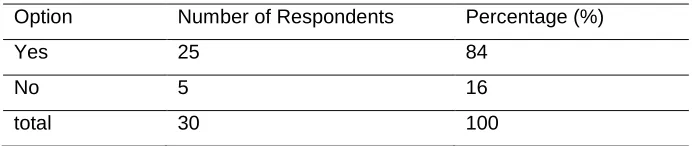
Q2 Staff training and development does not significantly affect the financial performance of the organization?
Table (2b) Financial performance
Option Number of Respondents Percentage (%)
Yes 25 84
No 5 16
Licensed under Creative Common Page 536 The table 2b above shows that 84% of the respondents with the option that the training and staff development does not significantly affect the financial performance of the organization while the remaining 16% were not agreed.
Q3 Is it true that the impact of man power development and training on labour productivity do contribute to the banking sector in Nigeria?
Table (3b) Contribution to banking sector
Option Number of Respondents Percentage (%)
Yes 20 66
No 10 34
total 30 100
As represented in table 3b above, the respondent responded that 66% is true that the impact of manpower development and training or labour productivity has contribute to the banking sector in Nigeria, while 34% respondent were not.
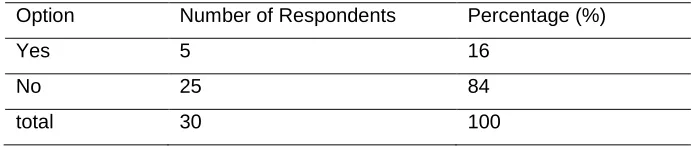
Q4 Does a customer face problem with staff all the time? Table (4b) Staff and customer conflict
Option Number of Respondents Percentage (%)
Yes 5 16
No 25 84
total 30 100
The table 4b above represent that 16% responded that the bank face problems with the customers, this indicates that only 25 of 30 people are of the opinion that the bank do not face problems with the staff.
CONCLUSIONS
i. There is positive impact on employee training and his productivity. ii. The bank is at all time ready to satisfy its customers need or demand.
iii. There is efficiency in the labour productivity in labour productivity in relation to profit earning by the banking sector.
iv. There is also problems in attending to customer need encountered by the bank.
Licensed under Creative Common Page 537 vi. Individual carrier aspirations should be discussed so that the firm can build company goals with individual aspirations in the design of training programmes.
vii. The NDIC commenced operations in march 1989 with primary mandate of deposit guarantee. In addition, however, as a risk minimizing deposit insurer, it has power to monitor insured financial institution health status through supervision as well as provide mechanism for orderly resolution of failure, including bank liquidation. In the event of failure of an insured institution, the N.D.I.C will compensate affected depositors for their deposits, up to N 500,000 for deposit money Banks, non Interest Banks (Islamic Banks) and N 200,000 for primary Mortgage banks and Microfinance banks per depositor per insured institution.
RECOMMENDATIONS
From the findings so far, it can be seen that manpower training has a lot of advantages the researchers would want to make the following recommendations:
i. There should be definite and well designed training policies that will improve the standard of manpower training.
ii. There should be a means through which adequate funds should be raised which will facilitate effective training programmes on labour productivity in the banking industry.
iii. There should also be an examination or test for those employees that are undergoing training programmes that is to test their rate of assimilation.
iv. New employees should be instructed thoroughly and explanation of their specific tabs assigned to them.
v. The organization should provide solutions to the problems they are facing with employee that are undergoing training programmes.
vi. The organization should also provide means or method of identifying training needs within the organization.
vii. There should also be continuous training of employees which will help them develop their ability and help them to adapt to new jobs methods, learning to use new kinds of equipment or advancement technology machines and adjusting to major changes of their jobs and relationship at work.
viii. In the years to come technological development will continue to change many work situations. Adaptability may well be the most important advantage that can be received from training. Training constitutes an investment in human resources.
Licensed under Creative Common Page 538 LIMITATIONS OF THE STUDY
Like most studies, this research work is subject to a number of limitations. The limitation of the study is the issue of survivorship bias related to the period of study; as only banks being listed on the NSE between the period were included. Hence, those that have not been listed within the period were not captured (not listed within the period) were excluded. The study should have used all the twenty-five banks, but dearth of data and survivorship bias hindered the use of all the banks.
REFERENCES
Abdul-Azeez A (2013): African journals of Business Management Vol. 6 (44) pp. Academic Journals, November 2011.
Aminu K (2003); principles of Financial Management, 1st Edition benchmark Publishers Limited Kano. Archibon A (2000) : Restructuring in solvent Banks Role of the regulatory Authorities NDIC.
Belts, P. (1981); Office Management, Richard Day (the career press) Limited (Bungay Suffack 1981). Carter R. (1985); Stores Management and Related Operations, 2nd Edition, M& E Publishers, London. Solomon, J. (2001); Conducting web-based surveys practical assessment research and evaluation.
Casio, W. (1978); Applied Personnel Psychology in Personnel Management Publishing in Riston-Publishing Company.
Nwachukwu C (2009); Management Theory & practice Revised Edition.
Chruden W, (1984); Management Human Resources, South Shermon Western Published Company Ohio.
Ebohenen, E (1991); The problems of manpower development in Nigerian Banking Industry. Published in the NDIC Journal Vol 1.
Flippo, B. (1984); Principle of Personnel Management. MC Grow Hill Book Company, New York.
Ghartey Z. (1993); Continuing Actions for Accounting in Africa. International Journals of Academic research in Business and social science Vol. 4
Nworgu, W. (1999), Guide on research study, proposal and report written, Lagos, El-Today Publishers.
Nwachukwu .C (1988) management theory and practice. Anisha; Africana-FEP publisher Limited UNDP (1998) UNDP report on poverty in sub-sahara Africa publishers under the titled progress against poverty in Africa, Division for social policy and development (www.under.org/africa/poverty.shtm).
Osuola .C (2005), Introduction to research methodology, Onisha, African-first publishers limited
Sanusi, L. (2012) banking reform and it is impact on the Nigeria economic. CBN Journal of Applied Statistics.
APPENDIX
Self-designed questionnaire
Section (A) Respondent Bio data
• Sex: Male Female
• Age: Under 20yrs 20-40yr
Licensed under Creative Common Page 539 Section B (option of answering question)
A. Yes B. No Section C (questionnaires)
• Is there any positive impact on employee training and his productivity?
Yes No
• Do you agree that training of workers is indispensable to your organizations high
productivity?
Yes No
• The purpose of training and development is to enhance the Bank performance?
Yes No
• Does the staff always work for the efficient management when the customers settled
their debt?
Yes No
• In respect of the account kept with the bank, is there any efficiency in the labour
productivity in profit earning?
Yes No
• Is there any positive impact on employee training and the customer satisfaction service?
Yes No
• Training and staff development does not significantly affect the financial performance of
the organization?
Yes No
• Is it true that the impact of manpower development and training on labour productivity do
contributing to the banking sector in Nigeria?
Yes No
• Does customer face problem with the staff all the time?