108 | P a g e
FACE SKETCH RECOGNITION BASED ON SIFT
AND MLBP
Mugdha Joshi
1, Prof. Gargi Phadake
2, Prof. Shamal Salunkhe
31,.2,3
Instumentaion Department, Ramrao Adik Institute of Technology, Navi Mumbai, (India)
ABSTRACT
Facial Sketches are most widely used in law enforcement agencies for identification and apprehension of
suspects, which may involve in several criminal activities. A forensic artist is commonly used to work with the
eyewitness in order to draw a sketch that depicts the facial look of the criminal according to the spoken
description. Facial sketches are particularly important when eyewitness' or victim's descriptions are the only
form of evidence available it is then disseminated to law enforcement officers and media outlets with the hopes
of someone knowing the suspect. In this work we plan to implement an efficient system to recognize a forensic
sketch images to a gallary of mug shot images which will help law enforcement agencies. Our approach
essentially will be to implement and verify the algorithm of Face Sketch Recognition, which solves the sketch
recognition problem for 2-D image of faces, using the local feature based discriminant analysis (LFDA),
multiscale local binary patterns(MLBP), Scale Invariant Feature Transform (SIFT) as feature descriptor and
principal component analysis. In this work SIFT and MLBP algorithms are explained for feature extraction with
an LFDA framework for dimensionality reduction. This report focuses on comparative analysis of SIFT and
MLBP algorithms on the basis of experiments performed using 20 sketches with rotation and brightness changes
for matching against gallery of photo images also experiments are performed for 40 semi-forensic sketches for
matching against gallary of 125 images.
Keywords:
Feature descriptor, Forensic Sketch, Mugshot, Principle Component Analysis
I. INTRODUCTION
Face recognition is a technology of using computer to analyze the face images and extract the features for recognizing the identity of the target. Due to illumination variations and occlusion, the appearances of a face complicate many problems in face recognition. Here in this report we are going to focus on the forensic application of face recognition. Improvements in biometric technology have provided criminal investigators additional tools to help determine the identity of criminals. There is a lack of technology to efficiently capture the biometric data like finger prints within a short period after the scene of crime is a routine problem in remote areas.
appearance from gallery of face images is required.
But forensic sketches include several inadequacies because of the incomplete or approximate description provided by the eye-witness. Generally, forensic sketches are manually matched with the database comprising digital face images of known individuals. This face recognition algorithms can be used directly and does not any require additional processing to address the non-linear variations present in sketches and digital face images. An automatic sketch to digital face image matching system can assist law enforcement agencies and make the recognition process efficient and relatively fast.
II. RELATED WORK
Most of the work in matching viewed sketches was performed by [1] and they have proposed a novel face photo-sketch synthesis and recognition method using a multiscale Markov Random Fields (MRF) model. They first approached the problem using an Eigen transformation method to either project a sketch image into a photo subspace, or to project a photo image into a sketch subspace. Once projected into the same image subspace, they were matched using a PCA-based matcher. Here, the synthetic sketches generated were matched to a gallery of photographs using a variety of standard face recognition algorithms.
In the paper [2] the authors discussed a method for representing face which is based on the features which uses geometric relationship among the facial features like mouth, nose and eyes. Feature based face representation is done by independently matching templates of three facial regions i.e. eyes, mouth and nose. Principal Component Analysis method which is also called Eigen faces is appearance based technique used widely for the dimensionality reduction and recorded a greater performance in face recognition.
In the paper [3] which presents a novel and efficient facial image representation based on local binary pattern (LBP) texture features. The face image is divided into several regions from which the LBP feature distributions are extracted and concatenated into an enhanced feature vector to be used as a face descriptor. A local feature-based method [5] for matching facial sketch images to face photographs, which is the first known feature-feature-based method for performing such matching and demonstrate the ability to match sketches to photos directly using SIFT feature descriptors, in a common representation that measures the similarity between a sketch and photo by their distance from the training set of sketch/photo pairs. This is achieved by using local binary patterns (LBP) in addition to the SIFT feature descriptor, which is motivated by LBP’s success in a similar heterogeneous matching application [6].
III. PROCESS OF MATCHING SKETCH TO PHOTO
To design a robust and inexpensive sketch recognition system that would work well in a practical forensic application for identification and apprehension of suspects, which may involve in several criminal activities with much efficient algorithm to identify sketches is required.
110 | P a g e the law enforcement agencies, when the photo of the suspect is not available and this is the inspiration for the project.
Following are the steps involved in sketch to photo matching:
Apply feature extraction techniques on each input sketch image and the corresponding photo and store results in the database.
build up this feature extraction results for every image into a feature database.
For every probe image, the equivalent match is that with the minimum distance calculated with Euclidean Distance matching method.
The concluding top retrieve images from are then displayed.
A photograph of criminals after arresting them stored in database called mugshot database. The purpose of the mugshot is to maintain a photographic record of the arrested individual to allow for identification by victims and investigators. Sketch image is the input given to the system that is to be identified against the available mugshot images.
The acquisition module of forensic face matching system captured images with a digital or surveillance camera or any image capturing devices. These captured images are Pre-processed to meet the standards required by the given recognition system. Then database is updated with P-processed images. Some of the databases are taken as training database and one of the face databases is taken as test database. The Feature Extraction module takes the normalized that is pre-processed image as input and important features are extracted as output, thereby reducing its dimensionality. Comparison between the test image and training image is performed by classifier and finally closest match is displayed as a result. [9].
Image feature descriptors describe an image or image region using a feature vector that captures the distinct characteristics of the image. Image based features have been shown to be successful in face recognition , most notably with the use of local binary patterns [4].
IV. LOCAL FEATURE BASED DISCRIMINANT ANALYSIS
In the LFDA framework [4], each image feature vector is first divided into “slices” of smaller dimensionality, where slices correspond to the concatenation of feature descriptor vectors from each column of image patches.
Next, discriminant analysis is performed separately on each slice by performing the following three steps:
PCA
within class whitening
between class discriminant analysis
Lastly, to remove redundant information among the feature slices to extract the final feature vector, PCA is applied to the new feature vector as shown in “Fig.4.1”, of training and matching of LFDA.
In this paper we have compared two feature descriptors Scale Invariant Feature Transform (SIFT) & Multiscale Local Binary Patterns (MLBP)
4.1.SIFT
SIFT is a mathematical algorithm for extracting interest point features from images that can be used to perform reliable matching between different views of objects. For any object in an image, interesting points on the object can be extracted to provide a "feature description" of the object. This description, extracted from a training image, can then be used to identify the object when attempting to locate the object in a test image containing many other objects. SIFT based object matching is a popular method for finding correspondences between images. SIFT object matching consists of both a scale invariant interest point detector as well as a feature-based similarity measure. In this work only gradient based feature descriptors are used. A SIFT image feature is a compact vector representation of an image patch based on the magnitude, orientation, and spatial vicinity of the image gradients [5].
The SIFT feature descriptor quantizes both the spatial locations and gradient orientations within an s × s sized image patch, and computes a histogram in which each bin corresponds to a combination of a particular spatial location and orientation. For each image pixel, the histogram bin corresponding to its quantized orientation and location is incremented by the product of the magnitude of the image gradient at that pixel and the value of a Gaussian function centered on the patch with a standard deviation of s/2 [5]. Trilinear interpolation is used on the quantized location of the pixel, which addresses image translation noise. The final vector of histogram values is normalized to sum to one. It is important to reiterate that because we are sampling SIFT feature descriptors from a fixed grid and we do not use SIFT keypoint detection, the SIFT feature descriptor is computed at predetermined locations.[4]
112 | P a g e To perform reliable recognition, it is important that the features extracted from the training image be detectable even under changes in image scale, noise and illumination. Such points usually lie on high-contrast regions of the image, such as object edges. Another important characteristic of these features is that the relative positions between them in the original scene shouldn't change from one image to another. Features located in articulated or flexible objects would typically not work if any change in their internal geometry happens between two images in the set being processed. However, in practice SIFT detects and uses a much larger number of features from the images, which reduces the contribution of the errors caused by these local variations in the average error of all feature matching errors. SIFT can robustly identify objects even among clutter and under partial occlusion, because the SIFT feature descriptor is invariant to uniform scaling, orientation, and partially invariant to affine distortion and illumination changes. This section summarizes Lowe's object recognition method and mentions a few competing techniques available for object recognition under clutter and partial occlusion. The algorithm for SIFT is as follows:
Scale-Space Extrema Detection: The scale space is defined by the function.
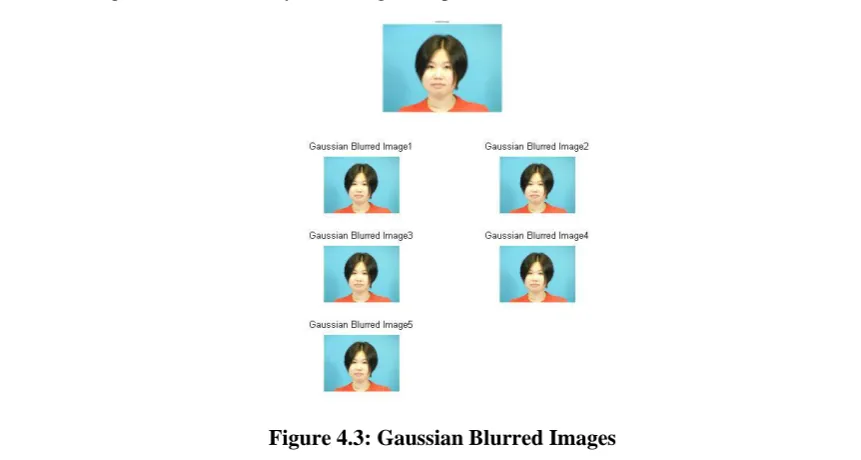
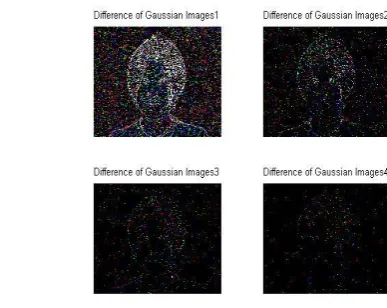
L(x, y, σ) = G(x, y, σ) * I(x, y) Where * is the convolution operator, G(x, y, σ) is a variable scale Gaussian and I(x, y) is the input image. Difference of Gaussians technique is used for locating scale space extrema, D(x, y, σ) by computing the difference between two images, one with scale k times the other as shown in “Fig.4.4” D(x, y, σ) = L(x, y, kσ) - L(x, y, σ)
Keypoint Localization: Elimination of more points by finding those that have low contrast or are poorly localized on an edge. This is achieved by calculating the Laplacian.
Orientation Assignment: To assign an orientation we use a histogram and a small region around it. Using the histogram, the most prominent gradient orientation(s) are identified. If there is only one peak, it is assigned to the keypoint. If there are multiple peaks above the 80 percent mark, they are all converted into a new keypoint (with their respective orientations).Next, we generate a highly distinctive “fingerprint” or “feature vector”, having 128 different numbers for each keypoint.
Figure 4.2: Original Image
Keypoint Descriptor: Keypoint descriptor typically uses a set of 16 histograms, aligned in a 4x4 grid, each with 8 orientation bins, one for each of the main compass directions and one for each of the mid-points of these directions. This result in a feature vector containing 128 elements. These resulting vectors are known as SIFT keys and are used in a nearest neighbors approach for sketch to photo matching. The nearest neighbors are defined as the keypoints with minimum Euclidean distance from the given descriptor vector. The probability that a match is correct can be determined by taking the ratio of distance from the closest neighbor to the distance of the second closest.
4.2.MLBP
MLBP is a type of feature used for classification in computer vision. It has since been found to be a powerful feature for texture classification; it has further been determined that when LBP is combined with the Histogram of oriented gradients (HOG) descriptor, it improves the detection performance considerably on some datasets. In the LBP histogram, an image pair is first split into sub-regions.
The similarity score of each local LBP histogram pair is measured using the similarity function. The similarity scores are then concatenated to form an input feature vector for feature selection process. Over complete features can be provided by shifting and scaling the local regions.
The original local binary patterns (LBP) operator takes a local neighborhood around each pixel, thresholds the pixels of the neighborhood at the value of the central pixel and uses the resulting binary-valued image patch as a local image descriptor. It was originally defined for 3×3 neighborhoods, giving 8 bit codes based on the 8 pixels around the central one. The operator labels the pixels of an image by thresholding a 3×3 neighborhood of each pixel with the centre value and considering the results as a binary number, and the 256-bin histogram of the LBP labels computed over a region is used as a texture descriptor. The limitation of the basic LBP operator is that its small 3×3 neighborhood cannot capture the dominant features with large scale structures. As a result, to deal with the texture at different scales, the operator was later extended to use neighborhoods of different sizes called as MLBP. It describes the face at multiple scales by combining the LBP descriptors computed with radii r Ʃ {1, 3, 5, 7}[4].
114 | P a g e
V. EXPERIMENTAL RESULTS
One of the images is taken as test image and considers rest as training image. The important features of face are extracted and similarity measure between training image and test image is taken. Finally, the person who receives minimum distance is chosen as the best match.
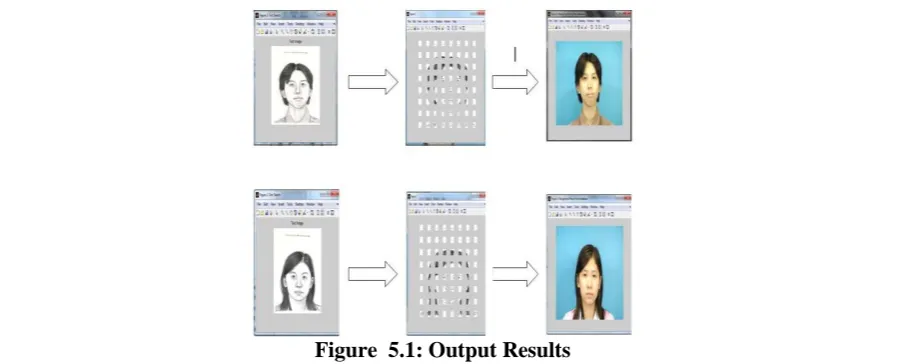
“Fig 5.1”, shows, some results of our proposed method, first image is viewed sketch which is given as a test image, feature descriptors are calculated for the same and compared with all trained images of database. The image for which minimum Euclidean distance is zero is shown as recognized image from the database otherwise it gives a dialog box of "Person is not available in database". All the tests are performed on MATLAB R2013a. To provide a perspective on the angle of our region-division approach that uses majority voting, comparison between the recognition performance of three techniques, namely the Scale Invariant Feature Transform (SIFT), Multiscale Local Binary Pattern (MLBP) and Linear Feature Discriminant Analysis (LFDA)is done.
5.1.Rotation and Brightness Tests
In this subsection, we show some experimental results of face sketch recognition on SIFT and MLBP algorithms individually and the comparison between the two is illustrated. Results of fusion of both the algorithms will be illustrated in the future work.
Training of the CUHK face sketch database [10] is done with sketch and its respective photo image prior to performing experiment on 20 sketches to test accuracy of SIFT and MLBP algorithms against gallery of 25 photo images.
Figure. 5.3: Brightness Test
Figure 5.1: Output Results
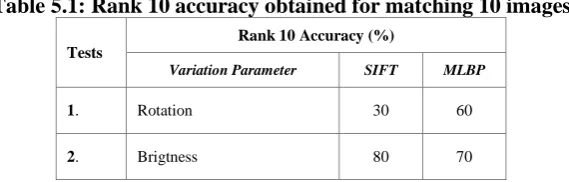
“Table 5.1”, summarizes the results of test performed on SIFT and MLBP algorithm. After changing rotation and brightness of 10 images and testing them against the trained database; it has been observed that MLBP shows 60 and 70 accuracy respectively for Rank-10 (whether the perfect image is present or not in top 10 images) as depicted in “Fig. 5.2 and Fig.5.3”.
Table 5.1: Rank 10 accuracy obtained for matching 10 images
Tests
Rank 10 Accuracy (%)
Variation Parameter SIFT MLBP
1. Rotation 30 60
2. Brigtness 80 70
“Fig.5.4”, shows Rank Vs Accuracy plot for all 20 tested images. It shows that for Rank-10 accuracy MLBP outperforms the SIFT algorithm.
5.2. Semi-forensic Sketch Test
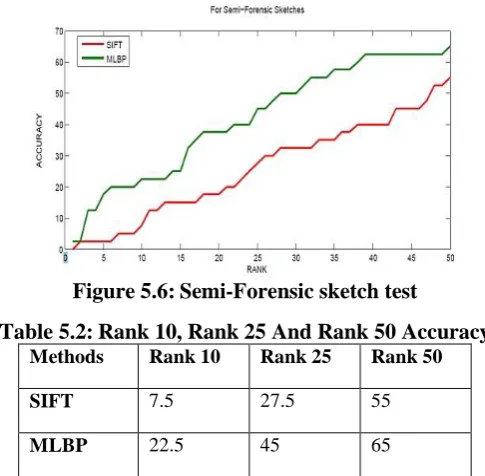
In the next experiment, we trained the CUHK database of 125 photos and their viewed sketches. SIFT and MLBP algorithms are tested with 40 semi-forensic sketches of CUHK database[11] against gallery of 125 images and rank 50 accuracy has been calculated.
In this case test image is semi-forensic sketch as shown in Fig. 5.5(C),therefore minimum Euclidean distance is not zero, hence to verify effectiveness of systems all the Euclidean distances are observed and top 50 results are considered for calculating Rank 50 accuracy.
Figure 5.4 :Performance of SIFT and MLBP
116 | P a g e For the test performed on example shown in fig 5.5, the semi-forensic skecth is given as test image, features are extracted and similarity with database images is observed by Euclidean distance. It has been observed that MLBP has recognised the required match at rank-3 whereas SIFT has recognised it at rank-10
Similarly, 40 Semi-forensic sketches are tested against gallary of 125 images. Rank Vs accuracy curve for the same is as shown in Fig.5.6.
Table 5.2:
Rank 10, Rank 25 And Rank 50 Accuracy
Methods Rank 10 Rank 25 Rank 50
SIFT 7.5 27.5 55
MLBP 22.5 45 65
This shows that MLBP is showing better results throughout the test.
VI. CONCLUSION
Our aim to design a robust and inexpensive sketch recognition system that would work well in a practical forensic application for identification and apprehension of suspects, which may involve in several criminal activities, is satisfied. From results of semi-forensic sketch test, it has been observed that for MLBP outperforms SIFT. Comparative analysis for brightness and rotation tests on MLBP and SIFT algorithm shows that MLBP surpasses the SIFT results.
REFERENCES
[1] Xiaogang Wang, Xiaoou Tang, "Face Photo-Sketch Synthesis and Recognition", IEEE Transactions on Pattern Analysis and Machine Intelligence, vol.31, no. 11, pp. 1955-1967, November 2009, doi:10.1109/TPAMI.2008.
[2] A. Sharma, P. Devale, " An Application To Human Face Photo-Sketch Synthesis And Recognition" ,International Journal of Advances in Engineering and Technology, May 2012,ISSN: 2231-1963
[3] T. Ahonen, A. Hadid and M. Pietikainen, "Face Description with Local Binary Patterns: Application to Face Recognition," in IEEE Transactions on Pattern Analysis and Machine Intelligence, vol. 28, no. 12, pp. 2037-2041, Dec. 2006., doi: 10.1109/TPAMI.2006.244
[4] B. Klare, Z. Li and A. K. Jain, "Matching Forensic Sketches to Mug Shot Photos," in IEEE Transactions on Pattern Analysis and Machine Intelligence, vol. 33, no. 3, pp. 639-646, March 2011.
[5] Brendan Klare ; Anil K. Jain; “Sketch-to-photo matching: a feature-based approach”, Proc. SPIE 7667, Biometric Technology for Human Identification VII, 766702 (April 14, 2010); doi:10.1117/12.849821. [6] S. Liao, D. Yi, Z. Lei, R. Qin, and S. Li, “Heterogeneous Face Recognition from Local Structures of
Normalized Appearance,” Proc. Third Int’l Conf. Biometrics, 2009.
[7] P. Ambhore, L.Bijole, "Face Sketch to Photo Matching Using LFDA and Pre-Processing," International Journal of Science and Research, Volume-3 Issue-5, May 2014
[8] Y. Wang,C. Wang and L.Liang, "Sparse Representation Theory And Its Application For Face Recognition," International Journal On Smart Sensing And Intelligent Systems, Vol. 8, No. 1, March 2015
[9] N. Lavanyadevi, SP. Priya and K. Krishanthana, "Performance Analysis of Face Matching and Retrieval In Forensic Applications," International Journal of Advanced Electrical and Electronics Engineering,Volume-2, Issue-Engineering,Volume-2, 2013
[10] X. Wang and X. Tang,"Face Photo-Sketch Synthesis and Recognition," IEEE Transactions on Pattern Analysis and Machine Intelligence (PAMI), Vol. 31, 2009.