Patient Preference and Adherence
The effects of acupressure on severity of primary
dysmenorrhea
Shahla Gharloghi1 Shahnaz Torkzahrani2 Ali Reza Akbarzadeh3 Reza Heshmat4
1Department of Midwifery, School
of Nursing and Midwifery, Kermanshah University of Medical Sciences, Kermanshah, 2Department
of Midwifery, School of Nursing and Midwifery, Shahid Beheshti University of Medical Sciences,
3Department of Biostatistics, School
of Health, Shahid Beheshti University of Medical Sciences, Evin, Tehran, IR Iran; 4International University for
Acupuncture, Lyon, France
Correspondence: Shahnaz Torkzahrani Department of Midwifery, Shahid Beheshti University of Medical Sciences, Evin, Tehran, IR Iran
Tel +1 98 21 8820 2512 Fax + 1 98 21 8820 2523 Email [email protected]
Background: Dysmenorrhea constitutes one of the most frequent disorders in women of a fertile age. The objective of this research was to determine the effects of acupressure at Sanyinjiao (SP6) point and DiJi (SP8) point on pain severity of primary dysmenorrhea and the associated systemic symptoms.
Materials and methods: In this crossover clinical trial, 50 females aged 18–30 years old who met the study criteria and were under the care of Sarpolezahab Health Center were selected. Subjects were randomly assigned to one of two groups and evaluated during three menstrual cycles. We evaluated pain severity using the McGill pain scale and associated systemic symptoms using a verbal multidimensional scoring system. Data acquired from 42 cases were analyzed using SPSS software, with a P value of ,0.05 considered significant.
Results: The findings of our study indicate that the severity of dysmenorrhea pain diminishes significantly for up to 2 hours following treatment with acupressure at the SP6 and SP8 points (P, 0.001). Furthermore, the severity of associated systemic symptoms reduced significantly after acupressure at the SP6 and SP8 points, except for nausea and vomiting. Comparison of the severity of systemic symptoms with acupressure at the SP6 and SP8 points revealed no significant difference except for severity of fatigue, which was reduced significantly further with SP6 point compared to SP8 point (P= 0.004).
Conclusion: Acupressure at the SP6 and SP8 points can reduce pain severity of dysmenorrhea for up to 2 hours after application, and these points may be used to alleviate the severity of systemic symptoms accompanying dysmenorrhea.
Keywords: dysmenorrhea, systemic symptoms, acupressure, SP8 point, SP6 point
Introduction
Dysmenorrhea constitutes one of the most frequent fertility disorders, presenting as either primary or secondary. The former is defined as painful menstruation without pelvic pathology, which usually develops 1 or 2 years after menarche. It afflicts young
women but may persist in females as old as 40 years of age.1 Dysmenorrhea affects
almost half of all women, with symptoms becoming so severe in 10% of them as to
disrupt their routine activities.2 Although primary dysmenorrhea is not fatal and causes
no organ failure, it may affect the patient’s life and result in disability and inefficiency.3
Complications of dysmenorrhea include disruption of routine activities; absence from school or workplace; medication use; physical and mental disorders; and social,
economic, or familial problems.4 In the USA, an annual loss of 600 million hours and
US$2 billion is attributable to dysmenorrhea.5 Moreover, dysmenorrhea influences
young girls’ opinion of femininity and even the method of childbirth chosen.6
Dove
press
O R I G I N A L R E S E A R C H
open access to scientific and medical research
Open Access Full Text Article
Patient Preference and Adherence downloaded from https://www.dovepress.com/ by 118.70.13.36 on 26-Aug-2020
For personal use only.
Number of times this article has been viewed
This article was published in the following Dove Press journal: Patient Preference and Adherence
Generally, treatment options for dysmenorrhea include both medical and non-medical options. Nonsteroidal anti-inflammatory drugs and oral contraceptive pills are the most common pharmacologic treatments for primary
dysmenorrhea;1,7 however, despite the fact that these
medications may provide immediate pain relief, their use entails possible adverse reactions, drug dependence, and unnecessary
medical expenses.8 Nonmedical options include bed rest,
exer-cise, heating, and herbal medicines.9 One therapeutic option for
dysmenorrhea is using traditional Chinese medicine, such as acupuncture, which has been used to treat acute and chronic
pains including dysmenorrheal.5 Some researchers have
sug-gested that manipulating the small myelinated peripheral nerve fibers in muscles with needles dispatches signals to spinal cord, midbrain, and the pituitary axis, resulting in release of sub-stances such as enkephalin, dynorphin, serotonin, norepineph-rine, and beta-endorphines, among others, into the bloodstream and cerebrospinal fluid, thus alleviating pain.10
Acupressure is an alternative form of acupuncture in which physical pressure is applied to the same energy
points and channels that are used in acupuncture.5 Traditional
Chinese philosophy holds that certain channels in the human body (called Qi) regulate the flow of energy and it is the unbalanced flow of Qi that results in disease. Acupuncture is believed to open the channels and balance energy, thus restoring health to the body.10
The Sanyinjiao (SP6) point is one of many points used in acupressure, particularly for gynecologic, genitourinary, and digestive disorders, as well as dystocia and alleviating labor pain.10,11 It is located on the medial aspect of the calf,
three cuns (the breadth of patient’s thumb) above the medial malleolus posterior to the border of tibia, on the spleen meridian.10
The DiJi (SP8) point is another point used in acupressure as emergency point of pain relief, particularly for abdominal pain, bloating, diarrhea, dysuria, dysmenorrhea, and irregular menses.12 It is among the best points for treating any type of
dys-menorrhea and is probably the optimal point for dysdys-menorrhea caused by stasis. It is located on the line joining the malleolus to the Sanyinjiao (SP6) point, on the medial-lateral aspect of the calf, below the inferior margin of tibia and gastrocnemius,
three cuns below the SP9 point on the spleen meridian.13
Previous studies have indicated that acupressure at the SP6 point may be considered as a noninvasive method for alleviating primary dysmenorrhea, with its effects
persist-ing as long as 2 hours after treatment.8,14 Considering that,
as far as the authors are aware, no study has yet been con-ducted to assess acupressure at SP8 point for alleviating
dysmenorrhea, despite the fact that acupuncture textbooks
present it as effective for reducing menstrual pain,12,13 and
that insufficient studies have been conducted to compare the effects of acupressure at different points on primary dysmenorrhea, we undertook the present study to compare the possible differences in effects of acupressure at the SP6 and SP8 points on primary dysmenorrhea.
Methods
Participants
This study was a crossover clinical trial. Health care person-nel invited females aged 18–30 years old who were under the care of the Sarpolezahab Health Center to attend a meeting at the center. Once the objectives of the study were explained to them, 150 females who suffered from dysmenorrhea and wished to participate in the study were evaluated. According to our inclusion criteria, participants: were single females with a minimum education level of high school diploma, who suffered from primary dysmenorrhea with a severity of mod-erate to severe (as determined by McGill scale); had regular menses with periods of 21–35 days; had not been diagnosed for documented chronic disease; did not mention symptoms such as itching, burning or abnormal discharge; did not have a history of pelvic inflammatory disease, myoma and tumors, pelvic infection, or ovarian cyst; and had not used, in the 6 months prior to the study, an oral contraception pill, an intrauterine device, or any particular medicine. In addi-tion, participants did not smoke and did not mention having experienced a stressful event, such as parental separation or death of a first-degree relative, in the last 6 months.
We used power analysis to determine the sample size. Extrapolating for a medium size effect of 0.50, a minimum sample of 42 subjects was needed to achieve a power of 0.80 with an alpha of 0.05. However, taking into account the possible 20% sample loss, a total of 50 samples were selected. Therefore, 50 participants who met the inclusion criteria and provided informed consent were randomized using a computer-based randomization program procedure to randomly assign 25 individuals to either group A or B. Ultimately, from each group, four patients were excluded due to Ramadan fasting, loss to follow-up, marriage, or develop-ment of severe vaginal discharge. In the final sample, there were 21 participants in each group who were evaluated for three menstrual cycles (Figure 1).
Procedures
After allocation of participants to each group (A or B), subjects were taught acupressure techniques by a researcher. Dovepress
Gharloghi et al
Patient Preference and Adherence downloaded from https://www.dovepress.com/ by 118.70.13.36 on 26-Aug-2020
Participants were instructed on the correct methods of locating either the SP6 or SP8 point and applying pressure; thus, as soon as pain started, each participant was instructed to press the specified point with her thumb in a clockwise circular fashion for 5 minutes, then press the point on the other foot for 5 minutes, this time in a counterclockwise fashion, and then repeat the whole procedure to yield a total period of 20 minutes; two periods of 5 minutes spent on each foot. After applying acupressure, participants were allowed to use any additional conventional treatments as needed. The procedures were applied once per day during first 3 days of the menstruation period. The instruction took place at the site of the health care center and continued until the researcher was convinced of the learner’s correct location and manipulation of the points. Accuracy of SP6- and SP8-point identification was validated with researcher who was
taught by specialist in acupressure for more than six sessions over a period of 1 month.
Participants completed standardized questionnaires that included items on sociodemographic characteristics and information regarding severity of dysmenorrhea, systemic symptoms, and other issues related to menses at baseline and through the first 3 days of the first menstrual cycle (average duration of menstrual pain) and for two consecu-tive cycles. The main outcome parameter was average pain intensity, which was measured on a numeric rating McGill
scale15 ranging from 0 to 10. The proper method of using
the McGill scale was explained to the participants by the researcher. On this scale, a score of 1–3 indicates mild pain, 4–7 moderate pain, and 8–10 severe pain. The par-ticipants completed the part pertaining to the McGill pain scale before therapy, immediately after therapy and then Randomized (=50)
Allocated to group B (n = 25)
First month: Initial test (n = 25)
Analyzed (n = 21) Assessed for eligibility
(n = 150)
Allocated to group A (n = 25)
Did not meet inclusion criteria (n = 74) Declined to participate (n = 26)
First month: Initial test (n = 25)
Second month: Received acupressure at SP6 (n = 25)
Second month: Received acupressure at SP8 (n = 25)
Third month:
Received acupressure at SP8 (n = 21)
Third month:
Received acupressure at SP6 (n = 21)
2- Lost to follow-up 1- Declined to participate 1- Marriage
2- Lost to follow-up 1- Vaginal discharge 1- Fasting
Analyzed (n = 21)
Figure 1 Flow diagram of participant progress.
Abbreviations: SP6, Spleen 6 (or Sanyinjiao); SP8, Spleen 8 (or DiJi).
Dovepress Effects of acupressure on severity of primary dysmenorrhea
Patient Preference and Adherence downloaded from https://www.dovepress.com/ by 118.70.13.36 on 26-Aug-2020
30 minutes, 1 hour, and 2 hours after applying acupressure. They also completed the part pertaining to verbal multi-dimensional system for evaluation of systemic symptoms before therapy and 2 hours after applying acupressure. The verbal multidimensional scoring system for evaluation of systemic symptoms is graded from 0 to 3: 0 (no symptoms); 1 (symptoms exist only mildly and do not interfere with rou-tine activities); 2 (symptoms exist moderately and interfere with routine activities but are not debilitating); and 3 (symp-toms exist severely and are completely debilitating).
Through 3 months of follow-up, on first menstrual cycle as an initial assessment, information about severity of dysmenor-rheal and systemic symptoms was obtained from both groups. On the second menstrual cycle, group A applied acupressure at SP6 and group B at SP8 point. On the third menstrual cycle, group A applied acupressure at SP8 and group B at SP6 point. Data was obtained by questionnaire (in Farsi [Persian]) and their validity and reliability were determined by content valid-ity and test re-test, respectively. The participants were asked to complete the questionnaires once per day. All questionnaires were gathered by the researcher at end of each month.
Data analysis
Data were analyzed by Wilcoxon as a nonparametric test to compare two paired groups. The severity of pain and symp-toms through variety of time and cycle were also compared by Friedman test. The accepted level of significance for all
other analyses was P , 0.05. Data analyses were carried out
using SPSS (v 16; IBM Corp, Endicott, NY).
Results
The findings in this study indicate that 73.3% of participants were aged between 18 and 22 years, their mean age was 21.14
(±2.88) years, 71.4% had high school diploma, and 28.6%
had university education. Of the participants, 2.4% had mild, 59.5% moderate, and 38.1% severe menstruation periods. There was no significant difference between the two groups regarding menstruation period severity, age, and education.
As Table 1 demonstrates, mean (standard deviation [SD]) pain severity in the group using the SP6 point was 6.56 (±1.05) prior to acupressure, which diminished to 5.69 (±1.14)
immediately after acupressure, 5.20 (±1.25) 30 minutes after
acupressure, 4.20 (±1.41) 1 hour after acupressure, and 2.89
(±1.36) 2 hours after acupressure. In addition, mean (SD) pain
severity in the group using the SP8 point was 6.84 (±1.09) prior
to acupressure, which diminished to 4.47 (±0.99) immediately
after acupressure, 4.08 (±1.01) 30 minutes after acupressure,
3.17 (±0.96) 1 hour after acupressure, and 2.03 (±0.94) 2 hours later. The reductions in pain severity were significant
for all intervals and at both SP6 and SP8 points (P, 0.001).
Comparison of the acupressure applied at SP6 and SP8 points revealed that, for all intervals, acupressure at the SP8 point reduced pain severity significantly more than the SP6 point (P, 0.001).
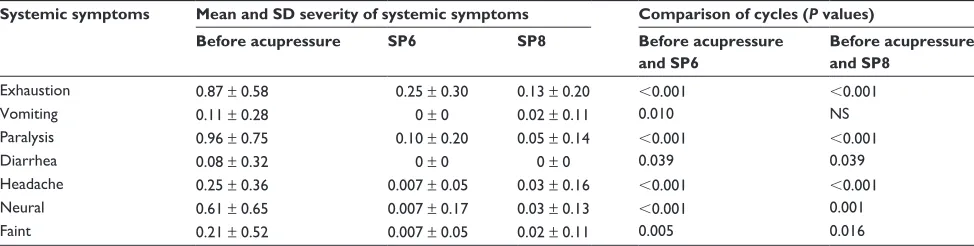
Mean severity of systemic symptoms of participants before and after acupressure at the SP6 and SP8 points is shown in Table 2. The severity of seven systemic symptoms accompanying dysmenorrhea diminished significantly after application of acupressure at the SP6 point. Similarly, the severity of all these symptoms, except nausea, diminished significantly with acupressure at the SP8 point. Comparing the severity of systemic symptoms between acupressure at the SP6 and SP8 points revealed no significant difference, except for fatigue, which was alleviated significantly more
with SP6 than SP8 (P= 0.004).
Discussion
In the present study, we divided 50 patients randomly into two groups. During the first cycle, we determined the severity of dysmenorrhea for each group prior to intervention. During the next two cycles, each group experienced, alternatively, acupressure once at SP6 point and once at SP8 point. Since in this type of clinical trial (crossover trial) each group is once the intervention group and once the control group, the confound-ing factors are almost completely under control. Therefore, the crossover clinical trial is a powerful clinical study. Our
Table 1 Pain severity experienced by subjects before, immediately, 30 minutes, 1 hour, and 2 hours after acupressure at the Sanyinjiao (SP6) and Diji (SP8) points
Cycle Mean and standard deviation of pain severity
Before acupressure Immediately after acupressure
30 minutes after acupressure
1 hour after acupressure
2 hours after acupressure
SP6 6.56 ± 1.05 5.69 ± 1.14 5.20 ± 1.25 4.20 ± 1.41 2.89 ± 1.36
SP8 6.84 ± 1.09 4.47 ± 0.99 4.08 ± 1.01 3.17 ± 0.96 2.03 ± 0.94
Comparing SP6 and SP8 NS P, 0.001 P, 0.001 P, 0.001 P, 0.001
Abbreviation: NS, not significant.
Dovepress
Gharloghi et al
Patient Preference and Adherence downloaded from https://www.dovepress.com/ by 118.70.13.36 on 26-Aug-2020
findings indicate that the severity of dysmenorrhea diminished significantly immediately, 30 minutes, 1 hour, and 2 hours after application of acupressure at the SP6 and SP8 points. Previous studies indicate that acupressure at the SP6 point alleviates dysmenorrheal pain.14,16–19 In a study similar to the present
study, Jun et al demonstrated the effects of SP6 acupressure on dysmenorrheal pain in women by series of measurement time points (ie, immediately, 1, 2, and 3 hours post-treatment) and by blinding the participants to the treatment.8 In contrast, our
study was not blinded. Moreover, in this study the severity of dysmenorrhea was determined within 2 hours after applying acupressure. In Jun et al’s study, there was a significant differ-ence in severity of dysmenorrhea between the two groups of intervention (acupressure at the SP6 point) and control (placing the thumb on the SP6 point slowly with no pressure) immedi-ately after and for up to 2 hours after applying acupressure, but no difference was observed between the two groups at 3 hours
after applying acupressure.8
Wong et al reported that acupressure has a long-term and
accumulative effect in relieving primary dysmenorrhea.17
They showed that SP6 acupressure has an immediate pain-relieving effect and a significant pain reduction in the third month. However, our study failed to show that SP6 acupres-sure had effectiveness over a long time period because the two groups received acupressure at the SP6 point for one cycle and the SP8 point for one cycle. Also, the effects reported in our study were similar to findings in previous literature where there was a statistically significant reduction in the intensity of pain and anxiety of dysmenorrhea when acupressure at
the SP6 point was applied.14 However, in our study, anxiety
of dysmenorrhea was not determined. As for acupressure at the SP8 point, we were unable to find a similar study that has evaluated its effects on dysmenorrhea.
The findings of this study indicate the possible physi-ological mechanism of acupressure, such as decreasing pain through activation of an endogenous opioid system
and release of specific neuropeptides20 and restoring health
to body through balance of energy.10,21
Another result of this study is the more efficacious pain relief experienced with the SP8 point compared with the SP6 for different intervals. The SP8 point is considered the emer-gency point for pain relief; it constitutes one of the best points for treating dysmenorrhea of any type and is probably the
optimal point for treating dysmenorrhea caused by stasis.12,13
This study also corroborates the better efficacy of this point for relieving menstrual pain; however, further studies are required to allow for a more confident conclusion.
Furthermore, our findings indicate that systemic symptoms accompanying dysmenorrhea diminish significantly with acu-pressure at both points – except for nausea at the SP8 point. The SP6 and SP8 points did not differ significantly in their efficiency for reducing these systemic symptoms, except in the case of fatigue, which diminished further with the SP8 point compared with the SP6. Previous studies also report the ability of acupressure to alleviate systemic symptoms.5,14,22 Smith et al
conducted a study in 2011 and concluded that acupressure and acupuncture are more efficient in relieving systemic symptoms compared with medical therapy and traditional Chinese herbal medicines.23
Conclusion
Considering the findings of the present study, it appears that acupressure at the SP6 and SP8 points alleviates menstrual pain. The resting period was 2 hours after application and was more pronounced with the SP8 point compared with the SP6. Therefore, the SP8 point can be considered an emergency point for relieving primary dysmenorrhea. Moreover, acu-pressure reduces the severity of systemic symptoms of dys-menorrhea. Given these effects of acupressure, it may be used as a convenient self-care method for different patients, free of cost and complications. To the authors’ knowledge, this is the first controlled study to provide evidence that acupressure at
Table 2 Mean severity of systemic symptoms of study units before and after acupressure at Sanyinjiao (SP6) and Diji (SP8) points
Systemic symptoms Mean and SD severity of systemic symptoms Comparison of cycles (P values)
Before acupressure SP6 SP8 Before acupressure
and SP6
Before acupressure and SP8
Exhaustion 0.87 ± 0.58 0.25 ± 0.30 0.13 ± 0.20 ,0.001 ,0.001
Vomiting 0.11 ± 0.28 0 ± 0 0.02 ± 0.11 0.010 NS
Paralysis 0.96 ± 0.75 0.10 ± 0.20 0.05 ± 0.14 ,0.001 ,0.001
Diarrhea 0.08 ± 0.32 0 ± 0 0 ± 0 0.039 0.039
Headache 0.25 ± 0.36 0.007 ± 0.05 0.03 ± 0.16 ,0.001 ,0.001
Neural 0.61 ± 0.65 0.007 ± 0.17 0.03 ± 0.13 ,0.001 0.001
Faint 0.21 ± 0.52 0.007 ± 0.05 0.02 ± 0.11 0.005 0.016
Abbreviation: SD, standard deviation.
Dovepress Effects of acupressure on severity of primary dysmenorrhea
Patient Preference and Adherence downloaded from https://www.dovepress.com/ by 118.70.13.36 on 26-Aug-2020
Patient Preference and Adherence
Publish your work in this journal
Submit your manuscript here: http://www.dovepress.com/patient-preference-and-adherence-journal Patient Preference and Adherence is an international, peer-reviewed, open access journal focusing on the growing importance of patient preference and adherence throughout the therapeutic continuum. Patient satisfaction, acceptability, quality of life, compliance, persistence and their role in developing new therapeutic modalities and compounds to
optimize clinical outcomes for existing disease states are major areas of interest. This journal has been accepted for indexing on PubMed Central. The manuscript management system is completely online and includes a very quick and fair peer-review system. Visit http://www.dovepress.com/ testimonials.php to read real quotes from published authors.
the SP8 point may be effective for the treatment of primary dysmenorrhea. Therefore, we recommend the conduct of further studies using acupressure at the SP8 point for different periods and cycles and on larger populations.
Study limitations
Due to the type of study this was and the self-administration of acupressure by the participants, neither providers nor participants were blinded to treatment. Therefore, unblinding bias cannot be ruled out. Some common limitations of the crossover trial design such as carry-over (previous treatment) and order effects may affect studies of this kind. Carry-over effect is unlikely to apply in this study because of the 1-month interval between treatment of the two groups, but it is possible that the order in which the SP6 or SP8 points were used as treatment affected the outcomes in this study. The attrition rate was not excessive (16.7%), but attrition bias could accrue; however, the characteristics of those partici-pants who dropped out were similar to those who completed the follow-up.
Acknowledgments
This study was an MSc dissertation. Thereby, we express our gratitude to authorities of Shahid Beheshti University of Medical Sciences. We also thank the participants in the trial who helped us in conducting this research.
Disclosure
The authors declare no conflicts of interest in this work.
References
1. Berek JS, Novak E. Dysmenorrhera. Novak’s Gynecology. 14th ed. Philadelphia, PA: Lippincott Williams and Wilkins; 2007:391–393. 2. Daniels SE, Torri S, Desjardins P. Valdecoxib for treatment of primary
dysmenorrhea. J Gen Intern Med. 2005;20(1):62–67.
3. Whittle GC, Slade P, Ronalds CM. Social support in women reporting dysmenorrhea. J Psychosom Res. 1987;31(1):79–84.
4. Pour Eslami M, Amin A, Sarmast H. Assessment of knowledge, attitudes and behavior of adoloescent girls in suburban districts of Tehran regarding dysmenorrhea and menstrual hygiene. Journal of Shahid Sadoughi University of Medical Sciences and Health Services. 2002;9(4):23–29.
5. Taylor D, Miaskowski C, Kohn J. A randomized clinical trial of the effectiveness of an acupressure device (relief brief) for managing symptoms of dysmenorrhea. J Altern Complement Med. 2002;8(3):357–370.
6. Teperi J, Rimapelä M. Menstrual pain, health and behavior in girls. Soc Sci Med. 1989;29(2):163–169.
7. Zhang WY, Li Wan Po A. Efficacy of minor analgesics in primary dysmenorrhea: a systematic review. Br J Obstet Gynaecol. 1998;105(7): 780–789.
8. Jun EM, Chang S, Kang DH, Kim S. Effects of acupressure on dys-menorrhea and skin temperature changes in college students: a non-randomized controlled trial. Int J Nurs Stud. 2007;44(6):973–981. 9. Akin MD, Weingand KW, Hengehold DA, Goodale MB, Hinkle
RT, Smith RP. Continuous low-level topical heat in the treatment of dysmenorrhea. Obstet Gynecol. 2001;97(3):343–349.
10. Heshmat R, Rostami U. Acupressure and Health Moxibustion in Family Fertility Health and Infertility Treatment. 1st ed. Tehran: Teimorzadeh; 2009. Persian.
11. Gentz BA. Alternative therapies for the management of pain in labor and delivery. Clin Obstet Gynecol. 2001;44(4):704–732.
12. Cheng K. Chinese Acupuncture and Moxibustion. 1st ed. Foreign Languages Press; 1999:150.
13. Sionneau P. Acupuncture. Les Points Essentiels [Acupuncture. The essential points]. Trédaniel G, editor. Paris: Guy Trédaniel; 2000. French.
14. Chen HM, Chen CH. Effects of acupressure at the Sanyingiao point on dysmenorrhea. J Adv Nurs. 2004;48(4):380–387.
15. Melzack R. The McGill Pain Questionnaire: major properties and scoring methods. Pain. 1975;1:277–299.
16. Chang SB, Jun EM. Effects of SP-6 acupressure on dysmenorrhea, cortisol, epinephrine and norepinephrine in the college students. Taehan Kanho Hakhoe Chi. 2003;33(7):1038–1046. Korean.
17. Wong CL, Lai KY, Tse HM. Effects of SP6 acupressure on pain and menstrual distress in young women with dysmenorrhea. Complement Ther Clin Pract. 2010;16(2):64–69.
18. Mirbagher-Ajorpaz N, Adib-Hajbaghery M, Mosaebi F. The effects of acupressure on primary dysmenorrhea: a randomized controlled trial. Complement Ther Clin Pract. 2011;17(1):33–36.
19. Kashefi F, Ziyadlou S, Khajehei M, Ashraf AR, Fadaee AR, Jafari P. Effects of acupressure at the Sanyingiao point on primary dysmenor-rhea: a randomized controlled trial. Complement Ther Clin Pract. 2010;16(4):198–202.
20. Ernst E, Fialka V. The clinical effectiveness of massage therapy – a critical review. Forsch Komplementarmed. 1994;1:226–232. 21. Navidi AA, Khedmat H, Helli Saz MT, Naseri MH, Ghasemi
Salmanie KH. Basic Principles and Clinical Acupuncture. Tehran: Tabib Publications; 2006.
22. Wang MC, Hsu MC, Chien LW, Kao CH, Liu CF. Effects of auricular acupressure on menstrual symptoms and nitric oxide for women with primary dysmenorrhea. J Altern Complement Med. 2009;15(3):235–242.
23. Smith CA, Zhu X, He L, Song J. Acupuncture for primary dysmenorrhoea. Cochrane Database Syst Rev. 2011;1:CD007854.
Dovepress
Dove
press
Gharloghi et alPatient Preference and Adherence downloaded from https://www.dovepress.com/ by 118.70.13.36 on 26-Aug-2020