GSJ: VOLUME 6, ISSUE 8, AUGUST 2018 63
GSJ: Volume 6, Issue 8, August 2018, Online: ISSN 2320-9186
www.globalscientificjournal.com
I
MPACT OF THE
I
NTERACTION
T
RACES
C
ONTEXTUALIZATION ON THE
P
ERFORMANCE OF
T
RACES
-B
ASED
S
YSTEMS
Macaire Ngomo*,**
* CM IT CONSEIL – Département Ingénierie, Innovation, Recherche – Pôle Economique de la MEFER – 32 rue Milford Haven 10100 Romilly sur Seine (France) ** Institut National des Sciences Appliquées de Rouen – Laboratoire LITIS, Campus INSA de Rouen - Avenue de l’Université, 76801 Saint-Étienne-du-Rouvray Cedex (France)
KeyWords
Collaborative environment, learning management system, IEHL, systems based digital traces, modelling, observation, data acquisition, inter-action unit, interinter-action space, digital interinter-action traces, learning traces, trace model, trace-based system.
ABSTRACT
The new dimension of collaboration, brought by collaborative platforms, induces a new management approach that must consider methods of observation and behaviour analysis as a means to optimize the productivity of organizations. From this point of view, although they have evolved a lot in recent years, especially with social networks, the contextualization of digital interaction traces within collaborative platforms remains a major topic for the performance of data operating systems. The work that we present in this paper is part of the projects of im-plementation of collaborative and learning management systems, collaborative work and services, in a IT Environment for Human Learning vision (IEHL), more precisely, on the intelligent architectures of the platforms aiming at a better or-ganization around the concept of unity of interaction which introduces a sort of contextualization of the collected digi-tal traces. The resolution of the problem of the personalization of IEHL is moreover essentially dependent on the ability to produce relevant and exploitable digital traces of the individual or collective ac-tivity of the users (learners in particular), who interact with an IEHL. In the present work, we are interested in the organization of collabora-tive tools and its impact on the performance of digital interaction traces analysis mechanisms. Our study is based on the results of observa-tion and analysis of human interacobserva-tions within collaborative platforms, in particular those developed within the framework of our projects.
Macaire Ngomo*,**
* CM IT CONSEIL – Département Ingénierie et Innovation – Pôle Econo-mique de la MEFER – 32 rue Milford Haven 10100 Romilly sur Seine (France)
** Institut National des Sciences Appliquées de Rouen – Laboratoire LITIS,
GSJ© 2018
1 I
NTRODUCTIONCollaborative platforms bring another dimension to communication and exchange between individuals, fundamentally transforming how humans communicate, interact, share information, knowledge and skills in society and how information is organized and ex-ploited. A new form of management has emerged where teamwork is one of the ways to optimize the productivity of organizations. This form of management is based on the management of knowledge and collective intelligence and not only on means and struc-tures.
The new dimension of collaboration, brought by collaborative platforms, induces a new management approach that must consider methods of observation and analysis as means to understand individual and collective behaviours within organizations. The concept of collective knowledge management is induced by the development of collaborative tools that promote human interactions. These tools turn out to be the modern solutions in the service of management (project management, tutoring, coaching, e-learning, man-agement of a production unit, etc.).
However, although they have evolved a lot in recent years, collaborative platforms are still not very effective. The solutions pro-posed are still lacking effective and intelligent tools for observing and analyzing human behaviour. Publishers are largely uninterested in observing and analyzing interactions. Almost all modern collaborative environments today integrate traditional collaboration tools (communication tools, sharing tools, production tools, etc.).
However, despite this wealth of available tools and their individual performance, their integration is often done without perspec-tive in terms of observation and analysis of behaviours. In general, for some, these platforms are limited to the collection of statistical and technical data necessary for the development of dashboards. For others, especially trace-based systems (SBT [38], [39]), the col-lection of interaction traces is done regardless of the interaction context. This absence of the interaction context does not allow a good analysis of relations within the system. The interaction traces do not take into account the exchange context. But it is exactly through a better observation and analysis of human behaviour that we can understand how users operate and their relationships within systems. The data provided, often purely technical and devoid of behavioural information, are generally quantitative, limited to statistics on the use of the system (number of connections, date of connection, number of resources, number of community members, etc.).
How to understand, from the human interactions gener-ated around resources and spaces of collaboration, the individual and col-lective behaviours of a community or a group of individuals to anticipate and react effectively? In this article, we are interested in studying the behaviour of virtual communities in collaborative processes through the analysis and observation of human interactions within collaborative platforms. More specifically, we are interested in the organization of the interaction tools and its impact on the performance of mechanisms to help analyze data or traces resulting from these interactions within environments.
This area has already been the subject of several research projects. Our reflection takes into account in particular the studies car-ried out on the methods of measurement of group cohesion within a virtual community ([5], [6], [7], [8], [10], [11], [12], [13], [14], [15], [16], [17], [18], [22], [23], [24], [32], [33] ], [34], [35], [41], [42], [43]), based on the analysis of social networks ([9], [36], [45], [46] [ 47]) and on trace-based systems (SBT [38], [39]).
However, it highlights the organization of interaction tools and its impact on methods of acquisition, observa-tion, analysis and exploitation of data from human interactions within collaborative platforms. . Indeed, we estimate, and the results of analysis of the tools prove it, that the methods of acquisition and analysis of the traces of interactions can be effective only if the tools of interaction which generate these data are integrated of to ensure the quality and relevance of the data; this is not always the case in the current state of existing systems.
However, it is exactly at the level of data quality that we must first work to guarantee that of the results of the methods of analysis or exploitation of the data. Most of the current collaborative platforms integrate various communication, exchange and sharing tools (address book, email, mailing lists and discussion forums for asynchronous communications, chat for synchronous communications, shared calendars and space for sharing documentary resources, etc.), and when infrastructures allow, these environments integrate advanced management and communication tools: IP telephony and videoconferencing, project management, task list, task manage-ment, notes, file managemanage-ment, resource planners, versioning, content publishing, name-spaces, watch list, page template, email noti-fication, voting system, instant messaging, web conference, etc.
However, the organization of these tools is lacking. Although the improvement of some collaborative tools, taken individually, is necessary and desirable - work is being done in this direction [18] - it is not their effectiveness that is questioned here, but their or-ganization at collaborative platforms that need to be revisited.
This is exactly what we are dealing with in this article through the introduction of interaction unit or collaboration concepts, inter-action or collaboration space, and resource space. Tools generating data from human interinter-actions must be organized in such a way as to improve the quality, the relevance of the data collected, their organization and consequently the quality of the data exploitation services.
The work we present in this article is part of the implementation projects of training systems, collaborative work and services, in a vision IEHL (Computer Environment for Human Learning) [42] [44] [45], more precisely, on the intelligent architectures of the plat-forms aiming at a better organization around the concept of interaction unit which introduces a kind of contextualization of the col-lected digital traces. The resolution of the problem of the personalization of IEHL is moreover essentially dependent on the capacity to produce relevant and exploitable digital traces of the individual or collective activity of the users (learners in particular), which
GSJ - Global Scientific Journal, Volume 6, Issue ???, August-2018 ISSN:2320-9186
interact with an IEHL.
To represent virtual communities, we consider multidimensional relationships between individuals for whom we have profiles, past interactions (chat, forum, sending email messages, etc.) and actions with a common resource database (documents, reports, tasks, projects, ...); the co-production of resources for example or acting on common objects that can be seen as indirect interactions. We thus consider two types of interactions that make it possible to establish relationships between individuals: direct interactions and indirect interactions. The study considers community structures, that is, configurations of sub-networks of individuals reflecting communities built around interaction or collaboration units, and the emergence of communities from multidimensional social net-works.
2
D
EFINITIONS OFC
ONCEPTSWe mean by collaborative what is meant to foster peer collaboration by enabling communication, sharing, producing information, knowledge, skills, resources etc. to better achieve a common project. Thus, we will say: collaborative learning, collaborative work, collaborative training and collaborative culture ([31]).
Collaborative work is therefore an active process by which the individual and the group work towards the realization of a common work. This approach combines two approaches: that of the individual and that of the group or the community. In the collaborative process, individuals collaborate in the activities of the group and, in return, the group collaborates with those of the individuals. [19]. The concept of a collaborative tool is very broad. It re-covers everything that can communicate and work together in a company, the simple device that allows exchanging e-mail to the collaborative work platform. This definition places an important place on the shar-ing of knowledge and know-how which implies: identification, expression, materialization, makshar-ing available [20] [29] [30].
By collaborative work, we therefore designate, on the one hand, the cooperation between the members of a team, a group and, on the other hand, the realization of a common activity or project (product, service, etc.). Collaborative work is spreading strongly thanks to the Internet (in particular thanks to its communication functionalities) and allows the creation of remote work teams. The Internet appears to be the right tool to implement collaborative activities.
Here we must emphasize the distinction between communication and collaborative work. This distinction is in terms of objectives. Communicating does not necessarily give rise to achievements that are visible to everyone, whereas in a collaborative project, the goal is to create something in a group and in particular by communicating. Communication is then a means and not an end in itself. We call this term interpersonal communication that promotes exchanges between one or more people in the virtual community. Communicating allows you to consult the community to exchange and gather information. Communication enriches interactions and therefore activities by permitting peer-to-peer contacts. This type of activity is based, at the technical service level, on both asyn-chronous communication protocols (e-mail, forums) and on synasyn-chronous communication protocols (chat, instant messaging, vide-oconferencing, etc.). .
Settouti [38], [39] defines the Trace Based System (SBT) as a computer system that allows and facilitates the exploitation of traces. It is composed of different components.
In an SBT, the trace [38], [39] is a collection of temporally located ob-servings, that is to say a structure information resulting from the observation of an interaction, these observed being by relation to a temporal order relation which may be [40] a time interval, a se-quence of any elements providing the temporal order relation (for example the set of natural numbers).
A modelled trace (m-trace) is the association of a collection of temporally located observations and an explicit model of this observed collection.
3 E
XISTINGA
PPROACHEST
OT
HEM
ANAGEMENTO
FD
IGITALT
RACESO
FI
NTERACTIONI
NT
RACEB
ASEDS
YSTEMSThe exploitation of digital traces not only produces ele-ments of interest for behavioural or conceptual model-ling, but also a relevant personalization of IEHL by pro-ducing feedback or changing interfaces. It is therefore necessary in this context to help the users of the trace to collect, transform and analyze the traces resulting from observations of human activity. In this overall manage-ment process, data collection is the first step in ensuring data relevance. The observed must therefore be seen in its context without which the in-formation will be trun-cated and devoid of all its dimensions.
For this purpose, the notion of trace-based system (SBT) is proposed as a tool for handling traces [38], [39]. We have seen that in an SBT, the trace is a collection of temporally located observations, that is to say a struc-tured information resulting from the observa-tion of an interacobserva-tion, these observed being in relaobserva-tion to a relaobserva-tion of temporal order which can be [40] a temporal interval, a se-quence of any elements providing the temporal order relation (for example the set of natural numbers). However, this definition does not highlight a very important element, namely is the context of the observation or the observed that we consider essential and therefore to be taken into account in this definition. Each trace therefore has its own structure and semantics that must take into account not only the temporal order of relationship but also the context, depending on the system that generated it and the nature of the activity being traced. To be able to be used, a trace is always accompanied by its model. We speak here of a trace model, that is to say the vocabulary of the trace which describes in an abstract way the objects which form part of it [40]. From a purely comput-er point of view, the trace model is a set of classes that can give a description to the obscomput-erved trace. The traces at the SBT level are modelled. Technically, they are represented in the form of an ontology OWL instance of the ontology of its model.
There are different components of an SBT: the collection system, the transformation system, the visualization system, and so on. Our
GSJ© 2018
study is positioned at the level of the collection system, the first essential component of the system. Indeed, before being exploited in an SBT, the traces are first collected using the collection system. This system represents all the structured processes needed to con-vert the data into traces. Collection is the process of automatically, semi-automatically or manually operating a set of tracing sources to obtain a trace of the trace-based system.
The resulting trace consists of a collection of temporally located ob-servations associated with a trace pattern. The resulting traces of the collection process are called the first trace of the SBT, because it is the first to be ma-nipulated in this system at the end of the collection. The SBT stores the collected traces in the m-trace database which groups together all the traces of the SBT and their respective models. It allows permanent storage and ac-cess to m-traces at any time. It represents the SBT knowledge base.
Our research problem is therefore at the level of this process of col-lecting raw traces, especially at the level of the architecture of the sys-tems making it possible to op-timize the process and to improve the rel-evance of the data and the performances of SBT analysis.
Figure 1 shows the architecture of the system as a whole by explain-ing the process in a general way as to the gen-eration of the profiles, it begins with a collection of data from the database "Moodle", then mate-rializes the traces modelled according to a model of traces before pro-ceeding to the calculations of indicators which will allow us in the end to be able to generate a set of pro-files.
4 T
HEO
RGANIZATIONO
FI
NTERACTIONT
OOLSA
NDT
HEIRI
NTEGRATIONW
ITHINT
RACEB
ASEDS
YSTEMSIn a collaborative platform, collaboration is done through the tools of communication, exchange, sharing, dissemination, production, etc. We can distinguish here two levels of functionalities or collaboration tools that can generate direct or indirect interactions. The first level of functionality must allow:
- to make available resources (documents, courses, articles, ...), - to access resources,
- communicate: interpersonal communication via messaging is the first level of communication essential in a collaborative platform. The second level of functionality initiates collaborative work through a set of technologies and associated work methods that, through electronic communication, allow the sharing of information and knowledge to a group engaged in a collaborative effort or work.
The tools found there can be classified in:
> Basic communication tools
Their role is primarily to circulate information among colleagues. - messaging tools (instant or not)
- the White board
- the electronic conference (videoconference, videoconference, chat, ...) - social networks
-...
> Shared work tools
They allow several people to work on the same document or application. - application sharing
- shared edition
- shared document space
- information exchange tools (electronic forums and related tools) - shared calendars
- contact management tools -...
> Knowledge access tools - or Knowledge Management - the libraries
- the MOOCs
Fig. 1. Architecture of the Moodle system [37] [46].
GSJ - Global Scientific Journal, Volume 6, Issue ???, August-2018 ISSN:2320-9186
- The tools of peer to peer - content portals
- skills mapping - electronic directories - mailing lists
- the FAQs
- WiKi (kinds of portals that get rich thanks to the contribution of the people who consult them) - search engines
-...
> Workflow tools
These are probably the most spectacular tools. "Software intervention is no longer at the level of information, communication or collaboration, but at the higher level of coordination".
- Synchronization tools - Task management tools - Shared calendars -...
> ...
These features can also be classified into two categories: asynchronous features and synchronous features.
In this paper, we will focus on the basic tools of exchange and production that favour interactions between individuals: messaging, forum, chat, shared agenda, document sharing, voting system, presence indicator, indicator of d allocation, manual or automatic no-tification system, publishing and production systems, intelligence collaborative tools, etc.
The analysis of current collaborative platforms ([4], [21]) shows that most advanced collaborative platforms integrates these tools. But this integration does not often bring great efficiency to collaborative tools since made without a global vision by placing them-selves on the side of the user and the side of the manager, the decision maker. In the majority of cases, one simply wants to have for example a forum or a general cat without giving himself the means to observe and analyze the behaviours of the individuals through the human interactions that are generated there. Putting these tools in a collaborative platform is not effective if we can not restore the context or context of the exchanges to understand the behaviour of individuals and groups of individuals. Techniques based on the semantic analysis of messages ([17], [34]) exchanged between individuals are not sufficient to allow them to understand the be-haviours of a virtual community.
An analysis of current environments shows us that collaboration tools are integrated without vision, without precise strategy allow-ing the optimal and intelligent acquisition and exploitation of data resultallow-ing from human interactions or individual and collective ac-tivity. This lack of global vision means that the treatments applied to these data lead to quantitative, statistical and often very basic macroscopic results (how many people are connected, how many messages, how many documents shared, etc.). We believe that a better organization of the collaboration tools within the systems has a big impact on the performances of the methods of acquisition, observation, analysis and exploitation of the data and consequently on the quality of the data of these human interactions.
Whereas most interactions, direct or indirect, between individuals take place around shared resources (documents, training modules, courses, etc.) and within spaces or units of collaboration (groups, projects, tasks, workshops, etc. .), we believe that collaboration tools can be integrated and organized around resources and spaces or units of collaboration, allowing contextualization of interac-tions, identification of the context or context of exchanges, monitoring interpersonal relationships as well as participation or in-volvement of individuals in collective activities. We build this new organization around the concepts of unity / space of interaction or collaboration and resource space.
We call unity / space interaction or collaboration, a virtual space of communication, exchange, sharing built within a virtual space (group, project team, project, task, workshop, etc. .) or a resource (document, file, article, pedagogical module, support, etc.) to which interaction tools promoting interactions between individuals and relationships between spaces or units are associated. An interaction space is created when a space or resource is created and disappears when the space or resource is deleted. Human inter-actions have an influence on the life of space and make it live.
Example, a project or task space: a project with which communication tools (messaging, forum, chat, etc.) are associated. The mes-sages exchanged between individuals are part of the life process of the interaction space which is here the project. These interactions can lead to relationships with other spaces (eg sharing resources with other projects, other tasks).
We distinguish two types of units / spaces of interaction or collaboration:
- interaction or collaboration units with resource, built around a resource (document, article, training module, etc.) that we also call spaces or resource unit
- interaction or collaboration units without resources that do not require the presence of a res-source (group, project, task, work-shop, etc.)
We call space or resource unit, an interaction unit that is to say a virtual space a virtual space of communication, exchange, sharing built around a resource, composed of the resource itself to which we associate interaction tools favouring.
GSJ© 2018
5 Q
UALITYO
FD
ATAA
NDP
ERFORMANCEO
FD
ATAC
OLLECTIONA
NDA
NALYSISP
ROCESSI
NDUCEDB
YT
HEN
EWO
RGANIZATIONIn today's collaborative platforms, interactions between individuals generate a wealth of data that allows indi-viduals to observe, analyze, and understand the behav-iours or lifestyles of the community (who do they com-municate with, when? on what, what is the framework of the exchanges, what are the levels of implication of the individuals, what is the level of cohesion of the group, ...). When collaboration tools are integrated effectively, with a vision and a strategy in terms of data acquisition and exploitation, by plac-ing themselves on the side of the user but also of the manager, the quality of the data resultplac-ing from the interactions also guarantees the results of the associated treatments. This is not the case at the current state of existing systems.
The majority of current systems are not able to respond to simple queries (individual and collective contributions in an activity, level of involvement in a collective activ-ity, relationships within a community, etc.). Only once the problem of the organization of collabo-rative tools and thus of the quality of the data is solved can we guarantee the quality of the associated services such as the measure of the cohesion of a group, subject treated by several authors ([32], [33], [34], [35], [23], [17], [6], [15], [18], [22]). The new organiza-tion that we propose aims at a double goal: the efficiency of the methods of acquisiorganiza-tion and consequently the quality of the data and the performance of the methods of treatment. It allows to contextualize the interactions and to introduce more efficiency in the pro-cessing of the information acquired. The system is then equipped with greater intelligence in the acquisition, observation, analysis and exploitation of data than systems built using traditional approaches. The contextualization of interactions aims to link the ac-quired data to their source, their context and to bring intelligence to the system.
6 I
MPLEMENTATIONIn this section, we discuss the problem of implementing the concepts of interaction unit or collaboration and resource space. To do this, we relied on SERPOLET ([2], [25], [26], [27], [28]) and COGNIFER ([1], [25], [26], [27], [28]), two multi-language training man-agement systems that integrate both general collaborative features and specific collaborative learning features.
The first implementation of the interaction unit and resource space concepts is done to extend the animation support capabilities of the SERPOLET and COGNIFER systems. These two systems use the same management mode. We will therefore only describe the SERPOLET system that led, in the context of the development of French-language digital campuses, to the development of the COG-NIFER platform.
6.1 The SERPOLET system and its derived products
SERPOLET or its derivatives COGNIFER, TELJ +, SAATAR, etc. ([2], [25], [26], [27], [28]) are training systems that offer an author system (au-thoring system for creating pedagogical resources) and a training man-agement system that integrates SBT dimension. Their complete train-ing cycle describes the course of the train-train-ing in five main phases: the creation phase, the orienta-tion and planntrain-ing phase, the learntrain-ing phase, the monitoring and evaluation phase, the management phase. Learner follow-up is an important part of this overall learning cycle. It is done during the learning phase. It allows to trace the activity of the learner during his apprenticeship and to retrieve the data on his activi-ties. Collaboration between individuals in a learning community or between learners and tutors is done through synchronous and asyn-chronous interaction tools (messaging, forum, chat, application sharing, white board, document sharing, etc.). SERPOLET and these deriva-tives offer functionalities allowing the construction of the individualized courses that courses of group. As part of a collaborative learning, our reflections have allowed us to identify some areas for improvement to make the system a real decision-making tool. The contextualiza-tion of the digital interaccontextualiza-tion traces is one of the elements consid-ered to take into account all the observacontextualiza-tion dimensions.
6.2 Implementation of the interaction spaces
To implement the concepts of unity of interaction within our platforms, we organized the tools around several types of components that define the context of the interaction: the resources (document and educational content in particular), the task / activity / pro-ject, the individual and the group, ... Thus, each type of element corresponds to a type of interaction space or an interaction context. The document and the educational content are associated with the interaction units with resources or resource spaces. We will ex-amine in the following section, the organization of each type of interaction unit.
a. Interaction unit with resource
Resource space: Resource space associated with the document: A resource space associated with the document is a resource space (space for interaction with resource) built around the "document" resource, made up of the "document" resource and associated collaboration tools.
Each document is associated with a document space that gives access to different interaction tools: messaging, forum, comment editor, voting system, etc. It can be attached to other types of interaction units. Each new version of the document is particularly related to the latter. Thus, in a document space one can follow the history of a document thanks to the rela-tions that link it with its versions.
GSJ - Global Scientific Journal, Volume 6, Issue ???, August-2018 ISSN:2320-9186
Figure 2 highlights several parts of a resource space associated with a document. The first part of the toolbar offers a set of tools for collaboration and a tool for analyzing the activity around the document (forum, chat, questionnaire/vote, messaging, voting tool, etc.). That the other offers management tools (creation, modification, deletion, search, opening,...) around the resource.
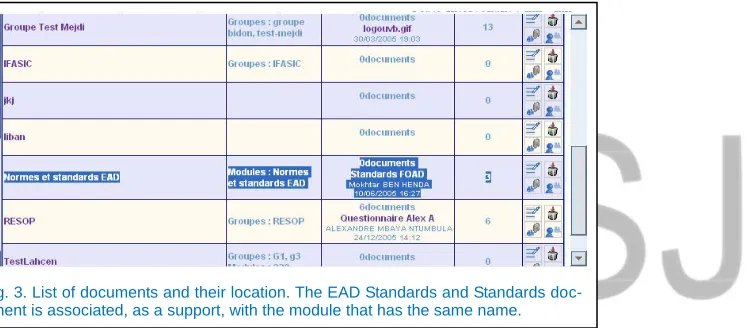
These tools are used in a general context or that of the document. Figure 3 also shows a list of three documents associated with the original document.
Resource space associated with a pedagogical module: A module space is an (resource interaction space) a resource space built around the "Modulated" resource that can be attached to other interaction spaces such as a task, a project or group. Each module is associated with a module space giving access to different interaction tools: messaging, forum, comment edi-tor, voting system, etc. This space can be associated with other types of resources such as media, articles, software, and so on. Each module resulting from the modification of another module is in particular in relation with the latter. Thus, in a module space one can follow the history of a module thanks to the relations that link it with its versions. A module space also gives access to all the prerequisite modules.
Fig. 2. Document space associated with the resource (document) EAD Standards.
Fig. 3. List of documents and their location. The EAD Standards and Standards doc-ument is associated, as a support, with the module that has the same name.
Fig. 4. "Module space" associated with the resource (educational module) Test Course (Scorm).
GSJ© 2018
Figure 4 highlights several parts of a "module" space. As in the space "document", the toolbar of a space "module" proposes tools of management (creation, modification, suppression, search, execution, ...) whereas its right part offers a set of collabo-ration tools around the document (forums, chats, questionnaires / votes, messaging, ...) as well as tools for analyzing the ac-tivity around the resource. The figure also shows a list of three documents associated with the resource.
b. Interaction unit without resource
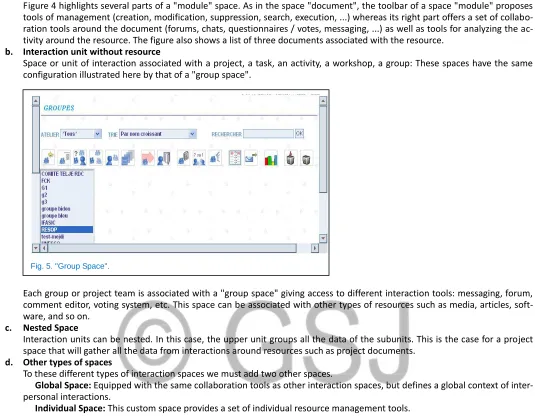
Space or unit of interaction associated with a project, a task, an activity, a workshop, a group: These spaces have the same configuration illustrated here by that of a "group space".
Each group or project team is associated with a "group space" giving access to different interaction tools: messaging, forum, comment editor, voting system, etc. This space can be associated with other types of resources such as media, articles, soft-ware, and so on.
c. Nested Space
Interaction units can be nested. In this case, the upper unit groups all the data of the subunits. This is the case for a project space that will gather all the data from interactions around resources such as project documents.
d. Other types of spaces
To these different types of interaction spaces we must add two other spaces.
Global Space: Equipped with the same collaboration tools as other interaction spaces, but defines a global context of inter-personal interactions.
Individual Space: This custom space provides a set of individual resource management tools.
6.3 Impact of interaction units on the performance of mechanisms to help manage collaborative activities
To represent virtual communities, we considered multi-dimensional relationships between individuals for whom we have profiles, past in-teractions (chat, forum, e-mail, etc.) and actions with a common resource database; the co-production of resources for example or acting on common objects that can be seen as indirect interactions. We considered two types of interactions that make it possible to establish links between people: direct interactions and indirect interactions. The SERPOLET and COGNIFER study highlighted community structures, that is sub-network configurations reflecting communities built around interaction units and resource spaces, as well as the emergence of com-munities from a multidimensional social network. Our community structure model is a set of explanations of some links in a complex net-work, and that according to different types of situations, in other words, the article leaves an important part to the modelling of the context in the optics operational work.
The integration of the interaction units in SERPOLET and COGNIFER was intended to contextualise the inter-actions and thus the information and knowledge ac-quired, to better organize it and to allow an efficient ex-ploitation in terms of analysis of individual and collec-tive behav-iour. The integration of the interaction units in SERPOLET and COGNIFER made it possible to achieve these objectives.
Indeed, the SERPOLET and COGNIFER analysis, be-fore and after the integration of the interaction units, clearly showed a clear improve-ment in the quality of the data acquired and the performance of the manageimprove-ment support services (monitoring animation) collaborative activities. The organization of collaborative tools (mes-saging, chat, forum ...) within the interaction units al-lowed bettering contextualizing the acquired informa-tion. This contextualization significantly improved data acquisition methods and exploitation services in terms of ana-lyzing the behaviour of individuals and groups of individuals through the analysis of human interactions. This has brought a new dimension to the SERPOLET and COGNIFER systems, making them real decision-support tools that allow the processing of complex que-ries (who communicates with whom (analysis of inter-personal relations), around what do they communicate, in hat context, what is the level of in-volvement of indi-viduals, what is the level of coherence of the group, ...) and provide dashboards very rich in information.
Fig. 5. "Group Space".
GSJ - Global Scientific Journal, Volume 6, Issue ???, August-2018 ISSN:2320-9186
7 C
ONCLUSION AND PROSPECTSIn this article we introduced a new form of organization of collaboration tools by introducing the concepts of interaction unit and resource space. The interaction units aim at better organization of collaboration tools within a collaborative platform in order to improve the per-form-ance of data acquisition and analysis methods resulting from human interactions. In order to experiment with our approach, we used two collaborative learning platforms, SERPOLET and COGNIFER [1] [2] [3]. The integration of interaction or collaboration units within these two platforms has significantly improved their ability to analyze human interaction data and thus provide effective services for monitoring and facilitating collaborative activities. The integration of interaction units in a collaborative environment brings a better or-ganization of collaborative tools, a better acquisition and exploitation of data from human interactions, powerful monitoring services and more. anima-tion of collective and individual activities. The interacanima-tion or collaboraanima-tion units guarantee the quality of the data resulting from the interac-tions between individuals and improve the performance of the animation support mechanisms and the monitoring of the collaborative activities. To increase the performance of observation services, our study will continue to model and integrate dashboards by interaction unit. It is a question of enriching the environments and allowing a better restitution of the results of analysis. Another point we are working on is measuring the degree of involvement of individuals in collective activities. This involves de-fining roles in collaborative processes.
A
CKNOWLEDGMENTThis work is the result of collaborations with several organizations, in particular the teams of the LITIS and LMI labs (INSA Rouen, France), OMERIC (Observatoire Mondial des Enseignements et des Relations Inter-Culturelles, France) . The Author would like to thank his collegues in LITIS lab, in particular Professor Habib Habdulrab, for their wonderfull collaboration, their expert advice, their extraordinary support and renewed en-couragement.
R
EFERENCES[1] A6, 2007a. Cognifer
http://a6m.prosygma-serveur.info/telje/cognifer.asp [2] A6, 2007b, Serpolet/Telje+
http://62.212.103.221/telje/ [3] A6, 2007c. www.a6.fr.
[4] Académie de Rennes, 2007, Analyse comparative des environnements d'après quelques solutions (clas-sées par principaux types), http://www.ac-rennes.fr/tic/glossaire/AnalysePlateformes.htm
[5] BRAHAMI Mustapha Anwar, CHERBAL Moham-med El-Amin. Développement d’un Système à Base de Traces modélisées (Le système ATER). Mémoire de fin d’étude en vue de l’obtention du diplôme d’Ingénieur d’état en Informatique sous la direction de : SETTOUTI Lotfi-Sofiane, CHIKH Azzedine.
[6] Betbeder M.-L., Reffay C. and Chanier T., 2006. Environnement audiographique synchrone : recueil et transcription pour l'analyse des interactions multimo-dales. In JOCAIR 2006, Premières journées Communication et Apprentissage instrumentés en réseau, Amiens, France, pages 406--420, July 2006.
[7] Damien Cram. Visualisation de traces : Application aux traces réflexives d'eLycée, Fev 2007. Rapport de stage, effectué dans le cadre du projet eLycée sous la direction de Denis Jouvin et Alain Mille.
[8] Cram D., « Visualisation de Traces : Application aux Traces Réflexives d'eLycée », Rapport de Master de recherche, Université Claude Bernard Lyon1, 2007. [9] Degene A. and Forse M., 1994. “Les réseaux so-ciaux”; Collection U, Série Sociologie, Armand Colin, Paris, 1994.
[10] DIMITRACOPOULOU, A., BRUILLARD, E. (2006). Enrichir les interfaces de forums par la visualisation d’analyses automatiques des interactions et du contenu. Revue STICEF, Vol. 13.
[11] Djouad Tarek, Ingénierie des indicateurs d’activités à partir de traces modélisées pour un Environnement Informatique d’Apprentissage Humain (THESE). Université Claude Bernard - Lyon I.
[12] DJOUAD Tarek, MILLE Alain, REFFAY Christophe, BENMOHAMED Mohamed, "Ingénierie des indicateurs d'activités à partir de traces modélisées pour un Environnement Informatique d’Apprentissage Humain", Sciences et Technologies de l´Information et de la Communication pour l´Éducation et la Formation (Revue Sticef.org), Volume 16, 2009 Article de recherche.
[13] Djouad Tarek, Settouti Lotfi Sofiane, Mille Alain, Prié Yannick et Reffay Christophe (2010). Un Système à Base de Traces pour la modélisation et l'élaboration d'indicateurs d'activités éducatives individuelles et collectives. Mise à l'épreuve sur Moodle. Techniques et Science Informatique, 29 (6), Hermès, pp 721-741. [14] DJOUAD, T. (2008). Analyser l’activité d’apprentissage collaboratif : Une approche par trans-formations spécialisées de traces d’interactions. 2ième rencontre des
jeunes chercheurs RJC-E.I.A.H.08, Lille, France, p. 93-98.
[15] Fjuk A., Ludvigsen S., 2001. “The complexity of distributed collaborative learning : Unit of analysis”. (EU-CSCL’01), Maastricht, 2001.
[16] France L., Heraud J M., Marty J C., Carron T., « Visualisation et régulation de l'activité des apprenants dans un EIAH tracé », dans les Actes de la conférence EIAH 2007, Lausanne, Suisse, 27-29 Juin 2007, p.197-184.
[17] Greffier F. and Reffay C., 2006. Les échos du forum de discussion en FAD. In JOCAIR 2006, Premières journées Communication et Apprentissage instrumentés en réseau, Amiens, France, pages 130--144, July 2006.
[18] George S., 2001. “Apprentissage collectif à distance. SPLASH : un environnement informatique support d’une pédagogie de projet”; Thèse de Doctorat en in-formatique, Université du Maine, 2001.
[19] Henri F. and Lundgren-Cayrol K., 2001. Apprentis-sage collaboratif à distance : pour comprendre et concevoir les environnements d'apprentissage virtuels. Sainte-Foy (Québec, Canada) : Presses de l'Université du Québec, 2001, 181p.
GSJ© 2018
[20] Innovative Learning Technologies. Définition des termes LCMS et LMS : LCMS et LMS, quelles diffé-rences ?, http://www.innovativelearningtechnologies.fr/tendances/definition-des- termes-lcms-etlms-lcms-et-lms-quelles-differences-202, consulté le 20 Mai 2013. [21] Journal du Net, 2007, 16 outils collaboratifs Open Source
http://developpeur.journaldunet.com/tutoriel/out/051214-outils-collaboratifs-open-source.shtml
[22] Mbala A., Reffray C. and Chanier T., 2002. “Integration of automatic tools for displaying interaction data in computer environments for distance learning” ; Intel-ligent Tutoring System Conference, Biarritz, France, 2002, p.841-850.
[23] Mbala A., Reffay C., and Anyouzoa A.G.N., 2005. Supporting Distributed Collaborative Learning with Usage Analysis Based Systems. In Procs of the Int. Work-shop 'Usage analysis in learning systems', in conjuction with the AIED'2005 Int. Conf. on Artificial Intelligence and EDucation, Amsterdam, Netherlands, pages 111--112, July 2005.
[24] Mazza R., Dimitrova V., « Visualising Student Tracking Data to Support Instructors in Web-Based Distance Education », Dans les actes de: the thirteenth Interna-tional World Wide Web Conference-EducaInterna-tional Track, New York, USA, 2004, p.154-161.
[25] NGOMO M., ABDULRAB H. and OUBAHSSI L., 2005a. "Application Service Provider System : a new concept to provide interoperability between learning management systems"; Proceedings of E-Learn 2005 World Conference (World Conference on E-Learning in Corporate, Government, Healthcare, and Higher Education), Vancouver,(Canada); Research/Technical Showcase; pp 2763-2769 (2005)
[26] NGOMO M. and ABDULRAB H., 2006. "Applica-tion Service Provider System: Using Web Services to Provide Interoperability between Learning Management Systems"; International Conference WTAS 2006 (Web Technologies, Applications, and Services), July 17-19, 2006, Calgary, Alberta, Canada, Editor(s): J.T. Yao; pp 119-125 (2006)
[27] NGOMO M., OUBAHSSI L. and ABDULRAB H., 2005b. "La fourniture de services : une approche novatrice pour l'ouverture des systèmes de formation et du marché de la FOAD"; EIAH '2005 (Environnements Informatiques pour l'Apprentissage Humain), Montpellier, (France), 26-27 Mai 2005; pp 309-320 (2005) [28] OUBAHSSI L., Grandbastien M., Ngomo M. and Claes G., 2005. « The Activity at the Center of the Global Open and Distance Learning Process. » The 12th
In-ternational Conference on Artificial Intelligence in Education, AIED 2005, Amsterdam. [29] O’Neil M. What is E-learning, Home Magazine, May 2001.
[30] Observatoire e-collaboration, 2007,
http://www.observatoire-ecollaboration.com/innov/article_2.php3
[31] OQLF, 2001. Office Québécois de la Langue Française - http://www.granddictionnaire.com/
[32] Reffay C. and Chanier T., 2003a. Mesurer la cohé-sion d'un groupe d'apprentissage en formation à distance. In Actes de la conférence Environnements Informa-tiques pour l'Apprentissage Humain (EIAH '2003), Strasbourg, France, pages 367--378, April 2003.
[33] Reffay C. and Chanier T., 2003b. How social net-work analysis can help to measure cohesion in collaborative distance-learning. In Procs. of Computer Supported Collaborative Learning Conference (CSCL'2003), Bergen, Norway, pages 343-352, June 2003. Kluwer Academic Publishers : Dordrecht(nl).
[34] Reffay C., 2005. Réseaux sociaux et analyse de traces des forums d'une communauté d'apprentissage. In G.-L. Baron, E. Bruillard, and M. Sidir (Dir.), editors, Symposium, formation et nouveaux instruments de communication, Amiens, France, pages 13 pages, January 2005.
[35] Reffray C. and Chanier T., 2002. “Social network analysis used for modelling collaboration in distance learning groups”; Intelligent Tutoring System Confer-ence, Biarritz, France, 2002, p.31-40.
[36] Scott J., 2000. “Social network analysis : a hand-book”; 2°ed., SAGE, London, 2000.
[37] Romero C., Ventura S., Garcia E. (2008). "Data Mining in Course Management Systems: MOODLE Case Study and Tutorial". Computers & Education. 51(1): 368– 384.
[38] SETTOUTI L.S., PRIE Y., MILLE A., MARTY J-C. (2005). Système à base de traces pour l'apprentissage humain. L’objet. Volume 8 – n ° 2 / 2005.
[39] SETTOUTI L.S., PRIE Y., MILLE A., MARTY J-C. (2006). Système à base de traces pour l'apprentissage humain. TICE Colloque international en «Techno-logies de l’Information et de la Communication dans l’Enseignement Supérieur et l’Entreprise », Toulouse.
[40] SETTOUTI Lotfi-Sofiane, PRIE Y, MARTY Jean-Charles, MILLE Alain. Vers des systèmes à base de traces modélisées pour les EIAH. Workshop Traces, interac-tions, co-constructions collectives et relations à la cognition, AS CoMETE, Paris, Avril 2007.
[41] Arnaud Séjourné, Michael Baker, Kristine Lund, and Gaëlle Molinari. Schématisation argumentative et co-élaboration de connaissances : le cas des interactions médiatisées par ordinateur. Actes du colloque international "Faut-il parler pour apprendre ?" (Arras), 2004.
[42] Tchounikine P. (2002), Pour une ingénierie des Envi-ronnements Informatiques pour l'Apprentissage Humain. In: Revue I3 Information Interaction Intelligence Vol. 2, n°1, p. 59-95.
[43] Sereysethy Touch. Système d’exploitation intégrant des traces (SET), Sep 2006. Mémoire en vue de l’obtention du diplôme de Master Recherche Infor-matique de Lyon Sous la direction de : Alain Mille et Yannick Prié.
[44] Université de Nîmes. ECTS grading scale. En ligne http://www.unimes.fr /en/practical_information/ects_grading_scale.html, consulté le 5 juin 2013. [45] Wassermann S. and Faust K., 1994. “Social net-work analysis : methods and applications”; Cambridge University Press, New York, 1994.
[46] HAFFAF Soufyane, ZENATI MOHAMMED El Amine, Génération du profil d’apprenant à partir de traces modélisées de Moodle. Mémoire de fin d’études pour l’obtention du diplôme de Master en Informatique. Option: Système d’Information et de Connaissances (S.I.C).Université Abou Bekr Belkaid, Tlemcen, Al-gérie. Année universitaire : 2012-2013.
[47] Kris Lund, Alain Mille. Analyse de traces et personnalisation des EIAH : Traces, traces d'interactions, traces d'apprentissages : définitions, modèles informa-tiques, structurations, traitements et usages. ICAR- Interactions, Corpus, Apprentissages, Représentations CNRS / Université Lumière Lyon 2 ENS-LSH 69342 Lyon, LIRIS- Laboratoire d’Informatique en Image et Systèmes d’information UMR 5205 CNRS/ Université Claude Bernard Campus de la Doua 69622 Villeur-banne Cedex
![Fig. 1. Architecture of the Moodle system [37] [46].](https://thumb-us.123doks.com/thumbv2/123dok_us/8403186.1687834/4.612.36.263.117.316/fig-architecture-moodle.webp)