Kacham Abhishek
Student, Computer Science, Jyothishmathi, Karimnagar
HNO: 10-1 -336/1, Santhosnagar, Ramnagar, Karimnagar, India 505001 9494722322
Email:[email protected]
---Abstract:
The main aim or objective of my project is to make use of technology by making their work complete as simple and save time. This is done by using IB Card and its site. The smart card which is the integration of several cards such as your bank cards (Debit and Credit cards) and general identification cards (Voter Id, PAN, aadhar and soon). And your access cards and gift and reward cards are also integrated.
And the card site is going to act as a common interface to all current payment sites to provide a secure and flexible environment to make there payment for multiple instances this is done by storing users card information and make use of them at the time of payment that is the user name, address, and in detail of how many cards presently the user is holding and they are categorized according to the users data.
And make use of them at multiple instances of time that is irrespective of time and location this means anywhere and at any time you can use the card. As smart card play an increase role as “active” security device. Due to its microcomputer and programmable memory, a smart card can cater for specified needs of the environment it is used.
Smart card handling and storage of sensitive data such as user privileges. They are secure tokens by means of which a user can be identified and authenticate a computer system or communication network.
And more over the payment is done very securely and safe by using NFC and Chip-N-Chip which is present on the card. This paper provides a comprehensive introduction into the feature of chip cards standards governing them.
History of Smart Card
Antecedents:-In the 1950s, charge card company Diners Club produced the first card to use for financial payments. The company used a synthetic material called PVC which was a huge improvement over the paper-based cards of the day. Moreover, it conferred prestige on a select group that owned this card since members only need to hand over the card instead of counting cash.
By the time other companies like VISA and MasterCard entered this market, the PVC card evolved to a machine-ready card, then to an integrated circuit card, in response to a need for better security regarding transactions.
Patents:-1968’s
In 1968, German electrical engineer Jürgen Dethloff (1916 to 1981) and his colleague Helmut Grötrupp applied for the first ICC-related patents, which were finally approved in 1982. Kunitaka Arimura of Japan and Roland Moreno of France followed in 1970 and 1974, respectively.
1970’s
It was not until 1977 that the smart card began to be mass-produced. Manufacturers Bull CP8, SGS Thomson and Schlumberger spearheaded the smart card's mainstream use. Two years later, Motorola developed the first secure single chip micro-controller.
1980’s
In 1984, the smart card reached a milestone when the French Postal and Telecommunications services (PTT) successfully tested ATM bank cards with chips. Within two years, the use of smart cards proliferated throughout the world.
1990’s to present:
-In 1994, Europay, MasterCard and Visa came to a joint agreement on developing specifications for the use of smart cards in banking. This is called the EMV system. The use of smart cards continues to grow, applied to several activities from making phone calls to ATM withdrawals. At the same year 1994 the patent of smart card was taken by the Sam Pitroda at that time it just was an idea him to develop and mostly he is known as Satyanaraya Gangram Pitroda he is the founder and chairmen of the C-SAM. But at the year of 2010 he had started working on the Digital wallet and due to some conditions he had stopped the experiment and at the year of 2009 again he had started working on it.
In the year of 2013-2017 many more companies have come in to the race of smart card but at this time they have come with the real time model i.e. the smart card enter in to the real time but this was implemented in the aboard for a long time and it is still exiting.
Introduction/Executive summary:
In my project the basic concept lies between 2 things that is IB Card and its site. Both of them are used for the secure payment but the difference lies is that the payment is done by a physical card and the virtual site.
1. IB Card: - As I mentioned above instead of using all the cards why we can’t integrate all of them and use them as a single card i.e. IB card “THE SMART CARD”.
In the development of smart card the concept is merging of all cards and fabricating them as one and single card that can be used for all purpose at any payment situation. This type of technological development helps the customer not to carry a Bunch of cards while travelling or any emergency, urgency situation and also the problem of maintaining bunch of cards is a risky task. As we all are aware that in near future Indian government is taking necessary steps to implement only card type transactions to reduce black money in India. If you carry a smart card all the cards of you are with you and there is no need to remember the password because when all the cards a combine comes into one card and remembering only one password is easy.
When you are using the card there will be a touch screen present on the card by which the users can enter the password and unlock the card to select a card to proceed to the payment. As you select the card once it is going to be locked so by this user can do the payment without any worry and fear. Because when you are going to lock the card the information regarding the selected card will be decrypted in to the smart card and get locked this is done by some of the algorithm. Not only this you can use your IB Card as you access card at the office, college and any other restricted place and user can use this card at the time of general checkup by the police for the driving license and identification cards to and whatever everything can be done by this single card. This makes your work as simple and fast as possible as and saves your time.
2. IB Card Site:- [7] As the name suggest this is the site which is belong to the IB Card in this site we are going to store the information regarding users data that is the user name, address and the different kind of cards presently the user holding. And they are categorized according the information and stored and maintained.
This is done because there are N number of payment apps are present in the market such as BHIM, T-Wallet, PayPal, Paytm and M-Pesa. And this create a lot of confusion and fed-up feeling to user at the time of their payment because the user are insist by the government apps that are BHIM and T-Wallet to pay there several bill regarding the municipal tax payments and for the funds transfer. And other private payment companies are going to offer some cash back and some exiting offers to attract the user and makes the user to do there payment by using their sites.
So this create an in convent and clumsy environment condition to user and to overcome this we are going to implement this site where the user can access multiple site a single instance of time. This is done very securely and very efficient. The user can proceed to the payment by the bank site or the sites which I have mentioned above.
IB Card main vision is to make use of technology by providing an safe and secure environment to do there payment by a card and site which belongs to the IB Card and site act as an common interface to all other payment site. [2]
We provide a facility to user to make there payment to irrespective of their location and time that is they can access at multiple instance of time.
Research shows that consumers in this industry primarily focus on the following factors when making purchasing decisions:
Single card multiple payments. Single card single password. Easy to access and maintain.
Single site multiple payment site access.
Single site single click can do their payments for multiple instances.
Short and Long Term goals: Short Term:
My short terms goals is to provide this technology and make use of them by least some of the people in India.
Long Term:
And my long term goal is to introduce several other technologies which reduces man workload but not the power of the man and saves the time but not make people lazy.
MARKETING SUMMARY Target Markets
The Company's major target markets are as follows:
The persons who had fed-up with carrying of several bank cards and remembering their password can make use of smart card. And the user who to make their payment digital can use your site instead of using several other payment sites.
Pricing Strategy
The Company has completed a thorough analysis of its competitors' pricing. Keeping in mind our competition's pricing and the costs of customer acquisition, we have decided on the following pricing strategy:
Overall cost of IB Card: - 12,269 Rs.
Which includes a 4k deciphers, Electrophoretic display, Micro controller, EEPROM, PROM, NFC chip and contact chip.
Cost of all Magnetic Stripe Card Reader EMV Smart IC Chip RFID NFC PS AM Card Reader Writer is 19,879.
SWOT Analysis Strengths
High profitability and revenue. Barriers of market entity. Reduced labor costs.
Weaknesses
Competitive market. Slow Adoption. Opportunities
New markets.
Income level is at a constant increase. Global markets.
New products and services. Growing economy.
Threats
External business risks. Rising cost of raw materials. Price changes.
Competition
In the BHIM, PayPal, Paytm & M-Pesa industry, customers make choices based upon 1. Single card multiple payments.
Single password.
Easy to access and maintain.
Single App multiple payment access.
Single click can do their payments for multiple instances.
The level of competition is Highly Competitive because in this central and state government is involved and other private companies such as Paytm, PayPal and EVM and Rupay.
The primary competitors for the business are the following: BHIM
T-wallet. Paytm. PayPal. M-Pesa. EVM. Rupay. Mobikwik.
Services
Designing process of smart card:
-In preparation of the smart card the initial step start’s by making the contact pad that is the plastic card where we are going to mount the components. In this we have to consider size of the card.
The size of the smart card is as equal to the size of the present using cards (credit & debit). [6] The IC card electric characteristics
VCC (power supply).
GND (Ground or reference voltage). CLK (clock).
VPP (programming voltage). RST (reset signal).
There are 3 reset modes that are Internal Reset.
Active Low Reset.
Synchronization High Active Reset.
But we are going to consider the “Active low reset”. 6. I/O Serial.
Characteristics of the Smart Card & Functionality of each component: The dimension of card is;
Height is 53.98 mm. Width is 85.6 mm.
The placing of the chip is 10.25 mm from top of the card and 19.23 mm from left side of card.
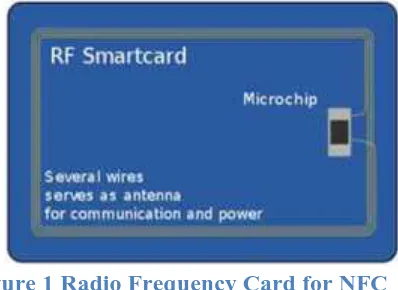
Under the chip a micro-chip with several wires are surrounded which serves as antenna for communication & power. As shown in the below figure.
The chip is used for the wireless communications i.e. NFC (Near Filed Communication). The microchip and the chip fabrication is done as the 25um gold or aluminum wire is
bounded to the pad on the chip using ultrasonic or thermo compression bonding.
And then after some more components are added to the card after the fabrication of chip that are touch screen, micro-controller, RAM, ROM & EEPROM (Electric Erasable Programmable ROM).
Touch Screen is used to select and lock the card and the micro controller is used to control the input and output singles and RAM is used for the processing and ROM is used to store the operating system and EEPROM is used to store the several different cards. And the connections are given to the card before the mounting the card and then after it is
fully mounted and ready for the use.
EEPROM memory (128-512 bytes) & memory control logic, more sophisticated application demand ROM, EEPROM, RAM and a micro-controller that really leads to the term “SMART”.
ROM contains the Operating System of the smart card. It is largely concerned with the management of data file but it may optionally involve additional features such as cryptographic algorithms.
The Mask ROM contains the OS of the chip and is made as part of the chip fabrication process. This memory is read only and can’t be changed once the chip is made.
EEPROM memory is the non-volatile storage area of the chip that allows data to be written and read under program control. This data is preserved even after the power to the chip is switched off. By writing data into the EEPROM we can give each chip a unique identity. The smart card chip from most semiconductor manufacturers have the facility to make parts of the EEPROM memory write once only. This is sometimes called as OTP (One Time Programmable).
The Random Access Memory (RAM) forms the memory working space to be used by the process while executing program either in ROM or EEPROM. The memory is volatile and all the data will be lost when the power to the chip is removed.
The serial I/O port should be considered just another peripheral to the process which may be read and written under software control.
Figure 1 Radio Frequency Card for NFC
After fabrication and mounting the components the code is written and injected to the ROM and while writing the code we should consider some of the things that are.
Character Transmission. Answer Forest (ATR).
Protocol Type Selection (PTS).
Figure 2 Chip Fabrication Process How Data is Read & Written to Smart Card: -1. Starting the reader is connected to the system.
Figure 3 Credit and Debit Card Reader
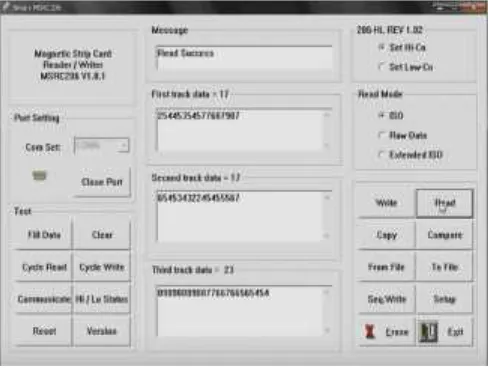
Figure 4 Interface to display data.
4. As you can see there are different options to read, write & copy the data not only this but we can also perform many other functions.
5. When the read option is selected the yellow light start blink so by that we can say that the read is set to perform read operation.
Figure 5 swiping the card through reader
7. After the data display then select the copy option by that the data will be copied.
8. Then after click on the write option and before that paste the data which you have copied. 9. And now by using the NFC reader write the data to the card.
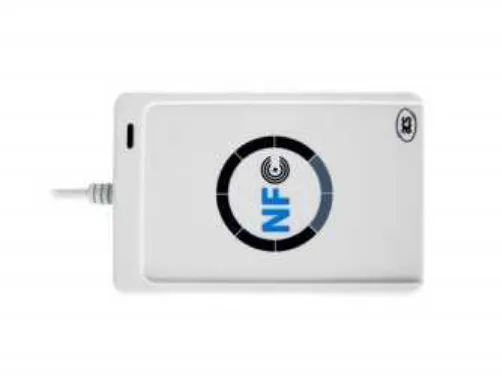
Figure 6 Reader used to read and write IB Cards
Security Measures
1. There are number of stages described by the role of an entity in the card life cycle. One of the key principles to be achieved is security segregation such that no one can break the security controls.
2. The asymmetric situation is a relative new concept first proposed by Diffie & Hellman in 1976 and represent the case where the 2 keys are different and where it is not particular feasible to derive one key from a knowledge of the other.
3. Key 1 public for a particular entity. This means that anyone could produce a cipher using key 1 but only the owner of key 2 would be able to recover the original plain text. It should also be noted that the entity that creates the cipher using key 1 is equally incapable of reversing the process.
4. There are number of security mechanisms that can be used in Smart Card application but a particular interest are those mechanisms that relate to data integrity and authentication. 5. The Cryptographic Check Value (CVV) and Digital Signature (DS) are the most widely
used mechanisms. Sometimes the term signature is applied to both mechanisms.
Cryptography and Key Management
1. This algorithm has been developed over the year, in practice only 2 are in common use for financial applications. The DES (Data Encryption Standard) algorithm was proposed in 1977 and the RSA (Rivets, Shamir & Adelman) in year of 1978. [11] 2. This algorithm represent 2 different classes of operation, DES is a symmetric while
RSA is asymmetric algorithm.
Cryptographic Check Value
(CVV):-1. The check value is generated by using the DES algorithm in cipher block chain mode. Then often used MAC (Message Authentication Code) was originally defined by the ANSI X9.9 standard and subsequently adopted as the ISO 8730 standard for financial messages.
2. [13] The primary purpose of the CVV is to provide a data integrity function that ensure that the message has not been manipulated in any way i.e. modification, addition and deletion of data.
Digital
Signature:-The availability of the public key cryptography algorithm has led to the adoption of the range of digital signature mechanisms. The signature not only produces the properties of the data integrity and source authentication but also effectively meet the requirement for non-repudiation. A digital signature may be generated by means of the RSA algorithm.
Signature Generation: - [14]
S = M Power d mod N (Equivalent to the decipherment operation). Signature
checking:-M = S Power e mod N (Equivalent to the encipherment operation). Where M = Message Block.
S = Signature.
e = Public Key (of sender). d = Secret Key (of sender). N = Modules.
Figure 7 Final Card (IB Card) Applications of Smart
card:-Now at day the era of the smart card has been increased a lot and the use age of the smart card facility is growing rapidly day by day and there is N-Number of applications of the smart card.
Smart cards are used in many current and real world systems and are proposed for many future applications. In fact the capability and numbers of cards growing rapidly in just about all area of use. Some of the most notable applications include.
few well know European applications: Visa cash and Mondex in the UK, Geldkart in Germany, Minipay in Italy, And Monco in France and PayPal in India.
2. Mobile Phones: - The GSM Standard, Followed by UMTS, introduced the concept of SIM (Subscriber Identity Module) and USIM, respectively which represent portable devices for user identifications. ASIM/USIM card maintains user identifications information and cryptographic keys used to authenticate the subscriber and to encrypt digital voice transmissions. Consequently a smart card is plugged into different cell phone presenting the carrier always with the same specific identity. SIM/USIM functional requirement perfectly match to corresponding functionalities offered by smart cards, there for smart card implementation (with a plastic support of small dimensions) has been a natural choice.
3. Health Cards: - The smart card using for the health card has been started from the long back since from the 1990’s to till now the smart cards are serving in the health sector. And there are many organizations based on these sectors.
4. E-Government: - In this domain smart card are mainly used as an identification tool and to store personal information. Among several applications we can cite: electronic IDS, national service cards, health cards, social security cards, voting cards, digital signature cards etc.
5. Identification: - A quickly growing application is in digital identification cards. In this application the cards used for authentication of identity. The most common example is in conjunction with a PKI (Public key infrastructure). The smart card will store an encrypted digital certificate issued from the PKI along with any other relevant or needed information about the card holder. Example includes the U.S. Department of Defense (DOD) common access card (CA) and the use of various smart cards by many governments.
6. Transport.
7. Physical Access Control. 8. IT access control.
9. Satellite TV. [2]
Figure 8 Smart Card Application by sector.
Other safety measures by Smart Card: - There are 3 measures by which the user can have safety that are.
2. Remote Wipe System: - And after the alert message arrives there is no need to worry the user can erase the information which is present on the Smart Card by remote wipe system. By this the user as a privilege to specify the time in order to unavailable of the information and then after the resynchronization process will be done to add the cards to smart card.
3. Mobile App: - This mobile app is used only to get the alert message and the transaction done messages and more over the remote wipe system and proximately alert system code are written in the mobile app code any synchronizes to the smart card.
Or else the code is directly written into the smart card code and stores in the ROM and synchronizes with the phone app.
Like this several safety measures are going to be provide to user in order to do his payment safe and secure not only that but also to act in a smart way and make use of the technology.
References:-Smart Cards: The development tool kit, By Timothy M.Jurgense, Scott B.Guthery, Prentice Hall Professional, 2002, No:- 6.
Smart Card Glossary, By US Government NIST website on security term and CardLogix Corporation, 2009, No: -4.
Composite Product evaluation for smart card & similar device by NLNCSA Version 1.2, April 2012, No: - 5.
Tutorial–Introduction to Smart Card, By David B Everett, September 1992, No: -1.
Smart Card project guide, By Australian government department of finance & deregulation (Finance), 2008, No:-7.
RFID Handbook (Fundamentals and application in contactless smart card), by Klaus Finkenzeller, Wiley, 2003, No:-8.
Smart Handbook, by Wolfgang Effing, 4th Edition, Wiley, 1997, No:-18.
Smart card security and applications, by Mike Hendry, Artech House, 1997, No:-9.
RF id and Contactless smart card application, by Dominique Paret, Wiley, 2005, No:-13.
Smart card Research & Advanced Applications, by Giles Grimaud & Francois-Xavier, Springer, 2008, No:-2.
Smart Card Programming, by Ugo Chirico, 2ndEdition, Abe Books, No:- 14.
Smart Card marketing system dynamic and strategic swot analysis, Retrieved from Swotanalysis24.com, No: - 3.
Smart Card, September 7, 2016, retrievewww.basicofy.com/smartcard/, No:-10.
Mike Newman, The race for the all-in-one card, retrieved from www.coolmaterial.com/tech/the-race-for-the-all-in-one-cerdit-cardNo: - 16.
Kevin cash, Nov 20, 2015, Stratos, coin, plastc, swyp: sizing up multi cards card, retrieved from www.nerdwallet.com/blog/credit-card/stratos-coib-plastc-swyp-multiaccount-cards, No: - 17.
Nathan Seidle, Aug 3, 2010, Magnetic Card Reader, retrieved from
www.youtube.com/watch?v=zurkcpkeos. No: - 11.
Binary company, Feb 15, 2011, MSRC2006, Magnetic stripe Card reader/writer, retrieved from
![Figure 3 Credit and Debit Card Reader2. [6] the above shown reader is used read the cards data that which we are using presently.](https://thumb-us.123doks.com/thumbv2/123dok_us/8395802.1684390/8.612.108.340.75.398/figure-credit-debit-card-reader-shown-reader-presently.webp)