2018
volume 35
Review Board 2018 Amanda Alexander University of Texas, Arlington Dan Barney
Brigham Young University Terry Barrett
University of North Texas Juan Carlos Castro Concordia University Cala Coats
Arizona State University Tyler Denmead
University of Illinois, Urbana-Champaign Michelle Bae Dimitriadis
Buffalo State College Elizabeth Garber University of Arizona Laura Hetrick
University of Illinois, Urbana-Champaign Lisa Hochtritt
Chicago Art Institute Ami Kantawala
Teachers College, Columbia University J. Celeste Kee
Boston University Dana Kletchka The Ohio State University
Maria Lim
University of North Carolina, Greensboro Jorge Lucero
University of Ilinois, Urbana-Champaign Natasha S Reid
University of Arizona Mindi Rhoades The Ohio State University James Sanders III The Ohio State University Stacey Salazar
Maryland Institute College of Art Shari Savage
The Ohio State University Manisha Sharma University of Arizona Kryssi Staikidis Northern Illinois University Laura Trafí-Prats
University of Wisconsin, Milwaukee Sarah Travis
University of Illinois, Urbana-Champaign Jason Wallin
University of Alberta Courtnie Wolfgang
Virginia Commonwealth University Senior co-Editors
Karen Hutzel, The Ohio State University Ryan Shin, University of Arizona Associate Editor
Joni Acuff
The Ohio State University Managing Editor Elle Pierman The Ohio State University
USSEA President Fatih Benzer
Missouri State University Past Editor
Elizabeth Garber University of Arizona
Publication:
Once a year by the United States Society for Education through Art (USSEA). Subscriptions:
jCRAE is an open-source online publication of USSEA. While access is free, readers and people interested in supporting the mission and activities of the journal and of USSEA are encouraged to join USSEA (for more information about the organization, please visit www.ussea.netU). Annual membership dues are $25 and include issues of the Newsletter. Check or money orders should be made payable to USSEA and sent to:
Nanyoung Kim Jenkins Fine Art Center East Carolina University Greenville, NC 27858 [email protected] Editorial Office:
Karen Hutzel, Senior co-Editor
Associate Professor and Department Chair, Department of Arts Administration, Education and Policy
1813 N High St, 2nd floor Columbus, OH 43210 [email protected]
Ryan Shin, Senior co-Editor Associate Professor School of Art University of Arizona Art, PO 210002 Tucson, AZ 85721-0002 [email protected] Copyright:
United States Society for Education through Art, 2011-2014. All rights reserved.
Permission:
Individual must request permission from the editor to reproduce more than 500 words of journal material.
Cover:
Arianna Garcia-Fialdini, Ayotzinapa, Corazon y Memoria, Atoyzinapa, Heart and Mind. For more information, please refer to the article by Arianna Garcia-Fialdini in this issue.
Layout:
Elle Pierman, The Ohio State University
jCRAE
2018 Volume 35Journal of Cultural Research
in Art Education
The Journal of Cultural Research in Art Education is published through generous support from United States Society for Education through Art
(USSEA), The Ohio State Univerisy, and The University of Arizona.
USSEA was founded in 1977 to promote multicultural and cross-cultural
research in art education. It is an independent organization affiliated
with the International Society for Education through Art (InSEA) and the
National Art Education Association (NAEA).
The editors of the Journal of Cultural Research in Art Education are indebted to Elle Pierman, PhD Student, Department of Arts Administration,
Education, and Policy, The Ohio State University, for integral editorial and
Past Editors
jCRAE
Volumes 1-4Volumes 5-8
Volumes 9-12
Volume 13
Volumes 14-18
Volumes 19-22
Volumes 23-25
Volumes 26, 27
Volumes 28, 29
Volumes 30-32
Larry Kantner 1982-1986
University of Missouri
Rogena Degge 1986-1990
University of Oregon
Volume 6 Guest Editors: Paul Bolin, Doug Blandy, & Kristin Congdon
Ronald W. Neperud 1990-1994
Douglas Marschalek
University of Wisconsin-Madison
Ronald W. Neperud 1994-1995
Don H. Krug
University of Wisconsin-Madison
Don H. Krug 1995-1999
The Ohio State University Volume 18 Guest Editor: Patricia L. Stuhr
Tom Anderson 2000-2004
Florida State University
Enid Zimmerman 2004-2007
Indiana University
Kristin G. Congdon 2008-2009
University of Central Florida
Dipti Desai 2010-2012
New York University
Elizabeth Garber 2012-2015
8
13
26
44
55
75
93
113
132
jCRAE
2018 Volume 35Contents
Editorial - Borderless: Global Narratives in Art Education Karen Hutzel and Ryan Shin
Global Consciousness in Art Education: Utility and Problematics of Curriculum Development within a Critical Postmodern Relational Praxis
Gloria J. Wilson
An Indigenous Reframing of Art Education Historical Research: Acknowledging Native American Spiritual Values
Laurie Eldridge
K-Pop and Critical Multicultural Art Education Hannah Kim Sions
Dis/locating Comfort Women Statues: Reflections on Colonialism and Implications for Global Art Education
Hyunji Kwon
Down the Rabbit Hole: Girlhood, #metoo, and the Culture of Blame Shari Savage
From Cultural Tolerance to Mutual Cultural Respect: An Asian Artist’s Perspective on Virtual World Cultural Appropriation Sandrine Han
Educating Diversely: The Artist Talk Platform Arianna Garcia-Fialdini
Teach Me Your Arctic: Place-Based Intercultural Approaches in Art Education
Elina Härkönen
Enabling the ‘Other Community’ through Creative Pedagogies for Urban Renewal: Exploring the Affiliation between Contemporary Art Practices and Democratic Values
Esther Sayers
Art Practice as Research: A Global Perspective Judith Briggs and Nicole DeLosa
To Know or to Understand One Another: Developing New Identities through International Teaching
Amanda E. Barbee
Art as a Global Necessity: MoMA’s International Children’s Art Carnival as a Catalyst for Globalization
Sara Torres Vega
Disrupting the Colonial Globe and Engaging in Border Thinking: An Art Educator’s Critical Analysis and Reflection on (de)Colonial Discourses in Global Art Narratives
Injeong Yoon
Global Narratives of Refugee Youth: Examining the Interwoven Strands of an Interdisciplinary Arts Process
Kate Collins
Facilitating Productive Encounters with Difference: A Visual Essay Becky Shipe
151
175
212
226
249
267
| 8 | Journal of Cultural Research in Art Education Vol. 35 2018 | 9 |
Editorial – Borderless: Global Narratives in Art
Education
Ryan Shin
University of Arizona Karen Hutzel
The Ohio State University
Who are we in relationship to other cultures and countries? What issues in art education are potent across the world? How can art educators address issues and teach with a narrative of “being global?” This issue’s theme, Borderless: Global Narratives in Art Education, challenges us to look outward as we reflect inward. When facing global issues and divisions on top of contestation about worldviews and ontological discourses, we are challenged to reflect on our established views about and beyond local or regional history and knowledge. Therefore, seeking new and open-ended approaches to globalization, art educators share their critical and theoretical explorations and responses as global educators. They offer critical reflections on art education approaches to globalization and reiterate the transforming and/or communicative opportunities of art and visual culture education (Delacruz, 2009; Meskimmon, 2010). Art educators as curriculum designers create cultural narratives. We tell stories. A narrative is the creation or interpretation of views, stories, or ideologies by a person, groups of people, or popular culture and media. Said’s (1978) criticism from decades ago, for example, on the development of Western historical, political, and cultural views on the East informs that Orientalism as a narrative serves and justifies the West’s dominance. Curriculum as a narrative might also reflect the idea and viewpoint of selected groups, views, and ideologies. Our narratives in art education have created important frameworks for the field, such as visual culture art education, arts-based research, and new materialism. As these narratives are continually rewritten, new frameworks have emerged that are flexible, challengeable, and often revised and rewritten. In this issue, the authors share critical narratives on the histories, emerging issues, and future visions for a globalized art education.
One of the most exciting aspects of working on this volume was that we collaborated with seven other art education journals around the world who are publishing issues under the same theme. The participating journals are:
1. Australian Art Education, Australia (https://www.arteducation. org.au/about-australian-art-education),
2. Revista Portuguesa de Educação Artística, Portugal (http://
recursosonline.org/rpea),
3. Synnyt/Origin, Finnish Studies in Art Education, Finland (https://wiki.aalto.fi/display/Synnyt/Home),
4. Tercio Creciente, Spain (http://www.terciocreciente.com), 5. Culture, Art and Education, Czech Republic (www.kuv.upol.
cz),
6. Art Education Review, Korea (http://www.saek.or.kr), 7. The International Journal of Arts Education (www.hyread.com.
tw), Taiwan.
We offer this international collaboration as a call to extend research in art education beyond national borders - to expand the dialogue and embrace non-traditional cultural frameworks and practices exposed in art education outside the U.S. Each journal will publish in its native language; however, readers can access English abstracts available on each journal’s web site. Our hope is for this collaborative publication project to facilitate an exchange of global research and scholarship by 1) providing a global sense of art education theories and practices beyond language, 2) challenging issues and problems that arise from global and regional politics, and 3) stimulating global readership of our journal.
| 10 | Journal of Cultural Research in Art Education Vol. 35 2018 | 11 | Art educators’ stories in this issue also attend to the voices of under-
and mis-represented groups in our society. Shari Savage’s narrative inquiry implores readers to pay attention to current socio-political issues such as the #metoo movement by critically examining the culture of contextualizing and sexualizing girlhood. Savage provides an in-depth analysis of Lewis Carroll’s rabbit-hole as a metaphor for sexualizing girlhood, which appeared in many blogs and website communities. She uses this metaphor to encourage art educators to challenge such cultural myths in which girls are blamed and sexualized in society, engaging students with empowering artworks and critiquing advertisements and popular culture. Based on her extensive research on Third Culture, Sandrine Han conducts a case study to expose cultural appropriation in virtual worlds, employing a semiotic approach for interpretation and understanding. Her findings focus on narratives of virtual world users that are open-minded and respectful of other cultural imagery when creating and borrowing objects in the virtual world. She suggests that art educators develop and teach visual literacy in virtual worlds in a critical manner. The power of narratives echoes in Arianna Garcia-Fialdini’s essay based upon her artist talk as an unusual pedagogical space and opportunity for immigrants, refugees, and other diverse audiences to share their voices and experiences. Noting her journey as an immigrant artist-teacher from Mexico, she describes the artist talk as not only a productive space for sharing artistic narratives, but also a socially engaged learning site for marginalized groups in society.
Narratives of art educators sharing their own art projects and education research in other countries offer us opportunities to gain a global understanding of art education. Using a place-based approach for cultural understanding and art practices, Elina Härkönen presents an arts-based action research study based upon an art course “Our Arctic,” in which both art and education students worked with local children to encourage them to express their understanding of the Arctic as a collective narrative. Reflecting on her research, she addresses the concern of place-based education when teachers as outsiders work with local children through narrative; in doing so, she advocates mutual respect and communication concerning local knowledge and interpretations through art. Esther Sayers’ narrative of ArtScapers participating in a North West Cambridge community describes how artists, researchers, parents, and primary school children (ages 5-11) engaged with art in response to their community’s development. Sayers reports five core values of creative pedagogy that emerged from this nine-year community engagement project, which provides a useful guide for art educators who work in community spaces. Judith Briggs and Nicole DeLosa share a case study about tenth grade students in New South Wales who engaged in research as art practice, making metaphorical and symbolic connections through metacognitive language analysis.
Stories of art educators’ shifting practices in a globalized world are another significant theme of this issue. Amanda E. Barbee’s article provides a unique contribution to this mini-theme as she shares the experiences of a U. S. art teacher relocating to a non-profit international school in China. She shares her shifting personal and professional identities as an autoethnographic exploration by describing cultural challenges and critical self-reflections, including expectations of teaching overseas as a foreign art educator. Sara Torres provides an analysis of the role of the Children’s Art Carnival at the Museum of Modern Art in 1937 in broadening local and regional art practices globally, as the Carnival then took place in Milan, Barcelona, and Brussels. Injeong Yoon shares a personal narrative as an “in-betweener” between traditional cultures, arguing for the complication of fixed notions of culture toward a more fluid lens of border thinking. She offers an example through the work of Lee Bul as a connection to decolonial “aestheSis” and decoloniality as a subaltern perspective. Kate Collins’ article provides a context for engaging undergraduates in developing understandings about refugee youth through community-engaged interdisciplinary arts pedagogy. Art and narrative underscored the process for developing collaborative arts practices. As an alternative submission, Becky Shipe visualizes how teachers can facilitate productive encounters with difference through art, transforming such encounters into opportunities for growth and counter-learning against stereotypes and misconceptions. She also encourages art teachers to expose their students to various global narratives for empathetic and self-reflective thinking.
This issue presents just a snapshot of the potential for narrative research to expand scholarship and increase understandings globally. The narratives shared here also raise new questions for consideration, such as: How can art educators incorporate global narratives in our teaching and research? How can we teach with, about, and for emerging global narratives? Can narratives about teaching and learning compete and conflict with each other globally? Which narratives demand global focus and attention? In what ways do dominant narratives continue to contribute to damaging single stories? What is the role of art educators in the age of globalizing conflicts based on differing social, political, cultural, and religious ideologies and practices? And how can we address or create equitable global narratives toward global inclusion, diversity, and justice? We encourage forward-looking collaborative research with these questions.
| 12 | Journal of Cultural Research in Art Education Vol. 35 2018
captivating themes during the NAEA convention journal board meetings; the three themes have been: Media in a Post-Racial Society (2016), New Culture Wars (2017), and Borderless: Global Narratives in Art Education (2018). It has been wonderful to work with current and past reviewers who offered critical and constructive comments and suggestions and also the authors who made a significant impact on our field through their scholarship. Lastly, we thank our editorial assistant Elle Pierman who provided amazing organizational and management skills that helped put together each volume with unparalleled caliber.
References
Delacruz, E. M. (2009). Mapping the terrain: Globalization, art, and education. In E. M. Delacruz, A. Arnold, M. Parsons, & A. Kuo (Eds.), Globalization, art, and education (pp.
x-xviii). Reston, VA: National Art Education Association.
Meskimmon, M. (2010). Contemporary art and the cosmopolitan imagination. New York, NY: Routledge.
Global Consciousness in Art Education | 13 | Global Consciousness in Art Education: Utility and
Problematics of Curriculum Development within a Critical Postmodern Relational Praxis
Gloria J. Wilson, Ph.D.
Virginia Commonwealth University ABSTRACT
When we, as practitioners of art education, challenge ourselves to reflect on established views about and beyond local, regional, and national history and knowledge and how these views have necessarily created boundaries, we might think of the utility and limitations of a critical postmodern relational framework. This type of framework allows for the possibilities of thinking through critical and postmodern theories as a starting point for examining and understanding cultures affected by colonial structures, which has resulted in the denial of agency and a flattening of narratives. Often, these “bedrock” views, in their simplistic, one-dimensional, and reductive nature, cast an “othering” on cultures lesser-known in contemporary art education. Additionally, this framework exposes the limitation of Western critical thought in attempting to understand and center the aesthetic practices of non-Western societies. To consider how we might address these views within our teaching, research, and art-making is no small task. In this paper, I present a look at how an attempt at designing a curriculum and art education project for a Secondary Methods art education course offered the potential to critically reflect on the challenges of how Western patterns of thought and practice re-inscribe a colonialist mindset and privilege.
KEYWORDS: art education, curriculum, global consciousness, multicultural, pre-service, postmodern principles, teaching and learning, transcultural
Aesthetics is of necessity concerned with differences in the ways of sensing and seeing that distinguish artists, tastes, and sensibilities.
Gaining mastery of the whole of “global aesthetics” may be an unachievable goal—but learning more is not so difficult. (Higgins,
2017, p. 342)
| 14 | Journal of Cultural Research in Art Education Vol. 35 2018 Global Consciousness in Art Education | 15 | understanding postmodern art education principles. Consequently, I acknowledge that these “new found principles” are in fact not “new,”
which highlights a gap in our field that requires discussion beyond the scope of this paper. On a positive note, I found this offering to be most accessible for my population of first-generation college students.
Without establishing the foundation that Gude’s (2004) framework provided, my students may have been less inclined to fully engage, which may lead to a stagnation in the learning process (Dewey, 1938).
Contemplations of the Pre-service Art Teacher
It is important to briefly note that art education students exist at
a unique crossroads. They are, at once, students of visual art who
are also early practitioners within the field of education. Uniquely
situated at this intersection, they are provoked to consider processes of art-making alongside theories of learning and instruction. In my class,
students began by discussing and reflecting on who they are as artists in relation to what they know about non-Western aesthetics,1 along
with how they might avoid reductionist pedagogical and art-making
practices.
Like Anderson (2004), McLean (2014), and Higgins (2017), my students agreed that the Western world does not have a monopoly on wisdom and insight regarding the fundamental nature and value of art. To this end, they began by critically asking: What motivations prompt works of art in human cultures? (see Anderson, 2004) and What might we learn about the visual practices (symbol systems) of cultures of other nations? While aiming to keep the integrity of
non-Western traditions, students placed varied global narratives/stories at the center of their investigation and curricular planning while carefully aiming to avoid a singular and often marginalized re/ presentation of three cultures examined in Anderson’s (2004) text, Calliope’s Sisters: aesthetics of Early India, the San of Africa, and the Aborigines. To examine each of these cultures is beyond the scope
of this paper. As such, I highlight an example of a student-planned/
led lesson of Aboriginal aesthetics and practice (see chapter three
in Anderson), which ultimately led to critical self-reflection of the
practices of Western appropriation of creative expression often critiqued
in critical scholarship (Greene, 2008). I offer recommendations for
the possibilities and value of considering a “hybrid space of critical postmodern theory” in art education (Stinson & Bullock, 2012, p. 52).
1 The author acknowledges the problematics of using a singular term (aesthetics) to define the whole of all symbol systems of meaning-making across cultures. The author’s use of the term aesthetics, when referring to non-Western cultures, is a direct reference to Anderson’s (2004) use of the term in his text Cal-liope’s Sisters. The author also acknowledges that further development in terms of what constitutes “Western” and what comes to be qualified as “non-Western” aesthetics is sorely needed in K-16 education, yet beyond the scope of this paper.
in 2014, when I became an educator of pre-service teachers and was
tasked with teaching a Secondary Methods course, I aimed to make
connections to my prior experiences in 6-12 visual arts teaching. Since
leaving the secondary classroom environment in 2008, educational interest has progressed toward issues of global context and relational mobilities (Alice, 2012; Hague, 2014).
To these ends, every Fall semester from 2014-2017, I designed
and taught a Secondary Methods in Art Education course for a
university located in the Southeastern United States. Pre-service students in this course were tasked with developing a three-week
lesson for a secondary classroom environment. I designed this course to explicitly combine three distinct approaches with aims for contemporary curriculum design and teaching and learning within and for a contemporary global art education. It was my hope that these approaches, like the legs of a stool, when combined, provided a
framework which I believe allows pre-service art teachers an opening
to critically address the utility of a relational scope in transforming intercultural/multicultural global narratives (Dervin, 2015) into a transcultural approach (McLean, 2015). In other words, my aim is to present to students ways in which we might reach a deeper understanding of other human cultures as a means to awaken a global conscience. Through the process of curriculum design, pedagogical
practice, and art-making, my students discovered new spaces to resist
a limited trajectory of a Western narrative of dominance.
This paper addresses how I (and subsequently, my students) designed curricula inspired by Anderson’s (2004) comparative philosophies of art, a theory of Art for Life (Milbrandt & Anderson, 2004), and postmodern principles of design (Gude, 2004) to: 1) advance teaching
and learning about non-Western systems of meaning-making; 2)
design curriculum, placing the practices of these cultures at the
center; and 3) complicate and inform PreK-16 studio practice so as
not to advance and reproduce simplistic/reductive narratives of these cultures.
My specific use of the aforementioned texts/scholarship (Anderson,
2004; Gude, 2004; Milbrandt & Anderson, 2004), allowed my students an introduction into concepts and theories through use of accessible language for deeper understanding. Informed by my prior attempts at designing curriculum for this course, I understood that I needed to contextualize the course material based on students’ prior knowledge. Many of them had been taught the elements and principles of design
during their compulsory K-12 education (Alexander, Day & Getty
Center for Education in the Arts, 1991).
| 16 | Journal of Cultural Research in Art Education Vol. 35 2018 Global Consciousness in Art Education | 17 | theory and approach (Anderson & Milbrandt, 2004) as critical praxis. This approach, paired with examination of non-Western aesthetics (as in Anderson, 2004) and inspired by contemporary approaches to critical multicultural art education curricula (Acuff, 2012; Jay, 2003), challenged students to find utility in critical engagement with postmodern principles of art (Gude, 2004) alongside contemporary non-Western aesthetics in order to offer a nuanced commentary of the lived human experience through art. Though not “new” to the artworld in general, Gude’s (2004) postmodern principles of art (appropriation, hybridity, layering, reconceptualization, juxtaposition, gazing, interaction of text and image, and representin’), are presented to the field of art education as a fresh way to engage with 21st century art curricula. To these ends, these concepts push beyond standardization and the use of traditional elements/principles of art and disrupt the essentialist system of logic of designing curricula, which fails to de-center the strict use of traditional elements and principles of art.
For my own pedagogical practice, these principles became provocations for challenging reductionist intercultural views, ideologies, and narratives (Dervin, 2015). Additionally, I wanted my pre-service students to expand a myopic view of aesthetics and make a priority to pursue global narratives using a critical theoretical art education lens (Acuff, 2012). Understanding how systems of power have worked to maintain reductionist perspectives allows a supporting lens through which to view, challenge, and de-center systems of domination in various forms (McLaren, 2015). To some, this might seem counterintuitive to a postmodern view with aims to reject a fixed truth - that multiple forms of truth are made/remade with/in socio-cultural, -historical, and -political discourses (Foucault & Gordon, 1980; Stinson & Bullock, 2012). The addition of a critical lens allows not only a space for acknowledgement of a history and legacy of colonization and its impact on non-Western and Western culture, but also the tools to intervene with this awareness (McLean, 2014).
I first came to embrace a critical postmodern lens in previous arts-based intra-racial research (Wilson, Shields, Guyotte, & Hofsess, 2016); as a person of color, I saw the utility and necessity of critiquing systems of power while being provided tools for empowerment (Wilson et al., 2016). As I see it, in the specific case of my Secondary Methods course, the utility and strength of a hybrid critical
postmodern lens is that it offers: 1) the space for my pedagogical practice to illuminate, critique, and de-center the static discourse of traditional elements and principles of design; 2) my students’ entree to accessible “postmodern language” articulated by an art educator; and 3) a lens through which my students could view and understand non-Western aesthetics.
The Danger of a Single Story
In 2009, the Nigerian writer Chimamanda Ngozi Adichie gave a wonderful TED talk called “The Danger of a Single Story” (Adichie, 2009). It was about what happens when complex human beings and situations are reduced to single narratives. Whether created by a person, group of people, or popular media, these narratives have the potential to reflect flattened views and ideologies (Pauly, 2016). Ngozi’s point was that if we are not attuned to the multi-dimensional nature of humans and cultures, this reduction proves to provide a less-than-holistic narrative of distant cultures, whether intentional or unintentional. Further, these limited narratives contribute to cultural apartheid between indigenous and Western ways of being and knowing, and in the case of the project outlined in this paper, an “aesthetic apartheid” (McLean, 2014).
The process of education, in both formal and informal environments, has been critiqued by scholars (Furnham, 2015; Giroux, 1981, 1995, 2015; Robinson, 2015) who argue that reductive knowledge about other cultures is transmitted both through sanctioned and “hidden” curricula. Literature offers varied definitions for a hidden curriculum, including the significance of how the visual plays a role in
determining what becomes understood as a “norm” (Baker, Ng-He, & Lopez-Bosch, 2008). For instance, Pauly (2016) offers a nuanced look at the ways in which Native American culture has been appropriated and represented, reinforcing singular and storied stereotyped caricatures. These harmful stereotypes, whether consciously or unconsciously shared, reinforce “asymmetrical systems of power and privilege” (p. 71) and have also been applied to peoples of other historically colonized nations (Harris, 2003).
Drawing from Skelton’s (1997) view of the potential influences of a hidden curriculum, critical perspective identifies the hidden curriculum with its function to reproduce inequitable perspectives. Its cycle of reinforcement has been explored by a range of educational scholars (Gatto, 2009; Giroux 1981, 1995, 2015; Phillips, 2009;
Robinson, 2015;) who contend that significant changes are required in the way we educate young people. The hidden curriculum both reflects and perpetuates beliefs according to ideologies of prevailing political power, often based on an erroneous or skewed understanding of historic and anthropological developments. Herein lies the value of making connections between critical and postmodern theories.
Toward Building Relational Aesthetic Narratives through Postmodern Principles of Art
| 18 | Journal of Cultural Research in Art Education Vol. 35 2018 Global Consciousness in Art Education | 19 | the possibilities of what these principles could become and how they might use them in their planning and art-making. Students began by using their own words to define the concepts (see Figure 1). By doing an internet search, they included examples of what this might look like.
Figure 1. Postmodern Principles Posters (Brigette Adkins, 2016) Once students were able to define and visualize the possibilities of these principles, their next task was to use these concepts as a provocation for creating a three-week lesson plan. These provocations also served as a means to investigate, complicate, and represent the duality of artist/educator of the pre-service student. Students understood that they could imagine using these principles in any aspect of their planning. Their three-week lessons would become the teaching framework for in-class group instruction.
Divided into groups of three, each group selected a non-Western culture to study, located within the Calliope’s Sisters text (Anderson, 2004). In order to complicate a global-relational (Hague, 2014) framework, pre-service students needed to address the following in their curriculum: the history of the visual practices of the culture studied, exemplars of contemporary visual art by these indigenous cultures, and reconceptualized meaning-making approaches inspired by traditional and contemporary indigenous visual practices and Western aesthetics.
Pre-service students placed Aboriginal culture at the center of their curricular-planning efforts and aimed to expand on visual practices in Anderson’s (2004) text. They encouraged their peers to explore combining dot-painting techniques along with the shared/relational practice of storytelling in Western and non-Western traditions. In observing their teaching/art-making, I noted that by utilizing In what follows, I detail the ways in which a curricular project with
aims for nuanced analysis and application of the hybridization of Western and non-Western aesthetics reinforced an imposition of Western appropriation of non-Western expression. Pre-service students were challenged to displace metaphors of primitivism in order to bring attention to how dominant ideologies are shaped by a periphery—by means of appropriation—which has been given less credit (McLean, 2014). Students looked to complicate an examination of these intersections and depart from an ethnocentric gaze/stance in hopes of critical and re-formed understandings that might arise from their investigations of asymmetrical systems of power.
Through close and careful study of non-Western aesthetics, pre-service students in my course were challenged to pull back the curtain to reveal complex narratives of peoples whose cultures have been reduced, marginalized, and submerged. By using Gude’s (2004) postmodern principles as a tool for offering a complex view of these cultures, students then designed curriculum for teaching this content within a secondary art classroom. Gude describes these principles as “a fusion of a visual form and a conceptual art making strategy…. [the] hybridization itself is a hallmark of many postmodern cultural productions, eschewing the boundaries imposed by outmoded discipline-based structures” (p. 8). I found utility in these principles for creating a space for students to find the relational aspects of imagined borders between Western and non-Western aesthetic practices. This was my attempt to de-center an othering of the non-Western practice.
Pre-service students also found utility in how these principles would resonate meaningfully with the lives of pre-adolescent and adolescent students (grades 6-12), realizing the necessity to engage youth in this age group beyond the traditional elements and principles of design (Gude, 2004). Inspired by these “post” principles, my students were then tasked with modeling instruction through in-class group-teaching, which resulted in completed studio projects, a naive attempt at offering more nuanced global/cultural narrative.
Critical Praxis: Curriculum Development as Relational Globalizing Narrative
| 20 | Journal of Cultural Research in Art Education Vol. 35 2018 Global Consciousness in Art Education | 21 | beyond imitation.
Figure 3. Student example of a storied triptych, 2017
The broader hope of the original curricular strategy was to engage students in critically thinking about the ways in which cultural practices can be acknowledged, preserved, and given prominence in Western thought—a possibility of disrupting aesthetic apartheid without submerging the narratives of “the othered.” My pre-service students were inspired by their new learnings about Aboriginal dot paintings to create symbolic gestural work. Drawing from the postmodern principles of design, they were provoked to complicate their understanding of Aboriginal aesthetics and of human
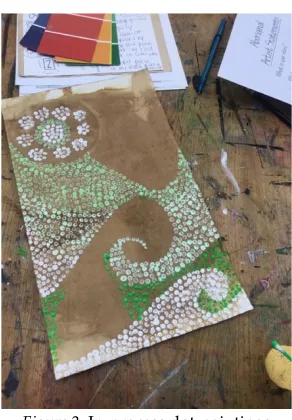
relationality. Using the postmodern principle of hybridity (Gude, 2004), for instance, we discussed how representing the complexity of visual practice brings to mind how cultures are inextricably mixed— relational. By first creating postmodern visual resources (see Figure 1), students could think beyond the “technical” aspects of visual practice and embrace the relational aspects of aesthetics across cultures. Still, though, their earnest aims at creating a three-week curriculum failed to push beyond a flattened handling of the art-making that would follow (see Fgure 2). On a hopeful note, after engaging in post-project discussion, I do believe my students will continue to push the boundaries of what is possible in the realm of a global sensibility in their art-making/teaching practice.
Cautionary Tales: Limitations and Implications for Art Education
In writing about this curricular project, the existing tensions in my aims at disarticulating a colonialist imposition through Western (critical) thought were brought to my attention; not only do the examples of pre-service students’ curricular art-making tasks necessarily (yet, not consciously) re-inscribe an aesthetics of Western dominance, but also that there exist limitations of imposing a critical theoretical framework when considering non-Western ways of being/knowing. While my aims to suggest how a hybrid critical and postmodern theoretical framework (Stinson & Bullock, 2012) may work to help students examine, understand, and challenge systems of “Western aesthetic thought” alongside non-Western visual practices,
my students’ aims could be critiqued as an imposition of colonialist practice; what was not considered was an alternative way of
highlighting a relational aspect and effects of colonialism, which will be discussed in the conclusion.
The lesson designed by pre-service students focused on the
Aboriginal theme of storytelling/mapping; students were able to find personal resonance in the relational qualities of this theme, and used the aesthetic tradition of “story systems” (Milroy & Revell, 2013). Additionally, using a dot-painting technique, students were careful to acknowledge the relational aspects of this type of mark-making, which is significant to Aboriginal culture.
Figure 2. In-process dot-paintings
Contemporary Aboriginal artist, Sarrita King, was used as one exemplar and provided initial inspiration for dot-painting techniques (see Figure 2) that pre-service students explored to tell stories, further inspired by the postmodern principles (Gude, 2004). My students used dot-painting techniques to create storied triptychs (see Figure 3). The aim of the final triptych composition was an attempt to keep traditional Aboriginal visual practices intact while working toward a relational narrative. In other words, students wanted to acknowledge non-Western tradition and Western re-conceptualization through development of their own personal stories. The intent was not merely to appropriate the visual practice of another culture. Later, pre-service students were able to reflexively acknowledge the challenges associated with re-inscribing a Western dominance mindset,
| 22 | Journal of Cultural Research in Art Education Vol. 35 2018 Global Consciousness in Art Education | 23 |
project were to extend beyond my own critical multicultural pedagogical practice to awaken my students’ consciousness of the nuance of ways of being/knowing in human nature. What must also be considered are the limitations of Western theory when attempting a discussion about non-Western cultures and practices.
An Art for Life approach (Anderson & Milbrandt, 2004) to curriculum design offered my students a way to bring meaning and relevance of art to humanity by placing the “quest for
personal and social meaning” (p. ix) at the center. It allowed these students an opening for a deeper level of engagement by connecting them to the art-making of non-Western artist
exemplars such as Talia Smith, Tia Ranginui, and Te Iwihoko Te Rangihirawea whose lives and aesthetic practice speak directly to colonialism and its structures. Through contemporary practice, these artists challenge viewers to become conscious of social and political issues and systemic inequities affected by colonization. As art educators, it is our role to complicate these conversations, as we must do within our curriculum and the curricula our pre-service students advance, while also being reminded of the rigid structures within imposed limitations created by standardization and policy in K-12 environments (Hughes, 2004).
Finally, with aims to combine these curricular frameworks, the blind spots that are capable of guiding our decisions without our being aware of the consequences (Banaji & Greenwald, 2013) are revealed. A critical relational and pedagogical practice (Freire, 2000; McLaren & Kincheloe, 2007) and the possibilities of using postmodern concepts as a means of embracing a critical transcultural educational philosophy broaden a global circle of concern for art educators and students. These practices offer a way to begin a nuanced and complex conversation necessary to work within global narratives and a way to strengthen structural and cultural competencies toward disrupting dominant narratives.
References
Acuff, J. B. (2012). “How will you do this?” Infusing multiculturalism throughout
art teacher education programs. Journal of Cultural Research in Art Education, 30, 83-102.
Adichie, C. N. (2009). The danger of a single story [Video file]. Retrieved from
https://www.ted.com/talks/chimamanda_adichie_the_danger_of_a_ single_story.
Alexander, K. Day, M., & Getty Center for Education in the Arts (1991). Discipline-based art education: A Curriculum Sampler. Los Angeles, CA: Getty. Anderson, R. L. (2004). Calliope’s sisters: A comparative study of the philosophies of art
(2nd ed.). Upper Saddle River, NJ: Pearson Prentice Hall.
Anderson, T., & Milbrandt, M. (2004). Art for life. New York, NY: McGraw-Hill. Baker, M. H., Ng-He, C., & Lopez-Bosch, M. A. (2008). Reflection on the role of
artists: A case study on the hidden visual curriculum of the School of the power/dominance within Western culture(s), as a Western tradition/
institution, it necessarily falls short of fully supporting them in critical self-reflexivity against a non-Western backdrop.
To these ends, this emerging question: How might art education simul-taneously look outward and reflect inward? is salient. Since leaving the secondary classroom in 2008, much has changed in the whole of our world and within our own U. S. borders. Most ubiquitous are the technological advancements (social media, for instance) which have allowed us to be “connected” globally; this speaks to the need for art educators in the West to be equipped to examine biases and blind spots (Banaji & Greenwald, 2013) when aiming to address curricular design for transcultural (McLean, 2015) approaches toward teaching and learning. Soberingly, I am also reminded of the many in-service and pre-service teachers who have questions and anxieties about bi-ases and blind spots as they relate to cultural, social, and educational inequities within our own nation. As I mentioned earlier, this work requires accepting that this is no small task, and as Higgins (2017) writes, “Because we know our own culture better than those that are more distant we might conclude that, however positive our attitude toward non-Western aesthetics, it is not our business to discuss it” (p. 342). I would add that perhaps, as educators, it is our business to responsibly pursue a deeper awareness and understanding of diverse creative acts beyond our Western borders so as to disrupt a myopic vision of what has historically been deemed “art” (Higgins, 2017). As a starting point of self-reflexivity, we should ask: Who are we in relation to other cultures and nations? Why is this important to know/ understand? To visit these questions is a start toward understanding the relational nature of human existence; we are not divorced from one another, whether global or local. We are connected relationally, through educational, social, and political systems.
Art educators are called to serve these relationships through complex intersections of teaching and learning, sometimes as practitioners and facilitators of research and theory, while other times practitioners and facilitators of art-making. In these times of multicultural and transcultural concern (Acuff, 2012; Dervin, 2015), our role challenges us to provide openings for critical global conversation (Delacruz, 2009). We should be awakened to the role our curriculum plays in this quest. As a discipline, art education must also ask itself: What are our aims for the study of other cultures? Surely, it must be beyond an ethno-tourist approach.
| 24 | Journal of Cultural Research in Art Education Vol. 35 2018 Global Consciousness in Art Education | 25 | light of postmodern insights. Curriculum Studies, 5(2), 177-193.
Stinson, D. W., & Bullock, E. C. (2012). Critical postmodern theory in mathematics education research: A praxis of uncertainty. Educational Studies in Mathematics, 80(1/2), 41-55.
Art Institute of Chicago. Teaching Artist Journal, 6(4), 290-297.
Banaji, M. R., & Greenwald, G. (2013). Blindspot: Hidden biases of good people [Kindle iPad version]. Retrieved from http://www.amazon.com/
Çobanoğlu, R., & Engin Demir, C. (2014). The visible side of the hidden curriculum in schools. Ilkogretim Online, 13(3), 776-786.
Delacruz, E. M. (2009). Mapping the terrain: Globalization, art, and education. In E. M. Delacruz, A. Arnold, M. Parsons, & A. Kuo, (Eds.), Globalization, art, and education (pp. x-xviii). Reston, VA: National Art Education Association.
Dervin, F. (2015). Towards post-intercultural teacher education: Analysing ‘extreme’ intercultural dialogue to reconstruct interculturality. European Journal of Teacher Education, 38(1), 71-86.
Foucault, M., & Gordon, C. (1980). Power/knowledge: Selected interviews and other writings, 1972-1977. New York, NY: Pantheon Books.
Freire, P. (2000). Pedagogy of the oppressed. New York, NY: Continuum.
Furnham, A. (2015). Young people’s understanding of society. London & New York: Routledge.
Gatto, J, T. (2009). Weapons of mass instruction. Canada: New Society Publishers. Giroux, H. A. (1981). Schooling and the myth of objectivity: Stalking the politics of
the hidden curriculum. McGill Journal of Education, 16(1), 282-304. Giroux, H. A. (1995). Animating youth: The disnification of children’s culture.
Socialist Review, 24(3), 23-55.
Giroux, H. A. (2009). Youth in a suspect society. New York, NY: Palgrave Macmillan. Green, K. J. (2008). “Copynorms,” Black cultural production, and the debate over
African American reparations. Cardozo Arts & Entertainment Law Journal, 25(3), 1179-1227.
Gude, O. (2004). Postmodern principles: In search of a 21st century art education. Art Education, 57(1), 6-14.
Harris, M. D. (2003). Colored pictures. Chapel Hill, NC: University of North Carolina Press.
Hauge, C. (2014). Local networks, global reels: Social media and civic engagement in the context of international development (Unpublished doctoral dissertation). University of British Colombia, Vancouver, Canada.
Higgins, K. M. (2017). Global aesthetics: What can we do? The Journal of Aesthetics and Art Criticism, 75(4), 339-49.
Hughes, B. (2004). The opposite intended effect: A case study of how over-standardization can reduce efficacy of teacher education. Teacher Education Quarterly, 31(3), 43-52.
Jay, M. (2003). Critical race theory, multicultural education, and the hidden curriculum of hegemony. Multicultural Perspectives, 5(4), 3-9. McLaren, P. (2015). Life in schools (6th ed.). New York, NY: Routledge.
McLaren, P., & Kincheloe, J. L. (2007). Critical pedagogy: Where are we now? New York, NY: Peter Lang.
McLean, I. (2014). Double desire: Transculturation and indigenous contemporary art. Newcastle upon Tyne: Cambridge Scholars Publishing.
Pauly, N. (2016). Media resistance and resiliency revealed in contemporary Native Art: Implications for art educators. Journal of Cultural Research in Art Education, 33, 68-91.
Phillips, C. B. (2009). Student portfolios and the hidden curriculum on gender: Mapping exclusion. Medical Education, 43(9), 847-853.
Revell, G., & Milroy, J. (2013). Aboriginal story systems: Re-mapping the West, knowing country, sharing space. Occasion: Interdisciplinary Studies in the Humanities, 5, 51-24.
Robinson, K. (2015). Creative schools. Chichester, UK: Capstone.
| 26 | Journal of Cultural Research in Art Education Vol. 35 2018 Indigenous Reframing of Art Eduation History | 27 |
An Indigenous Reframing of Art Education Historical
Research: Acknowledging Native American Spiritual
Values
Laurie Eldridge Independent Scholar
ABSTRACT
Including historical art education curricula for Native American students in art education history has potential for assisting decolonizing efforts and expanding art education historiography with new insights. The 1934 art education curriculum framework titled “Art for the Schools of the Southwest: An Outline for the Public and Indian Schools,” written by Mary-Russell Ferrell Colton, is an example of what the author calls salvage education, the underlying concept of which was to rescue Native American cultures. This is compared to efforts of early art educators Reel and Dunn to ‘save and improve’ Indian art through instruction to Native American students. These ideas are intertwined with the history of suppression of Native American religions. Colton’s curriculum has not been previously examined in the field of art education history. This article continues to decolonize art education historiography through Indigenous reframing, particularly in reference to Native American spirituality.
KEYWORDS: Native American, Indigenous reframing, spirituality, Mary-Russell Ferrell Colton, art education history
AUTHOR NOTE: The author wishes to acknowledge the scholarly assistance of Dr. Mary Stokrocki and the reviewers of this article.
Correspondence concerning this article should be sent to the author at [email protected]
In June of 2017, I participated in the Cherokee ceremony known as Going to Water. I stepped in to
the cool creek water in Tahlequah, Oklahoma. My feet hurt from the sharp stones in the creek bed. Led
by Cherokee traditionalists, I stumbled my way through the motions as I prayed and symbolically
washed away negative thoughts and feelings.
The history of art education has been repeatedly critiqued for lack of inclusion of diverse cultural voices (Acuff, 2013; Acuff, Hirak, & Nangah, 2012; Bey, 2011; Bolin, Blandy, & Congdon, 2000; Slivka, 2011). Early art education historians’ primary task was to investigate information and corroborate the actions of prominent people in the field of the past (Daichendt, Funk, Holt, & Kantawala, 2013). This was in sync with other early historians’ focus on the elite and powerful and events recorded by them (Burke, 2001). However, views on analyzing history have broadened since then. Influenced by postmodern thought, some twenty-first century historians of art education are using new frameworks for examining histories of art education. One such framework is Indigenous reframing.
Indigenous Reframing
In Linda Tuhiwai Smith’s (1999) groundbreaking treatise Decolonizing Methodologies: Research and Indigenous Peoples, she states that
Indigenous researchers are engaged in exploring themes such as cultural survival, self-determination, healing, restoration, and social practices through a diverse array of projects. In tune with Smith’s (1999) categorization of Indigenous research studies, I found that for this study, I needed to concentrate on Smith’s concept of Indigenous reframing. Indigenous centers on politics of Indigenous identity and Indigenous cultural action. Reframing occurs within the ways Indigenous people themselves write or engage with theories or accounts of what it means to be Indigenous. Indigenous reframing, therefore, is an effort to take greater control over the ways that Indigenous issues are discussed and conducted (Smith, 1999). I interpret the term Indigenous reframing as infusing Native knowledge and perspectives, including spirituality, into research about Native peoples.
Central principles of Native identity are multidimensional, can include notions of land, family, language, and spirituality, and are complex in that sacred and secular interests are often intertwined (Ballengee Morris & Staikidis, 2017; Mithlo, 2012). Because Native artists may work on several levels within one piece of work, including conceptual, realistic, and spiritual, it makes sense to view their works on these levels (Ballengee Morris & Staikidis, 2017). The distinction between secular and ceremonial objects is hard to make because the sacred/secular dichotomy is a Western imposition of thought on Native forms of thinking (Berlo & Phillips, 1998).
| 28 | Journal of Cultural Research in Art Education Vol. 35 2018 Indigenous Reframing of Art Eduation History | 29 |
personally know a Native artist who paints realistically in oils and
prays over her works, and of Native artists who create traditional
art forms but do not invoke higher power in the creative process.
A multidimensional world view, however, can mean that artistic
creation involves the use of materials in which spiritual power
resides, including wood, stone, and pigments. When a person transforms these power-filled materials for another purpose, they are engaging in a relationship of reciprocity with these powers, which can make it impossible to divide the sacred and the secular (Berlo & Phillips, 1998).
When the ceremony is finished, you are supposed to
walk away from the running water without looking back. As I turned in the water and walked to the bank of the creek, I felt lighter in spirit. However, because of the interruption of the boarding school experience in my family, it was a shame that I had not been able to share this experience with them. My
father had been in the Murrow Indian Orphanage
from the age of five. He attended Bacone Indian
School in his younger years and Chilocco Indian
Boarding School for middle school and high school.
A quiet man, he rarely talked about his youth, and when he did, it was with bitterness at his educational and life experiences at these institutions. He had been separated from his Cherokee culture and family, and therefore was not able to pass on many traditional Cherokee teachings to his children. This sorrow over the loss of culture and the mistreatment
of family members is deep within me. It will take more than one immersion in cleansing waters to ease
this generational trauma.
I feel a personal obligation to assist in the reframing efforts of
Indigenous people and also address my obligations to my family
and larger Native community who continue to suffer the effects of
boarding school experiences. I utilize mainstream historical research methods as a background for my presumption that some Native American people would like to practice spiritual ceremonies in the
creation of art forms, and that these practices have historically been severely limited in the United States by education and Indian policy. In a brief overview of four art education efforts from 1901 to 1937, I
include government policy concerning education of Native students
and the practice of Native religions. I attempt to bring a narrative of the past that has been largely overlooked in art education history to light through an Indigenous lens that emphasizes the importance of spirituality in the creation and use of Native art forms.
Three of these art education efforts were selected due to their significant historical influence on the art education of Native
American students. One curriculum, written by Mary-Russell Ferrell Colton and published in 1934, has not been examined in historical
art education literature previously. As little has been written about
historical art education curricula in the Southwest, I am choosing to bring Colton’s work to the attention of the field now.
Indian Policy Focused on Native Religions and Education of Native Students
The United States has a history of overt and covert policies designed
to destroy or impede the practice of Native religions and their intertwining with Native art forms. American society’s ignorance of and animosity toward Native religions is longstanding and
multilayered. The Bureau of Indian Affairs (BIA) from its inception turned to Anglo churches for administrative, personnel, and financial support in their efforts to acculturate Native people (O’Brien, 1995). Shared assumptions that Christianity and civilization coexisted
helped forge strong alliances between Christian missionaries and
federal officials. They thought that conversion of Native Americans to Christianity and civilization would happen simultaneously (Heise, 2017). In 1819, the U.S. government established the ‘Civilization Fund’ to fund Christian missionary schools within Indian Territory.
This was before the majority of the western territories became states and before much of the public school system that we know was created. The goals of the missionary boarding schools focused on civilizing and Christianizing Native students as much as their
education (Noel, 2002).
In 1865, a Congressional Committee recommended the creation of boarding schools away from Indian communities (Noel, 2002).
These residential schools were designed to take Native children from
their families and villages, train them for marginal participation in the labor market, and turn them into industrious Christian citizens (Cervera, 2014; Lentis, 2017).
| 30 | Journal of Cultural Research in Art Education Vol. 35 2018 Indigenous Reframing of Art Eduation History | 31 | traditional clothing of all genders was often burned (Adams, 1995).
Richard H. Pratt, who established the first off-reservation boarding school in Carlisle, Pennsylvania, insisted that the best way to civilize the Indian was to “immerse him in civilization and keep him there until well soaked” (Utley, 1964, xxi). Indian boarding schools were fundamental to the process of cultural genocide against Native people and were designed to physically, ideologically, and emotionally remove Indian children from their families, homes, and tribal affiliations. Students were not allowed to express themselves culturally, artistically, spiritually, or linguistically in any way that was considered to be Indian (Archluleta, Child, & Lomawaima, 2000). In many cases, children were punished severely for any act or comment that would associate them with their ethnic identity. The academic training was substandard; children attended school less than half the day and spent the larger half laboring to maintain the facilities and grounds, often providing much of the necessary income needed to support the schools (Adams, 1995; DeJong, 1993; Lomawaima, 1994; Marker, 2000). As part of the training thought necessary to create willing workers, the schools were organized into military units with students participating in marching drills, militaristic rules, harsh discipline, and compulsory attendance (Adams, 1995; DeJong, 1993; Lomawaima, 1994; Noel, 2002).
The schools did not entirely meet their stated goals of saving Indian children from their cultural practices; Indians continued their traditions and religions in secret, often against the law. Interior Secretary Henry Teller promulgated the Code of Indian Offenses in 1883, which squarely attacked Native religions, banning traditional dances, healing rites, and other rituals (Heise, 2017). This did not completely stop Native people from practicing their traditions and religious rites, so in 1892 Thomas Morgan, Commissioner of the BIA, directed the Indian Courts of Federal Offenses to enforce a series of laws outlawing religious practices, including dances and ceremonies by medicine men, among other cultural expressions. Violators were punishable by imprisonment or denial of rations (O’Brien, 1995).
Course of Study for Indian Education: Estelle Reel
It was only eight years later that Estelle Reel designed a uniform course of study in 1901 that was indicative of Indian policy at the time. Reel attempted to revive basket weaving among Indians as a way to salvage what was considered a dying art and bring much needed income to Native communities; she recommended the same rationale and treatment for weaving, pottery, and beadwork
(Slivka, 2011). Reel thought that the guidance of an “intelligent white teacher” (Reel, 1901, p. 57) was needed to make decisions regarding authenticity and the use of modern designs for the market. The idea that a Native teacher would be used was not considered.
Reel saw herself as someone who permitted Indian students this small area of cultural expression – an expert on Indian art and the reasons behind making it. She did not see herself as a colonizer who divorced Native art forms from their emic, internal meanings for Native people. Because the teaching of Native art forms in Indian schools was emptied of their intrinsic epistemologies, the use of Native art forms in schools was an attempt to colonize the consciousness of the students and make them fit into dominant society (Lentis, 2017). If the art forms were dying, Indian schools’ assimilation practices had caused this disruption of intergenerational teachings, including the prayers and ceremonies as well as the construction and use of traditional objects.
However, children and adults resisted assimilation in hundreds of creative and subtle ways, finding private corners away from Anglo surveillance to affirm their identity, epistemology, cosmology, and history (Marker, 2000). Dances and ceremonies were held sub-rosa, which in turn prompted BIA Commissioner Charles H. Burke to issue Circular 1665 in 1921, amended in 1923, urging the suppression of Native dance and ceremony (Heise, 2017). These acts of resistance comprised an early form of Indigenous reframing.
Course of Study: The Department of the Interior
In 1922 the Department of the Interior, Office of Indian Affairs issued another uniform course of study for Indian schools; the mention of using Indian teachers for traditional craft education was not included. Discussion of “native industries” was limited to two short paragraphs, mentioning that “Indian methods of hand weaving” should be used for seat work instead of paper weaving.1 This course of study recommended that native industries be developed for economic gain or as a way of keeping Native people busy “during odd moments of time” (Department of the Interior, Office of Indian Affairs, 1922, p. 8). Instead of recommending courses of study in traditional crafts, a plan for art training was now in place. The curriculum included drawing, imaginative drawing, paper cutting, pasting, clay-modeling, weaving, and picture study, among other
1 Seat work included spool knitting and braiding, rug and mat making,
| 32 | Journal of Cultural Research in Art Education Vol. 35 2018 Indigenous Reframing of Art Eduation History | 33 |
activities, with a decided focus on European art and American themes. The rationale was not salvaging dying Native art forms, as it had been earlier, but instead to primarily develop manual dexterity in preparation for vocational courses.
Art was believed to train the head and the hand, instilling a sense of dominant society aesthetics and teaching order, industriousness, and self-sufficiency (Lentis, 2017). By refocusing art education away from traditional Native arts, Indian education policymakers possibly hoped to circumvent any sub-rosa activity on students’ parts of passing on traditional worldviews and values to one another.
The Effects of the Meriam Report
The Problem of Indian Administration of 1928 (commonly called the Meriam Report) came about from pressures from Indian advocacy groups (Watras, 2004).2 It stated that Native Americans endured harsh conditions, and the report blamed the federal government for these abuses (Watras, 2004). The education section of the report stated unequivocally that the U.S. Department of the Interior, which oversaw Indian policy, had to change its prevailing policy of education and adopt a more progressive view that children should be raised within the natural settings of home and family life. The Meriam Report stated that the education branch should adopt a more modern understanding of human growth and development; thus, education should focus upon activities that the child was familiar with at home (Adams, 1995). Therefore, the report recommended the establishment of more day schools. This brought about a reduction in the number of boarding schools, an increase in day schools, and greater numbers of Indian students enrolled in public schools, which was about 48,000 by the end of 1932 (Watras, 2004).
The Meriam Report did note that some traditional arts instruction happened in the Indian schools, mostly in the Southwest, where the production of rugs and pottery and the drawing and painting of traditional designs was encouraged by teachers. However, they found such instruction scattered and sustained by a few individuals and not the result of any educational policy (McLerran, 2009).
The Meriam Report found that traditional handcrafts flourished in places where Native religions were strongest, but these places were
2 Lewis Meriam of the Brookings Institute was selected to head the in-vestigation into schools and hospitals (Adams, 1995), and the report is commonly
named after him.
few (McLerran, 2009). Traditional religious practices and ceremony had waned due to the vigorous efforts of the government and missionaries. Consequently, the creation of the arts interconnected with these practices had also decreased. Early Christian reformers had justified the suppression of traditional arts because traditional spiritual practices were important in the production of Native arts, which they thought should be discouraged.
After the Meriam report, changes in policy did allow more Native cultural influences in schools; however, only those cultural aspects perceived as nonthreatening, such as art forms unconnected from their ceremonial or spiritual aspects, would be incorporated into school life (Cervera, 2014).
The Indian New Deal
In January 1934, John Collier (then U.S. Commissioner of Indian Affairs and long-time Indian advocate) began a campaign to obtain passage of the Indian Reorganization Act, also known as the Wheeler-Howard Act. This act, which became the basis of what was called the Indian New Deal, was signed into effect in June 1934 and profoundly changed Indian policy. The act ended a system of individual
allotment of Indian lands, and it gave Native Americans the right to organize into self-governing bodies. The original proposal called for appropriation of funds for schools to teach Indian children and adults about Indian tribal cultures and as well as traditional arts and crafts; however, the final act only provided funds for vocational education. Collier brought anthropologists into the U.S. Office of Indian Affairs beginning in 1935 to assist in helping American Indians understand and profit from the Indian Reorganization Act. Additionally, the anthropologists helped White teachers in the Indian schools to better understand the cultures of their students (Watras, 2004). Although Commissioner Collier ended the BIA’s overt repressive policies, mainstream society’s failure to understand the tenets and needs of Native religious practices caused persecution to persist (O’Brien, 1995).
| 34 | Journal of Cultural Research in Art Education Vol. 35 2018 Indigenous Reframing of Art Eduation History | 35 | detractors, and things were slow to change.
In the late 1940s, policy focused on termination, which heralded a return to efforts to end the separate status of Native Americans by assimilating them into mainstream society (Watras, 2004). After World War II, Indian education shifted more to public schools. Efforts of Native American activists in the 1960s and beyond have resulted in a number of previous boarding and day schools now being tribally controlled, and Haskell (a former BIA boarding school) is now Haskell Indian Nations University (Lomawaima, 1994). Actions of Indian activists and their allies also resulted in the passage of the American Indian Religious Freedoms Act in 1978. This act, and its amendment, provides protection for Native Americans to believe, express, and exercise their traditional religions through ceremonials and traditional rites (American Indian Religious Freedoms Act, 1978).
Dorothy Dunn
From 1932 to 1937, Dunn taught painting and drawing to Native students at the Santa Fe Indian School. Hundreds of artists, authors, anthropologists, tourists, tour promoters, arts patrons, and social activists arrived in the Taos and Santa Fe areas after World War I, bringing with them a primitivist view of Indigenous art. Enchanted by the “primitive” way of life of Native peoples, these individuals looked to Native American cultures as a source of societal and spiritual renewal (McLerran, 2009). Many began promoting Native American arts as a way to salvage a supposedly dying Indian culture and bring much needed money into Native communities (Eldridge, 2001). Dunn also promoted the primitivist idea that Indian art needed to be preserved so it could serve as a basis for a new American aesthetic (Eldridge, 2001). For a thirty-year period beginning in 1919, Pedro DeLemos echoed this aim in his editorial work and writings in the publication of School Arts Magazine (White, 2001).
Dunn’s art teaching, exhibition of her students’ works, and
publications helped to codify ideas about Native American identity as well as Native American painting and its authenticity for both Native peoples and non-Natives (Eldridge, 2001). She did not make room for her students’ views on spirituality, ceremony and prayer, as she seemed to see these important aspects of Native American life as traditions of the past and not part of the creation of new art forms. However, she was not the only educator working with Native students at that time.
Mary-Russell Ferrell Colton
Mary-Russell Ferrell Colton, with her husband Harold Colton, was instrumental in creating the Museum of Northern Arizona (MNA). She taught art at Flagstaff High School from 1928 to 1931, and also taught night classes for adults at the museum. Colton was involved in several projects to promote Native American art and art education. These included the Hopi Craftsman Exhibit, the Junior Art Show and other art shows for students, a travelling exhibit of Hopi and Navajo art titled Craftsmen of the Painted Desert which was sent to schools and museums nationally, and “treasure chests” that were smaller versions for the public and Indian schools in Arizona (Eaton, 1994). Additionally, her treatise, Art for the Schools of the Southwest: An Outline for the Public and Indian Schools, was published by the MNA in 1934 (Colton, 1934).3 Colton believed that Hopi arts were the least valued of the Pueblo groups, and wanted to use MNA resources to ‘save and improve’ Hopi art forms and encourage innovation in traditional Hopi designs with new uses (Eaton, 1994). Like Dunn and Reel, Colton took the position that there was a ‘right’ way for Native American arts to be taught (Eaton, 1994).
By 1912, the number of Native children in public schools was larger than in government schools; by 1930, there were 707 Indian schools nationally in 24 states, both boarding and day schools (Noel, 2002). Colton developed the Outline at the request of the Indian Service for a curriculum for arts and crafts that could be used by teachers at the Indian day schools, and also in reply to requests from teachers at rural county schools for the same. A brief discussion of the role of museums and Indian traders also appears in Colton’s Outline, but her main focus was teaching general art education to all students, including minorities, with a special emphasis on teaching traditional arts to Hopi and Navajo children.

![Figure 3. Whyte, S. (2017). Comfort women memorial [Sculpture]. San Francisco, CA: The city of San Francisco](https://thumb-us.123doks.com/thumbv2/123dok_us/8415818.1692298/36.792.50.352.136.338/figure-whyte-comfort-women-memorial-sculpture-francisco-francisco.webp)
![Figure 5. Kim, S. (2017). South Korea The statue of peace in Jecheon, North Chungcheong Province, [Painting]](https://thumb-us.123doks.com/thumbv2/123dok_us/8415818.1692298/38.792.52.353.39.245/figure-south-korea-statue-jecheon-chungcheong-province-painting.webp)