Instant Evaluation of Teaching Methods and Students’
Comprehension Level using Smart Mobile Technology
George Tsamis
1,*, Nikos Papadakis
1, Evangelos Tzirakis
1, Maria Rousaki
1, Evi Katsaraki
2, John
Nikolopoulos
3, Emmanouela Panteri
4, and Kostas Vassilakis
11 Technological Educational Institute of Crete, 71410 Heraklion, Greece 2 University of Crete, 70013 Heraklion, Greece
3 Pointnet, 71409 Heraklion, Greece
4 Hellenic Centre for Marine Research, 71003 Heraklion, Greece
Abstract
We design, implement and evaluate performance of Exantas application which is compatible with Android Operating System Smartphone devices. As Exantas tool was able to show ancients travelers the correct route to follow, we show that our application can help educational staff to improve their skills and evaluate on the fly how efficient is the educational style that they follow. Results can help teachers measure while teaching how much of the lessons content has been successfully absorbed by students and what are the topics that need further analysis or even a completely new explanation approach. Moreover, teachers are now able to perform quickly and without effort, small evaluation tests during their lessons for each student individually and keep tracking of their overall semester performance, concluding in a more extensive, generic and reliable grading system.
As experiments show, Exantas is able to reduce teaching efforts and to reveal real lessons comprehension status since teachers can make multiple Questions to all students and receive answers in seconds. Moreover, all queries are processed anonymously ensuring anonymity and integrity since students are not afraid to provide their actual answers when teaching method is evaluated, and individually for each account when students’ performance is checked.
Keywords: Mobile, Application, Real Time, Teaching Methods, Evaluation.
Received on 31 May 2018, accepted on 10 July 2018, published on 18 July 2018
Copyright © 2018 George Tsamis et al., licensed to EAI. This is an open access article distributed under the terms of the Creative Commons Attribution licence (http://creativecommons.org/licenses/by/3.0/), which permits unlimited use, distribution and reproduction in any medium so long as the original work is properly cited.
doi: 10.4108/eai.13-7-2018.156384
*Corresponding author. Email: [email protected]
1. Introduction
In the student-centered environment, emphasis is placed on the student’s previous knowledge and skills rather than on the teacher’s [1]. According to diagnostic teaching, students try to discover their beliefs and their misunderstandings about a problem [2] rather than teachers try to improve their teaching methods or techniques. As Vygotsky (1978) claimed, the active role of students is very important during teaching. An issue supported by his bigger idea, that
children grow into the intellectual life of those around them (teachers included).
Nowadays, it is very important for every teacher to know the background of their students during teaching. This fact could reduce teaching effort, because he is able to adapt his education method depending on the needs of his students. Furthermore, teacher can locate possible misconceptions of students and explain again topics that students didn’t fully and clearly understand. Using this approach, instructor can help the procedure of correctly modifying the students’ perspective, based on the fact that knowledge can be considered as a building in which each store is supported by its previous one.
More specifically, knowledge transfer is based on the cognitive background of each student and on the collaborative learning. Each transfer either simple or complex can lead to a negative or positive outcome. This means that teachers should ensure that knowledge transfer has a positive impact on students [3] and is successive. An issue that is pointed out in this work [4].
Nowadays, the educational science provides a variety of educational methods and mechanisms for more effective teaching procedures. This is why, all teachers should evaluate and apply the suitable education method for them.
Every method’s evaluation takes place through appropriate research tools or applications. For this reason, the paper presents a useful, adaptive application through which the educational method will be evaluated in real time. According to principles of learning and understanding and with respect to the four key aspects for pedagogical framework for mobile learning (integration of tools, pedagogical approaches, assessment techniques and teacher training) [22], evaluation should take place continuously during teaching procedure and inform teacher, pupils and parents about students’ cognitive level [2]. A teaching method comprises the principles and methods used by teachers to enable student learning. These strategies are determined partly on subject matter to be taught and partly by the nature of the learner. It is the primary role of teachers to pass knowledge and information onto their students. Additionally, the collaboration of students with their teacher through the use of our application makes them more active, enhancing their interest and performance for the content of the lessons [13-14]. Also, if students are able to monitor in real time their increasing performance, it can have as result a positive motivation for them to try even more. Last but not least, revealing and observing their performance through all small tests that students have participated during semester a direct comparison with their final mark can be achieved leading in a more reliable grading system [14-15].
There are many different methods that can be used for learning [5]. They measure the effectiveness and satisfaction on the student’s side and ignore Teachers skill. Moreover, as previous research has shown [17-21], students found the use of an electronic device to be more satisfying and attractive for teaching purposes than conventional means [6, 7]. Also, research [8-11] has verified that concerning university students, more than 96% of them makes use of real time communication, 89% uses internet to search for information and 86% of them owns at least one Smartphone device which they always carry. In addition, research found that there was no statistical difference between males and females or among students age.
Last but not least, compared to existing electronic voting/quiz systems [23-26] our approach is based on the same basic principles but dedicated to be used as a teaching tool with no need of extra software, that in addition offers a fresh and user friendly implementation design, which is compatible with all Android OS devices since version 2.2 Froyo with API level 8. We are also making use of new technologies such as QR coding and we are able to inform teachers in real time about the current evaluation state of
their study. Moreover, we are able to evaluate both teachers and students using the same application. Therefore, we introduce Exantas, an education assistance application for Android Smartphone devices.
The rest of this paper is structured as follows: In Sect. 2, we present the implemented user interface of the application. In Sect. 3, we briefly describe the entity – relationship model of the database. In Sect. 4, we describe the experimental results. Finally, in Sect. 5, concludes this paper and presents directions for future work.
2. Application Design and Implementation
Application core functionality is a mix of different but necessary technologies such as PHP, MySQL, SQLite, MPAndroidChart (a powerful Android chart view/graph library), Volley (used to make HTTP calls library). Notice that in order to operate successfully, Exantas application is demanding a Wi-Fi or 3G connection, which means that user must provide device hardware access and Internet permissions.
In order to establish communication with the server side applications (which hold registering data and all results from all available researches) and complete a correct while safe interaction with MySQL database we had to implement some new functionalities which are necessary. This mechanism will be able to respond into requests initiated by users, make SQL transactions with existing dedicated database to our application and finally forward results back to the specific user.
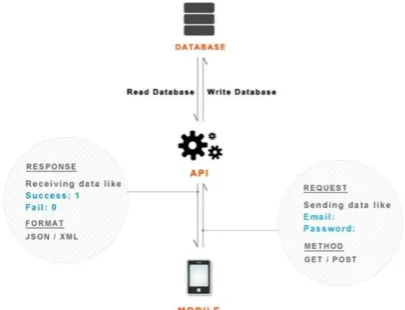
Figure 1. Database communication mechanism
As Figure 1 shows our server accepts requests using GET, POST methods. On server PHP files are able to communicate with database and make insertion or retrieve data which are forwarded back to the user in JSON format.
In details, previously mentioned database communication mechanism involves the following when an already registered teacher is asking for identification or a new one is asking for a new account creation (notice that teachers are considered to be Researchers by the application since they are conducting a survey). On the server 5 files are waiting for a request to arrive (Table 1).
Table 1. Server side content.
File name Internal operation
Config.php Contains necessary data to connect to MySQL database
DB_Connet.php Able to successfully establish a database connection
DB_Functions.php All functions that are necessary to manage MySQL database content
Login.php Able to identify a registered user Register.php Responsible for a new user registration
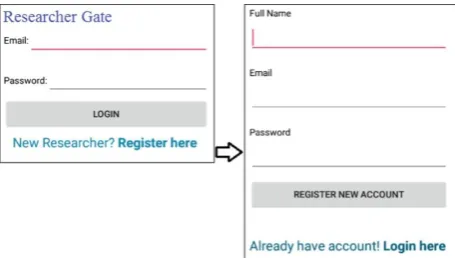
On the Config.php f i le important database security information is stored which must be secret to the rest of the world and can be called only from Exantas application. On the DB_Connet.php file we handle safe database opening and closing connection. DB_Functions.php contains all functions implementations that we need in order to communicate with the database e.g. new user insert, user’s information receive, update or delete entries from database arrays. Last, Login.php and Register.php files are used to identify user based on the records stored in our database and to add a new one if there is no other user matching the same email account. Notice that all sensitive information like Researcher password is transmitted and stored using 128bit AES encryption ensuring safety and integrity. This choice was crucial in order to ensure that the results provided by students will remain personal, secret and confidential eliminating the possibility of mistrust. The implemented interface for login or registration activity is shown in the Figure 2.
Figure 2. Login and register activity interface
2.2. Selecting a Specific Research or Test
from Database
Each research is described by a unique ResearchID or a QR code which contains the ResearchID in a computer accessible form. Application users (considered as Voters by the database) can either insert the ResearchID by typing it, using device keyboard, or by scanning a figure of QR code which is generated by our application. This approach makes specific Research choosing process easier for users and reduces human error possibility since all procedures are made as automatic as possible. Android compatible zxing library is used to generate and parse two dimensional barcode and its core functionality is included inside app package and there is no need for external software installation. If a correct ResearchID has been provided then VotingActivity is called and a request is raised for a specific research content. Otherwise, user is informed that given research ID does not corresponds to an existing research and is asked to retry to select a specific ID (Figure 3).
Figure 3. ResearchID selection procedure
QR code (Quick Response Code) [12], is the trademark for a type of matrix barcode (two-dimensional barcode) first designed for the automotive industry in Japan. The QR code consists of black squares arranged in a square grid on a white background and can be easily scanned by Smartphone’s camera or other image input hardware. Encoded data can be extracted from patterns that are present in both horizontal and vertical components of the image. Internal information translating mechanism provides even error correction features ensuring data transfer correctness. Its main benefit is that it offers an easy machine readable barcode reading mechanism which can efficiently store content using four standardized encoding modes (numeric, alphanumeric, byte/binary, and kanji). QR representation has become very popular nowadays even outside of the automotive industry which was initially designed for, since it offers an easy way to transport data between different platforms which might otherwise be incompatible.
one of them and can be used in the form described in Figure 2.
2.3. Creating or Improving a Research or
Test
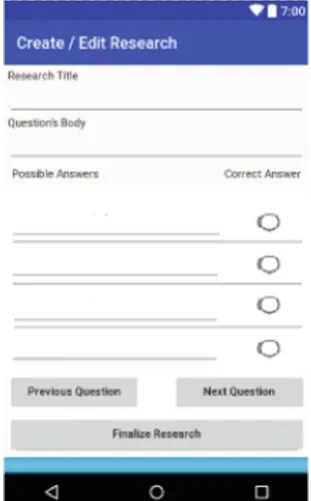
Every Researcher is able to create one or more Researches, or different instances of the same Research. On the other hand Researcher should be able to make important editions if necessary. For each one of them, as shown in the Figure 4, the system is requiring a Research Title which will be the same for all included Queries that Researcher will provided in next steps. After that Researcher is asked to insert for each Query the Question that will be asked to users, all possible Answers that will be shown and finally mark the correct answer so that system can automatically and correctly cross-check between the correct answer and all answers provided by users. Notice that application is able to consider more than one of the answers as correct if Researcher is demanding it, achieving higher rates of flexibility. Navigation between Queries is supported through Previous and Next buttons. Finally, research is saved in database when Finalize button is pressed.
The exact same mechanism is used in order to create Tests from teachers and store their content in the remote application’s database leading in design simplicity.
Figure 4. Create or edit research interface
2.4. Monitoring Research or Test Results
Making use of MPAndroidChart library users answers that are stored in database can be retrieved, processed and visualized in a human friendly interface. In this way,
Researcher reduces effort and saves important time which can be better consumed in data mining, information extraction and results evaluation. Collected data can be extracted and stored locally for further examination in txt, csv, or xml data type.
Except the fact that Researcher can monitor the amount of correct and wrong answers for each Query three main visualization approaches are provided by Exantas application in its current version. First one, provides information about the amount of Correct and Wrong Answers per Question and the ability to measure how many users have selected each Answer making use of Pie and Bar charts as Figure 5 shows in case (a) and (b). In second one, Researchers can observe how many correct Answers have been counted in each Query. Based on this feature, which is presented in case (c), important and critical information can be quickly extracted about where there are spots of misunderstanding or need of further explanation since e.g. presentation audience has failed to answer in many Questions that are related to each other. In third and last visualization technique, as shown in case (d), Researcher can monitor the average time duration of users spent during voting activity, realizing in this way the difficulty of Queries.
Figure 5. Research results visualization interface
2.5. Voting or Answering Activity
3. Database Implementation
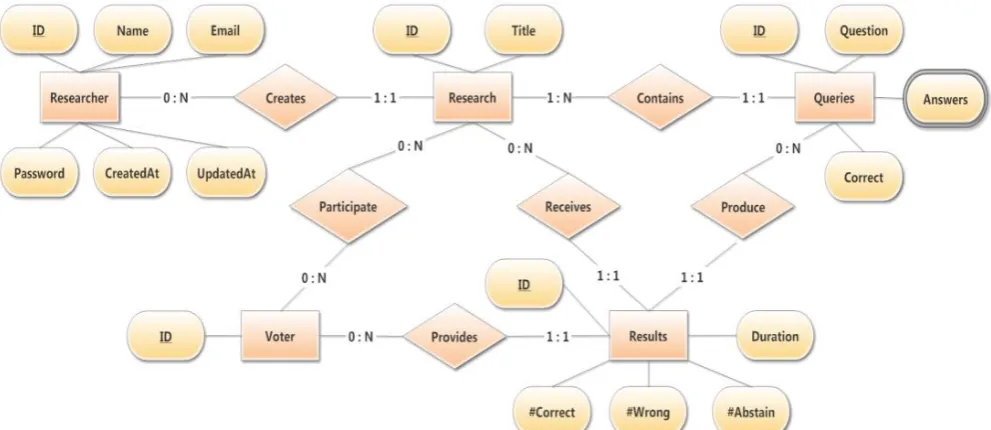
The Entity Relationship model shown in Figure 6 describes basic Entities, Relationships and Cardinality. Implementation is using a MySQL database on a Linux operating system server platform. In details, our implantation of Exantas database has as primary object the Researcher which means that all stored information belong
to at least one Researcher and without him database can’t retrieve information from users.
One Researcher can create one or more Researches. Each research has a Title which helps a lot distinguishing different database entries and can contain multiple numbers of Queries, and each Query is referencing a variable number of Answers. Results Entity contains information selected from all users that have participated in our Research.
Figure 6. Database Entity Relationship diagram
Due to extensions made in order to measure the comprehension level of the students, the Entity Relationship model has evolved and been equipped with a new Voter entity. In this case, the Voter entity contains information only when a student’s comprehension level evaluation is performed, but when a teaching method is evaluated no personal data or other user’s information are stored in the database. Using this approach we can ensure anonymity and results integrity, when a teaching method is evaluated, because students won’t be afraid to reveal their true opinion. Moreover, Voter entity contains only information about user ID and not his or her Name. Using this technique, only the Researcher – Teacher will know which Voter – Student has provided which answer.
4. Experimental Results
As we all know almost all students when asked if they have understand lecture content they answer positively or ignore question. Measuring the results of this experiment when Exantas application is used we saw that reality differs from students’ previous answer. As Figure 7 shows when this scenario is used in a classroom of 20 random students ~70% to ~85% believed that they have correctly understood topics stated in the presentation when asked from teacher. Results extracted from Exantas app revealed that actually only ~40% to ~60% have in fact understood
presentation content and making use of this information teacher had to repeat certain sections and explain again questions that student failed to answer.
Figure 7. Queries results asked from teacher versus Exantas
not something easy but Exantas application can help significantly.
Figure 8. Amount of correct answers when teacher consults Exantas app
The figure below Figure 9 compares the results of conventional testing against real time application tests using the app introduced in this work. Data were collected during a 13 week semester, on a randomly chosen class and all values refer to the average grades originated from the same group of individuals, consisting of 30 students. Conventional testing shows average grades from a simple test (week 4), a midterm test (week 6), an essay (week 11) and the final exam (week 13). On the other hand, tests through the app were performed for each one of the 13 weeks of the semester. It can be observed that all average grades of app testing were higher in comparison to those of the common practice.
Figure 9. Conventional Testing vs Exantas Application
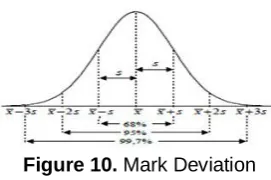
Using dispersion function we saw that the deviation is very close to the classic, expected and in normal rates form with almost ~70% of the students to be very close to the average mark which is close to ~6.1 and deviation close 0.6 as Figure 10 shows.
Figure 10. Mark Deviation
5. Conclusions and Future Work
We designed and implement Exantas application, a fully functional education assisting algorithm, compatible with Android OS, which is able in real time to provide important anonymous information to Queries stated by Teachers or Professors in order to test their teaching methods, measure students’ misconceptions and reveal their perspectives. As experiments show, Teachers can significantly improve their skills and avoid time or effort spending procedures.
As a future work we are planning to redesign application in a more functional and user friendly interface providing the necessary internal mechanism to self-adapt Queries content based on previous answers provided by users.
Moreover, we plan to perform performance evaluation and test the limits of the complete chain of dataflow using many simultaneous users answering on the same or not Research ensuring at the end the so cold quality of service.
We are also working on a more simplistic mechanism which implements all basics core functionalities but can be used not only for academic purposes but also for industrial or marketing purposes. Last but not least, porting the algorithm in other platforms such us iOS is considered to be a critical and essential step as well as releasing new and stable version in Google Play Platform and making it available to anyone.
References
[1] Tsamis, G., Papadakis, N., Tzirakis, E., Katsaraki, E., Rousaki, M., Nikolopoulos, J. and Vassilakis, K., 2017. Real Time Evaluation of Education Methods via Smart Mobile Technology. In Interactivity, Game Creation, Design, Learning, and Innovation (pp. 95-104). Springer, Cham.
[2] National Research Council: How People Learn: Brain, Mind, Experience, and School, Expanded edn. National Academies Press, Washington (2000).
[3] Abachi, H.R., Muhammad, G.: The impact of m-learning technology on students and educators. Comput. Hum. Behav. 30, 491–496 (2014).
[5] Furió, D., Juan, M.C., Seguí, I., Vivó, R.: Mobile learning vs. traditional classroom lessons: a comparative study. J. Comput. Assist. Learn. 31(3), 189–201 (2015).
[6] Luckin, R., Clark, W., Avramides, K., Hunter, J., Oliver, M.: Using teacher inquiry to support technology-enhanced formative assessment: a review of the literature to inform a new method. Interact. Learn. Env. 25(1), 85– 97 (2017).
[7] Nam, S.Z.: Evaluation of university students’ utilization of smartphone. Int. J. Smart Home 7 (4), 175–182 (2013). [8] Paige, K., Bentley, B., Dobson, S.: Slowmation: an
innovative twenty-first century teaching and learning tool for science and mathematics pre-service teachers. Aust. J. Teacher Educ. 41(2), 1–15 (2016).
[9] Shi, Y., Qin, W., Suo, Y., Xiao, X.: Smart classroom: bringing pervasive computing into distance learning. In: Nakashima, H., Aghajan, H., Augusto, J.C. (eds.) Handbook of ambient intelligence and smart environments, pp. 881–910. Springer, Boston (2010). https:// doi.org/10.1007/978-0-387-93808-0_33.
[10] Sun, J.C.Y.: Influence of polling technologies on student engagement: an analysis of student motivation, academic performance, and brainwave data. Comput. Educ. 72, 80– 89 (2014).
[11] Zheng, B., Warschauer, M., Lin, C.H., Chang, C.: Learning in one-to-one laptop environments: a meta-analysis and research synthesis. Rev. Educ. Res. 20(10), 1– 33 (2016).
[12] Soon, T.J.: QR code. Synth. J. 2008, 59–78 (2008). [13] Fraga, Lucretia M., and Belinda Bustos Flores. "Mobile
learning in higher education." Handbook of research on mobile technology, constructivism, and meaningful learning. IGI Global, 2018. 123-146.
[14] El-Hussein, M., Osman, M. and Cronje, J.C., 2010. Defining mobile learning in the higher education landscape. Journal of Educational Technology & Society, 13(3).
[15] Herrington, J., Herrington, A., Mantei, J., Olney, I.W. and Ferry, B., 2009. New technologies, new pedagogies: Mobile learning in higher education.
[16] Nassuora, A.B., 2012. Students acceptance of mobile learning for higher education in Saudi Arabia. American Academic & Scholarly Research Journal, 4(2), pp.24-30. [17] Sung, Y.T., Chang, K.E. and Liu, T.C., 2016. The effects
of integrating mobile devices with teaching and learning on students' learning performance: A meta-analysis and research synthesis. Computers & Education, 94, pp.252-275.
[18] Valk, J.H., Rashid, A.T. and Elder, L., 2010. Using mobile phones to improve educational outcomes: An analysis of evidence from Asia. The International Review of Research in Open and Distributed Learning, 11(1), pp.117-140. [19] Mcconatha, D., Praul, M. and Lynch, M.J., 2008. Mobile
learning in higher education: An empirical assessment of a new educational tool. Turkish Online Journal of Educational Technology-TOJET, 7(3), pp.15-21.
[20] Baran, E., 2014. A review of research on mobile learning in teacher education. Journal of Educational Technology & Society, 17(4), p.17.
[21] Naismith, L., Lonsdale, P., Vavoula, G.N. and Sharples, M., 2004. Mobile technologies and learning.
[22] Ozdamli, F., 2012. Pedagogical framework of m-learning. Procedia-Social and Behavioral Sciences, 31, pp.927-931.
[23] Draper, S.W. and Brown, M.I., 2004. Increasing interactivity in lectures using an electronic voting system. Journal of computer assisted learning, 20(2), pp.81-94.
[24] Simpson, V. and Oliver, M., 2007. Electronic voting systems for lectures then and now: A comparison of research and practice. Australasian Journal of Educational Technology, 23(2).
[25] Kennedy, G.E. and Cutts, Q.I., 2005. The association between students' use of an electronic voting system and their learning outcomes. Journal of Computer Assisted Learning, 21(4), pp.260-268.