© Global Society of Scientific Research and Researchers
http://ijcjournal.org/
Data Auditing and Security in Cloud Computing: Issues,
Challenges and Future Directions
Geeta C M
a*, Raghavendra S
b, Rajkumar Buyya
c, Venugopal K R
d, S S
Iyengar
e, L M Patnaik
fa,b,dDepartment of Computer Science and Engineering, University Visvesvaraya College of Engineering,
Bangalore University
c
Cloud Computing and Distributed Systems (CLOUDS) Lab, School of Computing and Information Systems,
The University of Melbourne, Australia
eDepartment of Computer Science and Engineering, Florida International University, USA
fINSA, National Institute of Advanced Studies, Indian Institute of Science Campus, Bangalore, India
aEmail: [email protected]
bEmail: [email protected]
cEmail: [email protected]
d
Email: [email protected]
e
Email: [email protected]
fEmail: [email protected]
Abstract
Cloud computing is one of the significant development that utilizes progressive computational power and
upgrades data distribution and data storing facilities. With cloud information services, it is essential for
information to be saved in the cloud and also distributed across numerous customers. Cloud information
repository is involved with issues of information integrity, data security and information access by unapproved
users. Hence, an autonomous reviewing and auditing facility is necessary to guarantee that the information is
effectively accommodated and used in the cloud. In this paper, a comprehensive survey on the state-of-art
techniques in data auditing and security are discussed. Challenging problems in information repository auditing
and security are presented. Finally, directions for future research in data auditing and security have been
discussed.
Keywords: Cloud Computing; User Revocation; Deduplication; Public Auditing; Consistency; Re-generating
Codes; Key-Exposure Resilience.
---
1.Introduction
The most recent utility oriented distributed computing model that has envisioned an immense transformation of
Information Technology (IT), to increase capacities of the client access to a common pool of platforms,
applications and infrastructures without having to really claim them in distributed computing. In the context of
deployment, the cloud computing is grouped into four approaches: (i) public, (ii) private, (iii) hybrid and (iv)
community clouds that are described below:
• Public Cloud: In public cloud, the service suppliers transfer various applications as service and
encourage the customers by offering access to the resources by means of concentrated distributed
servers over the Internet for example, Amazon Web Services, Google App Engine.
• Private Cloud: The services and framework are utilized and supervised absolutely by a performance
institution.
• Community Cloud: The services and framework are distributed by an arrangement of institutions that
are overseen either privately or by a dependable outsider.
• Hybrid Cloud: Hybrid cloud adopts a blend of on-premises, private cloud and third-party public cloud
services with arrangement among the two platforms.
Liu and his colleagues [1] discusses about the cloud computing reference architecture and taxonomy of three
service models i.e., Platform as a Service (PaaS), Software as a Service (SaaS), Infrastructure as a Service
(IaaS). Fox and his colleagues[2] examine the impediments to and opportunities for selection and development
of distributed computing and classes of utility computing. Buyya and his colleagues[3] proposed framework for
market-oriented distribution of assets inside the clouds. It provides the attributes of cluster, grid and clouds and
awareness on market-based assets administration procedures. Cloud service provider offers three types of
service models, for example, Software as a Service (SaaS), Infrastructure as Service (IaaS) and Platform as
Service (PaaS). Clients of SaaS layer are granted to adopt all sorts of programming from their relating cell
phones. For example, Microsoft Live Mesh grants document and folder distribution between numerous
reckoning gadgets. The PaaS framework gives designers with a runtime circumstance as indicated by their
specific necessities.
The PaaS gives programming system, libraries and toolboxes for the designers to authorize them to create,
convey and look after applications. Some prominent PaaS systems such as like Amazon Elastic MapReduce
(EMR), Google App Engine are accessible in the business sector. The IaaS delivers reckoning, reposition and
systems administration in a kind of versatile Virtual Machine (VM) to the trading customers for example, S3
(Simple Storage Service) and EC2 (Elastic Cloud Computing). Distributed computing provides cloud repository
as one of the service in which information is maintained, managed, backed up remotely and made accessible to
customers over a network (typically the Internet). The customer is worried about the integrity of information
saved in the cloud as the customers information can be attacked or altered by external attacker. Therefore, a new
concept called data auditing is introduced in Cloud Computing to deal with secure information storage. Auditing
is a process of verification of customer information which can be carried out either by the customer himself
the cloud.
The two categories of verifier’s role are: first one is private auditing, in which only customer or information
proprietor is allowed to verify the honesty of the hoarded information. No other person has the authority to
question the server regarding the data. But it tends to increase verification overhead of the user. Second is public
auditability, which allows anyone, not just the customer, to challenge the server and performs information
verification with the help of TPA. The TPA is an entity which is used so that it can act on behalf of the client. It
has all the necessary proficiencies, intelligence and professional expertise that are needed to handle the work of
integrity certification and it also decreases the overhead of the customer. It is necessary that TPA should
efficiently verify the distributed information storage without requesting for the local copy of information. It
should have zero knowledge about the information saved in the distributed server.
1.1 Data Storage Auditing Model
Blum and his colleagues [4] explored the auditing issue that empowers information proprietors to verify the
honesty of remote information. Numerous conventions have been suggested: e.g., Remote Integrity Checking
(RIC), Proof of Retrievability (POR) and Provable Data Possession (PDP) conventions. Systems comprising of
information proprietor and distributed server is known as private verification framework. Role of two entities in
private verifying framework is explained below: (a) Information proprietor: is the proprietor of information,
consist of both individuals and administration. Information proprietor is relying on cloud service provider for
proper sustentation of information. (b) Cloud Storage Server (CSS): maintains information repository space to
information proprietor. Distributed service provider is authoritative for managing the distributed repository
servers. This entity is considered to be semi-trusted. System framework for private auditing is shown in Fig. 1.
The model consists of two entities- Information proprietor and Cloud service provider. This framework provides
permission only to Information proprietor to interact with the distributed repository server to verify information
sincerity and accomplish data structure operations on deployed information.
Figure 1: System Framework for private auditing.
The convention that acknowledges a third party other then information proprietor to verify information sincerity
is termed as public verifying system. This framework consists of Information proprietor, CSS and a Third party
auditor. Role of Third party auditor in public verifying framework is elucidated below: a. Third Party Auditor
(TPA): is an accomplished individual possessing resources, and skills to access services administered by
distributed repository server. Information proprietor may solicit TPA to verify the accomplishment of
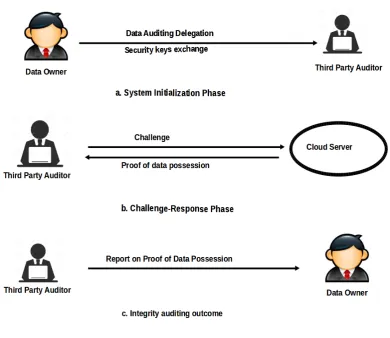
distributed repository server. The system framework for public auditing is shown in Fig. 2. It consists of two
The information proprietors create cryptographic keys, estimates metadata of their information to be hoarded on
distributed server. Then information proprietor interchanges the cryptographic keys with the TPA and saves
information on cloud and goes off line. Second communication is amidst TPA and CSS as shown in Fig. 2b. The
sincerity verification is done via a challenge-response verifying convention. This feedback verifying convention
has three phases: Challenge, Authentication, and Verification. At any time TPA wishes to verify ownership of
information it throws a challenge to the distant server. The server provides a proof of possession of information
that is acknowledged to the TPA. The TPA validates the proof for its correctness utilizing the cryptographic
keys applicable and develops a statement of ownership of information. This statement is then conveyed to the
information proprietor as shown in Fig. 2c. This verification report from TPA will guide the information
proprietor to evaluate their registered cloud service provider.
Figure 2: System framework for public auditing: a. System Initialization phase. b. Challenge-Response phase.
c. Integrity auditing outcome.
1.2 Organization
information storage auditing. Section 3 describes Public Honesty Verification with Group Client Repudiation.
Section 4 outlines Public Verification for Collaborative Information in the Cloud. Section 5 discusses issues in
Secure Verification and Deduplicating Information in Cloud. Section 6 and Section 7 presents issues on
Auditing Cloud Consistency and Provable Verification for Deployed Database in Cloud. Section 8 emphasizes
on Cloud Repository Auditing with Key-Disclosure Protection. Public Verification for
Reconstructing-Code-Based Cloud Repository is given in Section 9. Conclusions are presented in section 10.
2. Challenging issues in information repository auditing
2.1 Dynamic auditing
As the outsourced information is dynamic by nature, it is essential to construct a verifying convention that
supports for dynamic operations on outsourced information. Homomorphic authenticators are utilized in a
public verification method to accomplish a constant transmission overhead. In the earlier homomorphic
authenticated procedures, the chunk value was utilized in the course of authenticator estimation to prohibit
distributed server to accomplish proof of possession of proprietor’s information by adopting same authenticator.
However the limitation of utilizing token value is that they develop complexity in chunk insertion operations.
Insertion of an information chunk needs to update authenticated tags of all the subsequent information chunks,
that is extremely idealistic in real cloud scenario. As a result, to thoroughly accomplish dynamic operations
token value has to be prevented in tag estimation. To realize this condition, the classic Merkle Hash Tree (MHT)
can be utilized. Leaf nodes of MHT are hashes of information file chunks. All of the information chunks can be
validated by verifying root value and utilizing auxiliary information. Erway and his colleagues[5] introduced
continued version of PDP framework namely vital provable information possession advocating updating on the
owner’s information. They discussed two mechanisms namely skiplist based and MHT based authenticated
dictionary.
2.2 Collaborative auditing
Numerous information sincerity verifying conventions that are relevant for a single cloud scenario has been
recently proposed (Ateniese and his colleagues[6]; Juels and Kaliski, [7]; Shacham and Waters, [8]) and they do
not support multi cloud environments. Today’s distributed repository frameworks support new Distributed File
Systems (DFS) in order to offer low cost and location independence to proprietor’s information. The benefit of
such cooperative frameworks is the repository and processing of enormous amount of proprietor’s information.
Hence, highly efficient auditing mechanisms are required for such systems. Collaborative auditing is the
verification of proprietor’s information over multi clouds. The challenging problems for the collaborative
verification are:
• The data transfer between distributed servers play an important role in cooperative verification. These
homomorphic verifiable responses decreases transmission costs considerably and also reveals the
tangible location of information outsourced in a multi-cloud surroundings. The advantage of using
physical location of information deployed in a multi cloud neighborhood.
• Task assignment: The cooperative verifying conventions comprises of a TPA for verification and are
appropriate to multi-cloud environment. For an adept cooperative verifying convention, a candid third
party auditor is necessary.
• Security guarantee: information disclose assault and tag counterfeit assault are the two potential attacks
in collaborative auditing. These assaults may also pose threat to secrecy of information and also to
ownership of information. This verifying convention must present security guarantee for proprietor’s
information. In addition, in cooperative verification, the issues such as estimation complexity,
repository overhead and system applicability need to be addressed.
2.3 Batch verification
The anticipation of cluster verification was initially introducedin Yamamoto’s protocol [9]. The Batch auditing
hasseveral advantages over independent auditing:
• It can savethe correspondence bandwidth, as the server just needs toforward the continuous sequence
of all the tested informationchunks whose size is identical to one information chunk.
• It can lower the reckoning intricacy for examination on both the public verifier and the distributed
server. The group inspectingfor various information chunks are used in numerousevaluating conventions, for
instance, Ateniese’s Provable DataPossession (PDP) [10], Juel’s Proof of Retrievability (POR) [7] and Zhu’s
Cooperative Provable Data Possession (CPDP)[11] and so on.
Wang and his colleagues [12] presents a cluster verifying convention for several information chunks from
various information proprietors. In spite of the fact that the cluster verifying can incredibly enhance the
adeptness of verifying, while outlining the group verification protocol, it is important to study the data
processing intricacy and transmission overhead for cluster operations. Yang and his colleagues [13] have
performed a comprehensive review on repository examination approaches. Set of prerequisites of the reviewing
mechanisms are presented for information repository in distributed computing.
2.4 Support for blockless verification
A verification scheme without the adoption of certification labels and signature aggregation mechanisms
depends upon the server to send the challenged chunks to assure the integrity. The drawback of this scheme is
that there is more transmission overhead at the server and also the effectiveness of verification scheme is
affected. Although blockless verification can improve adeptness of verification scheme and lower transmission
overhead considerably, it may also let the server to deceive. Assume the information proprietor desires to carry
out any update operation say the information proprietor desires to alter a chunk. It is viable that after the update
operation the server is preserving prior information and its signatures. As both the information and signatures
are genuine, so the verifier may not be capable of recognizing whether the information is updated precisely or
2.5 Privacy preserving
When information proprietor deploy information to the distant cloud or delegate the verification job to the
trustworthy third party, it is essential for them that the verifiers or cloud not be given the freedom to acquire
intelligence of the information content or be able to create a duplicate of the primary information. That is, most
of the information verification mechanisms for the cloud servers generally believe that the public verifier is a
reliable delegate; however such an irrelevant inference additionally leads to information leakage. Randomization
of information chunks and labels is a trivial mechanism to address the security problem to avoid label or
information leakage throughout the auditing phase.
2.6 Error localization
As per the survey of existing mechanisms, most of them yields binary results about verification of information
(Ateniese and his colleagues[6]; Juels and Kaliski, [7]; Shacham and Waters, [8]). The proprietor’s information
is appropriated over numerous servers; one realizes the repository status of information across multiple servers
but no information about the misconducting server.
2.7 Accountability
Usually, the distributed server is considered as semi-trusted party. The public verifier discloses the sincerity of
distributed server only. The verification record need to identify not only the correctness of information but also
account for the entity that is authoritative if any complication arises, including information proprietor, public
verifier and distributed server. There is a need to achieve accountability when all the entities are malignant.
2.8 Contribution
This summary presents a State of the Art work in Data Auditing and Security in Cloud Computing. We have
compiled the techniques and algorithms with their performance, advantages and disadvantages. We have
indicated the scope and issues that needs future research.
3. Public honesty verification with group client repudiation
With information repository and distribution administration supplied by the cloud, customers can conveniently
work together as a cluster by distributing information with each other. For security reasons, when a customer
quits the cluster or misbehaves, the customer ought to be repudiated from the cluster. As a result, this repudiated
customer need no longer be able to retrieve and alter combined information, and the signatures created by this
repudiated customer are no longer legitimate to the cluster. Therefore, even though the content of collective
information is not modified during customer repudiation, the chunks, that were apriori signed by the repudiated
customer, still needs to be re-signed by the current customer in the cluster. Hence the sincerity of the entire
information can still be proved with the public keys of existent customers only. In this section we study the
3.1 System Framework
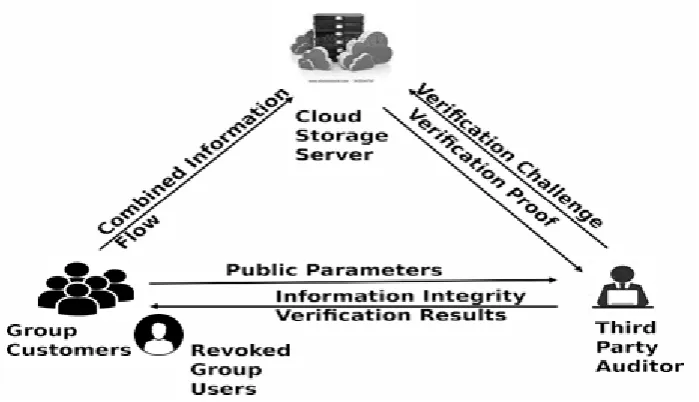
The system architecture includes: the distributed storage server, ensemble of clients and a public verifier (see
Fig. 3.) Batch clients comprise of an information proprietor and various customers. Information repository
services are given by the cloud storage server to the collection of clients. Third party auditor performs the
information trustworthiness of the combined information saved in the distributed server. The information
proprietor can encode and transfer the information to the distant distributed repository server. The information
proprietor has the right to safely repudiate a batch client when the batch customer is discovered malignant or the
agreement of the client is terminated.
Jiang and his colleagues [14] ensures public trustworthiness with group client repudiation. A collusion attack
problem is considered where a renounced client can conspire with a malicious cloud server to change the group
client’s information. There is a possibility that one of the user in the group may behave maliciously. The data
owner revokes the malicious user from the group. Security is of concern in the group users’ data when a
semi-trusted cloud server co-operates with the revoked user. The proposed mechanism supports the group information
encoding and decoding during data repair process and achieves proficient and secure client renouncement. It is
constructed using vector assurance scheme, Asymmetric Group Key Agreement (AGKA) scheme and verifier
local revocation aggregate signature scheme. The system model is shown in Fig. 3. It has been debated that the
most proficient technique is to safely outsource neighborhood repository to a distant distributed server. Ateniese
and his colleagues[10] and Juels and his colleagues[7] introduced the mechanisms of Verifiable Information
Ownership and Proofs of Retrievability (PoR). Homomorphic authentication approach has been used to reduce
both the transmission and data processing cost.
Figure 3: Cloud Storage Model
Wang and his colleagues [15] introduced public inspecting system for the trustworthiness of transmitted data
with effective customer denial. By using the notion of intermediary signatures, the cloud is permitted to
re-sign chunks. In addition, an auditor continually examines the candidness of assembled data without retrieving
the complete data from the cloud. The scheme improves cluster reviewing by examining varied reviewing jobs
at the same period. The mechanism can be extended to implement collusion-resistant intermediary re-signature
approaches while also supporting public verification.
Reference [16] also achieves secure batch client elimination along with their vital public forthrightness
analyzing mechanism. The scheme depends on polynomial confirmation and adopts intermediary label update
procedures which endorse public reviewing and dynamic user revocation. This scheme does not support cipher
text store. Raghavendra and his colleagues [17] proposed a Most Significant Index Generation Technique
(MSIGT) that improves safe and effective token creation period adopting a Most Significant Digit (MSD) radix
sort. An analytical framework is refined to encode the indexed keywords for safe token creation. The advantage
of the scheme is that it reduces the cost to the data owner.
Further considering the verification of outsourced database, Bennabbas and his colleagues[18] discussed the
realistic testable database mechanism established on the rigidity of the subbatch association issue in bilinear
groups with complex order. This mechanism does not bolster the feature of public validation. While Catalano
and Fiore [19] achieves improved public validation along with their provable database from vector commitment
mechanism. The mechanism presumes that the client can learn apriori the outsourcing function and the
dimension of the outsourced fixed database. Backes and his colleagues[20] address the problem of verifiable
delegation of computations on outsourced data. The solution works for computations over integers and supports
the evaluation of arithmetic circuits. It also solves the security problem of Catalano-Fiore MAC completely.
Key management issue arises when various clients are repudiated from the group. This problem is addressed by
Bruhadeshwar and Kulkarni [21], they discussed on a family of key management algorithms for productively
disseminating the new group key when various clients are repudiated from the group. The storage at the group
controller is linear and the storage at the clients is logarithmic to the size of the group. Techniques are illustrated
to decrease the number of keys stored by the clients and the group manager. Algorithms are suited for overlay
multicast applications. In heterogeneous frameworks, the algorithms can be used to enhance battery life span of
wireless systems. Energy consumption is dominated by the amount of transmitted data. Raghavendra and his
colleagues[22] introduced an effective procedure for keyword inquiry over encoded cloud information. In this
scheme token creation procedure for keywords is constructed by utilizing split factor. The keywords are saved in
wildcard based method within the token tree that is saved safely with little repository cost. The mechanism is
adept in terms of index creation and repository cost.
Li and his colleagues[23] proposed a convertible Identity Based Encryption (IBE) scheme in the server-assisted
framework. It discharges the vast majority of the key generation associated procedure to a Key Update Cloud
Service Provider. This objective is accomplished by using a novel collusion-resistant technique. The
disadvantage is that key-issuing stage in the proposed scheme is relatively longer than that in the IBE scheme.
To support an adaptable encryption of assets in RBAC frameworks, Zhu and his colleagues [24] presents a
generic role-based encryption over Role-Based Access Control (RBAC) model. The proposed design enhances
suggested remote information honesty checking convention for distributed storage. The convention is
appropriate for giving honesty assurance of client’s information and improves the operations on information at
the chunk level, and enhances public testability. The mechanism is safe against the semi-trusted server. It is
effective in terms of data processing, calculation and storage costs. Data level dynamics at minimum costs is yet
to be achieved.
Li and his colleagues [26] introduced an effective verifiable information ownership mechanism that utilizes a
SN (sequence number)- BN (chunk number) vector to support information chunk modification. The mechanism
is adept with reduced estimation, repository and correspondence overhead. An extensive PDP mechanism that
has huge proficiency and fulfils every fundamental specification is provided. The limitation is that public
verifiability, secrecy protection, legitimacy and multiple-duplicate inspecting are not supported. Ni and his
colleagues[27] designed a privacy-protection reviewing convention for the distributed storage as discussed in
[28]. A dynamic attacker can change the evidence of verification to deceive the verifier and the data possessor
such that the distant cloud documents are uncorrupted, but the documents are impaired.
Extending the work from single data proprietor to multi-proprietor, Wang and his colleagues [29] presents a
public auditing mechanism to review the righteousness of multi-proprietor information in a semi-trusted cloud
by taking the benefit of multisignatures. The confirmation period and capacity overhead of signatures on
multi-proprietor information in the cloud are independent with the quantity of multi-proprietors. The limitation is that it has
high communication cost and verification time when the number of elements increase. Xue and Hong [30]
proposed a vital immune batch allocating system in public distributed computing. In the proposed system, the
administration authority is permitted to few particular cluster individuals. Shared records are securely stored in
cloud servers. TGDH mechanism is built to dynamically update the group key pair. Though the group
individuals are online together, the proposed mechanism performs well. Forward secrecy and reverse secrecy
are given by upgrading computerized envelopes in view of intermediary re-encryption. The scheme
accomplishes the design objective and maintains a lower data processing intricacy and transmission overhead
for every individuals of the cluster.
Luo and his colleagues[31] presents a public verification mechanism for the honesty of combined information
with effective and collusion resistant client repudiation. Polynomial-based validation labels are developed which
supports secure and effective public auditing. The mechanism is protected and effective, the aggregate overhead
of the auditing mechanism is relatively small. Dong and his colleagues [32] achieves information privacy
against untrusted cloud. They proposed a secure, effective and versatile information coordinated mechanism.
Security examination demonstrates that the proposed mechanism is safe against versatile chosen ciphertext
attacks. Experimental analysis demonstrated that it is exceptionally productive and has small overhead on
estimation, communication and storage. The scheme does not achieve data consistency.
Huang and his colleagues [33] presents a quality based secure information sharing mechanism with efficient
revocation in distributed computing. The design ensures information security and accomplishes fine-grained
access control. The mechanism accomplishes prompt attribute repudiation which ensures forward and backward
Identity-Based Encryption (RIBE) schemes with a consistent number of private key components. It is
constructed in three-levelled multilinear maps. The proposed scheme possesses a consistent number of group
components in private key and update key. Another Revocable Identity-Based Encryption (RIBE) scheme is
built with decreased public parameters and short keys are generated by consolidating the Hierarchical
Identity-Based Encryption (HIBE) mechanism. Constraint of the second Revocable Identity-Identity-Based Encryption (RIBE)
scheme is that it requires high-levelled multilinear maps.
Confidentiality-protecting public auditing convention is proposed by Zhang and his colleagues[35] that uses
opportunist assortment work. It comprises of the following features: (1) the individuality protection of
information client is saved for distributed server; (2) the legitimacy of the transferred information is confirmed;
(3) information security is safeguarded for the examiner in evaluating process; (4) calculation cost to create
information label is small. The disadvantage is that the cloud server has high computation cost. Hwang and his
colleagues[36] outlined a group signature mechanism advocating the controllable linkability. The considerable
benefit of this scheme is that the signature length is short. The proposed scheme bolsters security features for
example, secrecy, traceability, nonframeability, and linkability under a random oracle model. Privacy is not
preserved by global linkability. Hong and his colleagues [37] revisited the proposed design by Yang i.e., a
multi-authorization ciphertext-approach, feature established encryption-based data access regulation for
distributed repository. It embraces a bidirectional re-encoding strategy in ciphertext restoring. An attack
technique is proposed that uses a unidirectional re-encoding mechanism.
Among the various existing efficient public auditing for shared data mechanisms, Yaun and Yu [38] proposed
an effective verifying mechanism for cloud information sharing services portrayed by multiuser changes, public
verification, large fault location likelihood, effective client revocation and pragmatic
computational/communication inspecting performance. The scheme overcomes client impersonation attack and
permits the customer to review the honesty of a combined record with a steady estimation overhead and a
limited communication cost. The drawback is that it does not accomplish reliability and error detection. Li and
his colleagues[39] presents two confidentiality conserving public verifying conventions for secure stockpiling
in cloud. Both conventions depend on the online/offline signatures, through which a client just requires to
accomplish low estimation. They bolster batch auditing and information dynamics. The disadvantage is that
time cost increases continuously as the number of chunks increases at the user side.
Cryptographic approaches are used in few of the verifying schemes such as, Hur and his colleagues [40]
proposed a cryptographic approach to deal with fragile access control on the outsourced information, that is
double encryption convention utilizing the combined attributes of the ciphertext-approach encryption and group
key administration algorithm. The proposed mechanism permits an information proprietor to characterize the
access control strategy and authorize on his outsourced information. It also features a system that empowers
more fine-grained access control with effective characteristic and customer repudiation capability. It is
proficient and scalable to safely deal with the outsourced data. The drawback of the scheme is that the revoked
client can access the outsourced information with other attributes that he holds.
distributed computing by employing Ciphertext Policy Attribute-Based Encoding (CPABE) and the strategy of
Identity-Based Encryption (IBE). The technique assures fine-grained information admission control, in
backward secrecy and protection against collusion of customers with the cloud and supports user addition,
revocation and attributes modifications. The scheme does not reveal any attributes of clients to the cloud. It has
low overhead and efficient. The scheme needs to be implemented in real Cloud Service Provider (CSP)
platform. Wu and his colleagues [42] presents a generic construction, which uses two Ciphertext Policy
Attribute-based Encoding (CPABE) schemes as building blocks. The scheme can revoke on attribute per
encryption. The model of CP-ABE supports
the attribute revocation under the direct revocation model, in which the repudiation record is inserted in the
ciphertext and none of the clients secret keys are influenced by the renouncement procedure.
Muthi Reddy and his colleagues[43] discuss on secure information sharing in distributed computing. They have
analyzed different issues in data security and reviewed on various schemes that provide secure information
sharing in distributed computing. Lu and Li [44] proposed a certificate-based agent re-encoding mechanism
(CB-PRE) deficient of bilinear pairings. It demonstrates safe under the computational Diffie-Hellman
expectation in the arbitrary prediction model. The mechanism essentially reduces the computation cost by
avoiding tedious bilinear matching operations. In contrast with the previous mechanisms with bilinear pairings,
it has improvement in the calculation proficiency. The CB-PRE mechanism requires to be developed in the
standard model without bilinear pairings.
Both, Identification privacy and trackability for cluster individuals are protected by a proficient public verifying
solution that is suggested by Yang and his colleagues [45]. The scheme accomplishes information security
during authenticator generation by using blind signature. In this scheme, the identification of cluster individuals
are unknown to the auditor and the cluster administrator can reveal the identification of untruthful customer in
case of controversy. Identity traceability is accomplished through the group manager. The scheme has low
overhead to implement both identification privacy and trackability. The data processing cost on the cluster
manager needs to be reduced while lightweight authenticator creation has not been addressed.
A safe way for key distribution has been discussed by Zhu and his colleagues[46] where the clients can safely
acquire their secret keysfrom cluster administrator. The scheme likewise fulfils fragileadmission control, and
repudiated customers cannot approach the cloud once they are repudiated. The scheme is protected from
collusion attack. By utilizing the polynomial function, the mechanism accomplishes a secure user revocation. It
is efficient as clients need not modify their secret keys else either a client participates in the cluster or a user is
eliminated from the cluster. A revision on works on secrecy and protection problem in cloud information
repository has been performed by Selvamani and Jayanthi [47]. They have examined about encryption based
strategies and auditability schemes. Public verifier cannot acquire any information details at the time of public
inspectingand hence integrity is ensured. Furthermore, it is observed that the auditing jobs can be carried out
concurrently. A detailed review of various information trustworthiness strategies for cloud computing has been
performed by Garg and Bawa [48]. They have observed that most of the current conventions focus on honesty
Xu and his colleagues[49] propose Multi-authorization Proxy Re- Encoding method based on ciphertext-policy
attribute-based encryption (MPRE-CPABE) for distributed repository frameworks. The Weighted Access
Structure (WAS) is introduced that reduces the estimation overhead of granting the keys. MPRE-CPABE
utilizes intermediary re-encryption to minimize the estimation overhead of access revocation. This scheme
enormously minimizes the estimation overhead of the creation of key elements and the withdrawal of customers
access right.
The impediment of the mechanism is that it requires longer computational time for setup. Raghavendra and his
colleagues [50] presents a safe multi-owner information distribution for vital cluster in the cloud with RSA
Chinese Remainder Theorem (RSA-CRT) encode approach and substring token creation procedure. RSA-CRT
effectively handles repudiation list, key administration, with decreased repository and reckoning cost. The
substring token creation algorithm decreases the repository space and Search algorithm reduces the time to
search files from the cloud. The limitation is that the protocol does not support multi-media files.
Further, More and Chaudhari [51] presents a secure and effective privacy preserving auditing scheme. The
mechanism utilizes TPA (Third Party Auditor), performs the inspection without retrieving the data copy,
subsequently security is preserved. The data is divided into blocks and then stored in the encoded format in the
distributed storage, thus maintaining the privacy of data. The information uprightness is confirmed by TPA on
demand of the customer by checking both the signatures.
The proposed scheme does not support information dynamic operations, for example, updation, deletion and
insertion of data. Wang [52] proposed proxy provable information ownership (PPDP) convention. In public
clouds, PPDP is a phenomenon of important significance while the customer cannot achieve the distant
information ownership auditing. An effective PPDP convention is outlined by utilizing bilinear pairings. The
convention counteracts mischievous customers and has small transmission overhead. The comparison of
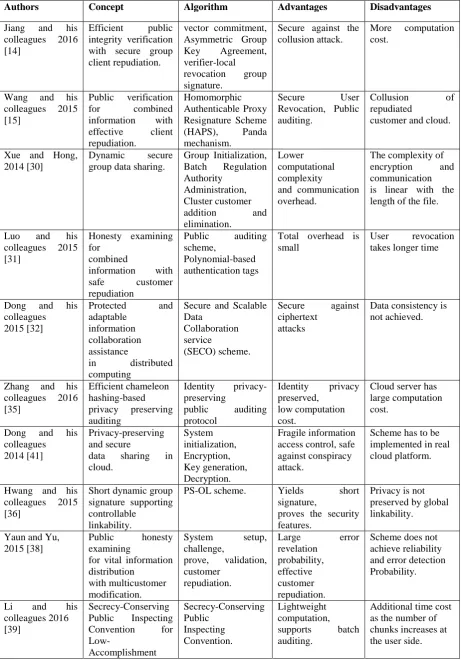
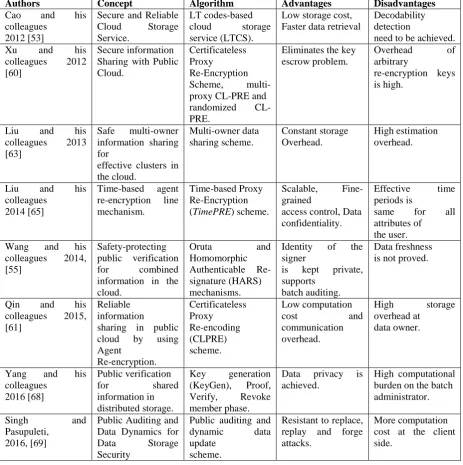
schemes for Public Honesty Verification with Group Client Repudiation is shown in Table 1.
4. Public auditing for collaborative information in the cloud
Cloud service suppliers offer customers adept and extensible information repository benefits. Sharing
information among various customers is one of the highest appealing features that inspires distributed
repository.
Therefore, it is also essential to guarantee the honesty of combined information in the cloud is legitimate.
Currently, many schemes [10,8,53,54] have been suggested to grant not only a information proprietor itself but
also a public examiner to regularly carry out honesty examination without downloading the complete
information from the cloud, that is referred to as public reviewing.
However, an advanced compelling secrecy problem introduced in the case of combined information is the
leakage of personality secrecy to public auditors. In this section we present an extensive survey on public
Table 1: Comparison of schemes for public honesty verification with group client repudiation
Authors Concept Algorithm Advantages Disadvantages
Jiang and his colleagues 2016 [14]
Efficient public integrity verification with secure group client repudiation. vector commitment, Asymmetric Group Key Agreement, verifier-local revocation group signature.
Secure against the collusion attack.
More computation cost.
Wang and his colleagues 2015 [15] Public verification for combined information with effective client repudiation. Homomorphic Authenticable Proxy Resignature Scheme (HAPS), Panda mechanism. Secure User Revocation, Public auditing. Collusion of repudiated
customer and cloud.
Xue and Hong, 2014 [30]
Dynamic secure group data sharing.
Group Initialization, Batch Regulation Authority Administration, Cluster customer addition and elimination. Lower computational complexity and communication overhead.
The complexity of
encryption and communication
is linear with the length of the file.
Luo and his colleagues 2015 [31] Honesty examining for combined information with safe customer repudiation Public auditing scheme, Polynomial-based authentication tags
Total overhead is small
User revocation takes longer time
Dong and his colleagues 2015 [32] Protected and adaptable information collaboration assistance in distributed computing
Secure and Scalable Data Collaboration service (SECO) scheme. Secure against ciphertext attacks
Data consistency is not achieved.
Zhang and his colleagues 2016 [35] Efficient chameleon hashing-based privacy preserving auditing Identity privacy-preserving public auditing protocol Identity privacy preserved, low computation cost.
Cloud server has large computation cost.
Dong and his colleagues
2014 [41]
Privacy-preserving and secure
data sharing in cloud. System initialization, Encryption, Key generation, Decryption. Fragile information access control, safe against conspiracy attack.
Scheme has to be implemented in real cloud platform.
Hwang and his colleagues 2015 [36]
Short dynamic group signature supporting controllable
linkability.
PS-OL scheme. Yields short
signature,
proves the security features.
Privacy is not preserved by global linkability.
Yaun and Yu, 2015 [38]
Public honesty examining
for vital information distribution with multicustomer modification. System setup, challenge, prove, validation, customer repudiation. Large error revelation probability, effective customer repudiation.
Scheme does not achieve reliability and error detection Probability.
Li and his
colleagues2016 [39] Secrecy-Conserving Public Inspecting Convention for Low-Accomplishment Secrecy-Conserving Public Inspecting Convention. Lightweight computation, supports batch auditing.
End
Appliances in Cloud.
Xu and his
colleagues 2016 [49]
Multi-authority proxy reencryption based on CPABE for cloud storage system.
MPRE-CPABE scheme and WAS scheme.
Low computational cost of key distribution.
Longer computational time of setup.
4.1 System Model
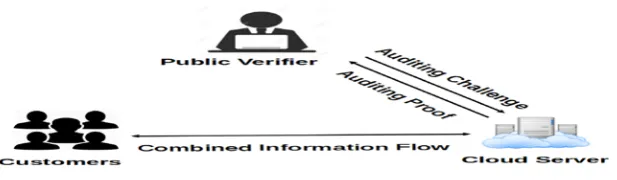
The system architecture consists of three entities: the distributed server, a cluster of clients and auditor (see Fig.
4). Batch customers consist of an information possessor and a number of batch clients. The data owner generates
combined information in the cloud and allocates it to the batch clients. Each customer of the batch is authorized
to retrieve and alter the combined information. The distributed server stores both the combined information and
its confirmation metadata (i.e., endorsements) authorized to retrieve and alter the combined information. The
distributed server stores both the combined information and its confirmation metadata (i.e., endorsements).
Figure 4: System framework consists of the distributed server, a cluster of clients and a public auditor.
Public auditor offers proficient information examining administration or an information client foreign to the
batch expecting to utilize the combined data, can freely prove the honesty of joint data cached in the distributed
server. When an auditor verifies the sincerity of the combined information, he initially transmits an inspecting
challenge to the distributed server. After accepting the inspecting challenge, the distributed server acknowledges
to the auditor with a reviewing evidence of the ownership of collective information. Then, the auditor examines
the imperativeness of the complete information by proving the accuracy of the verifying proof. Wang and his
colleagues[55] introduced a security protecting public evaluating framework for combined information in cloud
by the scheme of One Ring to Rule them All (Oruta). Ring signatures are exploited to accomplish validation
metadata anticipated to examine the accuracy of combined data. In the proposed protocol, the individuality of
the endorser on every chunk in the combined information is maintained unrevealed from the public auditors,
who can adequately verify combined data respectability without fetching the complete file. The scheme
performs numerous reviewing jobs simultaneously. Limitation of the scheme is that the identity privacy is not
preserved and does not support traceability. They have used the system model that is shown in Fig. 4. Shacham
Shacham short signatures (BLS) and the second depends on spurious-haphazard functions. Recently, research on
network catalogue-based cloud repository systems is performed, namely Chen and his colleagues [54]
introduced Remote Data Checking (RDCNC), a protected and effective Remote Data Checking (RDC)
mechanism for network catalogue-based cloud repository systems. RDC-NC alleviates current attacks and is
able to preserve low correspondence expense of the repair element. The mechanism is computationally
reasonable for both customers and servers. The drawback of the mechanism is that the correspondance rate
increases directly with the document size. Venugopal and his colleagues[56] use soft computing techniques for
data mining applications. A safe distributed storage maintenance is designed by Cao and his colleagues[53] that
addresses the issue of fidelity. The scheme supports public honesty confirmation. To totally release the
information proprietor from the burden of being on the web after information deployment, a correct repair result
is outlined so that no metadata should be produced on the fly for reconstructed information. The analysis shows
that the convention has less capacity cost, significant speedy information recovery and similar transmission cost.
The scheme does not detect decodability efficiently. Wang [57] proposed an innovative procedure, Uncertainty,
to ensure both existence security and cooperative protection with small data deficit. The secrecy model is
characterized and the security certification of Uncertainty against both existence leakage and cooperative
leakage is measured. It isdemonstrated that the data damage of Ambiguity is lower than the exemplary
generality-based anonymization system. An enhanced mechanism PriView is built that can accomplish
preferable data loss over Ambiguity. The scheme does not include dynamic datasets. One can design tools and
approaches which address all aspects of cloud responsibility by using the Cloud Accountability Life Cycle
(CALC) and three deliberation layers, proposed by Ko and his colleagues [58]. They have examined
responsibility and auditability as an essential viewpoint towards expanding trust in distributed computing.
Logging and mapping of virtual machines to physical machines in CALC has not been achieved. A
cryptographic construct namely the hourglass schemes [59], empowers customers to check remotely if a server
stores documents in a specific target format. Hourglass schemes influence server resource limits to accomplish
their security confirmations. Three primary hourglass developments are discussed; two draw on storage-access
times as an asset bound, and another on hardness presumptions on the RSA cryptosystem. Xu and his
colleagues [60] introduced a Certificateless Proxy Re-encoding mechanism (CL-PRE) for cloud-established
information sharing. CL-PRE exceptionally coordinates identification based public key into intermediary
re-encryption, and dispenses with the key insurance issue in customary identification based encryption; the
certificates are not used to ensure the legitimacy of public keys. The overhead of arbitrary re-encryption keys is
high. Further Qin and his colleagues [61] introduced a firmly safe and proficient Certificateless Proxy
Re-encoding mechanism (CLPRE) lacking pairings for cloud based information distribution scenario. The
mechanism is inferably IND-CCA reliable in a more robust protected framework. It is observed that the scheme
is firmly protected and applicable for cloud positioned information distribution in terms of estimation and
transmission overhead for information proprietor, Cloud Service Provider (CSP) and information receiver.
Provable information ownership model [62] gives trustworthiness and originality in a vital, multi-client context.
By utilizing reliable hardware on the server, Forking and rollback assaults are eliminated. The proposed
constructions eliminate client-side storage costs and are relevant for situations in which various users work
cooperatively on deployed information. It does not support load-balancing across multiple servers. Considering
mechanism, Mona. Customer repudiation is effectively accomplished through a repudiation record without
refreshing the private keys of the rest of the customers. The magnitude and calculation overhead of encoding are
consistent and resilient with the number of relinquished clients. The drawback is that it has high estimation
overhead. Rasheed and Hassan [64] analyzed the verification of cloud computing in terms of client inspecting
prerequisites, standard procedures for secure reviewing and current cloud assistance provider facilities for
satisfying review requisites. Client verifying requisites are classified into infrastructure secure evaluation and
information safety verification. TimePRE framework [65] achieves small-grained fetch control and adaptable
client repudiation. Every client’s right to retrieve is successful in a pre-decided timeframe and empower the CSP
to re-scramble encoded texts. The drawback of the mechanism is that it requires the powerful time periods to be
the same for all features related with a client. Yu and his colleagues[66] revised triple verifying systems for
collective information in the distributed systems, including two identity secrecy-maintaining reviewing schemes
and cloud storage uprightness inspecting system. It is observed that if the distributed server does not authorize
its acknowledgement, a dynamic attacker can instigate an assault to breach the repository accuracy. In
particular, the attacker can immediately change the cloud information without being distinguished by the
reviewer in the auditing stage. A protected digital signature mechanism is proposed to settle this issue. Abbas
and Khan [67] have surveyed the methodologies and techniques that are at present being utilized to manage the
imperative issue of secrecy. The authors have detailed the scientific classification of the systems that have been
utilized to safeguard the security of the current information. There is a need to set up an effective verifying and
liability mechanisms. There is a compelling need to construct more adaptable and proficient information
examination procedures without trading off on security of the cloud. Considering the issue of identification
security and trackability, Yang and his colleagues [68] designed a state-of-the-art structure for information
distribution in cloud and formalized the meaning of public verification mechanism for combined cloud
information advocating identification security and trackability. The mechanism ensures individuality protection
and trackability. The constraint of the mechanism is that there is high computational weight on the group
administrator and lightweight authenticator generation has not been addressed. Further to resolve the issue of
information honesty confirmation (by an intermediary verifier), Singh and Pasupuleti [69] proposed a
convention to perform proficient chunk-level and fragile effective information refresh process on information
saved on cloud utilizing a variant Opportunist Certification Tree. The proposed conventions are productive and
can resist replay, replace and forge attacks. Overall computation time per task allows the increase in number of
auditing tasks. Li and his colleagues [70] proposed a key-revising and authorization developing scheme with
void-intelligence protection of the stored documents for safe cloud information examination, which includes
void learning evidence frameworks, intermediary re-signature and homomorphic direct endorser. The scheme
has low communication and computation cost while maintaining attractive security. The time complexity of key
update is linear with the updating times. In order to decrease the workloads of information clients caused due to
group client revocation, Cui and his colleagues [71] proposed Server-Aided Revocable Attribute-Based
Encryption (SR-ABE) mechanism in which the data client’s workloads are delegated to an untrusted server and
the client just needs to store a key of constant size. A security framework for SR-ABE is designed. This does not
require any protected channels for key transmission. In the decryption stage, information client just needs to
perform one exponentiation calculation to decrypt a cipher-text. A Novel and Efficient Public Auditing
cloud. NaEPASC adopts an identity-based aggregate signature, to develop real-time and homomorphic
verifiable labels, and the TPA can review the accuracy in favor of the clients. The mechanism eliminates the
burden on cloud users of inspecting tasks, and in addition reduces the clients fear of losing their keys. This
mechanism is adept and secure in verifying the uprightness of the information stored in the cloud. It has a
considerable estimation overhead on the server side and TPA has increased verification time. Raghavendra and
his colleagues [73] present most significant single keyword inquiry over encoded cloud information that
supports effective and precise search. The scheme supports a considerable number of information documents,
decreases token creation time, token repository space and keyword inquiry time. Limitation is that the
mechanism does not support index storage space on multimedia. The comparison of schemes for Public
Verification of Combined Dynamic Cloud Information is summarized in Table 2.
Table 2: Comparison of schemes for public verification of combined dynamic cloud information.
Authors Concept Algorithm Advantages Disadvantages
Cao and his
colleagues 2012 [53]
Secure and Reliable Cloud Storage Service.
LT codes-based
cloud storage service (LTCS).
Low storage cost, Faster data retrieval
Decodability detection
need to be achieved.
Xu and his
colleagues 2012 [60]
Secure information Sharing with Public Cloud.
Certificateless Proxy
Re-Encryption Scheme, multi-proxy CL-PRE and randomized CL-PRE.
Eliminates the key escrow problem.
Overhead of arbitrary
re-encryption keys is high.
Liu and his
colleagues 2013 [63]
Safe multi-owner information sharing for
effective clusters in the cloud. Multi-owner data sharing scheme. Constant storage Overhead. High estimation overhead.
Liu and his
colleagues 2014 [65] Time-based agent re-encryption line mechanism. Time-based Proxy Re-Encryption (TimePRE) scheme.
Scalable, Fine-grained
access control, Data confidentiality.
Effective time periods is
same for all attributes of
the user.
Wang and his
colleagues 2014, [55]
Safety-protecting public verification for combined information in the cloud. Oruta and Homomorphic Authenticable Re-signature (HARS) mechanisms.
Identity of the signer
is kept private, supports
batch auditing.
Data freshness is not proved.
Qin and his
colleagues 2015, [61]
Reliable information
sharing in public cloud by using Agent Re-encryption. Certificateless Proxy Re-encoding (CLPRE) scheme. Low computation
cost and
communication overhead.
High storage overhead at
data owner.
Yang and his
colleagues 2016 [68] Public verification for shared information in distributed storage. Key generation (KeyGen), Proof, Verify, Revoke member phase.
Data privacy is achieved.
High computational burden on the batch administrator.
Singh and Pasupuleti,
2016, [69]
Public Auditing and Data Dynamics for Data Storage Security
Public auditing and dynamic data update
scheme.
Resistant to replace, replay and forge attacks.
5. Secure verification and deduplicating information in cloud
Though distributed repository system has been extensively accepted, it is unsuccessful to furnish some
substantial arising needs such as the capabilities of verifying honesty of cloud documents by cloud customers
and identifying corresponding documents by distributed servers. In this section we have performed survey based
on the problem of honesty verifying and protected deduplication on cloud information.
5.1 System Framework
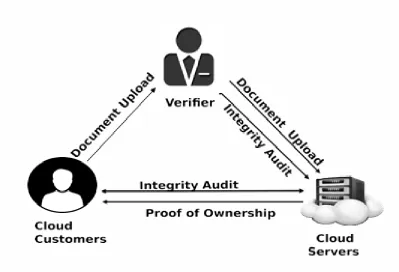
As shown in Fig. 5. the SecCloud framework has three objects: Cloud customers, distributed servers and
verifier. Cloud Customers possess large documents to be hoarded and depend on the cloud for information
conservation and estimation. Distributed servers virtualize the assets as determined by the prerequisites of
customers and present them as repository pools. Customer achieves the identical checkup with the distributed
server to validate if such a document is saved in cloud repository or not before transferring a document. If there
is a matching document, another convention called Proof of Ownership is executed among the customer and the
distributed repository server. Distributed server acknowledges the customer that it has the same copy of the
document and hence does not permit the customer to upload the document. The verifier provides users certain
support with uploading and assess their deployed data, and acts like authentication supremacy.
Figure 5: Cloud data auditing and deduplication framework.
Li and his colleagues [74] proposed two secure frameworks, SecCloud and SecCloud+ where these two
frameworks accomplish both information sincerity and deduplication in cloud. SecCloud considers a verifying
tags and in addition examine the sincerity of information that have been saved in cloud. The computation by
customer in SecCloud is considerably decreased during the record transferring and evaluating stages. SecCloud+
encodes user’s information before deploying, empower honesty verification and safe deduplication on encoded
information.
The Seccloud architecture is shown in Fig. 5. Various researchers worked on the issue of integrity and
deduplication of information in the cloud. They have proposed efficient deduplication mechanisms, few of them
are discussed in this section. Li and his colleagues [75] proposed an approved information deduplication
mechanism. They also displayed a few novel deduplication mechanisms encouraging approved duplicate
verification in the hybrid cloud architecture. The mechanisms are safe in terms of internal and foreign assaults.
Proof generation phase incurs little overhead.
The cloud deduplication frameworks [76], enhance the authenticity of information in the time of accomplishing
the secrecy of the clients’ deployed information without an encoding convention. The deduplication frameworks
are implemented utilizing the Ramp secret allocation mechanism with little encrypting/decrypting cost. Wang
and Chen [77] have performed survey on the methods of provable information repository and protected
information deduplication.
They have examined systems for verifiable database deploying and the security challenges and solutions.
Further, research direction recommended is publicly verifiable ODB, privacy-protecting VDB, user-revocable
deduplication. Hur and his colleagues [78] examined server-side deduplication mechanism for encoded
information. The procedure grants the distributed server to restrict access to deployed information even when
the proprietorship renews actively. This counteracts information spillage to revoked clients and distributed
storage server. Further, the proposed mechanism ensures information honesty against any tag irregularity
assault. It involves extra computational overhead. Dekey [79], is a proficient and solid focalized key
administration conspire for safe deduplication. Dekey employs deduplication among confluent keys and
disseminates convergent key portions over various key servers, while safeguarding syntactic protection of
convergent keys and secrecy of deployed information. Dekey is implemented utilizing the Ramp secret
distribution mechanism with encrypting/decrypting overhead.
In order to accomplish record level and chunk level deduplication, Chen and his colleagues [80] proposed
Block-Level Message-Locked Encryption (BL-MLE) scheme. The scheme also accomplishes chunk key
administration and verification of possession utilizing a small set of metadata. It does not support proof of
storage and is not computationally efficient.
In order to counteract deduplication of unpopular information, Stanek and Kencl [81] introduced intrinsic
pressure between storage streamlining techniques and end-to-end encryption. It is resilient to client collusion
assaults and never deduplicates unpopular files. The limitation of the scheme is that it has low space-saving
efficiency. Extending the work to multi-server scenario, Miao and his colleagues [82] proposed multi-server
supported deduplication mechanism using blind signature. The protocol can successfully oppose the conspiracy
the off-line brute force intrusion. It is expensive to record uploading. Zheng and his colleagues[83] proposed
secure deduplication system that supports secure deduplication with strong video protection against malicious
clients and untrusted cloud.
The algorithm is implemented utilizing RSA-OPRF convention and Threshold RSA-OPRF convention. It
supports secure deduplication with resistance to limited information leakage and with guard against brute-force
assaults over predictable videos. Computation overhead is high in case of decentralized servers. Yao and his
colleagues [84] proposed a secure hierarchical deduplication framework to enhance privilege-based duplicate
checks and privilege-based client profiling by the storage server. The framework depends on a novel
Hierarchical Privilege-Based Predicate Encryption (HPBPE) protocol. HPBPE is used to create the
cryptographic document tokens for copy checks without revealing the clients privilege data to the storage server.
An improved mechanism called HPBPE-R is built to support dynamic privilege changes. Min and his colleagues
[85] present fingermark administration mechanism called LRU-positioned Token Segregation and Incremental
Modulo-K(INC-K) method. LRU-positioned Token Segregation utilizes the idea of tablet and employs
admission conditions of the fingermark lookup in organizing fingermarks. It is observed that there is an increase
in chunking time and decrease in deduplication ratio. Christian [86] discusses a study of twelve varieties of six
ordering systems. It is suggested to implement the Febri model using indexing approaches and examination of
learning systems for proficient and precise registering.
Xia and his colleagues [87] have reviewed various approaches of data deduplication. A detailed scientific
categorization of the new information deduplication methods is explored that gives thought to significant issues
of deduplication-based repository frameworks. As the volume of digital information progress to advance
exponentially, there is a requirement for everlasting repository maintenance. Wang and his colleagues [88]
proposed I-sieve, a formidable achievement of inline deduplication framework for use in distributed repository.
I-sieve has incredible foreground performance contrasted with Internet Small Computer Systems Interface
(iSCSI) applications. Moreover, I-sieve is suitable for deduplication in small storage situations, particularly with
virtual machine applications.
The limitation of the scheme is that it has extra computational overhead. Considering the security of sensitive
data, Raghavendra and his colleagues [89] introduce the Domain and Range Specific Multi-keyword Search
(DRSMS) approach that minimizes the inquiry period and token repository space. The technique decreases
token repository space and searchable time for top-k multi-keyword retrieval. It prevents sensitive data leakage
and hence better privacy of keywords is achieved. The drawback of the scheme is that it requires more search
time on the image dataset. A public verifying mechanism [90] for distributed depository frameworks, achieves
deduplication of encoded information and information trustworthiness examination inside the system. The
distributed server can effectively examine the possession for original proprietors and the reviewer can accurately
verify the trustworthiness of deduplicated information. The protocol enhances deduplication of encoded
information by utilizing the strategy for intermediary re-encryption and achieves deduplication of information
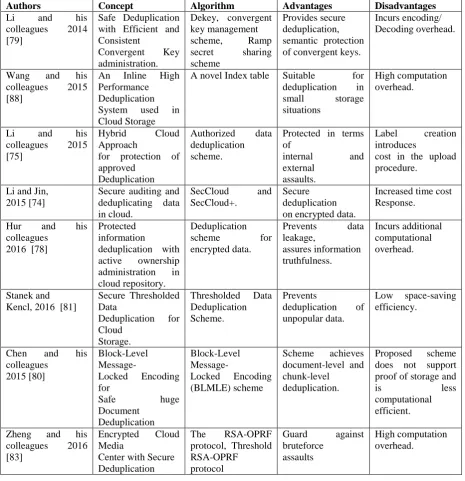
label by combining the labels from various proprietors. The comparison of schemes for Protected Auditing and
Table 3: Comparison of schemes for protected auditing and deduplicating information in cloud
Authors Concept Algorithm Advantages Disadvantages
Li and his
colleagues 2014 [79]
Safe Deduplication with Efficient and Consistent
Convergent Key administration.
Dekey, convergent key management scheme, Ramp secret sharing scheme Provides secure deduplication, semantic protection of convergent keys.
Incurs encoding/ Decoding overhead.
Wang and his
colleagues 2015 [88]
An Inline High Performance
Deduplication System used in Cloud Storage
A novel Index table Suitable for deduplication in small storage situations
High computation overhead.
Li and his
colleagues 2015 [75]
Hybrid Cloud Approach
for protection of approved
Deduplication
Authorized data deduplication
scheme.
Protected in terms of internal and external assaults. Label creation introduces
cost in the upload procedure.
Li and Jin, 2015 [74]
Secure auditing and deduplicating data in cloud. SecCloud and SecCloud+. Secure deduplication on encrypted data.
Increased time cost Response.
Hur and his
colleagues 2016 [78]
Protected information deduplication with active ownership administration in cloud repository. Deduplication scheme for encrypted data. Prevents data leakage, assures information truthfulness. Incurs additional computational overhead. Stanek and Kencl, 2016 [81]
Secure Thresholded Data Deduplication for Cloud Storage. Thresholded Data Deduplication Scheme. Prevents
deduplication of unpopular data.
Low space-saving efficiency.
Chen and his
colleagues 2015 [80] Block-Level Message- Locked Encoding for Safe huge Document Deduplication Block-Level Message- Locked Encoding (BLMLE) scheme Scheme achieves document-level and chunk-level deduplication. Proposed scheme does not support proof of storage and is less computational efficient.
Zheng and his colleagues 2016 [83]
Encrypted Cloud Media
Center with Secure Deduplication The RSA-OPRF protocol, Threshold RSA-OPRF protocol Guard against bruteforce assaults High computation overhead.
6. Auditing cloud consistency
A cloud is a huge-scale distributed system where every chunk of information is duplicated on diversified
geographically-distributed servers to accomplish high availability and high performance. Actually, mandated by
the Consistency, Availability and Partition tolerance (CAP) principle, many cloud service providers (e.g.,
Amazon S3) only guarantee weak consistency, such as eventual consistency, for performance and high
availability, where a customer can read stale information for an epoch of time. The Domain Name System
consistency assurance. Various applications have distinctive consistency requisites. For example, mail services
need monotonic read consistency and read-your-write consistency, but social network services need causal
consistency. In this section we present a review on auditing cloud consistency.
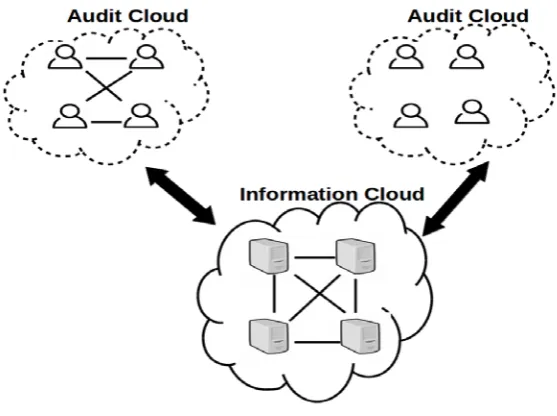
Figure 6: Auditing Cloud Consistency Framework.
6.1 Auditing Cloud Consistency Framework
As shown in Fig. 6, Auditing Cloud Consistency framework comprises of an information cloud, various
verification clouds. The information cloud, managed by the cloud assistance supplier, is a key-esteem
information repository framework, where every bit of information is distinguished by a particular key. To afford
consistency-on services, the cloud service provider duplicates the entire information on numerous
geographically allocated distributed servers. A verification cloud comprises of a cluster of clients that co-operate
on a task, e.g., a file or a program. It is assumed that every client in the verification cloud is distinguished by a
particular ID. Before deploying the task to the information cloud, the verification cloud and the information
cloud participates in a service level agreement (SLA), which specifies the guaranteed level of firmness that
ought to be given by the information cloud. The verification cloud checks whether the information cloud follows
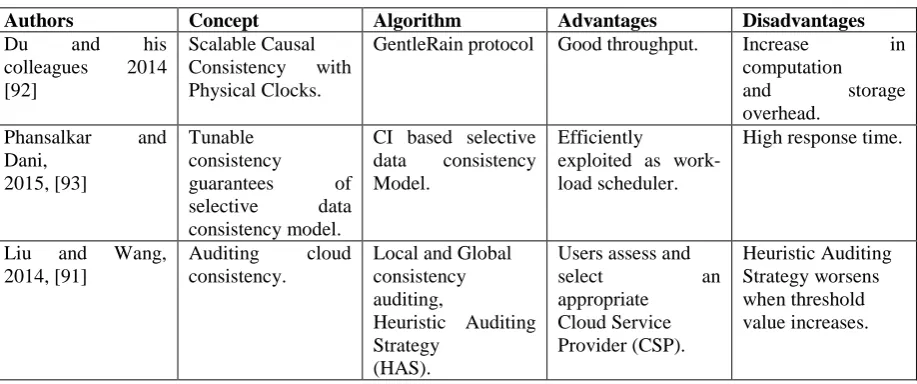
the SLA and evaluates the seriousness of infringement. Liu and his colleagues [91] presented an innovative
model called Consistency as a Service framework. It incorporates a wide information cloud and many tiny
verification clouds that are unique. The information cloud is hosted and monitored by the cloud service
providers, while verification cloud is accessed by individual users for the purpose of verification and checking
its consistency without any failure. A dual auditing architecture has been built in for effective functioning of the
system model. In turn, it depends on a loosely coordinated clock in the auditing cloud. It monitors and measures
the number of misbehaviors and its severity. The staleness of significance of a read is also verified and has been
designed to expose as many misbehaviors as feasible. Simulations and real cloud implementations have been
performed for validation of Heuristic Auditing Strategy (HAS). They have used the system model shown in Fig.