CORINTH,
1971:
FORUM AREA
(PLATES 19-29)-
T HE 1971 spring excavation of the American School of Classical Studies was
concentrated in the southwest quarter of the Roman forum of the ancient city of Corinth.' Dr. Nancy Bookidis continued work at the same time in the sanctuary of Demeter and Kore on the north slope of Acrocorinth.2
Excavation in the area immediately southwest of the Roman bema was conducted generally to bedrock in 1937, at which time Geometric graves and a hero shrine were discovered.' Excavation in the fall of 1937 cleared most of the Late Roman and later fills from the area over what is here named Building II' and in 1938 removed the late material over the present Building II.8 In 1953 excavation was continued in this last area, bringing to light the remains of that classical structure which was identified at the time as the Tavern of Aphrodite.6
The area between the hero shrine and the Tavern of Aphrodite was completely cleared to classical levels this year. Closer examination was made as well in certain restricted areas both around the hero shrine and in the Tavern of Aphrodite. Through-
1 The Corinth Excavations owe much gratitude to Professor James R. McCredie, Director of
the American School of Classical Studies, for his aid and interest in the year's work; thanks are also due to Mrs. Evangelia Deilaki, Ephor of Antiquities for the Argolid and Corinthia, for her contribution to the smooth running of the excavation. This year, as well as last year, the excava- tion has gained much from the skills of its numismatist, Miss Joan Fisher; thanks are extended to her for her work and for her report of the coins found in 1971 in the forum. Student supervisors were Misses Sarah Bancroft, Sharon Herbert, Messrs. Goldstein and Mason. Miss Kathryn Butt again directed the spring work in the museum; Misses Herbert and Mary Sturgeon accepted the museum responsibilities on the first of July. Miss Dorothy Monahan assisted in organizing the 1971 pottery finds. Mr. Michael Katzev of Oberlin College dug a number of test trenches in the forum during July 1971; his skills in this activity are much appreciated. Mrs. Katzev provided this report with its pottery profiles. Mr. Photios Notes was general foreman; Ioannidou and Bartzioti once again served as excavation photographers. All deserve thanks for their efforts and interest.
The architectural complex examined this spring is oriented NE-SW. In order to simplify the description of this area, I have changed the-compass points in the text so that NW will be called, simply, N; NE is E, SE is S, and SW is W.
2 Dr. Bookidis will present a separate report for the activities in the sanctuary. Miss Cynthia
Thompson assisted Dr. Bookidis in this spring's work there. Mr. Roger Holzen assisted in the execution of the architectural drawings.
C. H. Morgan, II, "Excavations at Corinth, 1936-37," A.J.A., XLI, 1937, pp. 539-552. For discussion of the area, see 0. Broneer, " Hero Cults in the Corinthian Agora," Hesperia, XI, 1942, pp. 128-161, esp. 143-144.
4 C. H. Morgan, II, " Excavations at Corinth, Autumn 1937," A.J.A., XLII, 1938, pp. 362-370.
5C. H. Morgan, 11, " Excavations at Corinth, 1938," A.J.A., XLIII, 1939, pp. 255-267.
6 C. H. Morgan, " Excavations at Corinth, 1953-A Tavern of Aphrodite," Hesperia, XXII, 1953, pp. 131-140.
Hesperia, XLI, 2
American School of Classical Studies at Athens is collaborating with JSTOR to digitize, preserve, and extend access to Hesperia
144 CHARLES K. WILLIAMS, II AND JOAN E. FISHER
out, remains earlier than the classical period were distinguished, cleared when feasible, and recorded. For convenience in the following discussion of the exca- vation of 1971, the term " shrine " will be used for the area associated with the chthonic shrine excavated in 1937. Immediately north and northwest of the shrine lies a lower area, along whose western limits are the L-shaped foundations of a structure to be referred to as Building I. Immediately west of Building I is a large rectangular structure, 19.80 by 22.60 m., designated as Building II. Directly west of Building II lies the Tavern of Aphrodite, here to be called Building III.
EARLY LEVELS
Scattered sherds of Neolithic and Early Helladic date were frequently found in the levels immediately over bedrock. A ceramic gap exists, however, from Early Helladic II through Early Geometric. Of architectural remains, one 1.60m. long segment of wall was found associated with E. H. II sherds and is probably, itself, of E. H. II date. This wall lies at the very northwest corner of Building II and was discovered only after intensive cleaning of the bottom of the trench that had been robbed of the foundations of the north wall of classical Building II. The full extent and plan of the Early Helladic structure as well as the strata associated with it remain to be investigated. The most readily recognizable Early Helladic sherds from this level are:
1. Deep bowl with pinched plastic band. P1. 19. C-71-205. Max. pres. dim. 0.115 m.
Hard, coarse clay, gray to tan, with white inclusions.
Handmade deep bowl inturning slightly at rim, plastic band with pinched decoration be- low, outside of rounded rim.
2. Body sherd with pinched plastic band. P1. 19.
C-71-206. Max. pres. dim. 0.085 m.
Hard, coarse clay tan to reddish tan with
dark gray core, some inclusions, coarsely stroked outside surface.
Handmade body sherd with pinched plastic band.
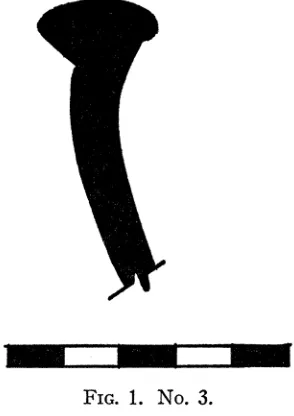
3. Bowl with thickened rim. Fig. 1, P1. 19. C-71-207. Max. pres. dim. 0.065 m.
Tan clay with white inclusions, red slipped inside and out.
Handmade bowl with outcurving wall rising to vertical, rim thickened inside and out, flat- tened on top.
The Late Geometric remains also are neither impressive in quality nor notable in quantity. A Late Protocorinthian to Transitional well, 71-4, lying under the south wing of Building I, had some Geometric material in its shaft fill. From a second well, 71-5, under the floor of Building II, pottery mainly of the Early Protocorinthian Period was recovered, but with some Late Geometric pottery as well.
The wall already identified as Geometric that runs along the north side of the
Tavern of Aphrodite T was tested this year. A number of Middle Geometric sherds
CORINTH, 1971: FORUM AREA 145
FIG. 1. No. 3.
Five graves in two distinct groups were found between 4.50 m. and 7.50 m. north of this Geometric wall, set into the Early Helladic fill in the area directly north of the tavern. Two of the skeletons were found with Geometric bronze hair rings with thickened ends; the other three skeletons were bare of grave gifts or artifacts. A fragment from a Geometric pithos helped to cover one of the bodies. All of the graves were sealed under the poros chip paving that had been laid down in the fifth and fourth
centuries B.C. in a large part of the area later occupied by the Roman forum. Because
of the compactness of the two burial groups and the similarity of interment, all burials should be thought of as Geometric.
Three Protocorinthian-Corinthian building complexes have been identified this year as a result of the examination of the southwest forum (Fig. 2). The most com- plete unit of walls lies under the northeast quarter of Building II (P1. 21); a second set of walls is under the western side of the same house; probably originally it ex- tended westward into the limits of Building III. Traces of a third unit with a burnt strosis and cobbles exist at the western extremity of Building III. Also to be in-
cluded among the early remains is a well,8 dated to 600-540 B.C., lying immediately
southwest of the second early complex; it is not necessarily to be associated specifically, however, with those remains that lie under Building II.
The Protocorinthian structure under the northeast quarter of Building II appears to have been rectangular; the east wall of the building was destroyed with the con- struction of the east wall of Building II but probably was in about the same line as
7Ibid., p. 132, fig. 1, wall B.
' Eva Brann, "A Well of the ' Corinthian ' Period found in Corinth," Hesperia, XXV, 1956,
146 CHARLES K. WILLIAMS, II AND JOAN E. FISHER
KSITE
OF' SEVENTH
A
CENTURY
TEMPLE,7%
G
L.
At
X
41<~~~~~~~~~~~~~~~~~~~~~~~~~~~~~~~~~~~~~~~~1
X / s;~/
\\W
/t ~GRAV OOUSE 2
//, \:\\~x 3't' / OUSE
)QkE
~~~~~~~~~kzyHUS
O 10 20 30 40 50. / O S 4
C. KW. F ItA 7 1.21&\ 4X SEo, . 0B.
CORINTH, 1971: FORUM AREA 147
that of its successor. This earlier complex has a plan of two large rectangular rooms along its south side and probably three smaller rooms along the north. The north wall is built on the eastward extension of the Geometric terrace wall discovered in 1953 at the north side of the Tavern of Aphrodite. Under Building II, however, the north wall of the earlier structure is not totally preserved, since the south, or back, wall of the Roman Central shops is built across it and has destroyed it almost completely. The early building, as restored, has a southeast room probably ca. 3.00 by 4.30 m., a southwest room 3.30 by 4.30 m., a northeast corner room, a north-central room 2.60 m. north-south, and a northwest room 2.00 by 2.60 m.
The building probably was a private house; its southwest room may have been a court and apparently provided the main entrance into the house. Evidence for this is to be found at 1.10 m. from the southwest corner of that room, where the wall terminates with a large poros block; the foundations terminate at the same point, probably the position of the west door jamb of a large opening. The east jamb has been destroyed by a large pit disturbance.
At 3.00 m. west of this building a line of post holes and a shallow trench extend south from the east-west Geometric terrace wall on which the north wall of the house is built. The south wall of the house is extended westward to meet this trench and line of post holes. These remains of a post and woven reed wall may have served as an enclosing fence for a livestock yard built against the west side of the building.
One peculiarity of the wall construction in this building is the generous size and depth of the footing trenches which are dug into the soft poros bedrock. So far this is without parallel elsewhere in Corinth, except in the hero shrine excavated in 1937 (see below, p. 149). Walls constructed of small field stones were built within the foundation trenches up to the level of the floor of the house. The superstructure appears to have been mudbrick. The footing trenches are of such a generous scale that the walls constructed within them seem, by comparison, insignificant. Also, in orientation the walls do not agree exactly with the foundation cuttings. This is especi- ally noticeable along the south wall of the house. It is almost as though the cuttings in bedrock were made for an earlier building of similar plan, but that all traces of the earlier building have been removed.
The house was constructed after well 71-5 had been abandoned. This well is within the foundation trench for the west extension of the south wall of the building. Apparently the well was abandoned and filled before the construction of the house itself; a certain space of time exists between the filling of well 71-5 and the construc- tion of the building. This well can be dated from its pottery to the very beginning of the Early Protocorinthian period.
4. Early Protocorinthian oinochoe. P1. 19. C-71-215. Max. D. of body 0.179m. Most of body preserved; missing foot, most of neck to lip.
Fine clay greenish to buff; glaze black, brown, to red-orange, added white.
148 CHARLES K. WILLIAMS, II AND JOAN E. FISHER
white on black glazed exterior. White line on lower body, second at mid-point of body; two lines joined at intervals by groups of 6 sigmas, immediately below handle; reserved handle with 15 horizontal black glazed lines to panel of 5 vertical lines near top of handle, then five horizontal lines continue from panel to lip. Lip decorated with row of dots in added white; in- side reserved.
5. Early Protocorinthian trefoil oinochoe. P1. 19. C-71-216. H. 0.219, D. of base 0.077, max. D. of body 0.153 m.
Full profile preserved; body fragments, upper handle missing.
Fine clay buff to pinkish buff, glaze black to reddish, added white.
Flat, slightly concave base, ovoid body to cylindrical neck, slightly offset from body; tre- foil rilm; vertical strap handle. Added white on black glazed exterior; white line immediately above base, one at maximum diameter of body, one at shoulder, one on neck just below trefoil mouth.
6. Late Geometric trefoil oinochoe. P1. 20. C-71-217.
Two unjoining fragments of neck and lip. Fine clay pink to cream, glaze black to red, added white.
Cylindrical neck, glazed inside and out; coursed isodomic design in added white. Prob- able front panel in lower course on neck pre- serves front half of crudely executed bird, swastika in panel immediately above, lip deco- rated with row of dots in added white. 0.032 tn. long horizontal zigzag line under upturn of trefoil lip and above neck decoration. Reserved line inside immediately below lip.
Sherds found in uncontaminated foundation trench of a wall of the house:
7. Middle Protocorinthian kotyle. P1. 20. C-71-213. Pres. H. 0.125 m.
Upper wall of kotyle.
Fine Corinthian clay buff tending to green, glaze dark brown.
Lower body zone of large rays, three lines, animal zone of hare leaping right, coursing hound, both with incised detail, two lines above with zone of checkerboard decoration, four lines to rim offset slightly on outside; rim deco- rated with band of vertical lines, interrupted by hourglass and again by crosshatched lozenge with extended lines; two lines at lip; reserved line below lip on inside, inside glazed.
8. Middle Protocorinthian pyxis with animal
frieze. Pl. 20.
C-71-218. Est. D. of base 0.068m. Lower wall of body.
Corinthian clay light gray to greenish buff, glaze thin black to light brown.
Flat bottom, slightly concave vertical side; underside reserved with two thin concentric circles. Wall has two fine lines above base, zone of rays, two parallel lines, two rows of checkerboard, two lines, animal frieze preserv- ing front half of dog going right, tail and lower legs of second dog also going right, both with incised details. Above animal zone two lines, two-row checkerboard, two horizontal lines. Interior completely glazed.
From the floor of the house:
9. Protocorinthian aryballos. P1. 20. C-71-214. H. 0.070m.
Corinthian clay, glaze brown. Complete but chipped.
CORINTH, 1971: FORUM AREA 149
This building and the one immediately to its west were destroyed at the begin-
ning of the fifth century B.c.g Fill from the earliest of the pits which had been dug
into the floors of the house and which destroyed the earlier house walls is to be dated
to the late sixth and early years of the fifth century B.C. Fill of the last quarter of
the fifth century, at which time Building II was constructed, was found in the latest of these pits.
THE SHRINE
(Fig. 3, P1. 22, a)
The hero shrine has been restored variously as unwalled and unroofed,"0 or with
four columns on its north fagade.1` The restoration here submitted is that of a facade with a single column in antis, built in front of a previously existing, humbler structure. The facade might be considered, from its four deep rectangular cuttings, to have had an anta or wall terminus in its easternmost rectangular cutting; a second cutting, which is smaller than the other three in this fa?ade, still preserves in situ an 18-fluted column shaft of poros, broken away at a height of 0.625 m. above its rectangular foundation block. The nine flutes of the back or southern half of the shaft are faceted. The third cutting from the east is for the second anta; the fourth deep cutting is for a structural post or anta. Between the third and fourth deep cuttings is a shal- lower trench for a screen wall.
The floor of the shrine is cut into bedrock and rises to a ledge on the east and west sides and the south end of the shrine. At the northwest corner of the building this ledge makes a right angle and extends to the west behind the above-mentioned deep cuttings three and four of the faqade. This ledge was probably cut to serve as a bedding for the original wall of the shrine, against which the facade of a sinlgle column in antis was later constructed. The deep rectangular cutting in the south or back wall of the shrine is in line with the cutting in the center of the shrine and with the column in the north faqade. Probably the cutting in the back wall was for the placement of a vertical structural member which supported the ridge pole for the roof of the shrine.
9 Destruction debris apparently of this date was retrieved from a well excavated in 1937 at the very southeast corner of Building II. No walls can be associated with the well; even so, the well probably was part of a house complex destroyed between 500 and 480 B.C.; M. T. Campbell,
" A Well of the Black-Figured Period at Corinth," Hesperia, VII, 1938, pp. 557-611. Lively re- building activity in the Demeter Sanctuary is attested in the late second, early third quarter of the 5th century; N. Bookidis, "The Sanctuary of Demeter and Kore on Acrocorinth," Hesperia, XXXVIII, 1969, pp. 305, 307 for two examples. It is interesting to note that, at about this same time, the early temple of Poseidon at Isthmia was also destroyed; 0. Broneer, Isthmia, I, Temple of Poseidon, 1971, p. 55.
150 CHARLES K. WILLIAMS, II AND JOAN E. FISHER
\'\
DYE WORKS1-
ARCHAIC TEMPLE 'N. FOUNTAIN HOUSE
A
R C HA I C TEM PLE \ \ \ NRTH t N X b
BUILDING
SPRING
I~~~~~o
~~~FOUNTAIN HOUSE
RACE COURSE*
U-1~~~~~~~/ -
R RI NE
'7 ~~~~~UILDING ir
BUILDING Z 0
CORINTH, 1971: FORUM AREA 151
The peculiarly deep cuttings for the foundations of this shrine have already been mentioned in connection with the deep foundation trenches dug for the Protocorinthian house walls under Building II (see p. 147).
AREA OF BUILDING I
(Figs. 3, 5, P1. 23)
Immediately north of the shrine lies an irregularly shaped lower level, partially artificially cut out of the living bedrock. Its ground level is below the top of the natural bedrock at both its east and south, and below the floor of Building II, which is built at its west. Within this lower level is an L-shaped structure, Building I, whose floor is 78.48 m. above sea level. For a general understanding of the topo- graphical contours of the area, compare this floor elevation with elevation 79.44 m., the lip of a Geometric sarcophagos cut into the bedrock at the east side of the sunken area, also with the elevation of the foundation stone that supports the column in the fa?ade of the shrine south of the sunken area, 78.86 m. above sea level, and finally compare it with the floor of the entrance of Building II west of Building I. This is between 79.22 and 79.31 m. above sea level. The area in which Building I was built probably had its ground at approximately the same level as the dromos of the race course which passed by the northern limits of this lot.
The sunken lot had a stone retaining wall limiting its south side. The wall was built against the bedrock that rose to the south, which was cut back to make the sunken area more regular. The wall was built in random ashlar, most of which has been dismantled. The wall appears to have been removed in the third quarter of the fourth century and to have been rebuilt with a slightly different orientation. The earlier line, however, is clearly distinguished because its setting bed was cut deeply into the irregular surface of the bedrock. The cutting in it is still well preserved, going 1.06 m. into bedrock at the east and 1.05 m. into bedrock toward the southwest corner of the sunken lot. The earlier back wall of the area was oriented northeast- southwest with the same orientation as the back wall of Building II.
Building I lies along the western side of the sunken lot, with a 13Y2 degree
deviation from the axis of the earlier south terrace wall and from Building II. The plan of Building I can be traced in cuttings in the soft bedrock made for its socle course. Today only eleven poros blocks of that socle are still in situ. At the north end of the building a fragment of the original cement and pebble floor is still pre- served; this establishes the original elevation for the floor of this building. No super- structure of Building I is preserved in situ, nor, at the moment, can any architectural fragments be associated with it.
152 CHARLES K. WILLIAMS, II AND JOAN E. FISHER
did exist, its remains lie under the foundations of a mediaeval tower complex 12 and,
perhaps, are partially destroyed by the Roman Central Shops.
That part of the building which has been examined this year has certain features which suggest that cult activities were conducted within the confines of its walls. A square at the southwest corner of the building, defined by the foundations of the south and west outside walls of the building and by two poros interior cross walls, forms a space 3.40 m. square. Therein and apparently arranged in line along the walls are a series of pits dug into bedrock (P1. 23, b). No floor was found preserved that can be said to have sealed any of the pits. They are preserved to depths of from 0.08 to 0.25 m., and in diameter range between 0.30 and 0.60 m. Also, these pits are not limited to this one square. They have been found inside the west wall of Building I as far as 5.10 m. north of the southwest corner of the building.
The pits appear to have been votive in nature, most commonly having in them one-handled cups and miniature pots, very few terracotta figurines, and some bronze coins (p. 153). The soil was not heavily mixed with carbon nor were there many bones; the fill was flecked, however, with bits of carbon, as though a fire had at some time been built here. Also, in places the bedrock does still show traces of fire scarring. The votives from the pits are miniatures of normal table wares: drinking cups, kraters, and large jars. All are casually executed in Corinthian clay. The following group is selected from one pit:
10. Miniature column krater. P1. 23. C-71-83. H. 0.022m.
Missing one handle, otherwise intact. Disc base, flaring sides, two horizontal han- dles applied to rim.
Also second krater, C-71-82, H. 0.017 m. 11. Miniature pyxis. P1. 25.
C-71-86. H. 0.03 m. Missing one handle.
Disc foot, ovoid body, short neck, wide motuth, two horizontal flaring handles; glazed. For shape Corinth, XIII, deposit 12h, pl. 53; also, " storage-bin," Sparkes and Talcott, Athenian Agora, XII, pl. 67.
12. Miniature skyphos. P1. 23. C-71-81. H. 0.018m.
Missing one handle and chip from rim. Flat base, flaring sides, two horizontal han- dles at lip. Black glazed on bottom and ex-
terior of base, line below handle, handle zone decorated with vertical lines. Interior black glazed.
13. Miniature one-handled cup. P1. 23. C-71-84. H. 0.02 m.
Handle missing, otherwise intact.
Disc foot, curving out to mid-point, gently carinated, traces of the one vertical handle from lower body to rim; glazed.
Also, probably cup, C-71-85. H. 0.022 m. Other pits were found to contain standard household pottery as well as miniatures; the most common shapes are one-handlers and echinus bowls, as in the following pit.
14. One-handler.
C-71-66. H. 0.046, D. of foot 0.055, D. at rim 0.086 m. Chipped.
Vertical ring foot, wide globular bowl, at lip
CORINTH, 1971: FORUM AREA 153
horizontal handle bet-ween horseshoe and tri- angular in shape. Totally glazed.
15. Small echinus bowl. P1. 23. C-71-67. H. 0.032, D. of foot 0.042, max. D. 0.064 m. Intact.
Slightly flaring ring foot, echinoid body, curving into slightly tapering, rounded lip. Totally glazed.
Coin No. 60, 71-209, a Corinthian Pegasos and trident, was also found in this pit.
CHRONOLOGY FOR BUILDING I
The foundations for an interior wall of Building I were built over a pit that had
been filled in the third quarter of the fifth century B.C."8 A terminus post quem is
thereby established for the construction of the building. Pits that were dug into the floor inside of the building and aligned with its walls and which suggest cult activity in the building had pottery dated at the latest to the third quarter of the fourth century.
The pit with the latest datable material contained coin No. 185, Salamis, 339-318 B.C."4
The building was destroyed late in the third quarter of the fourth century. This is fixed with precision by the datable pottery and coins mixed in the fill of the drain that ran along the south and west sides of Building I (pp. 154-163 for dis- cussion and catalogue). The fill from this drain extended into the foundation trench of the west wall of Building I; such an accumulation was possible only after the walls of Building I had been dismantled (p. 155).
After the destruction of Building I and part of the east wall of the entrance into Building II, a rebuilding of the whole sunken area, albeit at a higher level, was achieved before the South Stoa was built. Evidence for this intermediate period of occupation exists only in three places. The first evidence is in the rebuilding of the terrace wall along the south side of the sunken area. Pottery recovered from the pack- ing behind, or south of, this rebuilt wall is similar to that found in the drain within the sunken area.15 The most interesting object from the fill, however, is a bronze base for a statuette dedicated by a certain Timokrates to Artemis Korithos.
16. Statuette base, inscribed. P1. 23. MF-71-51. H. 0.025, L. 0.069, W. 0.049m. Bronze with two unattached lead clamps. Rectangular statuette base made of sheets of bronze; bottom sheet projects 0.0075 m. from base sides, top sheet projects 0.0052 m. with three holes on top where statuette, weight on proper left foot, right forward, was attached. Top of vertical walls of base has fascia with engraved egg pattern. On front vertical face of base inscribed in two lines by dots:
'ApTequt KiOpC'ot
on back long face:
cWEG?KE
Final sigma of Timokrates inscribed on end wall of statue base.
For dative 'ApTacut, see I.G., IV, 577 (Ar-
gos). For dative 'ApTequc, see Boardman, Arch.
13 Corinth pottery lot 6741.
14 Coin 71-221, Corinth pottery lot 6742.
154 CHARLES K. WILLIAMS, II AND JOAN E. FISHER
Report for 1962-3, p. 47, fig. 29 (Pantika- peion); also I.G., V, ii, no. 402 (Lousoi in Arkadia). For dative *APTV,ut, see I.G., V, ii, no. 397 (Lousoi in Arkadia).
Pausanias (Messenia, XXXJV, 7) mentions a sanctuary of Apollo Korynthos eighty stades from Koroni. The cult which emphasized the healing aspects of the god had a long history and was established by the early classical period.
Excavation of the site is reported by 4op. Bepaa-
IC', " To 'I[Epov Tov Kopv'Oov 'Aro6AXwvoi;," AXr.,
XI, 1916, pp. 65-118. Dedications found were
'A7ro'AXOW[& K]opv'Oa and 'A2roAAWV& KopvvOA; for
discussion of the variations see p. 117. A cult of Artemis Korithos existed in Corinth; ap- parently the epithet, spelled as Ko'pvvOo&, Ko'pv- O&R, or KO'ptOos, could be used equally as well by Artemis as by her brother Apollo.
The second indication of intermediate occupation around Building I is a basin constructed at the southwest corner of the sunken area, against the north face of the rebuilt terrace wall. The basin had a pebble cement bottom, poros slab curbs, and a poros threshold block; also, its south side was plastered where it was built against the terrace wall. Plaster is still preserved on the wall south of the basin. The basin was built over the southern extension of the north-south drain that ran along the west side of Building I, and some of the pottery from this fourth century drain still remains in situ under the basin. The third piece of evidence for the intermediate period is a rather tenuous change in the mudbrick fill, coming at the level of the socle course of the east wall of Building II. Roof tiles were found fallen and scattered at this level from immediately over the floor of the basin in the south corner to the area immediately east of the side entrance of Building II (P1. 28). No pottery in among the tiles indicates a date later than that suggested by the pottery from the round- bottomed drain beneath the mudbrick debris.
The round-bottomed drain that runs along the base of both the south and the west walls of Building I was cut throughout its length into soft bedrock. The north- south arm of the drain sloped from the southwest corner of the building toward the north, where, apparently, it poured into the classical city drain that ran from southwest to northeast toward Peirene.16 This larger drain ran along the north, or front, facade of Buildings I, II, and III; it served as the major public drain for the upper Lechaion Road valley.
The north-south arm of the round-bottomed drain at the west wall of Building I did not originate at the southwest corner of the structure. It extended farther south where it turned with a right angle to the west, around the southeast corner of Building II. This drain appears to have originated at the northeast corner of a large, rect- angular pit that lies against the south wall of Building II.
The east-west arm of the round-bottomed drain ran along the base of the south wall of Building I, originating at the northwest corner of a rock-cut pit (p. 163)
found and cleared in 1937,17 or, perhaps, originating slightly farther to the east.
16 Hesperia, XXII, 1953, p. 132, fig. 1.
CORINTH, 1971: FORUM AREA 155
The whole drainage system within the low area or confine was cut into bedrock, apparently at the time of the construction of Building I. The drains went out of use with the destruction of this same building, at which time the walls of the building and much of the socle were removed and the drain was filled with a concentration of discarded coarse, kitchen, and black-glazed table wares (P1. 21, b). Some of this dump overflowed into the wall trenches that had previously held the socle course of Building I (p. 153).
This discarded material was, in turn, covered by discarded mudbrick debris. The whole filling process appears to have been the result of a purposeful clearing and rebuilding program which started with the removal of stone walls of Building I, then the dumping of broken pottery and furnishings, and, finally, the dumping of dis- mantled mudbrick walls. To be coupled with this alteration is the dismantling of the south wall of the area in which Building I had stood and the rebuilding of the wall along a more east-west line (pp. 151, 153).
The discarded household material included many lamps, one lead lamp holder, numerous drinking cups, both kantharoid and skyphoid, one-handled and two-handled cups, a variety of pyxides, mesomphalic phiales, a few rare fine ware shapes, lekanides, louteria, tubs of all sorts, more than 24 wine amphoras (mainly of Corinthian manu- facture), six figurines, some bronzes and bone objects. Only two pots were inscribed, and one bronze half -mina weight which records its weight and that it is of the city of the Corinthians. Two figured pots, both Corinthian red-figured, were found in the deposit. A few furniture attachments, but no jewelry, were recovered. A selection of pots and other finds are here presented to give an idea of both the variety and the date of the deposit.
Pottery Deposit from the Drain between Buildings I and II 18
17. Argive amphora with graffito. P1. 24. C-71-121. D. of rim 0.114m.
Upper shoulder, both handles, and rim pre- served.
Clay tan to grayish, pinkish at core, soapy surface.
Vertical neck rising from shoulder in con- tinuous profile, outward flaring rim, at edge turning slightly downward. Vertical strap handles from shoulder to immediately under rim, horizontal ridge around neck under rim at point of attachment of handles. Thumb impres-
18 In the following catalogue the term kotyle will be used instead of Corinthian type skyphos;
156 CHARLES,K. WILLIAMS, II AND JOAN E. FISHER
sion at base of both handles. Graffito on neck below horizontal ridge: 1-0.
For Argive epichoric lambda, see L. H.
Jeffery, The Local Scripts of Archaic Greece,
1961, pp. 151-152. One of the latest uses of the f frm is a mason's mark, second half of fourth century; B. H. Hill, L. Lands, C. K. Williams, The Temple of Zeus at Neme, p. 42, pl. XXVIII.
18. Table amphora (?) with graffito. P1. 24. C-71-338, joined with C-37-2655. Max. W. 0.151m.
1% shoulder preserved.
Clay tan with cream slip on exterior, slightly micaceous. Inturning, almost horizontal shoul- der of closed pot with scratched inscription in two lines:
K Y I [E] A 0 1 X I K 0 [ E E Y [
Letters on top line ca. 0.013 to 0.018m. high; letters on lower line 0.008 to 0.013 m. high.
Fragment C-37-2655 was found in wine cel- lar B, south of Building I. Fragment C-71-338 was found in the north-south drain between Buildings I and II, another indication that drain and wine cellar B were filled contempo- raneously.
It is tempting to restore k ov7rovrcwv or Ce
Cvio,r in the second line.
19. Table amphora. P1. 24. C-71-185. H. 0.365, D. of base 0.133, D. of rim 0.245 m.
Chipped, one handle missing.
Clay hard, reddish buff with white inclusions, core gray in places, pink-buff wash, firing caus- ing it to go gray in places; similar but finer than Corinthian wine amphora fabric.
Bevelled flaring ring foot, ovoid body, wide cyllndrical neck set off from shoulder by ridge, flaring rim with moulded profile on outside; apophyge, ovolo, cyma reversa, cavetto, two strap handles with double ridges attached from shoulder to just under rim; streaked wash over exterlor and interior.
20. Corinthian bell krater. P1. 24.
C-71-316. H. 0.138, D. of foot 0.078, est. D. of rim 0.017m.
Complete profile, % body, % rim.
High ring foot in two degrees, upper degree little more than ridge, bell-shaped body from ring foot to rim ; overhanging rim in two degrees, lower degree convex, upper a moulded ridge. Horizontal handles with nipples at sides of both handles. Glazed inside and out, reserved groove between degrees of foot and lip washed with miltos. Traces of ivy garland in applied white at handle zone.
Two other kraters from deposit: C-71-317 with ivy garland; C-71-220, Corinthian, red- figured bell krater, A. seated female with tym- panum, B. athlete holding fillet.
21. Official Corinthian cylindrical measure. P1. 25.
C-71-335. Max. pres. H. 0.152, D. of base 0.147 m.
'2 base, about 1% lower wall preserved, upper
body and rim missing.
Cylindrical container with fiat bottom and three short feet. Bottom of container originally made with vertical ring foot, three segments of which were then cut away, leaving three 0.04 m. long portions of ring foot as low legs. Wall of cylinder slightly inset from base, walls rise vertically; upper body missing. Inscription on vertical outer face of feet made by shaving away background, producing effect of raised letters:
on totally preserved foot A A M on broken second foot O E [
Interior of pot wall pared, apparently before firing. Vertical paring marks stop at line around lower inside of wall. No trace of glaze. Close to M. Lang, Athenian Agora, X, pp. 54-55, DM 45, second half fourtlh century.
22. Corinthian decanter (mushroom jug). Pl. 25.
C-71-236. H. 0.204, D. of base 0.113, D. of
rim 0.078 m.
CORINTH, 1971: FORUM AREA 157
Concave disc foot, squat ovoid body, vertical neck rising from shoulder in continuous profile, wide outward thickened rim with sharp lip; two vertical strap handles from mid shoulder to rim where they attach to rim side by side. Two body stripes in dilute brown glaze, one at maxi- mum diameter, one at shoulder under point of handle attachment, band on upper exterior of rim, line on outside of lip.
Closest Corinthian parallel, C-37-251, from wine cellar B.
23. Round-mouthed blisterware oinochoe. Pl. 25.
C-71-188. H. 0.268, max. D. 0.23, D. at rim 0.12 m.
Body badly chipped.
Blisterware fabric, orange-pink surface to gray core.
Concave bottom, ovoid body, cylindrical round neck, rising in sharp angle from shoul- der; wide flaring rim, groove on lip, strap handle from shoulder to lip, upper body and shoulder surface decorated in three rows of artificial blisters; real blisters over whole sur- face of body.
24. Attic ovoid kotyle. Fig. 4, Pl. 25. C-71-90. H. 0.114, D. at foot 0.045, D. at rim 0.094 m.
Y4 complete.
Wide flaring ring foot, high ovoid body with inturning lip. Reserved underside with two concentric circles, glazed outside of foot, care- less cross-hatched zone above foot. Lustrous glaze inside and out, reversed handle panels and inside of handles. Miltos used on reserved areas.
Cf. Athenian Agora, XII, no. 326, 350-330
B.C.
25. Corinthian ovoid kotyle. Fig. 4, P1. 25. C-71-99. H. 0.078, D. at foot 0.048, D. at rim 0.070 m. Chipped.
Profile similar to 24, handles triangular in form; thin walled; totally black glazed, low luster.
Cf. Athenian Agora, XII, nos. 325, 326, 350-
330 B.C.
26. Corinthian ovoid kotyle.
C-71-127. H. 0.092, D. of base 0.042, D. at rim 0.084 m.
Chipped.
Flaring ring foot, high ovoid body to inturn- ing rim, slightly concave near foot, pinched horseshoe handles. Underside reserved with dot and two concentric circles, glazed resting surface, unglazed outside of foot continuing into narrow reserved body zone. Upper body and inside glazed, lustrous black, fired gray in places.
27. Attic skyphos, type A. Fig. 4, Pl. 25. C-71-105. H. 0.100, D. at foot 0.046, D. of rim 0.108 m.
% preserved, most of one handle missing. Torus ring foot, compound body curve to vertical rim, outturning lip, handles triangular in form. Underside reserved with two concen- tric circles, resting surface of foot reserved, rest of skyphos covered in lustrous black glaze; miltos.
Cf. Athenian Agora, XII, no. 352, ca. 330
B.C.
28. Corinthian skyphos, type A.
C-71-194. H. 0.089, D. of foot 0.044, est. D. of rim 0.084 m.
?
upper body missing.Torus ring foot, body with compound curve, pinched-horseshoe handles, nearly triangular, totally glazed, fired to gray and brown.
29. Attic cup kantharos with moulded rim. P1. 25.
C-71-100. H. to lip 0.062, max. D. of rim 0.089 m.
Missing one handle, part of second.
158 CHARLES K. WILLIAMS, II AND JOAN E. FISHER
5 CM (C-71-269)
NQ 40 (CC ?1- 154 NO. 38 (C 71-139)I
r X - 65 CM
NO.55 (L-71-4) NO. 56 (L-71-9) NOQ53 (L-71-5)
CORINTH, 1971: FORUM AREA 159
Resting surface of foot reserved, reserved band between two degrees of foot, otherwise totally black glazed, rouletting in floor of bowl.
Cf. Athenia1 Agora, XII, no. 661, 350-325
B.C. Proportions suggest that Athenian Agora example is slightly earlier than 29.
30. Attic calyx cup. P1. 25. C-71-49. H. 0.060, D. at rim 0.098 m. Complete except for chips.
No foot, recessed bottom forming omphalos on inside of bowl with groove around outside edge; echinoid ribbed body, inset vertical rim flaring to horizontal lip, groove on interior of rim at lip. Lustrous black glaze fired to gray, miltos washed reserved groove around recess in bottom of body.
Cf. Athenian Agora, XII, no. 691, second quarter fourth century.
31. Corinthian one-handler. P1. 26. C-71-92. H. 0.044, D. of foot 0.045, D. at rim 0.099 m.
Complete except for chips.
Cut out disc foot, broad echinoid body to vertical lip. Horizontal handle ovoid in plan, attached at lip. Dip glazed misfired to gray in places, reserved disc and lower exterior. 32. Corinthian one-handler. P1. 26.
C-71-26. H. 0.046, D. of foot 0.055, max. D. 0.089 m.
Chipped.
Vertical ring foot, globular body to vertical rim flattened on top, one horizontal handle horseshoe in plan approaching triangular. Totally glazed.
33. Kyathos. P1. 26.
C-71-98. H. of bowl 0.045, D. of rim 0.086 m.
% of rim and end of handle missing. Tan clay, low-luster glaze, Attic(?)
Echinoid bowl with flat bottom, double rolled handle joining bowl at rim, bowl dip- glazed, handle reserved.
Cf. Athenian Agora, XII, p. 143, going only as late as the middle of fourth century B.C.
34. Athenian bowl with outturned rim,
stamped. P1. 26.
C-71-101. H. 0.064, D. of foot 0.114, D. of rim 0.209 m.
All of base to about half of rim preserved. High vertical ring foot, almost horizontal lower body wall going to almost vertical out- ward thickened rim. Underside reserved with miltos ( ?), central glazed dot and two concen- tric circles, then glazed band; resting surface reserved, reserved line at joint of foot to body, body glazed inside and out. Stamped body floor decoration: small central circle surrounded by seven alternately linked 11-leaf palmettes, surrounded by rouletting. Stacking imprint of base of second pot preserved on floor of bowl. Cf. Athenian Agora, XII, no. 807, ca. 325
B.C.
35. Corinthian semi-glazed bowl. P1. 26. C-71-266. H. 0.075, D. of foot 0.039, D. at rim 0.130 m.
3/4 complete.
Small ring foot, ovoid body, curving inward immediately below flaring rim. Reserved ex- terior, black wash on interior.
36. Corinthian saucer with carinated body. P1. 26.
C-71-97. H. 0.022, D. of foot 0.056, max. D. 0.077 m.
Intact but chipped.
Vertical ring foot, shallow flaring bowl, sharply carinated, inturning above to vertical lip. Totally glazed.
37. Corinthian fish plate. P1. 26. C-71-153. H. 0.030, D. of foot 0.072, D. of rim 0.146m.
Chipped rim.
Vertical ring foot, convex underside, flaring body, slightly flaring down-turned rim. Scraped groove between rim and floor of plate, central depression 0.04 m. in diameter, 0.011 m. deep, set off by scraped groove. Black glazed, miltos in grooves.
160 CHARLES K. WILLIAMS, II AND JOAN E. FISHER
38. Attic fish plate. Fig. 4, P1. 26. C-71-139. H. 0.032, D. of foot 0.097, D. of rim 0.180 m.
Chipped, % rim missing.
Flaring ring foot with groove in resting surface. Underside convex; wide flaring body, down-turned rim, nearly vertical; central de- pression 0.039 in diameter, 0.008 m. deep, set off by groove. Black glazed except for resting surface and reserved band between rim and floor of plate; stacking imprint of base of another pot preserved on floor. Graffito on underside: TT.
39. Corinthian plate with stamped decoration. P1. 26.
C-71-94. H. 0.047, D. of base 0.125, D. of rim 0.214 m.
Over half of body, %5 foot preserved, chipped. High ring foot with groove in resting surface, widely flaring body with echinoid profile to rim with outward thickened ovoid profile, offset from lip by groove. Two concentric circles incised on center of plate floor, then ten (8 pre- served) stamped palmettes alternately joined; incised circle on plate floor close to rim. Plate black glazed except for incised concentric circles and where foot joins body; reserved resting surface of foot and central disc of underside but with two concentric glazed lines, central dot; reserved areas covered with miltos.
40. Attic plate with stamped decoration. Fig. 4, P1. 26.
C-71-154. H. 0.028, D. of rim 0.220, D. of base -0.144 m.
About half preserved.
Ring foot with rounded resting surface and interior ridge on ring, nipple on underside. Almost horizontal body in cyma recta profile, rolled rim offset from body. Drilled suspension hole through rim. Totally glazed. Stamped decoration on floor of plate: ten (five pre- served) stamped palmettes alternately joinied, circle of rouletting. 12-leaf paltnette stamps used.
Cf. Athenian Agora, XII, no. 1057, ca. 350
B.C.
For variations in stamp designs from same deposit, see C-71-271, C-71-272, P1. 26.
41. Attic squat lekythos. P1. 27. C-71-102. H. 0.082, max. D. 0.062 m. Chipped.
Low disc foot with concave underside, grooved. Ovoid body curving to rim in un- broken profile, bell-shaped rim with flattened outturned lip, strap handle shoulder to upper neck. Glaze black to brown except for washed underside. Two horizontal grooves at mid point of body, grooved crisscrosses above rising to two horizontal grooves at level of attachment of handle to shoulder, two more grooves be- tween upper shoulder and neck.
42. Attic fluted guttus. P1. 27. C-71-130. D. of foot 0.066, max. D. 0.086 m. Complete except for missing rim.
Ring foot, squat ovoid body, shoulder offset, ring handle with two grooves, attached verti- cally at body below offset of shoulder, body ribbed from just below maximum diameter to offset. Totally glazed lustrous black.
43. Attic lamp filler. P1. 27. C-71-151. H. except handle 0.056, D. of foot 0.050, max. D. of body 0.082 m.
Hole in underside, chipped spout and rim, otherwise intact.
Disc foot cut out to imitate ring foot with cushion. Wide ovoid body to nearly horizontal shoulder, neck rising, contracting slightly to closed mouth whose concave surface is per- forated with sixteen holes. Mouldmade lion head pour spout at right angles to handle. Totally glazed lustrous black, body fluted from lower body to shoulder.
Cf. Athenian Agora, XII, no. 1189, ca. 350
B.C.
CORINTH, 1971: FORUM AREA 161 Body badly chipped.
Cut out disc foot, squat globular body; rounded on top, projecting downward and in- turned on inside. Horizontal strap handle with returns applied to side at approximately maxi- mum diameter. Conical spout attached on upper body at slightly more than Y4 of the way around body from handle. Exterior of disc foot painted, band just below maximum diameter of body, two lines below rim, band on top of rim, line on downward projecting rim, line on top of and continuing down returns of handle, spout deco- rated with three strokes and three triangles of glaze. Inside glazed. Black glaze fired red in places.
45. Imitation Cypriot amphoriskos. P1. 27. C-71-150. Est. D. of foot 0.034 m.
Part of foot, one side of body preserved to neck.
Clay hard-fired reddish buff to gray at core, cream slip, wash red and gray.
Disc foot, ovoid body, horizontal handle at shoulder. Lower half of body reserved, two gray bands at mid-point, zone above with two red three-leaved branches, gray vertical line on body from handle; shoulder banded: gray, red, four gray, red.
For discussion of Imitation Cypriot pottery, see C. K. Williams, II, Hesperia, XXXVIII, 1969, pp. 57-59.
46. Corinthian pyxis with convex sides. P1. 27.
C-71-191. H. to lip 0.094, D. of foot 0.087, D. of lip 0.070 m.
Intact except for one handle.
Disc base slightly concave, ovoid body with straight lower walls and abruptly curving shoul- der. Top of shoulder inturning to horizontal, terminating in raised, wide flat rim. Two) horizontal strap handles with returns rising vertically on shoulder. Underside reserved, resting surface black, sides of disc base red, black band immediately above disc, reserved lower body, then red line, black line, horizontal zone with vertical " leaf " daubs, framed above
by red, black, red lines on shoulder. Handle on shoulder zone, on either side of handle decoration feathery palmettes and two counter- curving spirals. Flat top of rim with black edge, red line, inside of lip black, inside re- served. Handle painted with leaf daubs, stem ends alternating.
47. Two-handled chytra. Pl. 27. C-71-152. H. 0.080, max. D. 0.099, D. of rim 0.072 m.
Intact.
Brown to gray cooking fabric with white lime inclusions.
Wide globular body, sloping shoulders, wide neck with outturned, nearly horizontal rim. Two vertical strap handles from just above maximum diameter of body to lip.
One-handled chytrai also common in this de- posit. C-71-128 is example of about the same size: H. 0.075, max. D. 0.110 m.
48. Lopas. Pl. 27.
C-71-48. H. 0.042, D. at rim 0.179 m. Chipped.
Clay gritty orange, fire-scarred.
Shallow convex body to carination, flaring offset rim, two vestigial handles applied to sides, applied to rim and rising slightly above lip.
49. Corinthian miniature mesomphalic phiale. P1. 27.
C-71-56. H. 0.010, D. of rim 0.040 m. Intact.
Slightly concave undersurface, string cut; flaring sides from flat base, bevelled rim, om- phalos at center inside.
50. Bronze phiale. P1. 27. MF-71-92. D. of rim 0.087m.
Fragmentary. Bronze.
162 CHARLES K. WILLIAMS, II AND JOAN E. FISHER
51. Marble pyxis lid. P1. 27. MF-71-89. D. of rim 0.126m.
Fragmentary, preserving Y4 rim.
White crystalline marble.
Slightly convex lid with flange on underside; almost horizontal rim but sloping slightly down- ward to lip, upper side with two concentric raised ridges, slightly convex zone, then third raised concentric ridge.
MF-71-91, disc base, perhaps fragment of same pyxis.
52. Bronze half-mina weight, inscribed. P1. 27.
MF-71-48. Radius 0.046, Th. 0.009 m. Weight 206.8 grams.
Intact.
Hemispherical bronze weight, punched in- scription around edges on one face:
17/itilvaov on flat edge
SGa4Aotov Koptov on curved edge
Corinthian mina of 412.50 grams; see Corinth, XII, p. 204.
53. Corinthian lamp. Fig. 4, P1. 27. L-71-3. H. 0.039, D. of base 0.049m. Complete, end of nozzle broken.
Wheelmade lamp with concave disc foot, globular body, continuing to inward sloping concave rim; nozzle flat on top, wash on inside, spilled on disc outside. Traces of use burning. Cf. Howland, Athenian Agora, IV, close to type 25 A prime; Corinth type VII, last quarter fourth century.
54. Attic lamp. P1. 27.
L-71-5. H. 0.044, D. of base 0.046 m. Handle and end of nozzle broken.
Wheelmade lamp with heavy concave disc base, inside rising in convex hump. High sided ovoid body, angled shoulder, downward sloping convex rim with deep groove. Nozzle flat on top, horizontal strap handle at back. Glazed interior and exterior except underside of base and groove around rim. Traces of use burning.
Cf. Howland, Athenian Agora, IV, no. 269, from fill of end of fourth century.
55. Corinthian lamp. Fig. 4, P1. 27. L-71-4. H. 0.055, D. of base 0.050 m. Chipped, end of nozzle missing.
Wheelmade lamp with heavy concave disc foot, inside rising in convex hump. Globular body separated from downward sloping con- cave rim by two concentric grooves. Nozzle flat on top, diagonally pierced lug on side near top. Self-slipped, glazed interior.
Cf. Howland, Athenian Agora, IV, 25 B prime, early in series, third quarter of fourth century.
56. Corinthian lamp. Fig. 4, P1. 27. L-71-9. H. 0.038, D. of base 0.043 m. Intact.
Concave disc foot, convex body, angled shoulder, inward sloping rim with one groove. Long nozzle, flat on top, somewhat squared end. Traces of use burning.
Second of this type, from same deposit; no exact parallel in other dated context.
Terracotta figurines (a selection) from drain between Buildings I and II:
57. Snake stele. P1. 27.
MF-71-52. H. 0.098 m. Complete.
Corinthian soft clay, pinkish buff.
Rectangular plaque with snake crawling up- wards to crowning fascia, decorated with one horizontal groove.
From same mould as Corinth, XII, no. 183 (MF 6364), provenience wrongly cited as Pot- ter's Quarter.
58. Comic actor. Pl. 27. MF-71-53. H. 0.073 m.
Intact.
Corinthian fine buff clay, white ground, purple paint.
CORINTH, 1971: FORUM AREA 163
exposing artificial phallos. Proper right hand on head, left bent at elbow, hand holding chlamys over left shoulder. Long, pointed beard, wide, open mouth. Eyes picked out in red.
Cf. Corinth, XV, ii, no. 10 (KT 22-1), class
XIX, not later than 330 B.C.; 58 larger and
with slightly different pose.
Second actor figurine from deposit, MF-71- 88, fully draped with protruding stomach.
Old nurse, MF-71-30, with cloak pulled over head.
The basin and pit mentioned above (p. 154) were both cut into a soft, reddish poros bedrock which does not hold water. These cisterns appear never to have been stuccoed nor to have been otherwise waterproofed. It is for this reason, mainly, that their identity is now questioned. Possibly these underground rectangular pits served as wine cellars; such a use is here suggested at least for the reservoir south of Building II, here to be called wine cellar A. It is cut 1.08 m. into bedrock and has its floor at 0.97 m. below the top of the socle of the south wall of the building. By accident, the diggers of wine cellar A cut into an earlier well shaft, filled in the first
quarter of the fifth century B.C.19 Thus, if the rectangular pit or wine cellar had been
designed to hold water, a waterproof cement floor would have been needed to cover the well shaft. As it is, all liquid that would have accumulated in the wine cellar drains quickly into the earth fill of the earlier well shaft, making it impossible for the pit to hold water.
The wine cellar was found filled with mudbrick debris; above the socle level of Building II the mudbrick debris contained red wall plaster, below the socle the mud- brick changed slightly in consistency and had no plaster in it. At 0.25 m. above the floor, tile debris started to appear in the mudbrick. At 0.20 m. above floor level fragments of wine amphoras, closely packed, appeared, apparently lying as they had been crushed or as they had fallen when thrown whole into the wine cellar. Because of the debris retrieved from the cellar south of Building II, it is suggested that the cellars had tile roofs, under which wine was stored in amphoras. The other pit, wine cellar B at the southwest corner of the lot in which Building I is situated, appears in
form and purpose to have been similar to cellar A south of Building II,20 except that
the shape is trapezoidal rather than rectangular (P1. 22). Its south wall was deter- mined by the line of the earlier terrace wall that runs along the south side of the sunken area. Its north wall was determined by the line of Building I. Access to cellar B was obtained from steep steps at its southwest corner. The east-west drain that led into the north-south drain mentioned above (p. 154) started at the northwest corner of wine cellar B; it apparently served to carry away the rain water that came from the roof of the wine cellar as well as from Building I.
The sunken lot in which Building I and wine cellar B are situated also contains
164 CHARLES K. WILLIAMS, II AND JOAN E. FISHER
traces of another structure, almost completely cleared in earlier seasons.21 Much of the building had been destroyed by late intrusions and by the foundations of the Roman Central Shops. The foundations of a Byzantine tower may also cover part of the classical structure.
The building in question had a socle of rectangular poros blocks, closely jointed and squared. A length of 4.70 m. runs north-south. At the south end of the line one poros block is laid in the east-west direction, testifying to the position of the southeast corner of the building.
This year, in close examination of the line of poros blocks, certain new facts were
determined. The socle appears to have been laid in the late fifth century B.C.,22 with
an alteration or addition to the structure made in the early fourth century.23 This addition was built against the east side of the poros socle; only about a square meter of the addition is now preserved. This is the southwest corner of a room, with 1.16 m. of its south wall, remains of two couches, and a pillow divider still in situ. These suggest an identification of the remains as a dining room. Much datable pottery as well as numerous terracotta figurines were recovered from the fill that was dumped against the south side of the south wall of the addition. The figurine types were limited to horse and riders, horses, doves, banqueters, standing korai with bird and pomegranate, and votive loops or wreaths.
IDENTIFICATION OF THE AREA OF BUILDING I
The fragmentary building at the northeast corner of the sunken area is ill- preserved and its function is unknown; the addition against its east wall preserves, however, part of a dining room. The building, if not a dining hall itself, had dining facilities. Building I west of it preserves in its northernmost room a fragmentary cement floor. This might well have been the floor of a dining room. It is badly pre- served and a positive identification cannot be made, especially considering the fact that the southwest corner room of the same building and perhaps the rooms to its east and north were used for cult practices; perhaps these were chthonic in nature, re- quiring funeral meals. Adequate space does exist, however, in the rest of the building to restore a number of regular dining rooms.
The discarded pottery in the drain at the south and west of Building I and in wine cellar B implies that the debris is from within this sunken area, perhaps from either one or both of the buildings just mentioned.
Either civic or sacred celebrations, including feasting, are postulated for this
area; as much pottery as was found in the drain and wine cellar cannot be an accu- mulation from a single private house. Also, the weight, 52, and the cylindrical meas-
21 A.J.A., XLI, 1937, plan, pl. XIII 2, three hatched blocks south of the Central Shops. 22 Corinth pottery lot 7073.