R E S E A R C H
Open Access
Research on iris image encryption based on
deep learning
Xiulai Li
1,2, Yirui Jiang
1, Mingrui Chen
1*and Fang Li
3Abstract
With the development of information technology, the demand for information security is increasing. For more convenient and safer needs, the encryption technology based on biometrics has developed rapidly. Among them, iris technology has become an important research object of information security research due to the stability of iris characteristics and its difficulty in forgery. In this paper, the iris feature encryption technology based on the iris is studied by using the method of deep learning as the feature classification method and the iris feature as the research object. The simulation experiment is carried out by using the common iris database. The results show that the method can greatly improve the consistency of iris encryption and improve the security of encryption and decryption process.
Keywords:Image analysis, Iris, Deep learning, Image encryption
1 Introduction
With the development of technology, people have en-tered the era of big data, Internet technology and com-puter technology have developed rapidly, the popularity of the network is very extensive, and information inter-action technology is becoming more and more mature. While people generally use the network to transmit in-formation, it also breeds many information security is-sues. As the network enters various fields, the security of information transmission increasingly affects the security of individuals, enterprises, and even countries.
The image has a very good expression effect on the con-tained information because of its visual characteristics. It is widely used in information interaction, so many informa-tion expressions are more favored for images. Owners with important value images often use the Internet to achieve auctions or publish their own image information. This method overcomes the limitations of geographical condi-tions such as geography and is not only convenient and fast, but also reduces economic costs. However, in the process of network transmission, the insecurity factors of image information give the malicious attack the opportun-ity to attack, and the original image information may be attacked and lead to information leakage or information
destruction. Image encryption algorithm aims at improving the security of image information, reducing the probability of information leakage and destruction, and ensuring the safe transmission of original information. In some special circumstances, image data must be encrypted to transmit. For example, in medical image transmission, in order to protect patient privacy, these pictures need to be encrypted before they can be transmitted over the Internet. The secur-ity of image information involves a wide range of social sec-tors, ranging from individuals to countries. Attacks such as malicious destruction and information theft by the crimi-nals frequently occur, and image encryption technology is developing rapidly. How to improve image security, anti-attack capability, and key transmission security is an urgent problem to be solved [1].
The rapid development of information technology, the increasing need for information security transmission, and the biometric-related technology are developing rap-idly. Human biometrics refer to the information features produced by human tissue structure, including the iris [2–4], face [1, 5], fingerprint [6–8], voice [9–11], DNA [12–14], and palm postures [15]. The biological charac-teristics of human body are widely used in identity recog-nition and other fields because of their uniqueness. Iris recognition technology is used to extract the characteris-tics of the iris. By comparing with the iris database image to calculate the similarity, the identity decision is finally * Correspondence:[email protected]
1Hainan University at Meilan, No. 58 People’Rd. Meilan District, Haikou, China
Full list of author information is available at the end of the article
secrecy, and so on.
The target information contained in the image is filtered by feature extraction to perform information processing according to the user’s needs. The biggest disadvantage of traditional machine learning is that many parameters need to be set manually during the learning process. This short-coming is especially noticeable when dealing with big data and high-dimensional complex data. Deep learning tech-nology belongs to machine learning [16–20], based on artificial neural network for data feature extraction. The original information is expressed as a feature vector through feature learning, input into a sub-learning system (such as classifier, decision maker), and then the sample is classified or detected. Feature learning is a means of de-tecting and classifying input samples. Through feature learning of input samples, feature extraction is automatic-ally realized.
Deep learning uses a nonlinear neural network model to transform original data into higher-level abstract represen-tations through nonlinear transformations. Deep learning uses an artificial neural network structure. After multiple linear transformations and nonlinear transformations, complex functions are constructed. The principle of sam-ple classification is to strengthen the ability to discrimin-ate data and weaken irrelevant factors by high-level expression of original data, illustrated by an example: The image is a matrix composed of many pixels. The first layer of the model expresses the features of the edge and pos-ition of the image. The second layer will display the fea-tures such as edges on the basis of the feafea-tures extracted by the first layer to detect the pattern, while the interfer-ence item will be ignored. The third layer may further splicing and combining the detected images to show the part that has obvious detection or classification help for the target. Thus, as the number of layers in-creases, the target to be detected is gradually formed. Traditional machine learning is based on manual fea-ture setting and machine learning algorithm is used to screen. The core of deep learning is automatic feature setting in each layer. Model training is realized through continuous feedback, and features are constantly learned from data. There are also some relevant re-search results on this aspect of rere-search, which proves that relevant research is feasible [21,22].
image acquisition in the process of decryption in order to achieve a correct decryption operation. In recent years, deep learning has solved many unsolved problems in the field of artificial intelligence with its excellent fea-ture learning ability and has achieved rapid develop-ment. Research shows that deep learning is superior to other learning algorithms in many fields, especially in feature learning on high-dimensional complex data and big data, and has been applied in commercial, economic, and government fields. The reason why deep learning can be applied to image encryption technology is that it exhibits excellent learning ability for dealing with a large amount of data, accurately extracts essential features, and satisfies the high security requirements of image encryption.
In this paper, the deep learning algorithm is introduced to extract the iris image. Based on the original iris image encryption algorithm, a new iris image encryption algo-rithm based on deep learning is proposed. The image en-cryption function is realized by training the sample. The simulation experiments on the iris samples of the public iris database show that the proposed method can solve the inconsistency of iris features and improve the confidential-ity of the encryption and decryption process.
2 Proposed method 2.1 Iris feature extraction
The structure of the human eye mainly includes the pupil, the iris, and the sclera (as shown in the upper left of Fig. 1). The pupil is an approximately circular black structure in the center of the eye. The white area around the eyeball is the sclera. The iris is located in the annular region between the pupil and the sclera. The texture in-formation is very rich. The details of the iris are mainly stripes, wrinkles, crypts, stains, and so on (as shown in the lower left of Fig. 1). The best choice for biometric technology is the iris. The reason is that the iris has the advantages of highest uniqueness, high recognition ac-curacy, high speed, strong biological activity, strong anti-counterfeiting ability, and lifelong stability com-pared with other biological features.
development, and the cell tissue grows randomly, result-ing in a series of differences in shape, color, and gray in the iris area. These differences constitute iris texture fea-tures. The different shapes of scars, different gray areas, and randomness of features make the difference between iris very large. Texture is not affected by gene regulation, even though the iris texture of the right and left eyes of the same person varies greatly. After iris localization and human eye image segmentation, how to effectively ex-tract the texture features contained in the iris is the most important step in the whole iris recognition sys-tem. Iris feature extraction refers to extracting the rich texture information contained in the iris as the feature code of the iris for subsequent matching recognition, and the distance measurement function determines the similarity between the two iris images. Iris recognition technology uses the invariance of the iris and the differ-ence of features to achieve individual identification.
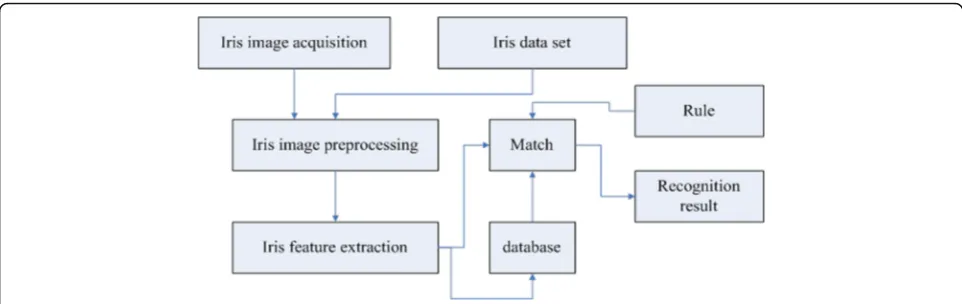
Individual identity is determined by comparing the simi-larities between features of the iris image. Image process-ing, pattern recognition, and other methods are used to describe and match the characteristics of the iris to auto-matically identify the identity. Typical iris recognition sys-tems include iris image acquisition, preprocessing, feature
extraction, and recognition. According to the above de-scription of iris recognition technology, the iris recogni-tion system framework is shown in Fig.2.
As an important branch of pattern recognition, feature extraction and pattern classification of iris recognition are two important tasks. From the perspective of feature ex-traction, the existing iris recognition algorithms can be roughly divided into three categories: based on phase method, zero crossing representation method, and texture analysis method. From the perspective of the classification mechanism of iris samples, the existing algorithms can be divided into three categories: the algorithm based on the distance classification, the method of using the correlation analysis, and the classification algorithm through machine learning. There are few algorithms for classifying using machine learning. The most popular is the use of learning vector quantization (LVQ) in the classifier.
The iris contains rich features, and it is suitable for recognition, encryption, and other fields because of its excellent quality. How to extract high-efficiency and strong distinguishing features from iris images is a key part of iris application. Iris preprocessing mainly includes iris dryness, filtering, localization, and normalization.
Fig. 1Human eye structure and human eye sample
tails such as edges and blurred contours, so smoothing noise removal is maintained as much as possible while maintaining image detail.
Smoothing usually uses Gaussian template for digital image processing. It removes point mutations for fixed point and several surrounding points to remove certain noise. The Gaussian template used in this paper is as follows:
1 16
1 2 1 2 4 2 1 2 1
In the case where the noise is not obvious, the smoothness does not contribute much to the segmenta-tion and matching of the image, but it becomes difficult to find the edge point boundary due to the problem of blurring. The purpose of sharpening the image is to make the edges and outline blurred images clear and the details clearer. From a spectral point of view, the average or integral operation of the reverse operation (such as differential operation) is usually used. The essence of the image blur is the attenuation of the high-frequency com-ponent, which can make the image clear by the high-pass filter. It should be noted that sharpening of the image must require a higher signal to noise ratio, generally eliminating or reducing noise prior to sharpen-ing. The difference method is one of the common methods of image sharpening, and the difference method is divided into two methods: first-order tial and second-order differential. Second-order differen-tial operators are more sensitive to noise and tend to enhance noise components, so smoothing operations usually use second-order differentiation. Although the edge of the sharpened image is enhanced, the increase in noise is more serious, and image smoothing can effect-ively reduce noise.
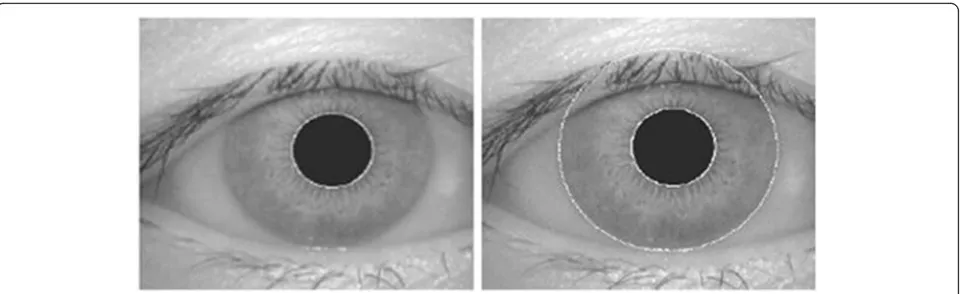
The iris feature includes a lot of noise data, although the noise reduction method can reduce the noise, but it can-not remove all the noise. For the eye sample selected in this paper (as shown in the right of Fig.1), in order to bet-ter extract the eye features, iris inner edge positioning and outer edge positioning method are used in this paper.
point of the pupil.
The outer edge of the iris is positioned by the calculus operator method. Based on the gray scale characteristics of the human eye, the sclera is white, and the iris is dar-ker. In the image, the gray scale contrast is large, so the detection of the outer boundary of the iris needs to be treated as follows on every point on the image.
(1) According to the length and width of the input image, the circle detection range of the center and the corresponding radius is determined. According to the circumferential parameters of the rough location of the outer iris boundary, the range of the value is narrowed and the positioning speed is accelerated.
(2) For all possible radii, count the gray scale average of the points on the circumference.
(3) Find the gray scale gradient of two adjacent circles. (4) Find the radius of the gray gradient jump value.
The inner and outer edges of the iris are positioned as shown in Fig.3. The left side of Fig.3is the inner edge, and the right side is the outer edge.
2.2 Deep learning theory
Deep learning is a popular research direction in recent years. Due to its unique network structure, its deepening in academic and industrial fields is often referred to as deep neural network. The deep learning network itself is an artificial neural network model, but it has improved in terms of network structure and learning algorithms than traditional artificial neural networks.
Deep learning is a new field of machine learning re-search. By establishing an artificial neural network model, it simulates the working mode of the human brain, so that it can make a correct judgment on the input information. After the deep learning network model is established, con-tinuous learning is needed to optimize the training net-work model and improve the decision-making results. It is similar to human beings who need continuous learning after birth to make more accurate judgments.
network structure is used to extract features. Regardless of the human brain’s visual mechanism or its mathemat-ical properties, the characteristics of the deep model are far superior to the shallow model extraction feature, and the use of this feature is very good for classification and recognition. In this process, the depth of the multi-layer hidden layer model is a method, and feature extraction is the purpose of deep learning.
The convolutional neural network (CNN) is proposed by Yan Lecunn and his team. It belongs to a multi-layer neural network. The original CNN is mainly for the data processing of images and other data and has achieved very advanced results. The CNN structure has three spe-cial structures: convolution, downsampling, and weight sharing. The network structure of CNN makes it very few in terms of the number of parameters relative to other network structures. Each computing layer of the network consists of multiple feature maps, each of which is mapped into a plane with a higher distortion tolerance for the input samples in the recognition.
The CNN algorithm mainly includes two stages of for-ward propagation and back propagation, which are di-vided into four steps:
The first stage, the forward transmission phase:
(1) Extract a sample (X,Yp) from the sample set and
enterXinto the network (X,Y);
(2) Calculate the corresponding actual outputOp.
In the forward propagation phase, information is con-verted from the input layer to the output layer, and the network performs the training process after completing normal operations. In this process, the network is imple-menting the calculation (actually, the input weight matrix is multiplied by each phase point, and the final output):
Op¼ Fn … F2 F1 XpWð Þ1
Wð Þ2
…
Wð Þn
ð1Þ
The second stage, the backward propagation phase:
(1) Calculate the error of the network layer outputOp
and the ideal outputYp;
(2) The weight matrix is adjusted by inverse propagation according to the algorithm such as gradient descent, and the parameters are optimized.
CNN recognizes two-dimensional graphics with distor-tion invariance in the form of displacement and scaling. The feature detection layer of CNN is learned from training data, avoiding explicit feature extraction, and learning from the training data implicitly when using CNN. In addition, the weights of neurons on the same feature mapped surfaces can be studied in parallel, which is one of the advantages of CNN relative to the neurons connected to each other. CNN has a unique ad-vantage in speech recognition and image processing. It has a special structure with local weight sharing, and the layout is closer to the actual biological neural network. The sharing of weight reduces the complexity of the net-work, especially for high-dimensional data. The input vector image can be directly input to the network fea-ture to avoid the complexity of data reconstruction in feature extraction.
2.3 Iris feature extraction method based on deep learning Deep learning can learn by unsupervised, semi supervised, or supervised methods of the original data, and extract the advanced features contained in the information. It can be used for pattern recognition, classification, and other scenes. Compared with the traditional feature extraction methods, it can produce better accuracy and achieve bet-ter application results. It is necessary to extract the fea-ture of the iris image by using the iris to generate the image encryption key. However, the traditional feature extraction method is based on the image processing or shallow learning, and the operation is cumbersome and the quality of feature extraction is poor. So the feature extraction of iris image is carried out by deep
an iris image;
(2) Iris image preprocessing to form an iris data set; (3) Using the deep learning model CNN to learn the
collected iris image dataset, including parameter initialization, model selection, and hyperparameter selection, and using the inverse gradient descent algorithm to train the model;
(4) The output matrix of the deep learning model is the extracted iris feature.
2.4 Reed-Solomon error correcting code
In the whole process of image acquisition, preprocess-ing, and feature extraction of the iris, due to many factors such as the external environment, the iris fea-ture vector obtained by the two feafea-ture extractions before and after cannot be exactly the same. Then, in the image encryption algorithm, it is necessary to en-sure that the encryption key used by the encryption side and the decryption key used by the decryption side are completely identical, so that the entire process of encryption and decryption can be success-fully implemented. This creates a serious contradic-tion: the contradiction between the inconsistency of the iris feature vector and the strict correspondence of the keys. The error correction code model can well solve this contradiction.
The Reed-Solomon error correcting code (referred to as RS code) consists of two parts: the original code and the check code. The original code contains the original data, and the check code is a data code generated after performing a certain regular operation on the original code. Due to the interference of external factors, when the original code is different, the original code can be corrected by the check code, so that the original source code can be finally obtained. The coding algorithm steps of the RS code are:
(1) Calculate themquery source polynomial table according to the relationn= 2m−1 to obtain the original polynomialp(x) corresponding toGF(2m), thereby generating an extension field ofGF(2m) and
establishing a correspondence relationship between the domain elementdand themvector.
g xð Þ ¼X2 t
i¼0
ak ið Þxi ð
3Þ
(3) Encoding the information bit polynomialM(x) according to the relationC(x) =M(x)g(x) to obtain the code word polynomialC(x).
The RS code belongs to the system linear block code, including the information bit and the supervised bit. The block code divides the continuous data bit stream into fixed-length groups, each group being further di-vided into m-bit symbols, usually taking 3 or 8 bits of
data to form a symbol. The K symbols together form a
source word, which is linearly encoded after being
encoded as a code word called an m-bit symbol block
code.
2.5 Iris image encryption and decryption method based on deep learning
The iris image encryption algorithm based on deep learning firstly performs normalization and other pre-processing on the collected iris image dataset and then uses the deep learning neural network model to extract the features of the iris image. The extracted feature vec-tor is used for key generation, and finally, the XOR oper-ation is performed on the key and the pixel value of the original image.
The encryption process can be described as the follow-ing steps:
(1) Normalizing the iris dataset and using the iris dataset to train the deep learning neural network model;
(2) The encryption side collects the iris image and inputs the trained deep learning model to extract the feature vectorV. The dimension of the feature vector V1 can be adjusted according to the adopted image encryption algorithm;
(4) Using the encryption key Vk1 and the pixel matrix gray value of the image matrix to perform XOR operation to obtain an encrypted image, the entire encryption process is completed.
The decryption process is performed after the image is encrypted by the encrypting side, and after receiving the image ciphertext and the RS error correcting code transmitted by the encrypting side, the reverse algo-rithm of the encryption algoalgo-rithm is used to realize the decryption of the ciphertext to obtain the plaintext. But the algorithm in this paper is not a complete inverse transformation. The decryption process can be de-scribed as the following steps:
(1) Performing iris image acquisition on the decryption side, inputting into the trained deep learning model, and realizing iris feature vector extraction V2;
(2) Since V2 and V1 may have different values in some dimensions, the RS error correction code is used to correct the feature vector V2 to obtain the
decryption key Vk2;
(3) Using the decryption key Vk2 to encrypt the image matrix corresponding to the gray value of the pixel to perform XOR operation, and get the decrypted image, and then complete the whole process of decryption.
2.6 Evaluation method
Iris image encryption is different from general image en-cryption algorithms and has different indicators in algo-rithm evaluation. The evaluation indexes of iris image encryption algorithm mainly include the following.
False acceptance rate and error rejection rate: The false acceptance rate (FAR) is the probability that the wrong key correctly decrypts the original image. The false rejection rate (FRR) is the probability that the original image cannot be correctly decrypted with the correct key.
System security: System security is the most import-ant indicator to measure the encryption algorithm, which restricts the feasibility of the encryption algo-rithm. It mainly includes indicators such as the prob-ability of being attacked. The specific indicators and their implementation methods will be elaborated in the experiments in the following chapters. There is a prob-ability that the attacked probprob-ability pointer will operate on the encryption system and successfully decode the plaintext. Unidirectionality refers to the ability to re-cover plaintext from all aspects of the encryption process. Discrimination refers to the successful decryp-tion performance of different irises.
3 Experiments and results 3.1 Experimental dataset
In order to improve the credibility and predictability of the algorithm, the experimental iris dataset uses the CASIA iris database public version; CASIA is the first large-scale iris shared database built by the Institute of Automation of the Chinese Academy of Sciences using the self-developed iris image acquisition device. This paper uses the CASIA version 4.0. CASIA Iris Library
Version 4.0 has added three distinctive datasets
ASIA-Iris-Distance, Thousand, CASIA-Iris-Syn based on version 3.0 and was officially released in March 2009. By the end of November 2010, there were more than 3635 applicants from more than 100 coun-tries and regions, including 522 domestic and 3113 for-eign countries, mainly in India (787), China (522), the USA (290), Britain (114), Brazil (82), France (39), and other countries. The database applicants include re-searchers from internationally renowned universities such as Harvard, MIT, CMU, and Cambridge, and other well-known international institutions, as well as R & D personnel from famous international enterprises such as Microsoft, Philips, BT (British Telecom), Sagem, and other government institutions such as the American Standardization Technology Institute and the US Naval Research Institute.
The deep learning model for feature learning of the iris uses CNN, and the dataset contains 400 images of irises in total, 10 types, 40 images per class. The CNN structure uses a five-layer network layer, the convolution process is a 5 × 5 convolution filter, and the sampling layer is a 2 × 2 pooling filter.
3.2 Experimental simulation environment
In this paper, the data simulation is carried out in the MATLAB 2014B environment.The data of each subject is divided into test set and training set according to the tenfold cross validation method. That is, the sample of the subjects was equally divided into ten parts, nine of which were training sets and one was a test set, which were calculated ten times for each sample, and the final results were averaged.
4 Discussion
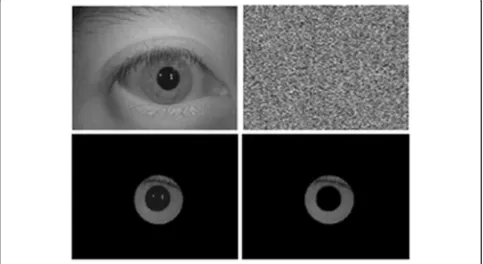
The feature extraction is performed on the iris as de-scribed above. First, the inner and outer edges of the iris are positioned, and then the iris image is encrypted. The encryption process is described in Fig. 4, and the result
of Fig. 4 shows that the original inner and outer edge
features of the iris are encrypted into a set of encrypted images that are unrecognizable in appearance.
test and training samples, the result of Fig.5shows that the precision of the training sample is higher than that of the test sample, because the training sample is the feature set of the input learning machine fitting, so the precision of the sample is higher than the test sample.
For the same person to perform feature extraction twice, two sets of feature vectors are generated. If two set of feature vectors are defined as A1 and A2, then for
the random selected n group features, the difference
index between the description feature (the difference de-greeFvalue) calculation method is as follows:
f ¼ Xn
i¼1
ffiffiffiffiffiffiffiffiffiffiffiffiffiffiffiffiffiffiffiffiffiffiffiffiffiffiffiffiffiffiffiffiffiffiffiffiffiffiffiffiffiffiffiffiffiffiffiffiffiffiffiffiffiffiffiffiffiffiffiffiffiffiffi X256
j¼1
A1ij−A2ij
=ðA1=2þA2=2Þ
v u u t 0 @
1 A
n ð4Þ
whereiandjare the number of two sample set.
Table1 shows the difference results of the deep learn-ing iris encryption features before and after encodlearn-ing. From the results of Table1, the feature extraction differ-ence of the same person collected in different cases is about 9%. The image encryption algorithm requires that the encryption key must be consistent with the decryp-tion key before it can be decipher successfully. It is said that the difference between the feature vectors is 0%, so that can successfully encrypt and decrypt as the key. Therefore, Reed-Solomon error correction code is used to solve this problem. By comparison, the extracted
Fig. 4Encryption of iris image
256-dimensional feature vector is coded and corrected by RS code, then the feature vector selectsngroups ran-domly for similarity matching and calculates the similar-ity between the feature vectors according to the formula, as shown in Table1. The results were about 0.
Figure6shows the results of image encryption and de-cryption using the iris.
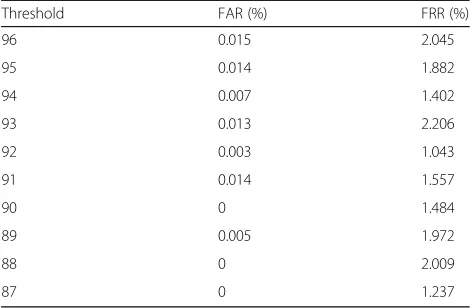
In order to verify the feasibility of the algorithm, this paper evaluates the algorithm from two aspects: decryp-tion accuracy and security. The encrypdecryp-tion algorithm re-quires that an illegal key cannot successfully decrypt the ciphertext, so the FAR must be equal to zero. Due to some unavoidable external interference during image ac-quisition, the iris image cannot be exactly the same. Therefore, the generated encryption key and decryption key cannot be completely consistent, and the legitimate user cannot be decrypted absolutely successfully, and the repeated operation is required to achieve the successful purpose.
As can be seen from Table 2, atT= 92, FAR = 0.003%, FRR = 1.043%, and the RS error correction code is encoded by (440, 256). That is to say, the illegal key can-not be successfully decrypted, and the legitimate key user has 1.043% need to perform two or more decryp-tions to achieve successful decryption.
After the encryption is completed, the ciphertext and the RS error correction code are transmitted. According to this, the plaintext reply cannot be performed, indicat-ing that the encryption algorithm has unidirectionality. When the key is attacked according to the RS error
cor-rection code, only the guess can be made. WhenT= 92,
the key with the key length of 256 is attacked by the
probability of 2–428, so the deep learning algorithm is introduced to generate the key. It can greatly reduce the chance that the key will be compromised, thus improv-ing the security of encryption.
5 Conclusions
In cryptography, the key is the key to successful encryp-tion and decrypencryp-tion. The security of informaencryp-tion de-pends on the security of the key. The traditional image encryption algorithm cannot resist the attack of mali-cious key sharing and repudiation. If the key length is too large, it will be easy to lose and it will be difficult to remember. Biometric encryption technology emerged as the times require, trying to solve the problem of poor se-curity of key. The key is generated according to the bio-metrics of the individual and then applied to the corresponding image encryption algorithm to realize the information encryption. The biological features that can be encrypted should meet the characteristics of uniqueness, stability, non-aggression, and so on. The iris not only satis-fies the requirements mentioned above, but also has rich feature information, strong anti-attack ability, and excellent encryption potential. Iris image encryption has become an
Table 1Comparison of iris characteristics
Number of groups 5 10 20 30 40
Before coding 0.93 0.92 0.91 0.89 0.89
After encoding 0 0.01 0 0 0
Fig. 6Encryption and decryption results
Table 2FAR and FRR for different thresholds
Threshold FAR (%) FRR (%)
96 0.015 2.045
95 0.014 1.882
94 0.007 1.402
93 0.013 2.206
92 0.003 1.043
91 0.014 1.557
90 0 1.484
89 0.005 1.972
88 0 2.009
encryption.
Abbreviations
CNN:Convolutional neural network; DNA: Deoxyribonucleic acid; FAR: False acceptance rate; FRR: False rejection rate; LVQ: Learning vector quantization; RS code: Reed-Solomon code
Acknowledgements
The authors thank the editor and anonymous reviewers for their helpful comments and valuable suggestions.
About the authors
Xiulai Li was born in Anqing, Anhui, People’s Republic of China, in 1992. He received bachelor’s degree from Beijing Forestry University, People’s Republic of China. Now, he studies in the College of Information Science and Technology, Hainan University. His research interest includes computational intelligence, cloud security, and information security.
Yirui Jiang was born in Zhumadian, Henan, People’s Republic of China, in 1994. She received bachelor’s degree from Zhengzhou University, People’s Republic of China. Now, she studies in the College of Information Science and Technology, Hainan University. Her research interest includes computational intelligence.
Mingrui Chen was born in Chengmai, Hainan, People’s Republic of China, in 1960. She received bachelor’s degree from South China Normal University, Hainan, People’s Republic of China. Now, he works in the College of Information Science and Technology, Hainan University, His research interests include software engineering, computer science, and information security.
Fang Li was born in Hanchuan, Hubei, People’s Republic of China, in 1968. She received bachelor’s degree from Tongji Medical University, Shanghai, People’s Republic of China. Now, she works in The Maternal and Child Health Hospital of Hainan Province; her research interests include health care and health management during pregnancy and childbirth, Internet Med, and Big data on health.
Funding
This work was supported by the funding project of A study on multiple mapping fusion Chinese and English automatic word alignment system based on multi-preprocessing mechanism takes the establishment of parallel corpus on the Chinese-English translation website of Hainan tourism text as an example (No. 20167238) and the funding project of Construction and ap-plication of female health system in Hainan (No. ZDYF2016136).
Availability of data and materials
We can provide the data.
Authors’contributions
All authors take part in the discussion of the work described in this paper. The author XL wrote the first version of the paper. The authors XL and YJ did part experiments of the paper, and MC revised the paper in different versions of the paper, respectively. All authors read and approved the final manuscript.
Competing interests
The authors declare that they have no competing interests.
1. M. Carcary, K. Renaud, S. Mclaughlin, et al., A framework for information security governance and management. IT Prof.18(2), 22–30 (2016) 2. X. Wu, N. Qi, K. Wang, et al., inIihmsp '08 International Conference on
Intelligent Information Hiding and Multimedia Signal Processing. An iris cryptosystem for information security (IEEE, Elsevier Advanced Technology Publications Oxford, 2008), pp. 1533–1536
3. J. Daugman, Information security technical report - prospectus: recognizing people by their iris patterns. Inf. Secur. Tech Rep.4, 29 (1999)
4. W. Abdul, A. Alzamil, H. Masri, et al., Fingerprint and iris template protection for health information system access and security. J. Med. Imaging Health Inform.7(6), 1302–1308 (2017)
5. S. Zhou, X. Lu, inInformation Science and Management Engineering. Fingerprint identification and its applications in information security fields (IEEE, Shaanxi, 2010), pp. 97–99
6. M.M. Mahmoud Musleh, I.I. Ba, K.M.A. Nofal, et al., Improving information security in e-banking by using biometric fingerprint: a case of major bank in Malaysia. Int. J. Comput. Sci. Inf. Secur.10(3), 1–4 (2012)
7. J. Shang, H. Huang, inInternational Conference on Computer Science and Service System. Shallow fingerprint identification information security technology in the electronic commerce application (IEEE, 2011), pp. 1684–1687
8. Ryu H. Information security attachment device for voice communication and information security method for voice communication using the same. 2016 9. L.A. Johnson, K.L. Dempsey, D. Bailey, et al., SP 800-128. Guide for security-focused configuration management of information systems. J. Dairy Sci.
77(6), 1604–1617 (2011)
10. J.G. Chouhan, N.K. Singh, P.S. Modi, et al., Camera and voice control based location services and information security on android. J. Inf. Secur.07(3), 195–205 (2016) 11. G. Cui, L. Qin, Y. Wang, et al., inIEEE International Workshop on
Anti-Counterfeiting, Security, Identification. Information security technology based on DNA computing (IEEE, Xiamen, 2007), pp. 288–291
12. G. Cui, L. Qin, Y. Wang, et al.,Information Security Technology Based on DNA Computing(2007), pp. 288–291
13. G. Cui, C. Li, H. Li, et al., inInternational Conference on Natural Computation. DNA computing and its application to information security field (IEEE Computer Society, Tianjin, 2009), pp. 148–152
14. Y. Mizuchi, Y. Hagiwara, A. Suzuki, et al.,Monocular 3D Palm Posture Estimation Based on Feature-Points Robust Against Finger Motion(2013), pp. 1014–1019 15. S. Bhilare, G. Jaswal, V. Kanhangad, et al.Single-sensor hand-vein multimodal
biometric recognition using multiscale deep pyramidal approach[J]. Machine Vision & Applications(2018) pp. 1-18.
16. Y. Rao, J. Ni, inIEEE International Workshop on Information Forensics and Security. A deep learning approach to detection of splicing and copy-move forgeries in images (IEEE, London, 2017), pp. 1–6
17. J. Ye, J. Ni, Y. Yi, Deep learning hierarchical representations for image steganalysis. IEEE Trans. Inf. Forensics Secur.12(11), 2545–2557 (2017) 18. M.E. Aminanto, K. Kim, inInternational Workshop on Information Security
Applications. Detecting impersonation attack in WiFi networks using deep learning approach (Springer, Cham, 2016), pp. 136–147
19. T.P. Le, Y. Aono, T. Hayashi, et al., inInternational Conference on Applications and Techniques in Information Security. Privacy-preserving deep learning: revisited and enhanced (Springer, Singapore, 2017), pp. 100–110
20. Z. Chen, D.O. Information, Face deep learning technology in the design and implementation of the security in colleges and universities. J. Anyang Inst. Technol.16(6),70-75(2017)
21. M. Kumar, Y.H. Mao, Y.H. Wang, T.R. Qiu, C. Yang, W.P. Zhang, Fuzzy theoretic approach to signals and systems: static systems. Inf. Sci.418, 668–702 (2017) 22. W.P. Zhang, J.Z. Yang, Y.L. Fang, H.Y. Chen, Y.H. Mao, M. Kumar, Analytical fuzzy