A model-based evaluation of the long-term cost-effectiveness of systematic case-finding
for COPD in primary care
Tosin Lambe MSc1, Peymané Adab MD1, Rachel Jordan PhD1*, Alice Sitch MSc1, Alexandra
Enocson PhD1, Kate Jolly PhD1, Jen Marsh PhD1, Richard D Riley PhD2, Martin R Miller MD1,
Brendan G Cooper PhD3, Alice M Turner PhD4, Jon Ayres MD1, Robert Stockley DSc4, Sheila
Greenfield PhD1, Stanley Siebert PhD5, Amanda Daley PhD1, KK Cheng FMedSci1, David
Fitzmaurice PhD1, Susan Jowett PhD1*
1 Institute of Applied Health Research, University of Birmingham, Birmingham, UK
2 Research Institute for Primary Care and Health Sciences, Keele University, Keele, UK
3 Respiratory Medicine, University Hospitals Birmingham, Birmingham, UK
4 Queen Elizabeth Hospital Research Laboratories, Mindelsohn Way, Birmingham, UK
5 Business School, University of Birmingham, Birmingham, UK
Corresponding authors and contact details *
Dr Rachel Jordan PhD
Reader, University of Birmingham, Birmingham,B15 2TT Email: [email protected]
Tel: +44 (0)121 414 6775
Dr Sue Jowett PhD
Reader in Health Economics, University of Birmingham, B15 2TT Email: [email protected]
Tel: +44 (0)121 414 7898
Key words
COPD; Markov model; case-finding; early diagnosis, cost-effectiveness
Abstract
Introduction: “One-off” systematic case finding for COPD using a respiratory screening questionnaire is more effective and cost-effective than routine care at identifying new cases. However, it is not known whether early diagnosis and treatment is beneficial in the longer term. We estimated the long-term cost-effectiveness of a regular case-finding programme in primary care.
Methods: A Markov decision-analytic model was developed to compare the cost-effectiveness of a 3-yearly systematic case finding programme targeted to ever smokers aged >50 years with the current routine diagnostic process in UK primary care. Patient-level data on case-finding pathways was obtained from a large RCT. Information on the natural history of COPD and treatment effects was obtained from a linked COPD cohort, UK primary care database and published literature. The discounted lifetime cost per quality-adjusted life year (QALY) gained was calculated from a health service perspective.
Results: The incremental cost-effectiveness ratio of systematic case finding versus current care was £16,596 per additional QALY gained, with a 78% probability of cost-effectiveness at a £20,000 per QALY willingness-to-pay threshold. The base case result was robust to multiple one-way sensitivity analyses. The main drivers were response rate to the initial screening questionnaire and attendance rate for the confirmatory spirometry test.
Discussion: Regular systematic case-finding for COPD using a screening questionnaire in primary care is likely to be cost-effective in the long-term despite uncertainties in treatment effectiveness. Further knowledge of the natural history of case-found patients and the effectiveness of their management will improve confidence to implement such an approach.
Key messages
What is the key question?What is the long-term cost-effectiveness of undertaking a regular programme of case-finding and early detection of COPD?
What is the bottom line?
Why read on?
Introduction
Chronic Obstructive Pulmonary Disease (COPD) is one of the most common long-term conditions with significant public health impact, costing over £1.5 billion per annum to the UK NHS1, largely
due to emergency hospital admissions among patients experiencing exacerbations and costs of maintenance medication2. Despite considerable health service use3 it is thought that perhaps half of all
subjects with this disease still remain undiagnosed4. Smoking cessation interventions,
pharmacotherapy and non-pharmacological approaches such as pulmonary rehabilitation and self-management can reduce morbidity, particularly the frequency of exacerbations, and prolong the life of diagnosed COPD patients5-9. Observed benefits might be even greater if undiagnosed patients were
found earlier and appropriate treatment commenced, although evidence to support this is currently limited10.
A number of small uncontrolled studies of different approaches to identify patients with undiagnosed COPD from primary care and other settings have been undertaken11, but there are few appropriately
designed trials to address this issue. We recently conducted the largest cluster randomised controlled trial (TargetCOPD)12 to evaluate two alternative systematic approaches to identify undiagnosed
symptomatic patients compared with routine practice (no systematic case-finding). The systematic strategies consisted of opportunistic case-finding, where a respiratory screening questionnaire was administered when eligible patients attended their primary care practice for consultation, and an active approach, where patients were additionally invited by mail to complete the same questionnaire. In both cases, symptomatic patients were then invited for diagnostic spirometry. Over the one-year trial period, active case-finding was the most effective and cost-effective approach to identify new cases (OR=7.5 [95%CI=4.80-11.55]; £333 per additional case detected) compared with routine practice.
Although short-term clinical and cost-effectiveness of a single “one-off” programme of case-finding was demonstrated, this does not necessarily translate into future long-term benefits for a regular programme. Furthermore, the results of the economic analysis (cost per case detected) are not easily comparable with results from other health programmes13. In the absence of long-term trial data,
model-based economic evaluations are needed14. We report the results of a model-based economic
evaluation of the long-term costs and benefits of a regular programme of systematic active case-finding over routine practice, using data from the TargetCOPD trial12, the linked Birmingham COPD
cohort15, a large primary care database and the published literature. The model outcome is expressed
in cost per quality-adjusted life year (QALY) gained, a measure where a cost-effectiveness decision threshold rule exists in the UK16.
A Markov decision model was built with TreeAgePro 2015 (TreeAge Software, Williamstown, MA, USA) to estimate the long-term cost-effectiveness of systematic active case-finding for COPD among ever-smokers without a prior diagnosis of COPD in primary care versus routine practice. A cost-utility analysis was undertaken, to calculate the cost per QALY gained from a health service perspective (the UK NHS).
The model was based on the methods in our published case-finding trial, using data from the most effective strategy identified in the trial (“active” case finding) compared with routine care12 17. The
population in the trial comprised ever smokers aged 40-79 years without a prior diagnosis of COPD. However, for this long-term model, we chose a starting cohort of those aged 50 years, as few patients were identified below this age in the trial12.
For the active case-finding approach, eligible patients were identified through electronic health records using a standardised search and their records “flagged”. Flagged patients were offered a respiratory symptom screening questionnaire at any routine practice visit, and were also sent the questionnaire by mail with a reply-paid envelope with up to two reminders. Patients who reported relevant chronic respiratory symptoms on the questionnaire were invited for a confirmatory spirometry test to diagnose COPD according to UK criteria18. Routine practice was defined according
to UK and international guidance19, which recommends spirometric confirmation of COPD among
those over the age of 35 years who have a risk factor (generally smoking) and who present with exertional breathlessness, chronic cough, regular sputum production, frequent winter ‘bronchitis’ or wheeze18. Case-finding was a one-off activity in the TargetCOPD trial, but in this study we have
assumed that the intervention would be repeated every three years.
Model structure
Patients without a prior COPD diagnosis in each strategy moved between 14 mutually-exclusive health states over their lifetime (Figure 1). The health states were grouped into three broad disease categories: disease-free, undiagnosed disease, diagnosed disease, dead. Patients with no airflow obstruction, either with or without respiratory symptoms, were classified as “disease free”. Those with relevant respiratory symptoms and airflow obstruction were classified as either remaining undiagnosed or becoming diagnosed. A diagnosis required either a new health record of a COPD diagnosis through routine care or receiving a diagnosis through the case-finding programme18 20.
COPD health states were defined according to the traditional GOLD severity classification with stages 1-4 based on airflow obstruction21 in line with previous Markov models on the management of
COPD22. However, the GOLD stage 4 health state was not made available for undiagnosed patients as
COPD-related events such as exacerbations23. The time horizon was 50 years assuming a maximum age of
100 years.
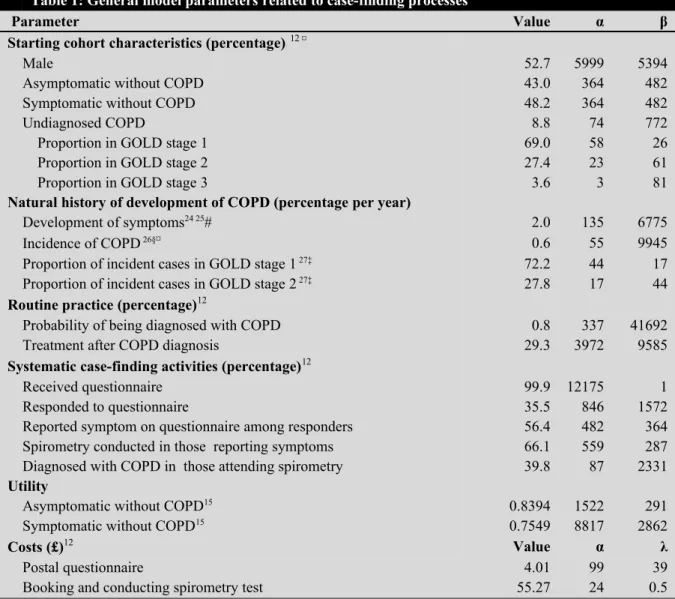
The base case starting cohort of patients was distributed across five of the thirteen health states, in line with the patient distribution observed in the TargetCOPD trial for the 50 year old age-group, where 52.7% were male (Table 1)12. 43.0% had no respiratory symptoms, 48.2% had symptoms but no
Table 1: General model parameters related to case-finding processes
Parameter Value α β
Starting cohort characteristics (percentage)12¤
Male 52.7 5999 5394
Asymptomatic without COPD 43.0 364 482
Symptomatic without COPD 48.2 364 482
Undiagnosed COPD 8.8 74 772
Proportion in GOLD stage 1 69.0 58 26
Proportion in GOLD stage 2 27.4 23 61
Proportion in GOLD stage 3 3.6 3 81
Natural history of development of COPD (percentage per year)
Development of symptoms24 25# 2.0 135 6775
Incidence of COPD 26§¤ 0.6 55 9945
Proportion of incident cases in GOLD stage 1 27‡ 72.2 44 17
Proportion of incident cases in GOLD stage 2 27‡ 27.8 17 44
Routine practice (percentage)12
Probability of being diagnosed with COPD 0.8 337 41692
Treatment after COPD diagnosis 29.3 3972 9585
Systematic case-finding activities (percentage)12
Received questionnaire 99.9 12175 1
Responded to questionnaire 35.5 846 1572
Reported symptom on questionnaire among responders 56.4 482 364 Spirometry conducted in those reporting symptoms 66.1 559 287 Diagnosed with COPD in those attending spirometry 39.8 87 2331
Utility
Asymptomatic without COPD15 0.8394 1522 291
Symptomatic without COPD15 0.7549 8817 2862
Costs (£)12 Value α λ
Postal questionnaire 4.01 99 39
Booking and conducting spirometry test 55.27 24 0.5
‡ Cohort study of Danish general population at year 0, 5 and 15 (Copenhagen City Heart Study). Of symptomatic normal at baseline that later developed COPD 15 years later, 72% and 28% had GOLD stage 1 and 2 respectively. This was assumed to be a fixed distribution
# Based on clinical opinion, it was considered that incident cases account for 10% of prevalent cases (20%) of respiratory symptoms in the UK population, which was validated using values from Eagan (2002).
§ A longitudinal observational primary care database (Dutch Integrated Primary Care Information [IPCI]) follow-up study. The incidence rate was reported in 1000 person-years, which was then converted to one-year probability.
¤ Age dependent parameters. Values presented are for 50-year-olds
Beta distribution: The symbols α and β are parameters that define a beta distribution, which is a continuous probability distribution bounded at the extremes by 0 and 1. The number of successes is α while failure is β.
Gamma distribution: The symbols α and λ are parameters that define a gamma distribution, which is a continuous discrete distribution bounded at the extremes by 0 and ∞. The mean of the distribution is α(1/λ) and variance is α(1/λ)2
(e.g. movements from GOLD 1 directly to 3 and from GOLD 2 to 4 were not allowed). Transition from an undiagnosed to a diagnosed health state was permitted, but not the reverse. Not all diagnosed patients received treatment (Figure 2). Improvements were only permitted in treated patients. Undiagnosed GOLD stage health states were assumed to have the same baseline transitions to worse undiagnosed GOLD stages as diagnosed health states. Finally, there was a risk of exacerbation and death in a 3-month time cycle within any health state. The case-finding processes were modelled as events within each health state (Figure 1). Systematic case-finding only occurred every three years, although a new diagnosis of COPD could arise through routine care in either strategy in every cycle.
Data values used in the model
Most of the data related to the process of case finding and diagnosis of COPD were derived from the active arm of the TargetCOPD trial12 and the associated Birmingham COPD cohort study15 (Table 1
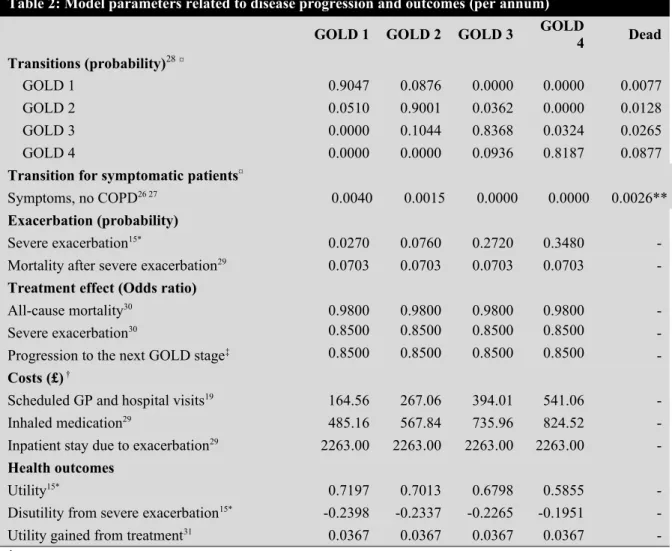
Table 2). Transition probabilities between GOLD stages were obtained from The Health Improvement Network (THIN) database, which holds longitudinal primary care information on over 11 million UK patients, including about 2 million with diagnosed COPD28 (See Supplementary material for detailed
Table 2: Model parameters related to disease progression and outcomes (per annum)
GOLD 1 GOLD 2 GOLD 3 GOLD4 Dead
Transitions (probability)28¤
GOLD 1 0.9047 0.0876 0.0000 0.0000 0.0077
GOLD 2 0.0510 0.9001 0.0362 0.0000 0.0128
GOLD 3 0.0000 0.1044 0.8368 0.0324 0.0265
GOLD 4 0.0000 0.0000 0.0936 0.8187 0.0877
Transition for symptomatic patients¤
Symptoms, no COPD26 27 0.0040 0.0015 0.0000 0.0000 0.0026**
Exacerbation (probability)
Severe exacerbation15* 0.0270 0.0760 0.2720 0.3480
-Mortality after severe exacerbation29 0.0703 0.0703 0.0703 0.0703
-Treatment effect (Odds ratio)
All-cause mortality30 0.9800 0.9800 0.9800 0.9800
-Severe exacerbation30 0.8500 0.8500 0.8500 0.8500
-Progression to the next GOLD stage‡ 0.8500 0.8500 0.8500 0.8500
-Costs (£) †
Scheduled GP and hospital visits19 164.56 267.06 394.01 541.06
-Inhaled medication29 485.16 567.84 735.96 824.52
-Inpatient stay due to exacerbation29 2263.00 2263.00 2263.00 2263.00
-Health outcomes
Utility15* 0.7197 0.7013 0.6798 0.5855
-Disutility from severe exacerbation15* -0.2398 -0.2337 -0.2265 -0.1951
-Utility gained from treatment31 0.0367 0.0367 0.0367 0.0367
-† Cost method was adapted and unit costs were updated to 2015 price year.
¤ Age depended parameters. Values presented are for 50-year-olds
* Birmingham COPD cohort: Data from the Birmingham Lung Improvement StudieS – an ongoing series of studies aimed at evaluating better strategies for identifying and managing COPD in primary care.15 Disutility data shows
utility loss over one year:50% utility loss in the first month and 25% utility loss for the second and third month per cycle. The impact of exacerbations on quality of life is greater in patients with less severe disease who also tend to be younger32.
** Value represents mortality risk in the general population
‡ Expert panel comprised consultant pulmonologists, epidemiologists and senior health economist. The panel was presented with results of prior scoping reviews on the effect of treatment on exacerbation, mortality and lung function, but there was no review transition between GOLD stages. Given that the odds ratio in reviews were around 0.85, the panel agreed then that the odds of treatment slowing disease progression to the next worse GOLD stage should be 0.85 for the base case.
For pragmatic reasons, only severe exacerbations (i.e. those requiring in-patient stay33) were
considered in this evaluation as these episodes alone account for over 84% of all COPD related healthcare costs34. The annual rate of severe exacerbations by undiagnosed and diagnosed GOLD
stage was obtained from baseline data from the Birmingham COPD cohort15. The rates were
converted to quarterly transition probabilities and beta distributions were fitted about the point estimates.
counting COPD-related mortality. Age specific all-cause mortality rates for diagnosed COPD patients were derived from the annual transition matrix generated from the THIN database (Table S7). COPD-adjusted all-cause mortality for the “disease free” cohort was derived from the UK life tables (Table S1).
Prescription patterns in UK primary care show 29.6% of COPD patients receive a LABA-based inhaled medication (excluding LAMA), 9.5% receive a LAMA-based combination (excluding LABA), and 25.0% receive combinations that include LABA+LAMA36. Treatment effects from
published systematic reviews suggest reductions in risk of exacerbations of up to 27% (OR=0.73) for some dual inhaler combinations with further reductions for triple drug combinations9. It was not
practical to model treatment effects for each COPD inhaler combination on each type of outcome, therefore, a conservative simplifying assumption was made, using the point estimates from a meta-analysis of the effect of a single LAMA versus placebo on mortality (OR=0.98) and severe exacerbation (OR=0.85)30. The published evidence was largely based on patients with a forced
expiratory volume in 1 second (FEV1)<60%, but the effect was assumed to be similar across all
GOLD stages, although emerging evidence shows that patients with FEV1>60% may have even
greater capacity to benefit from early treatment37.
Only 29.3% of newly diagnosed patients were modelled to commence treatment annually36. This
annual rate was derived from a study that showed 82.7% of COPD patients in the UK were on treatment 5 years post diagnosis. This is likely to be a conservative estimate as reports from other countries suggest treatment initiation rates to be higher38.
Utility values for undiagnosed and diagnosed GOLD stages 1 to 4 health states were derived from baseline data from the Birmingham cohort15, containing patients representative of a UK primary care
COPD population in a stable condition and also symptomatic individuals without COPD. For individuals without symptoms; utility values were derived from a published age-adjusted algorithm, developed from utility values from the general population39, as there was no utility value for
ever-smokers in the general population in the literature. The model assumed that utility loss following severe exacerbation persisted for three months, in line with a previously published model29. Disutility
was modelled to be higher in the first month (50%) compared to the second (25%) and third (25%) month, after which quality of life was assumed to return to pre-exacerbation levels. This loss was applied to mean utility scores across all the four COPD severity levels40 41.
Resource use and costs: The cost of systematic case-finding was estimated from the active arm of the TargetCOPD trial12 (Table 1, Table 2 , Table S3, Table S4, Table S5). Estimation of healthcare
costs for the diagnosed and treated GOLD stages (Table 2) followed existing costing frameworks29 41.
the Birmingham cohort. No cost was attached to routine care or comorbidities since these were assumed to be the same for both arms.
Unit costs were primarily from the Personal Social Services Research Unit (PSSRU)42, NHS reference
costs and the British National Formulary43. Costs were inflated to 2015 prices using the Hospital and
Community Health Services (HCHS) inflation index42 where necessary.
Assessment of cost-effectiveness
An incremental cost-effectiveness ratio (ICER) was calculated as a ratio of the mean difference in cost and the mean difference in QALY gained between systematic case-finding and routine practice and presented as cost per QALY gained. Discounting was applied to costs and outcomes at a rate of 3.5% in line with NICE guidance16. Where available, data were entered into the model as distributions in
order to fully incorporate the uncertainty around parameter values, so that a probabilistic sensitivity analysis could be undertaken. A gamma distribution was fitted for all cost parameters. A lognormal distribution, which accommodates the ratio nature of risk measures, was constructed for odds ratios. Beta distributions were fitted for all transition probabilities and utility estimates. The probabilistic sensitivity analysis was run with 10,000 simulations, and effectiveness planes and cost-effectiveness acceptability curves (CEAC) were produced. The CEAC is the standard method for quantifying the likelihood that an intervention is more cost-effect compared to an alternative.
Additional one-way sensitivity analyses
A series of one-way sensitivity analyses was conducted to assess how key parameters such as starting age of cohort, screening interval and time horizon affected the results. The impact of other important parameters such as questionnaire response rate, spirometry attendance rate, treatment initiation rates and the effectiveness of treatment with regards to exacerbations, mortality and quality of life gain were also explored.
Results
The base-case results for 50-year old ever smokers (Table 3) showed that compared to routine practice, a three-yearly systematic active case-finding strategy was more expensive but more effective, with a greater number of QALYs gained over a lifetime time horizon. The difference in cost was £466, with 0.0281 QALYs gained, producing an ICER of £16,596 per QALY gained.
Table 3 Base-case result Cost-Utility Analysis
Case-finding strategy Mean values Mean difference ICER
Cost (£) QALYs Cost (£) QALY (£/QALY)
Routine care 1,007.64 14.1767
Results from the probabilistic sensitivity analysis (Figure 3) showed all 10,000 resampled points were clustered in the North-East quadrant, representing instances where systematic case-finding was more expensive and more effective than routine practice. 78.4% of these points were below the £20,000/QALY willingness-to-pay threshold (WTP)16, which represents the probability of systematic
case-finding being effective at that threshold. The CEAC shows the probability of cost-effectiveness at different WTP thresholds (Figure S1)
Sensitivity analysis
Varying the age for starting screening altered both the intervention costs and the QALYs gained (Table 4). The most cost-effective age to begin screening in UK ever-smokers was estimated to be 60 years. Although the intervention costs were higher, the QALY gains from management of symptoms were also greater. Compared to younger age groups, a higher proportion of 60-year-olds had developed COPD during the first case-finding cycle, and therefore did not incur the costs associated with case-finding in subsequent cycles. The 60-year-olds were also young enough to maximally benefit from treatment of their symptoms relative to older cohorts.
Table 4: Sensitivity analysis results
Cost difference differenceQALY ICER (£/QALY)
Cohort Age
40 years 356.32 0.0184 19,373.50
50 years 465.87 0.0281 16,596.28
60 years 520.27 0.0333 15,645.62
70 years 448.61 0.0265 16,915.53
Screening Interval
1 year 910.08 0.0465 19,586.35
3 years 465.87 0.0281 16,596.28
5 years 334.09 0.0210 15,922.52
10 years 217.00 0.0143 15,219.88
Time horizon
20 years 316.94 0.0147 21,522.47
30 years 411.87 0.0226 18,206.16
40 years 458.44 0.0272 16,883.96
50 years 465.87 0.0281 16,596.28
Spirometry attendance rate
10.5% (Threshold 2) 159.21 0.0054 29,556.13
26.3 % (Threshold 1) 260.33 0.0130 20,097.49
66.1% (Base case) 465.87 0.0281 16,596.28
Questionnaire response rate
4.0% (Threshold 2) 122.88 0.0040 30,364.90
11.6% (Threshold 1) 219.19 0.0109 20,056.90
35.0% (Base case) 465.98 0.0281 16,595.80
Utility gain from treatment
0.0000 465.87 0.0115 40,456.80
0.0092 (Threshold 2) 465.87 0.0155 30,011.41
0.0269 (Threshold 1) 465.87 0.0233 19,999.67
0.0367 (Base case) 465.87 0.0281 16,596.28
Threshold 1= Willingness-to-pay threshold at £20,000 per QALY Threshold 2= Willingness-to-pay threshold at £30,000 per QALY
Questionnaire response rate after the initial invite in the TargetCOPD trial = 15% (2312/15387)Error: Reference source not found
Questionnaire response rate after the first reminder in the TargetCOPD trial = 25% (3936/15387)Error: Reference source not found
Base case values are in bold fonts
simultaneously adjusted to 1, systematic case finding was not preferred over routine practice (Figure S2), with an ICER of £28,811/QALY.
The model was also sensitive to the magnitude of the additional impact on quality of life which was independent of the impact on quality of life and survival from progression, mortality and exacerbation (Table 4). If the utility gain reduced to less than 0.0269, then systematic case finding was no longer cost-effective at £20,000/QALY. Assuming treatment had no additional impact on quality of life resulted in an ICER of £40,457/QALY. Another important determinant of cost-effectiveness was the treatment initiation rate. A systematic case-finding programme was cost-effective as long as treatment was initiated in at least 8% of previously untreated patients yearly (Figure 4).
Discussion
There are as yet no published primary studies which provide data on the long-term cost-effectiveness of a systematic programme of case finding for undiagnosed COPD. In their absence, this novel economic model aims to address this unanswered question using data from the best published sources available. We have shown that the systematic screening of ever-smokers aged 50 years and over, every 3 years is potentially a cost-effective strategy according to UK cost-effectiveness thresholds. The results were supported by the majority of the sensitivity analyses except in the most extreme scenarios. For case-finding to be cost-effective, a sufficient proportion of patients must respond to the initial screening questionnaire (12%) and attend the confirmatory spirometry test (26%). In our published trial, 15% responded after the initial invite without a reminder12 and more than 63% of
those invited attended the spirometry test. Crucially, one in twelve (8%) of previously untreated patients must also be started on treatment yearly for systematic case-finding to remain cost-effective. Data from long term follow up for the Target COPD trial suggests that twelve months after diagnosis, 21% of case-found patients in the active case-finding arm were on the practice COPD QOF register, suggesting they were likely to be receiving some treatment. Mean lifetime costs for both systematic case finding and routine care are relatively low (less than £1,500), however this can be explained by the low incidence of COPD and a relatively low proportion of undiagnosed COPD in the starting cohort. Therefore only a relatively small proportion of patients in the model will develop COPD over time and incur costs. Furthermore, in the case finding strategy, as approximately only a third of patients respond to the questionnaire, only a small proportion will actually go onto receive spirometry
and incur these additional costs
.
treatment for the intervention to be cost-effective. Second, once treatment commenced, the risk of exacerbation and mortality were simultaneously reduced. Fewer exacerbations result in lower loss in QALYs as well as cost savings from fewer admissions to hospital. Reduced risk of mortality among treated patients results in greater accumulation of QALYs compared to their untreated counterparts. Overall, mortality did not have a significant impact on the ICER because treated patients who survived longer also consumed more healthcare resources. There are also further benefits from the effect of treatment on disease progression, and we also assumed a small utility benefit of being on treatment independent of disease progression and exacerbations. If this additional benefit was removed, then case-finding was no longer cost-effective.
Ten yearly systematic active case-finding was the most cost-effective screening interval, although policymakers need to balance this against a greater proportion of the cohort remaining undiagnosed for longer and the value patients and practitioners place on early diagnosis44.
To the best of our knowledge this is the first model to evaluate the long-term cost-effectiveness of a COPD case-finding strategy. The reliability of the main data sources that informed the model was a notable strength. Patient-level data from the TargetCOPD trial, the Birmingham COPD cohort, and THIN dataset provided up-to-date information on both diagnosed and undiagnosed COPD patients in primary care in the UK.
Another strength was the use of conservative estimates of the treatment effect to prevent overestimation of the benefits of systematic case-finding. The natural history of COPD in untreated patients remains largely unknown. Here, we assumed that untreated and treated patients had the same natural history. In reality, undiagnosed patients may have a slightly poorer quality of life from sub-optimal management and the disease progression rate might be faster3 36.
This study, however does have several limitations. The first limitation is the uncertainty around the effect of treatment on progression from one GOLD stage to the next45 46. This estimate was not
available in the literature. Although some previous studies have shown that treatment slows lung function decline (for example changes in FEV1)47 48 <sup>2,3</sup>, there is currently no clear
method for transforming changes in FEV1 decline into risk ratios that could be used in this model. Nonetheless, the reduced lung function decline in treated patients is an indication that treatment may reduce risk of progressing to a worse GOLD stage. However, in order to explore the uncertainty regarding the impact of treatment, extensive sensitive analyses were undertaken.
improve HRQoL and reduce exacerbations, were not considered. Inclusion of other interventions would have made systematic case-finding more cost-effective but few patients receive these interventions, thereby making their wider benefit uncertain.
Another possible weakness is the use of the traditional GOLD staging criteria50 as airflow obstruction
relates only weakly to quality of life. For instance, some patients with GOLD stage 2 may experience worse symptoms and impact than those with GOLD stage 3. Other symptom-based classification systems that are better predictors of prognosis now exist51. However there is no consensus regarding
the most appropriate staging criteria and the GOLD staging used here was the one used in previous literature which has informed inputs for assumptions used in the model.
We have also assumed that transitions between GOLD stages, exacerbation rates and utility values for undiagnosed states are the same as diagnosed (and untreated) GOLD stage health states. However, this assumption is supported by findings from cohort studies (e.g. the Can COLD study) that show that those with undiagnosed COPD have similar rates of health service use related to respiratory disease as those who have diagnosed COPD3.
Despite this, a further weakness lies in the assumption made regarding costs of undiagnosed disease. Only COPD-related costs are taken into account rather than all-cause costs. This may underestimate costs in the undiagnosed states, where there may be greater health care utilisation (e.g. primary care visits) due to COPD but the costs are not yet related to the condition. We also assume that untreated patients do not incur any healthcare cost until an admission for severe exacerbation occurs, whereas it is likely that some would have received prescriptions for their symptoms. However, it would be difficult to estimate these additional health care costs, and the conservative approach we have taken means that it is likely that case-finding would be more cost-effective with their inclusion.
earlier diagnosis and the overall financial impact on primary healthcare organisations of a much larger population of COPD patients to manage. Should a new programme of case-finding be implemented, a clear pathway of care would need to be provided in order to ensure newly diagnosed patients are optimally treated, as current data suggest that this is seldom the case37.
Conclusion
We conclude that a three-yearly systematic approach to case-finding is likely to be cost-effective in the long term given the current management of COPD patients in primary care setting. The true importance of early diagnosis and treatment of COPD will be better understood as more evidence emerges on the effect of treatment on COPD and the longer-term results of case-finding trials are available. Longer-term follow-up of newly diagnosed patients may also further clarify the natural history of COPD.
Figure legends
Figure 1: Transitions between model health states
Figure 2: Example of pathway for an undiagnosed patient with GOLD stage 3 during a 3-month systematic case-finding cycle
Figure 3 Cost-effectiveness plane for the comparison of systematic case-finding with routine care, based on 10,000 cost-effect pairs
NOTES
Acknowledgements
This paper summarises independent research funded by the National Institute for Health Research (NIHR) under its Programme Grants for Applied Research (grant reference number RP-PG-0109-10061). The views expressed are those of the authors and not necessarily those of the National Health Service (NHS), the NIHR, or the Department of Health. The original TargetCOPD trial was part of the Birmingham Lung Improvement Studies (BLISS) and we thank the GPs, patients and BLISS research team for making the trial possible, and Andy Dickens for providing data from the BLISS cohort study. We thank IMS Health for use of the THIN data.
Declared interests
KKC reports grants from Pfizer China, outside of the submitted work. RS reports personal fees from Boehringer Ingelheim, personal fees from GSK, personal fees from Chiesi, personal fees from Takeda, personal fees from Novartis, personal fees from Polyphor, grants from CSL Behring, grants from Talecris, and personal fees from Dyax, outside of the submitted work. AMT reports grants from Linde REAL fund, grants from Alpha 1 Foundation, non-financial support from GSK, non-financial support from Boehringer Ingelheim, personal fees and non-financial support from Chiesi, and personal fees and non-financial support from AZ, outside of the submitted work. SJ, PA, REJ, KKC, MRM KJ, RDR, DF, SS, AD, BGC, RS, JA and SG report grants from NIHR, during the conduct of the study. Other authors declare no competing interests.
Contributions of Authors
and model pathways. PA, REJ, DF, JA, KKC, SJ, KJ, RDR, MRM, BGC, RS, SG, SS, AD, JM as the original co-investigator team had input in the study set up. All authors had input into the analysis and interpretation of the model, and edited the manuscript.
I, the Submitting Author has the right to grant and does grant on behalf of all authors of the Work (as defined in the below author licence), an exclusive licence and/or a non-exclusive licence for
contributions from authors who are: i) UK Crown employees; ii) where BMJ has agreed a CC-BY licence shall apply, and/or iii) in accordance with the terms applicable for US Federal Government officers or employees acting as part of their official duties; on a worldwide, perpetual, irrevocable, royalty-free basis to BMJ Publishing Group Ltd (“BMJ”) its licensees and where the relevant Journal is co-owned by BMJ to the co-owners of the Journal, to publish the Work in Thorax and any other BMJ products and to exploit all rights, as set out in our
http://authors.bmj.com/submitting-your-paper/copyright-and-authors-rights.
References
1. McLean S, Hoogendoorn M, Hoogenveen RT, et al. Projecting the COPD population and costs in England and Scotland: 2011 to 2030. Sci Rep 2016;6:31893. doi: 10.1038/srep31893 [published Online First: 2016/09/02]
2. Mahon J, Bartlett C, Isojarvi J, et al. Literature review: the economic costs of lung disease and the cost effectiveness of policy and service interventions [Report of literature review]. British Lung Foundation; 2017 [updated October 2017. Available from:
https://www.brit- thoracic.org.uk/document-library/research-and-innovation/documents/literature-review-the-economic-costs-of-lung-disease/ accessed 25 April 2018.
3. Labonte LE, Tan WC, Li PZ, et al. Undiagnosed Chronic Obstructive Pulmonary Disease Contributes
to the Burden of Health Care Use. Data from the CanCOLD Study. Am J Respir Crit Care Med
2016;194(3):285-98. doi: 10.1164/rccm.201509-1795OC [published Online First: 2016/02/03]
4. Jordan RE, Lam KB, Cheng KK, et al. Case finding for chronic obstructive pulmonary disease: a model for optimising a targeted approach. Thorax 2010;65(6):492-8. doi:
10.1136/thx.2009.129395 [published Online First: 2010/06/05]
5. McCarthy B, Casey D, Devane D, et al. Pulmonary rehabilitation for chronic obstructive pulmonary disease. Cochrane Database Syst Rev 2015(2):CD003793. doi:
10.1002/14651858.CD003793.pub3 [published Online First: 2015/02/24]
6. Zwerink M, Brusse-Keizer M, van der Valk PD, et al. Self management for patients with chronic obstructive pulmonary disease. Cochrane Database Syst Rev 2014(3):CD002990. doi: 10.1002/14651858.CD002990.pub3 [published Online First: 2014/03/26]
7. Godtfredsen NS, Vestbo J, Osler M, et al. Risk of hospital admission for COPD following smoking cessation and reduction: a Danish population study. Thorax 2002;57(11):967-72. [published Online First: 2002/10/31]
8. Puhan MA, Gimeno-Santos E, Cates CJ, et al. Pulmonary rehabilitation following exacerbations of
chronic obstructive pulmonary disease. Cochrane Database Syst Rev 2016;12:CD005305. doi:
9. Nannini LJ, Poole P, Milan SJ, et al. Combined corticosteroid and long-acting beta(2)-agonist in one inhaler versus placebo for chronic obstructive pulmonary disease. Cochrane Database Syst
Rev 2013(11):CD003794. doi: 10.1002/14651858.CD003794.pub4 [published Online First:
2013/11/12]
10. Guirguis-Blake JM, Senger CA, Webber EM, et al. Screening for Chronic Obstructive Pulmonary Disease: Evidence Report and Systematic Review for the US Preventive Services Task Force.
Jama 2016;315(13):1378-93.
11. Haroon SM, Jordan RE, O'Beirne-Elliman J, et al. Effectiveness of case finding strategies for COPD in primary care: a systematic review and meta-analysis. NPJ Prim Care Respir Med
2015;25:15056.
12. Jordan RE, Adab P, Sitch A, et al. Targeted case finding for chronic obstructive pulmonary disease versus routine practice in primary care (TargetCOPD): a cluster-randomised controlled trial.
The Lancet Respiratory Medicine 2016;4(9):720-30.
13. Van Boven J. COPD case finding: effective, but also cost-effective? Lancet Respir Med
2016;4(10):49.
14. Briggs A, Sculpher M, Claxton K. Decision modelling for health economic evaluation: OUP Oxford 2006.
15. Adab P, Fitzmaurice DA, Dickens AP, et al. Cohort Profile: The Birmingham Chronic Obstructive Pulmonary Disease (COPD) Cohort Study. Int J Epidemiol 2017;46(1):23. doi:
10.1093/ije/dyv350 [published Online First: 2016/07/06]
16. National Institute for Health and Care Excellence (NICE). Guide to the Methods of Technology Appraisal. In: NICE, ed. United Kingdom: NICE, 2013.
17. Jordan RE, Adab P, Jowett S, et al. TargetCOPD: a pragmatic randomised controlled trial of targeted case finding for COPD versus routine practice in primary care: protocol. BMC Pulm
Med 2014;14:157. doi: 10.1186/1471-2466-14-157 [published Online First: 2014/10/05]
18. National Institute for Health and Care Excellence (NICE). Chronic obstructive pulmonary disease in over 16s: diagnosis and management. NICE guideline [NG115]: NICE; 2018 [Available from: https://www.nice.org.uk/guidance/NG115 accessed December 2018.
19. National Institute for Health and Care Excellence (NICE). Chronic Obstructive Pulmonary Disease (COPD) costing report: Implementing NICE guidance [CG101]. London, United Kingdom WC1V 6NA: National Institute for Health and Care Excellence (NICE),, 2011.
20. Agusti A, Celli BR, Chen R, et al. Global Strategy for the Diagnosis, Management, and Prevention of Chronic Obstructive Lung Disease (2018 Report). GOLD strategy: Global Initiative for Chronic Obstructive Lung Disease, Inc (GOLD), 2018.
21. GOLD. 2015 report: Global Strategy for the Diagnosis, Management, and Diagnosis of Chronic Obstructive Pulmonary Disease (GOLD) 2015 [Available from:
http://www.goldcopd.org/uploads/users/files/GOLD_Report_2015_Sept2.pdf. [Archive https://goldcopd.org/archived-reports/ ] accessed 10 October 2015.
22. Hoogendoorn M, Feenstra TL, Asukai Y, et al. Cost-effectiveness models for chronic obstructive pulmonary disease: cross-model comparison of hypothetical treatment scenarios. Value Health 2014;17(5):525-36. doi: 10.1016/j.jval.2014.03.1721 [published Online First: 2014/08/17]
23. Hoogendoorn M, Feenstra TL, Hoogenveen RT, et al. Association between lung function and exacerbation frequency in patients with COPD. Int J Chron Obstruct Pulmon Dis 2010;5:435-44.
24. NatCen Social Research RFaUCMS, Department of Epidemiology and Public Health,. Health Survey for England, 2010. [data collection]. [data collection]. 3rd Edition. UK Data Service. SN: 6986. http://doi.org/10.5255/UKDA-SN-6986-3, 2015.
26. Afonso AS, Verhamme KM, Sturkenboom MC, et al. COPD in the general population: prevalence, incidence and survival. Respir Med 2011;105(12):1872-84. doi: 10.1016/j.rmed.2011.06.012 [published Online First: 2011/08/20]
27. Vestbo J, Lange P. Can GOLD Stage 0 provide information of prognostic value in chronic obstructive pulmonary disease? Am J Respir Crit Care Med 2002;166(3):329-32.
28. James GD, Donaldson GC, Wedzicha JA, et al. Trends in management and outcomes of COPD patients in primary care, 2000-2009: a retrospective cohort study. NPJ Prim Care Respir Med
2014;24:14015. doi: 10.1038/npjpcrm.2014.15 [published Online First: 2014/07/06]
29. Dretzke J, Blissett D, Dave C, et al. The cost-effectiveness of domiciliary non-invasive ventilation in patients with end-stage chronic obstructive pulmonary disease: a systematic review and economic evaluation. Health Technol Assess 2015;19(81):1-246.
30. Karner C, Chong J, Poole P. Tiotropium versus placebo for chronic obstructive pulmonary disease.
Cochrane Database Syst Rev 2014(7):CD009285. doi: 10.1002/14651858.CD009285.pub3 [published Online First: 2014/07/22]
31. Briggs AH, Lozano-Ortega G, Spencer S, et al. Estimating the cost-effectiveness of fluticasone propionate for treating chronic obstructive pulmonary disease in the presence of missing data. Value Health 2006;9(4):227-35. doi: 10.1111/j.1524-4733.2006.00106.x [published Online First: 2006/08/15]
32. Menn P, Weber N, Holle R. Health-related quality of life in patients with severe COPD hospitalized for exacerbations - comparing EQ-5D, SF-12 and SGRQ. Health Qual Life Outcomes 2010;8:39.
33. Rodriguez-Roisin R. Toward a consensus definition for COPD exacerbations. Chest 2000;117(5 Suppl 2):398S-401S.
34. Starkie HJ, Briggs AH, Chambers MG. Pharmacoeconomics in COPD: lessons for the future. Int J Chron Obstruct Pulmon Dis 2008;3(1):71-88.
35. Office for National Statistics (ONS). Death registrations summary tables - England and Wales: Office for National Statistics (ONS),; 2016 [updated July 18, 2018. Available from: https://www.ons.gov.uk/peoplepopulationandcommunity/birthsdeathsandmarriages/ deaths/datasets/deathregistrationssummarytablesenglandandwalesreferencetables accessed November 24 2017.
36. Price D, West D, Brusselle G, et al. Management of COPD in the UK primary-care setting: an analysis of real-life prescribing patterns. Int J Chron Obstruct Pulmon Dis 2014;9:889-904. 37. Zhou Y, Zhong NS, Li X, et al. Tiotropium in Early-Stage Chronic Obstructive Pulmonary Disease. N
Engl J Med 2017;377(10):923-35.
38. Barrecheguren M, Monteagudo M, Ferrer J, et al. Treatment patterns in COPD patients newly diagnosed in primary care. A population-based study. Respiratory Medicine 2016;111:47-53. 39. Ara R, Brazier JE. Populating an economic model with health state utility values: moving toward
better practice. Value in Health 2010;13(5):509-18.
40. Rutten-van Molken MP, Oostenbrink JB, Miravitlles M, et al. Modelling the 5-year cost effectiveness of tiotropium, salmeterol and ipratropium for the treatment of chronic obstructive pulmonary disease in Spain. Eur J Health Econ 2007;8(2):123-35.
41. Jordan RE, Majothi S, Heneghan NR, et al. Supported self-management for patients with moderate to severe chronic obstructive pulmonary disease (COPD): an evidence synthesis and economic analysis. Health Technol Assess 2015;19(36):1-516. doi: 10.3310/hta19360 [published Online First: 2015/05/20]
42. Curtis LA, Burns A. Unit Costs of Health and Social Care 2015 Canterbury, UK: Personal Social Services Research Unit, University of Kent; 2015 [accessed October 27 2015.
44. Summers RH, Sharmeen T, Lippiett K, et al. A qualitative study of GP, nurse and practice manager views on using targeted case-finding to identify patients with COPD in primary care. NPJ Prim Care Respir Med 2017;27(1):49.
45. Rennard SI, Vestbo J. Natural histories of chronic obstructive pulmonary disease. ProcAmThoracic Soc 2008;5(9):878-83.
46. Kohansal R, Martinez-Camblor P, Agusti A, et al. The natural history of chronic airflow obstruction revisited: an analysis of the Framingham offspring cohort. Am J Respir Crit Care Med
2009;180(1):3-10.
47. Celli BR, Thomas NE, Anderson JA, et al. Effect of pharmacotherapy on rate of decline of lung function in chronic obstructive pulmonary disease: results from the TORCH study. Am J Respir Crit Care Med 2008;178(4):332-8.
48. Geake JB, Dabscheck EJ, Wood-Baker R, et al. Indacaterol, a once-daily beta2-agonist, versus twice-daily beta2-agonists or placebo for chronic obstructive pulmonary disease. Cochrane Database of Systematic Reviews 2015;1:CD010139.
49. Anthonisen NR, Connett JE, Kiley JP, et al. Effects of smoking intervention and the use of an inhaled anticholinergic bronchodilator on the rate of decline of FEV1. The Lung Health Study.
Jama 1994;272(19):1497-505.
50. Rabe KF, Hurd S, Anzueto A, et al. Global strategy for the diagnosis, management, and prevention of chronic obstructive pulmonary disease: GOLD executive summary. Am J Respir Crit Care
Med 2007;176(6):532-55.