R E S E A R C H
Open Access
Consequences of screening in abdominal
aortic aneurysm: development and
dimensionality of a questionnaire
John Brodersen
1,2*, Anders Hansson
3,5, Minna Johansson
4,5, Volkert Siersma
1, Marcus Langenskiöld
6and Monica Pettersson
7Abstract
Background:In interview studies, men under surveillance for screening-detected abdominal aortic aneurysms have reported ambivalence towards this diagnosis: the knowledge was welcomed together with worries, feelings of anxiety and existential thoughts about life’s fragility and mortality due to the diagnosis. Previous surveys about health-related quality of life aspects among men under surveillance for screening-detected aneurysm have all used generic patient-reported outcomes. Therefore, the aim of this study was to extend the core-questionnaire
Consequences of Screening for use in abdominal aortic aneurysm screening by testing for comprehension, content coverage, dimensionality, and reliability.
Methods:In interviews, the suitability, content coverage, and relevance of the core-questionnaire Consequences of Screening were tested on men under surveillance for a screeningdetected abdominal aortic aneurysm. The results were thematically analysed to identify the key consequences of abnormal screening results. Item Response Theory and Classical Test Theory were used to analyse data. Dimensionality, differential item functioning, local response dependency and reliability were established by item analysis, examining the fit between item responses and Rasch models.
Results:The core-questionnaire Consequences of Screening was found to be relevant for men offered regular follow-up of an asymptomatic screening-detected abdominal aortic aneurysm.
Fourteen themes especially relevant for men diagnosed with a screening-detected abdominal aortic aneurysm were extracted from the interviews:‘Uncertainty about the result of the ultra sound examination’,‘Change in body perception’,‘Guilt’,‘Fear and powerlessness’,‘Negative experiences from the examination’,‘Emotional reactions’,
‘Change in lifestyle’,‘Better not knowing’,‘Fear of rupture’,‘Sexuality’,‘Information’,‘Stigmatised’,‘Self-blame for smoking’,‘Still regretful smoking’. Altogether, 55 new items were generated: 3 were single items and 13 were only relevant for former or current smokers. 51 of the 52 items belonging to a theme were confirmed to fit Rasch models measuring fourteen different constructs. No differential item functioning and only minor local dependency was revealed between some of the 51 items.
Conclusions:The reliability and the dimensionality of a condition-specific measure with high content validity for men under surveillance for a screening-detected abdominal aortic aneurysm have been demonstrated. This new questionnaire called COS-AAA covers in two parts the psychosocial experience in abdominal aortic aneurysm screening.
* Correspondence:[email protected]
1
Section and Research Unit for General Practice, Department of Public Health, Faculty of Health Sciences, University of Copenhagen, Øster Farimagsgade 5, P. O. Box 2099, DK-1014 Copenhagen, Denmark 2Primary Health Care Research Unit, Sorø, Zealand Region, Denmark Full list of author information is available at the end of the article
Background
Abdominal aortic aneurysm (AAA) is a life-threatening condition that may lead to death due to sudden rupture of the aorta. Risk factors for developing AAA are smoking, male sex, advanced age and family history [1]. Therefore, prevention of AAA and its complications is done by smok-ing cessation (primary prevention) and early detection via screening (secondary prevention). Screening for AAA re-duces AAA-related mortality by reducing the number of AAA-ruptures [2] and has therefore been introduced in Sweden, the US and the UK during the last two decades [3]. Approximately 50% of screening-detected AAA will in 5 years reach an aortic diameter for which surgery is recommended [4]. It is suggested that approximately 45% of men with screening-detected AAAs are overdiagnosed because their aneurysm would never have led to symptoms or death [2,3]. These men have to live with the fear of a life-threatening condition and are offered regular ultra-sound surveillance throughout their remaining life [5]. No condition-specific questionnaire to measure psychosocial aspects or quality of life of participants in AAA screening is available. The development and validation of such an in-strument would be of great importance in evaluating the balance between the potential benefits and the potential harms of AAA screening. Moreover, such an instrument could also potentially lead to an improvement of the care and information given to men attending aortic surveillance programmes.
In interview studies, men under surveillance for screening-detected AAAs have reported ambivalence to-wards the knowledge of having an AAA and toto-wards lines of actions because of the condition. The knowledge was welcomed together with worries, feelings of anxiety and ex-istential thoughts about life’s fragility and mortality due to the diagnosis. These men experienced anxiety about the risk of rupture [6–10]. However, because these studies are quali-tative they cannot estimate the degree or extent of psycho-social harms. We have identified six quantitative studies about psychological aspects and quality of life (QoL) follow-ing the diagnosis of a screenfollow-ing-detected AAA [11–16]. One study displayed decreases in QoL 12 months after screening [15]. The other five studies indicated no clinically important decrease in QoL compared to unscreened men [11–14, 16]. However, each of these studies used generic questionnaires to measure the psychological aspects and QoL, e.g. SF-36, ScreenQL, EQ-5D and HADS [11–16]. Generic questionnaires may have lack of content validity compared to condition-specific questionnaires [17,18]. This means that aspects that might be specifically important for men with screening-detected AAAs are lacking, e.g. anxiety about rupture during sexual activity. Additionally, aspects irrelevant for this specific group can lead to incorrect infer-ences [17,18]. Therefore, the use of generic instruments is questioned in a screening context [19–21]. The lack of
studies using condition-specific questionnaires is pointed out in two recent systematic reviews [1,22].
Three condition-specific questionnaires with high con-tent validity and adequate psychometric properties (using Rasch modelling) have previously been developed by Bro-dersen et al., to measure short and long term psychosocial consequences in breast cancer screening (the Consequence of Screening in Breast Cancer (COS-BC)) [23, 24], in lung cancer screening (Consequence of Screening in Lung Cancer (COS-LC)) [25] and in cervical cancer screening (Consequence of Screening in Cervical Cancer (COS-CC)) [26]. In the qualitative studies conducted when developing these three measures a common core-questionnaire COS was revealed. Moreover, some of the informants perceived the cancer they were screened for as a non-communicable life threatening disease [23,25,26]. Also the men who took part in our previously conducted qualitative study had a perception of being under surveillance for a non-communicable life threatening disease, e.g. by some of the men described as“a ticking bomb inside your stomach” [7]. An unanswered question is if COS is also relevant in a setting of AAA screening. Therefore, the aim of the present study was threefold:
1. to examine the content relevance and content coverage of the core items of the COS in a setting of AAA screening among men under surveillance for a screening-detected AAA;
2. if lack of content coverage of the COS was revealed, to generate themes and new items especially relevant for men under surveillance for a screening-detected AAA and to test the items for suitability; 3. if new items were generated, to test the extended
version of the COS for dimensionality using Item Response Theory Rasch models.
Methods
Data collection: Interviews about content relevance and content coverage of the COS for application in AAA screening
Fifteen men with screening-detected AAA were recruited in 2010 for single interviews [7]. In the present study, these men were re-invited in groups of five to participate in three group interviews that took place on August and September 2012. From 2010 to 2012 all 15 men had had at least one follow-up ultrasound examination. The group interviews took place in a non-hospital setting.
validated Swedish version of the COS has been published and was used in this study [27]. The potential AAA-screening-specific items together with the COS items were tested in the first group interview for relevance. If the potential AAA-screening-specific items were found relevant they were thereafter regarded as ‘new’ items in an AAA context.
The group interviews consisted of two parts: first, an open-ended discussion on the psychosocial consequences of being diagnosed with an AAA via screening. The con-ceptualisation of ‘psychosocial consequences’ was based on Engel’s the bio-psycho-social model [28]. Second, the participants were asked to complete a draft of a question-naire encompassing: the COS, the potentially AAA-screening-specific items plus any newly generated items from the previously open-ended discussion(s). After completing the draft of the questionnaire the group partic-ipants were asked to discuss if these items had been–or were – relevant for them at any time during the period from their first screening visit until now.
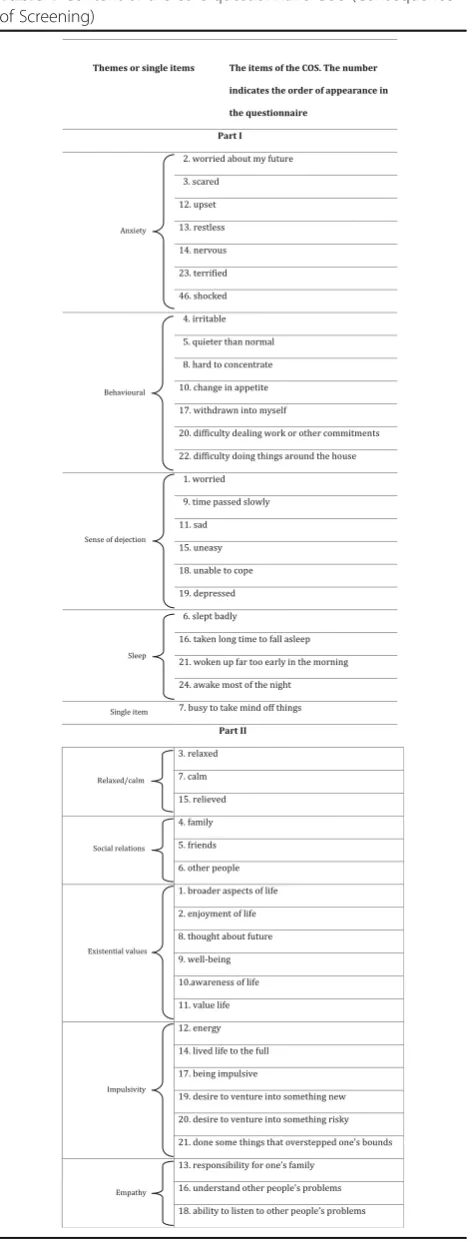
COS consists of two parts. Part I of the COS encompasses one single item and four dimensions, in total 25 items [23– 25]. If some of the potentially AAA-screening-specific items were found relevant and if new items were generated in the open-ended discussions, the participants in the following group interviews would be asked to complete a draft to a new questionnaire called COS-AAA (Consequences Of Screening in Abdominal Aortic Aneurysm) encompassing: relevant items from the COS plus items identified in the pre-ceding group interviews. Part II of the COS encompasses six dimensions including 23 items [23, 25]. The theme“breast/ lung/cervical cancer”encompassing two items in Part II was for obvious reasons deleted from the part II of the COS. The COS-items are ordered thematically in Table1.
In the group interviews, cognitive interviewing was also carried out item-by-item and covered understand-ability and content coverage [29,30].
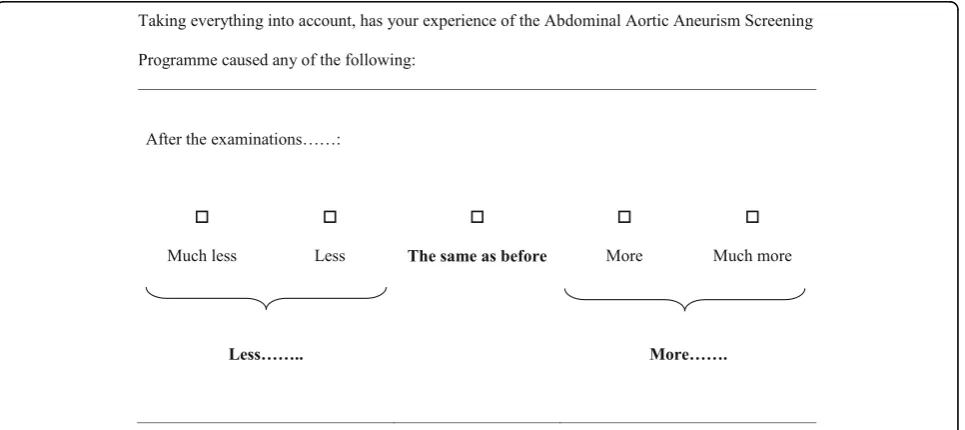
The response options were also reviewed for relevance and ease of completion. In part I there are four ordinal categorical response options: ‘Not at all’,‘A bit’,‘Quite a bit’and‘A lot’(Fig.1). The five response options in part II: ‘Much less’, ‘Less,’ ‘The same as before’, ‘More’ and
‘Much more’ are also ordinal categorical variables that are partially ordered (Fig.2).
The COS-BC part II was developed so that each item in-cluded response options indicating‘no change’as an anchor relative to two other options of changes in opposing direc-tions. It follows that any change from‘The same as before’ is to be regarded as a long-term psychosocial consequence of an abnormal screening result [25,31]. Therefore, the re-sponses to part II should be recoded: a response to‘Much less’or‘Much more’becomes a response to one variable of
‘much less/more change’, a response to‘Less’or‘More’ be-comes a response to one variable of‘less/more change’and
finally a response to ‘The same as before’ becomes a re-sponse to a variable of‘no change’[25,31].
The group interviews were audio-recorded. After each interview the recording was independently audited by two authors conducting thematic analyses to determine the key psychosocial consequences. In the subsequent group interviews the identified themes were discussed. Further-more, the participants’ verbatim comments were used to define a construct, e.g. negative experiences from the
examination.
Data collection for statistical psychometric analyses The draft of the COS-AAA was posted from January to April 2013 to 250 men who had been diagnosed with an AAA via screening and 500 men who had received a normal screening result. Eligible were men who had participated in Västra Götaland’s AAA screening programme aged 65 years. The men were asked to complete the questionnaire and return it in an enclosed stamped addressed envelope.
Psychometric statistical analyses
To provide measurement of psychosocial consequences consistent with Rasch philosophy, the scales calculated from the data collected for psychometric analysis should fit a partial credit Rasch model [32]. If a scale did not fit this model, the data were used to identify particular problems and to give directions how to adjust the scales so as to repair these.
Overall assessment of a scale’s homogeneity and differ-ential item functioning (DIF) was evaluated by Andersen’s conditional likelihood ratio test [33]. Homogeneity was tested by comparing the two subgroups in the data de-fined by a dichotomisation of the total score on all items. DIF was tested by comparing the subgroups defined by the categories of specific exogenous variables: screening result, social group, education level, income and mother tongue. Local response dependency (LD) was identified using graphical log-linear Rasch models (GLLRM) [34].
If the overall tests indicated problems with the Rasch model fit of a scale, the individual items were investigated;
Fig. 1The layout and response categories for part I of the Consequences of Screening questionnaire
GLLRMs were employed here where specific tests for conditional independence identify particular problems [34]. Individual item attribution to the heterogeneity of the scale was assessed by conditional infits and outfits. Infits are chi-square statistics with each observation weighted by its statistical information; they are sensitive to patterns of re-sponses by persons on items that are targeted on them. Out-fits are conventional chi-square statistics; they are sensitive to responses by persons on items that are very easy or very hard for them [35]. By analysis of the association between items and theirrest-scores,i.e. the total score with the corre-sponding item removed; an item shows misfit if this associ-ation is different from the associassoci-ation expected in a Rasch model [34,35]. DIF in individual items relative to the afore-mentioned exogenous variables was assessed by a test for the association between the items and the exogenous variables adjusted for the total score [36]. Likewise, LD was assessed by the association between item pairs adjusted for the appro-priate rest-score [34, 37]. In these accounts, the Benjamini-Hochberg procedure was used to account for multiple testing [38]. Items exhibiting the most problematic behaviour relative to the above tests were deleted from the scales sequentially until the scale fitted the Rasch model, e.g. the functionality of the item’s response categories [25].
Reliability was assessed by Cronbach’s alpha [39,40]. All analyses were carried out using DIGRAM [41]. The single items were not included in the Rasch ana-lyses because these items did not belong to any theme.
The study was partly funded by FoUU-centrum Fyrbodal. The study was approved by the Regional Ethical Review Board in Gothenburg. Informed consent was obtained from all individual participants included in the study.
Results
Results from the interviews
Five (100%), four (80%) and two (40%) men accepted each to participate in group interviews.
The items in the COS were all found relevant by the participants. Fourteen themes especially relevant for men diagnosed with a screening-detected AAA were extracted from the interviews: ‘Uncertainty about the result of the ultra sound examination’, ‘Change in body perception’,
‘Guilt’,‘Fear and powerlessness’,‘Negative experiences from the examination’,‘Emotional reactions’,‘Change in lifestyle’,
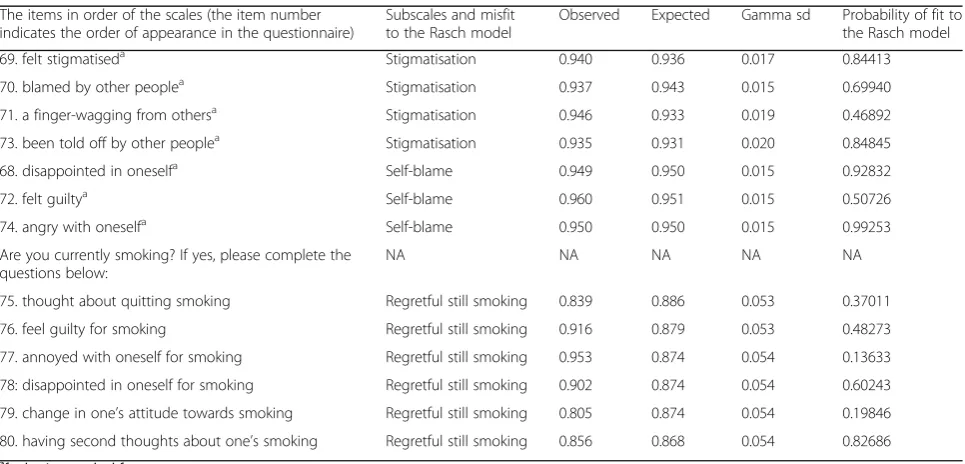
‘Better not knowing’,‘Fear of rupture’,‘Sexuality’,‘ Informa-tion’,‘Stigmatised’,‘Self-blame for smoking’,‘Still regretful smoking’(Table 2). The latter three themes: ‘Stigmatised’,
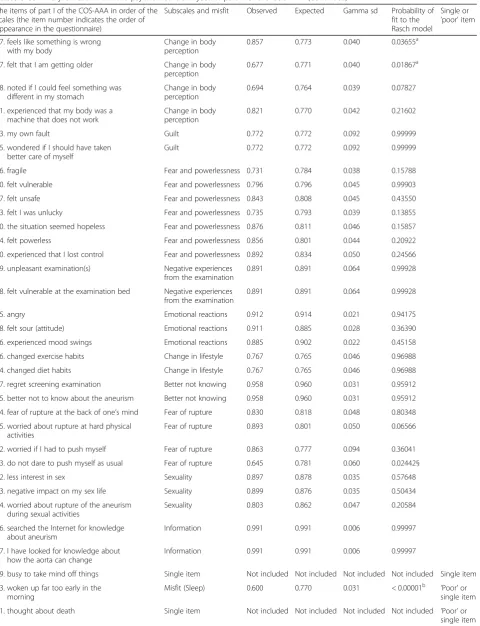
‘Self-blame for smoking’,‘Still regretful smoking’were only relevant for former or current smokers. Altogether, 55 AAA-screening-specific items for part I were generated of which 3 were single items and 13 were only relevant for former or current smokers (Tables 3 and 4). The 14 themes and the subject matter for all 55 AAA-screening-specific items were generated in the first
group interview and accepted in the following group inter-views. The response options were found relevant, compre-hensive and easy to complete.
Results of the data collection for the statistical psychometric analyses
158 (63%) men with screening-detected AAA and 275 (55%) men with normal screening results returned the questionnaire. These 433 completed questionnaires were used in all analysis unless otherwise noted.
Results from the psychometric statistical analyses Part I
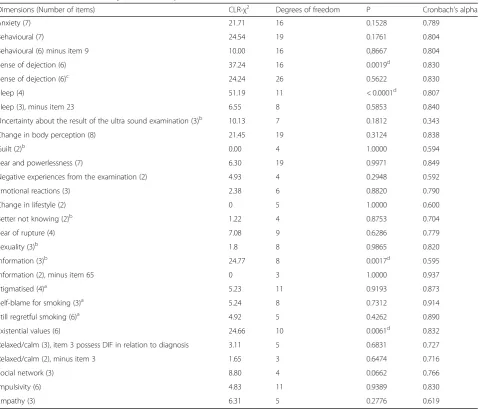
Dimensionality of part I of the core-questionnaire COS (Table1)Three dimensions fitted the partial credit Rasch model forming scales of: ‘anxiety’,‘sense of dejec-tion’and‘negative impact on behaviour’(Table2). None of included items possessed DIF.
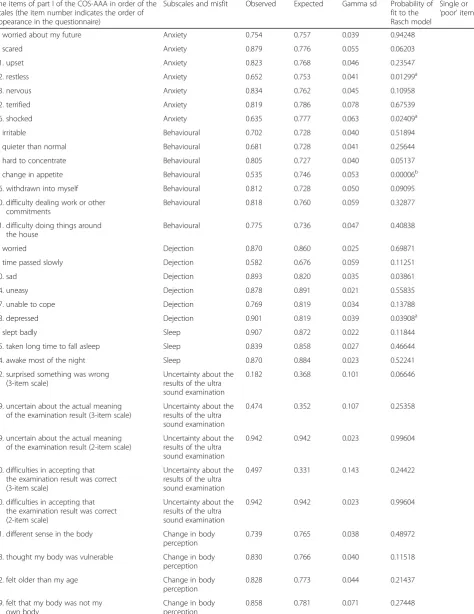
Three items in the‘sense of dejection’scale showed mis-fit to the partial credit Rasch model and moderate to se-vere LD was revealed between two pairs of items: items 1&9 and items 1&15. After merging these items into super items in a GLLRM the fit increased substantially (Table2). Item 9 in the‘negative impact on behaviour’scale showed misfit to the model (Table3) and at the same time the over-all fit to the scale was sufficient,p= 0.1761 (Table2). If item 9 was deleted from the behavioural scale the overall fit of the scale increased and the Cronbach’s alpha did not change.
The four-item dimension ‘negative impact on sleep’ showed misfit where item 23‘woken up far too early in the morning’ revealed severe misfit to the model and possessed DIF in relation to social group, income and mother tongue. After deleting item 23 from the sleeping dimension the remaining three items fitted the model, no DIF was identified and only minor LD between items 16 and 24 was revealed.
Dimensionality of part I of the AAA-screening-spe-cific items Except for the three items (65, 66 and 67) in the theme ‘Information’ all the remaining 49 items in-cluded in the 13 different new AAA-screening-specific themes fitted their respective Rasch models (Tables2,3
Part II
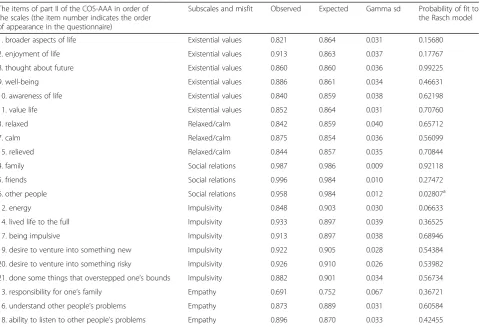
Dimensionality of part II of the core-questionnaire COSIn five of six dimensions the items fitted the partial credit Rasch model according to the overall fit statistics (Table 2) and the item fit statistics (Table 5). The six items included in the ‘Existential value’scale also fitted the Rasch model at item level but revealed marginal mis-fit at the overall mis-fit statistic’s level. In the‘Relaxed/calm’ scale item 3 ‘relaxed’possessed DIF in relation to diag-nosis and LD was revealed between item 3 and the two other items. After deleting item 3 from the scale the fit to the model dropped a bit and so did Cronbach’s alpha (Table 2). No DIF was identified the in remaining 20 items in part II of the COS. Moreover, only minor LD
was revealed in two item pairs in respectively the ‘ Im-pulsivity’scale and in the‘Empathy’scale.
All the items’ thresholds were in order in each of the Rasch analyses.
Discussion
In this study, a new condition-specific questionnaire with high content validity and adequate psychometric properties measuring psychosocial consequences of be-ing diagnosed with an asymptomatic AAA has been de-veloped. The core-questionnaire COS that previously has been found to be relevant for participants in breast, lung and cervical cancer screening was also found to be relevant for men offered regular follow-up of an asymp-tomatic screening-detected AAA. Moreover, 14 new Table 2Fit statistics and reliability (Cronbach’s alpha) of the dimensions of the COS-AAA
Dimensions (Number of items) CLR-χ2 Degrees of freedom P Cronbach’s alpha
Anxiety (7) 21.71 16 0.1528 0.789
Behavioural (7) 24.54 19 0.1761 0.804
Behavioural (6) minus item 9 10.00 16 0,8667 0.804
Sense of dejection (6) 37.24 16 0.0019d 0.830
Sense of dejection (6)c 24.24 26 0.5622 0.830
Sleep (4) 51.19 11 < 0.0001d 0.807
Sleep (3), minus item 23 6.55 8 0.5853 0.840
Uncertainty about the result of the ultra sound examination (3)b 10.13 7 0.1812 0.343
Change in body perception (8) 21.45 19 0.3124 0.838
Guilt (2)b 0.00 4 1.0000 0.594
Fear and powerlessness (7) 6.30 19 0.9971 0.849
Negative experiences from the examination (2) 4.93 4 0.2948 0.592
Emotional reactions (3) 2.38 6 0.8820 0.790
Change in lifestyle (2) 0 5 1.0000 0.600
Better not knowing (2)b 1.22 4 0.8753 0.704
Fear of rupture (4) 7.08 9 0.6286 0.779
Sexuality (3)b 1.8 8 0.9865 0.820
Information (3)b 24.77 8 0.0017d 0.595
Information (2), minus item 65 0 3 1.0000 0.937
Stigmatised (4)a 5.23 11 0.9193 0.873
Self-blame for smoking (3)a 5.24 8 0.7312 0.914
Still regretful smoking (6)a 4.92 5 0.4262 0.890
Existential values (6) 24.66 10 0.0061d 0.832
Relaxed/calm (3), item 3 possess DIF in relation to diagnosis 3.11 5 0.6831 0.727
Relaxed/calm (2), minus item 3 1.65 3 0.6474 0.716
Social network (3) 8.80 4 0.0662 0.766
Impulsivity (6) 4.83 11 0.9389 0.830
Empathy (3) 6.31 5 0.2776 0.619
a
Scales only relevant to former and current smokers b
Only for those men diagnosed with screening-detected AAA c
Graphical log-linear Rasch model where two super items were included: item 1 & item 9 and item 1 & item 15 d
Table 3Summary of result from the psychometric analyses of part 1 of the COS-AAA
The items of part I of the COS-AAA in order of the scales (the item number indicates the order of appearance in the questionnaire)
Subscales and misfit Observed Expected Gamma sd Probability of fit to the Rasch model
Single or ‘poor’item
2. worried about my future Anxiety 0.754 0.757 0.039 0.94248
3. scared Anxiety 0.879 0.776 0.055 0.06203
11. upset Anxiety 0.823 0.768 0.046 0.23547
12. restless Anxiety 0.652 0.753 0.041 0.01299a
13. nervous Anxiety 0.834 0.762 0.045 0.10958
22. terrified Anxiety 0.819 0.786 0.078 0.67539
46. shocked Anxiety 0.635 0.777 0.063 0.02409a
4. irritable Behavioural 0.702 0.728 0.040 0.51894
5. quieter than normal Behavioural 0.681 0.728 0.041 0.25644
7. hard to concentrate Behavioural 0.805 0.727 0.040 0.05137
9. change in appetite Behavioural 0.535 0.746 0.053 0.00006b
16. withdrawn into myself Behavioural 0.812 0.728 0.050 0.09095
20. difficulty dealing work or other commitments
Behavioural 0.818 0.760 0.059 0.32877
21. difficulty doing things around the house
Behavioural 0.775 0.736 0.047 0.40838
1. worried Dejection 0.870 0.860 0.025 0.69871
8. time passed slowly Dejection 0.582 0.676 0.059 0.11251
10. sad Dejection 0.893 0.820 0.035 0.03861
14. uneasy Dejection 0.878 0.891 0.021 0.55835
17. unable to cope Dejection 0.769 0.819 0.034 0.13788
18. depressed Dejection 0.901 0.819 0.039 0.03908a
6. slept badly Sleep 0.907 0.872 0.022 0.11844
15. taken long time to fall asleep Sleep 0.839 0.858 0.027 0.46644
24. awake most of the night Sleep 0.870 0.884 0.023 0.52241
32. surprised something was wrong (3-item scale)
Uncertainty about the results of the ultra sound examination
0.182 0.368 0.101 0.06646
39. uncertain about the actual meaning of the examination result (3-item scale)
Uncertainty about the results of the ultra sound examination
0.474 0.352 0.107 0.25358
39. uncertain about the actual meaning of the examination result (2-item scale)
Uncertainty about the results of the ultra sound examination
0.942 0.942 0.023 0.99604
40. difficulties in accepting that the examination result was correct (3-item scale)
Uncertainty about the results of the ultra sound examination
0.497 0.331 0.143 0.24422
40. difficulties in accepting that the examination result was correct (2-item scale)
Uncertainty about the results of the ultra sound examination
0.942 0.942 0.023 0.99604
31. different sense in the body Change in body perception
0.739 0.765 0.038 0.48972
38. thought my body was vulnerable Change in body perception
0.830 0.766 0.040 0.11518
42. felt older than my age Change in body perception
0.828 0.773 0.044 0.21437
49. felt that my body was not my own body
Change in body perception
Table 3Summary of result from the psychometric analyses of part 1 of the COS-AAA(Continued)
The items of part I of the COS-AAA in order of the scales (the item number indicates the order of appearance in the questionnaire)
Subscales and misfit Observed Expected Gamma sd Probability of fit to the Rasch model
Single or ‘poor’item
47. feels like something is wrong with my body
Change in body perception
0.857 0.773 0.040 0.03655a
57. felt that I am getting older Change in body perception
0.677 0.771 0.040 0.01867a
58. noted if I could feel something was different in my stomach
Change in body perception
0.694 0.764 0.039 0.07827
61. experienced that my body was a machine that does not work
Change in body perception
0.821 0.770 0.042 0.21602
33. my own fault Guilt 0.772 0.772 0.092 0.99999
55. wondered if I should have taken better care of myself
Guilt 0.772 0.772 0.092 0.99999
26. fragile Fear and powerlessness 0.731 0.784 0.038 0.15788
30. felt vulnerable Fear and powerlessness 0.796 0.796 0.045 0.99903
37. felt unsafe Fear and powerlessness 0.843 0.808 0.045 0.43550
43. felt I was unlucky Fear and powerlessness 0.735 0.793 0.039 0.13855
50. the situation seemed hopeless Fear and powerlessness 0.876 0.811 0.046 0.15857
54. felt powerless Fear and powerlessness 0.856 0.801 0.044 0.20922
60. experienced that I lost control Fear and powerlessness 0.892 0.834 0.050 0.24566
29. unpleasant examination(s) Negative experiences from the examination
0.891 0.891 0.064 0.99928
48. felt vulnerable at the examination bed Negative experiences from the examination
0.891 0.891 0.064 0.99928
25. angry Emotional reactions 0.912 0.914 0.021 0.94175
28. felt sour (attitude) Emotional reactions 0.911 0.885 0.028 0.36390
56. experienced mood swings Emotional reactions 0.885 0.902 0.022 0.45158
36. changed exercise habits Change in lifestyle 0.767 0.765 0.046 0.96988
44. changed diet habits Change in lifestyle 0.767 0.765 0.046 0.96988
27. regret screening examination Better not knowing 0.958 0.960 0.031 0.95912
45. better not to know about the aneurism Better not knowing 0.958 0.960 0.031 0.95912
34. fear of rupture at the back of one’s mind Fear of rupture 0.830 0.818 0.048 0.80348
35. worried about rupture at hard physical activities
Fear of rupture 0.893 0.801 0.050 0.06566
52. worried if I had to push myself Fear of rupture 0.863 0.777 0.094 0.36041
53. do not dare to push myself as usual Fear of rupture 0.645 0.781 0.060 0.02442§
62. less interest in sex Sexuality 0.897 0.878 0.035 0.57648
63. negative impact on my sex life Sexuality 0.899 0.876 0.035 0.50434
64. worried about rupture of the aneurism during sexual activities
Sexuality 0.803 0.862 0.047 0.20584
66. searched the Internet for knowledge about aneurism
Information 0.991 0.991 0.006 0.99997
67. I have looked for knowledge about how the aorta can change
Information 0.991 0.991 0.006 0.99997
19. busy to take mind off things Single item Not included Not included Not included Not included Single item
23. woken up far too early in the morning
Misfit (Sleep) 0.600 0.770 0.031 < 0.00001b ‘Poor’or single item
AAA-screening-specific scales were developed and vali-dated encompassing more than 50 new items.
Measuring psychosocial consequences of healthcare interventions is complex and such studies require careful methodological considerations to be able to provide meaningful results. Our study shows that the use of a condition-specific measure in quantitative studies about psychosocial aspects in AAA screening is valid. We had to develop 14 new scales encompassing more than 50 new items in addition to the core questionnaire COS (encompassing 48 core items) before a new question-naire called the COS-AAA achieved high content valid-ity. This strongly supports that the psychosocial consequences of living with an asymptomatic AAA under surveillance are diverse and multidimensional. Previous quantitative studies on psychosocial conse-quences of AAA screening have not ensured high con-tent validity or adequate psychometric properties of the questionnaires used [11–16]. Therefore, the findings of
our study suggest that the results of these previous stud-ies might not comprehensively and adequately investi-gate all potential psychosocial consequences of AAA screening.
The incidence of AAA has dropped more than 70% in Sweden [42] and the UK [43] most likely caused by re-duced smoking but adjuvant medication for cardiovascu-lar risk factors could also be a plausible explanation. If the incidence of a condition screened for drops, the absolute benefits of a screening programme diminishes, and thereby the benefit-to-harm balance could become less favourable [44]. The drop in incidence of AAA makes it important to adequately measure the potential psycho-social consequences of AAA screening: evidence from longitudinal surveys using a condition-specific measure, e.g. the COS-AAA, are needed to evaluate the benefit-to-harm balance of AAA screening comprehen-sively and adequately. Another benefit of using a psycho-social condition-specific measure is to identify areas of
Table 3Summary of result from the psychometric analyses of part 1 of the COS-AAA(Continued)
The items of part I of the COS-AAA in order of the scales (the item number indicates the order of appearance in the questionnaire)
Subscales and misfit Observed Expected Gamma sd Probability of fit to the Rasch model
Single or ‘poor’item
51. felt sick Single item Not included Not included Not included Not included ‘Poor’or single item
59. more tired than usual Single item Not included Not included Not included Not included ‘Poor’or single item
65. missed information about physical activities and aneurism
Misfit (Information) 0.357 0.593 0.077 0.00199b ‘Poor’or single item
a
Adjusting thep-values in the table in order to control the false discovery rate and so avoid spurious significant results due to multiple testing suggested that this result should be regarded as not significant [38]
b
Misfit after a correction by the Benjamini-Hochberg procedure [38]
Table 4Summary of result from the psychometric analyses of item to former and current smokers
The items in order of the scales (the item number indicates the order of appearance in the questionnaire)
Subscales and misfit to the Rasch model
Observed Expected Gamma sd Probability of fit to the Rasch model
69. felt stigmatiseda Stigmatisation 0.940 0.936 0.017 0.84413
70. blamed by other peoplea Stigmatisation 0.937 0.943 0.015 0.69940
71. a finger-wagging from othersa Stigmatisation 0.946 0.933 0.019 0.46892
73. been told off by other peoplea Stigmatisation 0.935 0.931 0.020 0.84845
68. disappointed in oneselfa Self-blame 0.949 0.950 0.015 0.92832
72. felt guiltya Self-blame 0.960 0.951 0.015 0.50726
74. angry with oneselfa Self-blame 0.950 0.950 0.015 0.99253
Are you currently smoking? If yes, please complete the questions below:
NA NA NA NA NA
75. thought about quitting smoking Regretful still smoking 0.839 0.886 0.053 0.37011
76. feel guilty for smoking Regretful still smoking 0.916 0.879 0.053 0.48273
77. annoyed with oneself for smoking Regretful still smoking 0.953 0.874 0.054 0.13633
78: disappointed in oneself for smoking Regretful still smoking 0.902 0.874 0.054 0.60243
79. change in one’s attitude towards smoking Regretful still smoking 0.805 0.874 0.054 0.19846
80. having second thoughts about one’s smoking Regretful still smoking 0.856 0.868 0.054 0.82686 a
improvement regarding men undergoing surveillance for AAA. For the present analysis we have collected cross-sectional data from men participating in AAA screening having a normal screening result or being diag-nosed with AAA. We are planning in a separate study to publish results on the difference in psychosocial conse-quences between men diagnosed with AAA and living under surveillance of the aneurysm and men having a nor-mal screening result. Such results could also indicate if the COS-AAA is able to discriminate between these two groups of screening participants. However, because our data are not longitudinal and we do not have two or more repeated measurements, we cannot estimate to what degree and for how long the two groups of men are experiencing psychosocial consequences (e.g. relief or more anxiety) due to their participation in AAA screening. An ideal design for such a study would be to include a baseline measurement before invitation to screening and thereafter follow hundreds of men for years, diagnosed with AAA or having normal screening results.
Item 9‘change in appetite’showed misfit to the Rasch model despite the overall fit of the behavioural scale was
sufficient (Tables 2and 3). This could be a type 1 error or an actual misfit. Before deciding to delete item 9 per-manently from the behavioural scale in an AAA setting it would be needed to confirm this misfit to the behav-ioural scale in additional data collected with the COS-AAA. Item 23‘woken up far too early in the morn-ing’revealed substantial misfit in the sleeping scale both at the item level and at the overall level plus items 23 possessed DIF in relation to three co-variates (Tables 2
and 3). Deleting item 23 from the sleeping scale was followed by a substantial increase in the overall fit statis-tics indicating that item 23 should be handled as a‘poor’ item (Table 2). In the sense of dejection scale two pairs of items showed moderate to severe local response de-pendency (LD). After handling this problem by merging these pairs into so-called super items the fit to the sense of dejection scale improved substantially (Table 2). Therefore, the sense of dejection scale can be used in-cluding all six original items. When two or more items in a scale have LD the item information drops. In psy-chosocial research in healthcare the latent constructs that are wanted to be measured cannot be described in hundreds of nuances, e.g. in how many ways can you Table 5Summary of result from the psychometric analyses of part 2 of the COS-AAA
The items of part II of the COS-AAA in order of the scales (the item number indicates the order of appearance in the questionnaire)
Subscales and misfit Observed Expected Gamma sd Probability of fit to the Rasch model
1. broader aspects of life Existential values 0.821 0.864 0.031 0.15680
2. enjoyment of life Existential values 0.913 0.863 0.037 0.17767
8. thought about future Existential values 0.860 0.860 0.036 0.99225
9. well-being Existential values 0.886 0.861 0.034 0.46631
10. awareness of life Existential values 0.840 0.859 0.038 0.62198
11. value life Existential values 0.852 0.864 0.031 0.70760
3. relaxed Relaxed/calm 0.842 0.859 0.040 0.65712
7. calm Relaxed/calm 0.875 0.854 0.036 0.56099
15. relieved Relaxed/calm 0.844 0.857 0.035 0.70844
4. family Social relations 0.987 0.986 0.009 0.92118
5. friends Social relations 0.996 0.984 0.010 0.27472
6. other people Social relations 0.958 0.984 0.012 0.02807a
12. energy Impulsivity 0.848 0.903 0.030 0.06633
14. lived life to the full Impulsivity 0.933 0.897 0.039 0.36525
17. being impulsive Impulsivity 0.913 0.897 0.038 0.68946
19. desire to venture into something new Impulsivity 0.922 0.905 0.028 0.54384
20. desire to venture into something risky Impulsivity 0.926 0.910 0.026 0.53982
21. done some things that overstepped one’s bounds Impulsivity 0.882 0.901 0.034 0.56734
13. responsibility for one’s family Empathy 0.691 0.752 0.067 0.36721
16. understand other people’s problems Empathy 0.873 0.889 0.031 0.60584
18. ability to listen to other people’s problems Empathy 0.896 0.870 0.033 0.42455 a
ask about sleeping problems without asking the same question? Therefore, if a latent construct in psychosocial healthcare is to be measured, and as many as possible items are generated from interviews to describe different nuances and severities of the latent construct, some de-gree of redundancy and some dede-gree of LD are inevit-able and must be accepted. A result of LD is the drop in item information and thereby theoretically a drop in reli-ability. This drop in information and reliability can be compensated by using multi-dimensional questionnaires encompassing as many scales as needed to achieve high content validity.
In the new AAA-screening-specific scale ‘Information’ Item 65‘missed information about physical activities and aneurysm’revealed misfit to the Rasch model at the item and overall level (Tables2and3). There was no indication of DIF or LD among the three items in the‘Information’ scale. Deleting item 65 from the ‘Information’scale sub-stantially improved the overall fit to the model. Therefore, it cannot be decided if item 65 should be handled as a sin-gle item or as a ‘poor’ item would need further psycho-metric analysis in new datasets collected with COS-AAA.
In part II of the COS the overall fit to the Rasch model for the six items in the‘Existential values’scale showed marginal misfit (Table2). However, all six items revealed sufficient fit statistics at the item level (Table 5). There were no indications of DIF or LD among these six items. Therefore, the most plausible explanation is that the re-vealed marginal misfit is a type 1 error. Item 3 ‘relaxed’ in the ‘Relaxed/calm’scale possessed uniform DIF in re-lation to diagnosis. After deleting item 3 from the scale both the overall fit statistics and Cronbach’s alpha dropped a bit. Therefore, the‘Relaxed/calm’scale can be used with all three items as long as the uniform DIF in relation to diagnosis is taken into account [45]. However, a 2-item‘Relaxed/calm’scale could also be used.
Conclusion
A new condition-specific questionnaire, called the COS-AAA (Consequences Of Screening in Abdominal Aortic Aneurysm), with high content validity and adequate psychometric properties measuring psychosocial conse-quences of being diagnosed with an asymptomatic AAA has been developed. The COS-AAA consists of two parts: part I encompasses 18 scales including more than 70 items and part II encompasses 5 scales including 21 items.
Implications for practice and research
Our study suggests that results from previous surveys about psychosocial consequences of AAA screening might be of limited value; hence the magnitude and duration of psychosocial harm caused by AAA screening is unknown.
New surveys are needed using the COS-AAA or other condition-specific questionnaires with high content
validity and adequate psychometric properties. Such sur-veys should include a baseline measurement before invita-tion to screening plus follow-up in a longitudinal design including several measurements in a time period of years.
Abbreviations
AAA:Abdominal aortic aneurysm; COS: A common core-questionnaire for the three measures above: Consequence of Screening; COS-BC: Consequence of Screening in Breast Cancer; COS-CC: Consequence of Screening in Cervical Cancer; COS-LC: Consequence of Screening in Lung Cancer; DIF: Differential item functioning; GLLRM: Graphical log-linear Rasch models; LD: Local response dependency; QoL: Quality of life
Availability of data and materials
Please contact corresponding author for data requests.
Authors’contributions
The study was devised and designed by JB and AH. The first 15 single interviews were conducted by AH, the first group interview by JB, MP and AH, and the last two group interviews by MP and AH. AH and JB conducted the first translation of the Danish items in COS-BC, COS-LC, and COS-CC into Swedish. Data collection was conducted by MP and AH. Statistical psychometric analysis was done by JB, MJ and VS. MJ drafted the introduction and JB drafted the remaining manuscript. MJ, MP and AH contributed with parts to the manuscript. All authors contributed with substantial comments to the manuscript and approved the final version.
Ethics approval and consent to participate
The study was approved by the Regional Ethical Review Board in
Gothenburg. The participants gave consent by completing and returning the questionnaire. No further legal or ethical approvals are needed in Sweden.
Competing interests
As a PhD student Minna Johansson received funding to her sallary by FoUU-centrum Fyrbodal. The funding body had no role in the design of the study and collection, analysis, and interpretation of data and in writing the manuscript. The authors declare that they have no competing interests.
Publisher’s Note
Springer Nature remains neutral with regard to jurisdictional claims in published maps and institutional affiliations.
Author details
1Section and Research Unit for General Practice, Department of Public Health, Faculty of Health Sciences, University of Copenhagen, Øster Farimagsgade 5, P. O. Box 2099, DK-1014 Copenhagen, Denmark.2Primary Health Care Research Unit, Sorø, Zealand Region, Denmark.3The University Health Care Research Center, Region Örebro County, School of Medical Sciences, Örebro University, Örebro, Sweden.4Research Unit and Section for General Practice, FoUU-centrum Fyrbodal, 46235 Vänersborg, Sweden. 5
Department of Public Health and Community Medicine, Institute of Medicine, Sahlgrenska Academy, University of Gothenburg, Gothenburg, Sweden.6Department of Vascular Surgery and Institute of Medicine, Department of Molecular and Clinical Medicine, Sahlgrenska University Hospital and The Sahlgrenska Academy at the University of Gothenburg, Gothenburg, Sweden.7Department of Vascular Surgery, Sahlgrenska University Hospital, and Sahlgrenska Academy, University of Gothenburg, Institute of Health and Care Sciences, Gothenburg, Sweden.
Received: 1 October 2017 Accepted: 16 August 2018
References
1. Guirguis-Blake, J. M., Beil, T. L., Senger, C. A., & Whitlock, E. P. (2014). Ultrasonography screening for abdominal aortic aneurysms: A systematic evidence review for the U.S. preventive services task force.Ann Intern Med, 160(5), 321–329.
3. Johansson, M., Hansson, A., & Brodersen, J. (2015). Estimating overdiagnosis in screening for abdominal aortic aneurysm: Could a change in smoking habits and lowered aortic diameter tip the balance of screening towards harm?BMJ, 350, h825.
4. Svensjo, S., Bjorck, M., & Wanhainen, A. (2014). Editor’s choice: Five-year outcomes in men screened for abdominal aortic aneurysm at 65 years of age: A population-based cohort study.Eur J Vasc Endovasc Surg, 47(1), 37–44. 5. Thompson, S. G., Ashton, H. A., Gao, L., Buxton, M. J., & Scott, R. A. (2012). Final
follow-up of the multicentre aneurysm screening study (MASS) randomized trial of abdominal aortic aneurysm screening.Br J Surg, 99(12), 1649–1656. 6. Bertero, C., Carlsson, P., & Lundgren, F. (2010). Screening for abdominal aortic
aneurysm, a one-year follow up: An interview study.J Vasc Nurs, 28(3), 97–101. 7. Hansson, A., Brodersen, J., Reventlow, S., & Pettersson, M. (2012). Opening
Pandora’s box: The experiences of having an asymptomatic aortic aneurysm under surveillance.Health Risk Soc, 14(4), 341–359.
8. Pettersson, M., & Bergbom, I. (2013). To be under control: a qualitative study of patients’experiences living with the diagnosis of abdominal aortic aneurysm.J Cardiovasc Nurs, 28(4), 387–395.
9. Pettersson, M., Gedda, B., & Berndsson, I. (2014). Experiences of screening for abdominal aortic aneurysm-in and out on five minutes.Health, 6, 1385–1395. 10. Pettersson, M., Hansson, A., Brodersen, J., Wann-Hansson, C. (2017).
Experiences of the screening process and the diagnosis abdominal aortic aneurysm among 65-year-old men from invitation to a 1-year surveillance.
J Vasc Nurs,35(2): 70–77.
11. Lucarotti, M. E., Heather, B. P., Shaw, E., & Poskitt, K. R. (1997). Psychological morbidity associated with abdominal aortic aneurysm screening.Eur J Vasc Endovasc Surg, 14(6), 499–501.
12. Lindholt, J. S., Vammen, S., Fasting, H., & Henneberg, E. W. (2000). Psychological consequences of screening for abdominal aortic aneurysm and conservative treatment of small abdominal aortic aneurysms.Eur J Vasc Endovasc Surg, 20(1), 79–83.
13. Ashton, H. A., Buxton, M. J., Day, N. E., Kim, L. G., Marteau, T. M., Scott, R. A., et al. (2002). The multicentre aneurysm screening study (MASS) into the effect of abdominal aortic aneurysm screening on mortality in men: A randomised controlled trial.Lancet, 360(9345), 1531–1539.
14. Spencer, C. A., Norman, P. E., Jamrozik, K., Tuohy, R., & Lawrence-Brown, M. (2004). Is screening for abdominal aortic aneurysm bad for your health and well-being?ANZ J Surg, 74(12), 1069–1075.
15. Wanhainen, A., Rosen, C., Rutegard, J., Bergqvist, D., & Bjorck, M. (2004). Low quality of life prior to screening for abdominal aortic aneurysm: A possible risk factor for negative mental effects.Ann Vasc Surg, 18(3), 287–293. 16. Lesjak, M., Boreland, F., Lyle, D., Sidford, J., Flecknoe-Brown, S., & Fletcher, J.
(2012). Screening for abdominal aortic aneurysm: Does it affect men’s quality of life?Aust J Prim Health, 18(4), 284–288.
17. Streiner, D. L., & Norman, G. R. (2008).Health measurement scales: A practical guide to their development and use. Fourth edition edn. New York: Oxford University Press Inc.
18. Brodersen, J., Doward, L., Thorsen, H., McKenna, S. (2012) Writing health-related items for Rasch models - patient reported outcome scales for health sciences. In: Kreiner S, Mounir M, Christensen KB, editors. Rasch Related Models and methods for Health Science. In press edn. Wiley.
19. McCaffery, K. J., & Barratt, A. L. (2004). Assessing psychosocial/quality of life outcomes in screening: How do we do it better?J Epidemiol Community Health, 58(12), 968–970.
20. Brodersen, J., Thorsen, H., & Cockburn, J. (2004). The adequacy of measurement of short and long-term consequences of false-positive screening mammography.J Med Screen, 11(1), 39–44.
21. Brodersen, J., McKenna, S. P., Doward, L. C., & Thorsen, H. (2007). Measuring the psychosocial consequences of screening.Health Qual Life Outcomes, 5(1), 3. 22. DeFrank, J. T., Barclay, C., Sheridan, S., Brewer, N. T., Gilliam, M., Moon, A. M.,
et al. (2014) The psychological harms of screening: The evidence we have versus the evidence we need.J Gen Intern Med,30(2): 242–248. 23. Brodersen, J., & Thorsen, H. (2008). Consequences of screening in breast
Cancer (COS-BC): Development of a questionnaire.Scand J Prim Health Care, 26(4), 251–256.
24. Brodersen, J., Thorsen, H., & Kreiner, S. (2007). Validation of a condition-specific measure for women having an abnormal screening mammography.
Value Health, 10(4), 294–304.
25. Brodersen, J., Thorsen, H., & Kreiner, S. (2010). Consequences of screening in lung Cancer: Development and dimensionality of a questionnaire.Value Health, 13(5), 601–612.
26. Brodersen, J., Siersma, V., Thorsen, H. (2017) Consequences of Screening in Cervical Cancer: Development and Dimensionality of a Questionnaire In progress. 27. Bolejko, A., Wann-Hansson, C., Zackrisson, S., Brodersen, J., & Hagell, P.
(2013). Adaptation to Swedish and further development of the
‘Consequences of screening - breast Cancer’questionnaire: A multimethod study.Scand J Caring Sci, 27(2), 475–486.
28. Engel, G. L. (1977). The need for a new medical model: A challenge for biomedicine.Science, 196(4286), 129–136.
29. Willis, G. B. (1999) Cognitive interviewing. A“How to”guide.http://www. chime.ucla.edu/publications/docs/cognitive%20interviewing%20guide.pdf. 30. Collins, D. (2003). Pretesting survey instruments: An overview of cognitive
methods.Qual Life Res, 12(3), 229–238.
31. Brodersen, J. (2006).Measuring psychosocial consequences of false-positive screening results - breast cancer as an example. Department of General Practice, Institute of Public Health, Faculty of Health Sciences. Copenhagen. ISBN: 87–88638-36-7: University of Copenhagen: Månedsskrift for Praktisk Lægegerning.
32. Rasch Models in Health Londen & Hoboken: ISTE & Wiley; 2013.
33. Andersen, E. B. (1973). Goodness of Fit Test for Rasch Model.Psychometrika, 38, 123–140.
34. Kreiner, S., & Christensen, K. B. (2011). Item screening in graphical Loglinier Rasch models.Psychometrika, 76(2), 228–256.
35. Kreiner, S. (2011). A note on item-rescore association in Rasch models.Appl Psychol Meas, 35, 557–561.
36. Goodman, L. A., & Kruskal, W. H. (1954). Measures for Association for Cross Classifications.J Am Stat Assoc, 49, 732–764.
37. Hansen, P. E., Siersma, V., Ross, L., Mortensen, E. L., Riegels, M., Tjornhoj-Thomsen, T., et al. (2007). Psychometric properties of brief indexes designed to measure social-cognitive predictors of smoking initiation.Drug Alcohol Depend, 88(1), 64–74.
38. Benjamini, Y., & Hochberg, Y. (1995). Controlling the false discovery rate: A practical and powerful approach to multiple testing.J R Stat Soc, 57(1), 289–300. 39. Cronbach, L. J. (1951). Coeffcient alpha and the internal structure of tests.
Psychometrika, 16(3), 297–334.
40. Cronbach, L. J. (1988). Internal consistency of tests: Analyses old and new.
Psychometrika, 53(1), 63–70.
41. Kreiner, S., Nielsen, T. Item analysis in DIGRAM 3.04: Part I: Guided tours. Department of Biostastistics, University of Copenhagen; 2013. Report No.: 6, Vol. 13.
42. Svensjo, S., Bjorck, M., Gurtelschmid, M., Djavani, G. K., Hellberg, A., & Wanhainen, A. (2011). Low prevalence of abdominal aortic aneurysm among 65-year-old Swedish men indicates a change in the epidemiology of the disease.Circulation, 124(10), 1118–1123.
43. Darwood, R., Earnshaw, J. J., Turton, G., Shaw, E., Whyman, M., Poskitt, K., et al. (2012). Twenty-year review of abdominal aortic aneurysm screening in men in the county of Gloucestershire, United Kingdom.J Vasc Surg, 56(1), 8–13. 44. Glasziou, P. P., & Irwig, L. M. (1995). An evidence based approach to
individualising treatment.BMJ, 311(7016), 1356–1359.