SIMPLE SURVEILLANCE STRUCTURE USING PIR
SENSOR NETWORK AND GSM
Sathishkumar.M
1,
Rajini.S
2,
1
PG Scholar ,
2Associate professor, Kumaraguru College of Technology,
Coimbatore, Tamilnadu, (India)
ABSTRACT
Surveillance is most main security systems in house, industrial, office and public places. In this security system is
based on the embedded system along with GSM and sensor networks. The human movement is detect using the PIR
sensors. In this time, the system triggers an alarm detecting the presence of person in a specific interval of time
and simultaneously sends the how many persons are intruder via message to the SMS through GSM Modem. When
the security scheme is activated, the CCTV camera is activated. This highly reactive approach has low
computational condition. Therefore it is well suited for home surveillance system. This surveillance security
system implemented using PIC micro controller, camera, GSM and Sensors.
Key words
:
PIR Sensor; GSM; PIC microcontroller; Camera.
I INTRODUCTION
Surveillance is most essential field in security system. Surveillance is the monitoring of the behavior, actions, or
other changing information, usually of people for the purpose of influencing, running, directing, or protecting
them. surveillance systems are normally used in home, office, factory or vehicle monitoring and image
recognition, but this system requires a high performance center, which works against some advantages of
embedded systems, such as low power consumption and low cost. Surveillance is very useful to governments and
law execution to keep social control, recognize and monitor threats, and prevent/investigate wrong activities.
Home/office secyurity systems have grown in popularity in recent years, a home/office owner’s look for ways to
defend their personal space and improve their home values. It is necessary for every home owner to allowing for
adding up a home security system, as burglaries, thefts and murders have become everyday in big cities.
PIR sensor are low cost security system for house applications in which Passive Infrared (PIR) sensor has been
implemented to sense the movement of human through the detection of infrared radiation from that human body.
PIR device does not emit an infrared radition but passively accepts incoming infrared radiation. PIR sensor notice
the presence of human in the home and generates signal which is read by the microcontroller. According to the
signal received by microcontroller, a call is acknowledged to mobile station through a GSM modem and thus alert
the presence of human in the home to owner-occupier.
intruder with 10 feet and alert the Owner of house or police control room by sending SMS through GSM modem
about the intruder.
II EXISTING SYSTEM
2.1 Video Cameras
Security and crime control concerns are the motivating factors for the process of video supervision cameras.
Closed-circuit television (CCTV) is the utilize of video cameras to transmit a signal to a specific place, on a limited
set of monitors. This performance just uses the cameras to do surveillance. It needs a command and control center
to monitor all the tricks using cameras. All the cameras are connected to the command center and send their data
directly to the central location. All the behavior which is happening in the association or inside the building can be
viewed live from the command center.
2.2 RFID
Radio Frequency Identification (RFID) use radio waves to robotically identify human being or objects. There are
many methods of recognition, but the most general is to store a unique serial number that identifies a human or
object on a microchip that is attached to an antenna. The combined antenna and microchip are called an "RFID
transponder" or "RFID tag" and work in mixture with an "RFID reader". An RFID system consists of a reader and
one or more tags. The reader's receiver is used to broadcast radio frequency (RF) energy. Depending on the tag
type, the force is "harvested" by the tag's antenna and used to power up the interior circuitry of the tag. The tag will
then adapt the electromagnetic waves generated by the reader in classify to transmit its data back to the reader. The
reader receives the modulated waves and converts them into digital data. In the case of the Parallax RFID Reader
Module, correctly received digital data is sent serially through the SOUT pin.
III PROPOSED METHOD
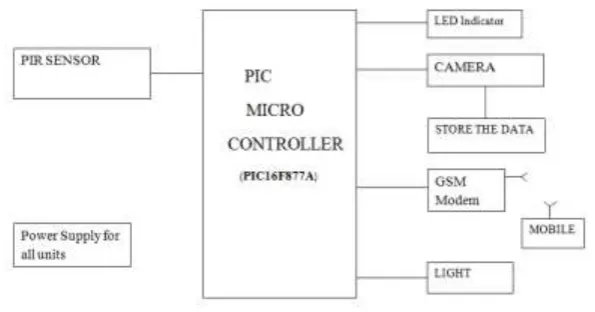
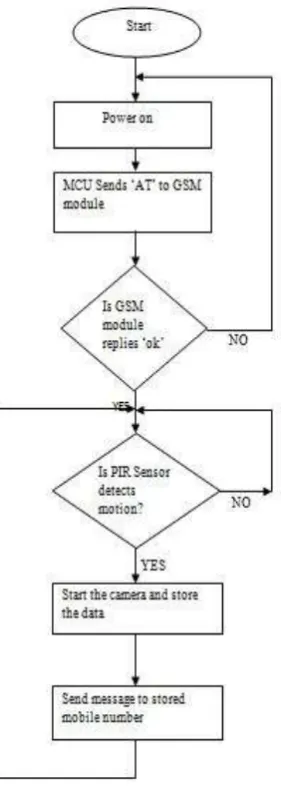
In this proposed system, the home based simple surveillance structure which evaluates the improvement of a very
Low-cost security system using PIR (Pyroelectric Infrared) sensors and video cameras built in the region of the
PIC(Peripheral Interface Controller) microcontroller. The person progress is detected using the PIR sensors. In this
time, the system triggers an alarm detecting the attendance of unauthorized person in a detailed interval of time and
concurrently send a message to the SMS through GSM Modem. When the security system is activated, the CCTV
camera is activated. This highly reactive approach has low computational requirement. Therefore it is well suited
for home surveillance system.
IV HARDWARE SPECIFICATIONS
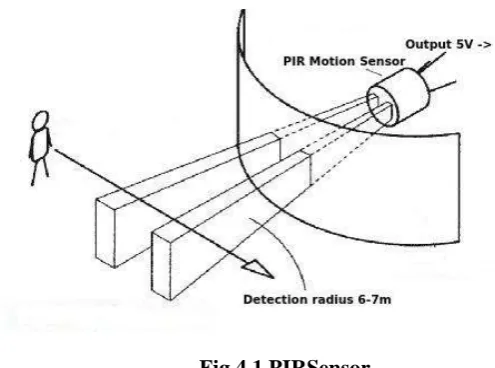
4.1 PIR Sensor
A Pyroelectric Infrared Sensor (PIR sensor) is an electronic sensor, in that type of sensor actions the infrared (IR)
light glowing from objects or human in its field of view. the normal sensor release the radiation but in this sensor
detect the radiation .
Fig 4.1 PIRSensor
All the objects with a temperature above absolute zero release warmth energy in the form of radiation. Usually this
radiation is not observable by person eye because it radiates at infrared wavelengths, but in this infrared can be
The PIR Sensor has a range of approximately 20 feet (6 meters). The sensor is considered to identify the gradually
changing situation that would happen normally as the daily progresses and the environmental situation changes, but
it responds by creation its output when sudden changes happen, such as when there is motion. This device is
considered mostly for internal use. Operation outside or in very high temperatures may affect constancy negatively.
Due to the high compassion of PIR sensor device, it is not suggested to use the some situation like rapid
environmental changes and strong shock or vibration. and also in not functioning in direct sun light or direct wind
from a heater or air condition.
Pin Name Function
- GND Connects to Ground or Vss
+ V+ Connects to Vdd (3.3V to 5V) @
~100uA
OUT Output Connects to an I/O pin set to INPUT mode (or transistor/MOSFET)
TABLE1. Pin representaion of PIR sensor
4.2 PIC Microcontroller
PIC is a family of adapted Harvard architecture microcontroller made by Microchip technology, derived from the
PIC1650 originally developed by General Instrument’s Microelectronics Division. The name PIC is referred to as
"Peripheral Interface Controller". PICs are popular with both industrial developers and hobbyists due to their low
cost, wide availability, availability of low cost or free development tools, and serial programming (and
re-programming with flash memory) capability.
Microchip introduced the new PIC32MX family of 32-bit microcontrollers operates at 2.3V to 3.6V supply voltage
with 80 MHz frequency. The initial device line-up is based on the industry standard MIPS32 M4K Core. The
device can be planned using the Microchip MPLAB C Compiler for PIC32 MCUs.
PIC microcontroller is the first RISC based microcontroller made-up in CMOS (complementary metal oxide
semiconductor) that uses separate bus for instruction and data allowing simultaneous access of program and data
memory. The main advantage of CMOS and RISC combination is low power consumption resulting in a very small
chip size with a small pin count.
TABLE 2. Various PIC Microcontrollers
PIC MCU device PIC MCU No. of Pins PIC MCU Flash memory
12F675 8 1k
16F88 18 4K
The main benefit of CMOS is that it has resistance to noise than other fabrication techniques. Various
microcontrollers offer different kinds of memories. EEPROM, EPROM, FLASH etc. are some of the memories of
which FLASH is the most freshly urbanized. Technology that is used in pic16F877 is flash technology, so that data
is retained even when the power is switched off. Easy Programming and Erasing are other features of PIC 16F877.
4.3 GSM
The GSM stands for Global System for Mobile Communications. In this technology is used to the communication
purpose; it operates at a baud rate of 9600bps in standard UART model through AT Commands. This GSM
Modem can recognize any of the 2G or 3G network operator SIM card and act like as cellular phone with its unique
phone number. Advantage of using this GSM modem will be that it can use RS232 port to communicate and
develop embedded safety applications or any other applications.
This modem used to SMS Control, data transfer, remote control and logging can be developed easily. The modem
can either be associated to PC serial port directly or microcontroller. It can be mainly used to send and receive SMS
or make/receive voice calls. This GSM modem is a highly flexible for plug and play quad band GSM modem for
direct and easy integration to RS232 applications.
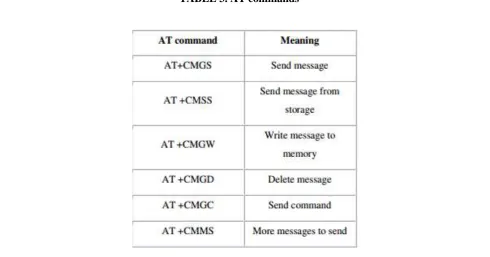
AT commands are also noted as Hayes AT commands. There are numerous views to know the meanings of “AT”.
Some call it “Attention telephone”, whereas others recognize as “Attention Terminal” commands. AT commands
giving instructions to both cell phone and normal landline telephones. The AT commands are sent to the phone’s
modem, which can be a GSM modem or PC modem. Different creator may have different sets of AT commands.
Luckily, many AT commands are the similar commands. Mobile phone manufactures may also provide with
attention to operators to allow or not to allow some commands on phones.List of AT commands are listed in
TABLE 3.
4.4 CCTV camera
Closed-circuit television (CCTV) is the use of video cameras to broadcast a signal to a specific place, on a
incomplete set of monitors. It differs from broadcast television in that the signal is not openly transmit, though it
may employ point to point (P2P), point to multipoint, or mesh wireless links.
4.5 Keypad
Keypad is used for multiple purpose .It can be use for routine time setting, manual time setting ,opening and
deactivation of sensors at particular interval of time.
V CONCLUSION
In this surveillance security scheme PIR sensor has been used which is low power, and low cost. It have a wide lens
range, and are simple to interface with microcontroller. This security scheme can be implemented in places like
home, office, shop etc. The sensitivity range for detecting motion of this system is 3to 4 feet. It can be raised up to
20 feet through careful using the concentrating optical lenses as future development. In addition to this, this system
can be prepared with glass fracture detectors to enhance the level of protection. Use of multi-sensor data fusion and
difficult algorithm can be used to increase the effective FOV for larger spaces. In order to enhance the location
accuracy and to improve the method of processing the PIR sensor signal, use of more advanced techniques such as
probabilistic theories.
REFERENCES
[1] M. Shankar, 1. Burchett, Q. Hao, B. Guenther, "Human tracking systems Using pyroelectric infrared detectors", Optical Engineering, vol. 10, no. 45, pp. 106401 (01-10), Oct. 2006.
[2] Kandhalu, A. ; Rowe, A. ; Rajkumar, R. ; Chingchun Huang; Chao-Chun Yeh “Real-Time Video Surveillance over IEEE 802.11 Mesh Networks“ ,IEEE Conference on 2009.
[3] [3] Bilal Ahmad Khan, Muhammad Sharif, Mudassar Raza,Tariq Umer,Khalid Hussain “An Approach for Surveillance Using Wireless Sensor Networks (WSN)”, Journal of Information & Communication
Technology, Vol. 1, No. 2, 2009.
[4] Anurag Kumar,, Bharadwaj Amrutur “Wireless sensor networks for human intruder detection” ,Journal of the Indian Institute of Science ,VOL 90:3 Jul–Sep 2010.
[5] Adamu Murtala Zungeru “Design and development of an ultrasonic Motion detector” International Journal of Advanced Research in Electronics and Communication Engineering (IJARECE) Volume 1, Issue 3, june
2010.
[6] Ms. Sneha Nahatkar, Prof. Avinash Gaur, Prof. Tareek M. Pattewar “Design of a Home Embedded Surveillance System with Pyroelectric Infrared Sensor & Ultra-Low Alert Power”, International Journal of
Advanced Research in Electronics and Communication Engineering (IJARECE)Volume 1, Issue 3,
September 2012.
[7] Taslee mandrupkar,Manisha kumari ,Rupali mane “Smart Video Security surveillance with mobile remote control”, International Journal of Advanced Research in Computer Science and Software Engineering,
Volume 3, Issue 3, March 2013.
[8] Qi Hao,Fei Hu,Yang Xiao “Multiple Human Tracking and Identification with Wireless Distributed Pyroelectric Sensor Systems” IEEE Transactions Volume 1, Issue 3, september 2013.
[9] Arulogn,o.t.,Adigun,a.Okedirn o “Design and Development of a Security Surveillance System based on Wireless Sensor Network” International Journal of Innovative Science, Engineering & Technology, Vol. 1
[10]Ying-Wen Bai, and Yi-Te Ku, “Automatic room light intensity detection and control using a microprocessor
and light sensors,” IEEE Transactions on Consumer Electronics, pp. 1173-1176, Aug. 2008..
[11] M. Moghavvemi and C.S. Lu, "Pyroelectric sensor for intruder detection," in Proc. TENCON 2004 Conf., pp. 656-659.
[12]Upendran Rajendran and Albert Joe Francis, ”Anti Theft Control System Design Using Embedded System”, Proc. IEEE, vol. 85, page no. 239- 242, 2011.
[13]R. C. Luo, O. Chen, C. W. Lin, “Indoor human monitoring system using wireless and pyroelectric sensory fusion system,” The 2010 EEE/RSJ International Conference on Intelligent Robots and Systems, Taipei,
Taiwan, October 2010, pp.1507-1512.
[14] Wahl, F.; Milenkovic, M.; Amft, O. A green “autonomous self-sustaining sensor node for counting people in office environments”, In Proceedings of the 5th European DSP Education and Research Conference, Graz,
Austria, 13–16 May 2012; pp. 203–207.
[15] Zappi, P.; Farella, E.; Benini, L. “Tracking motion direction and distance with pyroelectric IR sensors”, IEEE Sens. J. 2010, 10, 1486–1494.
[16]Yun, J.; Song, M.-H. “Detecting Direction of Movement using Pyroelectric Infrared Sensors”, IEEE Sens. J. 2014, 14, 1482–1489.
[17]Tao, S.; Kudo, M.; Nonaka, H.; Toyama, J. “Person authentication and activities analysis in an office environment using a sensor network”, In Constructing Ambient Intelligence; Springer Berlin Heidelberg:
Berlin, Germany, 2012; pp. 119–127.
[18]Wahl, F.; Milenkovic, M.; Amft, O. “A distributed PIR-based approach for estimating people count in office environments”, In Proceedings of the IEEE 15th International Conference on Computational Science and
Engineering, Paphos, Cyprus, 5–7 December 2012; pp. 640–647.
[19]http://en.wikipedia.org/wiki/Surveillance
Sathishkumar.M is a PG student in the Department of Computer science and Engineering at Kumaraguru College of Technology, Coimbatore,Tamilnadu,India. His research focuses on network and embedded system design.
Sathishkumar.M obtained his B.Tech. Information Technology from Anna University, Chennai, in 2012.
Ms S.Rajini, presently working as Associate Professor at Kumaraguru College of Technology in the Department of Computer Science & Engineering, Coimbatore, T.N., India. She has 15 years of teaching experience and her