University of Pennsylvania
ScholarlyCommons
Publicly Accessible Penn Dissertations
Summer 8-14-2009
Positive Affect and Project Team Development and
Effectiveness
Andrew P. Knight
University of Pennsylvania, [email protected]
Follow this and additional works at:http://repository.upenn.edu/edissertations
Part of theIndustrial and Organizational Psychology Commons,Organizational Behavior and Theory Commons, and theSocial Psychology Commons
This paper is posted at ScholarlyCommons.http://repository.upenn.edu/edissertations/11 Recommended Citation
Knight, Andrew P., "Positive Affect and Project Team Development and Effectiveness" (2009).Publicly Accessible Penn Dissertations. 11.
Positive Affect and Project Team Development and Effectiveness
Abstract
In this dissertation I develop and test a conceptual model of how positive affect shapes project team development and effectiveness. Integrating and extending the literatures on positive affect and project team development, I propose that team trait positive affect---the relatively stable collective tendency for the members of a team to experience shared positive moods over time---aids in the development of three resources that research suggests are critical for project team effectiveness: team task routines, friendship network density, and team efficacy. Specifically, I suggest that team trait positive affect---a stable team "disposition" built from team members' relatively homogeneous trait positive affect---shapes team
developmental trajectories---the paths that a team takes in building resources over the course of its lifespan. Extending the literature on team development and effectiveness, I propose that team developmental trajectories with respect to task routines, friendship density, and team efficacy are key drivers of team performance. As such, I argue that positive affect indirectly shapes project team effectiveness by influencing patterns of team resource development over time. I find empirical support for key components of my
conceptual model in a longitudinal survey-based study of 33 military teams preparing for and participating in a military competition. Team trait positive affect, my findings suggest, has important and significant effects on how teams develop over time, and furthermore, on team effectiveness. Indeed, while team trait positive affect relates to team effectiveness indirectly through its relationship with team developmental trajectories, the impact of team trait positive affect on team effectiveness is most clearly strong and direct. In total, my theory and my findings suggest that team trait positive affect is a critical variable for understanding project team development and effectiveness.
Degree Type
Dissertation
Degree Name
Doctor of Philosophy (PhD)
Graduate Group
Management
First Advisor
Katherine J. Klein
Keywords
positive affect, team development, team leadership, team learning, routines, project team
Subject Categories
POSITIVE AFFECT AND
PROJECT TEAM DEVELOPMENT AND EFFECTIVENESS
Andrew P. Knight
A DISSERTATION
in
Management
Managerial Science and Applied Economics
Presented to the Faculties of the University of Pennsylvania
in
Partial Fulfillment of the Requirements for the
Degree of Doctor of Philosophy
2009
Supervisor of Dissertation
Graduate Group Chairperson
~c
-,
Dr. Eric T. Bradlow, Professor of Marketing
Positive Affect and
Project Team Development and Effectiveness
COPYRIGHT
2009
Acknowledgements
Many of the ideas in this dissertation blossomed along the winding trails of the Wissahickon as my wife, Lauren, and I trained together for the Marine Corps Marathon. As I learned very quickly, there isn’t much to do but talk a little and think alot when running for hours at a time. Hour after hour—and, indeed, year after year—Lauren indulged my rambling thoughts, pushed me when I needed to find coherence, and, most of all, was a steady rock of support through the good, the bad, and even the nine kilometer military competition course that I asked her to run with me “in the name of science!”
The seeds of this specific project were planted and cultivated, however, long before it actually began to blossom. I am deeply indebted to Katherine Klein for the countless hours she spent teaching and mentoring me throughout this and other projects. I am appreciative to Katherine for challenging me to sharpen my thinking, to improve how I communicate my thoughts, and to write in ways that people will enjoy reading. Her uncompromising commitment to high quality, high-impact research—across theory, method, analysis, and write-up—continues to inspire me to pursue projects and papers that reflect truth; will be read, seen, or heard; and, will change how people think and act.
changed how I think about organizations, interpersonal relationships, and individuals. Si-gal’s feedback on all stages of this dissertation, including idea conception and development, research design, analyses, and writing has made this stronger research.
Valery Yakubovich, with his sociological perspective, was instrumental in clarifying my arguments in this dissertation and sharpening my hypotheses. Most importantly, Valery’s thoughtful questions and insightful comments on drafts of this dissertation helped me to see more clearly my taken-for-granted assumptions about organizations, to critically examine those assumptions, and to back them up.
This project would not have been possible without the support, encouragement, and logistical help of Archie Bates. His context-specific knowledge helped to inform me on nuanced aspects of this research setting. Archie also taught me one of the most valuable lessons of my graduate school career: You’ve gotta find a sense of urgency.
I am similarly grateful to Ryan and Kristin Knight for their behind-the-scenes insights about this research setting. Their tacit knowledge and intuition about what influences team development, based on their own experiences, was helpful in appropriately framing my questions, selecting constructs, and grounding this research in the practical realities of the research participants’ daily lives.
Leeds, Lisa Leslie, Dave Mayer, Shimul Melwani, Miguel Meuleman, Joeri Mol, Racheli Perl, Lakshmi Ramarajan, Hans Eibe Sorensen, Florian Taube, and Jonathan Ziegert have made this better research. Perhaps most importantly, however, each person in his or her own way has helped make this project enjoyable, exciting, and meaningful.
ABSTRACT
POSITIVE AFFECT AND
PROJECT TEAM DEVELOPMENT AND EFFECTIVENESS
Andrew P. Knight
Supervisor: Dr. Katherine J. Klein
Table of Contents
Acknowledgements iii
Abstract vi
Table of Contents viii
List of Tables ix
List of Figures x
Introduction 1
Method 54
Analyses 65
Results 80
Discussion 129
A Results of Supplementary Maximum Likelihood Analyses 144
List of Tables
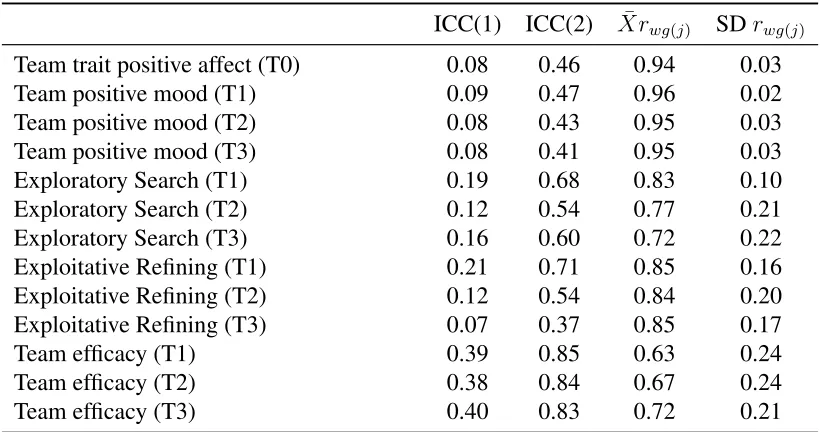
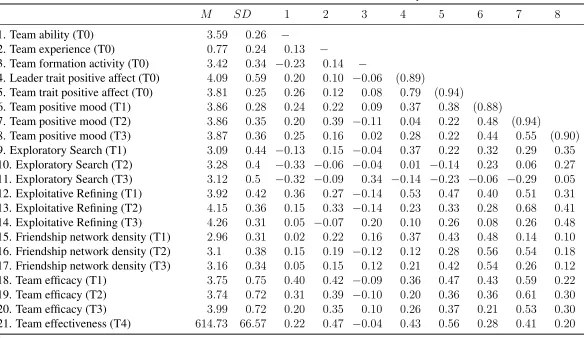
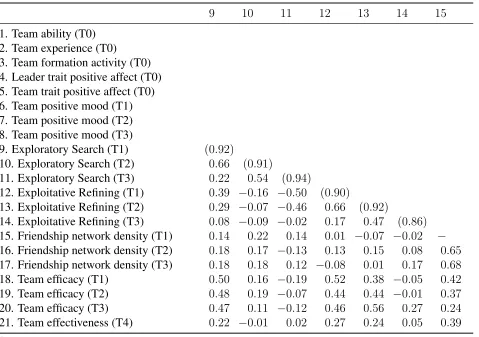
1 Aggregation Metrics for Team-Level Consensus Composition Constructs . 66 2 Frequentist and Bayesian Approaches to Growth Modeling . . . 73 3 Means, Standard Deviations, and Intercorrelations of Study Variables . . . 81 4 Results of Bayesian Models Used to Determine Base Growth Trajectories . 87 5 Results of Bayesian Growth Models Predicting Team Positive Mood over
Time . . . 89 6 Results of Bayesian Growth Models Predicting Exploratory Search over Time 93 7 Results of Bayesian Growth Models Predicting Exploitative Refining over
Time . . . 98 8 Results of Bayesian Growth Models Predicting Team Friendship Network
Density over Time . . . 102 9 Results of Bayesian Growth Models Predicting Team Efficacy over Time . . 105 10 Means, Standard Deviations, and Intercorrelations of Growth Trajectory
Parameters and Selected Study Variables . . . 109
A.1 Results of MLE Models for Base Growth Trajectories . . . 145 A.2 Results of MLE Growth Models Predicting Team Positive Mood over Time 146 A.3 Results of MLE Growth Models Predicting Exploratory Search over Time . 147 A.4 Results of MLE Growth Models Predicting Exploitative Refining over Time 148 A.5 Results of MLE Growth Models Predicting Team Friendship Network
List of Figures
1 Positive Affect and Project Team Development and Effectiveness . . . 6 2 Developmental Trajectories in 33 Project Teams . . . 84 3 Effect of Team Trait Positive Affect on Exploratory Search Change over
Time . . . 96 4 Bayesian Path Model of Team Trait Positive Affect, Exploratory Search
Trajectory, and Team Effectiveness . . . 114 5 Bayesian Path Model of Team Trait Positive Affect, Exploitative Refining
Trajectory, and Team Effectiveness . . . 115 6 Revised Bayesian Path Model of Team Trait Positive Affect, Exploratory
Search Trajectory, and Team Effectiveness . . . 116 7 Revised Bayesian Path Model of Team Trait Positive Affect, Exploitative
Refining Trajectory, and Team Effectiveness . . . 117 8 Bayesian Path Model of Team Trait Positive Affect, Team Friendship
Net-work Density Trajectory, and Team Effectiveness . . . 121 9 Revised Bayesian Path Model of Team Trait Positive Affect, Team
Friend-ship Network Density Trajectory, and Team Effectiveness . . . 122 10 Bayesian Path Model of Team Trait Positive Affect, Team Efficacy
Trajec-tory, and Team Effectiveness . . . 123 11 Revised Bayesian Path Model of Team Trait Positive Affect, Team Efficacy
Trajectory, and Team Effectiveness . . . 124 12 Bayesian Path Model of Team Trait Positive Affect, Team Development,
Introduction
The project team—a group of people assembled to generate a specific product, deliver a specific service, or accomplish a specific outcome within a delimited and typically short timeframe (Ericksen & Dyer, 2004; Gersick, 1988)—is a prevalent structure in organiza-tions today (Keller, 2001). Managers often deploy project teams when a small group of people can complete an entire stream of work, deadlines are critical and defined, and con-tinuity of collaboration is not needed once the job is complete. For example, software developers are often organized in project teams to engineer and produce a piece of soft-ware by its intended ship date. Similarly, new product developers are frequently organized in project teams and charged with generating a specific product within a delimited time-frame. In each example, a given team owns most if not all of the development process and there are high costs associated with failing to complete the job on time.
from the “ideal” normative pattern of development; rather than central tendency, the con-sequences of variance in developmental patterns drove conceptual and empirical efforts (e.g., Jehn & Mannix, 2001; Kozlowski, Gully, McHugh, Salas, & Cannon-Bowers, 1996; Kozlowski, Gully, Nason, & Smith, 1999). Spurred by this theory and research, which sug-gests that development can impact project team performance, scholars (e.g., Ericksen & Dyer, 2004; Chen, 2005; Mathieu & Schulze, 2006; Mathieu & Rapp, 2009) have most re-cently turned their attention to explaining why some teams deviate from normative patterns of development in the first place; that is, the antecedents of departing from ideal develop-mental patterns are currently of particular interest to teams theorists and researchers. In contrast to the earliest goal of describing team development in general, a primary focus of contemporary theory and research on team development is thus figuring out why some teams develop well, resulting in high team effectiveness, while other teams develop poorly, resulting in low team effectiveness.
affect—a stable tendency for individuals (and groups) to experience positive, high-energy moods such as enthusiasm and excitement (Kelly & Barsade, 2001; Watson et al., 1988). Attesting to the changing role of affective constructs in the teams literature, and in stark contrast to Guzzo and Dickson’s (1996) single sentence,Kozlowski & Ilgen (2006) devoted an entire section of their recent review of the teams literature to affect, highlighting col-lectiveconceptualizations of affect, moods, and emotions as an exciting are for conceptual
and empirical work (p. 96).
empir-ical examinations of positive affect and change over time. We thus know very little about what role positive affect plays in project team development.
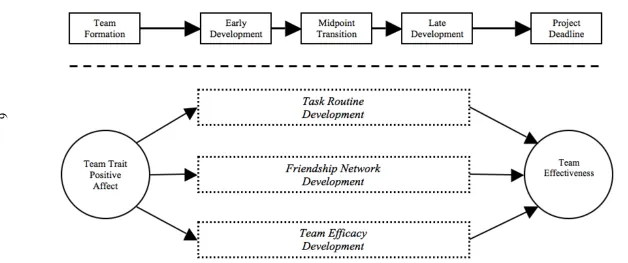
To fill these theoretical and empirical gaps and advance understanding of what drives effective patterns of project team development, I integrate the literature on positive affect with the literature on team development and propose a conceptual model of positive af-fect and project team development and efaf-fectiveness. Consistent with dominant theories of team development (e.g., Ilgen et al., 2005; Kozlowski et al., 1999; Marks et al., 2001), mine is an episodic model. That is, I conceptualize project team development as a series of inter-locked phases, such that the outputs of one phase of development feed into the next phase and serve as inputs to subsequent developmental phases. Grounded in theory and research on positive affect at both the individual and team levels, I propose that positive affect aids a project team in developing critical team resources—assets that team members collectively draw upon in the course of their work—in three distinct, but related, areas: task resources, social resources, and motivational resources. More specifically, I suggest that frequent shared experiences of positive and high-energy emotions help a project team develop inno-vative and well-honedtask routines—relatively stable patterns of coordinated task behavior that allow members to anticipate each others’ actions and respond appropriately (Edmond-son, Bohmer, & Pisano, 2001; Gersick & Hackman, 1990; Kozlowski, Gully, Na(Edmond-son, & Smith, 1999)—by influencing the extent to which a team engages in explorative search versus exploitative refinement over time. Shared positive affect also helps a project team, I suggest, develop an integrated and densefriendship network—a thick web of positive in-formal relationships among team members that facilitates communication and cooperative behavior (Balkundi & Harrison, 2006; Beal, Cohen, Burke, & McLendon, 2003; Jehn & Shah, 1997). Finally, I suggest that shared positive affect helps a project team develop high team efficacy—a shared perception held by team members that their team can perform its
Figure 1: Positive Affect and Project Team Development and Effectiveness
In developing and testing my conceptual model, I contribute to the literatures on pos-itive affect and project teams, respectively, in several ways. First, my conceptual model integrates two relatively isolated bodies of theory and research: the literature on positive affect and the literature on project team development. This integration brings dynamism to the literature on positive affect in teams, which to date has been relatively static (Kelly & Barsade, 2001), and infuses with affect the literature on teams, which to date has been dominated by cognitive and demographic constructs (Barsade et al., 2000, 2003; Kozlowski & Ilgen, 2006). Second, my conceptual model adds to the limited, but growing literature on the development and origins of critical resources in project teams by explaining how shared affective experiences in teams shape resource development over time. Third, an empirical test of my model helps address a need identified by affect scholars (e.g., Barsade & Gibson, 2007; Bartel & Saavedra, 2000; Brief & Weiss, 2002; Kelly & Spoor, 2006; Lyubomirsky et al., 2005) and teams scholars (e.g., Ericksen & Dyer, 2004; Kozlowski & Ilgen, 2006) alike for longitudinal studies of how and why processes unfold in teams over time. Fourth, an empirical study of my model provides a direct examination of the often-assumed, but seldom-tested claim that developmental trajectories—the paths a team takes in developing resources over time—impact project team effectiveness (Ericksen & Dyer, 2004; Kozlowski et al., 1999; Marks et al., 2001). In total, my theoretical model and ac-companying empirical test advance scholars’ understanding of how affect—the way people feel—shapes how project teams develop over time.
effectiveness. I then describe a longitudinal study of positive affect and team development and effectiveness in project teams preparing for and participating in a military competition. After presenting the results of my study, I discuss the implications of my conceptual model and empirical findings for theory and research on collective conceptualizations of positive affect, project team development, and team effectiveness.
Core Concepts
Affect across Dimensions, Time, and Levels
In addition to distinguishing between positive affect and negative affect, scholars also typically distinguish between trait affect and state affect. Trait positive affect describes a dispositional tendency to experience frequent episodes of pleasant, energetic moods (Wat-son, 2002). Trait positive affect is a stable characteristic that persists across time; people high in trait positive affect tend to have relatively more positive experiences across situa-tions compared to people low in trait positive affect, who tend to have relatively less positive experiences across situations (Watson et al., 1988). In contrast to trait positive affect, state positive affect describes shorter, more fleeting episodes of pleasant and energetic affective experiences (Barsade & Gibson, 1998). Episodes of state positive affect are driven in part by trait positive affect and in part by proximal situational stimuli (e.g., winning a raffle). On average, and across situations, high trait positive affect yields a relatively consistent frequency and intensity of state positive affect (Watson, 2002; Watson et al., 1988).
affect is meaningful not only in terms of their individual experiences, but also at the group level. The group has its characteristic kind of affect or affective tone.” Conceptualized as such, a team’s characteristic level of affect is a “shared” (Kozlowski & Klein, 2000) or “consensus” (Chan, 1998) construct; relative homogeneity among team members with respect to affect is necessary for the construct construct to be meaningful at the team level (George, 1990). Theorists suggest that team members may develop similar affective re-actions for a number of reasons (George, 1996; Kelly & Barsade, 2001). First, due to attraction-selection-attrition processes (Schneider, 1987) the members of a team may have similar dispositions (e.g., individual trait positive affect), leading them to emote in sim-ilar ways (George, 1990, 1996). Second, due to the socially contagious nature of affect (Allport, 1924), team members may “infect” one another with their moods (Barsade, 2002; Bartel & Saavedra, 2000; Totterdell et al., 1998; Totterdell, 2000), leading to convergence in affect within the team over time. And, third, members may develop consistent affective reactions because during the course of their work they often encounter the same external stimuli (Weiss & Cropanzano, 1996; Ilies et al., 2007; Totterdell et al., 1998; Totterdell, 2000) or are governed by the same external norms regarding affective expression (Kelly & Barsade, 2001).
Crossing trait affect/state affect with individual-level/team-level affect yields four mean-ingful variants of positive affect in teams. I define and refer to these four constructs as follows. Individual trait positive affect(trait, individual-level) is an individual’s stable and enduring tendency to experience positive affective states over time (Watson et al., 1988). Individual positive mood (state, individual-level) is an individual’s positive affective state
af-fect is a team’s “dispositional” positive afaf-fect and, as such, is relatively immutable over time (George, 1990). Team positive mood(state, team-level) is an emergent, shared, posi-tive affecposi-tive state at the team-level that is relaposi-tively short in duration and mild in intensity. Team positive mood is driven in part by team trait positive affect and in part by proximal situational stimuli (Barsade, 2002; George, 1995; Kelly & Barsade, 2001).
An Episodic Conceptualization of Team Development and
Developmen-tal Trajectories
An episodic conceptualization structures team development as a series of interlocked phases, cycles, or performance episodes. As teams develop they move through multiple stages that are linked, such that what occurs in one stage passes through to subsequent stages of devel-opment. In the past several years, episodic conceptualizations of team development have steadily gained prominence in the teams literature (Kozlowski & Ilgen, 2006), with theo-rists proposing a number of different frameworks: McGrath’s (1991) time, interaction, and performance theory (TIP); Kozlowski et al.’s (1999) theory of team compilation; Marks et al.’s (2001) time-based theory of team processes; Ilgen et al.’s (2005) input-mediator-output-input (IMOI) model; and, most recently, Burke, Stagl, Salas, Pierce, and Kendall’s (2006) input-throughput-output model. While there are differences among the episodic models that have surfaced in recent years (e.g., terminology, specified phases, focal levels of analysis), they share in common a few core features.
I-P-O model by treating team development as a series of multiple I-P-O phases that are interlocked, meaning that the outputs of one phase serve as the inputs to subsequent phases of development.
Second, theory and research viewing team development through an episodic lens sug-gests that there are four generalizable phases or episodes of project team development. During the team formation phase, team leaders or project managers select project team members, assembling and launching the project team. The team formation phase begins with the decision to put together a team to complete a specific task and ends with the complete formation of the team’s membership (Ericksen & Dyer, 2004; Edmondson et al., 2001). The early development phase begins after team formation, when the team meets for the first time, and extends up to the temporal midpoint of a project team’s lifespan. At this point, the team moves into themidpoint transition phaseof development, a relatively shorter phase that occurs at approximately the temporal halfway point between a team’s formation and the deadline for its deliverable. Research (e.g., Ericksen & Dyer, 2004; Ger-sick, 1988, 1989) suggests that the time surrounding the temporal midpoint is a critical period of team development. The final phase of team development, thelate development phase, begins just after the midpoint transition phase ends and extends through the project
deadline.
Critical Team Resources: Task Routines, Dense Networks, and Team
Efficacy
Three team resources are prominent in theory and research on project team effectiveness: task routines, friendship network density, and team efficacy (Kozlowski & Ilgen, 2006). These three resources, and more specifically how each resource develops over time, are similarly prominent in my conceptual model of positive affect and project team develop-ment and effectiveness.
Team task routinesare repetitive and interdependent patterns or sequences of
research (e.g., Cohen & Bacdayan, 1994; Gersick & Hackman, 1990; March, 1991; Nel-son & Winter, 1982) suggest that to develop effective team task routines, the members of a team must both search for and discover novel approaches to team tasks and also refine those approaches to store the routine in the team’s collective memory. Following March (1991), I refer to these two processes as, respectively, exploratory searchand exploitative refine-ment. Exploratory search describes a set of behaviors, such as questioning assumptions
and trial-and-error experimentation, oriented towards discovering new ways of complet-ing team tasks. Exploitative refinement describes a set of behaviors, such as rehearscomplet-ing or practicing a set of behaviors or making incremental improvements to an already-known solution, oriented towards storing a team task routine in collective memory.
Team friendship densityis a characteristic of the pattern of informal interpersonal,
pos-itive relationships among the members of a team. Network density indicates the relative connectedness of a team, or the extent to which relationships are formed among team mem-bers; in a team with maximum network density, each member is connected to or has a relationship with each other team member (Wasserman & Faust, 1994). Among the differ-ent types of informal relationships in teams—advice, friendship, and conflict relationships, for example—research to date indicates that a dense network of informal friendship ties is particularly important for facilitating team effectiveness and viability [see Balkundi & Harrison (2006) for a review and meta-analytic evidence]. A dense friendship network, in which most if not all members of a team are friends with one another, enhances cooper-ation, communiccooper-ation, and commitment to the team (Balkundi & Harrison, 2006; Jehn & Shah, 1997). For project teams, which are often composed of unfamiliar team members at the start (Keller, 2001), the development of dense friendship networks over time is of particular importance.
Team efficacyrefers to team members’ shared perceptions of team capabilities and, in
effec-tive manner (Gibson, 1999). A substantial body of empirical research indicates that team efficacy is significantly, positively related to team performance [see Gully et al. (2002) for a review and meta-analytic evidence]. Teams high in efficacy, theory and research suggest, set high goals, persist in the pursuit and completion of those goals, and overcome adversity throughout goal-directed activity (Bandura, 1997). For project teams, which have a very specific goal and deadline, team efficacy is especially critical for driving high performance (Gibson & Earley, 2007; Kozlowski et al., 1999).
Fredrickson’s Broaden-and-Build Theory of Positive Emotions
In describing how team trait positive affect helps teams accumulate resources over the course of their development, an emerging individual-level theory—Fredrickson’s “broaden-and-build” theory of positive emotions—serves as a useful analogue. In her theory, Fredrick-son (2001, p. 224) proposes that “positive emotions are vehicles for individual growth and social connection” that contribute to human flourishing. Fredrickson’s theory has two fundamental components. First, drawing from extensive research on the effects of positive affect at the individual level, Fredrickson (1998, p. 315) argues that positive affective states stimulate people to have “broadened thought-action repertoires.” That is, positive moods and emotions widen the scope of alternatives that people consider in approaching cognitive problems and lead people to respond to life situations with flexible mindsets. Supportive empirical findings for this component of the theory are prevalent throughout the literature on individual positive affect (Lyubomirsky et al., 2005) and, additionally, Fredrickson and her colleagues have found support in a series of laboratory experiments (Fredrickson & Branigan, 2005; Bramesfeld & Gasper, 2008).
predisposed to experience frequent positive moods and emotions are more likely than less positive others to build these types of stable resources. Empirical research on this compo-nent of the theory is currently limited, due in part to the practical challenges associated with collecting longitudinal data that tracks the development of resources over time. However, in a recent laboratory study, Fredrickson and her colleagues (Fredrickson et al., 2005) induced positive affect on a daily basis for a month in a sample of students and found that those so induced exhibited increasing resilience over time. Thus, although limited, evidence for the “building” component of the theory is promising.
Despite focusing exclusively on the individual level, Fredrickson’s broaden-and-build model is a useful analogue for framing the effects of team trait positive affect on the ac-cumulation of team resources across the intertwined phases of project team development. Adopting a “broaden-and-build” lens at the team-level, the outputs of frequent episodic experiences of team-level (i.e., shared) positive moods, make steady, incremental con-tributions to team resources, which subsequently become the inputs to further phases of development. Through a broaden-and-build mechanism, these incremental contributions accumulate and compound over time into stable team resources.
project team development.
Positive Affect and Team Resource Development
The Emergence of Team Trait Positive Affect during Team Formation
Team formation is the period “between project initiations and team launch meetings . . . during which, at a minimum, team members are identified and recruited” (Ericksen & Dyer, 2004, p. 439). Theorists (e.g., Hackman, 1987) and researchers (e.g., Edmondson et al., 2001; Ericksen & Dyer, 2004) have highlighted team formation as a valuable leverage point for project team leaders and managers; during formation leaders can work to assemble team members who collectively comprise the knowledge, skills, and abilities needed to complete the project successfully. In their qualitative, grounded theory-building study of project teams, Ericksen & Dyer (2004, p. 452) adopted an episodic conceptualization of team development and noted that “because team leaders chose their own members, team compo-sition (or design) can logically be seen as an output of the mobilization or launch phase.”
(1990) used team composition with respect to member trait affect to operationally define team trait positive affect, an approach I also take. 1 In addition to George’s early empirical
research (e.g., George, 1990, 1995), more recent studies of groups and teams have found significant homogeneity among team members in dispositional affect (e.g., Bartel & Saave-dra, 2000; Cole et al., 2008; Gibson, 2003; Ilies et al., 2007; Mason & Griffin, 2003, 2005; Sy et al., 2005). Replicating this research, I hypothesize:
Hypothesis 1: Project teams are homogeneous in team members’ trait positive
affect.
How, though, does a group or team come to be composed of people with similar affec-tive dispositions? George (1990, 1996) posited that relaaffec-tive homogeneity or consistency in team members’ trait affect stems from evolutionary dynamics consistent with Schnei-der’s (1987) attraction-selection-attrition (ASA) model. In brief, SchneiSchnei-der’s (1987) ASA model is an evolutionary process model that describes how similarity-attraction effects (e.g., Byrne, 1971) push organizations towards homogeneity with respect to members’ values, beliefs, and dispositions. According to Schneider, organizations become homo-geneous in members’ traits because (a) individuals are attracted to join organizations to which they feel similar, in terms of personality; (b) recruiters tend to select candidates for organizational membership whose personalities fit the organization’s culture; and, (c) peo-ple whose personalities are most dissimilar from others in the organization are at highest risk to turnover, leaving behind an increasingly homogeneous group. Together and over time, the processes of attraction, selection, and attrition yield an organization composed of people who have relatively similar personalities. Empirical research has largely supported Schneider’s theory (Bretz, Ash, & Dreher, 1989; Giberson, Resick, & Dickson, 2005;
son et al., 1991; Ployhart, Weekley, & Baughman, 2006; Schaubroeck, Ganster, & Jones, 1998; Schneider, Goldstein, & Smith, 1995; Ziegert & Schneider, 2004).
Trait positive affect is one personality characteristic, George (1990) suggested, that po-tential organizational members and recruiters use to judge similarity and, thus, trait positive affect is one characteristic that may drive the ASA cycle in groups and teams. Unlike large organizations, however, that employ recruiters to staff relatively long-standing departments and workgroups, a short-term project team’s membership is often driven by the formal project leader (Edmondson et al., 2001; Ericksen & Dyer, 2004; Hackman, 1987). Team leaders are responsible for identifying potential team members and potential team mem-bers also may volunteer their services to a team leader for a project of particular interest. Project team formation is thus a matching process between team leaders, who are actively searching for high quality team members, and prospective team members, who are actively searching for a high quality team experience.
With the prominence of the project team leader, homogeneity in project team members’ individual positive affect may stem from individual team members’ differential attraction to and selection by the team leader based on affective fit. If so, team trait positive affect—a team’s composition with respect to members’ trait positive affect—is, in part, a function of the team leader’s trait positive affect. Accordingly, I hypothesize:
Hypothesis 2: Leader trait positive affect is positively related to team trait
positive affect.
Consistent with the definition of team trait positive affect as a stable, disposition-like construct, team positive mood—the more short-term type of affective experience—is likely relatively consistent across project team life. Homologous to findings at the individual level, which indicate that individual trait positive affect is positively related to a relatively stable level of positive affective experiences across time (e.g., Staw & Ross, 1985; Staw, Bell, & Clausen, 1986; Watson, Clark, & Tellegen, 1988), teams high in team trait positive affect, by definition, should experience relatively consistent high positive moods across team life, while teams low in team trait positive affect should experience relatively con-sistent low positive moods. As such, I offer two hypotheses regarding the nature of the construct of team trait positive affect as I have defined it. Specifically, to verify that team trait positive affect is a disposition-like construct at the team-level, I examine the stabil-ity of team positive mood over time and the relationship between team trait positive affect and team positive mood. The following two hypotheses, in combination, are essential for verifying the nature of the construct as a disposition-like construct at the team-level:
Hypothesis 3: Team positive mood is relatively consistent across phases of
project team development.
Hypothesis 4: Team trait positive affect is positively related to team positive
Team Trait Positive Affect and the Development of Task Routines over
Time
The development of task routines in project teams—the process through which teams build interdependent patterns of behavior to complete their tasks—is a process of variation, se-lection, and retention (Gersick & Hackman, 1990; Gibson & Vermeulen, 2003). Over the course of its lifespan, a project team must (a) generate raw knowledge and ideas about how it can best complete its tasks (i.e., variation); (b) select the most promising and most feasible of these ideas given the characteristics of the team and the nature of its tasks (i.e., selection); and, (c) refine, codify, and implement those routines that are selected as viable solutions (i.e., retention) (Gibson & Vermeulen, 2003, p. 205-206).
without refined and stored task routines. Before describing this process, however, I briefly outline a useful metaphor for envisioning task routine development over time: The fitness landscape.
The Fitness Landscape as a Metaphor for Project Team Routine Development
The fitness landscape, developed in biology but imported into the organizational adaptation and learning literature (Levinthal, 1997), is a useful metaphor for visualizing the develop-ment of task routines in project teams over time. In the organizational sciences, theorists (e.g., Knudsen & Levinthal, 2007; Gavetti & Levinthal, 2000; Levinthal, 1997) have used the fitness landscape as a model for how multiple characteristics of an organization interact to affect the degree of fit between the organization and its overarching context. While the model has a number of nuances, a few core aspects are particularly relevant for envisioning the process of team task routine development over time.
The nature and picture of the landscape itself, with its single global peak, multiple local peaks, and many valleys, is a useful way to think about the variety of options that a given project team might have for completing its tasks. The elevation at any point on the fitness landscape represents the degree of fitness between a project team’s approach(es) to its tasks. A project team moves throughout the landscape with a goal of maximizing this fitness; in essence, a project team is trying to constantly climb to the top of the landscape. This top point—the single, global peak on the landscape—represents the absolute best way that a project team, given its characteristics (e.g., membership, resources), might accomplish its tasks. For a project team, which is frequently composed of people unfamiliar to one another before the start of the project (Keller, 2001), the best way is ambiguous and difficult to determine at the start, if ever.
op-timal ways of completing its tasks. Organizational theorists (e.g., March & Simon, 1958; March, 1991; Nelson & Winter, 1982; Levinthal, 1997) distinguish between two main types of movement or change in an organization’s approach to its tasks. In the first type, an or-ganization moves dramatically from one part of the landscape to another, long jumping in search of the global peak. I refer to this type of movement across the landscape as exploratory search. For a project team, exploratory search is a process of trying out new
techniques, new ideas, new solutions, and new approaches to interdependent interactions to effectively complete its tasks. In the process of task routine development described above, exploratory search drives variation
In the second type of movement across a landscape an organization moves slightly and continuously along its existing course, hill climbing in search of the peak of its cur-rent location on the landscape. I refer to this type of movement across the landscape as exploitative refinement. Exploitative refinement, this process of incrementally honing
in-terdependent actions and approaches, is critical for storing task routines in project teams (Gersick & Hackman, 1990; Gibson & Vermeulen, 2003) and extracting value from the results of exploratory search (March, 1991). In the process of task routine development described above, exploitative refinement drives retention of interdependent task routines.
From early development to the midpoint transition: Generating variety through ex-ploratory search
team plans and project strategies in formal documents, procedures, and stable or defined team task routines, team members’ efforts during early development are best-spent, so sug-gest teams theorists, on broad searches for the raw background information and ideas that will only later become refined task routines.
Some teams are better at experimentation, idea generation, and the exploratory search for solutions than others (Edmondson, 1999; Edmondson et al., 2001; Wong, 2004); some teams are better at long jumping across the fitness landscape with ease. An integration of the literature on positive affect and creativity with the literature on exploratory team learning suggests that, by broadening team members’ approaches to task problems, team trait positive affect may enhance a team’s ability to generate raw, creative solutions and ideas—the initial building blocks of team task routines—during the early development phase. While a few recent laboratory experiments (Bramesfeld & Gasper, 2008; Grawitch, Munz, & Kramer, 2003) have shown that groups induced to experience positive moods generate a higher quantity of creative ideas than either neutral or negative mood groups, the mechanisms behind the relationship between positive affect and variety-production at the team-level remain ambiguous (Amabile, Barsade, Mueller, & Staw, 2005).
experimenta-tion by making people feel safe to take risks, act and think playfully, and proactively explore their environments. A number of laboratory and field studies, using a diverse range of mea-sures of creativity, provide support for a positive relationship between positive affect and individual variety-production. For example, in two experiments using a word association test to measure creativity, Isen and her colleagues (1985) found that inducing positive affect in college students led them to generate significantly more unique word associations than students who did not receive the induction. And, in a recent study of creativity in the work-place, Amabile et al. (2005, p. 390) analyzed employees’ daily diary accounts of their work and found “consistent evidence of a positive relationship between positive affect and cre-ativity.” These two examples are just a thin slice of a large empirical literature that provides support for a relationship between positive affect and variety production at the individual level. Based on their meta-analysis of 102 effect sizes of the relationship between mood and creativity at the individual-level, Baas, De Dreu, & Nijstad (2008) concluded, “In gen-eral, positive moods produce more creativity than do mood-neutral controls.” Lyubomirsky et al. (2005) reached the same conclusion based on a qualitative review of nearly 60 effect sizes of the relationship between positive affect and creativity.
et al., 2001; Gibson & Vermeulen, 2003) suggest, and empirical research supports (Ed-mondson, 1999; Edmondson et al., 2001), that team members are most likely to engage in this type of public exploratory search when they feel comfortable taking interpersonal risks and exposing themselves in an unguarded way to possible failure or just the simple embarrassment of being wrong.
in exploratory search through team learning behaviors, publicly experimenting and com-municating with one another about new ways of approaching team tasks and interactions. Because of these effects, project teams high in team trait positive affect are more likely than project teams low in team trait positive affect to engage in frequent exploratory search during the early development phase of team life. Accordingly, I hypothesize:
Hypothesis 5: Team trait positive affect is positively related to exploratory
search during the early development phase of project team life.
From the midpoint transition through late development: Selecting and retaining promis-ing ideas through exploitative refinement
the midpoint and throughout late development; project teams must identify and store those ideas that are most promising and discard those ideas that are not.
In addition to this more recent line of work on the relationship between positive affect and satisficing, a rich literature on positive affect and decision-making similarly suggests that team trait positive affect might help the members of a project team select promis-ing ideas durpromis-ing the midpoint transition. Isen and her colleagues (e.g., Isen, 2000; Isen & Baron, 1991; Isen, 2001) laboratory studies on the impact of positive affective experi-ences on decision-making quality and efficiency indicate that when people feel positively, they effectively adapt their decision-making approach to the needs of the situation. When decision-making situations explicitly require efficient processing of information—such as when there is time pressure—people induced to feel positively come to a decision faster than do those who are not so induced (Isen & Baron, 1991; Isen, 2001). Isen’s research sug-gests that when people feel positively, they are more aware of and attuned to the nuanced needs of their tasks and situations and adjust their decision-making approach accordingly.
exploration and exploitation. In the case of project teams developing interdependent task routines, however, a middle-ground step between broad exploratory search and the ex-ploitation of interdependent routines is essential; teams must select, refine, and ingrain in their collective memory interdependent routines before they can be exploited (Cohen & Bacdayan, 1994; Gersick & Hackman, 1990).
tem-poral context surrounding their work changes, adjusting their approaches accordingly and making decisions in an efficient way at the midpoint.
Together, these four effects—the size and diversity of the available option set, the flex-ibility with which team members perceive their options, the degree to which team mem-bers individually maximize or satisfice, and the efficiency with which team memmem-bers make decisions—likely have a powerful impact on the trajectory of task routine development in project teams. In teams high in team trait positive affect, I suggest, the option set is large and rich, evaluative approaches are flexible, and members are content with solutions that, though perhaps not the best, get the job done. Viewing the ideas that they generated during early development as an acceptable set of potential solutions, members of teams high in team trait positive affect likely decrease time spent on exploratory search—public experi-mentation with new ways of doing things and communication especially about novel events or methods—following the midpoint transition phase of team development. In teams low in team trait positive affect, on the other hand, the option set is small, evaluative approaches are relatively rigid, and team members feel compelled to find the absolute best way of com-pleting their tasks. Frequently, unable to identify the best way of comcom-pleting their tasks, however, these teams likely persist in a never-ending search even as the project deadline ap-proaches; insufficient variety during early development combined with members’ tendency to maximize outweighs the pressure of the salient temporal midpoint.
Hack-man, 1990). Time spent exploring for new ways to accomplish team tasks or coordinate team activities at this point in team life is necessarily time taken away from practicing, re-hearsing, or learning-by-doing an already-selected approach. As such, compared to teams high in team trait positive affect, teams low in team trait positive affect likely struggle as the project deadline approaches during late development to hone and refine interdependent task routines; rather than adopting and repeatedly using a given approach, they continue to spend time trying out different approaches. Teams high in team trait positive affect, on the other hand, ramp down exploratory search behavior following the temporal midpoint and instead spend their time implementing and refining selected interdependent routines and ideas that they have selected, engraining these approaches in the teams’ collective task routine repertoire. Formally, regarding the trajectory of task routine development over the course of team life, I hypothesize:
Hypothesis 6: Team trait positive affect is negatively related to growth in
ex-ploratory search over the course of project team life.
Hypothesis 7: Team trait positive affect is positively related to growth in
ex-ploitative refinement over the course of project team life.
for subsequent phases. A multitude of raw ideas at the conclusion of the early development phase serves as the option set for idea selection during the midpoint transition phase. And, selected ideas from the midpoint transition phase serve as the ideas that are refined during the late development phase.
Team Trait Positive Affect and the Development of Friendship Network
Density over Time
In project teams, team members often do not know one another personally prior to working together (Keller, 2001). And yet, even before meeting one another in early team meetings, team members may receive information about who is going to be on the team. Depending on organizational context and the nature of the project, team members may know of other team members through their reputations despite not knowing them personally. With even limited information in hand, members likely begin forming initial impressions of their fel-low teammates as potential friends as soon as they join a team (Norman & Goldberg, 1966). These initial impressions and perceptions are modified and adjusted over time, however, as team members gain direct information about one another and as they share events and ex-periences with one another (Harrison, Price, & Bell, 1998; Newcomb, 1961). Together, these two components—how team members initially view friendship relations with one an-other and the change over time in these perceptions—form a project team’s developmental trajectory with respect to team friendship network density.
Be-cause individual friendship relations are the building blocks of team network density— mathematically an aggregation or summary of how connected a network is (Wasserman & Faust, 1994)—a team high in team trait positive affect may thus develop a friendship network that increases in density over the course of project team life, while the friendship network of a team low in team trait positive affect may stagnate at best and fall apart at worst.
Initial friendship network density during early development
People high in individual positive affect develop stronger and more positive interpersonal relationships throughout their lives than do people low in individual trait positive affect (Lyubomirsky et al., 2005). Researchers have linked individual trait positive affect with both the quantity of friends or close companions that people have (Pinquart & S¨orensen, 2000) and with the quality of interpersonal relationships that people report (Diener & Selig-man, 2002; Pinquart & S¨orensen, 2000). Theorists explain the observed relationship be-tween trait positive affect and friendship in a number of ways, but two explanations are especially notable. The first explanation focuses on how an individualperceivesandtreats others in his/her social environment, while the second explanation focuses on how a given individual is perceived and is treated by others in his/her social environment. The key distinction between these two explanations is the locus of positive affect as an explana-tory mechanisms for friendship relationships; in the first explanation, it is the perceiver’s positive affect that matters and in the second it is the perceived’s.
favorably than do people in either neutral or negative moods (Lyubomirsky et al., 2005). Isen’s program of laboratory research [see Isen & Baron (1991) for a review], for example, has shown that people induced to feel positively—by watching happy movies or receiving a small, unexpected gift—perceive and evaluate others more positively, even behaving to-wards others in more positive ways than people not so induced. Isen’s clever experimental studies have shown that people are more friendly, sociable, and talkative with others fol-lowing a very simple mood induction. Using a similar experimental research approach, Baron (1987) found that people induced to experience positive affect are more likely to identify with a stranger, feeling an interpersonal connection to someone they do not know, than are people not induced to experience positive affect. And, in a meta-analysis of stud-ies correlating subjective well-being (a variant of positive affect) with an exhaustive set of personality measures, DeNeve & Cooper (1998) found significant, positive relationships between well being and affiliation, sociability, and extroversion. People who feel good are more outgoing and friendly and have a greater desire to form relationships with oth-ers. Taken as a whole, extensive research support across laboratory and field studies led Lyubomirsky et al. (2005, p. 836) to conclude from their qualitative review of the literature on positive affect, “When feeling happy, people tend to seek out social interactions.”
positivity on shaping the perceptions of others can be strikingly subtle. In their study of interpersonal perception, Kashdan & Roberts (2004) found that observers rated women’s college yearbook photos more positively if they were expressing positive affect in their pictures through their facial expressions, leading Kashdan & Roberts (2004) to conclude that even the slightest indication that someone is positive leads others to rate him/her in a more favorable light. As reviewed by Lyubomirsky et al. (2005), researchers have studied a number of evaluative outcomes, including ratings of physical attractiveness, intelligence, friendliness, and morality. Across outcomes, those high in positive affect are viewed more favorably by others than those low in positive affect, leading Lyubomirsky et al. (2005, p. 827) to conclude that “most respondents like happy people much more than they like their less-than-happy peers.”
posi-tive affect to view one another in more posiposi-tive ways and to see each other as more likely candidates for friendship than members of teams lower in team trait positive affect. The increased likelihood of friendship relations leads to a relatively denser intrateam friendship network early in the project timeframe in teams higher in team trait positive affect than teams lower in team trait positive affect.
Hypothesis 8: Team trait positive affect is positively related to initial team
friendship network density during the early development phase of project team
life.
Growth in friendship network density across team development
According to an episodic conceptualization of project team development, the initial friend-ship network built during early development is an input into subsequent phases of team development (i.e., the midpoint transition and, further, late development). Theory and research on positive affect in group settings suggest that team trait positive affect may contribute further to ongoing, continuous growth in friendship network density from early development, past the midpoint transition, and through late development for two reasons.
team member who, on her own, has some positive affective experience due to situations or events external to the team (e.g., she is overjoyed by winning a raffle). If on a team with a dense friendship network, she is more likely to interact with team members on a regular and informal basis, thus increasing the likelihood that she might quickly infect her teammates with her positive mood through mood contagion—a process whereby moods and emotions transfer from one person to another through implicit facial signals, vocal tones, and explicit communication processes (Allport, 1924; Barsade, 2002; Bartel & Saavedra, 2000; Ilies et al., 2007). On a team with a sparse friendship network, on the other hand, mood contagion is less likely to occur; the focal team member is both less likely to interact with others on the team while her positive mood is active and even if she does there is a greater chance that her mood will run into a dead end in the network. Much like a power grid with broken wires fails to deliver electricity, a sparse network is relatively ineffective in channeling moods and emotions throughout the team. Of course, while a dense network is equally effective and efficient in spreading negative moods, in teams high in team trait positive affect members are predisposed to experience positive moods and emotions (George, 1990). As such, the initial friendship network composed during early development—which I have posited is denser for teams high in team trait positive affect—likely carries positive moods and emo-tions on a fairly regular basis, transmitting them throughout the team. Positive moods are thus more likely to fill the dense and interconnected channels of a team high in team trait positive affect, rippling positivity throughout the network whenever one team member feels positively. This repeated transmission of positive affect throughout the network may then further activate the rose-colored glasses and halo effects described above and increase the probability that new friendship relations develop or existing friendship relations strengthen (Walter & Bruch, 2008).
The-orists (e.g., Lawler, 2001; Kelly & Barsade, 2001; Newcomb, 1961; Walter & Bruch, 2008) suggest that social relationships among team members—both positive and negative—are sources of affect. Lawler (2001) proposed that positive relationships among team mem-bers, such as friendship, generate positive emotions and that these relationally-based emo-tions in the context of a group can contribute to feelings of cohesion and attachment. In a team high in team trait positive affect, which has developed a relatively denser friend-ship network, relationally-based emotions are likely to be more positive than in team low in team trait positive affect (Lawler, 2001). Such positive relationally-based emotions, Lawler (2001, p. 329) claimed, increase the “strength and durability of person-to-group and person-to-person relations,” further enhancing the interconnectedness of the project team over time.
a stable disposition and project teams are typically comprised of unfamiliar members, I propose that it is team trait positive affect that kicks off the virtuous cycle of growth in friendship network density by regularly activating both the rose-colored glasses and halo effects. These effects aid in the development of initial friendship ties and, over time, these friendship ties both encourage and transmit future positive affective experiences among team members. Through this cycle, teams higher in team trait positive affect are likely to develop increasingly denser friendship networks over time and across phases of team development compared to teams lower in team trait positive affect.
Hypothesis 9: Team trait positive affect is positively related to growth in team
friendship network density over the course of project team life.
Summarizing my predictions regarding the development of team friendship network density, I propose that team trait positive affect facilitates the initial development and con-tinued growth of friendship network density over the course of project team life. By shap-ing interpersonal perception such that people experiencshap-ing positive moods view others (i.e., rose-colored glasses) and are viewed by others (i.e., halo) in positive ways, teams high in team trait positive affect, I suggest, develop relatively denser networks during early devel-opment than teams low in team trait positive affect. Over time, I posit, a dense friendship network combined with high team trait positive affect results in a virtuous cycle of growth in friendship network density, as friendship ties both generate and communicate positive moods, which then further shape interpersonal perceptions and relationships.
Team Trait Positive Affect and the Development of Team Efficacy over
Time
begin even before team members start to actively work together on their tasks. Individual team members, once they have initial knowledge about other members of the team, the team’s leader, and the team’s tasks, may form very preliminary preconceptions about how likely it is that the team will succeed in its work. Once team members begin interacting with one another, they gain direct information about each others’ abilities and the team’s ability to work together effectively. This information leads individual perceptions of team efficacy to converge rapidly (Gibson & Earley, 2007; Tasa et al., 2007) in the early development phase. Because of how positive affect shapes self and interpersonal perception, as I detail below, team trait positive affect may contribute to initial efficacy beliefs and growth in efficacy over the course of team development.
Initial team efficacy during early development
During the early development phase, team members form initial shared perceptions of what their team can accomplish and the level at which their team can perform. At this point in team life, because project team members have limited information regarding how well their team can perform its tasks, members may base initial evaluations of one another on one another’s reputations or very small slices of team interactions. During this information-scarce time, team trait positive affect may positively influence the development of initial team efficacy beliefs for two reasons.
in-dividually. Indeed, in experimental studies, researchers (e.g., Brown, 1984; Kavanagh & Bower, 1985) have found a significant, positive relationship between individual-level pos-itive affect and self efficacy—an individual’s belief that he or she can perform effectively at a task. And, in two recent longitudinal field studies of insurance sales agents, Tsai et al. (2007) documented a strong, positive relationship between the tendency to experience positive moods and self efficacy; when people feel good they expect, individually, that they can perform at a high level. Members of teams high in team trait positive affect are thus likely to developsharedperceptions of high team efficacy in part because each individual team member evaluates his/her own capabilities in a positive, optimistic manner. Although team efficacy is more than just a simple aggregation of team members’ perceptions of self efficacy (Gibson & Earley, 2007), individual self efficacy does contribute to team efficacy, in part, in an additive way (Gibson, 2003). As such, one reason for a positive relationship between team trait positive affect and team efficacy is that the members of teams high in positive affect expect more of themselves as individuals than do the members of teams low in team trait positive affect.
Staw, Sutton, & Pelled, 1994; Wright & Staw, 1999) have found that people higher in pos-itive affect are rated by others as smarter, more competent, and higher performing than people lower in positive affect. Diener & Fujita (1995) collected extensive data from stu-dents, their friends, and their family members and found that students higher in positive affect were rated as more intelligent and more competent than students lower in positive affect. Thus, similar to how positive affect shapes people’s perceptions of the viability of others as friends both from the vantage point of the perceiver and the perceived, positive affect colors perceptions of ability and performance.
If project team members have confidence in one another’s abilities, they are more likely to share a sense of collective efficacy than if team members are uncertain or feel negatively about the likelihood that fellow team members can contribute meaningfully to team perfor-mance (Gibson & Earley, 2007). Consistent with this explanation, Gibson (2003) found in both experimental and survey-based research that team trait positive affect is significantly, positively related to team efficacy. Consistent positive affective experiences during the early development phase—a time when direct information about team abilities is scarce— thus likely lead members of teams high in team trait positive affect to feel more positively about their teams’ abilities than members of teams low in team trait positive affect. In the absence of direct information about one another’s capabilities, the perceptual effects of positive affect are likely to color and bias members’ beliefs about the likelihood that their team will succeed. Accordingly, I hypothesize:
Hypothesis 10: Team trait positive affect is positively related to initial team
efficacy during the early development phase of project team life.
Growth in team efficacy across team development
well-coordinated team. This information is likely to be especially prominent and salient during the midpoint transition phase of project team development, which is often characterized by an intense focus on task-based concerns (Gersick, 1988). In reflecting on, discussing, and debating the merits of various approaches the team has taken to its tasks to date, team members may renew or revise their efficacy beliefs. And, as team members share in-depth information with one another and openly debate the future direction that their team will take, members’ shared confidence in their team’s abilities to complete its tasks may be strengthened, weakened, or unchanged. While the mechanisms discussed above—self-perception and other-above—self-perception regarding abilities and performance—likely continue to operate through the midpoint transition and throughout late development, team trait positive affect may drive growth in team efficacy across team development for additional reasons.
two empirical studies—one in the laboratory and one in the field—Gibson (2003) found a positive relationship between team trait positive affect (as rated by external observers) and team efficacy (as rated by team members).
During the midpoint transition, when team members work to make sense of the direc-tion that their team is heading (Gersick, 1988) and in the late development phase when the project deadline is approaching, mood congruent recall is particularly relevant. In teams high in team trait positive affect, which I have posited are more likely to exhibit shared pos-itive moods throughout development, team members will collectively remember, discuss, and dwell on positive features and events in their team’s history. They will thus dispropor-tionately recall the positive over the negative and the salience of these positive events will drive an increase in team efficacy as members perceive their team as stronger, more capa-ble, and more successful as time passes. In teams low in team trait positive affect, on the other hand, team members will collectively remember, discuss, and dwell on relatively less positive experiences and events in their team history, disproportionately discussing times when they were perhaps less successful. These recollections do little to strengthen team members’ perceptions that they can collectively complete their tasks effectively. Accord-ingly, I hypothesize:
Hypothesis 11: Team trait positive affect is positively related to growth in team
efficacy over the course of project team life.
com-mon belief that they can accomplish their tasks. Over time, through the effects of positive affect on cognition, teams differentially store and recall information about their successes and failures, with frequent experiences of positive affect leading to recollections of team successes more than recollections of team failures or struggles. In recalling and reflecting on times when they have been successful, teams high in team trait positive affect grow in team efficacy over time, while teams low in team trait positive affect do not.
Team Trait Positive Affect, Developmental Trajectories, and
Project Team Effectiveness
As I describe in detail below, and in line with extant theory on team development and effectiveness (e.g., Ericksen & Dyer, 2004; Kozlowski et al., 1999), I hypothesize that team developmental trajectories with respect to team task routines, team friendship net-work density, and team efficacy—that is, the paths that a team takes in developing these three resources over time—are related to effectiveness in completing the team project. Fur-thermore, through its impact on each of these team resources, I propose that team trait positive affect—a team’s stable tendency to experience shared positive moods—indirectly impacts team effectiveness.
The Trajectory of Team Task Routine Development and Project Team
Effectiveness
through exploitative refinement during later phases of development. And, project teams that fail to close down exploratory search after the temporal midpoint leave themselves in-sufficient time to practice, store, and retain interdependent task routines in collective team memory; such teams are stuck with raw, unrefined ideas (Cohen & Bacdayan, 1994; March, 1991).
The ideal pattern of team task routine development, then, is one in which teams engage in high levels of exploratory search from early development through the midpoint transi-tion, but close down exploration following the temporal midpoint. In project teams navigat-ing the midpoint transition, maximiznavigat-ing behavior could be particularly harmful. Seeknavigat-ing the “best” possible solution, regardless of costs, could interfere with a project team’s abil-ity to meet the tight, fixed deadline for its deliverables. As the team deadline approaches during late development, team effectiveness is maximized by very slight modifications to team approaches and a focus on exploitative refinement (Gersick, 1988; Kozlowski et al., 1999). Accordingly, I hypothesize the following:
Hypothesis 12: Initial exploratory search during the early development phase
of project team life is positively related to project team effectiveness.
Hypothesis 13: Growth in exploratory search over project team life is
nega-tively related to project team effectiveness.
Hypothesis 14: Growth in exploitative refinement over project team life is
pos-itively related to project team effectiveness.
And, following from my hypotheses regarding the relationship between team trait pos-itive affect and the trajectories of exploratory search and exploitative refinement, respec-tively, I hypothesize:
Hypothesis 15: Team trait positive affect is indirectly positively related to team
search over project team life; and, (c) growth in exploitative refinement over
project team life.
The Trajectory of Team Friendship Network Density Development and
Project Team Effectiveness
Scholars argue that positive intrateam social networks facilitate high team performance by increasing intrateam communication, cooperation, and commitment to team activities (Beal et al., 2003; Lawler, 2001; Jehn & Shah, 1997; Weick, 1969). There is strong empir-ical support for these predictions. In a laboratory experiment, Jehn & Shah (1997) found that groups of friends performed significantly better than groups of acquaintances on lab-oratory tasks due to enhanced group processes, such as communication and cooperation. And, although there have been conflicting theoretical predictions offered regarding the spe-cific role of friendship network density, Balkundi & Harrison (2006) recently provided meta-analytic evidence for a positive relationship between friendship network density and team performance. Based on the combined findings from 37 studies, Balkundi & Harrison (2006) reported that the true score correlation between friendship network density and team performance is positive and moderate in strength (ρ= .22).