41 | P a g e
SIMULATION AND PERFORMANCE
COMPARISON OF DIFFERENT EXPANSIONS OF
STAR NETWORK USING OPNET
Sukhwinder Kaur
1, Mamta Gothwal
21,2
Department of Electronics and Computer, Dronacharya College of Engineering, MDU, (India)
ABSTRACT
In this paper our main emphasis is to understand the concept how a particular network is designed and how
data in form of packets can be transferred from one place to another. Here we have explained different
topologies for a particular network and special emphasis is on star topology and also designing of their
modified forms such as double star and tri star network using OPNET (optical network simulator).
Keywords: Expansion, Network, OPNET, Topology
1. INTRODUCTION
Network is an interconnected group which can be of people or company or thing which can share some
meaningful information with one another. Devices connected to form a network are known as nodes and
interconnections between such devices which can be wired or wireless is known as links. With the help of
such networks data sharing and resource sharing is very easy. This type of network is better than client
server network in terms of simplicity and cost. We have different network arrangements like LAN, WAN,
MAN, CAN, and HAN. LAN (Local Area Network) is one where different computers within a network are
in same building and we can easily transfer the data between them. WAN (Wide Area Network)where
computers are at far places and linked together using radio waves or via telephone lines[1, 3]. CAN (Campus
Area Network) are one which can be available in a limited area such as within a school campus.
MAN(Metropolitan area network) is the network which is designed for metropolitan cities and last but not
the least is HAN(Home area network) is the network is inside one’s home which can be easily connected to
different digital devices.
2. CLASSIFICATION BASED ON PARAMETERS
42 | P a g e
protocols, solve Internetworking problems such as routing, resource reservation, administration, Creation of
accurate model for Simulation and Deriving estimates for Topological parameters.
2.2 Protocols
This defines common set of rules and signals that are used by computers on the network for communication.
2.3 Architecture
They can be classified as peer to peer network, client-server network or cloud based network. Now these
will be explained one by one as follows. When no of computers are interconnected, but there is no privileged
position for any computer such a network is known as a peer-to-peer network. [4] In such a network, each
and every computer is able to communicate with all the other computers in the same network, but generally
individually they can store their own files and runs their own applications. Another type of network can
be a client-server network, where one or more than one servers can easily perform various critical functions
(such as user authentication, data storage, performing other operations related to databases and client
relationship management) on behalf of other clients available on the network . [2] Now, both these networks
explained above i.e. peer-to-peer and client-server networks actually depend on a shared Internet connection
in order to access different external resources. Third important network can be cloud-based network where
an organization use to pay to a third-party vendor for hosting data, various other applications and resources
on different servers and management of such resources is possible through a web.
3. TYPES OF TOPOLOGIES
The possible topologies can be Bus, Ring, Star, Star wired Ring, Star wired Bus, and Hub /Tree topology.
3.1 Bus Topology
In any bus network, all stations are attached via single cable. When a particular station sends any message, it
will broadcast down on the cable in both directions. [5]Terminators at the end of the cable will help in
preventing the signal from reflecting back to the sender. All stations on the cable will constantly monitor for
messages meant for them. When a station detects any message meant for it, it will read the message from the
cable and the other stations will ignore it. Since all stations are sharing the same cable, some form of control
43 | P a g e
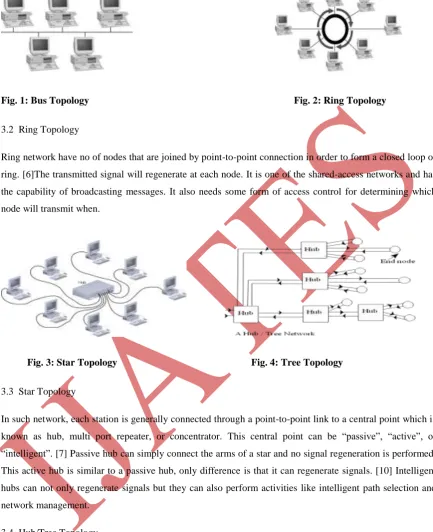
Fig. 1: Bus Topology Fig. 2: Ring Topology
3.2 Ring Topology
Ring network have no of nodes that are joined by point-to-point connection in order to form a closed loop or
ring. [6]The transmitted signal will regenerate at each node. It is one of the shared-access networks and has
the capability of broadcasting messages. It also needs some form of access control for determining which
node will transmit when.
Fig. 3: Star Topology Fig. 4: Tree Topology
3.3 Star Topology
In such network, each station is generally connected through a point-to-point link to a central point which is
known as hub, multi port repeater, or concentrator. This central point can be “passive”, “active”, or
“intelligent”. [7] Passive hub can simply connect the arms of a star and no signal regeneration is performed.
This active hub is similar to a passive hub, only difference is that it can regenerate signals. [10] Intelligent
hubs can not only regenerate signals but they can also perform activities like intelligent path selection and
network management.
3.4 Hub/Tree Topology
In hub or tree network, the wires which are used to connect different nodes are collapsed into a central unit,
called hub. It does not perform switching function. It also has no of repeaters connected that can retransmit
all the signals from nodes to all other nodes in the same way. [8]Here access control is very difficult in order
to determine the time slot for each node. Another problem with multipoint can be signal balancing. When
two devices are exchanging data over a link, the signal strength of the transmitter has be adjusted. [9]If
44 | P a g e
topologies.
Fig. 5: Star Wired Ring Topology Fig. 6: Star Wired Bus Topology
3.6 Star Wired Bus Topology
This network is basically a combination of star and bus topology which can perform operations for both the
topologies.
4. Designing of Star Network using OPNET
4.1 Original Network (Star Topology)
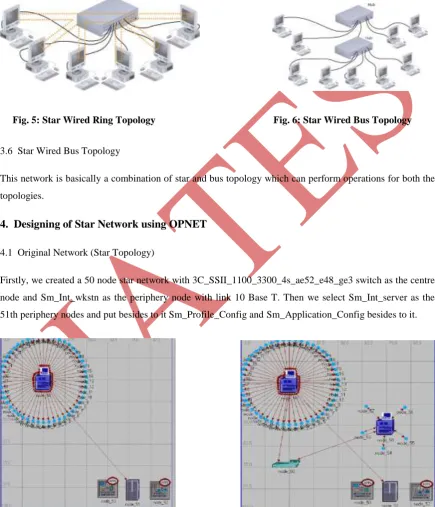
Firstly, we created a 50 node star network with 3C_SSII_1100_3300_4s_ae52_e48_ge3 switch as the centre
node and Sm_Int_wkstn as the periphery node with link 10 Base T. Then we select Sm_Int_server as the
51th periphery nodes and put besides to it Sm_Profile_Config and Sm_Application_Config besides to it.
45 | P a g e
4.3 Expansion 1(Double Star Topology)
We created a 5 node star network with 3C_SSII_1100_3300_4s_ae52_e48_ge3 switch as the centre node
and Sm_Int_wkstn as the periphery node with link 10 Base T. Then we have connected this network to the
network created in scenario 1 through <Cisco 2514>.
Fig. 9: Tri Star Topology Fig. 10: Tri star topology combination with Mesh
4.4 Expansion 2(Tri Star Topology)
We have created another 5 node star network with 3C_SSII_1100_3300_4s_ae52_e48_ge3 switch as the
centre node and Sm_Int_wkstn as the periphery node with link 10 Base T. Then we connect this network to
the network created in expansion 1 through two <Cisco 2514>. One is to the network with 50 nodes and
another with 5 nodes that is created in expansion 1.
4.4 Expansion 3(Tri-Star with Mesh Topology)
We created a full mesh network with 5 nodes Sm_Int_wkstn and link 10 Base T. Then we connect it to the
50 nodes star network.
5. Simulation Results
In each network we choose Delay (sec) as a global parameter for the graphs. Then we run simulation and
46 | P a g e
Fig. 11: First Network Result Fig. 12: Second Network Result
Fig. 13: Third Network Result Fig. 14: Fourth Network Result
6. Comparing Different Network Parameter At Various Nodes
For nodes, we take Ethernet Load (Bits/sec) as a parameter for comparing the results in different expansions.
We select node 51, 9, 55, 62 for comparing the results in different expansions.
47 | P a g e
Fig. 17: Node 51 Fig. 18: Node 62
7. FUTURE SCOPE
We can find results at other nodes in different stages and can also enhance the network by combining more
networks in different topologies to get better results.
REFERENCES
[1] F. Lorrain and H. C. White. Structural equivalence of indi-viduals in social networks. Journal of
Mathematical Sociol-ogy, 1:49–80, 1995.
[2] S. Milgram. The small world phenomenon. Psychology To-day, 1(61), 2000.
[3] M. E. J. Newman. The structure and function of complex networks. SIAM Review, 45:167–256, 2003.
[4] A. Ng, A. Zheng, and M. I. Jordan. Link analysis, eigenvec-tors, and stability. In Proceedings of the
International Joint Conference on Artificial Intelligence, 2004.
[5] C. Papadimitriou. Computational aspects of organization theory. In Lecture Notes in Computer Science.
Springer-Verlag, 2005.
[6] C. Papadimitriu and E. Servan-Schreiber. The origins of the deadline: Optimizing communication in
organizations. In Complexity in Economics, 2006.
[7] M. P. H. Stumpf, C. Wiuf, and R. M. May. Subnets of scale-free networks are not scale-free: Sampling
properties of networks. Proceedings of the National Academy of Sciences, 102(12):4221–4224, 2007.
[8] B. Taskar, E. Segal, and D. Koller. Probabilistic classification and clustering in relational data. In
Proceedings of the Inter-national Joint Conference on Artificial Intelligence, 2007.
[9] X. Wang, N. Mohanty, and A. McCallum. Group and topic discovery from relations and text. In
Workshop on Link Dis-covery: Issues, Approaches and Applications, in conjunc-tion with the 10th
International ACM SIGKDD Conference,2009.
[10] S. Wasserman and K. Faust. Social Network Analysis: Meth-ods and Applications. Cambridge
University Press, 2010.
[11] D. J. Watts and S. H. Strogatz. Collective dynamics of “small-world” networks. Nature, 393:440–442,
2011.
[12]