Page | 88
STUDY OF ENGINEERING PROPERTIES OF ROCK
SAMPLES FOR DEVELOPING EARLY WARNING
SYSTEM
Vaibhav patil
1, Dr.P.S.Patil
2 1Student, M.Tech Civil Structures, Rajarambapu Institute of Technology,Rajaramnager(India)
2
Professor , Civil Engineering, Rajarambapu Institute of Technology, Rajaramnager(India)
ABSTRACT
Structural rock mechanics which concerned with the stability of engineering structures in which the material is
predominantly rock. Excessive rock failure must be avoided in order to preserve the stability of the structure.
Rock fracture must be induced with the minimum input of external energy. Major disasters such as dam failures
and the Coal brook mine disaster; serve to illustrate the importance of rock fracture in practical engineering
terms.
The advancement of civil, mining and petroleum engineering spurred interest in the measurement of rock
stresses and from the relief methods of the 1930s the development of new stress measurement techniques has
been constantly increasing. To estimate the movement of earthquake generating faults, we need for estimates of
stress from the deep crust in rock. There are some techniques which are used for early warning fracture
detection in brittle material. Infra-red radiation (IIR) and acoustic emission (AE) monitoring are the two
examples of such system. But these techniques are more complex and costly hence need to propose a new
technique. Rock mechanics is the theoretical and applied science of the mechanical behavior of rock. It is the
branch of mechanics concerned with the response of rock to the force fields of its physical environment.
We develop a laboratory model for early indication of civil construction material rupture for some selective
samples of selective size. In this model, we develop controller based system for early warning. Maximum
compressive strengths of all samples are collected from civil engineering department. There are different
methods used for applying compressive force on rock and on other construction material. In our system, we
apply continuous unidirectional compressive force on sample under test by using hydraulic pressure. This
compressive force on sample will be measured by strain gauge sensor. The strain gauge sensor output is
pre-processed and will be given to controller.
Controller compares data obtained from strain gauge sensor and data regarding actual compressive strength and
take decision on rupture phenomenon and gives alarm on that time.
Keywords: Infra-Red Radiation (IIR),Acoustic Emission (AE),Disaster, StrainGauge,Rock Compressive Strength, Mechanics.
I. INTRODUCTION:
A civil engineer has to deal mostly with soils, rocks, timber, steel and concrete. In a great majority of civil
engineering projects, soils and rocks form sites of construction directly. Rock mechanics deals essentially with
Page | 89
of rocks is rather a generalized term. It might be understood to include discussion of all such properties of rocks
that are relevant to engineering application of these materials either after their extraction from their natural place
of occurrence or without extraction I.e.in their in –situ conditions. Failure of a material component is the loss of
ability to function normally. Components of a system can fail one of many ways, for example excessive
deformation, fracture, corrosion, burning-out, degradation of specific properties (thermal, electrical, or
magnetic), etc. Failure of components, especially, structural members and machine elements can lead to heavy
loss of lives, wealth. The survey of civil engineering works and reinforced earth structures is more and more
necessary either to detect the first sign of degradation before failure or to provide the designers/owners
information on the behavior of their structures. The first set would then include all those properties for which
rock specimens must be tested for selection as a material of construction for example as a building stone, road
stone or aggregate for concrete making. The second set of properties would include qualities of a natural bed or
rock mass that would determine its suitability for a proposed engineering project.
1.1 Testing Result
Firstly sensor of 50 ton capacity is to be taken for testing.The actual compressive strength of rock samples will
be calculated by 100 tonn capacity compressive testing machine.Then according to this the electric circuit will
be manufactured such that circuit gives alarm at 70 percent earlier of actual compressive strength.
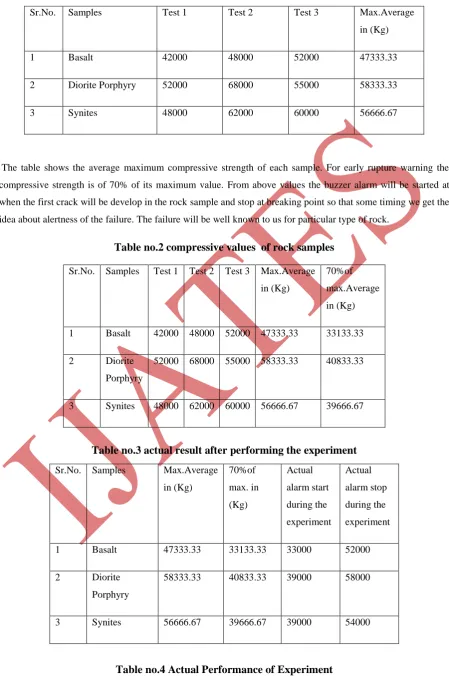
8 cm×8 cm rock samples of Basalt,Diorite Porphyry, Synites will be taken and actual failure at which the
sample will be broken will be find out first given in table below.Minimum three Test will be taken in the final
column average is given in table no.1
Fig.no.1 Rock samples with sensor mounting
Page | 90
Table no.1 compressive values of rock samples
The table shows the average maximum compressive strength of each sample. For early rupture warning the
compressive strength is of 70% of its maximum value. From above values the buzzer alarm will be started at
when the first crack will be develop in the rock sample and stop at breaking point so that some timing we get the
idea about alertness of the failure. The failure will be well known to us for particular type of rock.
Table no.2 compressive values of rock samples
Table no.3 actual result after performing the experiment
Table no.4 Actual Performance of Experiment
Sr.No. Samples Test 1 Test 2 Test 3 Max.Average
in (Kg)
1 Basalt 42000 48000 52000 47333.33
2 Diorite Porphyry 52000 68000 55000 58333.33
3 Synites 48000 62000 60000 56666.67
Sr.No. Samples Test 1 Test 2 Test 3 Max.Average
in (Kg)
70%of
max.Average
in (Kg)
1 Basalt 42000 48000 52000 47333.33 33133.33
2 Diorite
Porphyry
52000 68000 55000 58333.33 40833.33
3 Synites 48000 62000 60000 56666.67 39666.67
Sr.No. Samples Max.Average
in (Kg)
70%of
max. in
(Kg)
Actual
alarm start
during the
experiment
Actual
alarm stop
during the
experiment
1 Basalt 47333.33 33133.33 33000 52000
2 Diorite
Porphyry
58333.33 40833.33 39000 58000
Page | 91
II. CONCLUSIONSr.No. Samples 70%of
max. in
(Kg)
Actual alarm
start during
the
experiment
Actual
diff.between
the result
obtained
%Difference
between the
result
1 Basalt 33133.33 33000 133.33 0.41%
2 Diorite
Porphyry
40833.33 39000 1833.33 4.49%
Page | 92
Following are the conclusion made on result obtained –
1) By developing such type of electric system it is observed that failure of rock sample is possible to
predict.
2) It is observed that percentage accuracy is above 90%of accepted value as calculated after performing
the experiment.
3) The accuracy or the performance of experiment will be depend upon the quality of sample collected it
also depend upon properties of rock sample.
REFERENCES
[1]Morita K.(2008), “Crack detection methods using radio frequency identification and electrically conductive
materials”,14thWorld Conference on Earthquake Engineering october 12-17, Beijing, China.
[2]Rodriguez V.I. (2012), “A compressive sensing framework for seismic source parameter estimation”, Paper of Geophysical Journal, August 22. Received 2012 June 18; in original form 2012 March 8.