18 | P a g e
ISOLATION AND OPTIMIZATION OF ALKALINE
PROTEASE PRODUCING BACTERIAL ISOLATE
USING DAIRY EFFLUENT AS SUBSTRATE
Kinjal Raiyani
1, Arvindkumar B. Dungrechiya
21,2
Biogas Research Centre, Gujarat Vidyapith,
Sadra Gujarat (India)
ABSTRACT
A total 15 different alkaline protease producing bacterial strains were isolated by using casein agar medium plates based on zone of clearance. The samples were collected from dairy waste water and sludge of dudhsagar dairy, Mehsana, Gujarat, India. Among them RkNa2 strain gave highest protease activity (453.10 U/mL/min)
under submerged fermentation condition. Dairy waste water gave highest protease activity (345.9U/ml/min) among the different substrate studied. Maximum growth and enzyme activity was observed under optimum condition at 37ºC temperature, pH 8.0 (261.55U/mL/min), inoculum size 2%(135.00U/mL/min). Incubation period for maximum protease production was found to be 20 hrs(175.9U/mL/min) with galactose and 1 % peptone as a carbon and nitrogen source with optimum activity (84.35U/mL/min) and (288.12U/mL/min) respectively.
Keywords: Alkaline Protease, Submerged Fermentation.
I. INTRODUCTION
Enzymes are well known biocatalysts that perform many chemical reactions .They are commercially used in the detergent, food, pharmaceutical, diagnostics and fine chemical industries. More than 3000 different enzymes described to date the majority have been isolated from mesophilic organisms. These enzymes mainly function in a narrow range of pH, temperature, and ionic strength. Moreover, the technological application of enzymes under demanding industrial conditions makes the enzymes unrecommendable.[1]. Proteases are the most important group of enzymes produced commercially which are used in detergent, protein, brewing, meat, photographic, leather and dairy industries[2,3]. Microbial proteases are amongst the most important hydrolytic enzymes and have been studied extensively. In bacteria, this enzyme is produced mainly by many members belonging to genus Bacillus especially, B.licheniformis; B. horikoshii, B. sphaericus, Bacillus furmis, Bacillus alcalophilus, Bacillus subtilis[4].Alkaline proteases possess considerable industrial potential due to their biochemical diversity and wide applications in tannery and food industries, medicinal formulations, detergents and processes like waste treatment, silver recovery and resolution of amino acid mixtures[5].
19 | P a g e
II. MATERIALS AND METHODS
2.1. Isolation and screening of protease producing bacteria
Protease producers were isolated from dairy effluent, dudhsagar dairy, Mehsana, Gujarat, India. Samples were diluted and then different dilutions were applied on casein agar medium (nutrient agar with 1% casein) plates which were incubated 370C for 24 to 36 hours. Depending upon size of clearance of zone and protease activity, 15 different isolates were collected. Among them one potent isolate was selected for further study.
Selected isolate was biochemically characterized by Gram’s reaction, Motility Test, Spore Staining, carbohydrate fermentation, oxidase test, O-F test, H2S production, IMViC tests, NO2 reduction, starch hydrolysis, KOH Test , Vancomycin Test,as per the standard methods and was confirmed by Vitek 2 systems version:05.04.All the bacterial isolates were preserved on casein agar slant at 4⁰C temperature. Cultures were transferred at 15 days intervals.
2.2.Inoculum preparation
The culture was grown on casein agar plates at 37⁰ C temperature for 24 h. The cells were harvested from plates
and resuspended in required amount of distilled water. Cell density was measured at 660nm. The cell density of inoculums was adjusted to 1.0 O.D. (approximately 106CellsmL-1) to inoculate for enzyme production.
2.3.Production media and culture condition
Cultures were grown on production medium; containng (gL-1), peptone (10.0), meat extract (3.0), Nacl (5.0), casein (10). The casein medium was taken in 250 mL conical flasks. The flasks were sterilized in autoclave at 121⁰C (15 lb) for 15 min and after cooling, the flasks were inoculated with prepared cell suspension adjusted at
1.0 O.D 660 nm (approximately 106 CellsmL-1). The inoculated medium was incubated at 37⁰ C in shaker incubator for 24 h. At the end of fermentation period, the culture medium was centrifuged at 8000 rpm at 40C for 20 min. to obtain crude enzyme.
2.4.Extraction method
After incubation 1 mL broth from flask and 49 mL of (0.1 M) sodium glycinate buffer (pH 8.0) was taken in a 100 mL flask. The sample was mixed properly and centrifuged at 8000 rpm for 20 minutes using Heavy Duty Cooling Centrifuge at 4⁰ C. The supernatant was removed and subjected to further protease assay.
2.4.1.Enzyme assay method:
100 mL casein broth was inoculated with 1 mL inoculum, containing broth of actively growing culture and incubated at 37⁰C in an orbital shaker, at 100 rpm for 24 h. 1 mL broth from the flask and 49 mL sodium
glycinate buffer (0.1m) was taken after incubation in a 100 mL flask and after mixing it properly it was centrifuged at 8000 rpm for 20 min to obtain supernatant to be used as a crude protease enzyme source.
2.5.Optimization of cultural parameters for protease production
The selected bacterium was subjected to further optimization of that particular media by varying its different cultural parameters.
20 | P a g e Fermentation medium was supplemented with different raw materials such as dairy waste water, wheat bran, wheat husk, oil meal waste groundnut cake, groundnut shell powder, maize husk, whey waste, sorghum bran, rice bran at respective concentration. The substrates were sterilized, inoculated and incubated on orbital shaker at 100 rpm for 24 h. Protease activity was measured after centrifugation.
2.5.2.Effect of pH on protease production
Different pH i.e. 7.0, 7.5, 8.0, 8.5, 9.0 and 9.5 were studied to check their effect on protease production. The pH was adjusted using 1 N HCL or 1 N NaOH. The flask was incubated at 37⁰ C for 24 h at 100 rpm on orbital
shaker. After completion of the fermentation, protease activity was estimated and the optimum pH value was found out.
2.5.3.Effect ofsubstrate concentration on enzyme activity
Fermentation was carried out with 8% to 13% substrate concentration and other optimized parameter kept constant. The enzyme activity measured after fermentation by performing enzymatic assay.
2.5.4.Effect of temperature on enzyme activity
The flasks were incubated at temperature 35˚C, 37˚C, 40˚C, 42˚C and 45˚C at 100 rpm for 24 hr in shaker keeping the optimized parameters constant .
2.5.5.Effect ofincubation time on enzyme activity
The fermentation medium was incubated at 37˚C temperature at 100 rpm in environmental shaker. At regular time interval (4 hrs) that was starting from 4 hr to 38 hr, 5 mL of medium withdrawn and analyzed for protease production by protease assay method.
2.5.6.Effect of inoculum size on enzyme activity
Inoculum size ranging from 0.5% to 3.0% were inoculated at optimized temperature for 20 hr in orbital shaker at 100 rpm keeping the other optimized parameters constant. Sample was analyzed for protease production and selected for proper inoculum size.
2.5.7.Effect ofnitrogen sourceon enzyme activity
Different nitrogen sources concentration were used like meat extract and peptone at different concentration. The other components were kept constant. Meat extract as nitrogen source was added at different concentrations i.e. 0.10 %, 0.20 %, 0.3 %, 0.40%, and 0.50 %. Peptone as nitrogen source was added at different concentration i.e. 0.5%,1.0%, 1.5%, 2.0%, 2.5%, 3.0%, 3.5% 4.0%,4.5%, and 5.0%. The inoculated culture media was then incubated in environmental shaker at 100 rpm. The enzyme activity of the centrifuged supernatant was checked and the nitrogen sources which gave highest enzyme production was selected.
2.5.8.Effect of carbon source on enzyme activity
Carbon source like glucose, galactose, mannitol, maltose, sucrose and fructose at 0.05% concentration were chosen for study.Other then carbon source, optimized parameters were kept constant Fermentation media was prepared, inoculated and incubated in the orbital shaker at 100 rpm. The samples were analyzed for enzyme activity.
2.5.9.Effect of Nacl concentration on enzyme activity
21 | P a g e
III. RESULTS AND DISCUSSION
3.1.Screening and selection of protease producers
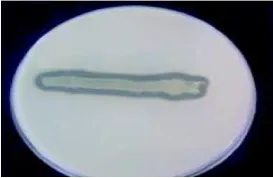
Out of the 15 different isolates one isolate (RkNa2) was selected for further study on the basis of its Zone of
clearance (9mm)(Fig 1) and Protease activity (453.10 UmL-1min-1).
Fig 1: Zone of clearance observed during growth of isolate RkNa
23.2.Identification of Alkaline Protease
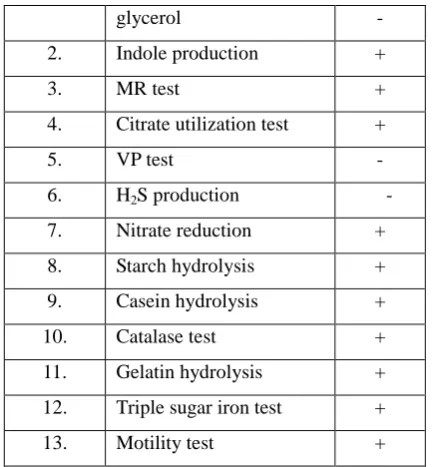
producer:-The bacterial isolate was found to be Gram negative,short rod shaped bacteria. producer:-The above results were confirmed by KOH and Vancomycin test. The isolate RkNa2 was identified on the basis of different biochemical
tests performed. For further conformation the isolate RkNa2 was sent to Supra Tech laboratory where it was
identified as Aeromonas sorbiausing Installed VITEK 2 Systems Version: 05.04 (Table 1& 2).
Table 1:Biochemical tests performed for the isolated RkNa
2Sr. No. Test Result
1. Sugar utilization
Glucose +
Sucrose +
Ribose +
Maltose +
Lactose -
Fructose +
Mannose +
Mannitol +
Galactose +
Arabinose -
Raffinose -
Trihalose +
Xylose -
Rhamnose -
Cellobiose -
Inositol -
22 | P a g e
glycerol -
2. Indole production +
3. MR test +
4. Citrate utilization test +
5. VP test -
6. H2S production -
7. Nitrate reduction +
8. Starch hydrolysis +
9. Casein hydrolysis +
10. Catalase test +
11. Gelatin hydrolysis +
12. Triple sugar iron test +
13. Motility test +
Key + positive, - negative.
Table 2:
Biochemical test on basis of VITEK 2 system
Well Test Results
1 Ala-phe-pro- ARYLAMIDASE +
2 ADONITOL
-3 L-Pyrrolydonyl-ARYLAMIDASE +
4 L-ARABITOL
-5 D- CELLOBIOSE +
6 BETA-GALACTOSIDASE
-7 H2S PRODUCTION
-8 BETA -N-ACETYL-GLUCOSAMINIDASE +
9 Glutamyl Arylamidase pNA`
-10 D-GLUCOSE +
11 GAMMA-GLUTAMYL-TRANSFERASE +
12 FERMENTATION /GLUCOSE +
13 BETA - GLUCOSIDASE +
14 D-MALTOSE +
15 D-MANNITOL +
16 D-MANNOSE +
17 BETA-XYLOSIDASE
-18 BETA-Alanine arylamidase PNA
-19 L-Proline ARYLAMIDASE
-20 LIPASE
23 | P a g e
22 Tyrosine ARYLAMIDASE +
23 UREASE
-24 D-SORBITOL
-25 SACCHAROSE/SUCROSE +
26 D-TAGATOSE
-27 D-TREHALOSE +
28 CITRATE(SODIUM) +
29 MALONATE
-30 5-KETO-D-GLUCONATE +
31 L-LACTATE alkalinisation
-32 ALPHA-GLUCOSIDASE
-33 SUCCINATE alkalinisation +
34 Beta-N-ACETYL-GALACTOSAMINIDASE +
35 ALPHA-GALACTOSIDASE +
36 PHOSPHATASE
-37 Glycine ARYLAMIDASE +
38 ORNITHINE DECARBOXYLASE
-39 LYSINE DECARBOXYLASE
-40 L-HISTIDINE assimilation +
41 CORMARATE +
42 BETA-GLUCORONIDASE
--43 O/129 RESISTANCE (comp.vibrio.) +
44 Glu-Gly-Arg-ARYLAMIDASE +
45 L-MALATE assimilation +
47 ELLMAN
-48 L-LACTATE assimilation
-3.3.Optimization of cultural parameters for protease production
3.3.1.Effect of raw materials on protease production
In the present study, dairy waste water, whey waste, wheat bran, wheat husk, groundnut oil meal waste cake, groundnut shell powder, maize husk and sorghum bran were used as substrate for production of protease from isolate RkNa2. Maximum production of protease (345.9 U\mL\min) was observed in case of dairy waste
24 | P a g e
Fig 2: Effect of raw materials on protease production
3.3.2.Effect of pH on protease production
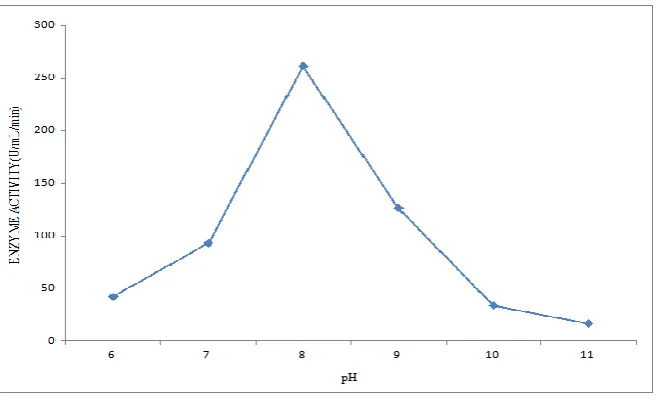
The optimum pH was found to be 8.0 at which isolate RkNa2 showed maximum activity 261.5U/mL/min (Fig
3). But, the organism showed very less enzyme activity i.e. 42.15 U/mL/min at pH 7.0 and no activity at pH 10.0. Our obtained results proved that the alkaline protease was produced in neutral to alkaline pH. The metabolic activities of microorganisms were very sensitive to the change in hydrogen ion concentration of their environment. Protease production was affected if pH level was higher or lower compared to the optimum value.Maximum activity for protease production was obtained by Bacillus spp. at pH 8.0[6,7].
Fig 3: Effect of pH on protease production
3.3.3.Effect of temperature on protease production
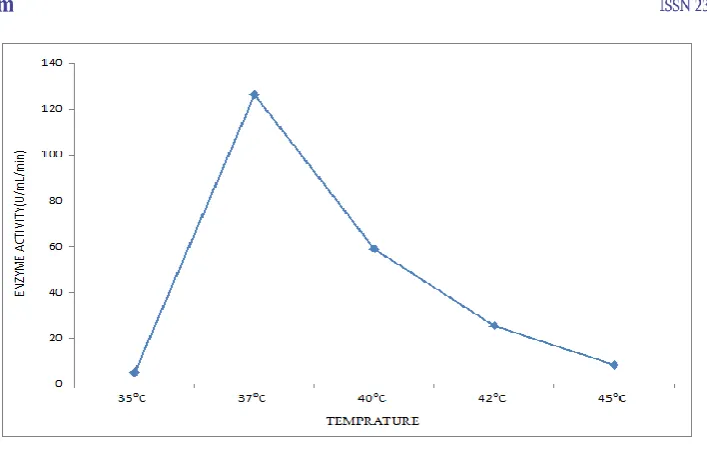
Isolate RkNa2 showed highest activity at 370C (Fig 4). Our results indicate that the organism was mesophilic in
25 | P a g e
Fig 4: Effect of temperature on protease production
Maximum activity has been obtained for Bacillus subtilis grown at 370C temperature. Pseudomonas spp has beenreported secerete maximum extra cellular protease at 340C and 370C[8,9].
3.3.4.Effect of incubation time on protease production
The highest protease activity was observed at 20hr with optimum activity 124.25 U/mL/min (Fig 5).Isolate RkNa2 showed gradually decreased protease production with increase in incubation time (20 h). A gradual
decrease in enzyme activity was observed with increased incubation time. The duration needed for incubation might depend on the growth rate of microbes and its enzyme production might be due to depletion of nutrient of fermentation medium. Thus the time required for enzyme production in case of bacteria is less because of their faster doubling time
Fig 5: Effect of incubation time on protease production
3.3.5.Effect of inoculum size time on protease production
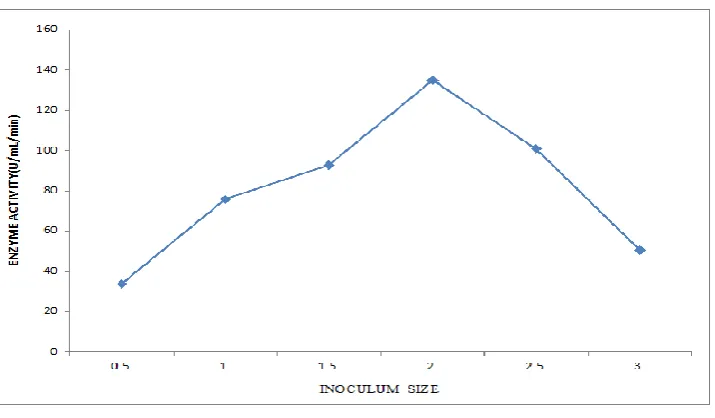
Different 6 inoculums size were studied to find out the effect of productivity on protease enzyme by Maximum protease activity for isolate RkNa2 was observed at 2% inoculums size with 135.00 UmL-1min-1 protease
26 | P a g e protease secreted. At higher percentage of inoculums size, protease activity was also found to be decreased even though luxurious growth was observed. studies have suggested that higher inoculums sizes resulted in reduced dissolved oxygen and increased competition towards nutrient and therefore decreased the protease production.Maximum protease activity has been obtained for Bacillus sp. MPTK 712 isolated from Dairy Sludge at inoculum size 2%. [10]
Fig 6: Effect of inoculum size on protease production
3.3.6.Effect of substrate concentration time on protease production
Isolate RkNa2 showed maximum protease production at 9 mL of substrate concentration with 92.80 UmL -1
min-1 protease activities(Fig 7). Enzyme activity increased or decreased on increasing or decreasing the substrate concentration. It was found that application of dairy waste water as crude protein source influenced the yield of protease.
Fig 7: Effect of substrate concentration on protease production
3.3.7.Effect of carbon source on protease production
It was observed that Isolate RkNa2 was capable of using a wide range of carbon sources, but protease production
varied according to the various carbon source. The isolated strain RkNa2 showed high enzyme activity (84.35
27 | P a g e observed with fructose as carbon source (Fig 8).
Fig 8: Effect of carbon source on protease production
3.3.8.Effect of nitrogen source on protease production
Peptone concentration was studied from 0.5% – 4.0%. The isolated strain RkNa2 showed high protease activity
(288.12 UmL-1min-1)at 1% concentration of peptone (Fig 9).
Fig 9: Effect of concentration of peptone on protease production
3.3.9.Effect of different concentration of meat extract as nitrogen source
Meat extract concentration from 0.1% – 0.5% was studied and it was observed that the isolated strain RkNa2
showed high protease activity (236.25 UmL-1min-1) at 0.3 % concentration meat extract (Fig 10).
28 | P a g e
Fig 10: Effect of concentration of meat extract on protease production
3.3.10.Effect of Nacl concentration on protease production
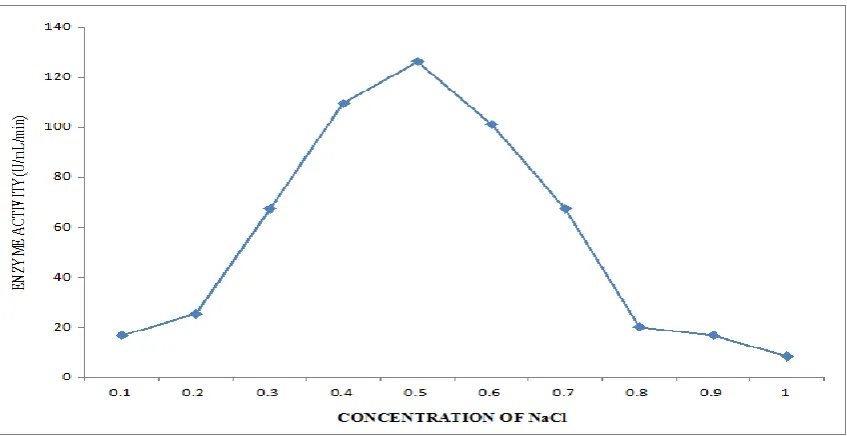
On studying the effect of different NaCl concentration on protease activity it was observed that at 0.5% NaCl concentration Protease activity increased (Fig 11). By changing upper and lower NaCl concentration protease
production negatively affected as compared to 0.5% NaCl concentration.
Fig 11: Effect of concentration of Nacl on protease production
IV. CONCLUSION
Isolate RkNa2 was identified as a potent protease producing bacterial species from dairy sludge of “Dudhsagar
dairy”, Mehsana, which was used as substrate. Further study related to compatibility of Protease with various
29 | P a g e
V. ACKNOWLEDGEMENT
I am thankful to the Head, Department of Microbiology, Gujarat Vidyapith, Sadra for providing necessary facilities to carry out my dissertation work.
REFERENCES
[1] Kumar C. G. and Takagi H.,Microbial alkaline protease, from a bioindustrial view point. Biotechnology advance. 17,1999, 561.
[2] Anwar A., Saleemudin M.,Alkaline protease :a review.Bioresourse technology. 64,1998, 175.
[3] Gupta, R., Beg Q.K. and Lorenz, P., Bacterial alkaline protease: Molecular approaches and industrial applications. Applied Microbiology and Biotechnology. (59), 2002, 15 – 32 .
[4] Ellaiah P., Srinivasula, B.and Adinarayana, K.,A review on microbial protease, Journal of Scientific and Industrial Research, 61, 2002, 690-704.
[5] Agrawal, D.; Patidar, P.; Banerjee, T. and Patil, S., Production of alkaline protease by Penicillium sp. under SSF conditions and its application to soy protein hydrolysis. Process Biochem., 39, 2004, 977-981
[6] Balakrishnan Padmapriya, Thamaraichelvan Rajeswari, Rajendran Nandita and Flanet Ra, Production and Purification of Alkaline Serine Protease from Marine Bacillus Species and Its Application in Detergent Industry,European Journal of Applied Sciences 4 (1),2012, 21-26.
[7] Swapna Vadlamani, Sreenivas Rao Parcha, Studies on industrially important alkaline protease production from locally isolated superior microbial strain from soil microorganisms. International Journal of Biotechnology Applications. 3(3), 2011, 102-105.
[8] Dutta, J. R. and Banerjee, R. Isolation and characterization of newly isolated Psuedomonas mutant for protease production. Bazilian Archives of biology and Technology, 49(1),2006, 37 – 47.
[9] Amrita Raj, Nancy Khess, Namrata Pujari, Sourav Bhattacharya, Arijit Das, Subbaramiah Sundara Rajan. Enhancement of protease production by Pseudomonas aeruginosa isolated from dairy effluent sludge and determination of its fibrinolytic potential, Asian Pacific Journal of Tropical Biomedicines.,2012, s1845 – s1851.
[10]D.J. Mukesh Kumar, Premavathi V12 enkatachalam,3N. Govindarajan,M.D. Balakumaran and P.T. Kalaichelvan. Production and purification of alkaline protease from Bacillus sp. MPTK 712 isolated from Dairy Sludge.( 2012) Global Veterinaria. 8 (5),2012, 433-439.