Publicly Accessible Penn Dissertations
2017
The Message As A Seed: Predicting The Diffusion
Of Anti-Smoking Arguments From Message
Construal
Stella LeeUniversity of Pennsylvania, [email protected]
Follow this and additional works at:https://repository.upenn.edu/edissertations Part of theCommunication Commons
This paper is posted at ScholarlyCommons.https://repository.upenn.edu/edissertations/2417
Recommended Citation
Lee, Stella, "The Message As A Seed: Predicting The Diffusion Of Anti-Smoking Arguments From Message Construal" (2017).
Publicly Accessible Penn Dissertations. 2417.
Arguments From Message Construal
Abstract
For many years, mass media health campaigns have strived to change population health-related attitudes and intentions. While it is important to assess the direct effects of exposure to health campaign messages on these campaign outcomes, it is equally valuable to examine whether messages can be further propagated into the public communication environment. When people decide to replicate (replication) the core arguments used in campaign messages as they diffuse them to additional campaign targets, this enhances the reach of a campaign. Moreover, when people extend (extension) the core arguments of campaign messages by diffusing arguments in the same category as the campaign theme but those not specifically targeted in campaign messages, this increases the diversity of campaign-relevant communication. This dissertation aimed to examine how exposure to anti-smoking campaign messages influences patterns of replication and extension with four experimental studies.
The first two studies examined whether message exposure can lead to replication and extension. Then, guided by construal level theory, the latter two studies examined whether different message characteristics and mindsets can increase or decrease patterns of extension. Study 1 found that exposure to why appeal messages (messages about reasons to quit smoking) and how appeal messages (messages about methods to quit smoking) influenced people to choose arguments that were targeted by the messages they were exposed to, to send to smokers. Study 2 focused on whether exposure to these messages influenced the selection of
arguments that were consistent with the appeals (why and how), but were not targeted by the messages participants were exposed to, and found partial support. Study 3 found that exposure to why appeal messages with proximal temporal frames could hinder the selection of non-targeted why arguments. However, no support was found for the hypothesis that inducing different construal mindsets could increase or decrease the selection of non-targeted arguments (Study 4).
The studies provided empirical tests of replication and extension—both outcomes that are important for advancing campaign effects. They also delved into the research question of whether certain message characteristics can promote or undermine the pattern of extension. Study results can inform campaign developers about which message strategies could be successful in further propagating campaign-relevant information into the public communication environment.
Degree Type
Dissertation
Degree Name
Doctor of Philosophy (PhD)
Graduate Group
Communication
First Advisor
Subject Categories
ANTI-SMOKING ARGUMENTS FROM MESSAGE CONSTRUAL
Stella J. Lee
A DISSERTATION
in
Communication
Presented to the Faculties of the University of Pennsylvania
in
Partial Fulfillment of the Requirements for the
Degree of Doctor of Philosophy
2017
Supervisor of Dissertation
Robert C. Hornik, Ph.D.,
Wilbur Schramm Professor of Communication and Health Policy
Graduate Group Chairperson
Joseph Turow, Ph.D., Robert Lewis Shayon Professor of Communication
Dissertation Committee
ANTI-SMOKING ARGUMENTS FROM MESSAGE CONSTRUAL
COPYRIGHT 2017
Before pursuing a doctoral degree, I had imagined the process of writing a
dissertation to be an individual’s lonely journey. I now realize that it is quite the opposite;
I would not have been able to complete this dissertation and the program without the
tremendous support I received from almost everyone around me.
First and foremost, I am extremely grateful to my advisor, Dr. Robert Hornik.
Your willingness to talk with me for hours about an unfamiliar theory and study designs
that could tackle my research question was what kept me motivated despite numerous
difficulties. It has been truly inspiring to work with someone as wise and insightful as
you, and I consider it an honor to be one of your advisees. Thank you so much for
helping me get to where I am now. I would also like to thank my committee members,
Dr. Joseph Cappella and Dr. Emily Falk for kindling my interest in message diffusion,
and providing thoughtful comments. Your support and suggestions have not only greatly
improved this dissertation, but have sparked further ideas for future directions.
I would also like to extend my sincere gratitude to members of the Annenberg
community. I had the fortune of working with such a smart and lively bunch of people:
Laura Gibson, Emily Brennan, Andy Tan, Ani Kybert-Momjian, Alisa Padon, Kirsten
Lochbuehler, LeeAnn Sangalang, Qinghua Yang, Sharon Williams, Michelle Jeong,
Danielle Naugle, Jiaying Liu, Elissa Kranzler, Allie Volinsky, Leeann Siegel, and
Kwanho Kim. Our struggles and laughter together always gave me the strength I needed
to move forward. I will surely miss our teamwork and camaraderie. I would also like to
help out. In addition to the Annenberg community, I would like to thank Wharton’s Risk
Center for funding my dissertation studies through the Russell Ackoff Doctoral Student
Fellowship.
Most importantly, I would like to thank my family for their unwavering support
and love. Mom, dad, Estelle, and Jaeyong, words cannot express how grateful I am to
each and every one of you. Your unshakeable faith in me was what kept me going and
brought me to where I am now. I love you all so much. Finally, I would like to thank my
husband Kwonsang for being there for me every step of the way. I could never have
imagined that you and I would end up in the same university to both pursue our doctoral
degrees when we met randomly on a subway train nine years ago. This journey to a PhD
had its joys but also sorrows, but every moment of it was worthwhile because I had you
by my side. Thank you, I love you.
THE MESSAGE AS A SEED: PREDICTING THE DIFFUSION OF
ANTI-SMOKING ARGUMENTS FROM MESSAGE CONSTRUAL
Stella J. Lee
Robert C. Hornik
For many years,mass media health campaigns have strived to change population
health-related attitudes and intentions.While it is important to assess the direct effects of
exposure to health campaign messages onthese campaign outcomes, it is equally
valuable to examine whether messages can be further propagated into the public
communication environment. When people decide to replicate (replication) the core
arguments used in campaign messages as they diffuse them to additional campaign
targets, this enhances the reach of a campaign. Moreover, when people extend
(extension) the core arguments of campaign messages by diffusing arguments in the same
category as the campaign theme but those not specifically targeted in campaign
messages, this increases the diversity of campaign-relevant communication. This
dissertation aimed to examine how exposure to anti-smoking campaign messages
influences patterns of replication and extension with four experimental studies.
The first two studies examined whether message exposure can lead to replication
reasons to quit smoking) and how appeal messages (messages about methods to quit
smoking) influenced people to choose arguments that were targeted by the messages they
were exposed to, to send to smokers. Study 2 focused on whether exposure to these
messages influenced the selection of arguments that were consistent with the appeals
(why and how), but were not targeted by the messages participants were exposed to, and
found partial support. Study 3 found that exposure to why appeal messages with proximal
temporal frames could hinder the selection of non-targeted why arguments. However, no
support was found for the hypothesis that inducing different construal mindsets could
increase or decrease the selection of non-targeted arguments (Study 4).
The studies provided empirical tests of replication and extension—both outcomes
that are important for advancing campaign effects. They also delved into the research
question of whether certain message characteristics can promote or undermine the pattern
of extension. Study results can inform campaign developers about which message
strategies could be successful in further propagating campaign-relevant information into
LIST OF TABLES ... x
LIST OF FIGURES ... xi
Introduction ... 1
Literature Review ... 4
Campaign Message Effects and Interpersonal Communication ... 4
Core Concepts and Tenets of the Construal Level Theory ... 12
Construal Level Theory and Prediction of Thoughts and Language... 15
Construal Level Theory and Message Effects ... 18
Overview of Studies ... 23
Study 1 Introduction ... 27
Pre-Study – Pilot to Select Arguments ... 28
Method ... 28
Pooling arguments. ... 28
Mechanical Turk pilot. ... 28
Analysis to choose arguments. ... 29
Study 1: The Effect of Exposure to Why and How Messages on ... 32
Selection of Targeted Arguments ... 32
Hypotheses ... 32
Method ... 32
Study design. ... 32
Participants. ... 33
Stimuli. ... 33
Argument choice measure. ... 36
Analysis... 37
Results ... 39
Discussion... 39
Study 2: The Effect of Exposure to Why and How Messages on ... 41
Selection of Non-targeted Arguments ... 41
Hypotheses ... 42
Analysis... 45
Results ... 45
Discussion... 46
Study 3: The Joint Effect of Temporal Frames and Message Appeals ... 49
on Non-targeted Argument Selection ... 49
Hypotheses ... 51
Method ... 52
Study design. ... 52
Participants. ... 54
Stimuli. ... 54
Argument choice measure. ... 57
Analysis... 57
Results ... 57
Discussion... 59
Study 4: The Joint Effect of Word Task and Message Appeals on ... 63
Non-targeted Argument Selection ... 63
Hypotheses ... 64
Method ... 64
Study design. ... 64
Participants. ... 65
Stimuli. ... 65
Construal level word task... 65
Argument choice measure. ... 66
Analysis... 66
Results ... 66
Discussion... 67
General Discussion ... 70
Summary of Results ... 70
Implications ... 71
Limitations ... 76
Future Directions ... 79
Figure 1. Replication and extension... 8
Figure 2. Example of Study 1 why and how messages ... 35
Figure 3. Example of Study 1 exposure procedure ... 36
Figure 4. Example of Study 1 argument choice measure and argument set ... 37
Figure 5. Study 3 conditions and number of participants ... 54
Introduction
For decades, mass communication health campaigns have strived to change a
variety of health-related behaviors, such as drug use, tobacco use, exercise, and fruit and
vegetable consumption. As such, most health communication research has focused on
examining how exposure to campaign messages can influence intention and behavior
change. Recent research has also explored how interpersonal communication around
campaign messages can help or hurt the effect of campaign exposure on outcomes such
as attitudes and intentions. However, researchers have seldom focused on how
interpersonal communication may be able to propagate campaign-relevant information to
campaign targets.
This dissertation aimed to examine how exposure to campaign messages
influences people to replicate (replication) or extend (extension) the core arguments used
in campaign messages as they diffuse them to additional campaign targets (Cappella,
2002). Replication refers to whether people choose to transmit the same arguments
targeted in campaign messages to campaign targets. Extension means arguments that
people choose to diffuse are in the same category as the campaign theme (e.g., reasons to
quit smoking), but were not specifically targeted in campaign messages. Examining how
replication and extension can be shaped in response to message exposure can provide
insight into how campaign messages can trigger the spread of more campaign-relevant
communication into the public communication environment. Ultimately, outcomes of
replication and extension are significant because they are both expected to contribute to
increasing the potential to move more people in the campaign’s intended direction.
Extension increases the diversity of campaign-relevant communication which in turn can
strengthen campaign effects via mechanisms of repeated exposure (i.e., exposure to a
number of different arguments that encourage health behavior change) and tailoring (i.e.,
an argument that was not targeted by messages, but tailored to a specific campaign
target). In sum, message exposure-induced propagation processes may enhance campaign
effects by extending the span of exposure to message-specific information, and by
expanding the depth of message-relevant information.
Through four studies, this dissertation attempted to examine how exposure to
anti-smoking messages can influence people’s choice of arguments to send to smokers (i.e.,
campaign targets). Guided by principles of construal level theory (Trope & Liberman,
2010), Study 1 tested whether exposure to messages influenced people to choose the
specific arguments targeted by the messages they were exposed to, to send to smokers
(replication). Study 1 found that exposure to messages increased the likelihood of
choosing targeted arguments to transmit to smokers. Study 2 began to examine extension
by testing whether exposure to messages prompted people to choose arguments that were
in the same category as the message themes, but were not specifically targeted by the
messages they were exposed to. Study 2 found evidence that supported this hypothesis.
Study 3 then investigated the research question of whether manipulating different
message characteristics could influence the pattern of extension. That is, whether
manipulating certain message characteristics could boost or hinder the choice of
non-targeted arguments to send to smokers. Study 3 results indicated that exposure to certain
4 explored whether different modes of processing (high vs. low construal mindsets) could
also encourage or discourage the choice of non-targeted arguments to send to smokers.
However, Study 4 did not find any significant results. Nonetheless, the studies provide
confirmation that exposure to messages can indeed influence the ways people choose
arguments to transmit to others, whether they are the same ones targeted by the messages
or ones that are in the same category as the message theme, but not targeted by messages.
Study 3 in particular indicated that the use of certain message characteristics can actually
hinder the flow of campaign-relevant information from reaching others. This opens up
further future research directions for investigating the relationship between certain
message characteristics and outcomes of propagation, which will be able to provide
campaign developers with knowledge about which message strategies can facilitate the
successful propagation of message content through the public communication
Literature Review
Campaign Message Effects and Interpersonal Communication
Scholarly interest in examining mass communication effects in concert with
interpersonal communication effects has burgeoned since Katz and Lazarsfeld’s,
Personal Influence (1955), which affirms the importance of social networks and our
conversations with others in diffusing information and adopting new behaviors. In line
with this tradition, current research on public health campaigns has also begun to
acknowledge that mass media campaign messages are not received in a void, but
accepted within the context of conversation with others. The dominant framework used to
conceptualize the role of interpersonal communication in public health campaigns is to
view interpersonal communication as a moderator of campaign effects or a mediator of
campaign effects (Southwell & Yzer, 2007). Briefly, interpersonal communication as a
mediator of mass media campaigns suggests two roles of interpersonal communication:
extending campaign reach and inducing behavior change. First, interpersonal
communication may expose a target individual to the campaign message (i.e., diffuse the
campaign message) when that individual has not yet seen the campaign message, thus
extending the campaign’s reach. Whether people diffuse the core arguments of campaign
messages to others around them has yet been directly tested, but research in other
contexts, such as national news events suggest that news tends to travel rapidly through
social networks (Larsen & Hill, 1954). Second, campaign exposure might lead a person
to talk with others about the campaign message, and discover positive or negative norms
influence smoking cessation intention and behavior via discussion about campaigns,
which suggests a mediating role of interpersonal communication (van den Putte, Yzer,
Southwell, de Bruijn, & Willemsen, 2011). Similarly, analysis of the Truth Campaign
found that campaign exposure led to campaign-related conversation which in turn had a
positive effect on youth anti-smoking beliefs (Hwang, 2012). Interpersonal
communication as a moderator indicates that it can amplify or dampen campaign effects.
For instance, the effect of exposure to an HIV-prevention campaign on HIV testing was
stronger for respondents who had discussed HIV with others (Rimal, Limaye, Roberts,
Brown, & Mkandawire, 2013), indicating the moderating role of interpersonal
communication on campaign effects. In an experimental setting, those who watched an
HPV vaccine ad and talked about it subsequently held more positive attitudes towards
getting the HPV vaccine compared to those who only watched the ad (Dunlop, Kashima,
& Wakefield, 2010).
In addition to literature that establishes the importance of the presence of
interpersonal communication in realizing campaign effectiveness, the call for an
understanding of how and when interpersonal communication can mediate or moderate
campaign effects (Southwell & Yzer, 2009) has also led to studies that examine the
mechanism and conditions under which interpersonal communication exerts influence in
the process of campaign effects. For example, some studies have explored more specific
elements of conversations such as, conversational valence and conversation partner
characteristics (e.g., David, Cappella, & Fishbein, 2006; Dunlop, 2011; Hendriks, Bruijn,
Meehan, & Putte, 2016; Hendriks, de Bruijn, & van den Putte, 2012; Richards, 2014) as
matters for behavior change. For instance, Hendriks and colleagues (2012) demonstrated
that anti-alcohol message exposure led to negative conversations about alcohol
consumption, which in turn increased intentions to refrain from binge drinking. In this
study, dyad participants were randomly assigned to two conditions where in one
condition the participants watched an anti-alcohol message while the other condition did
not. All participants were asked to talk about alcohol and binge drinking after watching
or not watching the message. The study was able to show that exposure to an
anti-drinking campaign message affected intention to refrain from binge anti-drinking through
conversational valence which was measured as how favorable or unfavorable participants
recalled their conversation about alcohol to be. In a similar vein, Brennan and colleagues
(Brennan, Durkin, Wakefield, & Kashima, 2016) were able to examine conversations that
ensued after exposure to anti-smoking messages in a more naturalistic context, where
participants were asked to watch anti-smoking messages at home and later asked to recall
the content of conversations about the messages. Results suggested that conversations
with favorable appraisals of the messages and those with quitting talk had positive effects
on intention change. In contrast, it was also found that conversation could undermine
message effects (David et al., 2006) if the conversation is dominated by conversation
partners unfavorable to the messages’ arguments. The study found that adolescents who
chatted with their peers after watching anti-drug ads, exhibited weaker anti-marijuana
beliefs than those who did not chat with their peers. This effect was mainly due to high
sensation-seeking adolescents and those who are at more risk of using marijuana uttering
more pro-drug comments than did low sensation-seeking adolescents and those with
In sum, recent research has explicated the way in which interpersonal
communication can influence campaign effects by focusing on how certain components
of interpersonal communication contribute to shaping campaign outcomes. Nonetheless,
there are two gaps in this line of research. First, research has focused less on the role of
interpersonal communication as a propagation mechanism, but more on whether it can
affect immediate campaign outcomes such as attitude and intention change. Treating
interpersonal communication as another consequential behavior that can promote the
diffusion of campaign themes or other related information matters because it allows
examination of whether campaign messages can penetrate society widely with varying
chain reactions of further communication. This can ultimately contribute to potentially
larger campaign outcomes because it expands the reach and diversity of campaign-related
information. This focus on propagation corresponds well with the “media as meme”
paradigm (Cappella, 2002). Cappella argues that media stories, like genes, are successful
when they replicate themselves across a broader social environment. This is similar to the
role of interpersonal communication acting as a mediator of campaigns by diffusing
campaign themes and arguments to a broader audience (Southwell & Yzer, 2007).
However, this notion has yet been empirically tested. For example, whether exposure to
campaign messages influences people to replicate the core message to others around them
is yet unknown (replication). Another characteristic of a gene is variation, where genes
do not only replicate themselves, but also propagate variants of themselves. Interpersonal
communication may also serve as a mechanism similar to variation when other
information in the same category as the campaign themes are passed on by people who
2002). For example, if a campaign message targets certain arguments about reasons to
carry out a health behavior, people exposed to these messages may also diffuse other
arguments that are about reasons to carry out a health behavior, but were not targeted
specifically by the messages. I call this “extension” rather than “variation” to better
capture the notion that a campaign theme can be extended via the diffusion of arguments
that are of the same category as the campaign theme. Extension is important because it
can broaden the range of public communication about campaign target behaviors, which
can lead to enhanced campaign outcomes (Hornik, 2002; Hornik & Yanovitzky, 2003). I
aim to examine interpersonal communication as a propagation mechanism by examining
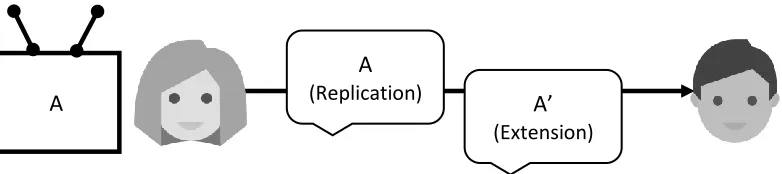
outcomes of replication and extension. Figure 1 represents these outcomes visually.
A second gap in literature is that research has seldom delved into how different
campaign messages can shape outcomes such as replication or extension. From the
viewpoint of campaign developers, knowing how certain campaign message
characteristics can shape post-exposure replication and extension is important because it
can ultimately predict which message strategies would produce patterns of propagation
conducive to campaign outcomes. While previously mentioned research on Figure 1. Replication and extension
A
A
(Replication) A’
conversational valence (e.g., Brennan et al., 2016; Hendriks et al., 2012) does not tap into
outcomes of replication and extension, they explicate a mechanism for how interpersonal
communication may promote or hinder campaign outcomes. However, they are
descriptive in a sense that they cannot predict whether favorable or unfavorable
conversations will result. Examining talk about campaign messages as a function of
conversation partners provides some element of prediction (e.g., David et al., 2006;
Hendriks et al., 2016; Richards, 2014), but campaign developers have little or no control
over who people will converse with. In contrast, message characteristics are directly
controllable components of a campaign. Examining how exposure to campaign message
characteristics can influence outcomes of replication and extension will aid campaign
developers’ decisions in selecting campaign messages that will propagate successfully.
There are a few studies that delve into how certain message characteristics can
drive replication (see Cappella, Kim, & Albarracín, 2015 for theoretical overview). For
example, an analysis of New York Times health news articles revealed that articles with
high informational utility and positive sentiment were shared more with others via email
or social media (H. S. Kim, 2015). An experimental study found that participants who
were exposed to content with high arousal emotions (e.g., amusement, anxiety) were
more willing to share the content with others than those exposed to content with low
arousal emotions (e.g., sadness, contentment) (Berger, 2011). These studies demonstrate
that message characteristics such as, informational utility, positive sentiment, and arousal
emotions help messages replicate to a larger audience via people’s retransmission
behaviors. However, these studies do not examine whether these message characteristics
While there are no studies that delve into the connection between message
characteristics and extension, a handful of studies have examined the effect of message
characteristics on characteristics of interpersonal communication, such as conversational
valence. For example, Dunlop, Cotter, and Perez (2014) found that highly emotional ads
(coded for being emotionally intense and powerful) were more successful than low
emotion ads in generating interpersonal pressure. Also, smokers who reported receiving
interpersonal pressure as a result of family and friends watching a high emotion ad were
more likely to have salient quitting thoughts compared to those who were pressured by
family and friends who saw a low emotion ad. Although these results indirectly indicate
that message characteristics such as emotionality may affect the strength of interpersonal
pressure, it is difficult to know what characterizes the interpersonal pressure generated by
high emotion ads. Also, the cross-sectional nature of the data render causal inference
difficult. To date, there are only two studies that explore how message characteristics
affect post-message exposure conversational valence with experiments. Hendriks and
colleagues (2014) examined whether messages with different types of emotions (fear,
disgust, humor) affect the valence of conversations that happen after exposure to those
messages. The study found that while a fear appeal message about anti-binge drinking
elicited negative conversational valence towards binge drinking, other appeals were not
related to conversational valence. However, a limitation is that the study did not examine
the valence of conversations directly, but asked participants for their perceptionsof
conversational valence as a proxy. This is problematic because perceived conversational
valence may reflect other cognitions, such as one’s own attitudes or intentions towards
colleagues (2010) also examined whether message format (narrative vs. advocacy) could
influence positive opinion sharing and favorability in post-exposure conversations. While
positive opinion sharing was measured by content analyzing utterances of participants,
conversation favorability was measured by asking participants to recall the tone of their
conversations. Thus, research on the relationship between message characteristics and
interpersonal communication characteristics has been scarce, and the outcome of interest
has been limited to conversational valence. Moreover, studies have relied solely on recall
or perceptions of conversations. To address this gap in research, I aim to examine how
different message types can influence outcomes of replication and extension by capturing
how people choose arguments to send to other people around them.
In predicting how certain messages can shape the diffusion and evolution of
message-relevant information, I argue that construal level theory (Trope & Liberman,
2010) can provide a useful framework. In other words, I believe it can guide questions
about how the nature of messages can affect the type of arguments an individual who is
exposed to those messages will prefer to transmit to others. Briefly, construal level theory
(CLT) is a theory that posits that people construe external stimuli such as actions and
objects either abstractly or concretely. This mindset (construal level) of representing
things abstractly or concretely has been shown to have an effect on a variety of outcomes
such as, object evaluation, behavior change, and self-control (Soderberg, Callahan,
Kochersberger, Amit, & Ledgerwood, 2015). Based on this line of research, I put forth
the claim that exposure to certain messages can induce construal mindsets, which
ultimately have the potential to affect the content of subsequent arguments people will
of CLT, and illustrate two lines of research: Literature that describes how construal level
can impact the content and form of salient thoughts and language and research that
operates on assumptions that certain message characteristics can elicit different construal
level. I attempt to connect these two lines of research together which ultimately leads to
my crucial hypotheses that the construal level of primary messages will shape
post-exposure preference for construal-related arguments to transmit to others.
Core Concepts and Tenets of the Construal Level Theory
CLT mainly asserts that people tend to construe, or mentally represent objects and
actions at either an abstract (high construal) or concrete (low construal) level. A high
level construal refers to relatively abstract, broad, and superordinate representations,
whereas a low level construal represents an emphasis on concrete, detailed, and
subordinate features. Trope and Liberman (2010) offer two criteria to distinguish which
features of an object or event should be considered as high level construal or low level
construal. The first criterion is centrality, which reflects the fact that changing a high
level feature will impact the meaning of the object or event more than when changing a
low level feature. For example, the meaning of a lecture would change more if the
speaker (high level) is changed than when the room (low level) is changed. The second
criterion is subordination, where the meaning of a low level feature depends more on the
high level feature rather than vice versa. Following the previous example, when an
individual is deciding whether to attend a lecture or not, the room the lecture is held in
only becomes important when the topic is interesting. Some operationalizations of high
primary features versus secondary features, and broad categories versus exemplars
(Carrera, Muñoz, Caballero, Fernández, & Albarracín, 2012; A. Y. Lee, Keller, &
Sternthal, 2010; Yan & Sengupta, 2013). Soderberg and colleagues (2015) provide a
more detailed list of high versus low construal examples derived from an extensive
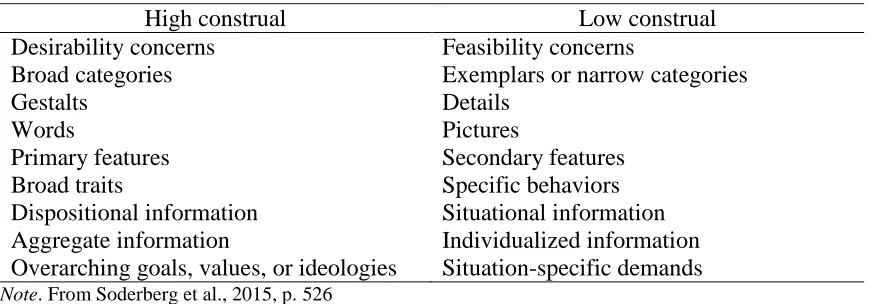
meta-analysis of studies on CLT which is summarized and described in Table 1 of this
manuscript. Taking desirability versus feasibility as an example, when one is in a high
construal level mindset, or in other words, when one construes an action or object at a
high level, the value of the action or object’s end state (‘why’ one should carry out an
action or desirability components of an object) is considered more; whereas when one
construes these at a low level, the means to reach the end state (‘how’ one should perform
an action or feasibility components of an object) are considered more. Another important
concept of CLT is psychological distance. Psychological distance is the extent to which
an event or object is temporally, spatially, socially, and hypothetically removed from
one’s own experience. That is, an object or event is psychologically distant if it occurs in
the future, in a remote location, to others less like oneself, or with a small probability.
Table 1. Examples of high vs. low construal characteristics
High construal Low construal
Desirability concerns Feasibility concerns
Broad categories Exemplars or narrow categories
Gestalts Details
Words Pictures
Primary features Secondary features
Broad traits Specific behaviors
Dispositional information Situational information Aggregate information Individualized information Overarching goals, values, or ideologies Situation-specific demands
Based on these two core concepts of construal and psychological distance, the
most important proposition of CLT is that psychological distance has a bi-directional
relationship with the level of mental construals (Liberman, Trope, & Wakslak, 2007;
Trope & Liberman, 2010). To elaborate, numerous studies have found that people tend to
think about psychologically distant objects (e.g. temporally, spatially, socially,
hypothetically distant) in higher levels of construal, and when primed with higher levels
of construal, tend to recall distant objects. As a brief example, Fujita and colleagues
discovered that participants who watched a video and were led to believe the actions in
the video took place in a spatially distant location, described the actions in the video in
more abstract and general language than those who watched the same video but believed
the actions occurred in a spatially near location (Fujita, Henderson, Eng, Trope, &
Liberman, 2006). Specifically, participants who thought the actions occurred from a
remote place described those actions in more abstract terms such as adjectives that refer
to broader dispositional characteristics rather than concrete terms which include verbs
that visibly describe situation specific details (Semin & Fiedler, 1988). Not only have
studies found the direct link between psychological distance and construal level (i.e., that
people think of distant objects and events in abstract and broad ways), but they have also
found that the relationship between psychological distance and construal level has
downstream consequences for decision-making and prediction. For example, participants
who were instructed to think about buying a DVD player this week (near future) had
higher evaluations of the DVD player when a presented message about the DVD player
emphasized a feasibility feature (i.e., manual is easy to use) than when the message
materials), while those instructed to think about buying a DVD player 3 months from
now (distant future) had higher evaluations of the DVD player when the presented
message was desirability-focused than when the message was feasibility-focused (Fujita,
Eyal, Chaiken, Trope, & Liberman, 2008). These results can be explained by the fact that
participants give more weight to desirability features because distant psychological
distance induces a high construal level mindset while a low construal level mindset
induced by proximal psychological distance makes participants more susceptible to
feasibility concerns. A meta-analysis of CLT studies found a medium-sized effect of
psychological distance on construal level (Hedges’ g=.475), and this effect size did not
vary by different fields or authors. In addition, a medium-sized effect (Hedges’ g=.526)
was also found for the downstream consequences of construal level (Soderberg et al.,
2015), which suggests that the propositions of CLT are highly robust.
Construal Level Theory and Prediction of Thoughts and Language
Based on the concepts and tenets of CLT, research has also delved into examining
how high versus low construal may affect the content and form of thoughts and language.
Scholars have examined whether construal levels influence the preference for certain
content and the salience of particular thoughts by manipulating psychological distance.
Most studies focus on psychological distance because psychological distance is known to
influence construal mindsets. When it comes to the content of language and thoughts,
most research has dealt with prominent high versus low level construal features such as
desirability versus feasibility. For example, Young (2015) found that participants who
manipulated to be more similar in attitudes and demographic characteristics (close social
distance) listed more feasibility-related health beliefs (low construal) than those who
were manipulated so that they understood the message source to be dissimilar (far social
distance) to them. The reverse pattern emerged for desirability-related health beliefs (high
construal), where participants listed more desirability beliefs when they believed the
message source to be dissimilar to themselves. It can be said that the perception of social
proximity of the message source led to a low construal mindset which increased the
salience of low construal features such as feasibility-related thoughts (e.g., “Set a time
every day to just spend on exercise and have a support group to help you get
motivated.”). Similarly, Lutchyn and Yzer (2011) found that those who were asked to
think about eating fruits and vegetables in the near future (tomorrow and three months
from now) listed more feasibility beliefs (e.g., “It is hard because it can be expensive”)
while those who thought about performing the behavior in the distant future (six months
from now and five years from now) listed more desirability beliefs (e.g., “Getting proper
nutrient is important”). Another study examined whether people craft messages
differently depending on the audience size they are considering (Joshi & Wakslak, 2014).
Based on CLT, the authors theorized that people will construct more high construal level
messages when they believe the audience is large. The rationale is that a communicator
addressing a large audience must craft broad or general messages in order to successfully
target many different types of individuals; the very reason high level construals are
functionally utilized (Trope & Liberman, 2010). Also, people may link larger audiences
with increased distance (i.e., increased social and spatial distance), which in turn will
One of the experiments manipulated audience size (one vs. 20 people) and asked
participants to select arguments to persuade the audience to recycle. Participants asked to
persuade 20 people selected more desirability arguments than those who were asked to
persuade one individual. These results were also replicated in the context of spatially near
versus distant audiences (Joshi, Wakslak, Raj, & Trope, 2016).
On one hand, some studies have focused on the form of language and thoughts by
examining whether psychologically distant objects or events are talked about in more
linguistically abstract terms, since psychological distance elicits an abstract mindset (e.g.,
Bhatia & Walasek, 2016; Huang, Burtch, Hong, & Polman, 2016; Snefjella & Kuperman,
2015). For instance, Snefjella and Kuperman (2015) analyzed a large corpus of Twitter
messages and found that the linguistic concreteness of tweets mentioning a city decreased
as the distance between the tweet author and the city mentioned in the tweet increased.
Parallel results were found with regard to temporal distance (tweets mentioning time
periods that range from “1 year ago” to “999 years ago”) and social distance (tweets
mentioning groups of people that range from socially distant [e.g., foreigners, visitors] to
socially close [e.g., family, friends] people) where the concreteness of tweets decreased
as social and temporal distance increased. Bhatia and Walasek (2016) come to similar
conclusions with an analysis of New York Times articles mentioning elections, where
they found that the concreteness of articles decreased as the distance between the date the
article was written and the date of the election mentioned in the article increased. In
addition to large scale textual analyses, a number of experimental studies have also
predicted the form of language based on CLT. For example, the previously mentioned
persuade a larger audience to buy an imaginary product chose more linguistically abstract
arguments than those asked to persuade a smaller audience (Joshi & Wakslak, 2014). In
addition, when asked to describe their daily life at school to incoming students
geographically far away (spatially distant), participants used more abstract words in their
descriptions than those asked to address students who were geographically close
(spatially near) (Joshi et al., 2016).
To summarize, an induction of high or low construal (by manipulating
psychological distance) is shown to drive the content (desirability vs. feasibility) of
salient thoughts and the form (abstract vs. concrete) of language. This implies that if
certain message characteristics can align with high or low construal, exposure to these
messages will make construal-related content or form salient in people’s minds.
Construal Level Theory and Message Effects
Researchers have started to apply CLT to message effect studies under the
assumption that a variety of message characteristics can be conceptualized as high or low
construal features. This line of research mainly focuses on the effect of a message’s
construal level on message evaluation and persuasion. A majority of message effects
studies based on CLT can be classified into two broad categories: 1) Research that
examines how certain message topic and design combinations can be more effective than
other combinations; and 2) studies that explore how messages can be tailored to certain
individual characteristics. Both lines of research build off the premise that a construal
level match across message components or message components and individual
characteristics that are assumed to align with high versus low construal are organized in
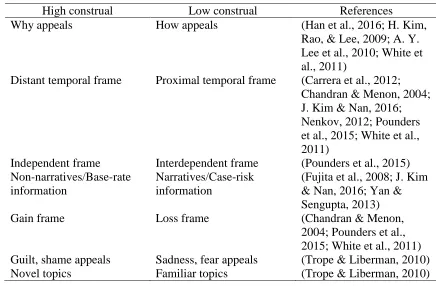
Table 2 from a review of the literature. First, scholars have hypothesized that messages
will be more persuasive when the message features of the same construal level are
combined together, as consistency of mental representation may improve message
processing (e.g., Chandran & Menon, 2004; J. Kim & Nan, 2016; Pounders, Lee, &
Mackert, 2015; White, MacDonnell, & Dahl, 2011). For example, White and colleagues
(2011) hypothesized that gain frames, distant temporal frames, and why appeals activate
a high construal mindset, while loss frames, proximal temporal frames, and how appeals
induce a low construal mindset, and predicted that combining message characteristics
consistent in their construal level will lead to greater persuasion than when message
characteristics inconsistent in construal level are combined together. The
conceptualization of distant temporal frames and why appeals into high construal is
straightforward, as temporal frames are related to temporal distance and why appeals
(i.e., appeals about reasons to carry out a behavior) tap into desirability concerns of CLT.
What may be less apparent is how gain frames align with high construal, while loss
frames activate a low construal. The authors argue that gain frames may activate a broad
abstract mindset (high construal level) because attaining desirable goals requires guarding
against errors of omission, while loss frames may activate a detailed concrete mindset
(low construal level) as addressing the threats implied by loss requires guarding against
errors of commission. In line with hypotheses, their experiment found that people who
were shown loss frame/how appeal messages (i.e., “Think about what will be lost. Think
about ways to make a difference”) and those exposed to gain frame/why appeal messages
exhibited more recycling behavior than before exposure to messages, while the recycling
behavior of those in the loss frame/why appeal message condition and gain frame/how
appeal message condition did not differ from their baseline behavior. In a separate
experiment, this study also found that when the temporal frame of a message was more
proximal (i.e., Recycle for a better Calgary today), participants reported more positive
recycling intentions in response to the loss frame than the gain frame, while when the
temporal frame was distant (i.e., Recycle for a better Calgary tomorrow), participants
reported more positive recycling intentions in response to the gain frame than the loss
frame. In a similar vein, Kim and Nan (2016) found that a present-oriented message
(framing benefits of HPV vaccine as immediate) paired with a narrative format was more
persuasive in increasing HPV vaccine intentions while a future-oriented message
(framing benefits of HPV vaccine as long-term) was more effective when it was
presented in a non-narrative format. Study hypotheses were formulated based on the
authors’ conceptualization of narratives as low construal features (as narratives are
concrete and specific representations of characters and events) and non-narratives as high
construal features. This study also provided support for the logic of matching construal
level within messages since construal-consistent combinations such as pairing
present-orientation (proximal temporal distance) and narratives (low construal) were more
effective than inconsistent combinations.
Second, studies have hypothesized that if certain individual characteristics can be
aligned with construal level, then matching the construal level of individual
characteristics and the message may lead to more effective persuasion (e.g., Han,
Montes, Estourget, & Valencia, 2005). For instance, studies have noted that the
individual characteristic of regulatory focus orientation can be mapped onto the
dimension of construal level (A. Y. Lee et al., 2010; Semin et al., 2005). Promotion
focused people move towards their goals in a broad manner to maximize fulfillment, and
try to ensure not to miss any ‘hits’ (high construal level) while prevention focused people
try to not make ‘mistakes’ and are concerned with security (low construal level) (Semin
et al., 2005). It was also found that priming promotion orientations correlated strongly
with measures of construal level (e.g., creating broad categories; abstract action/behavior
identification) (A. Y. Lee et al., 2010). It is then possible to hypothesize that while low
construal messages (e.g., messages with proximal temporal frames, feasibility
information, or concrete language) will be more effective in persuading prevention
focused people, while high construal messages (e.g., messages with distant temporal
frames, desirability information, or abstract language) will fit promotion focused people
more. A study found that participants with a promotion focus expressed higher intention
to exercise in response to a sports promotion message written abstractly than a message
written concretely, while those with a prevention focus indicated higher intention to
exercise in response to a concrete message than an abstract message (Semin et al., 2005).
In the context of advertising, Lee and colleagues (2010) found that promotion-primed
people had higher brand attitudes in response to an advertisement for an elliptical that
emphasized desirability features and reasons to use the product (e.g., ensures muscle
building) than one that emphasized feasibility features and ways to use the product (e.g.,
multiple incline settings), while prevention-primed people had higher brand attitudes for
In conclusion, a considerable amount of research has been devoted to predicting
message effectiveness based on assumptions that certain message characteristics map
onto high versus low construals. Study results that demonstrate the effectiveness of
matching the construal level within messages and across messages and individual
characteristics provide evidence that different message characteristics can map onto high
versus low construal. If this is so, then exposure to different message characteristics
could influence the content and form of salient construal-related thoughts which could
ultimately affect the way people choose arguments to transmit to others.
Table 2. Message characteristics pertaining to high versus low construal
High construal Low construal References
Why appeals How appeals (Han et al., 2016; H. Kim,
Rao, & Lee, 2009; A. Y. Lee et al., 2010; White et al., 2011)
Distant temporal frame Proximal temporal frame (Carrera et al., 2012; Chandran & Menon, 2004; J. Kim & Nan, 2016; Nenkov, 2012; Pounders et al., 2015; White et al., 2011)
Independent frame Interdependent frame (Pounders et al., 2015) Non-narratives/Base-rate
information
Narratives/Case-risk information
(Fujita et al., 2008; J. Kim & Nan, 2016; Yan & Sengupta, 2013)
Gain frame Loss frame (Chandran & Menon,
Overview of Studies
As an exploratory attempt to predict how message content will be replicated or
extended within a construal category by people exposed to messages, I examined
argument choices as an outcome. Specifically, guided by CLT principles, I aimed to
examine whether people’s patterns of choosing arguments to send to smokers differ as a
function of the type of anti-smoking messages they were exposed to. Through four
studies, I focused on two types of content: Why appeals and how appeals. In the context
of anti-smoking messages, why appeals refer to appeals that provide reasons to quit
smoking, while how appeals refer to appeals that provide ways to quit smoking. These
appeals were chosen primarily because the two appeals, in concept, respectively capture
high versus low construals. According to CLT (Trope & Liberman, 2010), desirability
attributes that are about the value of an action’s end state are high level construal
features, while feasibility attributes which are related to means to achieve an end state are
low level construal features. Why appeals can be perceived as high level construals
because they tap into desirability attributes, i.e., the value of an action’s end state or
‘why’ one should perform a behavior (Eyal, Sagristano, Trope, Liberman, & Chaiken,
2009). How appeals are relatively low-level construal because they concern the means to
an end (feasibility) by focusing on ‘how’ one should perform a behavior (Lutchyn &
Yzer, 2011). In addition, many anti-smoking campaign messages commonly utilize these
two types of appeals (Davis, Nonnemaker, Farrelly, & Niederdeppe, 2011; Durkin,
Brennan, & Wakefield, 2012) because why and how appeals are aimed at changing
attitudes and self-efficacy respectively, which are known determinants of behavior
example, the Food and Drug Administration’s (FDA) “The Real Cost” tobacco
prevention campaign (www.hhs.gov/TheRealCost) centers around reasons not to smoke
such as, addiction, harmful chemicals and health consequences. The American Legacy
Foundation’s “Ex Campaign” (https://www.becomeanex.org/) focuses on providing
methods useful for quitting such as identifying triggers and getting support from family
and friends.
Using why and how appeal messages in Study 1, I first examined replication by
testing the simple hypothesis of whether people choose to send smokers the exact same
arguments used in the messages they were exposed to. Specifically, I tested whether
those exposed to certain why appeal (how appeal) messages will choose to transmit the
same why arguments (how arguments) targeted by the messages they were exposed to,
compared to those who were not exposed to messages. The tendency to prefer specific
targeted why or how arguments can be explained by propositions of CLT where it can be
argued that why (how) appeals induce a high (low) construal which could reinforce
people to choose the arguments used in why (how) appeals.
However, an alternative explanation for replication could be that of accessibility,
in which participants could be choosing arguments targeted by the messages they were
exposed to simply because the arguments are salient in memory. The purpose of Study 2
was to address this alternative explanation by testing whether participants exposed to why
appeal messages choose more why-related arguments that were not directly targeted in
the messages than those not exposed to any messages. This hypothesis is based on the
notion that why (how) appeal messages would elicit a high (low) construal level which
are not explicitly targeted in the messages. The design of Study 2 thereby shifts away
from replication, and expands the inquiry into whether certain message appeals can
influence extension, i.e., the choice of arguments that are of the same category as the
message theme, but were not targeted by messages.
Nonetheless, even if the hypothesis of Study 2 is confirmed, it is still difficult to
argue that construal level is driving these results; it might be due to an increase in the
accessibility to simply why-related (how-related) memory or beliefs, rather than an
accessibility to a high (low) construal mindset. Therefore, Study 3 aims to uncover
whether construal level is the mechanism underlying Study 2 by inducing construal level
with message design characteristics unrelated to the message appeals (why or how). If
certain message design characteristics can induce construal level consistent with the
construal of message appeals, then the effect of message appeals on argument choice may
be increased. Or on the other hand, if the construal of a message design characteristic and
message appeal do not match, the effect of message appeals on argument choice could be
reduced. Study 3 advances the test for whether construal level underlies argument choice,
but also ventures into the seldom examined research question of whether certain
combinations of message appeals and design can be more conducive to propagating
certain types of arguments. Study 3 manipulates the message characteristic of temporal
frames because it aligns well with CLT’s concept of psychological distance and has been
researched sufficiently in the message effects domain (see Table 2).
Finally, Study 4 provides further evidence by inducing construal level with a
manipulation entirely separate from messages—a word task validated to induce high
to the logic of Study 3, if a construal level consistent with message appeals boosts
argument choice, or if an inconsistent construal level hinders argument choice, results
will provide evidence that construal level is indeed the underlying mechanism of the
effect of message appeals on argument choice. Study results will also demonstrate that
different information processing modes (i.e., high vs. low construal mindsets) can boost
or hinder the relationship between message exposure and the pattern of arguments chosen
Study 1 Introduction
The simplest claim derived from CLT is that if a message has a high versus low
construal level, the construal level will be carried over into arguments that will be chosen
for diffusion. If a message has a high (low) construal level feature, it will elicit a high
(low) construal level among those exposed to the message, which will reinforce them to
prefer diffusing high (low) construal level arguments which have been targeted in the
messages. Study 1 exposed participants to anti-smoking messages with why versus how
appeals, and examined whether participants chose the exact same arguments used in the
messages to send to smokers. Study 1 also effectively tested whether exposure to
messages influences people to transmit message-specific arguments to others around
them (i.e., replication). This is an aspect that has not been tested by previous research;
previous studies have either assumed that talk about specific health campaign messages
occurs (Dunlop et al., 2010). Moreover, other studies that studied the content of talk have
focused mainly on appraisals of messages or talk about quitting smoking in general,
rather than message-specific information (Brennan et al., 2016; Dunlop, 2011; Dunlop et
Pre-Study – Pilot to Select Arguments
A pilot study was conducted to select why and how arguments that are relatively
comparable in their likelihood to be chosen by people. This step was carried out to ensure
that any observed differences in the tendency to choose arguments across conditions
could be attributed only to message exposure, and not to arguments’ inherent likelihood
of being chosen. This was also an essential step to take since messages were constructed
based on the arguments that were chosen.
Method
Pooling arguments. A range of why and how arguments regarding tobacco
cessation were garnered from government agency sponsored smoking cessation
webpages such as the Centers for Disease Control and Prevention’s (CDC) “Tips From
Former Smokers” webpage
(https://www.cdc.gov/tobacco/campaign/tips/index.html) and the National Cancer
Institute’s (NCI) “Smokefree.gov” webpage (https://www.smokefree.gov). A total of 19
why arguments and 20 how arguments about smoking cessation were collected. For
example, one of the why arguments addressed benefits to the immune system as a reason
to quit smoking (i.e., “Quitting smoking strengthens your immune system, making you
less likely to get sick.”). One of the how arguments stated a method of avoiding smoking
triggers to quit smoking (i.e., “Identifying triggers that make you want to smoke and
avoiding those triggers can help you quit smoking.”).
to send to smokers. The number of 23 workers was chosen based on previous research
that found that 23 to 25 raters were enough to evaluate messages accurately (M. Kim &
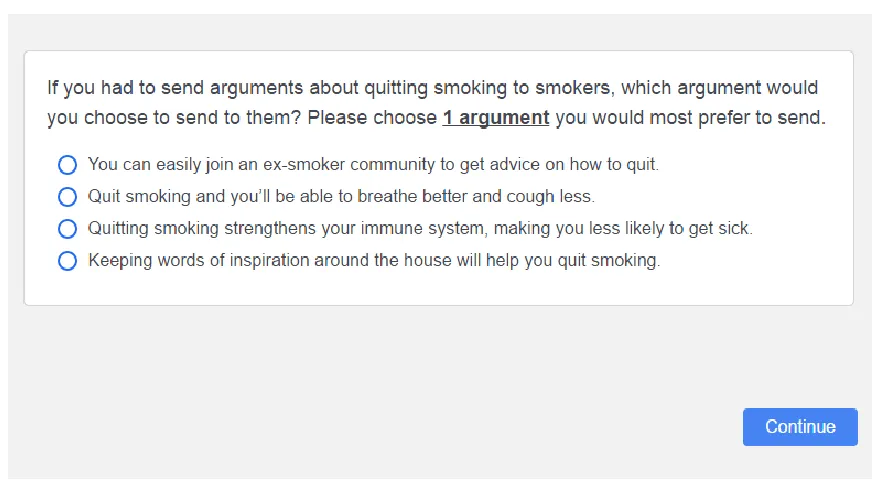
Cappella, 2014). For each argument, workers were asked: “If you had to send arguments
to smokers, how likely would you choose this argument about quitting smoking to send to
smokers?” Each argument was rated on a scale of one (Very unlikely) to five (Very
likely). The order of all arguments (why and how) was randomized so that why and how
arguments were interspersed among themselves.
Analysis to choose arguments. For each argument (19 why and 20 how
arguments), raters’ individual ratings were averaged to create a rating score for each
argument. How arguments tended to have lower scores (ranging from 2.43-4.04) than
why arguments (ranging from 3.13-4.48). For the purposes of Study 1, a set of 10 why
arguments and a set of 10 how arguments were chosen in a way that minimized the
difference between set aggregate average ratings. For example, when ordered by rating
scores, the top 10 how arguments were chosen while why arguments that had a similar
range as the top 10 how arguments were chosen to minimize set differences. The average
rating score for the 10 why arguments (M=3.80, SD=0.22) was not significantly different
from that of the 10 how arguments (M=3.78, SD=0.15); t(18)=.21, p=.84. In addition,
Studies 2, 3, and 4 required 15 why and 15 how arguments. Similarly chosen 15 why
(M=3.79, SD=0.34)and 15 how arguments (M=3.66, SD=0.22) did not differ
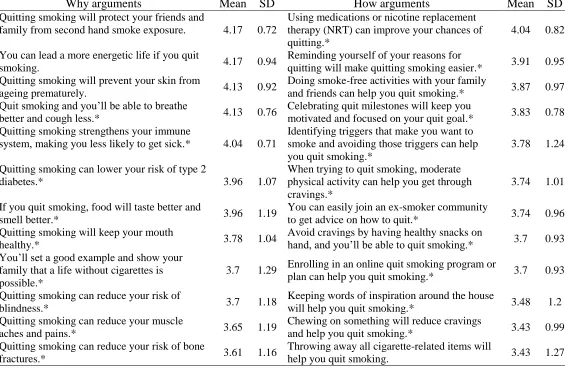
significantly in their average scores; t(28)=1.25, p=.22.Arguments used for the studies
30
Table 3 Rating score means and standard deviations for why and how arguments
Why arguments Mean SD How arguments Mean SD
Quitting smoking will protect your friends and
family from second hand smoke exposure. 4.17 0.72
Using medications or nicotine replacement therapy (NRT) can improve your chances of quitting.*
4.04 0.82
You can lead a more energetic life if you quit
smoking. 4.17 0.94
Reminding yourself of your reasons for
quitting will make quitting smoking easier.* 3.91 0.95 Quitting smoking will prevent your skin from
ageing prematurely. 4.13 0.92
Doing smoke-free activities with your family
and friends can help you quit smoking.* 3.87 0.97 Quit smoking and you’ll be able to breathe
better and cough less.* 4.13 0.76
Celebrating quit milestones will keep you
motivated and focused on your quit goal.* 3.83 0.78 Quitting smoking strengthens your immune
system, making you less likely to get sick.* 4.04 0.71
Identifying triggers that make you want to smoke and avoiding those triggers can help you quit smoking.*
3.78 1.24
Quitting smoking can lower your risk of type 2
diabetes.* 3.96 1.07
When trying to quit smoking, moderate physical activity can help you get through cravings.*
3.74 1.01
If you quit smoking, food will taste better and
smell better.* 3.96 1.19
You can easily join an ex-smoker community
to get advice on how to quit.* 3.74 0.96 Quitting smoking will keep your mouth
healthy.* 3.78 1.04
Avoid cravings by having healthy snacks on
hand, and you’ll be able to quit smoking.* 3.7 0.93 You’ll set a good example and show your
family that a life without cigarettes is possible.*
3.7 1.29 Enrolling in an online quit smoking program or
plan can help you quit smoking.* 3.7 0.93
Quitting smoking can reduce your risk of
blindness.* 3.7 1.18
Keeping words of inspiration around the house
will help you quit smoking.* 3.48 1.2
Quitting smoking can reduce your muscle
aches and pains.* 3.65 1.19
Chewing on something will reduce cravings
and help you quit smoking.* 3.43 0.99
Quitting smoking can reduce your risk of bone
fractures.* 3.61 1.16
Throwing away all cigarette-related items will
31
Your home and car won’t smell anymore if
you quit smoking.* 3.43 1.16
Setting a quit date will make you more
motivated to quit smoking. 3.43 1.16
If you quit smoking, you won't have to worry about when you can smoke next or where you can or can't smoke.
3.22 1.24 Asking your family and friends to not give you
a cigarette will help you quit smoking. 3.39 1.31
Quitting smoking will keep your hearing sharp.
3.13 1.22 Going to smoke-free places where you can’t
Study 1: The Effect of Exposure to Why and How Messages on
Selection of Targeted Arguments
Hypotheses
H1a. Participants exposed to why messages will choose more why arguments
targeted in the messages to send to smokers than those not exposed to
messages.
H1b. Participants exposed to how messages will choose more how arguments
targeted in the messages to send to smokers than those not exposed to
messages.
Method
Study design. A three condition (why message condition; how message
condition; control condition) experiment was conducted online using the Qualtrics
survey platform (qualtrics.com). Participants (N=300) were randomized to one of
three conditions, where participants assigned to the why message condition were
exposed to five why messages randomly chosen from a pool of 10 why messages,
while participants assigned to the how message condition were exposed to five how
messages randomly chosen from a pool of 10 how messages. Participants exposed to
messages answered argument choice measures after exposure, while participants in
the control group answered argument choice measures without being exposed to any
messages. All participants answered demographics questions after answering
Participants. Three hundred participants who had not smoked at least a 100
cigarettes in their life (non-smokers) were recruited from the MTurk crowd-source
platform to participate in this online experiment. Non-smokers were recruited because
they were expected to be more motivated to send smokers arguments about quitting
smoking, while current smokers may lack the motivation to do so. In addition, former
smokers may be motivated to send smokers arguments about quitting smoking, but
may have more solid ideas or opinions about quitting smoking which may render
them less susceptible to any message exposure. Participants’ mean age was 35.93
(SD=12.26), and 56.67% of participants were female. The sample was 71% White,
11% African American, and 17.99% Other. Fewer than 1% had less than a high
school education (0.33%), 7% had completed high school, 28.67% had some college
education, and 64% had a college degree or more.
Stimuli. The pools of 10 why messages and 10 how messages were constructed
based on the 10 why arguments and 10 how arguments chosen through the pilot study.
Each message centered on a why argument (or how argument) that explains reasons to
quit smoking (or explains ways to quit smoking). Each message stated its argument
verbatim and included additional information that explained the argument further. The
why messages included the statement: “Why should you quit smoking?” to emphasize
why-related (high construal level) aspects of the messages, while the how messages
included the statement: “How can you quit smoking?” to highlight how-related (low
construal level) aspects of the messages (Han et al., 2016; A. Y. Lee et al., 2010). For
example, the why message constructed based on the why argument, “Quitting smoking
you quit smoking? Quitting smoking strengthens your immune system, making you less
likely to get sick. Quitting smoking stops damage to the immune system and makes it
easier to fight off infections.” The how message constructed based on the how argument,
“Identifying triggers that make you want to smoke and avoiding those triggers can help
you quit smoking” was: “How can you quit smoking? Identifying triggers that make you
want to smoke and avoiding those triggers can help you quit smoking. Avoiding activities
or feelings linked with smoking, such as drinking coffee or feeling down will help you quit
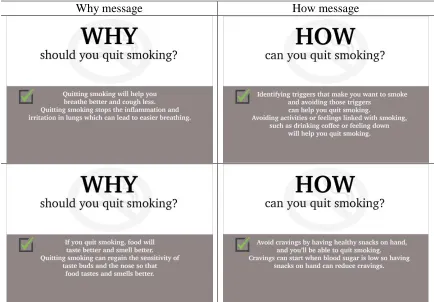
smoking.” Samples of messages used in Study 1 are included in Figure 2. Participants in
the treatment conditions (why message condition and how message condition) were
exposed to five messages randomly selected from their assigned category message pool
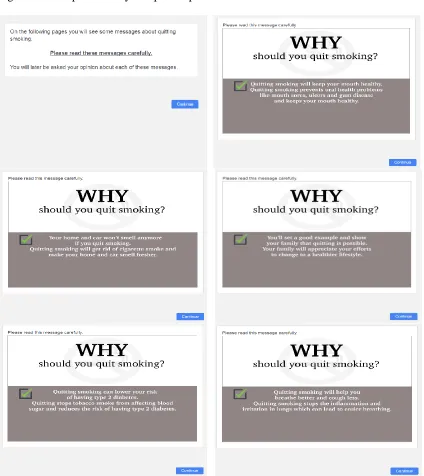
of 10 messages in random order. Figure 3 shows an example of what a participant is
exposed to. This multiple-message design can provide stronger evidence about the
generalization of message effects (O’Keefe, 2015) as each participant will receive a
different set of messages from the category he/she was assigned to. In addition, exposure
to five messages allowed for repeated exposure to construal level features which could
lead to enhanced effects (Hornik, 2002; S. J. Lee et al., 2016). External validity is also
extended as campaign targets in the real world are commonly not exposed to a single