789 |
P a g e
INTER-CLUSTER COMMUNICATION AND
INTRUSION DETECTION FOR EFFICIENT DATA
TRANSMISSION IN WIRELESS SENSOR NETWORKS
M.S.Vijayakumar
1, Dr.S.V.Manisekaran
2 1PG Scholar,
2Assistant Professor, Department of IT,
Anna University Regional Centre Coimbatore, Tamilnadu (India).
ABSTRACT
In wireless sensor network, during the process of communication the information is lost due to
lack of security in the network. Several authentication methods are present to increase the
security in the wireless sensor network. But still many Active and passive attacks are present in
the network to reduce the privacy of the network. The current state of art in the authentication
protocols will take us to the conclusion that the topic is still open. So in the proposal using the
clustering, intrusion detection and fusion methods to overcome the active and the passive attacks
in the network. PEGASIS Clustering is used to improve the efficiency of energy. The Algorithm is
used for intrusion detection is Rational Operating recall Curve Algorithm. It works to reduce the
intrusion rate of the system during the process of communication in the network. The fusion
method is also introduced to find the precision rate of the network. By using this method the
security of the wireless sensor network increases and the data loss and the delay factors are
reduced.
Keywords: AODV Routing, RORCA, Recall, Precision, Throughput, Pegasis, Omnet++.
I INTRODUCTION
The advancements in wireless communication technologies enabled large scale Wireless Sensor Networks (WSNs)
deployment. Due to the feature of ease of deployment of sensor nodes, wireless sensor networks (WSNs) have a vast
range of applications such as monitoring of environment and rescue missions. Wireless sensor network is composed
of large number of sensor nodes. The event is sensed by the low power sensor node deployed in neighborhood and
790 |
P a g e
Wireless sensor networks (WSN) are playing-vital role in commercial, military application, critical event monitoringand networks monitoring such as fire detection in forest, gas monitoring in coal mining, large scaled wireless sensor
nodes are deployed in wide range of area. The sensor nodes collectively work together and send the detected
information to other sensor nodes. To transmit the message it needs twice the energy it takes to receive the message.
Major challenge of WSN is reducing the energy consumption. To increase the efficiency of energy using a
techniques called cluster communication and Rational Operating Recall Curve Algorithm (RORCA). In
inter-cluster communication, each inter-cluster has a coordinator referred to as a inter-cluster head. In rational operating recall curve
algorithm, the intrusion detection rate of the system can find effectively.
1.1
Clustering in WSN
Clustering mechanism helps in improving the energy efficiency in sensor networks. Clustering in WSN splits the
sensor nodes into small groups. A cluster head (CH) would be selected for each group. The nodes in the group
reports the information gathered to the CH. All sensor nodes in a cluster are called cluster members; including one
cluster head. Cluster heads transmit the aggregated data to a base station, instead of collecting data from cluster
members. Thus, clustering reduces the overhead of the sink.
Clustering is introduced in network and is divided into ‘n’ radial level with base station (BS) at the center
Cluster Head
Cluster Sink
Figure 1: Cluster Model
The main idea of clustering is optimal selection of cluster head (CH) based on their level. Then the node having
more energy is selected as cluster head.
1.2 AODV Routing Protocol
Ad-hoc On-demand Distance Vector (AODV) routing protocol uses traditional routing information-base (RIB) for
one task creation and to determine an up-to-date path to receiver.
The neighbors are notified in case of route is broken due to temporal packet loss. Messages can be controlled using
791 |
P a g e
Route Request Message (RREQ)
Route Reply Message (RREP)
Route Error Message (RERR) HELLO Messages.
II RELATED WORK
Lettieri and Srivastava [6] have proposed a new adaptive link layer control technique to provide robust and energy
efficient operation even in the presence of orders of magnitude variations in bit error rates. An exchange exists
between one another to reduce the header and physical layer overhead by making frames large. In addition, the
adaptive frame length control can be used to improve the energy efficiency for a desired level of good put, and to
extend the usable radio range with graceful throughput degradation, but has battery energy limitations.
Ferriere et al. [4] have proposed the Simple Packet Combining (SPaC) error-correction scheme for wireless sensor
networks. When two or more corrupt versions of a packet grabs, a packet merge sequence makes an effort to achieve
the original packet from the corrupt copies. Packet combining exploits a multi-hop wireless network and
point-to-point forward error correction (FEC), packet combining therefore helps multi-node interactions such as multi-hop
routing or broadcasting as well as to hop-by-hop communication. SPaC does not estimate the channel conditions.
Dong et al. [1] have proposed a Dynamic Packet Length Control (DPLC). DPLC is used for packet length
optimizations for sensor networks to make more efficient in terms of channel utilization, incorporate a lightweight
and accurate link estimation method. It also provides two easy use of services, one is aggregating a small message
and another is fragmenting large message to facilitate upper layer application programming. A DPLC overcomes the
limitations of prior work, but still can reduce the overheads and increase the energy efficiency by using some other
techniques.
Krishnan et al. [5] have proposed a packet length adaptation (PLA) in wireless local area network (LAN). A packet
can lost due to many reasons, to reduce some of loss in medium access control (MAC) layer using a local packet
adaptation algorithm. In PLA, each node dynamically adjusts its packet length based on estimates of the
probabilities of each significant type of packet loss. In PLA, the access point periodically broadcasts channel
information in order to estimate current network conditions. The throughput gains up to 20% via NS-2 simulations,
but in transmitting hidden nodes unable to sense the transmission which leads to staggered collision.
Jamieson and Balakrishnan [2] have proposed a partial packet recovery (PPR). In before, to correct small number of
bit errors, retransmitting the whole packet by using Forward Error Correction (FEC). The FEC wasting network
capacity, to overcome this inefficiency, jamieson and balakrishnan implement a partial packet recovery (PPR)
system. PPR incorporate two new ideas such as SoftPHY and a post-amble scheme. As a result increases end-to-end
capacity by a factor of 2× under moderate load, but still can improve the performance of routing protocol in
792 |
P a g e
III DESIGN
It is proposed that the intrusion detection and fusion methods, to overcome the active and the passive attacks in the
network. Rational Operating recall Curve Algorithm (RORCA) is introduced in the rational intrusion detection
method. This Rational operating recall Curve Algorithm is used to find the intrusion detection rate of the system
effectively. And also employs to reduce the intrusion rate of the system during the process of communication in the
network. The fusion method is also introduced to find the precision rate of the network. As a result, the proposed
method performs well in monitoring the network and reduces the data loss.
Figure 2 shows an overall architecture design of proposal method. The application or data or messages are passed.
Network is formed and route is discovered, then sending a request to topology. A topology is selected as random
topology. In Inter-cluster communication cluster head is selected and cluster is formed. Then a method called
Intrusion detection used for prevent from attackers. In intrusion detection Rational Operating Recall Curve
Algorithm is used, then followed by recall, precision and fusion method.
Topology Selection Application
Intrusion Detection
Inter-Cluster Communication
RORCA
Recall Clustering
Precision
793 |
P a g e
Network Creation
The network is created based on topology. Here using random topology i.e., mostly using Mesh topology. The mesh
topology combines one or more topologies.
MAODV Protocol
The Multi-casting AODV routing protocol builds on top of the DSDV protocol that was previously described.
AODV is an improvement of DSDV as it minimizes the number of required broadcasts since it creates routes in an
on-demand basis, in contrast to DSDV which maintains a complete set of routes. It utilizes destination sequence
numbers to ensure loop-freedom at all times and to avoid the count-to-infinity problem associated with classical
distance-vector protocols.
When a node needs a route to a destination it broadcasts a Route Request (RREQ) message. The RREQ message is
spread throughout the network and as soon as the message reaches a node with fresh enough routes to the specific
destination or the destination node itself, a Route Reply (RREP) message is unicasted back to the requesting node.
AODV is able to provide unicast, multicast and broadcast communication ability. This capability of having all three
communication forms in a single protocol offers numerous advantages. When searching by using the multicast route
discovery it increases the unicast routing knowledge and vice versa. By having all three communication forms in a
single protocol simplifies the implementation process of the protocol.
Energy Aware Clustering
PEGASIS (Power-Efficient Gathering in Sensor Information Systems) is for each node to receive from and transmit
to close neighbors and take turns being the leader for transmission to the BS. This approach will distribute the
energy load evenly among the sensor nodes in the network. We initially place the nodes randomly in the play field,
and therefore, the i –th node is at a random location. The nodes will be organized to form a chain, which can either
be accomplished by the sensor nodes themselves using a greedy algorithm starting from some node. Alternatively,
the BS can compute this chain and broadcast it to all the sensor nodes. We used random 100-node networks for our
simulations.
PEGASIS performs data fusion at every node except the end nodes in the chain. Each node will fuse its neighbor’s
data with its own to generate a single packet of the same length and then transmit that to its other neighbor. With our
simulation experiments, found that the greedy chain construction performs well with different size networks and
random node placements. In constructing the chain, it is possible that some nodes may have relatively distant
neighbors along the chain. Such nodes will dissipate more energy in each round compared to other sensors. The
performance of PEGASIS is improved by not allowing such nodes to become leaders. By setting a threshold on
neighbor distance to be leaders, able to slightly improve PEGASIS’s performance further by applying a threshold
adaptive to the remaining energy levels in nodes. Whenever a node dies, the chain will be reconstructed and the
794 |
P a g e
3.4 Intrusion Detection
Intrusion Detection is used for detecting the intrusion, which are created by the external environment. To detect the
intrusion in network proposing the Rational Operating recall Curve Algorithm (RORCA).This Rational operating
recall Curve Algorithm is used to find the intrusion detection rate of the system effectively and also reduce the
intrusion rate of the system during the process of communication in the network. The data fusion method is used to
increase the precision rate of the system.
IV SIMULATION
This project is simulated in OMNeT++. OMNeT++ is an object-oriented modular discrete event network
frameworks simulation. OMNeT++ simulations can be run under various user interfaces. OMNeT++ also supports
parallel distributed simulation. The parallel simulation algorithm can easily be extended, or new ones can be
plugged in. OMNeT++ simulation tool is chosen, because it provides better performance than NS2 and OPNET.
OMNeT++ is much scalable than NS2. OMNeT++ joins with MIXIM and used in numerous domains from queuing
network simulations to wireless and ad-hoc network simulations. OMNeT++ cost is also low and it works well and
coding of this also easy compared to test-bed like TOSSIM. OMNeT++ provides more accuracy of results, it’s a
new development tool and it becomes popular in future
.
4.1 Simulation Results
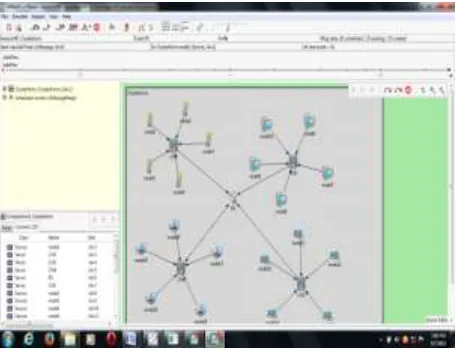
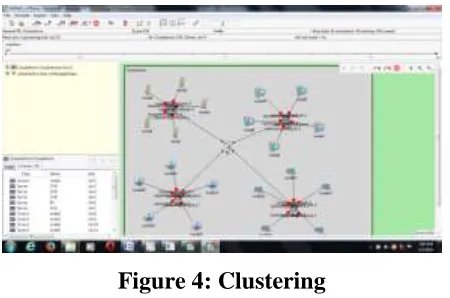
The simulation results are shown in figure 3and 4 respectively.
.
Figure 3: Network Creation
In fig. 3, the network is created by random topology selection which contains many numbers of cluster heads and up
795 |
P a g e
In fig. 4, the cluster communication is done by using pegasis clustering. In this simulation result, there istransmission of message between cluster heads and sensor nodes.
Figure 4: Clustering
4.2 Expected performance Analysis
In this section, representing expected performance analysis in comparison with proposal and existing method.
(a) Network Throughput vs Bandwidth. (b) Amount of Bandwidth vs BW Ratio.
(c) Network Throughput vs Time.
796 |
P a g e
In fig. 5, has three performance simulations in comparison of existing and proposed method. (a) represents networkthroughput in kbps versus amount of bandwidth (BW) in kHz. (b) represents bandwidth consumption ratio versus
amount of bandwidth in kHz. (c) represents network throughput in kbps versus time in milliseconds.
V CONCLUSION
This paper presents PEGASIS Clustering and Rational Operating recall Curve Algorithm (RORCA). PEGASIS
Clustering is used for improving performance and aware energy. RORCA is introduced in the rational intrusion
detection method. This Rational operating recall Curve Algorithm is used to find the intrusion detection rate of the
system effectively. The fusion method is also introduced to find the precision rate of the network. As the result, it is
expected that the proposed method performs well when compared with the existing method. Also the energy
efficiency increases by using pegasis clustering and provides safety by preventing from the attackers.
REFERENCES
[1] Bu, J, Dong, W, Liu, X, Chen, C, He, Y, Chen, G and Liu, Y, DPLC-Dynamic packet length control in
Wireless sensor networks: IEEE INFOCOM, 2010, pp. 1-9.
[2] Balakrishnan, H, and Jamieson, K, PPR- partial packet recovery for wireless sensor networks: ACM
SIGCOMM, 2007, vol. 37, Issue. 4, pp. 1-5.
[3] Davis, J & Goadrich, M, Relationship between precision-recall curves: 23rd IEEE conf. on machine
learning, 2006, pp. 3-4.
[4] Estrin, D, Ferriere, D and Vetterli, M, Packet combining in sensor networks: ACM SenSys,2005, pp.
102-115.
[5] Haghani, E, Krishnan, N, and Zakhor, A, Packet length adaptation in WLANs with hidden nodes and
time-varying channels: IEEE GlobeCom, 2011, pp. 1-6.
[6] Lettierri, P and Srivastava, B, Adaptive frame length control for improving wireless link throughput, range,