www.scienceworldjournal.org ISSN 1597-6343
ON THE APPLICABILITY OF RESOURCES OPTIMIZATION MODEL
FOR MITIGATING FREE RIDING IN P2P SYSTEM
Mohammed Onimisi Yahaya
Department of Mathematical Sciences, Abubakar Tafawa Balewa University, Bauchi - Nigeria.
Author email:[email protected]
ABSTRACT
The survival of peer-to-peer systems depends on the contribution of resources by all the participating peers. Selfish behavior of some peers that do not contribute resources inhibits the expected level of service delivery. Free riding has been found to seriously affect the performance and negates the sharing principle of peer-to-peer networks. In this paper, first, we investigate through simulations the effectiveness of a proposed linear model for mitigating free riding in a P2P system. Second, we extended the initial linear model by incorporating additional c o n s t r a i n t s on download and upload of each peer. This helps in reducing the effects of free riding behavior on the system. Lastly, we evaluate the impacts of some parameters on the models.
KEYWORDS: Peer-to-Peer, Resources, Free rider, Optimization, Constraints, Algorithm
INTRODUCTION
Peer-to-peer has become popular as a means of contents sharing among vast number of users the world over. The success of P2P networks is a result of it obvious advantages over traditional client-server model which is faced with the challenges of single point of failure and expandability. Despite the successes of P2P systems, it also has its challenges. One of such concerns is the problem of free riding. Free riding is a situation in which some peers in a P2P sharing system refuse to contribute resources to other while it uses others’ resources (Adar et al, 2000; Belmonte et al 2013). Several approaches have been proposed in the literature to combat free riding, since the survival of P2P systems depends on the availability of resources provided by the participating peer. In this paper, we propose a global resource optimization model as a means to tackle free riding. An extensive simulation is carried out to investigate the effectiveness of our approach in minimizing free riding.
The remaining parts of this paper are organized as follows: In section 2, a review of related literature is presented. Section 3 outlines the proposed model. The simulation studies are carried out in is carried out in section 4, 5, 6 and 7, while section 8 concludes the paper.
LITERATURE REVIEW
The rising popularity in the use of P2P systems for resource sharing also brought some of it challenges to the fore. Free riding, as one of the challenges bedeviling P2P network has been studied by several researchers e.g (Adar et al., 2000; Belmonte et al., 2013, & Azzedin et al., 2014). Currently, efforts are still being made to fully understand users’ behaviour and interactions among users, so as to design efficient mechanisms to tackle free riding. Several approaches have been employed in the literature to solve
the problem of free riding, but these efforts have not been able to eliminate completely free riding in P2P systems. One major challenge is the diverse and complex nature of the problem. Every solution proffered is usually caught up in the web of conflicting requirements. Performance requirements such as ease of use, distributed nature, and efficiency are not easy to achieve. For example, KaZaa and Emule uses reputation, and contribution level to rank peers and assign priority in the request queue based on their ranks. But this is not a strong deterrent against free riding, a patient free rider might still get services and hence, there is feeling of unfairness (Roussopoulous, 2004). Bit Torrent uses tit-for-tat to tackle free riding where a peer temporarily refuses to upload to a neighbor that refuses to upload to it. But this is only specific to Bit Torrent architecture, still the problem of unfairness is reported in free riding (Rafit, 2010). In general, free riders counteracting approaches can be broadly classified into micropayment/credit-based systems, trust/reputation based approaches, reciprocity and barter based system and game theory/utility based approaches. In micropayment based systems users are expected to pay for services received and be paid for any services provided to others. The idea is to attach economic value to resources in the P2P network so as to encourage contribution. This approach utilizes virtual currency. It needs centralization, accounting infrastructure, pricing and exchange mechanism for effective performance. Research work such as Xpay (Chen, et al., 2009 and KARMA Vishnumurthy et al., 2003) are based on this approach. Trust and reputation approach uses trust information about peer to detect free riding behaviour so as to punish unwanted behaviour and reward good behaviour. There is a need for trust and transaction history information to be able to utilize this approach. The problem of white washing, collusion and persistent identity poses serious challenge to this method. Examples of trust/ reputation based approach effort to tackle free riding are (Satsiou et al., 2010) and ( T s e n g e t a l . , 2 0 1 1 ) . Reciprocity or barter based approaches involves exchanges of services. The ability to predict future need from same peer is crucial for this mechanism. BitTorrent tit-for-tat (Cohen 2003, Legout et al., 2007) is an example of reciprocity based approach. Recently, game theory/utility based systems have been explored in the understanding of peers’ interactions and counteracting free riding in P2P systems. Researchers in (Golle et al., 2001; Gupta et al., 2005; Hua et al., 2012; Yu et al 2012; Zhao et al., 2012) used game theory in their study of incentives and free riding in P2P networks.
THE PROPOSED RESOURCE OPTIMIZATION MODEL
SIMULATION STUDY
In order to validate our results of the proposed model illustrated on examples. We performed a simulation study.
PER-RESOURCE-N-UPLOADER-BY-M-DOWNLOADERS MODEL
In this case, the simulation model is designed as follows; the tracker carries out the optimization for each file piece in the system at any time. The simulation model run for R1,R2, R3, … Rn;. Where R's are the resources (file pieces) and n is the number of f i le pieces in the system at a given time. For each resource, an optimization table is constructed
Table 1: Variable Xjk Table for _les
jnk O1 O2 Oi O3
D1 1 1 ... 1
D2 1 1 ... 1
D3 1 1 ... 1
D4 1 1 ... 1
. . . ... .
Dm 1 1 ... 1
PERFORMANCE EVALUATION
In order to validate our preliminary results, the proposed model is illustrated on examples and solved using Microsoft Excel Solver. We then performed a simulation study and compare the results. The simulation model is designed as follows; the tracker carries out the optimization for each file piece in the system at any time. The simulation model run for R1, R2, R3, . . .,Rn;. Where R's are the resources (file pieces) and n is the
number of file pieces in the system at a given time. For each resource, an optimization table is constructed as shown in Table 1.
SYSTEMINITIALIZATION
At the start of the simulation, we perform system initialization. This involves the network initialization, the tracker initialization and node initialization. During network initialization, we set the total numbers of peers, the total number of file pieces and average arrival rate of request from every peer in the system. In addition, we generate file pieces and randomly distribute it to each peer. Initially every peer holds one piece or the other, so that every peer has a piece to upload if requested. We assumed that at any time, there are pieces that can make up a complete file are in the system.
In node initialization, we categorize every peer in the system into three types, Altruist, In-between and Free rider with their probability of serving any request sent to them to be 1, 0.5 and 0 respectively. As simulation progresses, peers do not change their behaviour, they only interact based on their pre-assigned behaviour. The tracker is initialized with all peers’ information and it remains active throughout the simulation time. That is, we assume the tracker cannot die or go offline during simulations.
EVENTGENERATION
In each time slot, a request event is generated by a randomly selected peer. We model the arrival process of request as a Poisson distribution with mean λ. We divided the whole length of the simulation time into slots, so as to track interaction in every time slot and compute the statistics.
IMPLEMENTATION
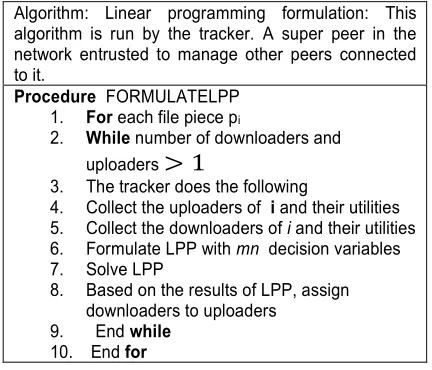
We implement our model using PeerSim (Montressor et al., 2009), a P2P simulator and BitPeer (Fabrizio et al., 2008) BitTorrent module for PeerSim- to evaluate the performance of our proposed method. We utilized the tracker in the BitTorrent module to run our algorithm. We integrate our simulator with LPsolve (LPsolve 2014) for solving the systems of linear equations resulting from the peers’ interactions. The results of the LPP when solved is returned to the tracker, it uses the results to perform the uploader to downloader assignment so as to optimize the entire environment. We used the simulation model depicted as flowchart in Figure 1.
PERFORMANCE METRICS
The objectives of any free riding mitigation mechanism are: (1) To ensure cooperation among participating peers (2) To ensure fairness amongst all peers in the system and (3) To alleviate the impact inauthentic and malicious resources in the system. In this paper, we approach the problem of fairness from the whole community point of view. That is, measuring the stability of the whole network by optimizing the total utility of the network. To determine the stability of the network based on the availability of resources, since the existence of P2P sharing is based on the resource availability; we propose the total sum of all the peers utility in the system as a performance metric.
EXPERIMENT1:SIMULATING EXAMPLES
First, we evaluate the proposed model by maximizing the total sum of all utilities in the system. To do this, we repeated the same parameters (See Table 2), constraints and objective functions used in the proposed examples which we solved with Excel solver using our simulator. The result is the same as that reported from the Excel Solver from the example. In this experiment, we used only one shot model without repetition. Hence, we compute the total utility of the system, when every peer both uploaders and downloaders utility are taken into consideration during maximization. The result here considers the utility maximization and stability of the entire system.
Algorithm: Linear programming formulation: This algorithm is run by the tracker. A super peer in the network entrusted to manage other peers connected to it.
Procedure FORMULATELPP 1. For each file piece pi
2. While number of downloaders and uploaders
3. The tracker does the following
4. Collect the uploaders of i and their utilities 5. Collect the downloaders of i and their utilities 6. Formulate LPP with mn decision variables 7. Solve LPP
8. Based on the results of LPP, assign downloaders to uploaders
9. End while 10. End for
2
Figure 1: Simulation flowchart
Start
Initialization
Peer types Arrival rates
of requests
If (Downloaders and Uploader of
i>1 Peers generate
requests for piece i
Tracker formulates LPP and solves LPP
solve LPP
Collect utility value of both Downloaders and Uploaders
of piece i
Tracker assigns Uploaders to Downloaders
End Check if
reach Simulation
Time ) > 1
Applicability Of Resources Optimization Model For Mitigating Free Riding In P2P System Table2 : Parameters and their values
Parameter Value
No. of peers 7
No. of Uploaders 3
No. of Downloaders 4
Average request per peer (λ) 1
Ratio of peer type {Altruist = 0:33; In- betweens = 0:33; F reerider = 0:33}
Prob. of serving by peer type {Altruist = 1; In-betweens = 0:5; F reerider = 0 }
No. of file pieces 2
EXPERIMENT 2: INVESTIGATING THE EFFECTIVENESS OF THE PROPOSED LINEAR MODEL TO COUNTERACT FREE RIDING To investigate the viability of the proposed linear model in improving fairness and discouraging free riders in a P2P system, we perform some experiments. In the previous experiment we carried out in section 4.4 the performance metric used is the total sum of utilities of all the peers in the system at any time t. This value measured the general wellbeing of the entire community, but did not give information on the individual characteristics of peers. It might be possible that, though the total utility of the system is maximized but unfairness may still exist.
To ascertain the impact of the model on the individual peer behaviour, we need to use a different performance metrics. We used the performance evaluation criteria proposed in (Hua et al., 2012). The criteria are as follow: (1) The number of request fulfilled of free riders: This measure the number of successful requests peer get from other peers in the network considering the behaviours of that peer. (2) The ratio of upload to
download of each peer in the system (fairness index): This measure the fairness of the whole system to the peers in terms of resource provision characteristics. For instance, we do not want few Altruists in the system to be overwhelmed by the requests of many free riders in the system. We also prefer each peer get resources proportional to its contributions to others in the system. The fairness index formula is given as
(1) Where Xi is defined as the ratio of upload to download of every peer. The fairness index is bounded by 0 (unfair) and 1 (fair). The larger the value the fairer the whole network (Hua et al 2012). The fairness index of 1 does not exists in real system due to availability of free riders. Assume there are Ns of peers in the networks, Nf of Free riders, Ni of In-between, and Na of Altruists with ratios Pf; Pi and Pa respectively.
Table3 : Parameters and their values
Parameter Value
No. of peers 10
Average request per peer (λ) 3
Ratio of peer type {Altruist = 0:33; In- betweens = 0:33; F reerider = 0:33}
Prob. of serving by peer type {Altruist = 1; In betweens = 0:5; F reerider = 0}
No. of pieces 50
Applicability Of Resources Optimization Model For Mitigating Free Riding In P2P System The value Xi for free riders is 0, hence, the maximum fairness index will be
a constant Q and it is bounded by the ratio of free riders. This can be derived as follows:
(2)
Now, to evaluate using the new set of performance metrics, we repeat the experiments in section 6 with the same simulation model for 10 time slots. In each time slot, we measure the total upload and download of each peer. We generate a random utility values between 0 and 10 and distribute it
amongst the peers. These utility values are used in the formulation of the LPP model. The parameters and their values are as shown in Table 3.The results of the Mixed Integer Linear Programming (MILP) model as shown in Figure 2 and Figure 3 focus on the download and upload amount of each peer in a time period. It reveals that the proposed model in it pure form does not prevent free riders from downloading a significant amount of file from others without contributing to others. It is shown in Figure 3 that free riders get on the average total upload of 25 units of resources which is slightly lesser than that of 30 units of In-between and 34 units of Altruists. Comparing their downloads to the corresponding upload of 0, 32 and 56 units for Free riders, In-between and Altruist respectively. We conclude that though, the MILP model maximized the total utility of the system, the problem of unfairness may still exist.
Figure 2: Total uploads and downloads per peer Vs Simulation Time
Figure 3: Average total uploads and downloads per peer Vs Peer type
EXTENDED LINEARMODEL To reduce the unfairness we observed in our previous model, we extended
Applicability Of Resources Optimization Model For Mitigating Free Riding In P2P System the linear model by adding additional constraint to the model. We made
the payoff a ratio of upload to download. The ratio is a threshold µ which is obtained as follows;
where is the total upload of peer i and is the total download of peer i. We added 1, to remove the possibility of division by zero, when no download is made by the peer. To test the effect of this additional constraint, we describe the experiment we performed in the following
section.
EXPERIMENT 3: EVALUATING THE EFFECTS OF ADDITIONAL CONSTRAINT
We repeat the same experiment with the same model but with the new constraint added. We set the value of µ = 0.8 initially and run the simulation for 10 time slots. The results as depicted in Figure 4 and Figure 5 show that there is a significant reduction on the total downloads free riders can do within this period. In this case, free riders got an average of 3 pieces compared to 25 in the previous model without the threshold.
Figure 4: Total uploads and downloads per peer Vs Simulation Time
Figure 5: Average total uploads and downloads per peer Vs Peer type
Applicability Of Resources Optimization Model For Mitigating Free Riding In P2P System EXPERIMENT 4: THE EFFECT OF SIMULATION TIME
ON MODEL
To determine the impact of time on the model, we extended the simulation time from 10 to 100. The results as shown in Figure 6 and Figure 8 indicate that there is no significant increase in the download amount of Free riders, compare to the upload and download of non-free riders. Though, we observe that there are differences between the upload and download amount of non-free riders as time progresses, this does not affect overall fairness of the system. Hence, we conclude that the
extended linear model is promising in our quest to effectively mitigate free riding in P2P systems. Since, it succeeded in avoiding a P2P system made up of island of few providers and many free riding consumers which may leads to the collapse of the entire system if the few resource providers leave the network. The model achieves a vital goal of any free riding mitigation techniques of improving fairness and ensuring resource availability. Since, the results show that those free riding peers that do not contribute file pieces to others are isolated from the network within the shortest possible time of interactions with others.
Table4 : Parameters and their values
Parameter Value
No. of peers 100
Average request per peer (λ) 3
Ratio of peer type {Altruist = 0:33; In-betweens = 0:33; F reerider = 0:33}
Prob. of serving by peer type {Altruist = 1; In- betweens = 0:5; F reerider = 0}
No. of pieces 1000
µ 0.8
Figure 6: Total uploads and downloads per peer Vs Simulation Time
Applicability Of Resources Optimization Model For Mitigating Free Riding In P2P System Figure 7: Average total uploads and downloads per peer Vs Peer type
Figure 8: Average Total service provided and received per peer Vs Peer type
EXPERIMENT 5: EVALUATING THE EFFCTS OF PARAMETERS
To determine the most suitable value of µ = 0:8 that we used in the model, we investigate the impact of different values of µ on the model. First, we study the impact of µ on the fairness index. The results as presented in Figure 9 shows that, the fairness of the system is stable after a short time period of around 18 time slots. Initially, the fairness index is undefined between 1 and 4 time slot represented as 0 in the figure, this is due to cold
start where majority of the peers interacting have not downloaded any piece at that time. Second, we evaluate the effects of the threshold µ on the download of Free riders. The results as shown in Figure 10 and Figure 11 indicate that the threshold has a significant impact on the model, as µ = 0:2, a free rider gets on the average of 152 downloads compared to 32 when the value of µ is set to 0.8. It is also observed through the experimentation, that the value of µ between 0.6 and 1 is a reasonable choice. This informed the choice of value of 0.8 in our simulations.
Applicability Of Resources Optimization Model For Mitigating Free Riding In P2P System Figure 9: The effects of µ on fairness index Vs Simulation Time
Figure 10: The effects of µ on Free riders Average Download
Applicability Of Resources Optimization Model For Mitigating Free Riding In P2P System Figure 11: The effects of µ on Free riders Download Vs Simulation Time
CONCLUSION
In this paper, first, we propose an analytical framework for incentive in P2P systems. Second we investigate through simulations the effectiveness of the proposed linear model for mitigating free riding in a P2P system. The results from the simulation of the example validate the correctness of the results from the Microsoft Excel Solver. Third, we extended the initial linear model by incorporating additional constraint on download and upload of each peer. This helps in reducing the effects of free riding behaviour on the system. Lastly, we evaluate the impacts of some parameters on the model.
Furthermore, it is pertinent to note that we only considered free riding type in which a free rider does not contribute resources to other peers in the system. We do not consider trust and reputation behaviour of the peers in our model. As future work, if this is incorporated it can improve the robustness of the model.
REFERENCES
Adar, E and Huberman, B.A. (2000) “Free Riding on Gnutella," First Monday, pp. 1-22.
Belmonte, M.-V., ManuelDaz, J.-L. and Cruz A. (2013). "COINS: COalitions and INcentiveS for Effective Peer-to-Peer Downloads." J. Netw. Comput. Appl. 36(1): 484-497. [Online]. Available:
http://dx.doi.org/10.1016/j.jnca.2012.04.
Chen, Y, Sion, R and Carbunar, B. (2009) “Xpay: practical anonymous payments for torrouting and other networked services," in WPES'09, 2009, pp. 41- 50.
Cohen, B. (2003) “Incentives Build Robustness in BitTorrent," in P2PECON Workshop Berkeley.
Golle, P., Leyton-brown, K. , Mironov, I. and Lillibridge, M. (2001) “Incentives for Sharing in Peer-to-Peer Networks," Electronic Commerce,,
Gupta, R. and Somani, A. K. (2005) “Game theory as a tool to strategize as well as predict nodes behavior in peer-to-peer networks," in Proceedings of the 11th International Conference on Parallel and Distributed Systems - Volume 01, ser. ICPADS '05. Washington, DC, USA: IEEE Computer Society, pp. 244-249. [Online]. Available:
http://dx.doi.org/10.1109/ICPADS.2005.157
Hua, J. S., Huang, D. C. Yen, S. M. and Chena, C. W. (2012) “A dynamic game theory approach to solve the free riding problem in the peer-to-peer networks," Journal of Simulation, vol. 6, pp. 43-55.
Krishnan, R and Smith, M. D. (2008) “The Virtual Commons: Why Free Riding Can Be Tolerated in File Sharing Networks," In International Conference on Information Systems. Lpsolve, 2014
http://sourceforge.net/project/lpsolve
Montresor, A. and Jelasity, M. “PeerSim: A scalable P2P simulator," in Proc. Of the 9th Int. Conference on Peer-to-Peer (P2P'09), 2009.
Rafit, I. R. (2010) “Improving the BitTorrent Protocol Using Different Incentive Techniques," PhD Thesis, University of California, Los Angeles.
Roussopoulos, M., Baker, and Rosenthal D. S. H. (2004). "2 P2P or Not 2 P2P ?" IPTPS'04 Proceedings of the Third international conference on Peer-to-Peer Systems: 1-6.
Saroiu, S., Gummadi, K. P., Dunn, R.J., Gribble, S. D., Levy, H.M, (2002). An analysis of internet content delivery systems." Proceedings of the 5th symposium on Operating systems design and implementation - OSDI '02:
Applicability Of Resources Optimization Model For Mitigating Free Riding In P2P System 315. New York, USA: ACM Press, 2002, p. 315. [Online]. Available:
http://portal.acm.org/citation.cfm?doid=1060289.1060319
Satsiou, A and Tassiulas, L(2010) “Trust-based exchange of services to motivate cooperation in P2P networks," Peer-to-Peer Networking and Applications, vol. 4,no. 2, pp. 122-145, Apr. 2010. [Online]. Available:
http://www.springerlink.com/index/10.1007/s12083-010-0069-z
Silverston, T. and Fourmaux, O. (2008). "Towards an incentive mechanism for peer-to-peer multimedia live streaming systems." 8th International Conference on Peer-to-PeerComputing,:6-9. [Online].Available:http://ieeexplore.ieee.org/xpls/absnall.jsp?arnumber=46 27269
Stoica, I., Morris, Karger, R. D. Kaashoek, M. F and Balakrishnan, H. (2003). "Chord : A Scalable Peer-to-peer Lookup Protocol for Internet Applications." IEEE Transactions on Networking 11: 1-14.
Tsai, K. Ho, K. and Weimin, H. (2012) “Tolerant Tit-for-Tat and Fibonacci Transmission Scheme," in Recent Advances in Computer Science and Information Engineering, Q. Zhihong, C. Lei, and H. Y. Weilian Su, Tingkai Wang, Eds. Springer-Verlag Berlin Heidelberg 2012, vol. 4.
Tseng, Y. M. and Chen, F.G. (2011) “A free-rider aware reputation system for peer-to-peer file-sharing networks," Expert Systems with Applications, vol. 38,no. 3, pp. 2432-2440.[Online].Available:
http://linkinghub.elsevier.com/retrieve/pii/S0957417410008158
Vishnumurthy, V., Chandrakumar, S. and Emin, G.(2003)”KARMA : A Secure Economic Framework for Peer-to-Peer Resource Sharing," 1st Workshop on Economics of Peer-to-peer systems, Berkeley, CA.
Wang, W. and Li, B (2003). "To Play or to Control: a Game-based Control- theoretic Approach to Peer-to-Peer Incentive Engineering." In International Workshop on Quality of Service: 174-192.
Yahaya, M. O. (2014). "Mitigation of Free riding in a Peer-to-Peer System” PhD Thesis, College of Computer Sciences and Engineering, King Fahd University of Petroleum and Minerals, Dhahran, Saudi Arabia
Yu, Z and n. Mihaela vander Schaa, (2012) “Peer-to-peer multimedia sharing based on social norms," SignalProcessing: Image Communication, vol. 27, pp. 383-400.
Zhang, K. and Antonopoulos, N. (2013). "A novel bartering exchange ring based incentive mechanism for peer-to-peer systems." Future Gener. Comput. Syst. 29(1): 361-369 [Online]. Available: http: //dx.doi.org/10.1016/j.future.2011.06.005
Zhao, B. Q., Lui J. C. S. and Chiu, D.M. (2012). "A mathematical framework for analyzing adaptive incentive protocols in P2P networks." IEEE/ACM Trans. Netw. 20(2):367-380.[Online]. Available:
http://dx.doi.org/10.1109/TNET.2011.2161770