
Willi a m s , R o b e r t a n d M c G ov e r n Wils o n , B ry a n ( 2 0 1 5 ) C u m b r i a n
a l c h e m y ( 2 0 1 2-2 0 1 4 ). I n: R a d i o a c tiv e w a s t e m a n a g e m e n t a n d
c o n s t r u c ti n g m e m o r y fo r f u t u r e g e n e r a ti o n s: P r o c e e di n g s of t h e
I n t e r n a ti o n al C o nf e r e n c e a n d D e b a t e 1 5-1 7 S e p t e m b e r 2 0 1 4
Ver d u n , F r a n c e . O r g a n i s a tio n fo r E c o n o mi c C o-o p e r a ti o n a n d
D ev el o p m e n t (O E CD) / N u cl e a r E n e r g y Ag e n cy ( N EA), P a ri s,
F r a n c e , p p . 1 1 1-1 1 6 .
Do w n l o a d e d fr o m : h t t p ://i n si g h t . c u m b r i a . a c . u k /i d/ e p ri n t/ 5 2 7 4 /
U s a g e o f a n y i t e m s f r o m t h e U n i v e r s i t y o f C u m b r i a’ s i n s t i t u t i o n a l r e p o s i t o r y ‘I n s i g h t ’ m u s t c o n f o r m t o t h e f o l l o w i n g f a i r u s a g e g u i d e l i n e s .
Any it e m a n d it s a s s o ci a t e d m e t a d a t a h el d i n t h e U niv e r si ty of C u m b r i a ’s in s ti t u ti o n al r e p o si t o r y I n si g h t ( u nl e s s s t a t e d o t h e r wi s e o n t h e m e t a d a t a r e c o r d ) m a y b e c o pi e d , di s pl ay e d o r p e rf o r m e d , a n d s t o r e d i n li n e wi t h t h e JIS C f ai r d e a li n g g ui d eli n e s ( av ail a bl e
h e r e) fo r e d u c a t i o n al a n d n o t-fo r-p r ofi t a c tiviti e s
p r o v i d e d t h a t
• t h e a u t h o r s , ti tl e a n d full bi blio g r a p h i c d e t ail s of t h e it e m a r e ci t e d cl e a rly w h e n a n y p a r t
of t h e w o r k is r ef e r r e d t o v e r b a lly o r i n t h e w ri t t e n fo r m
• a h y p e rli n k/ U RL t o t h e o ri gi n al I n si g h t r e c o r d of t h a t it e m is i n cl u d e d i n a n y ci t a ti o n s of t h e w o r k
• t h e c o n t e n t is n o t c h a n g e d i n a n y w a y
• all fil e s r e q ui r e d fo r u s a g e of t h e it e m a r e k e p t t o g e t h e r wi t h t h e m a i n it e m fil e.
Yo u m a y n o t
• s ell a n y p a r t of a n it e m
• r e f e r t o a n y p a r t of a n it e m wi t h o u t ci t a ti o n
• a m e n d a n y it e m o r c o n t e x t u ali s e it i n a w a y t h a t will i m p u g n t h e c r e a t o r ’s r e p u t a t i o n
• r e m ov e o r a l t e r t h e c o py ri g h t s t a t e m e n t o n a n it e m .
T h e full p oli cy c a n b e fo u n d h e r e.
Alt e r n a t iv ely c o n t a c t t h e U niv e r si t y of C u m b ri a R e p o si t o ry E di t o r b y e m a ili n g
2015
R
adioactive Waste
Management and
Constructing Memory
for Future Generations
Proceedings of the International
Conference and Debate
Radioactive Waste Management and Constructing
Memory for Future Generations
Proceedings of the International Conference and Debate
15-17 September 2014, Verdun, France
© OECD 2015 NEA No. 7259
NUCLEAR ENERGY AGENCY
ORGANISATION FOR ECONOMIC CO-OPERATION AND DEVELOPMENT
The OECD is a unique forum where the governments of 34 democracies work together to address the economic, social and environmental challenges of globalisation. The OECD is also at the forefront of efforts to understand and to help governments respond to new developments and concerns, such as corporate governance, the information economy and the challenges of an ageing population. The Organisation provides a setting where governments can compare policy experiences, seek answers to common problems, identify good practice and work to co-ordinate domestic and international policies.
The OECD member countries are: Australia, Austria, Belgium, Canada, Chile, the Czech Republic, Denmark, Estonia, Finland, France, Germany, Greece, Hungary, Iceland, Ireland, Israel, Italy, Japan, Korea, Luxembourg, Mexico, the Netherlands, New Zealand, Norway, Poland, Portugal, the Slovak Republic, Slovenia, Spain, Sweden, Switzerland, Turkey, the United Kingdom and the United States. The European Commission takes part in the work of the OECD.
OECD Publishing disseminates widely the results of the Organisation’s statistics gathering and research on economic, social and environmental issues, as well as the conventions, guidelines and standards agreed by its members.
This work is published on the responsibility of the Secretary-General of the OECD. The opinions expressed and arguments employed herein do not necessarily reflect the official
views of the Organisation or of the governments of its member countries.
NUCLEAR ENERGY AGENCY
The OECD Nuclear Energy Agency (NEA) was established on 1 February 1958. Current NEA membership consists of 31 countries: Australia, Austria, Belgium, Canada, the Czech Republic, Denmark, Finland, France, Germany, Greece, Hungary, Iceland, Ireland, Italy, Japan, Korea, Luxembourg, Mexico, the Netherlands, Norway, Poland, Portugal, Russia, the Slovak Republic, Slovenia, Spain, Sweden, Switzerland, Turkey, the United Kingdom and the United States. The European Commission also takes part in the work of the Agency.
The mission of the NEA is:
– to assist its member countries in maintaining and further developing, through international co-operation, the scientific, technological and legal bases required for a safe, environmentally friendly and economical use of nuclear energy for peaceful purposes;
– to provide authoritative assessments and to forge common understandings on key issues, as input to government decisions on nuclear energy policy and to broader OECD policy analyses in areas such as energy and sustainable development.
Specific areas of competence of the NEA include the safety and regulation of nuclear activities, radioactive waste management, radiological protection, nuclear science, economic and technical analyses of the nuclear fuel cycle, nuclear law and liability, and public information.
The NEA Data Bank provides nuclear data and computer program services for participating countries. In these and related tasks, the NEA works in close collaboration with the International Atomic Energy Agency in Vienna, with which it has a Co-operation Agreement, as well as with other international organisations in the nuclear field.
This document and any map included herein are without prejudice to the status of or sovereignty over any territory, to the delimitation of international frontiers and boundaries and to the name of any territory, city or area.
Corrigenda to OECD publications may be found online at: www.oecd.org/publishing/corrigenda. © OECD 2015
You can copy, download or print OECD content for your own use, and you can include excerpts from OECD publications, databases and multimedia products in your own documents, presentations, blogs, websites and teaching materials, provided that suitable acknowledgment of the OECD as source and copyright owner is given. All requests for public or commercial use and translation rights should be submitted to [email protected]. Requests for permission to photocopy portions of this material for public or commercial use shall be addressed directly to the Copyright Clearance Center (CCC) at [email protected] or the Centre français d'exploitation du droit de copie (CFC) [email protected].
Foreword
Many member countries of the Nuclear Energy Agency (NEA) have been engaging in the development of deep geological disposal projects for the long-term, final management of radioactive waste and spent fuel. Disposal facilities will be implemented and operated over several decades, but once they are closed, they will need to remain safe for millennia. Geological repositories are designed to be intrinsically safe and final, as safety should not depend on human presence and/or intervention. However, the intention is not to renounce, at any time, the obligation of maintaining records, knowledge and memory (RK&M) of the repository and the waste it contains. Enabling future members of society to make informed decisions is part of responsible, ethically sound and sustainable radioactive waste management. This attitude is also in line with a prudent approach to safety.
Preparing for future RK&M preservation is best addressed while waste management plans are being designed and implemented, and while funding is available. In 2011, the NEA Radioactive Waste Management Committee (RWMC) launched its initiative on the Preservation of RK&M across Generations to foster international reflection and progress towards this goal and meet increasing demands by waste management specialists and other interested parties for viable and shared strategies. The RK&M initiative is now in its second phase, which is to last until 2017. Current members include radioactive waste management organisations, regulators, nuclear research institutes and national archives from Belgium, Canada, the Czech Republic, Finland, France, Germany, Hungary, Japan, Spain, Sweden, Switzerland, the United Kingdom and the United States. The International Atomic Energy Agency (IAEA) takes part as an observer and the initiative is supported by the European Commission (EC). Other organisations and specialists contribute on an ad hoc basis, for instance by completing targeted questionnaires and by participating in meetings and workshops.
The reflections and activities of the RK&M initiative have included an ever-widening group of interested parties. Phase I of the initiative culminated on 15-17 September 2014 with the organisation of “Constructing Memory: An International Conference and Debate on the Preservation of Records, Knowledge and Memory of Radioactive Waste across Generations”. The conference took place at the Centre Mondial de la Paix, des Libertés et des Droits de l'Homme in the city of Verdun, France, and is documented in these proceedings.
It was attended by approximately 200 participants, representing 17 countries and 3 international organisations (the NEA, IAEA and EC). Among the participants were specialists from both nuclear and non-nuclear organisations, academics, local community representatives, interested citizens and artists, who took part in the conference by means of invited presentations, panel sessions, round-table discussions and poster sessions.
ACKNOWLEDGEMENTS
4 RADIOACTIVE WASTE MANAGEMENT AND CONSTRUCTING MEMORY FOR FUTURE GENERATIONS, NEA No. 7259, © OECD 2015
Acknowledgements
“Constructing Memory – An International Conference and Debate on the Preservation of Records, Knowledge and Memory (RK&M) of Radioactive Waste across Generations” was organised by the NEA, with the support of the French National Agency for Radioactive Waste Management (Andra).
The programme committee was led by Claudio Pescatore (RK&M co-ordinator) and included the following RK&M initiative members: Anne Claudel, National Cooperative for the Disposal of Radioactive Waste (Nagra), Switzerland; Jean-Noël Dumont, French National Agency for Radioactive Waste Management (Andra), France; Stephan Hotzel, Gesellschaft fuer Anlagen- und Reaktorsicherheit (GRS) mbH, Germany; Sofie Tunbrant, Swedish Nuclear Fuel and Waste Management Company (SKB), Sweden and Simon Wisbey, Nuclear Decommissioning Authority (NDA), United Kingdom.
Jantine Schröder (Belgian Nuclear Research Centre, SCK•CEN), a member of the RK&M initiative, provided the draft synthesis included in these proceedings. Radu Botez and Marine Formentini (NEA) participated in the organisation of the conference and finalisation of these proceedings.
Special thanks are due to the Andra team which made extensive efforts in supporting the organisation of the conference: Patrick Charton, Catherine Cobat, Jean-Noël Dumont, Bernard Faucher, Pauline Fournier, Corinne Le Veo, Valérie Renauld and Mathieu Saint-Louis.
The organisers would also like to express their gratitude to the Centre Mondial de la Paix, des Libertés et des Droits de l'Homme and its President, Gérard Longuet, for providing the venue of the conference.
Table of contents
Part I. Preservation of Records Knowledge and Memory (RK&M) ... 7
Introduction to the NEA RK&M initiative ... 9
Synthesis of the Constructing Memory Conference ... 15
Conclusions from the Constructing Memory Conference ... 31
Part II. Extended abstracts ... 33
Conference opening ... 35
Knowledge for the future – Time eats information ... 37
Short term: Period until repository closure ... 41
Preparing for the future today: The findings of the NEA RK&M initiative for the short term ... 43
The Nuclear Decommissioning Authority (United Kingdom) Nuclear Archive: The importance of stakeholder engagement ... 49
What’s the story? Using art, stories and cultural heritage to preserve knowledge and memory ... 53
Memory provisions for the Manche Surface Repository ... 57
Medium term: Period of continued oversight ... 63
The concept of oversight, its connection to memory keeping and its relevance for the medium term: The findings of the RK&M initiative ... 65
Heritage messages of a post-nuclear nature ... 71
The Great Hedge of India ... 75
Archival and museum curatorship challenges for RK&M preservation ... 79
Day 2 closing lecture: Anthropocene’s archive? ... 81
Long term: Period with no oversight ... 83
Long-term preservation and the concept of oversight ... 85
Could the landscape preserve traces of a deep underground nuclear waste repository over the very long term? ... 89
Defining a communication system for the long term ... 93
Archaeology and the future: Managing nuclear waste as a living heritage ... 97
Conference closure ... 103
TABLE OF CONTENTS
6 RADIOACTIVE WASTE MANAGEMENT AND CONSTRUCTING MEMORY FOR FUTURE GENERATIONS, NEA No. 7259, © OECD 2015
Part III. Contributions from artists, and posters ... 107
Artists ... 109
Cumbrian Alchemy (2012-2014) ... 111
Gérard Larguier ... 117
Constructing memory through artistic practices ... 125
A temporary index ... 133
Posters ... 137
Constructing Memory: Competence Maintenance, Education and Training Working Group on the Implementation of Geological Disposal of the Radioactive Waste Technology Platform ... 139
United States regulations for institutional controls at high-level waste repositories ... 143
Record keeping for the disposal of very low-level concrete waste at the Tokai-Mura site ... 145
Nuclear knowledge management in radioactive waste management programmes .... 149
List of annexes 1. List of abbreviations and acronyms ... 153
2. Final Programme of the Constructing Memory Conference and Debate ... 155
3. Biographies of speakers ... 161
Introduction to the NEA RK&M initiative
The Nuclear Energy Agency’s (NEA) initiative on the Preservation of Records Knowledge Memory (RK&M) across Generations, launched in 2011, has adopted a multidisciplinary and comprehensive approach to the study of the preservation of records, knowledge and memory of a repository in the short, medium and long term. These three time scales represent the three oversight regimes as indicated in Figure 1: i) short term – the period where oversight can be direct and indirect (i.e. up to repository closure); ii) medium term – the period of indirect oversight (up to 1 000 years); and iii) long term – the period of no oversight (beyond the medium term) (see also NEA, 2014a). Current practices are being assessed and compared internationally, and harmonisation among participating countries and organisations is encouraged.
Figure 1: Repository life phases and oversight regimes
Note: The thickness of the red lines represents the amount of human activity related to the repository.
The initiative is addressing this complex topic from a variety of perspectives. The RK&M members have drawn insights from disciplines other than radioactive waste management, such as archaeology, cultural heritage studies, and archival science. Specialists from these fields have participated in RK&M’s two workshops and eight regular meetings. Within this approach, “Constructing Memory: An International Conference and Debate” brought together a diverse audience to discuss ideas developed during Phase I of the initiative and to receive input in preparation for Phase II.
INTRODUCTION TO THE NEA RK&M INITIATIVE
10 RADIOACTIVE WASTE MANAGEMENT AND CONSTRUCTING MEMORY FOR FUTURE GENERATIONS, NEA No. 7259, © OECD 2015
In April 2014, the 47th NEA Radioactive Waste Management Committee (RWMC)
agreed to extend the RK&M initiative for another three years, until April 2017. On the same occasion, the RWMC adopted a collective statement on “Foundations and Guiding Principles for the Preservation of Records, Knowledge and Memory across Generations” (NEA, 2014b).
The collective statement underlines that enabling future members of society to make informed decisions is part of responsible, ethically sound and sustainable radioactive waste management. This attitude is also in line with a prudent approach regarding safety. The statement emphasises that preparing for future RK&M preservation is best addressed while waste management plans are being designed and implemented, and funding is available.
More information and documentation, including topical studies, strategic briefs, foundation documents, progress reports, proceedings of previous workshops and summary records of meetings can be found on the RK&M web page: www.oecd-nea.org/rwm/rkm/.
Findings from Phase I
The main overarching finding is that:
There is no single mechanism or technique that would achieve, alone, the preservation of RK&M over centuries and millennia. Rather, an RK&M preservation method is needed whose components offer a variety of RK&M transmission mechanisms that are integrated with one another or that complement one another with a view to maximising information accessibility, understandability and survivability over the timescales considered. This is referred to as a systemic approach.
A systemic approach for reaching out to future generations in the medium term would be based on a dual-track strategy – providing mechanisms for both mediated and non-mediated transmission of information – whereby the transmission mechanisms are designed to be complementary, to reinforce information content and to act as indexes for each other.
In addition, the following five main conclusions can be drawn at the end of Phase I:
The context has changed greatly since the 1980s, when RK&M preservation was thought to serve the sole function of deterring intrusion into a repository. Today, the goal is to preserve information to be used by future generations while maintaining technical and societal oversight of the repository for as long as practicable.
Oversight, understood as a general term for “watchful care” and referring to society “keeping an eye” on the technical system of the disposal facility and on the actual implementation of plans and decisions, may take many forms. This concept, which has been promoted by the International Commission on Radiological Protection (ICRP), could be implemented through regulatory supervision in the form of monitoring of pathways, through active memory keeping by preserving archival information and/or through society maintaining memories about the facility through lore and local history. While it would not mean ceasing oversight, the potential loss of oversight needs to be anticipated and planned. Provisions for the preservation of RK&M could facilitate recovery of oversight (see section on “the concept of oversight, its connection to memory keeping and its relevance for the medium term – findings of the RK&M initiative” on page 65).
The 2011 collective statement of the RWMC on RK&M preservation (NEA, 2011) called for the systematic identification of mechanisms for RK&M transfer. In the course of the initiative, a wide array of international mechanisms for RK&M preservation has been identified and will be further examined in Phase II of the initiative.
The period of time of a few centuries that will follow repository closure – defined in the RK&M glossary as the medium term – is rarely specifically addressed in the literature. Yet, this is an important period for RK&M preservation and for preparing the future.
The medium term refers to the period of indirect oversight activities that would follow repository closure. The envisaged timescale is in the order of a few hundred years. During Phase I of the initiative, an extensive literature review was conducted. The review indicated that the period conceived as the “medium term” by the RK&M initiative has often not been addressed as such, most of the literature dealing either with the current period or with an indefinite “long term”.
The regulatory aspects of long-term RK&M preservation are much in need of formulation and systematisation. Transfer of responsibilities is an important area. Much information is lost typically during changes in responsibilities.
During Phase I, the RK&M initiative reviewed national instruments (legislation, regulation, guidelines) governing the preservation of RK&M, which showed that long-term RK&M preservation is not covered adequately at the moment, nor is the question of transfer of responsibilities after closure. In order for oversight to continue after closure, other institutions and stakeholders than those who formulated relevant regulation and operated the facility will need to become involved.
Terminology is important when discussing long-term issues.
Discussions regarding RK&M preservation have underlined that it is important to use a consistent and well-elaborated vocabulary, particularly as commonly used concepts may change meaning when used with regard to the long term. For this reason, the RK&M initiative has developed a glossary of terms (NEA, 2014a).
Phase II work priorities
During Phase I, the initiative identified and examined areas important for the preservation of RK&M. These were introduced to the public at the international conference “Constructing Memory”. Input from the participants on these specific areas was sought during dedicated group discussions.
The lessons learnt from the conference were reviewed during the 8th RK&M meeting
in January 2015.
The members of the initiative decided to prioritise the selected topics that are presented below.
Archives
INTRODUCTION TO THE NEA RK&M INITIATIVE
12 RADIOACTIVE WASTE MANAGEMENT AND CONSTRUCTING MEMORY FOR FUTURE GENERATIONS, NEA No. 7259, © OECD 2015
Key information file
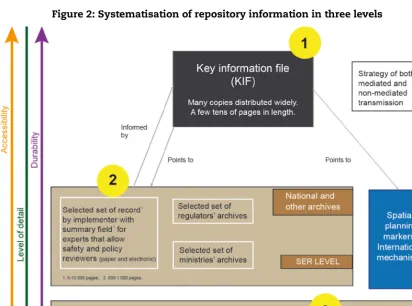
Related to the question of archives, the RK&M initiative has originated and is developing the concept of a key information file (KIF). The KIF corresponds to the top level within a three-tiered information system, consisting of the following levels:
• A basic level consisting of documents sent to the archives as a result of legal and
regulatory requirements. Typically, public bodies have to send all the documentation in their internal archives to the national archive. This documentation goes beyond safety case documents.
• A second level at which a selection would take place that aims at extracting the
documents that are related to the post-closure safety. These documents would be identified as such and also kept in the national archives and elsewhere.
• A top, third level which would consist of a summary of the previous
documentation in a format and language accessible to a public of non-specialists. The summary (KIF) would contain information not necessarily limited to safety, but referring also to the history of decision making concerning the repository. The RK&M initiative will develop a table of contents for the KIF. Existing national examples of similar documents, such as Andra’s synthesis document based on documents related to its Centre de la Manche disposal facility will serve as useful references. In a following step, the table of contents will be tested among participating organisations.
Markers
The RK&M initiative defines a marker as a “long-lasting object that indicates an area of influence, power or danger. It is placed strategically at or near the site for immediate recognition or for discovery at a later time” (NEA, 2014a). A marker is a good example for a non-mediated mode of information transmission under the dual-track strategy as it aims to reach an audience in the medium and long term without intermediaries.
In December 2013, the initiative published a “Literature Survey on Markers and Memory Preservation for Deep Geological Repositories” (NEA, 2013).
Phase II will study the issue of markers by discussing national case studies as well as by discussing emerging concepts such as surface traces that could be left behind on relevant sites to indicate past activity.
Underlining the concept of a systemic approach, markers could, for instance, point to the KIF outlined above. Also, they are strongly linked to the question of cultural heritage as they may persist if deemed culturally important and if they are becoming a part of society, which can also be a result of certain functions that markers may have.
International mechanisms
The RK&M initiative reviewed international mechanisms from different fields beginning in Phase I, for instance cultural heritage (e.g. the United Nations Educational, Scientific and Cultural Organization – UNESCO), that could be used as a means of collaborating and/or adapting the particularities of the field of radioactive waste management to support the preservation of RK&M. In preparing Phase II, the RK&M has subdivided international mechanisms into two different classes, for the purpose of studying them better with a view to establishing a systemic approach to RK&M preservation. These two classes are as follows:
• An international governmental mechanism (IGM) consists of entities and
• An international non-governmental mechanism (INGM) consists of entities and activities that bring together non-governmental, private or commercial organisations.
An additional categorisation of international mechanisms will be undertaken in Phase II.
Transfer of responsibilities
The question of transferring responsibilities is important: i) in order to demonstrate the willingness to continue maintaining oversight of the facility; and ii) because it is typically when responsibilities are handed over to another institutional body that much information is lost. Regulation and legislation tend not to address this issue. The RK&M initiative will make use of the presence of regulators and implementers among its participants to develop a discussion document on this issue. To further explore the question, the RK&M initiative will receive input from the NEA Regulators’ Forum.
The RK&M initiative has issued two studies that are related to the question of transfer of responsibilities. “Monitoring of Geological Disposal Facilities – Technical and Societal Aspects” (NEA, 2014d), which includes a contribution by the Forum on Stakeholder Confidence (FSC), discusses the role of local communities in maintaining the memory of a facility and provides an overview of issues related to technical monitoring. The study on “Loss of Information, Records, Knowledge and Memory – Key Factors in the History of Conventional Waste Disposal” (NEA, 2014c) concludes in part that records and information are often lost when responsibilities change.
Way forward
Through its activity over the past four years, the RK&M initiative has identified, examined and provided recommendations on the core components of any future national strategy for the preservation of RK&M. During the coming three years, it will analyse the interaction of these components to identify and provide suggestions for fostering synergies. This will provide waste management organisations and other interested parties with the resources necessary to address the issue of RK&M preservation adequately in their future activities.
References
NEA (2011), “Preservation of Records, Knowledge and Memory across Generations: An International Project of the NEA/RWMC”, OECD, Paris, www.oecd-nea.org/rwm/rkm /documents/rkm-collective-statement-2011-en.pdf.
NEA (2013), “Literature Survey on Markers and Memory Preservation for Deep Geological Repositories”, OECD, Paris, www.oecd-nea.org/rwm/docs/2013/rwm-r2013-5.pdf. NEA (2014a), “Glossary of Terms: Preservation of Records, Knowledge and Memory
(RK&M) across Generations”, OECD, Paris, www.oecd-nea.org/rwm/docs/2011/rwm 2011-14-rev4.pdf.
NEA (2014b), “Foundations and Guiding Principles for the Preservation of Records, Knowledge and Memory across Generations: A Focus on the Post-closure Phase of Geological Repositories”, OECD, Paris, www.oecd-nea.org/rwm/rkm/documents/flyer-A4-rkm-collective-statement-en-2014.pdf.
NEA (2014c), “Loss of Information, Records, Knowledge and Memory – Key Factors in the History of Conventional Waste Disposal”, OECD, Paris, www.oecd-nea.org/rwm /docs/2014/rwm-r2014-3.pdf.
Synthesis of the Constructing Memory Conference
Conference opening
Opening remarks to the conference were delivered by Thierry Dujardin, NEA Acting Deputy Director-General, Gérard Longuet, French Senator, former Minister and President of the Centre Mondial de la Paix, des Libertés et des Droits de l’Homme, and François-Michel Gonnot, President of Andra. These speakers highlighted that giving future generations the ability to make informed decisions about their heritage is a fundamental aspect of sustainable development. They expressed the opinion that the NEA RK&M initiative is helping break new ground in this regard, going beyond the technical aspects of nuclear technology development, encouraging a holistic approach and highlighting radioactive waste management as a humanistic and intergenerational endeavour.
Constructing memory in the digital era – experience, expectations and insights from the field of preservation of cultural heritage (Marinos Ioannides)
Prof. Marinos Ioannides from the Cyprus University of Technology highlighted the importance Mankind attaches to cultural heritage in all its various forms, but also the vulnerability of cultural heritage to deterioration and destruction. The centre of the talk was on research initiatives that aim to tackle this vulnerability by making cultural content available in digital forms through the support of information and communication technology (ICT). Prof. Ioannides mentioned existing international initiatives for the electronic documentation and preservation of cultural heritage (such as the EU Digital Library Europeana and the UNESCO Memory of the World Library) and showcased the development of various digitalisation tools and accessibility features (such as digital 3D reconstruction of artefacts and monuments and the inclusion of metadata in digitally preserved books).
Knowledge for the future – time eats information (Klaus Kornwachs)
Prof. Klaus Kornwachs of the University of Ulm gave the second opening lecture. He emphasised that for long-term RK&M preservation, one needs to think not only about technologies but, even more, about institutions that could preserve RK&M such as universities, academies or libraries. Support by international institutions like the OECD or the United Nations would also facilitate RK&M preservation. The reason one cannot rely on technological means alone is that information needs to be revisited in order to remain understandable and usable over time. In addition, it is important to indicate why information should be preserved; in the cases of chemical waste and the location of land mines, for instance, the reason for preserving information arises from their dangerous nature. We should not lead future generations into dilemmatic situations in which they cannot act in a responsible way anymore. RK&M preservation initiatives were thus presented as a way to meet our duty and help foster responsible behaviour over time. Preservation of records, knowledge and memory (RK&M) across generations: An NEA initiative under the aegis of its Radioactive Waste Management Committee
(Claudio Pescatore, RK&M Co-ordinator)
SYNTHESIS OF THE CONSTRUCTING MEMORY CONFERENCE
16 RADIOACTIVE WASTE MANAGEMENT AND CONSTRUCTING MEMORY FOR FUTURE GENERATIONS, NEA No. 7259, © OECD 2015
work. Namely, to present and test the RK&M findings, to enlarge the circle of potential contributors beyond radioactive waste management specialists, and to lay the foundations for Phase II of the programme of work. Section III of these proceedings provides a detailed introduction and overview of the initiative.
He explained that, in order to be effective in RK&M preservation, it is important to have in mind reference time scales, hence the organisation of this conference around three time periods characterised, respectively, by the active presence of technical specialists and regulators (short term: direct oversight), by surveillance by institutions that would include civil society and representing the taking of collective responsibility for memory preservation (medium term: indirect oversight), and a third period characterised by loss of societal memory keeping (long term: no oversight). He declared that “We do not inherit the earth from our ancestors; we borrow it from our descendants” and explained that the main driving factor to memory preservation is to give future generations the means to make their own informed decisions regarding their radioactive waste legacy. Contributions from artists
Cécile Massart – Constructing memory through artistic practices: Laboratories
Throughout her artistic work, which deploys a variety of visual media (video, photography, paint, and installations) Cécile Massart aims to raise awareness about radioactive waste disposal sites and to study their life within their surroundings for future generations. She proposes “laboratories” to be located within the perimeter of the disposal site, which would fulfil the function of markers and living research platforms at the same time. Through such laboratories each generation would try “to visualise” the radioactive waste sites, thus creating an international community of guardians, weaving a link from one generation to the next. The idea is to bring together people with a variety of backgrounds (musicians, archaeologists, writers, economists, artists, farmers, poets, among others) who would reflect about the transmission of memory from an ethical, economic or artistic perspective. These laboratories would work towards studying all the non-technical resources that could preserve the functions of this site in its landscape. It is thus Cécile Massart’s belief that artistic proposals carried out along with waste management agencies, local community projects, new media types and networks, changing institutions and connections with databases can provide a cultural anchor for future generations. Examples of Massart’s own artistic proposals for disposal sites can be found in Cover, a book published in 2009.
Gérard Larguier
Since 1998, the French painter Gérard Larguier has taken up the theme of memory in his works Chronique du XXème siècle, Autodafés et Palimpsestes and his series A saute-souvenance. Recently, he also completed an exhibition to increase the awareness of school children of the First World War, entitled Un regard neuf sur un siècle de mémoire. His compositions, which consist of collages with torn and burnt paper, express the complexity of society and its contradictions. For Larguier, memories occur in bursts and are reconstituted according to the vision of the moment and objective chance, which is what determines the judgements that one makes. His work reflects the idea that memory is fluctuating and fleeting, and ultimately concerned with giving meaning to life.
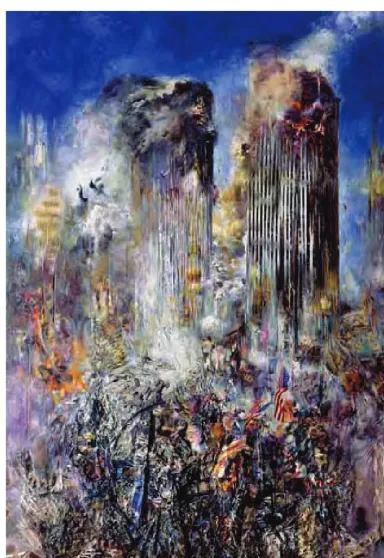
Robert Williams and Bryan McGovern Wilson: Cumbrian Alchemy
The Cumbrian Alchemy project explores issues emerging from an enquiry into convergent
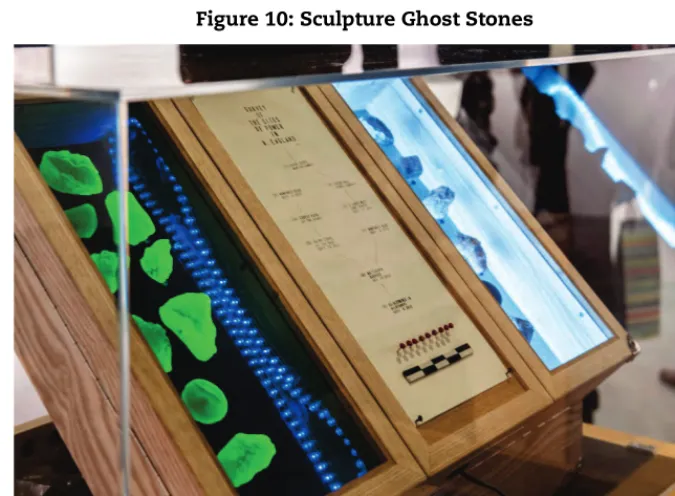
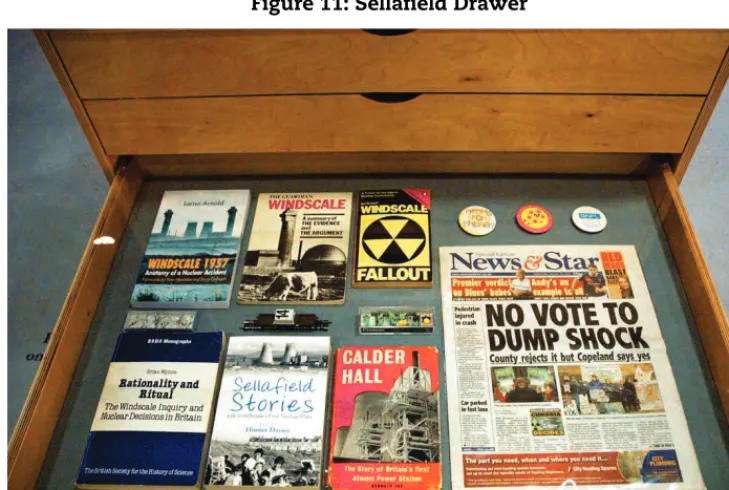
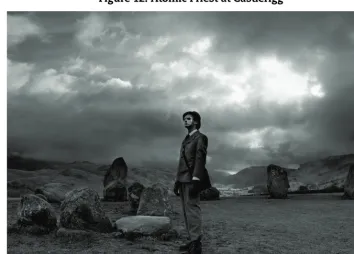
land. The work includes photographs, drawings, sculptures, material assemblages and film, and forms an interconnected network of possible readings and meanings to promote further insight, speculation, discourse and debate on RK&M.
Jon Thomson and Alison Craighead: A temporary index
With Temporary Index, Jon Thomson and Alison Craighead wish to create a series of
decorative, real-time numeric counters expressing radioactive decay. Each display will countdown in seconds, showing the time remaining before the given item of waste or a particular site is considered to be safe for humans. As a first step, data projections have been displayed in art galleries. The next step will be to establish a network of these counters online, in what could be described as a “virtual physiography”. Once the building of a network of counters in virtual spaces has begun, the information will be attached to places such as Google Earth and as this network of counters evolves it can also be displayed in galleries and museums. Ultimately, Thomson and Craighead will also look at possibilities of building semi-permanent physical counters in the places they refer to, with a view to making them self (solar) powered. However, they focus on developing these artworks in a way that concentrates on the present and not on their own physical persistence into a far-flung future. The underlying idea is that in making information more transparent, more visible and more widely known in societies now, we can have a greater chance that information will be transmitted into the future via our collective institutional memory. Cultural institutions have proven to be reasonable stores of pan-generational memory in this regard.
Session 1 – Short term: Period until repository closure
Preparing for the future today – the findings of the NEA RK&M initiative concerning the short term (Jantine Schröder)
RK&M initiative members define the short term as the period of time that ends with repository closure, thus including both the pre-operational and the operational phases of the repository and the possibility of both direct and indirect oversight. Jantine Schröder introduced the session on this time period by highlighting that RK&M loss takes place rapidly if it is not acted upon in a conscious, participatory, diverse and ongoing manner that starts today. RK&M preservation in the short term was explained as being concurrently about supporting ongoing implementation activities and preparing for the future. Against this background, project studies on RK&M loss, on present regulation in the field (or the lack thereof), and on existing international mechanisms (also outside the field of radioactive waste management) that could foster RK&M preservation were presented. Additionally, insights were drawn from the way the US Department of Energy Office of Legacy Management currently organises its long-term stewardship activities. The UK national archive initiative and the role of its different stakeholders
(Simon Wisbey in lieu of Simon Tucker)
SYNTHESIS OF THE CONSTRUCTING MEMORY CONFERENCE
18 RADIOACTIVE WASTE MANAGEMENT AND CONSTRUCTING MEMORY FOR FUTURE GENERATIONS, NEA No. 7259, © OECD 2015
Using art, stories and cultural heritage to preserve knowledge and memory (Hans Codée) In the Netherlands, the Central Organisation for Radioactive Waste (COVRA) is in charge of storing radioactive waste over a period of at least 100 years. After this period, deep geological disposal is planned. In order to make the waste management concept more visible and understandable, an art concept has been developed and implemented at
HABOG (Hoogradioactief Afval Behandeling- en Opslag Gebouw – high-level radioactive
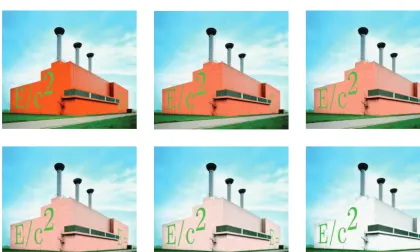
treatment and storage building), which is COVRA’s waste storage facility. Externally, the facility will be repainted in different and fading colours over the decades as a reminder of the radioactive decay of its contents. Collaboration with Dutch museums has also been established to use HABOG’s space as storage for museum collections that are not currently on display. With the recent, planned extension of the facility, the art concept has been refined further, for instance by making use of the periodical incidence of natural light on the facility and by creating a watching ritual around it. Thus, Hans Codée outlined how the implementation of artistic and cultural mechanisms can add value to something (waste) that by definition has no value, and in the process keep memory alive. RK&M preservation for a recently closed repository: The study of Andra’s Centre de la Manche (Florence Espiet)
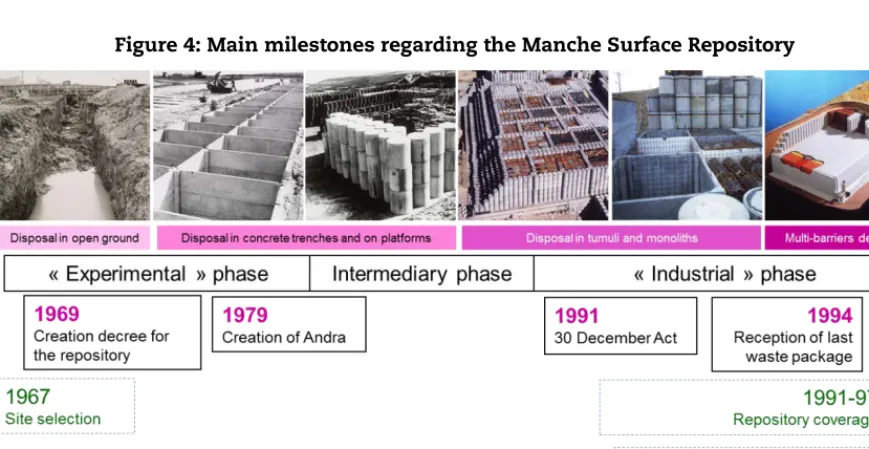
The French La Manche repository site received its last radioactive waste package in 1994. In 2003, the official surveillance phase of the closed repository started under the supervision of Andra (the national industrial operator), the French Nuclear Safety Authority (ASN) and society (e.g. the local municipalities). Florence Espiet explained that information on the existence of the repository, its content, how it was operated and how it works needs to be preserved. It also is planned to review the information periodically for a minimum of 300 years. She described the creation of two documents on memory (a detailed and a summary one), both on permanent paper, and the preservation of the land registration. The latter constitutes “passive” provisions for preserving memory. In addition, a number of “active” provisions are and will be put in place: guided visits, exhibitions, partnerships with organisations dealing with memory preservation, and the creation of a think tank. The latter consists of local citizens and politicians, retired employees from Andra and artists that meet several times a year and reflect on memory preservation from the perspective of, for instance, local history, education, arts and rituals. Finally, two types of markers will be used to preserve the repository’s memory:
i) three herbaria cataloguing the plants growing on the site of the repository, including a very short description of the repository, will be stored at different sites in France; ii) a stele indicating the main characteristics of the repository, potentially linked to an art work, will be erected at the repository.
Group discussions on the short term
Discussion Group 1: Policy and regulation
(Moderator: Jean-Paul Minon – Secretary: Sylvie Voinis)was that geological disposal is the responsibility of society at large, and that RK&M policy and regulation are a democratic obligation (response to a societal demand) and have a role in safety (complementing the “built-in” safety of the repository system).
Discussion Group 2: Key information file
(Moderator: Claudio Pescatore – Secretary: Anne Claudel)As a basis for discussion, the RK&M initiative’s systematisation of repository information in three levels was presented. With reference to Figure 2, the top level (level 1) consists of the key information file (KIF), level 2 is the set of essential records (SER), and level 3 consists of all records as they are typically transferred to the archives.
The group insisted on the principle of maintaining accessibility to as much information as possible and for as long as practicable. The reasons for this included reducing the probability of inadvertent intrusion as well as facilitating retrievability. The majority of participants were of the view that no discarding of documents should take place, even though it was acknowledged that large collections of records are difficult to access and understand. Care should be taken to structure the collections in a meaningful way and to include appropriate retrieval tools to facilitate access and interpretation. The three-level systematisation is a good step in that direction.
Figure 2: Systematisation of repository information in three levels
SYNTHESIS OF THE CONSTRUCTING MEMORY CONFERENCE
20 RADIOACTIVE WASTE MANAGEMENT AND CONSTRUCTING MEMORY FOR FUTURE GENERATIONS, NEA No. 7259, © OECD 2015
long periods of time than larger collections, which become more vulnerable over the years. However, all levels of detail are important for proper interpretation.
It was pointed out that in many countries records are eventually delivered to the National Archives, which have their own selection criteria and recommendations regarding the structure of records collections (classification schemes). National Archives traditionally cater for the needs of historians. In order to ensure the accessibility and the comprehensibility of collections of technical records, there is a need for collaboration between the National Archives and agencies involved in radioactive waste management. The RK&M initiative could act as a discussion platform for archivists and other specialists interested in this subject.
Discussion Group 3: Avoiding loss of critical records/opportunities of the digital world
(Moderator: Kevin McMahon – Secretary: Alexander Carter)The discussion group began with a review of the major factors for the loss of records as identified (NEA, 2014a) in the RK&M initiative:
• natural events and disasters (e.g. floods);
• lack of resources (e.g. inadequate preservation, management, indexing);
• regulatory inadequacies (e.g. agencies only hold what they are required to, often
focusing more on data than on knowledge or memory);
• neglect or unlawful activities (e.g. deliberate suppression of flood or
contamination records to preserve property prices);
• societal discontinuities (e.g. war, epidemic, mass migration).
The group reached a general agreement that, inevitably, “time eats information” (NEA, 2014a) and that knowledge transfer between generations constitutes a difficult problem; it is important to ensure that future generations understand why such information needs to be conserved and that they also retain sufficient interest in its preservation.
The group moved on to discuss how the loss of essential records could be mitigated. Some proposals were:
• use of multiple storage locations to provide redundancy;
• use of national archives;
• application of robust and well thought out regulations.
There was a discussion about how much information should be preserved, with some persons suggesting that all information should be preserved (“how do we know what will be required in the future, especially if unexpected technical problems arise?”) and others suggesting that we should be selective (“by keeping everything, we will end up not finding anything”). In this regard, international standards or guidelines that would be common to all were judged beneficial.
If large amounts of information are stored, the group felt that there need to be some criteria to identify critical/essential records. These should be developed by considering what is likely to be important to future generations and what story we need to tell them to understand what present generations have done. The RK&M idea of three levels of information with a common key information file was widely supported.
If such materials do become valuable in the future, information and records must be available to help future generations realise how hazardous future retrieval may be. It was also noted that this may not always work in a benevolent fashion (with reference to, for instance, the present-day theft of copper cables). Others were of the opinion that RK&M should be kept not for the waste but for human health. The idea was also expressed that a deliberate loss of all records may actually be beneficial. However, there are two significant counter-arguments against this approach: firstly, to prevent accidental intrusion while exploring natural resources, and, secondly, to prevent non-factual information about the facility entering folklore and attracting future archaeologists or explorers.
There was a brief discussion about the role that digital archives may play in the future although many people felt that paper was a “tried and tested” medium (lasting at least 300 years) which should be supplemented, rather than replaced. Digital archives, however, do have several advantages, such as easy dissemination of large volumes of information to multiple locations quickly and efficiently; improved searchability; and the chance to store links between pieces of information via metadata. It was noted that for large volumes of information (reference was made to the Yucca mountain nuclear waste repository licensing with around two million documents), digitalisation may offer the only practical solution, although it was also pointed out that previous digitalisation efforts (such as the Domesday book) had been less successful than hoped. Again, it was felt that a multi-level approach would be best, with the most important information being stored in multiple ways, including paper.
Session 2 – Medium term: Period of continued oversight
The concept of oversight, its connection to memory keeping and its relevance for the medium term – the findings of the RK&M initiative (Stephan Hotzel)
The medium term was introduced as the period of indirect oversight after repository
closure, with timescales in the order of a few hundred years. While the importance of intrinsic control or “passive” safety features in the post-closure phase of a geological repository has been recognised and stressed before, the role of oversight, by providing the capability to reduce or avoid some exposures, has come to the fore only recently. Oversight for the time being generally refers to “watchful care” and society “keeping an eye” on the technical system and the actual implementation of plans and decisions. In some regulatory frameworks oversight is indirectly required, for instance when mandating the creation of a land exclusion zone. In other frameworks, oversight is directly required, as illustrated, for instance, by the long-term stewardship concept of the US Environmental Protection Agency. Although sheer memory of the presence of the facility cannot be enough to constitute oversight, oversight and RK&M preservation do go hand in hand. For example, monitoring after repository closure fosters RK&M preservation, and vice versa. The presenter focused on terminology, potential oversight measures, and on roles and responsibilities of different stakeholders.
Heritage messages of post-nuclear natures (Anna Storm)
SYNTHESIS OF THE CONSTRUCTING MEMORY CONFERENCE
22 RADIOACTIVE WASTE MANAGEMENT AND CONSTRUCTING MEMORY FOR FUTURE GENERATIONS, NEA No. 7259, © OECD 2015
Researching the great hedge of India: RK&M lessons on what to do and what to avoid for memory preservation (Roy Moxham)
The “Great Hedge of India”, a 3 700 kilometre-long hedge installed by the British customs to safeguard the colonial salt tax system and avoid salt smuggling totally faded from both memory and records (e.g. maps) in less than a century. Roy Moxham found traces of the hedge in a book footnote and searched it for several years until he found its meagre remains. The speaker wrote a book about this quest. He said that this story reveals how things disappear when they are no longer useful and, especially, when they are linked to parts of history that are not deemed particularly positive (the hedge was a means of colonial power).
Archival and museum curatorship challenges for RK&M preservation (Christophe Jacobs) Heritage institutions, such as national archives, libraries, museums and monuments, face numerous challenges to their durability: political and geopolitical hazards (such as armed conflicts), natural hazards (such as floods), economic and social hazards (such as censorship and book burning) and everyday hazards (such as small-scale fires). For those running heritage institutions it is difficult to anticipate and adapt to these threats. However, a number of successful strategies to meet them and develop resilience have been formulated at the international (e.g. 1954 Hague Convention protecting heritage in times of war), national (e.g. guidelines to protect heritage sites from natural disasters) and local levels. Local communities and associations of heritage professionals appear to be of particular importance for contributing to the resilience and survival of these institutions.
Group discussions on the medium term
Discussion Group 4: International mechanisms
(Moderator: Georg Lindgren – Secretary: Erik Setzman)To start the discussion, the RK&M initiative’s definition of an international mechanism (IM) that supports RK&M preservation was mentioned: “a mechanism for RK&M preservation that has an international influence, scope or support and is based on international co-operation” (NEA, 2014b). It can be governmental (intergovernmental mechanism – IGM), which implies mutual agreements between national governments or non-governmental (international non-governmental mechanism – INGM).
In the discussion group the aims and drivers for IMs were discussed and it was observed that such mechanisms can improve chances of success of RK&M preservation, for instance, because they add redundancy. Furthermore, the openness and transparency that may come with such a mechanism can be a good basis for stakeholder dialogue. International comparisons that could be undertaken within the framework of IMs can also serve as a quality assurance for national strategies. Finally, it was observed that an IM may be a way to foster international standardisation.
models cannot simply be copied across borders. In this regard, the fact that representatives from the continents of South America, Africa, and, to a large extent, Asia were absent at the conference was mentioned, recognising that these, nevertheless, make up a large share of the world’s population. It was thus recommended to include these countries, including those without nuclear programmes, in future meetings addressing RK&M preservation issues. “Respect” and “sharing” were put forward as key terms.
Discussion Group 5: Archives
(Moderator: Christophe Jacobs – Secretary: Arne Berckmans)In order to set the scene for the diverse participants of the discussion group, a few concepts were defined based on the glossary of the RK&M initiative:
• Archives are defined as a “collection of records that have been selected for
permanent preservation due to their continuing administrative, informational, legal and historical value as evidence of the work of the creating organisation or programme”.
• The medium term refers to “the period of time of indirect oversight activities that
would follow repository closure”. This implies that the waste is no longer readily accessible. “Indirect oversight after closure” includes monitoring of radioactive release pathways under a variety of institutional arrangements. Land use controls will exercise further oversight of the repository at all times and are part of the protective measures that can be enforced.
It was mentioned that archiving in the short term will need to take into consideration the fact that at a later stage (medium term) the focus will change from operation activities to post-closure (monitoring) activities. As such, a new subset of knowledge and information will be needed. It was suggested that these knowledge subsets can be, at least, partly anticipated by constructing “what if” scenarios and supplying appropriate answers (“how to” topics) to questions springing from such scenarios. Moreover, it was felt that significant care should be taken on supplying sufficient context to all the technical data, in order to enable future generations to understand why things were built and why monitoring was and/or is done (“why” topics).
It was advised that apart from archives on acid free paper or other “permanent” carriers, all knowledge stored on digital carriers should be migrated to more recent software products on a regular interval (for example, every five years).
It was mentioned and acknowledged that history shows that to assure a transfer of knowledge about a given topic or issue, it is imperative that the knowledge is absorbed and embedded in the day to day life of a variety of stakeholders. This might not be relevant for the medium term, when indirect oversight is implemented by a given agency, but should the assigned agency fail for whatever reason (war, economic disruption, etc.), a redundant mechanism should be able to take over in the sense that local stakeholders, for example, will try to assure oversight, which is why they need to have knowledge about and of the disposal site.
SYNTHESIS OF THE CONSTRUCTING MEMORY CONFERENCE
24 RADIOACTIVE WASTE MANAGEMENT AND CONSTRUCTING MEMORY FOR FUTURE GENERATIONS, NEA No. 7259, © OECD 2015
Discussion Group 6: Transfer of responsibilities/cultural provisions
(Moderator: Johan Swahn – Secretary: Simone Brander)All participants agreed that transfer of responsibilities would take place. Although it is important to discuss the issue of responsibility transfer now, the opinion was also expressed that future generations should have the possibility to make their own decisions, and that it would be arrogant to presume that all questions can be answered today. Participants from the local communities highlighted that it is important to have regulations in place before the start of a project, in order to know how future RK&M transfer would take place.
In order to avoid that safety responsibilities would pass to the local level after the implementer ceases to exist, it was suggested that responsibilities would be transferred to the state after repository closure. The polluter pays principle was called upon: a fund should be established by the waste producers, to be transferred along with responsibilities. It was also acknowledged, however, that in the long run it is difficult to secure money in a fund according to the polluter pays principle.
It was mentioned that the envisioned responsible institutions should already be involved today, to avoid the loss of information.
Regulation for responsibility transfer was supported, but only in a general manner. Clear principles should be defined as part of the licence application, but specific guidelines should follow in the process of the project. Some expressed the importance of public participation in developing regulations for the transfer of RK&M responsibilities. International standards, for instance by the IAEA on record keeping, were deemed helpful in this regard, but regulation should fit the national level, for instance related to land use. Keeping in mind the volatility of national boundaries, the importance of the international level was also mentioned specifically for safeguards. Oversight, on the other hand, was perceived as more of a local issue.
Overall, it was said that risk management needs to be organised in such a way that an international mechanism can take over if a state fails at the national level. The local, national and international levels were thus all mentioned, but for different responsibilities, and there was some discussion on what regulation should specifically cover.
The International Commission on Radiological Protection (ICRP) guidelines of continuing forms of oversight for as long as practical was also discussed. Although all participants seemed to agree with the principle, there was no clarity about what it meant exactly and what compliance would consist of. A comparison was made with the dike maintenance system in the Netherlands. It was pointed out, however, that, for this case, the threat is clear and visible (danger of flooding), while for the case of geological repositories it is more complex. “You have to see the problems to know that you have to prepare” and “why would you believe in information when you do not see the problem?” it was said. The current situation in Syria was brought up and the group tried to imagine how to deal with geological repository oversight in such a situation. The relevance of international mechanisms came to the fore in this regard.
Day 2. Closing lecture by Peter van Wyck
instance, the time when we ask for consideration of time scales beyond anthropometric dimensions. Within the geological, social, and human sciences, one of the questions of the Anthropocene circles around when it would have started. There are various competing ideas about this. Some date it back to the acquisition of fire, others to the Industrial Revolution, and others to the great acceleration of science and technology in
the mid-20th century. Nuclear energy has also been suggested as a signature. Overall,
Prof. van Wyck suggested that the Anthropocene, as a kind of cultural meme, offers a moment in which cultural awareness around questions relating to nuclear energy may be broadened and enhanced.
Session 3 – Long term: Period with no oversight
Preservation of records, knowledge and memory in the long term – the findings of the RK&M initiative (Anne Claudel)
In line with the RK&M initiative’s glossary (NEA, 2014b), the “long term” was introduced as the period of time after repository closure with no repository oversight, extending over hundreds of thousands of years. Anne Claudel focused on the RK&M initiative findings regarding markers. She explained that, although they have often been presented as the main method to preserve memory and deter human intrusion, the RK&M literature survey on markers shows that there are no straightforward, conclusive answers to the objectives, messages and methods of marking. Even if they remain physically intact and traceable over time, future neglect or misunderstanding of their meaning cannot be ruled out. It was thus announced that the potential role of markers for RK&M preservation should be studied within a systemic approach to RK&M preservation. For instance, RK&M will investigate further the interaction of markers with other methods and tools, and the potential of internationally standardised markers.
Could the landscape preserve traces of a deep underground nuclear waste repository over a very long time? A study of the French case (Dominique Harmand)
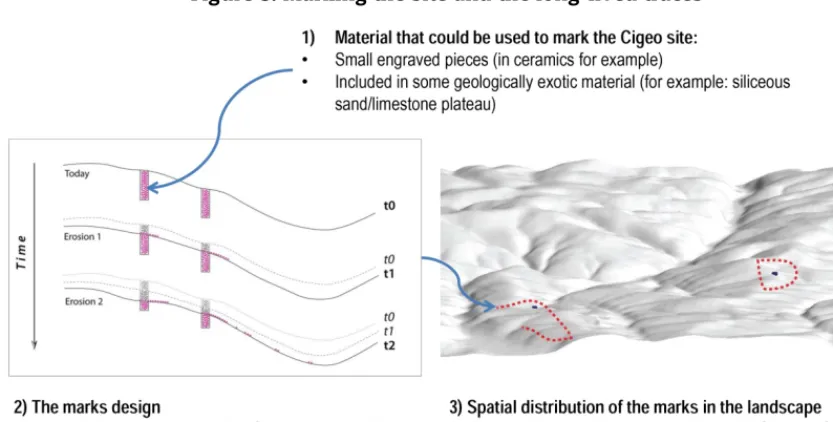
Prof. Dominique Harmand presented a study conducted on behalf of Andra that focused on the archaeology of abandoned underground mines in order to illustrate how ancient human activities have left traces in the landscape. Old mines often have left some traces at surface such as slag heaps and parts of shafts over relatively long timescales, up to thousands of years. Geological disposal projects are equally likely to leave traces in the landscape over time. In the case of the French Cigéo project (Centre industriel de stockage
géologique), research into the past and future geological evolution of the area shows that
traces of heads of shafts and inclined tunnels, and filled excavations will likely still exist at surface in the distant future. However, as these traces could be confused with other human and natural traces of all ages, steps need to be taken to ensure that they are correctly interpreted. A suggested approach to facilitate the correct interpretation in the future consists in marking the site, and especially its long-lasting traces, with long-lived anthropological elements, such as small engraved ceramic pieces. These could be placed around the repository’s surface buildings, but also in drill holes that would be a few metres deep. As a result of the natural erosion of the site, they would progressively reach the surface of the area in the long term.
SYNTHESIS OF THE CONSTRUCTING MEMORY CONFERENCE
26 RADIOACTIVE WASTE MANAGEMENT AND CONSTRUCTING MEMORY FOR FUTURE GENERATIONS, NEA No. 7259, © OECD 2015
A multidimensional message was proposed, for the purposes of information (“storage site here”), interpellation (to warn, prevent or alert) and integration (with regard to the surrounding environment). This corresponds to the systemic approach of the RK&M initiative, which is based on a variety of RK&M transmission mechanisms that are integrated with and/or complement one another.
Archaeology and the long-term future: Managing nuclear waste as a living heritage (Cornelius Holtorf and Anders Högberg)
Archaeology, the study of the remains of the ancient past, may be relevant to the long-term preservation of RK&M, because it works to recover information, knowledge and meaning that have been lost. As a discipline, archaeology studies how the past is understood in the present, potentially drawing lessons that could guide future action concerning the preservation of RK&M across time by indicating how future societies could make sense of the past. Case studies, such as an examination of European megalithic tombs, show that the understanding of the past varies across time. It was emphasised that archaeological interpretation always reflects contemporary perceptions of past and future, which are socially and culturally embedded and highly mutable over time. What is more, archaeology is a fairly recent discipline and there is no certainty that it will exist in the long term, to help recover and reconstruct lost RK&M. As a result, it cannot be assumed that information, knowledge and meaning of the past can be transmitted reliably in the long term. Based on this understanding Profs. Cornelius Holtorf and Anders Högberg made a case for trying to keep knowledge alive over time, continuously engaging each present. They used the notion of “living heritage”, which refers to striving for continuity in the short and medium terms as a way to reach the long term, keeping in mind that reinterpretation and knowledge development over time is a given. As a result, they suggest to “think about the long term but act for the short and medium terms”.
Group discussions on the long term1 Discussion Group 2: Markers and beyond
(Moderator: Cornelius Holtorf – Secretary: Stephan Hotzel)Discussion participants identified two poles with regard to marking: on one side, extreme marking to provide as much information as possible, as accessible as possible, for as long as possible. On the other side, no marking of the repository site in order to avoid stirring curiosity. One will have to find a convincing position somewhere on, or in between, these poles depending on the peculiar situation of the deep geological repository under consideration (i.e. in each country).
International standardisation (possibly with the help of e.g. the United Nations Educational, Scientific and Cultural Organization [UNESCO]) of, at least, some types of markers was considered a good idea as it could ease comprehension and create a link between sites, which was judged highly relevant over time (global recognition). However, risks were also pointed out; if the selected common marker is not understood, this is a common failure across sites.
It was agreed that the work on markers should not focus only on the long term; in light of oversight, they have importance for the medium term, too. Overall, participants saw markers functioning as pointers to where to look for more information. A “marking strategy” is thus needed, rather than just markers. Markers should be complemented by,
at least, a minimum key to interpret them, like the Rosetta Stone method, since language is likely to change.
The idea of time capsules, a cache of records or goods, intended to outlast long time spans before being opened, was also discussed. These could be included in repositories.
“Authentic marking” could increase credibility of the markers it was said, i.e. to develop natural (unintentional) traces of the disposal activity like landscape “scars” or “surface (and possibly sub-surface) traces” into markers.
Discussion Group 3: Facilitating knowledge reconstruction
(Moderator: Thomas Kaiserfeld – Secretary: Evaristo Bonano)The purpose of this discussion group was to examine ideas and thoughts about how to reconstruct knowledge over the long term, defined as the period without oversight.
A key thought, consistent with other discussions groups for both the short and medium term, was the need for redundancy. It was not clear who shall secure the available knowledge and facilitate the reconstruction of knowledge that may have been lost or misplaced: Should it be groups that have a personal interest (or passion) in preserving the knowledge or should it be groups – such as a formal institutions or organisations – that are either paid or required by law or regulation to preserve existing knowledge and reconstruct lost or misplaced knowledge?
There was agreement among the discussants that synergies should be developed and implemented with similar efforts to preserve knowledge. For example, it was mentioned that advantages should be taken for developing systems to preserve knowledge for nuclear waste jointly with similar efforts about chemical or conventional waste, and that links should be established between the NEA’s RK&M effort and similar efforts in other international organisations.
It was suggested that a “reflective approach”, rather than the direct or technical approach, could be considered, deciding what knowledge should be preserved and how it should be preserved by examining what the value associated with preserving the information or knowledge is and who would be interested in this information in the future. Should it be a “human” value in the interest of protecting human health and safety, or should it be the potential future economic value of the waste and/or of other materials buried with the waste?
It was also discussed that maintaining massive amounts of records could, perhaps, be of less importance than preserving key messages or specific pieces of knowledge, due to the uncertainty of how sophisticated future generations would be. It was mentioned that attempting to decide at the present time how to organise and preserve knowledge for generations more than tens of thousands of years in the future was a rather utopian undertaking. Instead, an evolutionary approach to maintaining the information that would allow adapting the methods and techniques for knowledge preservation to be consistent with generations at specific intervals in time might be a better approach, helping to address the uncertainty associated with the level of sophistication of future generations. One important aspect of this “adaptive approach” should be educating younger generations about radioactivity and nuclear waste matters.
Discussion Groups 4 and 6: Cultural heritage
(Moderators: Peter van Wyck and Hans Codée – Secretaries: Jantine Schröder andSofie Tunbrant)
SYNTHESIS OF THE CONSTRUCTING MEMORY CONFERENCE
28 RADIOACTIVE WASTE MANAGEMENT AND CONSTRUCTING MEMORY FOR FUTURE GENERATIONS, NEA No. 7259, © OECD 2015
components from the natural world (such as culturally significant landscapes, geologies, and biodiversity) (NEA, 2014b). The aim of the discussion groups was to reflect on developing this concept further for RK&M preservation in the context of geological disposal over the long term.
Cultural heritage mechanisms
Reference was made to the “Old Weather” project where members of the public are asked
to help scientists recover worldwide weather observations since the mid-19th century by
transcribing hand-written weather log-books into

![Cumbrian alchemy (2012-2014) [installation]](data:image/gif;base64,R0lGODlhAQABAIAAAP///wAAACH5BAEAAAAALAAAAAABAAEAAAICRAEAOw==)