Interpersonal Relationships and the Development of Student Interest in Science
Li-hsuan Yang
Marygrove College, USA
Abstract
This study explored how interpersonal relationships may affect the development of interest in science from college students’ perspectives. Semi-structured interviews with 24 college students were conducted and analyzed. The findings indicated that interpersonal relationships could start and sustain students’ interest in science; negative interpersonal relationships could cause students to lose interest in science. Four qualities were often associated with the interest-raising relationships: (1) The influential figure was perceived as having a positive relation with science. (2) The influential figure actively mediated the relation between the student and science. (3) The influential figure conveyed as well as created positive emotions about science when he or she did science with the student. (4) The influential figure and the student had a personal relationship characterized by caring, sharing, and/or launching. Interest-lowering relationships lacked these qualities. Implications for education and future research were discussed.
Key words: interest, science, interpersonal relationships, development, college students
Please direct all correspondence to: Li-hsuan Yang, Marygrove College, 8425 W. McNichols, Detroit, MI 48221, Phone: 313-927-1286, Email: [email protected]
Introduction
A common goal shared by many science educators is to help students develop a genuine and long-lasting interest in science because interest has the potential to enhance the quality of learning (Ainley, Hidi, & Berndorff, 2002; Hidi, Renninger, & Krapp, 2004) and increase the likelihood that students will continue learning outside the classroom. Yet it is clear that many students are not interested in science and many who are interested in science lose their interest over time (Barmby, Kind, & Jones, 2008; Krapp & Prenzel, 2011). In order to foster and maintain student interest in science, how people’s interest in science starts and develops needs to be understood. However, research on interest development is still “in its infancy” (Renninger & Su, 2012, p. 183). As Brophy (1999, 2004) pointed out, it is known that preexisting interest in a topic can lead to higher quality learning about the topic, but little is known about how to induce and nurture such interest if it is not already present (cf. Swarat, 2008).
theory that virtually all learning phenomena, resulting from direct experience, can occur vicariously by observing other people’s behavior and its consequences for them. Therefore, it might be possible that a child could observe how others do science and acquire positive experiences in science and hence learn to like science. In other words, Csikszentmihalyi, Bandura, and empirical evidence all suggest that it is reasonable to hypothesize that through interaction with others who are interested in science, a child might internalize that interest and make it his or her own.
The above described hypothesis, however, does not explain one phenomenon. Every individual encounters many people with their own interests. An individual does not develop shared interests with all the people with whom he or she has interacted. This hypothesis does not explain the reasons that cause one’s interests to be influenced by some people but not by others.
Deci and Ryan’s self-determination theory carries the potential to explain why an individual does or does not develop an interest similar to another person’s interest. The self-determination theory proposes that three basic psychological needs are intrinsic to the self --- the needs for competence, autonomy, and relatedness (Deci, 1992; Deci, Vallerand, Pelletier, & Ryan, 1991). It is hypothesized that social contexts that allow the satisfaction of these three basic needs will promote intrinsic motivation, internalization, and interest (Ryan & Deci, 2000; Ryan & Powelson, 1991; Ryan & Stiller, 1991). Since an individual forms different relationships with different people, it is possible that the qualities of these relationships mediate the extent to which the individual develops interests similar to other people’s interests. Numerous studies have shown that promoting information enhances interest, whereas competence-diminishing information undermines interest (e.g., Elliot et al., 2000; Harackiewicz, Abrahams, & Wageman, 1987). Empirical work has also shown that autonomy-supportive contexts tend to enhance interest, whereas controlling contexts tend to diminish interest (e.g., Black & Deci, 2000; Guay, Boggiano, & Vallerand, 2001).
From college students’ perspectives, is the development of their interest (or lack of interest) in science affected by other people?
What qualities of interpersonal relationships with the influential figures facilitate or hinder the development of their interest in science?
College students were chosen as the participants of this study because they were likely to have formed a relatively stable and enduring interest or lack of interest in science and have the ability to reflect on their experiences in thoughtful ways. Their reflections were also likely to reveal factors, possibly interpersonal relationships, in their experiences that had affected the development of their interest in science. The findings of this study should help science educators at all levels develop insights about ways to conceptualize and facilitate the development of student interest in science.
Conceptual Framework
Conceptualization of Science
In this study learning science was conceptualized as mastery of a canon of knowledge and norms for participation (Anderson, 1992). Mastering the canon of knowledge involves developing conceptual understanding of the accumulated knowledge in scientific communities; mastering the norms for participation involves learning ways that scientists use to generate knowledge, both individually and as social groups (Anderson, 1992).
A distinction was also made between science in school and science outside of school. Some students might not be very attentive during their science lessons or feel enthused about the science experiments they conduct in school, but they might read science books for their own interest or do experiments to figure out answers to their own questions outside of school.
Based on the distinctions discussed above, four aspects of student interest in science were explored in this study: (1) interest in learning science facts and concepts in school (e.g., listening to lectures or reading textbooks about various science topics), (2) interest in learning science facts and concepts outside of school (e.g., reading science magazines or watching TV programs about cancer, polymers, outer space, animals and plants), (3) interest in trying to figure out scientific knowledge in school (e.g., doing experiments, having discussions in school about science topics) and (4) interest in trying to figure out scientific knowledge outside of school (e.g., trying to understand the process of baking by varying temperature or ingredients and analyzing the results, trying to understand the function of a car, a watch, or a sewing machine by manipulating it in various ways, participating in discussion about science topics with friends or family members).
Conceptualization of Interest
individual interest in science was chosen as the central focus, because individual interest in science is the aim to be fostered in our students for their life-long science learning. Individual interest in science was conceptualized as a relatively stable and enduring preference toward learning science either for an intrinsic reason (i.e., enjoying the activity itself) (Csikszentmihalyi, 1990; Lepper & Hodell, 1989) or for a self-determined instrumental reason (i.e., the activity leading to something the person truly values, rather than being coerced to value) (Deci & Ryan, 1991, 2000).
It is important to point out that in this conceptual framework, interest is not necessarily manifested through a career choice. Although important work has been done to study reasons that cause students to switch from science-related majors to non-science-related majors (Seymour, 1992, 1995; Seymour & Hewitt, 1997; Tobias, 1990), it is not clear whether the reasons that account for switching majors do influence students’ interest in science as conceptualized in this study. A non-science major can still be very interested in science and use leisure time to read science magazines, watch the Discovery Channel, or figure out how a toaster works. Since a common goal among science educators is to help all students, not merely science majors, to develop their interest in science so they will continue learning science outside of academic settings and become scientifically literate citizens, this study did not directly build on the research that investigated issues related to the loss of science majors; instead it strove to understand factors, particularly interpersonal relationships, to which college students attributed their interest or lack of interest in science irrespective of their career choices.
Conceptualization of Interpersonal Relationships
Most research on personal relationships is directed at one of three levels of analysis: individual, dyadic and systemic (Sarason, Sarason, & Pierce, 1995). At an individual level of analysis, a personal relationship can be defined in terms of a participant’s perception of his or her relationship with another person. At a dyadic level of analysis, relationships are conceptualized primarily in terms of the social bond shared by two participants. A systemic level of analysis seeks to account for the links, not only between the two participants in a personal relationship, but also with others in the social network who influence and are influenced by members of the target dyad. The three levels can be viewed as mutually complementary rather than mutually exclusive. This study took an individual level of analysis based on the assumption that whether or how a certain relationship affects an individual’s development of interest in science mainly depends on how this individual makes sense of that relationship and comes to shape his or her interest in the context of that relationship (Maehr, 1991).
the images of self and other are images of self and other in relation, rather than self and other in isolation. The definition of the “self-with-other” construct proposed by Ogilvie and Ashmore (1991) illustrates the idea of self and other in relation. Ogilvie and Ashmore defined the “self-with-other” construct as a mental representation that includes the set of personal qualities (traits, feelings, and the like) that an individual believes characterizes his or her self when with a particular other person. In a similar way, one can define “other-with-self” as a mental representation that includes the set of personal qualities (traits, feelings, and the like) that an individual believes characterizes the other person when that other person is with this individual.
It seems reasonable to assume that students’ interest in science should be shaped by their experiences of engagement with science activities. During these engagements, there are often other people (e.g., parents, science teachers, peers) involved. It was assumed that students form relational schemas with these people. Since relational schemas can shape one’s sense of self (possibly including one’s self-perception related to science) and subsequent interactions with other people (possibly including other people in science), it is worth examining whether a student’s relational schemas affect development of interest in science, and if they do, how.
Methods
Participants and Recruitment
Twenty-four college students were recruited from a few undergraduate psychology courses through the subject pool established in a Midwestern university. All the research projects which were recruiting participants from the subject pool were posted for the students to volunteer. Students in the subject pool were encouraged to sign up for the research projects based on the project titles, restrictions for certain characteristics of the participants, the lengths of time required, and the schedules. The title of this project was posted as “understanding the development of student interest or lack of interest in science.” The amount of time required for this project was one and a half hours. Various time slots were offered for potential participants to sign up. Each potential participant was also offered the opportunity to set a time with the author that would work. Students were given some extra credits in their psychology courses for their participation in these research projects. In general, two to five hours of participation in these research projects constituted about 5% of the final grade.
The participants were grouped based on self-reported interest in science. The author intended to recruit 12 participants (six male, six female) who identified themselves as interested in science and 12 (six male, six female) who identified themselves as uninterested in science. Once six participants were recruited for one of the four groups needed (male interested, male uninterested, female interested, female uninterested) the recruitment for that group was stopped. The recruitment continued until the intended four groups were filled. Science majors were not differentiated from non-science majors because it was assumed that interest in science explored in this study was not necessarily manifested through career choice. Thus the distinction was not important for the purpose of this study.
Interviews
science, major experiences in science, and the development of interest or lack of interest in science. These interview questions are described in detail in another article (Yang, 2010). Then the questions listed below were asked to further explore the origin and development of the participant’s interest or lack of interest in science and the qualities of influential interpersonal relationships. It should be pointed out that the interview questions that directly asked the participants about people who have affected their interest in science were asked after the participants had been given opportunities to talk about any experience that had affected their interest in science. In this way the interview would not lead them only to talking about interpersonal relationships and ignoring other factors that might have affected the development of their interest in science.
How did your interest in science start? (or Why did you never develop an interest in science? Or How did your “non-interest” start?)
If you draw a curve to represent the development of your interest in science with time/age as the horizontal axis and the interest level in science as the vertical axis, what would your curve look like? Can you talk about the curve?
Is there anything in your life that has affected your interest in science? How did that something affect you?
Is there any person in your life who has affected your interest in science?
Can you tell me a little more about the change of your interest in science as a result of interacting with that person?
What did that person do to make you interested in science (or to lower your interest in science)? Can you give me an example?
How would you describe your interaction with that person? Can you give me an example?
How would you describe your relationship with that person?
Can you come up with some adjectives to describe your relationship with that person? Do you think that your relationship with that person has anything to do with your
interest in science? If yes, how?
During the interviews, probing questions were used to clarify the points the interviewees attempted to make. All the interviews were conducted in a quiet room, and were audio-recorded with the permission of the interviewees.
Data Analysis
Based on Glaser and Strauss’ (1967) constant comparative method, three stages of qualitative analysis were conducted by the author.
(1) Formulating categories and comparing incidents applicable to each category
(2) Integrating categories and their properties
As coding proceeded, this constant comparison of the incidents generated theoretical properties of the category. As the coding continued, the constant comparative units changed from comparison of incident with incident to comparison of incident with properties of the category. Revisions of categories were made when two or more tentative categories could be combined into one integrated category that was conceptually more meaningful in terms of making contrasts among participants.
(3) Developing claims with relevant evidence organized around the claims
At the third stage, comparisons were made to examine whether any differential pattern existed between the interested group and the uninterested group, as well as between the interest-raising relationships and the interest-lowering relationships.
Results
The analysis of the findings followed the tradition of grounded theory to identify patterns that emerged from the data (Glaser & Strauss, 1967). Therefore, the findings reported might not correspond perfectly to the conceptual framework used for the design of the study. This choice was made consciously because the purpose of this study was to develop a deeper understanding of students’ experiences and perceptions related to the research questions, not to impose the researcher’s thinking on the participants.
The findings related to the nature of the participants’ interest or lack of interest in science are discussed in another paper (Yang, 2010). The focus of this paper will be on the findings related to the interpersonal relationships that facilitated or hindered the development of student interest in science. All reported students' names are pseudonyms.
The Development of Interest in Science as Affected by Other People
All 12 participants in the interested group and seven participants in the uninterested group mentioned interest-raising influential figures in their interviews. The influential figures mentioned were science teachers (by 10 students in the interested group and three students in the uninterested group), parents or grandparents (by four students in the interested group and three students in the uninterested group), and siblings/cousins (by two students in the interested group and two students in the uninterested group). The influential figures were often described by the students as being interested in science, as practicing in a science-related field, as someone with a scientist’s habit of mind, or someone who demonstrated that science could be useful or relevant to life.
Fourteen of the 19 interest-raising influential figures mentioned by the students in the interested group and seven of the eight mentioned by the students in the uninterested group were also described as having a good relationship with the student. Andrea’s comments provided an example of a good relationship between the student and the influential figure.
Interviewer: Is there anything in your life that has affected your interest in science?
success and failure with fruit flies…He always asked us about them. He helped us with them. If we were frustrated, he reassured us.
Interviewer: How would you describe your relationship with this teacher? Andrea: Really good and personal, because we went on the wilderness trip.
He was with us…We were addressing him on a first name basis. We were like friends…because we had spent a lot of time together…
Three students (one male, two female) in the uninterested group mentioned interest-lowering experiences that involved negative relationships with science teachers. Since some students in the uninterested group also reported interest-raising relationships, the data suggested that it was not that the students in the uninterested group completely lacked interest-raising experience in their lives; it was quite possible that their interest-lowering experiences outweighed their interest-raising experiences. Edna’s experiences illustrated how some of her teachers lowered her interest in science through relationships that Edna described as “bitter.”
Interviewer: Is there any person in your life who has affected your interest in science negatively?
Edna: Just teachers. The way they teach it… Basically it’s like they are told what they have to teach for this class, and they go over that. There is no like, “Well, I know this is interesting,” like interesting facts at the beginning of the class, like “Do you know what’s happening outside?” It’s just like, “We are here. We are going to do our job, and we are going home.”
Interviewer: How would you describe your interactions with those teachers? Edna: Bitter, very bitter.
Interviewer: Why?
Edna: …They know it’s boring because half of the class was asleep, talking, or distracted, but they just keep on going. Listen or not, I just want to hurry up. They just got the attitude that I want to finish this hour of class and just go home.
Qualities Associated with Interest-Raising Relationships and Interest-Lowering Relationships
and (d) how they perceived the personal aspect of the relationship between the influential figure and themselves.
The reason why the four kinds of information were treated as information about a relationship came from Baldwin’s idea of relational schema (1992). As discussed earlier, according to Baldwin, a student’s perception of his or her relationship with an influential figure should contain three components: how the student perceives the influential figure (other-with-self), how the student perceives the ways the influential figure perceives the student (self-with-other), how the student perceives the pattern of interaction between the influential figure and the student. The first kind of information described in the previous paragraph would be important when we try to understand how the student perceived the influential figure. The second and third kinds of information described in the previous paragraph were primarily about patterns of interaction. The fourth kind of information was about certain patterns of interaction with strong implications about how the influential figure perceived the student. The meaning of each kind of information will be further revealed as the findings with regard to each category are discussed.
Relation between the influential figure and science. In interest-raising relationships, the influential figures were often perceived by the students as having a positive relation with science. They were described as being engaged in science at the behavioral level, the cognitive level, and/or the motivational level (cf. Fredricks, Blumenfeld, & Paris, 2004).
The most commonly mentioned behavioral engagement with science of the influential figure was practicing or learning in a science-related field. Twenty-two of the 27 interest-raising figures were described as practicing in a science-related field. Seven interest-raising figures were described as knowledgeable or smart in science. This description reflected the student’s perception of the influential figure’s cognitive engagement with science. Five interest-raising figures were described as interested in or curious about science. This description reflected the motivational engagement with science of this person.
A different pattern existed in the four interest-lowering relationships with regard to the relation between the influential figure and science. Although the four interest-lowering influential figures all practiced in a science-related field, no participant mentioned their positive cognitive or motivational engagement in science. In fact, some negative sides of cognitive and motivational aspects were mentioned about one interest-lowering influential figure. When Mark talked about why he was not interested in science before he came to the university, he mentioned that his high school teachers were not knowledgeable about science, did not seem to care about science, and how that lowered his interest in science.
How the influential figure mediated a relation between science and the student.
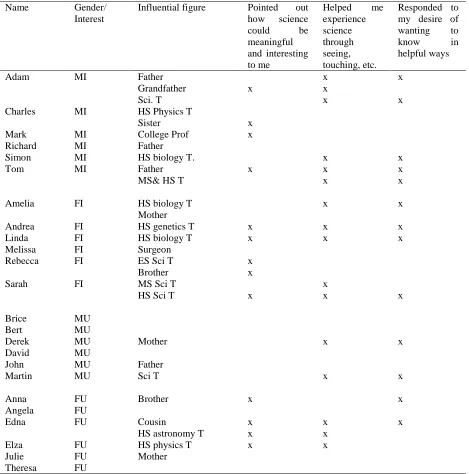
Table 1. How the influential figure mediated the relation between the student and science.
Name Gender/
Interest
Influential figure Pointed out
how science
could be
meaningful and interesting to me
Helped me
experience science through seeing, touching, etc.
Responded to my desire of
wanting to
know in
helpful ways
Adam MI Father x x
Grandfather x x
Sci. T x x
Charles MI HS Physics T
Sister x
Mark MI College Prof x
Richard MI Father
Simon MI HS biology T. x x
Tom MI Father x x x
MS& HS T x x
Amelia FI HS biology T x x
Mother
Andrea FI HS genetics T x x x
Linda FI HS biology T x x x
Melissa FI Surgeon
Rebecca FI ES Sci T x
Brother x
Sarah FI MS Sci T x
HS Sci T x x x
Brice MU
Bert MU
Derek MU Mother x x
David MU
John MU Father
Martin MU Sci T x x
Anna FU Brother x x
Angela FU
Edna FU Cousin x x x
HS astronomy T x x
Elza FU HS physics T x x
Julie FU Mother
Theresa FU
Note. MI = male interested; MU = male uninterested; FI = female interested; FU = female uninterested; HS = High School; MS = Middle School; ES = Elementary School; Sci = Science; T = Teacher(s); Prof = Professor(s).
Interviewer: Is there any person who has affected your interest in science? Mark: My psychology professor right now…He makes everything easier
to learn. He uses a lot of examples that apply to my daily life...He just talked about the effects of alcohol the other day. It just relates to me because my friends really like alcohol. It makes me think about it all the time.
Helping the student experience science through first-hand experience.Sixteen interest-raising influential figures were described by the students as having done something to help the student obtain first-hand experiences in science. Simon’s experience with his high school biology teacher provided an example.
Interviewer: Is there any person in you life who has affected your interest in science?
Simon: …my high school freshman biology teacher…We did dissections. She helped us to work with frogs and lab hearts...We measured openings of skulls. She gets you involved…
Helpfully responding to the student’s desire of wanting to know more.Thirteen interest-raising influential figures were mentioned as responding helpfully to the student’s desire of wanting to know more. Derek’s description of his mother provided an example.
Interviewer: Is there any person in your life who has affected your interest in science?
Derek: Probably my mom…just by taking me to places, like museums, science centers. I guess I go to her first to ask her. I probably know more science than she does, but I wouldn’t be afraid of asking her: “How does this work?” “How does that work?” “How does the radio work?” “Help me collect some leaves.” “Show me what poison ivy is.”
Later on during the interview…
Derek: Whatever book I wanted she would be willing to get for me. She would be willing to answer the questions. She would be patient with me. She stayed up late to watch whatever is on NOVA, Mr. Wizard.
No one mentioned in the four interest-lowering relationships any of these three positive aspects. Opposite to interest-raising relationships, two figures were described as “not providing help when the students needed it.”
Ten of the 27 interest-raising influential figures were felt by the students as “wanting the student to learn” due to the various ways they helped the students. Charles emphasized how his physics teacher wanted them to truly understand what they were learning, and be able to apply what they learned to their lives.
Interviewer: Can you tell me some of your major experiences with science? Charles: …My physics class in high school. I liked it. It was challenging. I
went to a Catholic school. An old priest was our teacher. He wanted you to learn from the course. It’s not only memorizing theories, but being able to apply them to things in your life, like how sound waves travel in the air so we hear things the way we do.
The sense of amazement or wonder was mentioned in episodes with five interest-raising influential figures. Edna’s feeling towards astronomy provided one example.
Interviewer: Can you tell me something that interests you a lot?
Edna: Astronomy.
Interviewer: Why is that interesting?
Edna: It’s just something that no matter how hard they are trying to rub their brains to find out what’s really going on, we just don’t know. We are always wondering… “Is there life on Mars.”…It’s just so mysterious…I had a really good astronomy teacher. I think that’s what really made me get into it…He was just like “You know, it’s just so interesting. There is so much stuff that we don’t know. The moon, the volcanoes, how do they get there, …” Just stuff like that. It was just really interesting.
Five students mentioned how the interest-raising influential figure challenged him or her to reach a higher standard, to figure out and to learn more. Richard’s interactions with his father provided an example. Richard described how his father’s questioning attitude affected his own thinking, so it developed toward being more like a scientist’s thinking.
Richard: I think another reason why I see my life as being so highly believing in science is because when I was a kid I used to say things that I heard, like “Dad, I heard that this and this happened.” My dad would say, “How do you know that happened for sure?” He would just ask me that question. I would say, “That’s what somebody said.” He would say, “How do you know if that person was true with you? How do you know what you read is true? You can’t believe everything you read or you hear or you see.”…I think because of him saying that to me, it more and more made me progress toward being a little bit more concise in stating the things I believe and the things I actually take to be true.
Once again, no one mentioned any positive aspects regarding emotions and motivations in the four interest-lowering relationships. The descriptions of two interest-lowering figures were strongly characterized by a lack of enthusiasm.
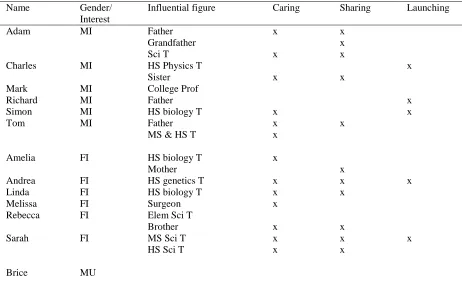
Personal aspects of interpersonal relationships between the influential figures and the students. The analysis revealed that many relationships between the interest-raising influential figure and the student had all or part of the following three qualities: (a) caring, (b) sharing, and (c) launching (Table 2). A caring relationship is a relationship in which the influential figure makes the student receive the message “This person cares about me. Therefore, I am important.” A sharing relationship is a relationship in which the influential figure and the student likes to do things together, and to reveal themselves to each other. A launching relationship is a relationship in which the student receives a message “This person sees my potential. Therefore, I can do better than I am doing.”
The quality of caring. Twenty of the total 27 episodes with interest-raising influential figures were identified as possessing the quality of a caring relationship. One student did describe his interest-lowering teachers as “not enthusiastic” and “boring,” but “cared and provided support when the students had questions.” The other three interest-lowering relationships lacked a caring quality. Linda’s description of her high school biology teacher offered an example of a caring relationship.
Linda: My freshman year in high school, I had biology…I had a great teacher…We had a lot of opportunities to have our questions answered. If we were confused, he would give reviews…If you had any questions, you could always ask him…He went out of his way to make sure we understand everything.
Interviewer: Went out of his way?
Linda: Like the review sessions. We had some for the final. We had reviews at 8:00 in the morning. I am sure he had better things to do that day.
The quality of sharing. Sixteen of the total 27 episodes with interest-raising influential figures possessed an element of sharing; none of the interest-lowering relationships possessed this quality. Some of the shared experiences were about science, while many others were about various aspects of their lives. Sarah talked about how the influential biology teacher shared certain experiences with her outside of biology, and how she knew that this teacher wanted to do fun things with the students.
Interviewer: Can you tell me a little bit more about your interaction with this teacher?
The quality of launching. In seven of the total 27 interest-raising relationships, the influential figure conveyed a message to the student about the potential of the student - a potential that pointed to a higher level, which the influential figure believed the student could reach, although the student had not reached that level yet. None of the interest-lowering relationships contained this component. Simon talked about how his high school biology teacher helped him see how he could be a better student, and out of that experience, he became a better student and more interested in science.
Interviewer: Can you come up with some adjectives to describe your high school biology teacher?
Simon: Challenging. She makes you work…She has high expectations. You will have to meet them. If you don’t meet them, switch out or fail.
Interviewer: Can you describe your relationship with her?
Simon: Interesting. I am one of those people who don’t like to do homework. She explained to me that I couldn’t do that and pass the class. She helped me to raise my conscience as a student…
Interviewer: Do you think your relationship with this teacher influenced your interest in science?
Simon: I think so. I was interested before. After her class, I learned a lot more about biology. I became a better student. I learned that I had to do certain homework to be able to be accomplished in any field, and that class definitely helped me be interested in science…
Table 2. Personal aspects of interest-raising relationships.
Name Gender/
Interest
Influential figure Caring Sharing Launching
Adam MI Father x x
Grandfather x
Sci T x x
Charles MI HS Physics T x
Sister x x
Mark MI College Prof
Richard MI Father x
Simon MI HS biology T x x
Tom MI Father x x
MS & HS T x
Amelia FI HS biology T x
Mother x
Andrea FI HS genetics T x x x
Linda FI HS biology T x x
Melissa FI Surgeon x
Rebecca FI Elem Sci T
Brother x x
Sarah FI MS Sci T x x x
HS Sci T x x
Bert MU
Derek MU Mother x x
David MU
John MU Father x x x
Martin MU Sci. T x
Anna FU Brother x x
Angela FU
Edna FU Cousin x x
HS astronomy T x
Elza FU HS physics T
Julie FU Mother x x x
Theresa FU
Note. MI = male interested; MU = male uninterested; FI = female interested; FU = female uninterested; HS = High School; MS = Middle School; ES = Elementary School; Sci = Science; T = Teacher(s).
Discussion
The findings of this study indicated that from many college students’ perspectives, influential figures affected the development of their interest in science. The findings also revealed characteristics associated with interest-raising and interest-lowering relationships. These characteristics of interest-raising relationships were fairly consistent with the characteristics of caring science teachers found by Sickle and Spector (1996) and the engaging pedagogy described by students (Darby, 2005), although Sickle and Spector’s and Darby’s studies did not directly address the effect of the caring and engaging science teachers on the development of their students’ interest in science.
Several previous studies found an association between interpersonal relationships and student interest in a related domain within a relatively short period of time. For example, Midgley and her colleagues found that when students moved from elementary teachers they perceived to be low in support to junior high teachers they perceived to be high in support, the intrinsic value of math was enhanced, while students who moved from teachers they perceived to be high in support to teachers they perceived to be low in support experienced a sharp decline in both the intrinsic value and perceived usefulness and importance of math (Midgley, Feldlaufer, & Eccles, 1989). Goodenow (1993) reported that early adolescent student-perceived teacher support explained over one third of students’ assessment of the interest, importance, and value of the academic work of that class. Basu and Calabrese Barton (2007) found that when the science learning environments were shaped by how students value relationships, youth developed a sustained interest in science. Patrick, Mantzicopoulos, Samarapungavan, and French (2008) found that kindergarten students’ motivation in science was positively related to children’s reports of qualities of their relationship with their teacher. The present study, taking a retrospective approach, further strengthened the assertion that from the students’ perspectives, interpersonal relationships could constitute an influential factor for the development of relatively long-term domain-specific interest in science.
engineering, and math (STEM) fields, and providing sufficient qualified science teachers for secondary school students. Findings from nationally representative data in the United States indicated that the African American-Caucasian science achievement gap, approximately -1.07 SD, did not change from Grade 3 to Grade 8, and the female-male gap, approximately -0.23 SD, only narrowed slightly by eighth grade (Quinn & Cooc, 2015). Less than 50% of the students who entered college with the aspiration to earn a Bachelor’s degree in STEM obtained the degree within six years, and the percentages were alarmingly low among Latino, African American, and Native American aspirants (Hurtado, 2015). The United States also faces the challenge of supplying sufficient qualified science teachers for secondary school students (Ingersoll & Perda, 2010; U.S. Department of Education Office of Postsecondary Education, 2013). Many factors are involved in these challenges; student interest in science is an important one among them. Teacher education programs for pre-service science teachers and professional development workshops for in-service science teachers and higher education science faculty should raise educators’ attention to the effects of teacher-student relationships on students’ interest in science and in becoming science teachers.
Given the assertion that positive interpersonal relationships facilitate the development of student interest in science, one observation in this study remained puzzling: many students who had some interest-raising experiences/relationships in science still identified themselves as being “uninterested in science.” Two issues related to this puzzle are worth a closer look. First, the dualistic conceptualization of people as being either interested or uninterested in science needs to be re-considered. This study started with such a dualistic conceptualization, which led to the design of the four groups (male interested, female interested, male uninterested, female uninterested) used in the study. Yet the findings of the study have revealed that interest in science is a much richer construct than what can be captured in this dualistic view. Many people who belonged to the uninterested group were actually quite interested in some areas of science in some contexts (Yang, 2010). In other words, even though one person belongs to the uninterested group in general, it does not necessarily mean that his or her interest in science is non-existent. As directly mentioned by some participants, their current existing interest, even though it might not be as strong or as broad as that of someone else who is strongly interested in science, comes as a result of early interest-raising experiences/relationships. Therefore, the fact that many people who had interest-raising relationships ended up in the uninterested group does not necessarily mean that these relationships were not important. Quite the opposite, without them, these people’s current interest could have been even lower than what was reported in the study (Yang, 2010).
The method by which the participants were recruited may be one limitation of this study. The participants were 24 college students taking certain psychology courses. They might have shared certain common interests; various reasons might also have affected their motivation to participate in this study. Some detailed characteristics of the participants (e.g., their motivation to take the psychology course, the science courses they had taken, their science GPA and self-efficacy in science) were not collected at the time of the study. Therefore, one cannot claim that the group recruited was an unbiased subgroup of the university student population. At the same time, it is important to point out that the intention of this study was not to recruit a large and representative sample of any population in order to establish generalizable findings for that population; it was to understand how interpersonal relationships might affect the development of some college students’ interest or lack of interest in science from their own perspective. The results of the study could be generalized to a theory through analytical generalization (Firestone, 1993). According to Firestone, “to generalize to a theory is to provide evidence that supports (but does not definitively prove) that theory” (Firestone, 1993, p. 17). Through analytical generalization, the findings of this study, taken together with findings related to the same issues obtained in other contexts, will contribute to the developing of a theory, identifying the scope of the theory, and establishing the generalizability of the theory. Through analytical generalization each reader of the article could also assess the findings’ applicability to his or her teaching situation and find their usefulness.
The reliance of this study only on retrospective self-reports of interest without triangulation by other measurements may be another limitation. Although it is reasonable to assume that a student could develop an interest in science because he or she had a good relationship with an influential person who was also interested in science, it is also possible that the student’s retrospective perception of the quality of the relationship was itself influenced by his or her experience of similarity with the “influential” person. In order to address this concern and further explore the effect of interpersonal relationships on the development of student interest in science, it is important to study the related phenomena in classrooms as they occur (Urdan & Schoenfelder, 2006; Urdan & Turner, 2005). Following this line of thinking, the following questions are proposed for future studies:
(1) In what ways are the interest-raising components mentioned in this study present in teacher-student relationships in science classrooms?
(2) When these interest-raising components are practiced by the science teachers as they interact with their students, is there an increase in their students’ interest in science? (3) It seems that not all students of a teacher with optimal interest-raising characteristics
would become strongly interested in science. What are the reasons to account for the individual differences in students’ response to the optimal interest-raising characteristics?
Acknowledgment
References
Ainley, M., Hidi, S., & Berndorff, D. (2002). Interest, learning, and the psychological processes that mediate their relationship. Journal of Educational Psychology, 94, 545-561.
Anderson, C. W. (1992). Teaching for functional scientific literacy. Unpublished manuscript, Michigan State University at East Lansing.
Baldwin, M. W. (1992). Relational schemas and the processing of social information. Psychological Bulletin, 112, 461-484.
Bandura, A. (1986). Social foundations of thought and action: A social cognitive theory. Englewood Cliffs, NJ: Prentice Hall.
Barmby, P., Kind, P. M., & Jones, K. (2008). Examining changing attitudes in secondary school science. International Journal of Science Education, 30, 1075-1093.
Basu, S. J., & Calabrese Barton, A. (2007). Developing a sustained interest in science among urban minority youth. Journal of Research in Science Teaching, 44, 466-489.
Black, A., & Deci, E. (2000). The effects of instructors’ autonomy support and students’ autonomous motivation on learning organic chemistry: A self-determination theory perspective. Science Education, 84, 740-756.
Bouchey, H. A., & Harter, S. (2005). Reflected appraisals, academic self-perceptions, and math/science performance during early adolescence. Journal of Educational Psychology, 97, 673-686.
Bowlby, J. (1973). Attachment and loss: Vol. 2. Separation: Anxiety and anger. New York, NY: Basic Books.
Bowlby, J. (1980). Attachment and loss: Vol. 3. Sadness and depression. New York, NY: Basic Books.
Brophy, J. (1999). Toward a model of the value aspects of motivation in education: Developing appreciation for particular learning domains and activities. Educational Psychologist, 34, 75-85.
Brophy, J. (2004). Motivating students to learn. Mahwah, NJ: Lawrence Erlbaum.
Csikszentmihalyi, M. (1988). Motivation and creativity: Toward a synthesis of structural and energistic approaches to cognition. New Ideas in Psychology, 6, 159-176.
Csikszentmihalyi, M. (1990). Literacy and intrinsic motivation. Daedalus, 119(2), 115-140. Dabney, K. P., Chakraverty, D., & Tai, R. H. (2013). The association of family influence and
initial interest in science. Science Education, 97, 395–409.
Darby, L. (2005). Science students’ perceptions of engaging pedagogy. Research in Science Education, 35, 425-445.
Deci, E. L. (1992). The relation of interest to the motivation of behavior: A self-determination theory perspective. In K. A. Renninger, S. Hidi, & A. Krapp (Eds.), The role of interest in learning and development (pp. 43-70). Hillsdale, NJ: Lawrence Erlbaum.
Deci, E. L., & Ryan, R. M. (1991). A motivational approach to self: Integration in personality. In R. Dienstbier (Ed.), Nebraska symposium on motivation: Vol. 38. Perspectives on motivation. Lincoln, NE: University of Nebraska Press.
Deci, E. L., & Ryan, R. M. (2000). The “what” and “why” of goal pursuits: Human needs and the self-determination of behavior. Psychological Inquiry, 11, 227-268.
Decker, D. M., Dona, D. P., & Christenson, S. L. (2007). Behaviorally at-risk African American students: The importance of student-teacher relationships for student outcomes. Journal of School Psychology, 45, 83-109.
Eccles-Parsons, J., Adler, T. F., & Kaczala, C. M. (1982). Socialization of achievement attitudes and beliefs: Parental influences. Child Development, 53, 310-321.
Elliot, A., Faler, J., McGregor, H., Campbell, W. K., Sedikides, C., & Harackiewicz, J. (2000). Competence valuation as a strategic intrinsic motivation process. Personality and Social Psychology Bulletin, 26, 780-794.
Ferry, T. R., Fouad, N. A., & Smith, P. L. (2000). The role of family context in a social cognitive model for career-related choice behavior: A math and science perspective. Journal of Vocational Behavior, 57, 348-364.
Firestone, W. A. (1993). Alternative arguments for generalizing from data as applied to qualitative research. Educational Researcher, 22(4), 16-23.
Fredricks, J. A., Blumenfeld, P. C., & Paris, A. H. (2004). School engagement: Potential of the concept, state of the evidence. Review of Educational Research, 74, 59-109.
Furrer, C., & Skinner, E. (2003). Sense of relatedness as a factor in children’s academic engagement and performance. Journal of Educational Psychology, 95, 148-162.
Glaser, B. G., & Strauss, A. L. (1967). The discovery of grounded theory: Strategies for qualitative research. Chicago, IL: Aldine.
Goodenow, C. (1993). Classroom belonging among early adolescent students: Relationships to motivation and achievement. Journal of Early Adolescence, 13, 21-43.
Guay, F., Boggiano, A., & Vallerand, R. (2001). Autonomy support, intrinsic motivation, and perceived competence: Conceptual and empirical linkages. Personality and Social Psychology Bulletin, 27, 643-650.
Hamre, B. K., & Pianta, R. C. (2001). Early teacher-child relationships and the trajectory of children’s school outcomes through eighth grade. Child Development, 72, 625-638. Harackiewicz, J. M., Abrahams, S., & Wageman, R. (1987). Performance evaluation and
intrinsic motivation: The effects of evaluative focus, rewards, and achievement orientation. Journal of Personality and Social Psychology, 53, 1015-1023.
Harter, S. (1996). Teacher and classmate influences on scholastic motivation, self-esteem, and level of voice in adolescents. In J. Juvonen & K. Wentzel (Eds.), Social motivation: Understanding children’s school adjustment (pp. 11-42). New York, NY: Cambridge University Press.
Hidi, S. (2006). Interest: A unique motivational variable. Educational Research Review, 1, 69-82.
Hidi, S., & Harackiewicz, J. M. (2000). Motivating the academically unmotivated: A critical issue for the 21st century. Review of Educational Research, 70, 151-179.
Hidi, S., Renninger, K. A., & Krapp, A. (2004). Interest, a motivational variable that combines affective and cognitive functioning. In D. Y. Dai & R. J. Sternberg (Eds.), Motivation, emotion, and cognition: Integrative perspectives on intellectual functioning and development (pp. 89-115). Mahwah, NJ: Lawrence Erlbaum.
Hurtado, S. (2015). STEM undergraduate education: Increasing diversity & productivity [PowerPoint slides]. Retrieved from http://www.heri.ucla.edu/nih/?c=presentations Ingersoll, R. M., & Perda, D. (2010). Is the supply of mathematics and science teachers
Jacobs, J. E., & Bleeker, M. M. (2004). Girls’ and boys’ developing interests in math and science: Do parents matter? New Directions for Child and Adolescent Development, 2004 (106), 5-21.
Johnson, D. W., & Johnson, R. T. (2009). An educational psychology success story: Social interdependence theory and cooperative learning. Educational Researcher, 38(5), 365– 379.
Krapp, A., & Prenzel, M. (2011). Research on interest in science: Theories, methods, and findings. International Journal of Science Education, 33, 27-50.
Lapointe, J. M., Legault, F., & Batiste, S. J. (2005). Teacher interpersonal behavior and adolescents’ motivation in mathematics: A comparison of learning disabled, average, and talented students. International Journal of Educational Research, 43, 39-54.
Lepper, M., & Hodell, M. (1989). Intrinsic motivation in the classroom. In C. Ames & R. Ames (Eds.), Research on motivation in education: Vol. 3. Goals and cognitions (pp. 73-105). San Diego, CA: Academic Press.
Maehr, M. L. (1991). The “psychological environment” of the school: A focus for school leadership. In P. Thurstone & P. Zodhiates (Eds.), Advances in educational administration Vol. 2 (pp. 51-81). Greenwich, CT: JAI Press.
Midgley, C., Feldlaufer, H., & Eccles, J. S. (1989). Student/Teacher relations and attitudes toward mathematics before and after the transition to junior high school. Child Development, 60, 981-992.
Murray, C., & Greenberg, M. T. (2000). Children’s relationships with teachers and bonds with school: An investigation of patterns and correlates in middle childhood. Journal of School Psychology, 38, 423-445.
Ogilvie, D. M., & Ashmore, R. D. (1991). Self-with-other representation as a unit of analysis in self-concept research. In R. C. Curtis (Ed.), The relational self (pp. 282-314). New York, NY: Guilford Press.
Palmer, D. H. (2009). Student interest generated during an inquiry skills lesson. Journal of Research in Science Teaching, 45, 1-9.
Patrick, H., Mantzicopoulos, P., Samarapungavan, A., & French, B. F. (2008). Patterns of young children’s motivation for science and teacher-child relationships. The Journal of Experimental Education, 76, 121-144.
Quinn, D. M., & Cooc, N. (2015). Science achievement gaps by gender and race/ethnicity in elementary and middle school: Trends and predictors. Educational Researcher, 44(6), 336-346.
Renninger, K. A., & Su, S. (2012). Interest and its development. In R. M. Ryan (Ed.) The Oxford handbook of human motivation (pp. 167-187). New York, NY: Oxford University Press. Riese, H., Samara, A., & Lillejord, S. (2012). Peer relations in peer learning. International
Journal of Qualitative Studies in Education, 25, 601-624.
Ryan, R. M., & Deci, E. L. (2000). Self-determination theory and the facilitation of intrinsic motivation, social development, and well-being. American Psychologist, 55, 68-78. Ryan, A. M., & Patrick, H. (2001). The classroom social environment and changes in
adolescents’ motivation and engagement during middle school. American Educational Research Journal, 38, 437-460.
Interpersonal Relationships and the Development of Student Interest in Science 38
Ryan, R. M., & Stiller, J. (1991). The social contexts of internalization: Parent and teacher influences on autonomy, motivation and learning. In P. R. Pintrich & M. L. Maehr (Eds.), Advances in motivation and achievement: Vol. 7. Goals and self-regulatory processes (pp. 115-149). Greenwich, CT: JAI Press.
Ryan, R. M., Stiller, J. D., & Lynch, J. H. (1994). Representations of relationships to teachers, parents, and friends as predictors of academic motivation and self-esteem. Journal of Early Adolescence, 14, 226-249.
Sarason, I. G., Sarason, B. R., & Pierce, G. R. (1995). Social and personal relationships: Current issues, future directions. Journal of Social and Personal Relationships, 12, 613-619. Seymour, E. (1992). "The problem iceberg" in science, mathematics, and engineering education:
Student explanations for high attrition rates. Journal of College Science Teaching, 21, 230-38.
Seymour, E. (1995). The loss of women from science, mathematics, and engineering undergraduate majors: An explanatory account. Science Education, 79, 437-73.
Seymour, E., & Hewitt, N. M. (1997). Talking about leaving: Why undergraduates leave the sciences. Boulder, CO: Westview Press.
Sickle, M. V., & Spector, B. (1996). Caring relationships in science classrooms: A symbolic interaction study. Journal of Research in Science Teaching, 33, 433-453.
Swarat, S. (2008). What makes a topic interesting? A conceptual and methodological exploration of the underlying dimensions of topic interest. Electronic Journal of Science Education, 12(2), 1-26.
Tobias, S. (1990). They’re not dumb, they’re different. Tucson, AZ: Research Corporation. Urdan, T., & Schoenfelder, E. (2006). Classroom effects on student motivation: Goal structures,
social relationships, and competence beliefs. Journal of School Psychology, 44, 331-349. Urdan, T., & Turner, J. C. (2005). Competence motivation in the classroom. In A. J. Elliot & C.
S. Dweck (Eds.), Handbook of competence motivation. New York, NY: Guilford.
U.S. Department of Education Office of Post Secondary Education. (2013). Preparing and credentialing the nation’s teachers: The secretary’s ninth report on teacher quality. Retrieved from https://title2.ed.gov/TitleIIReport13.pdf
Wentzel, K. R. (1997). Student motivation in middle school: The role of perceived pedagogical caring. Journal of Educational Psychology, 89, 411-419.
Wentzel, K. R., Barry, C. M., & Caldwell, K. A. (2004). Friendships in middle school: Influences on motivation and school adjustment. Journal of Educational Psychology, 96, 195-203.