Implementation of School-Based Reading Program
In The Division Of Lucena City
Marilyn A. Merto
Department of Education, Philippines
Abstract: This study aimed to examine the implementation of the school-based reading program in the Division of Lucena City. Specifically, it determined the performance of the grades 2 to 6 pupils in Phil-IRI, the extent of implementation of the school-based reading program, the difference in the assessment between the two groups of respondents, and the extent of stakeholder’s engagement in the program with an end view of proposing a Technical Assistance for SBRP. The descriptive method of research was utilized in this study where a research-made questionnaire was the main data gathering instrument complemented by interviews and focus group discussion. Respondents were 301 elementary school teachers and 43 school heads. Weighted mean, and t – test was utilized as statistical tools to treat the gathered data. Results revealed that the grade 2 to 6 pupils’ performance in Phil IRI from the school year 2016 to 2018 in the Division of Lucena City is generally categorized as frustration. The school-based reading program in the Division of Lucena City is moderately implemented. The school heads and the teachers have relatively the same assessment of the SBRP. The stakeholders moderately engage in the implementation of the SBRP. The proposed technical assistance for SBRP containing prioritized needs, gaps, alternative strategies, specific tasks and activities, time frame, and the resources was the output of this study. Based on the findings and conclusions drawn from the collected data, the researcher recommended that the Technical Assistance for SBRP be endorsed to the superintendent for initial implementation. Further and continued improvement on the aims of the program, teaching techniques, learning assessment strategies, intervention tasks, and monitoring and evaluation processes could be reinforced for the sustained implementation of school-based reading program. Engagement of the stakeholders could be further strengthened through constantly involving them in the implementation. Follow-up and similar studies may be conducted to explore other aspects of the implementation of school-based reading program.
Keywords: Philippine Informal reading Inventory, reading performance, school-based reading program, technical assistance,
1.
INTRODUCTION
Literacy refers to the ability to identify, understand, interpret, create, compute, and communicate using visual, audible, and digital materials across disciplines and in any context. Aligned with literacy is the ability to read, write, and communicate and interact with other people for purpose of knowing something worth remembering. The issue about literacy is not a nationwide but a global concern. 7165 states that it is the policy of the State to give highest priority to the adoption of measures for the total eradication of illiteracy. The advent of this act serves as a potent tool to totally eradicate the unprecedented increase of illiteracy which is truly alarming. This could be possibly happened if reading literacy would be properly addressed. In the Philippines, the ability to read and write is given utmost importance and priority. The Department of Education initiated and funded several programs and activities that cater the needs and demands of the 21st century diverse learners. The importance of reading literacy is truly commendable. It is worth to note that through literacy one is empowered to interact in a community and visualizes one’s worth as individual who can contribute in sustainable development of the society. To harness learners reading ability, posted a great challenge to all teachers being the classroom manager and facilitator of learning. Massive reading innovations need to implement wholeheartedly to uphold quality reading education that sustain the diverse learners’ needs and demands specially the struggling readers. It is important for the teachers to pursue their initiative in teaching reading. They should never give up on guiding and inspiring children in achieving literacy. Encouraging the learners to embrace reading during their formative years would be of great help for them to improve their reading performance level. It helps to uplift from the cavern of ignorance. In order to uplift one’s individual from the cavern of ignorance, s/he needs to embrace the dynamics of reading. It is important to encourage the learners to embrace reading as one of their
DepEd’s policy “No read, no move”, it is therefore the
primary concern of every teacher especially in primary grades to make their pupils learn to read. Moreover, reading comprehension truly plays a vital role in teaching reading. It is simply because without comprehension, a child though he or she can read still s/he is considered a struggling reader in the absence of comprehension. To maintain yet to visualize reading comprehension, it is necessary for teachers to emphasize certain comprehension strategies, to wit; recognizing story structure, monitoring comprehension, connecting to world knowledge, predicting, asking and answering questions, constructing mental images and summarizing. These truly serve as an avenue. In line with this, teachers need to ensure reading assessment to cater the needs and demands of the learners specifically the struggling readers who need continuous reading remediation in order for them to become fluent reader anchored with accuracy, automaticity and prosody. Despite several flagship programs and reading intervention and innovative reading strategies being implemented still the result of PHIL-IRI, frustration level is still prevalent. The alarming reading status of pupils necessitates intensive reading innovation that would help them to improve their reading abilities. Technical assistance and close monitoring by the school heads, education program supervisor, and other education experts is deemed necessary to fortify the reading program. Through the technical assistance, the schools are lobbied towards achieving its reading program set goals for continuous improvement, which is their foremost responsibility and accountability as a field organization (DO/School) of Department of Education. In delivering the technical assistance for reading program, one must consider and respect the capacity and pace of the school. Technical assistance ensures that the atmosphere or environment encourages the school not only to set their goals but also to determine the process of achieving them. The technical assistance encourages the schools to see everything as a learning process. Thus, in this atmosphere, the school heads and other personnel can express themselves freely, explore new ideas and even admit and correct mistakes in their pursuit of achieving their goals for reading program. The key to effective technical assistance is to help themselves and not on solving problems for them. Furthermore, if it is possible, there is a need to hire reading teacher whose concentration is just in reading to focus on improving reading itself. The advent of regional guidelines on comprehensive reading policies serves as a springboard to intensify reading program for the development of the learners being the center of the educative process. All teachers are encouraged to attend the seminar-training workshop relative to reading in order to keep abreast of the current trends in teaching reading. This activity serves as an avenue to confront issues and concern relative to reading. It also serves as an instrument to uphold the program and bridge the gap in literacy particularly in reading. Despite the effort and initiative of the regional office to help increase the reading performance of the schools within its jurisdiction, still reading outcome is a failure based on NAT result. In addition, the low performance of the Division of Lucena City in the National Achievement Test (NAT) and periodical test which is far behind national standard of 75% signifies that there is something wrong when it comes to the pupils’ reading performance due to poor comprehension. It is really hard on the part of the learners to find the correct
how to improve the reading program, consequently,
enhancing the pupils’ reading proficiency.
2.
LITERATURE REVIEW
The Philippine Informal Inventory Manual 2018 states that Phil-IRI is an informal reading inventory composed of graded passages designed to determine the individual student’s performance in oral reading, silent reading, and listening comprehension. These three types of assessment aim to find the student’s independent, instructional and frustration levels. The data from this measure could be used to design or adjust classroom, small group or individualized instruction to fit the students’ needs and abilities. [2] Philippine Informal Reading Inventory is conducted in July for pre-test where the results are utilized as basis for intervention activities while the post-test is done in January of the same school year. Target of intervention is to make the learners independent readers. Making every child a competent reader and a functional learner is the goal of every reading program. To become a competent reader, one should be able to construct meaning from print using appropriate active strategies to relate what he reads with background knowledge and experience. Evidenced-based researches and continuous improvement projects greatly suggest that the main driver to improve the student outcomes is to develop and implement effective school reading program. The experiences shared by these projects are three things that matter most: getting the right people to become reading teachers; developing them into effective reading teachers; and ensuring that system is available to deliver the best possible reading instruction for the child[3] (DepEd-CALABARZON Regional Guidelines on Comprehensive Reading Policies, 2018). In the current study, the implementation of the school-based reading program is viewed as to objectives, instructional strategies, assessment techniques, intervention activities, and monitoring and evaluation. Moreover, according to Cristobal (2015), reading program development follows procedure to make it more effective. This starts writing situation statement which is the definition of the issue. Its center is seeking to build community awareness to support for. Next step is to write the objectives by engaging the community. It answers about the purpose of the program development to be made, and what there is a need to make a program development. Third step is to find audience which is very important because audiences do the decision and they are the information consumers.[4] To establish literacy as a value in every family, the school should help every family understand that the home is the child’s first school, that the parent is the child’s first teacher, and that reading is the child’s first subject (Stone, 2009). [5] The evidence about the benefits of parents being involved in their children’s education in general, and their children’s literacy activities, is overwhelming. Research shows that parental involvement in their children’s learning positively affects the child’s performance at school in both primary and secondary schools, leading to higher academic achievement, greater cognitive competence, greater problem-solving skills, greater school enjoyment, better school attendance and fewer behavioral problems at school. Furthermore, Mogol (2005) stated that schools in the Philippines maintain strong relationship with the community and with other community workers. [6] They are looked upon by the community to lead in most of its social activities. As
community leaders, the teachers are fully sympathetic of the philosophy and practices of the community. As an institution of learning, schools maintain their positive image to the people in the community. In its capacity to lead members of the community, the school build satisfying and strong partnership with the community people to gain mutual respect and support from one another. The quality of programming depends largely on a trained, well-supported staff. To bridge the gap between evidence and practice, it is often necessary to provide training and technical assistance that build staff competencies in program content and implementation. Many are using TA strategies to improve the quality of programs. The technical assistance program consists of the analyses, decisions and actions and organization undertakes to create and sustain the competitive advantages (Dess, Lumpkin & Eisnerr, 2010).[7] Typically, TA is provided by program developers or intermediary organizations. In addition, according to Miclat (2005), the idea of the technical assistance program in the country had from the beginning carried a nationalistic fervor which linked it integrally with the aspirations for social, economic and political reforms. [8] In this perspective, the technical assistance program was more than a management tool and technology. It was viewed as an instrument for improving the quality of life of the people. Further, it was made as rallying point or the country in the building of a social framework in which the broader societal goals could be holistically planned, aggressively implemented, and progressively attained. A broader view of socioeconomic development planning had continued to provide the rationale in formulation and development of medium-and long-term plan.
3.
RESEARCH OBJECTIVES
This study intended to assess the implementation of school-based reading program in the Division of Lucena City. Specifically, it sought answers to the following questions: 1. How may the performance of grades 2 to 6 pupils in
Phil-IRI be described in terms of: 1.1. independent;
1.2. instructional; and 1.3. frustration?
2. What is the extent of implementation of the school-based reading program in terms of:
2.1. objectives;
2.2. instructional strategies; 2.3. assessment techniques; 2.4. intervention activities; and 2.5. monitoring and evaluation?
3. How do the two groups of respondents’ assessments differ? Are the differences significant?
4. What is the extent of stakeholder’s engagement in the program?
5. What technical assistance for SBRP may be proposed?
4.
METHODOLOGY
technical assistance program for the school-based reading
program. To substantiate the data that were gathered from the questionnaire, unstructured interview and focus group discussion were conducted. Interview schedule and focus group discussion were developed for the purpose of eliciting more information that enriched the analyses of the responses in the questionnaire. There were two groups of respondents in the study: the public elementary school teachers and the school heads in four districts in the Division of Lucena City namely Lucena North District, Lucena East District, Lucena West District and Lucena South District. Respondents of the study were 301 teachers and 43 school heads. No sampling was done for the group of school heads since there are only 43 school heads in the division. The 301 number of teachers in the sample was determined from a population of 1211 teachers using Slovin’s formula at .05 margin of error. Further, the teacher members of each sub-sample were selected through simple random sampling.
5.
RESULTS AND DISCUSSIONS
Based from the data gathered, the following findings were obtained:
1. Performance of Grades 2-6 Pupils in Phil-IRI. The performance of grades 2 to 6 pupils in Phil-IRI is described based on the baseline data which is the pretest. The Phil-IRI reading level is classified in terms of independent, instructional, and frustration level. Non-readers, however, are also included in the tabular presentation. There is a dominant number of readers under the frustration level for the school year 2015 to 2016 with a total of 16222. Independent level has the least number of readers with 2952. For the school year 2016 to 2017, the dominant number of readers is under the frustration level with a total of 15798. The least number falls under the instructional
level with 2965.The dominant number of readers under the frustration level for the school year 2017 to 2018 with a total of 17249. The least is under the independent level with a total of 2296 readers.
2. Assessment on the Extent of Implementation of the School-Based Reading Program. One of the thrusts of Philippine basic education is to enable every Filipino child to communicate proficiently both in English and Filipino through effective reading instruction. Hence, to ensure its effectiveness, assessment of school-based reading program must be done. The extent of implementation of the school-based reading program was assessed as to its objectives, instructional strategies, assessment techniques, intervention activities, and program monitoring and evaluation.
2.1 Objectives. Clear, concrete and specific objectives set forth will be a great driving force to achieve the desired outcomes. These are very essential to guide the school-based reading program in its proper direction and achievement of short and long-term targets. The extent of implementation of the School-Based Reading Program was of moderate extent. For the school heads, the objectives were implemented to a moderate extent with a composite mean of 3.31. The most favored was to develop reading habits among pupils with a mean of 3.40 described as implemented to a moderate extent. Least favored was an objective pertaining to establishing collaboration among stakeholders rated with 3.16 mean and of moderate extent. For the teachers, the objectives obtained with a composite mean of 3.30. Developing the literacy skills of pupils with 3.44 mean and moderate extent is the most favored while the least is establishing a collaboration among stakeholders rated with 3.0 mean and of moderate extent.
Table : School-Based Reading Program in Terms of Objectives
Items School Heads Teachers
WM VI R WM VI R
1. Develop love for reading among pupils 3.39 ME 2.5 3.40 ME 3
2. Develop the literacy skills of pupils 3.36 ME 4 3.44 ME 1
3. Develop pupils reading competencies appropriate for their grade level 3.34 ME 5 3.33 ME 5.5
4. Improve pupils reading speed and comprehension 3.33 ME 6 3.28 ME 7
5. Motivate the pupils through reading which lead to their increased scholastic
performance 3.39 ME 2.5 3.33 ME 5.5
6. Develop reading habits among pupils 3.40 ME 1 3.40 ME 3
7. Capacitate teachers with different reading strategies 3.30 ME 7 3.40 ME 3
8. Establish a sustainable school-based reading professional development for
teachers 3.25 ME 10 3.26 ME 8
9. Develop effective reading teachers 3.27 ME 8 3.23 ME 9
10. Enhance balanced reading program 3.26 ME 9 3.21 ME 10
11. Establish collaboration among stakeholders 3.16 ME 11 3.0 ME 11
COMPOSITE MEAN 3.31 ME 3.30 ME
Legend: ME-Moderate Extent (2.5-3.49)
2.2 Instructional Strategies. Strategies in the teaching of reading particularly those which have been found effective under normal conditions be adopted. Creative and innovative ones may also be tried out and adopted and classes be supervised and monitored more closely. The implementation of school-based reading program instructional strategies is of moderate extent. For school heads, instructional strategies are of moderate extent with a composite mean of 3.21. The most favored instructional strategy is integrating reading within and across curriculum
Table 2: School-Based Reading Program in Terms of Instructional Strategies
Items School Heads Teachers
WM VI R WM VI R
1. Providing training for teachers on content and pedagogy for reading 3.23 ME 6 3.40 ME 1 2. Providing differentiated instruction to different types of readers. 3.26 ME 2.5 3.30 ME 5.5
3. Providing different materials for diverse learners 3.21 ME 11 3.12 ME 13.5
4. Designing appropriate reading lessons to meet readers’ needs 3.22 ME 8.5 3.21 ME 10
5. Considering pacing for mastery of the lesson 3.18 ME 12 3.12 ME 13.5
6. Utilizing picture clues to aid pupils in reading 3.22 ME 8.5 3.35 ME 2
7. Utilizing illustrations in word recognition 3.26 ME 2.5 3.33 ME 3.5
8. Using ICT-based instruction in teaching reading 3.16 ME 13 3.30 ME 5.5
9. Providing explicit instruction on critical reading priorities 3.22 ME 8.5 3.28 ME 7 10. Providing vocabulary garden to enhance learners’ vocabulary skills. 3.12 ME 15 2.88 ME 15
11. Using peer-assisted instruction. 3.22 ME 8.5 3.16 ME 11
12. Developing materials for different reading activities 3.25 ME 4.5 3.23 ME 8.5 13. Integrating reading within and across curriculum teaching areas 3.29 ME 1 3.33 ME 3.5
14. Facilitating read-aloud strategies 3.25 ME 4.5 3.23 ME 8.5
15. Engaging learners to Directed Reading Thinking Activities. 3.14 ME 14 3.14 ME 12
COMPOSITE MEAN 3.21 ME 3.22 ME
Legend: ME-Moderate Extent (2.5-3.49)12
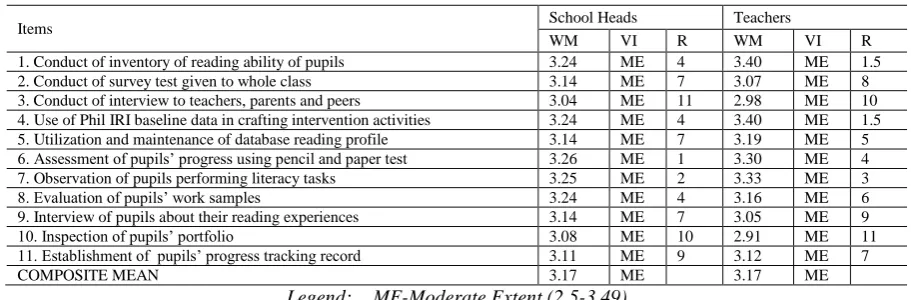
2.3 Assessment techniques. Assessment is an integral part of program implementation. This determines if the goals of the program are met. Sound assessment data is crucial for determining any program effectiveness to further allow the planners and decision-makers to evaluate why outcomes do or do not occur and plan for enhancement. Table 7 discloses the extent of implementation of the school-based reading program in terms of assessment techniques. The implementation of school-based reading program assessment techniques is of moderate extent. The school heads rated the school-based reading program assessment techniques of moderate extent with a composite mean of
3.17. The most favored was assessment of pupils’ progress using pencil and paper test with a mean of 3.26 described as implemented to a moderate extent. Least favored was an assessment technique pertaining to conducting interview to teachers, parents and peers with 3.04 mean and of moderate extent. For the teachers, the assessment techniques garner a composite mean of 3.17. The most favored was conducting inventory of reading ability of pupils and use of Phil IRI baseline data in crafting intervention activities with a mean of 3.40 and implemented to a moderate extent. Least favored was inspection of pupils’ portfolio rated with 2.91 mean and implemented to a moderate extent.
Table 3: School-Based Reading Program in Terms of Assessment Techniques
Items School Heads Teachers
WM VI R WM VI R
1. Conduct of inventory of reading ability of pupils 3.24 ME 4 3.40 ME 1.5
2. Conduct of survey test given to whole class 3.14 ME 7 3.07 ME 8
3. Conduct of interview to teachers, parents and peers 3.04 ME 11 2.98 ME 10
4. Use of Phil IRI baseline data in crafting intervention activities 3.24 ME 4 3.40 ME 1.5 5. Utilization and maintenance of database reading profile 3.14 ME 7 3.19 ME 5 6. Assessment of pupils’ progress using pencil and paper test 3.26 ME 1 3.30 ME 4
7. Observation of pupils performing literacy tasks 3.25 ME 2 3.33 ME 3
8. Evaluation of pupils’ work samples 3.24 ME 4 3.16 ME 6
9. Interview of pupils about their reading experiences 3.14 ME 7 3.05 ME 9
10. Inspection of pupils’ portfolio 3.08 ME 10 2.91 ME 11
11. Establishment of pupils’ progress tracking record 3.11 ME 9 3.12 ME 7
COMPOSITE MEAN 3.17 ME 3.17 ME
Legend: ME-Moderate Extent (2.5-3.49)
2.4. Intervention activities. The implementation of school-based reading program intervention activities is of moderate extent. The school heads perceived school-based reading program intervention activities of moderate extent with a composite mean of 3.12. The most favored were conducting EVA (Everyday Reading Activity), as well as building phonemic awareness activities into instruction in letter and sounds rated with a mean of 3.22 and implemented to a moderate extent. The least favored was conducting “Pick Me Up” Activity rated with 2.94 mean and implemented to a moderate extent. For the teachers, the intervention activities obtained a composite mean of 3.10 and
Table 4: School-Based Reading Program in Terms of Intervention Activities
Items School Heads Teachers
WM VI R WM VI R
1. Conduct “Pick Me Up” Activity 2.94 ME 13 2.79 ME 13
2. Conduct “Read Aloud and Ask” Activity 3.20 ME 3 3.19 ME 5.5
3. Conduct EVA (Everyday Reading Activity) 3.22 ME 1.5 3.30 ME 2
4. Conduct “Discover A New Word Through Reading Activity.” 3.10 ME 9 3.05 ME 8 5. Build activities that capitalized on children’s natural curiosity and sense of
playfulness 3.09 ME 10 2.95 ME 11
6. Include language activities that develop listening and expressive skills 3.13 ME 7 3.09 ME 7
7. Involve parents in the remediation teaching 3.11 ME 8 2.91 ME 12
8. Build phonemic awareness activities into instruction in letter and sounds 3.22 ME 1.5 3.37 ME 1 9. Stimulate the pupils’ interest in reading through creative story telling. 3.18 ME 4 3.28 ME 3
10. Provide materials for different types of readers 3.17 ME 5 3.21 ME 4
11. Tap stakeholders to support the program 3.08 ME 11 3.0 ME 10
12. Use tutoring or small group instruction for children who require additional
instructional support 3.16 ME 6 3.19 ME 5.5
13. Provide merit system to those parents who are advocates of reading 2.99 ME 12 3.02 ME 9
COMPOSITE MEAN 3.12 ME 3.10 ME
Legend: ME-Moderate Extent (2.5-3.49)
2.5 Monitoring and Evaluation. The implementation of the school-based reading program monitoring and evaluation is of moderate extent. For the school heads, the school-based reading program monitoring and evaluation was of moderate extent with a composite mean of 3.14. The most favoured was identifying the actual status of the reading program with a mean of 3.23 described as implemented to a moderate extent. Least favoured was identifying gaps on program implementation rated with 3.08 mean and described as
implemented to a moderate extent. For the teachers, the school-based reading program monitoring and evaluation gained 3.12 composite mean and implemented to a moderate extent. The most favoured was identifying the actual status of the reading program with a mean of 3.28 and implemented to a moderate extent. Least favoured was reviewing the plan of activities regularly rated with a mean of 2.95 and implemented to a moderate extent.
Table 5: School-Based Reading Program in Terms of Program Monitoring and Evaluation
Items School Heads Teachers
WM VI R WM VI R
1. Identify the actual status of the reading program 3.23 ME 1 3.28 ME 1
2. Determine if the activities are implemented as scheduled 3.17 ME 3 3.21 ME 2.5 3. Monitor the program progress from the start up to completion 3.21 ME 2 3.19 ME 4.5
4. Report analysis relative to evaluation report 3.13 ME 5 3.21 ME 2.5
5. Orient teachers after reading session 3.11 ME 9 3.14 ME 6
6. Identify the risks relative to program implementation 3.12 ME 7 3.07 ME 8
7. Identify plans for the continuous improvement of the program 3.14 ME 4 3.19 ME 4.5 8. Discuss the progress of the reading program among teachers and stakeholders 3.12 ME 7 3.09 ME 7
9. Review the plan of activities regularly 3.10 ME 10 2.95 ME 11
10. Provide periodic and timely feedback on the conduct of intervention activities 3.12 ME 7 3.0 ME 10
11. Identify the gaps on program implementation 3.08 ME 11 3.05 ME 9
COMPOSITE MEAN 3.14 ME 3.12 ME
Legend: ME-Moderate Extent (2.5-3.49)
3. Significant difference between the school heads’ and the teachers’ assessment on the extent of implementation of the school-based reading program. There is no significant difference between the assessment of school heads and teachers on the extent of implementation of program objectives since the t-value is 0.153 with a p-value of 0.88 which is greater than 0.05. The same is true for
instructional strategies where the t-value is -0.104 with a pvalue of 0.92; assessment technique where the tpvalue is -0.86 with a p-value of 0.93; intervention activities where the t-value is 0.174 with p-value of 0.86; and program monitoring and evaluation where the t-value is 0.12 with a p-value of 0.91, thus the null hypothesis is accepted.
Table 6: Differences in the Assessment on the Extent of Implementation of School-Based Reading Program
Variables p-values Computed t-values Decision on Ho Verbal Interpretation
Objectives .88 0.153 Failed to Reject Not Significant
Instructional strategies .92 -0.104 Failed to Reject Not Significant
Assessment techniques .93 -0.086 Failed to Reject Not Significant
Intervention activities .86 0.174 Failed to Reject Not Significant
4. Assessment on the Extent of Stakeholders’ Engagement
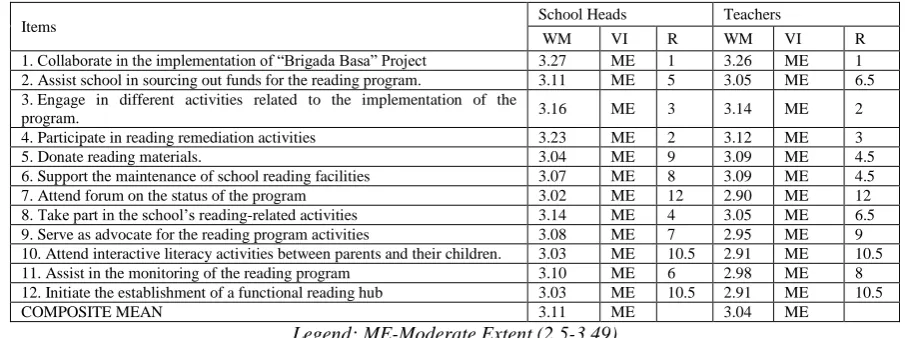
in the School Based Reading sa Program. The stakeholders’ engagement in School Based Reading Program was described of moderate extent. For the school heads, the stakeholders’ engagement was of moderate extent
with a composite mean of 3.11. The most favored was collaborating in the implementation of “Brigada Basa” Project with a mean of 3.27 and implemented to a moderate extent. Least favored was attending forum on the status of
the program with a mean of 3.02 and implemented to a moderate extent. For the teachers, the stakeholders’ engagement was of moderate extent with 3.04 composite mean. The most favored was collaborating in the implementation of “Brigada Basa” Project with a mean of 3.26 and was implemented to a moderate extent. Least favored was attending forum on the status of the program rated with a mean of 2.90 and implemented to a moderate extent.
Table 7: Extent of Stakeholders’ Engagement in the Program
Items School Heads Teachers
WM VI R WM VI R
1. Collaborate in the implementation of “Brigada Basa” Project 3.27 ME 1 3.26 ME 1 2. Assist school in sourcing out funds for the reading program. 3.11 ME 5 3.05 ME 6.5 3. Engage in different activities related to the implementation of the
program. 3.16 ME 3 3.14 ME 2
4. Participate in reading remediation activities 3.23 ME 2 3.12 ME 3
5. Donate reading materials. 3.04 ME 9 3.09 ME 4.5
6. Support the maintenance of school reading facilities 3.07 ME 8 3.09 ME 4.5
7. Attend forum on the status of the program 3.02 ME 12 2.90 ME 12
8. Take part in the school’s reading-related activities 3.14 ME 4 3.05 ME 6.5
9. Serve as advocate for the reading program activities 3.08 ME 7 2.95 ME 9
10. Attend interactive literacy activities between parents and their children. 3.03 ME 10.5 2.91 ME 10.5
11. Assist in the monitoring of the reading program 3.10 ME 6 2.98 ME 8
12. Initiate the establishment of a functional reading hub 3.03 ME 10.5 2.91 ME 10.5
COMPOSITE MEAN 3.11 ME 3.04 ME
Legend: ME-Moderate Extent (2.5-3.49)
5.Technical Assistance for School-Based Reading Program Implementation. Technical assistance program is based from the findings of the study. It presents the prioritized needs, the gaps/problems/weaknesses, alternative strategies, specific tasks and activities, time frame, as well as resources (persons responsible, materials, and budget). In the context of this TA program, the following areas and provisions are addressed: instructional strategies; assessment techniques; intervention activities; monitoring and evaluation; and stakeholders’ engagement in the program.
CONCLUSIONS
AND
RECOMMENDATIONS
The grade 2 to 6 pupils’ performance from the school year 2016 to 2018 in the Division of Lucena City is generally categorized to be in frustration level. The school-based reading program in the Division of Lucena City is moderately implemented. The school heads and the teachers have the same assessment of the school-based reading program. The stakeholders were not engaged in the implementation of the school-based reading program. The proposed technical assistance for school-based reading program containing prioritized needs, gaps, alternative strategies, specific tasks and activities, time frame, and resources was the output of this study. The proposed Technical Assistance for school-based reading program could be endorsed to the superintendent for initial implementation. Further and continued improvement on the aims of the program, teaching techniques, learning assessment strategies, intervention tasks, and monitoring and evaluation processes could be reinforced for the sustained implementation of school-based reading program. Engagement of the stakeholders could be further strengthened through constantly involving them in the implementation. Follow-up and similar studies may be
conducted to explore other aspects of the implementation of school-based reading program.
REFERENCES:
[1]. DepEd Order No. 45 s. 2002 Reading Literacy Program in the Elementary School.
[2]. The Philippine Informal Reading Inventory Manual 2018 Department of Education, Philippines
[3]. DepEd CALABARZON Regional Guidelines on Comprehensive Reading Polices, February 14, 2018 [4]. Cristobal, L. (2015). Literacy in the Philippines: The
Stories behind the Numbers.
[5]. Stone, S. (2009). “How They Read: Comprehension Monitoring of L1 and L2 Readers.” TESOL Quarterly 26 (2).
[6]. Mogol, Martha A. (2005). The Filipinos: The Education Yesterday and Today: Manila Ernest Press. [7]. Dess, E., Lumpkin, J. & Eisnerr, A. (2010). The
Impact of Gender on Language Learning: Strategies of Iranian EFL learners. International Journal of Academic Research, 3(2), 280-285. Retrieved from www.ijar.lit.az/pdf/10/2011(10- 46).pdf