ORIGINAL ARTICLE
DETECTION OF VANCOMYCIN-RESISTANT
ENTEROCOCCUS
SPP.
(VRE) FROM POULTRY
Haryanti Toosa, Son Radu, Gulam Rusul*, Abdul Reezal Abdul Latif*, Raha Abdul Rahim, Noorlis Ahmadand Ooi Wai Ling
Department of Biotechnology, Faculty of Food Science and Biotechnology,
Universiti Putra Malaysia 43400, Serdang, Selangor D.E.,
Malaysia
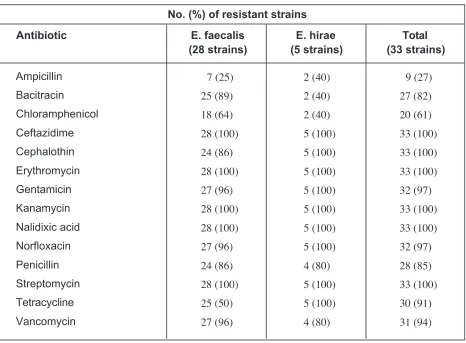
Twenty-eight isolates of E. faecalis and 5 isolates of E. hirae were isolated from chicken samples obtained from markets in Sri Serdang, Selangor. They were tested for susceptibility to vancomycin and other antimicrobial agents. All of the isolates showed multiple resistance to the antibiotic tested. All Enterococcus spp. were resistant (100%) to ceftaxidime, cephalothin, erythromycin, gentamicin, kanamycin, nalidixic acid and streptomycin. Resistance was also observed to norfloxacin (97%), tetracycline (91%), penicillin (85%), bacitracin (82%), chloramphenicol (61%) and the least resistance was to ampicillin (27%). High prevalence to vancomycin resistance was detected among the E. faecalis (27of 28) and E. hirae (4 of 5) isolates. The multiple antibiotic resistance index ranging between 0.64 to 1.0 showed that all strains tested originated from high-risk contamination. Plasmid profile analysis of Enterococcus spp. revealed plasmid DNA bands ranging in size from 1.3 to 35.8 megadalton but some isolates were plasmidless. No correlation could be made between plasmid patterns and antibiotic resistance.
Key words : Enterococcus spp., vancomycin-resistant, plasmid, poultry
Introduction
Enterococcus species usually inhabit the intestines of human and other animals. These organisms were considered as a part of normal flora of the bowel, genital tract with some also being found on the skin, vaginal secretions and in the perineal area. The genus Enterococcus are gram-positive cocci that are catalase negative, occur singly, in pair and short chains.
Enterococci have been increasingly involved in nosocomial infections, sometimes as a cause of hospital outbreaks (1). In recent years, they have emerged as pathogens in a growing number of
serious nosocomial and urinary tract infections including bacteremia and intraabdominal (2,3). The isolation of strains resistant to many antibiotic therapies has become an important public health concern (4,5,6). Once, the glycopeptide antibiotic agent, vancomycin was useful in the treatment of severe infections due to gram-positive bacteria (7,8). Unfortunately, resistance to vancomycin had been reported (9).
Our aim was to isolate and investigate the resistance of enterococcal poultry isolates to various antimicrobial agents including glycopeptide (vancomycin) as well as to determine their plasmid profiles.
Haryanti Toosa et al
Materials and Methods
Isolation of Vancomycin-Resistant Enterococci (VRE)
All thirty-three isolates of Enterococci were isolated from chicken meat samples (chicken breasts, chicken legs and other chicken parts) obtained from markets in Sri Serdang, Selangor.
Approximately 25 g of each poultry product was rinsed in 225 ml of azide dextrose broth and homogenized with a stomacher for 1 min. After overnight incubation at 370C, 0.1 ml of the diluted sample was plated on Slanetz and Bartley agar (SBA) supplemented with 20 μg/ml of vancomycin.
The agar plates were incubated aerobically at 370C for 24 hour. Typical red colonies from each SBA plate were randomly isolated and investigated further.
Species Identification
Presumptive identifications of the
Enterococcus spp. were performed by using the
following characteristics: Gram stained reaction,
colony morphology, growth and blackening of bile-esculin agar, growth in the presence of 6.5% NaCl and growth at 100C and 450C, the presence or absence of catalase and acidification of glucose with the production of gas (10).
Identification of the strains was further investigated to the genus level by growth and biochemical reactions as described by Facklam and Collins (11).
Plasmid isolation
The plasmid DNA of Enterococcus spp. strains were screened by the alkaline lysis method of Birnboim and Doly (12) with slight modification. The products were then electrophoresed for 1 hour at 150V on a 0.8% agarose gel. After staining the gel with ethidium bromide (0.5 μg/ml), the
photograph was taken. Molecular mass of the plasmid was determined by approximate comparison with plasmid of known molecular weight, E.coli
V517 that harboured 8 plasmid of 1.4 to 35.8 MDa (13).
Antimicrobial Susceptibility Testing
Table 1: Frequency of antibiotic resistance of the thirty-three Enterococcus spp. tested No. (%) of resistant strains
Antibiotic E. faecalis
(28 strains) (5 strains)E. hirae (33 strains)Total
Ampicillin Bacitracin
Chloramphenicol Ceftazidime Cephalothin Erythromycin Gentamicin Kanamycin Nalidixic acid Norfloxacin Penicillin Streptomycin Tetracycline Vancomycin
7 (25) 25 (89) 18 (64) 28 (100) 24 (86) 28 (100) 27 (96) 28 (100) 28 (100) 27 (96) 24 (86) 28 (100) 25 (50) 27 (96)
2 (40) 2 (40) 2 (40) 5 (100) 5 (100) 5 (100) 5 (100) 5 (100) 5 (100) 5 (100) 4 (80) 5 (100) 5 (100) 4 (80)
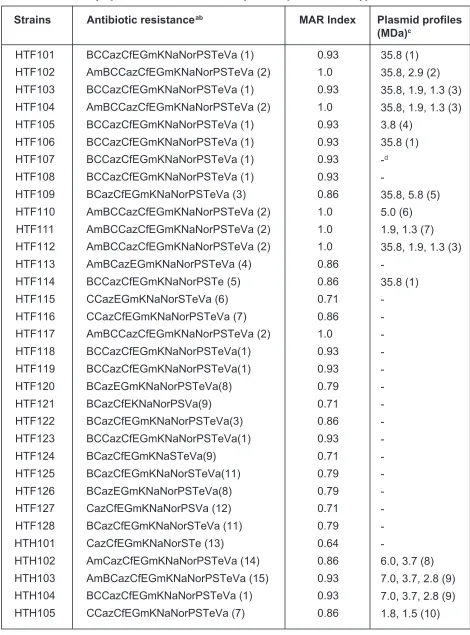
Table II: Plasmid profiles and antibiotic resistance patterns of Enterococcus spp. isolates
Strains Antibiotic resistanceab MAR Index Plasmid profiles
(MDa)c HTF101 HTF102 HTF103 HTF104 HTF105 HTF106 HTF107 HTF108 HTF109 HTF110 HTF111 HTF112 HTF113 HTF114 HTF115 HTF116 HTF117 HTF118 HTF119 HTF120 HTF121 HTF122 HTF123 HTF124 HTF125 HTF126 HTF127 HTF128 HTH101 HTH102 HTH103 HTH104 HTH105 BCCazCfEGmKNaNorPSTeVa (1) AmBCCazCfEGmKNaNorPSTeVa (2) BCCazCfEGmKNaNorPSTeVa (1) AmBCCazCfEGmKNaNorPSTeVa (2) BCCazCfEGmKNaNorPSTeVa (1) BCCazCfEGmKNaNorPSTeVa (1) BCCazCfEGmKNaNorPSTeVa (1) BCCazCfEGmKNaNorPSTeVa (1) BCazCfEGmKNaNorPSTeVa (3) AmBCCazCfEGmKNaNorPSTeVa (2) AmBCCazCfEGmKNaNorPSTeVa (2) AmBCCazCfEGmKNaNorPSTeVa (2) AmBCazEGmKNaNorPSTeVa (4) BCCazCfEGmKNaNorPSTe (5) CCazEGmKNaNorSTeVa (6) CCazCfEGmKNaNorPSTeVa (7) AmBCCazCfEGmKNaNorPSTeVa (2) BCCazCfEGmKNaNorPSTeVa(1) BCCazCfEGmKNaNorPSTeVa(1) BCazEGmKNaNorPSTeVa(8) BCazCfEKNaNorPSVa(9) BCazCfEGmKNaNorPSTeVa(3) BCCazCfEGmKNaNorPSTeVa(1) BCazCfEGmKNaSTeVa(9) BCazCfEGmKNaNorSTeVa(11) BCazEGmKNaNorPSTeVa(8) CazCfEGmKNaNorPSVa (12) BCazCfEGmKNaNorSTeVa (11) CazCfEGmKNaNorSTe (13) AmCazCfEGmKNaNorPSTeVa (14) AmBCazCfEGmKNaNorPSTeVa (15) BCCazCfEGmKNaNorPSTeVa (1) CCazCfEGmKNaNorPSTeVa (7) 0.93 1.0 0.93 1.0 0.93 0.93 0.93 0.93 0.86 1.0 1.0 1.0 0.86 0.86 0.71 0.86 1.0 0.93 0.93 0.79 0.71 0.86 0.93 0.71 0.79 0.79 0.71 0.79 0.64 0.86 0.93 0.93 0.86 35.8 (1) 35.8, 2.9 (2) 35.8, 1.9, 1.3 (3) 35.8, 1.9, 1.3 (3) 3.8 (4)
35.8 (1) -d
-35.8, 5.8 (5) 5.0 (6) 1.9, 1.3 (7) 35.8, 1.9, 1.3 (3) -35.8 (1)
-6.0, 3.7 (8) 7.0, 3.7, 2.8 (9) 7.0, 3.7, 2.8 (9) 1.8, 1.5 (10)
aTested for ampicillin (Am), bacitracin (B), chloramphenicol (C), ceftazidime (Caz), cephalothin (Cf) erythromycin (E), gentamicin (Gm), kanamycin (K), nalidixic acid (Na), norfloxacin (Nor), penicillin (P), streptomycin (S), tetracycline (Te), vancomycin (Va)
All isolates identified as enterococci were tested by disk diffusion tests on tryptic soy agar (11). All strains were tested for their susceptibility to ampicillin at 10 µg, bacitracin at 10 µg, chloramphenicol at 30 µg, ceftazidime at 30 µg, cephalothin at 30 µg, erythromycin at 15 µg, gentamicin at 10 µg, kanamycin at 30 µg, nalidixic acid at 30 µg, norfloxacin at 30 µg, penicillin at 10 U, streptomycin at 10 µg, tetracycline at 30 µg and vancomycin at 30 µg.
The multiple antibiotic resistance (MAR) index of isolates was defined as a/b where ‘a’ was the number of antibiotics to which the isolate was resistance and ‘b’ was the total number of antibiotics tested (14).
Results
From the 33 vancomycin-resistant Enterococci (VRE) isolated from the chicken meat examined, 28 (85%) strains were identified as E. faecalis and 5 (15%) as E. hirae. Generally the characteristics of the isolates agreed with previous studies that the genus Enterococcus comprised of gram-positive cocci that are catalase negative, grow in 6.5% NaCl and at pH 9.6. They grow both at 100C
and 450C and none produced gas from glucose.
They also grew on and blackened 40% bile-esculin agar (11, 15, 16). All thirty-three isolates of Enterococci were resistant to 9 or more antibiotic tested. The highest prevalence of resistance observed among the isolates were against ceftazidime, cephalothin, erythromycin, gentamicin, kanamycin, nalidixic acid and streptomycin (100%). The least resistance was observed for ampicillin (27%). Table I showed the resistant pattern among the
Enterococcus spp. tested. The results of plasmid profile analysis among the Enterococcus spp. isolates were shown in Table II. Fifteen of the isolates harbour one or more plasmid DNA bands ranging in sizes from 1.3 to 35.8 megadalton.
Discussion
The isolation of vancomycin-resistant enterococci (VRE) species in this study was to investigate the importance of chicken meat as a possible source for the transfer of VRE. The results obtained showed the presence of VRE in the chicken samples examined and similar reports have been published on the occurrence of Enterococcus spp. from animal sources (17, 18, 19, 20, 21).
to antibiotics among Enterococcus spp. in Malaysia. In this study, 94% of the isolates were vancomycin-resistant and more than 50% of the Enterococci isolates acquired high-level resistance to other antibiotics tested, reflecting the distribution of aminoglycoside resistance worldwide and resistance to other antibiotics among VRE worldwide (22). The resistance patterns in this study generally agreed with the observations reported by Murray (1) and Son et al. (23) on the prevalence of multiple drug-resistant enterococci. Twenty-seven of 28 E. faecalis and 4 of 5 E. hirae were resistant to vancomycin, which indicated the high prevalence of vancomycin-resistant enterococci from chicken samples tested in the study area. In addition, all isolates of
Enterococcus spp. from poultry sources used in this study had multiple antibiotic resistance (MAR) indices of 0.64 to 1.0, indicating that all strains originated from high-risk sources (14). Elsewhere, a frequent occurrence of antimicrobial resistance enterococci has been observed among food animals and food of animal origin (17, 19, 21, 24, 25). Taken together, the results of this study and those cited above suggested that food animals might be a reservoir of resistant enterococci and resistance gene capable of transferring to human through the food chain.
that have been previously considered of minor clinical importance, significant if associated with either multiple resistance factors or as a reservoir of resistance genes as observed in this study. However, at this stage of this study no specific correlation between the antibiotic patterns and plasmid profiles was observed. Further evidence on the correlation of the presence of plasmids and antibiotic resistance could be obtained by conjugation, transformation or curing experiments.
In conclusion, our findings showed that multiple resistant VRE isolates are already present in poultry and thus, there is every reason to be concerned as human infection due to VRE may stem from poultry sources.
Acknowledgements
This research was supported by the Malaysian Government through the IRPA grant mechanism and Universiti Putra Malaysia through the Seed Money grant No. 50523.
Correspondence :
Assoc. Prof. Dr. Son Radu, Department of Biotechnology,
Faculty of Food Science and Biotechnology, University Putra Malaysia, 43400 UPM Serdang, Selangor, Malaysia.
Tel: +6 03 - 89486101 ext. 3446 Fax: +6 03 -89423552
Email: [email protected]
References
1. Murray, B.E. The life and times of the Enterococcus. Clin. Microbiol. Rev. 1990, 3:46-65.
2. Schaberg, D.R., Culver, D.H. and Gaynes, R.P. Major trends in the microbial etiology of nosocomial infections. Am. J. Med. 1991, 91:72-75.
3. Jarvis, W.R. and Marton, W.J. Predominant pathogens in hospital infections. J. Antimicrob. Chemother. 1992,
29: 19-24.
4. McDonald, L.C., Kuehnert, M.J., Tenover, F.C. and Jarvis, W.R. Vancomycin-resistant enterococci outside the health-care setting: prevalence, sources and public health implications. Emerg. Infect. Dis. 1997, 3 :311-17.
5. Huycke, M.M., Sahm, D.F. and Gilmore, M.S. Multiple-drug resistant Enterococci: The nature of the problem and an agenda for the future. Emerg. Infect. Dis. 1998, 4:239-49.
enterococci. Emerg. Infect. Dis. 1998, 4: 37-47. 7. Gump, D.W. Vancomycin for treatment of bacterial
meningitis. Rev. Infect. Dis. 1981, 3:289-92.
8. Kirby, W.M. Vancomycin therapy in severe Staphylococcal infections. Rev. Infect. Dis. 1981, 3: 326-39.
9. Murray, B.E. Editorial response: What can we do about VRE. Clin. Infect. Dis. 1995, 20:1134-36.
10. Vandamme, P., Vercauteren, E., Lammens, C., Pensart, N., Ieven, M., Pot, B., LecLercq, R. and Goossens. H. Survey of enterococcal Susceptibility patterns in Belgium. J. Clin. Microbiol. 1996, 34:2572-76. 11. Facklam, R.R. and Collins, M.D. Identification of
Enterococcus species isolated from human infectious by a conventional test scheme. J. Clin. Microbiol. 1989, 27:731-34.
12. Birnboim, H.C. and Doly, J. A rapid alkaline extraction procedure for screening recombinant plasmid DNA. Nucleic Acid. Res. 1979, 7: 1513-23.
13. Macrina, F.L., Kopecko, D.J., Jones, K.R. A multiple-plasmid containing Escherichia coli strain: convenient source of size reference plasmid molecules. Plasmid. 1978, 1:417-20.
14. Krumperman, P.H. Multiple antibiotic resistance indexing of Escherichia coli to identify high-risk sources of fecal contamination of foods. Appl. Environ. Microbiol. 1983, 46: 165-70.
15. Facklam, R., Hollis, D. and Collins, M.D. Identification of gram-positive coccal and coccobacillary vancomycin-resistant bacteria. J. Clin. Microbiol. 1989, 27: 724-30.
16. Manero, A. and Blanch, A.R. Identification of Enterococcus spp. with a biochemical key. Appl. Environ. Microbiol. 1999, 65: 4425-30.
17. Bates, J., Jordan, J.Z. and Griffiths, D.T. Farm animals as a putative reservoir for vancomycin-resistant enterococcal infection in man. J. Antimicrob. Agents Chemother. 1994, 34:507-16.
18. Devriese, L.A., Ieven, M., Goossens, H., Vandamme, P., Pot, B., Hommez, J. and Haesebrouck. Presence of vancomycin-resistant enterococci in farm and pet animals. J. Antimicrob. Agents Chemother. 1996,
40:2285-87.
19. Klein, G., Pack, A. and Reuter, G. Antibiotic resistance patterns of enterococci and occurrence of vancomycin-resistant enterococci in raw minced beef and pork in Germany. Appl. Environ. Microbiol. 1998, 64: 1825-30.
H.C. Level of glycopeptide resistant E. faecium in broilers and pigs following ban on use of avoparcin. Microb. Drug Resist. 1999, 5:53-56.
22. Hall, L.M.C. Recent advances in understanding the epidemiology of enterococci. Rev. Med. Microbiol. 1993, 4:192-97.
23. Son, R., Nimita, F., Rusul, G., Nasreldin, E., Samuel, L. and Nishibuchi. M. Isolation and molecular characterization of vancomycin-resistant Enterococcus faecium in Malaysia. Lett. Appl. Microbiol. 1999,
29:118-22.
24. Thal, L.A., Chow, J.W., Mahayni, R., Bonilla, H., Pevri, M.B., Donabedian, S.A., Silverman, J., Taber, S. and Zerros, M.J. Characterization of antimicrobial resistance in enterococci of animal origin. Antimicrob. Agents Chemother. 1995, 39: 2112-15.
25. Wegener, H.C., Madsen, M., Nielsen, N. and Aarestrup, F.M. Isolation of vancomycin resistant Enterococcus faecium from food. Internat. J. Food Microbiol. 1997,
35: 57-66.
26. Boyce, J.M., Steven, M.O., Joseph, W.C., Marcus, J.Z., Gail, P.B., Charles, B.S., Rodrigo, L.C.R., Sandra Fortna, A.A.M. Outbreak of multidrug-resistant E.
faecium with transferable vanB class vancomycin
resistance. J. Clin. Microbiol. 1994, 32:1148-52. 27. Novick, R.P. Plasmid. Sci. Am. 1982, 246: 77-90.
28. Cooper, G.L. and Given, D. B. Vancomycin: a comprehensive review of 30 years of clinical experience. New York. Parker Row Publishers.
29. Woodford, N., Johnson, A.P., Morrisson, D. and Speller. D. E. E. Current perspectives on glycopeptides resistance. Clin. Microbiol. Rev. 1995, 8: 585-15. 30. Arthur, M., Reynolds, P.E., Depardiew, F., Evers, S.,
Dutka-Malen, S., Quintiliani, R. and Courvalin, P. Mechanism of glycopeptide resistance in enterococci. J. Infect. Dis. 1996, 32: 11-16.
31. LeClercq, R., Derlot, E., Duval, J. and Courvalin, P. Plasmid-mediated resistance to vancomycin and teicoplanin in Enterococcus faecium. N. Engl. J. Med. 1988, 41: 24-29.