Effect of Surfactants on the Corrosion Behavior of
Aluminum in Acid Solutions Containing Chloride Ions
B. A. Abd-El-Naby1,*, O. A. Abdullatef2, W. A. El-Mahmody1
1Faculty of Science, Alexandria University, Alexandria, Alexandria, Egypt 2Faculty of Pharmacy, Pharos University, Alexandria, Egypt
Abstract
The corrosion behavior of aluminium in 0.1 M HCl in presence of each of the cationic surfactant (Cetrimide) and the anionic surfactant Sodium Lauryl Sulphate (SLS) has been studied using mass loss method, potentiodynamic polarization and electrochemical impedance spectroscopy (EIS) techniques. The results showed that Cetrimide acts as accelerator and SLS acts as inhibitor which confirms our previously suggested mechanism of the inhibition of the pitting corrosion of aluminium in acid solutions containing Cl- ions. The thermodynamics of the adsorption of SLS at thealuminium/solution interface and the effect of SLS on the kinetics of the dissolution reaction of aluminium in 0.1 M HCl have been also studied.
Keywords
Aluminium, Pitting corrosion, EIS, Polarization1. Introduction
Aluminum and its alloys are widely used in many industries such as aluminum-air technology, food industry and desalination plants. These industrial applications are due to the low density, favorable mechanical properties, good finishing, benign effect on the environment and the human health. A glance at the electrochemical series indicates that the standard reduction potential of aluminum equals – 1.8 V, this leads to the conclusion that aluminum is a very active metal. However, aluminum possesses an excellent corrosion resistance due to the rapid formation of a coherent inert oxide layer (10-12 µm thick) and the passivity of aluminum has been also attributed to the formation of a chemisorbed layer of O2(g) on the surface of metal [1]. Aluminum is readily
soluble in acid solutions containing Cl- ions and corrosion of
aluminum by Cl- ions arises from damage to the protective
oxide layer, and when the metal oxide film dissolves, the metal corrodes uniformly [2]. The process of local dissolution of the oxide film has been termed pitting [3], and attributed to the tendencies of the halides to form aluminum soluble complexes [4]. In general, pitting of aluminium can be controlled by the action of some inorganic [5-12] and organic additives [13-23] which retard the adsorption of Cl
-ions and/or by the formation of more resistant oxide film on the metal surface [24].
Our group of research is interested in the study of the
* Corresponding author:
[email protected] (B. A. Abd-El-Naby) Published online at http://journal.sapub.org/pc
Copyright © 2017 Scientific & Academic Publishing. All Rights Reserved
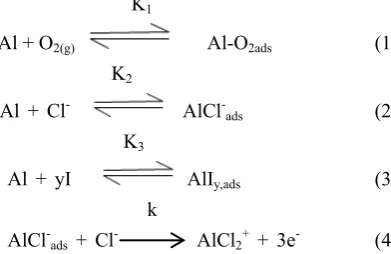
dissolution of aluminum in acid solutions and its inhibition. Four categories of inhibitors were investigated in our laboratory using chemical and electrochemical techniques to clarify and discuss their inhibition characteristics and adsorption mechanisms. These four categories of inhibitors are: 1) simple and synthetic organic compounds [25], 2) inorganic additives [26-29], 3) Chelates [30], and 4) natural products respectively [31-33]. In our previous work [26-28] we looked into some thermodynamic and kinetic factors governing the pitting corrosion of aluminum and its inhibition. These studies proposed a mechanism of inhibition involving three competitive equilibria: 1) molecular oxygen adsorption, 2) Cl- ion adsorption and 3) inhibitor adsorption.
This is followed by a rate determining Cl- ion catalyzed
dissolution step of AlCl -ads.
Due to the ability of the surfactants to adsorb on the surfaces, they should be effective corrosion inhibitors. The surfactant inhibitors have many advantages such as high inhibition efficiency, low price, low toxicity and easy production [34]. The inhibition characteristics of three novel synthesized amido-amine double tailed cationic surfactants [35] and Cetyltrimethylammonium bromide surfactant [36] have been investigated recently in our laboratory. Mass loss, potentiodynamic polarization and electrochemical impedance spectroscopy techniques were used to determine the efficiency of these surfactants in the inhibition of the acidic corrosion of steel. Thermodynamics of adsorption of these surfactants and their effects on the kinetics of the dissolution reaction of steel in acid solutions have been discussed.
hexadecylpyridinum bromide (HDPB) surfactants using the potentiodynamic polarization technique. The results showed that Tween 20 and 81 are more effective to inhibit the corrosion of pure aluminium than HDPB. The inhibition process was attributed to the formation of adsorbed film on the metal surface that protects the metal against corrosion species. Zhao et al [38] investigated the adsorption and inhibition characteristics of dodecyl benzene sulfonic acid sodium salt (DBSASS) and sodium dodecyl sulphate (SDS) anion surfactants for the corrosion of aluminum in 1.0 M HCl using weight loss method. It has been found that Langumir adsorption isotherm fit the experimental data. The thermodynamic parameters such as adsorption heat, adsorption entropy and adsorption free energy were calculated.
The aim of this work is to study the effect of an anionic surfactant (Sodium Lauryl Sulfate, SLS) and a cationic surfactant (Cetyltrimethylammonium bromide, Cetrimide) on the pitting corrosion of aluminum in 0.1 M HCl, using weight loss, potentiodynamic polarization and electrochemical impedance spectroscopy (EIS) techniques. It is important in this study to confirm the previous proposed mechanism of the inhibition of pitting corrosion of aluminum and discuss the adsorption processes of the surfactants at the aluminium/solution interface.
2. Experimental
2.1. Electrochemical Measurements
A frequency response analyzer potentiostat (ACM 604) was used to carry out the electrochemical impedance and polarization measurements. The frequency range for EIS measurements was 1 x 10⁴ to 0.1 Hz with applied potential
signal amplitude of 10 mV around the rest potential. A three electrode made cell contains an auxillary graphite electrode and saturated calomel reference electrode was used. The working electrode was fabricated in cylindrical form. Aluminium was encapsulated in epoxy resin in such a way that only one surface was left uncovered. The working electrode has the chemical composition (% wt) Al 99.687; Mn 0.001; Zn 0.001; Ni 0.003; Fe 0.171; Si 0.135; Cu 0.001. The exposed area (0.5 cm2) sample was wet hand-polished
using different grade emery papers of variable grades starting with a coarse one and proceeding in steps to the finest (1000) grade. The sample was then washed thoroughly with double-distilled water and finally dried by absolute ethanol just before immersion in the solution. Each experiment was carried out with newly polished electrode.
Before polarization and EIS measurements, the working electrode was introduced into the test solution and left for 20 min at the open circuit potential. The polarization curve measurements were obtained at scan rate of 20 mV/min starting from cathodic potential (Ecorr -300 mV) going to
anodic direction. All the measurements were done at 30.0 ±
0.1°C in solutions open to the atmosphere under unstirred conditions.
To test the reliability and reproducibility of the measurements, duplicate experiments were performed in each case of the same conditions.
2.2. Weight Loss Measurements
Rectangular specimens of aluminium with dimensions (2.0 cm x 5.0 cm x 0.05 cm) were used during weight loss measurements. The weight loss coupons were polished, cleaned and weighed, then suspended in beakers containing 100 ml of the test solutions. After definite time, the coupons were removed from the solution, washed with distilled water, ethanol and then dried by acetone and reweighed. The weight loss was then determined (gm cm-2hr-1), the experiment was
then repeated for different time intervals up to 6 hours. To test the reliability and responsibility of the measurements, duplicate experiments were performed in each case of the same conditions.
2.3. Solution Preparation
The test solutions were prepared from analytical grade reagents and distilled water. 36% HCl was purchased from Aldrich chemicals. Stock solution, of 1 M of HCl and 0.02 M of surfactant were used to prepare the test solution. Prior each experiment, 1.0 M HCl is added to an appropriate volume of 0.02 M surfactant solution and double distilled water to obtain a solution of 0.1 M HCl and the required concentration of the surfactant. Cetrimide and Sodium Lauryl Sulphate were obtained from Alpha Chemica with molecular weight 364.45 and 288.37g/mol respectively, their molecular structures are given in Figure 1.
Cetrimide Sodium Lauryl Sulfate
Figure 1. Chemical structure of Cetrimide and Sodium Lauryl Sulfate
3. Results and Discussion
3.1. Confirmation of the Previous Proposed Mechanism of the Inhibition of the Pitting Corrosion of
Aluminum
A general mechanism for the dissolution of aluminum in aqueous acidic solutions containing Cl- ions has been
reported in the literature as follows [39]:
Als + H2O AlOHads + H+ + e (R1)
AlOHads + 5H2O + H+ Al3+ + 6H2O + 2e (R2)
Al3+ + H
2O [AlOH]2+ + H+ (R3)
Zhang et al [40] suggested that the adsorption of the inhibitors on the aluminum surface partially displaces the water molecules originally adsorbed on the surface, which blocks the formation AlOHads [R2]. Thus both the oxidation
reaction [R3] and the complexation reaction [R4] can be prevented.
The following mechanism of the inhibition of the pitting corrosion of aluminum in acidic solutions containing Cl- ions
has been proposed in our previous work [30]. This mechanism stated that in presence of an inhibitor and Cl- ion
in the aerated acid solutions, three competitive equilibria are established: 1) molecular oxygen adsorption, 2) Cl- ion
adsorption and 3) inhibitor adsorption. This is followed by a rate determining, chloride ion catalyzed dissolution step of AlCl
-ads.
K1
Al + O2(g) Al-O2ads (1)
K2
Al + Cl- AlCl
-ads (2)
K3
Al + yI AlIy,ads (3)
k AlCl
-ads + Cl- AlCl2+ + 3e- (4)
According to this mechanism: (i) if the inhibitor is an anionic surfactant, in this case the competitive adsorption of the surfactant anions at the metal/solution interface hinders the adsorption of Cl- ions due to the coulombic repulsion and
the rate of corrosion of aluminum decreases, (ii) if the inhibitor is a cationic surfactant, in this case the cooperative adsorption of the surfactant cations at the metal/solution interface enhances the adsorption of Cl- ions due to the
coloumbic attraction and the rate of corrosion of aluminum increases.
In order to test the above argument, the potentiodynamic polarization curves and the Nyquist impedance diagrams of aluminum in 0.1 M HCl were recorded in absence and presence of 0.005 M of each of the cationic surfactant (Cetrimide) and the anionic one (SLS).
3.2. Potentiodynamic Polarization Results
Figure 2 shows the polarization curves of aluminum in 0.1 M HCl solution in absence and presence of 0.005 M Cetrimide or SLS surfactants.
It is clear that the anodic curves of aluminum in free HCl solution and in presence of the cationic surfactant (Cetrimide) show activation behavior followed by break down potential Eb, indicating pitting corrosion of aluminum as a result of
aggressive attack of Cl- ions. [31-33]. However, in presence
of the anionic surfactant (SLS) the break down behavior disappeared indicating that this surfactant prevented the pitting of aluminum.
Table 1 reports the values of the polarization parameters, Ecorr corrosion potential, icorr corrosion current, βc slope of the
cathodic Tafel line and % P percent inhibition of surfactant for the corrosion of aluminum in 0.1 M HCl. The corrosion current density was determined by the extrapolation of the cathodic Tafel line to the corrosion potential. The percent inhibition % P is calculated using the equation [31]:
%P = [(i0 -i) / i0 ]x100 (5)
where i0 represents the corrosion current density of
aluminum in free HCl solution and i represents the corrosion current density in presence of the surfactant.
Figure 2. Potentiodynamic polarization plots for aluminum in 0.1 M HCl
solution in the absence and presence of 0.005 M Anionic and Cationic surfactants at 30°C
Table 1. Electrochemical polarization parameters for aluminium in 0.1 M
HCl solution in the absence and presence of 0.005 M SLS and Cetrimide at 30°C
Solution - E(mv) corr (mA.cmicorr -2)
βc
(mv/decade) % P
0.1 M HCl 774.35 0.5380 97.683 -
0.1 M HCl +
0.005 M SLS 644.27 0.2366 97.683 56.02
0.1 M HCl +
0.005M Cetrimide 796.8 0.5418 97.683 -
The data in the table show that the addition of the surfactants to the medium leads to an increase of the value of the corrosion current density of aluminum in 0.1 M HCl in the case of Cetrimide and a decrease in the case of SLS. This means that Cetrimide acts as accelerator and SLS acts as inhibitor for the corrosion of aluminum in 0.1 M HCl with maximum percent inhibition (% P) of 93 %. In our previous work [41] when we used 3-(Alditol-1-yl)-1,2,4- Triazol [3,4,-a]phthalazimes as inhibitors for the corrosion of aluminium in 1 M HCl, this neutral substance gave maximum percent inhibition of 58 %. This behavior can be discussed on the basis that in this case there is no competitive adsorption between the inhibitor molecules and the Cl- ions.
The value of βc, the slope of the cathodic Tafel line of
aluminum in the free acid solution is similar to those in presence of the two surfactants indicating that the presence of the surfactants in the medium has no effect on the mechanism of the cathodic deposition of hydrogen.
3.3. Electrochemical Impedance Spectroscopy (EIS) Results
and presence of 0.005 M Cetrimide or SLS surfactants and the equivalent circuit model which fit well the impedance spectra are given in Figure 3(a,b). These plots manifested capacitive semicircle indicating that the dissolution of aluminum is mainly controlled by charge transfer process across the metal/solution interface. The equivalent circuit includes the solution resistance Rs shorted by the capacitor
Cdl which is placed in parallel to the charge transfer
resistance Rct.
Figure 3a. Nyquist plots for aluminum in 0.1 M HCl solution in the
absence and presence of 0.005 M Anionic and Cationic surfactants at 30°C
Figure 3b. The equivalent circuit model
The impedance spectra were analyzed by fitting the experimental data to a simple equivalent circuit model represented in figure 3b using Zsimpwin program and the data obtained are presented in table 2.
Table 2. Electrochemical impedance parameters for aluminium in 0.1 M
HCl solution in the absence and presence of 0.005 M surfactants at 30°C
Solution RS
Ohm.cm2 µF Q n Ohm.cmRCT 2 % P
0.1 M HCl 5.98 34.4 0.90 1204 -
0.1 M HCl +
0.005 M SLS 17.46 29.2 0.88 2778 56.6
0.1 M HCl +
0.005M Cetrimide 16.55 38.4 0.93 1055 -
The results showed that the addition of each of Cetrimide and SLS to HCl solution leads to the decrease of the value of the capacity of double layer at aluminum/solution interface indicating that the two surfactants are adsorbed at the metal surface. The presence of (Cetrimide) decreased the value of Rct, however, SLS increased its value. These results are in
agreement with the results obtained from polarization measurements which indicated that the cationic surfactant act as accelerator and the anionic one act as an inhibitor for the aluminum dissolution in HCl solution. These data confirm the previously suggested mechanism of the inhibition of the pitting corrosion of aluminum by Cl- ions.
3.4. Inhibition of Dissolution of Aluminium in 0.1 M HCl by Sodium Lauryl Sulfate (SLS)
3.4.1. Thermodynamics of the Adsorption of SLS at the Aluminium/Solution Interface
Table 3. shows the results of the weight loss for dissolution of aluminium in 0.1 M HCl after 2 hours of immersion at 30°C. The percentage inhibition efficiency % P was calculated using the relation [35]:
% P = [(w0 – w) / w0] x 100 (6)
Where w0, w are the weight loss in gcm-2hr-1, in absence
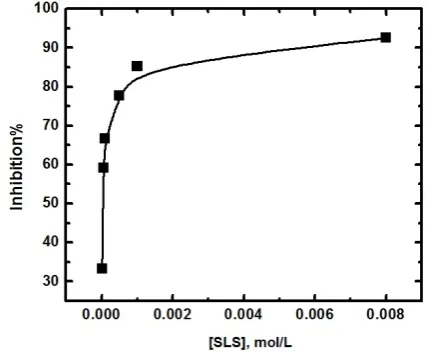
and presence of SLS respectively. It is clear that the presence of SLS in the medium leads to the decrease of the weight loss of aluminium and increase of the percent inhibition of SLS up to 92.59% at 0.008 M surfactant.
Table 3. Data of weight loss measurements for Aluminium immersed in
0.1 M HCl for two hours in the absence and the presence of different concentrations of sodium louryl sulphate
Concentration mol/L
Weight loss
g cm-2hr-1 %p
0.0 0.0027 -
1 x 10⁻⁵ 0.0018 33.33
5 x 10⁻⁵ 0.0011 59.25
1 x 10⁻⁴ 0.0009 66.66
5 x 10⁻⁵ 0.0006 77.77
1 x 10⁻³ 0.0004 85.18
8 x 10⁻³ 0.0002 92.59
Figure 4 represents the relation between the percentage inhibition efficiency, and concentration of SLS.
Figure 4. The relation between the percentage inhibition and the
concentration of SLS surfactant for aluminium in 0.1 M HCl
Figure 5 represents the application of Langumir adsorption isotherm to fit the experimental data of the adsorption of SLS at aluminium surface. The linearity of the graph with a slope nearly equal one indicates that Langumir adsorption isotherm is valid to fit the experimental data. The adsorption process in this case is mainly ideal and there is no mutual interaction between the surfactant molecules at the aluminium/solution interface. The binding constant of the surfactant with the aluminium surface K is obtained from the intercept of the graph and equals 3.16 x 10⁴. This binding
constant is related to the standard free energy change of adsorption ΔG0
ads according to the following equation [36].
K = 1/ Csolvent exp(ΔG0ads /RT) (7)
Where, R is the universal gas constant, T is the absolute temperature, Csolvent is the molar concentration of solvent
which is water and equals 55.5 mol/L.
Figure 5. Application of the Langmuir isotherm to fit the experimental
results of adsorption of SLS on aluminium surface in 0.1 M HCl
Substitute of the binding constant K = 3.16 x 10⁴ in the
above equation gives ΔG0
ads = -36.21 kJ/mol indicative that
the adsorption of SLS at the aluminium/solution interface is comprehensive (physical and chemical).
The inhibition characteristics of the three anionic surfactants; dodecyl sulfonic acid sodium salts (DSASS), dodecyl benzene sulfonic acid sodium salt (SDS) for the corrosion of aluminum in 1.0 M HCl at 50°C were investigated using weight loss method [38]. The results indicated that Langumir adsorption isotherm is applicable and the values of ∆G0
ads obtained are given in table (4). It is
clear that the values of ∆G0
ads are in the range 33.3-37.7
kJ/mol indicating that the type of adsorption of the three anionic inhibitors are comprehensive.
Table 4. ∆G0
ads values of the surfactants on aluminum surface in 1.0 M
HCl at 50°C, [38].
Surfactant ∆G0
ads
DSASS -37.3
DBSASS -33.3
SDS -33.5
3.4.2. Effect of SLS on the Kinetics of the Dissolution Reaction of Aluminium in 0.1 M HCl
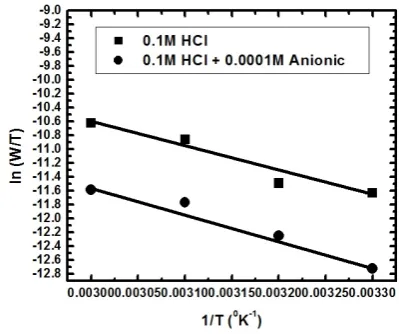
The activation parameters of the dissolution reaction of aluminium in free acid solution and in presence of the surfactant were obtained from linear square fit of lnW and ln(W/T) versus (1/T) according to Arrhenius and Transition State equations [30].
Arrhenius equation: ln W = ln A – (Ea/RT) (8) where Ea is the apparent effective activation energy, T is the absolute temperature, R is the universal gas constant and A is the Arrhenius pre-experimental factor.
Transition state equation:
W = (RT/Nh)exp(ΔS*/R)exp(-ΔH*/RT) (9) where, N is the Avogadro's number, h is the Planks constant, ΔH* is the enthalpy of activation and ΔS* is the entropy of activation. Figures 6a and 6b show that linear plots are produced when we plot (ln W) versus (1/T) and (ln W/T) versus (1/T) using data collected in experiments where aluminium was immersed in 0.1 M HCl in the absence or the presence of 0.0001 M SLS.
Figure 6a. Linear fit for (ln W) data vs. (1/T) for aluminium dissolution in 0.1 M HCl solutions in the absence and presence of 0.0001 M SLS
This data was used to calculate the values of the activation parameters Ea, ∆H* and ∆S*.
Table 5. Activation parameters of Aluminum dissolution in 0.1 M HCl in
absence and presence of 0.0001M of sodium lauryl sulphate
Solution Ea
kJ/mol
∆H◦
kJ/mol
∆S◦
J/mol K
0.1 M HCl 32.90 30.28 -194.85
0.1 M HCl +
0.0001M SLS 35.09 32.47 -195.68
The resulting values of the activation parameters are given in table 5. The values of each of Ea and ΔH* in presence of 0.001 M SLS are higher than those of the free acid solution. This behavior can be discussed on the basis that the competitive adsorption of the surfactant anions at the aluminium/solution interface increases the energy barrier of the corrosion reaction due to the coulombic repulsion with the Cl- ions. The negative values of ΔS* implies that the
activated complex represents an association rather than dissociation step, meaning that a decrease in disordering takes place as going from reactants to the activated complex [42]. In our previous work [30], it has been reported that, no significant variation in the Ea, ΔH* and ΔS* values on going from the free acid solution solution to inhibited solution by neutral surfactant (The macrocyclic ligand "cyclam"). In this case the inhibition does not alter the rate determining step and that its function is simply the blocking of the available surface sites for Cl- attack and there is no competitive
adsorption of the inhibitor molecules and Cl- ions.
4. Conclusions
1) Potentiodynamic polarization and impedance results indicated that the cationic surfactant (Cetrimide) acts as accelerator of the pitting corrosion of alminium by Cl- ions, however, the anionic surfactant (SLS) prevent it.
2) The results confirmed our previously suggested mechanism of the inhibition of the pitting corrosion of aluminium.
3) The thermodynamic study of the adsorption of SLS at aluminium/solution interface indicated that the adsorption process is comprehensive (physical and chemical).
4) The kinetic study of the dissolution reaction of aluminium in acidic solutions containing Cl- ions in presence
of SLS indicated that the competitive adsorption of the surfactant anions increased the energy barrier of the corrosion reaction.
REFERENCES
[1] H.H. Uhlig and R.W. Revie, Corrosion and Corrosion Control; An Introduction to Corrosion Science and Engineering, 3rd
edition, John Wiley & Sons, New York, 1985, pp. 69-73,
181-190, 341-354.
[2] K.F. Lorking and J.E.O Mayne, Br. Corros. J., 1(1966)181. [3] R.S. Alwitt, T.R. Beck and K.R. Herbert, Advances in
Localized Corrosion, H.S. Isaacs, Editor, NACE, Houston, Tx(1990).
[4] R.T. Foly, J. Electrochem. Soc., 122(1975)1493.
[5] C.B. Breslin, G. Treacy, W.M. Carroll, Corros. Sci., 36(1994) 1143.
[6] C.M.A. Brett, I.A.R. Gomes, J.P.S. Martins, Corros. Sci. 36(1994)915.
[7] S.I. Pyun, S.-M. Moon, J. Solid State Electrochem. 3(1999)331.
[8] S.S. Abdel Rehim, H.H. Hassan, M.A. Amin, Appl. Surf. Sci. 187(2002) 279.
[9] K.C. Emregul, A.A. Aksut, Corros. Sci. 45(2003) 2415. [10] J.W.J. Silva, E.N. Codaro, R.Z. Nakazato, L.R.O. Hein, Appl.
Surf. Sci. 252(2005) 1117.
[11] Kyung-Hwan Na, Su-lI Pyun, J. Electroanal. Chem. 596(2006)7.
[12] E.E. Abd El Aal, S. Abd El Wanees, A. Farouk, S.M. Abd El Haleem, Corros. Sci.68(2013)14.
[13] G.A. El Mahdy, S.S. Mahmoud, Corrosion NACE 51 (1995) 436.
[14] V. Branzoi, F. Golgovici, F. Branzoi, Mater. Chem. Phys. 78(2002)122.
[15] A.K. Maayta, N.A.F. Al-Rawashdeh, Corros. Sci. 46(2004)1129.
[16] A.S. Fouda, A.A. Al-Sarawy, F.Sh. Ahmed, H.M. El-Abbasy, Corros. Sci. 51(2009)485.
[17] K.F. Khaled, M.M. Al-Qahtani, Mater. Chem. Phys. 113(2009)150.
[18] K. Khaled, Corros. Sci. 52(2010)2905.
[19] Qi.Bo. Zhang, Y.X. Hua, Mater. Chem. Phys. 119(2010)57. [20] A. Yurt, O. Aykın, Corros.Sci. 53(2011)3725.
[21] S. Safak, B. Duran, A. Yurt, G. Turkog˘lu, Corros. Sci. 54(2012)251.
[22] Qi Zhang, Z. Gao, F. Xu, X. Zou, Colloids and Surfaces A: Physicochemical and Engineering Aspects 380(2011)191. [23] S.M. Abd El Haleem, S. Abd El Wanees ⇑, E.E. Abd El Aal,
A. Farouk,Corrosion Science 68(2013)1.
[24] S. Szklarska-Smialowska, Corros. Sci. 33(1992)1193. [25] E. Khamis, B.A. Abd-El-Nabey, M. Shaban, A. El-Sharnoby,
G.E. Thompson, Proceedings of the 7th European Symposium
on Corrosion Inhibitors (7SEIC) Ann. Univ. Ferrara N.S. Sez. V. Suppl. N.9. 1990, P.1173.
[26] A.A. El-Awady, B.A. Abd-El-Nabey and S.G. Aziz, 186th
[27] S.G. Aziz, A.A. El-Awady and B.A. Abd-El-Nabey, JKAU. Sci., 9(1997)101.
[28] A.M. Abdel-Gaber, B.A. Abd-El-Nabey, I.M. Sidahmed, A.M. El-Zayady and M. Sadawy, Mater. Chem. Phys., 98(2006)291.
[29] N. Khalil, F. Mahgoup, B. A. Abd-El-Nabey and A. Abd el-Aziz, Corros. Eng. Sci. Techn., 38(2003)205.
[30] A.A. El-Awady, B.A. Abd-El-Naby and S.G. Aziz, J. Chem. Soc. Faraday Trans. 89(1993)795.
[31] B.A. Abd-El-Nabey, O.A. Abdullatef, H.M. El-Kshlan, E. Khamis, M.A. Abd-El-Fatah, Portug. Electrochim. Acta, 33(2015)1.
[32] B.A. Abd-El-Nabey, Y.M. Goher, H.A. Fetoh and M.S. Karam, Portug. Electrochim. Acta, 33(2015)231.
[33] B.A. Abd-El-Nabey, O.A. Abdullatef, H.M. El-Kshlan, E. Khamis, M.A. Abd-El-Fatah, Portug. Electrochim. Acta, 33(5)(2015)265.
[34] A.. S. Fouda, Y.A. Elawady, H.K. Abd-El-Aziz, J. Chem. Sci. & Tech., 1(2012) 45.
[35] B.A. Abd-El-Nabey, H.A. Fetouh, I. Aiad, S.M. Shaban, S. El-Houssenny, A. Maher, Asian J. Sci. Tech. 7(2016)2491. [36] B.A. Abd El-Nabey, O.A. Abdullatef, E. Khamis, W.A.
El-Mahmody, Int. J. Electrochem. Sci., 11(2016)1271. [37] V. Bronzoi, F. Golgovici, F. Bronzoi, Mater. Chem. Phys.,
78(2002)122.
[38] T. Zhao, G. Mu, Corros. Sci., 41(1999)1937.
[39] T.H. Nguyen, R.T. Foly J. Electrochem. Soc. 129(1982) 32. [40] Q.B. Zhang, Yi Xin Hua. Mater. Chem. Phys. 119(2010)57. [41] B.A. Abd-El-Naby, M.M. Essa and M.A.E. Shaban, Surf.
Tech., 26(1985)165.