Determinant for Bud4’s Function in Septin Organization during Bud
Growth and Axial Bud Site Selection in Budding Yeast
Huan Wu,aJia Guo,aYa-Ting Zhou,aXiang-Dong Gaoa,b
Department of Microbiology, College of Life Sciences, Wuhan University, Wuhan, Chinaa
; Hubei Provincial Cooperative Innovation Center of Industrial Fermentation, Wuhan, Chinab
The anillin-related protein Bud4 ofSaccharomyces cerevisiaeis required for axial bud site selection by linking the axial land-mark to the septins, which localize at the mother bud neck. Recent studies indicate that Bud4 plays a role in septin organization during cytokinesis. Here we show that Bud4 is also involved in septin organization during bud growth prior to cytokinesis, as bud4⌬shs1⌬cells displayed an elongated bud morphology and defective septin organization at 18°C. Bud4 overexpression also affected septin organization during bud growth inshs1⌬cells at 30°C. Bud4 was previously thought to associate with the septins via its central region, while the C-terminal anillin-related region was not involved in septin association. Surprisingly, we found that the central region of Bud4 alone targets to the bud neck throughout the cell cycle, unlike full-length Bud4, which localizes to the bud neck only during G2/M phase. We identified the anillin-related region to be a second targeting domain that cooperates
with the central region for proper septin association. In addition, the anillin-related region could largely mediate Bud4’s func-tion in septin organizafunc-tion during bud growth and bud site selecfunc-tion. We show that this region interacts with the C terminus of Bud3 and the two segments depend on each other for association with the septins. Moreover, like thebud4⌬mutant, thebud3⌬ mutant genetically interacts withshs1⌬andcdc12-6mutants in septin organization, suggesting that Bud4 and Bud3 may cooper-ate in septin organization during bud growth. These observations provide new insights into the interaction of Bud4 with the sep-tins and Bud3.
T
he correct positioning of a polarity axis in response to spatial cues is important for a variety of cellular functions, such as neuronal transmission, cell fate determination, and directional cell migration (1–3). In the budding yeastSaccharomyces cerevi-siae, the spatial control of cell polarization is manifested by bud site selection, a process that takes place at late G1stage of the cellcycle, in which the mother cell chooses a new budding site (4,5). There are two patterns for bud site selection in budding yeast, depending on the cell type. HaploidMATaorMAT␣cells bud in an axial pattern, in which cells choose a new budding site next to the preceding cell division site. As a result, the bud scars are con-nected in a chain. DiploidMATa/MAT␣cells, however, bud in a bipolar pattern, in which the daughter cells choose the new bud-ding site exclusively at the pole distal to the precebud-ding cell division site, while the mother cells select the new budding site either ad-jacent to or opposite the preceding division site. As a result, the bud scars are distributed at the two poles of a cell (4–6).
Previous studies had established that a group of proteins, in-cluding Bud3, Bud4, Axl1, Axl2 (also known as Bud10), and the septins, is implicated in the control of axial bud site selection. All these proteins localize to the mother bud neck, and loss-of-func-tion mutaloss-of-func-tions in any of these proteins result in a failure to bud in an axial pattern but instead cause bipolar budding (7–13). Septins are a class of conserved GTP-binding proteins with a conserved function in cytokinesis. In budding yeast, five vegetatively ex-pressed septins (Cdc3, Cdc10, Cdc11, Cdc12, and Shs1/Sep7) as-semble into heterooligomeric complexes, which polymerize to form higher-order structure filaments at the bud neck (14,15). Septins at the bud neck function as a scaffold involved in anchor-ing other proteins there. They also function as a diffusion barrier confining cortical factors in the daughter cell (16). Bud3, Bud4,
Axl1, and Axl2 are thought to assemble into a protein complex (axial landmark) on the septin filaments in a sequential order at about the time of mitosis. Septin filaments first recruit Bud3 and Bud4 to the bud neck, and after that, Axl1 and Axl2 are recruited (17,18). During cytokinesis, the septin hourglass splits into two rings and the daughter cell and the mother cell each inherit one ring. Each ring lasts until the late G1stage of the next cell cycle
(16). The four proteins on the septin ring are thought to function as a spatial memory to activate Rsr1/Bud1, a Ras-family small GTPase, which in turn activates Cdc42, a Rho-family small GTPase, leading to the assembly of a new bud at an adjacent loca-tion (19). A recent study showed that Bud3 possesses weak gua-nine nucleotide exchange factor (GEF) activity toward Cdc42 and can activate Cdc42in vivo(20). This observation suggests that the axial landmark may interact with Cdc42 at multiple levels.
Apart from bud site selection, Bud4 is known to play a role in septin organization, as the septins inbud4⌬cells fail to form a
Received3 December 2014 Accepted4 January 2015
Accepted manuscript posted online9 January 2015
CitationWu H, Guo J, Zhou Y-T, Gao X-D. 2015. The anillin-related region of Bud4 is the major functional determinant for Bud4’s function in septin organization during bud growth and axial bud site selection in budding yeast. Eukaryot Cell 14:241–251.doi:10.1128/EC.00268-14.
Address correspondence to Xiang-Dong Gao, [email protected].
Supplemental material for this article may be found athttp://dx.doi.org/10.1128 /EC.00268-14.
Copyright © 2015, American Society for Microbiology. All Rights Reserved. doi:10.1128/EC.00268-14
on September 8, 2020 by guest
http://ec.asm.org/
discrete double ring during cytokinesis (21–23), whereas overex-pression of Bud4 causes the assembly of extra septin structures (23). Bud4 is also required for normal cytokinesis in the absence of Gin4 or Cla4 (22), two protein kinases important for septin ring assembly (14).
Bud4 shares a low degree of amino acid sequence similarity (18%) with anillin, an animal protein (24). Like anillin, Bud4 contains a pleckstrin homology (PH) domain at the C terminus. In fungal anillin-related proteins, a DUF1709 domain (function unknown) is also found next to the conserved PH domain (23). The common function of anillin and fungal anillin-related pro-teins appears to be the regulation of cytokinesis (25), and in most cases, this function involves their interaction with the septins. For example, anillin is known to directly bind septins (26). Mid2, one of two Bud4 homologues in the fission yeastSchizosaccharomyces
pombe, acts to stabilize septin rings during cytokinesis (27,28).
Int1, a Bud4 homologue in the opportunistic human pathogen
Candida albicans, can interact with the septins inS. cerevisiae(29).
A few anillin-related proteins regulate cytokinesis without inter-acting with the septins; for example, the fission yeast Mid1 plays a role in the positioning of the site for cytokinesis (30). It is currently not known whether Bud4 homologues in the filamentous fungi
Neurospora crassaandAspergillus nidulans, which are crucial for
cytokinesis (31,32), interact with the septins.
Although the functions of Bud4 in bud site selection and in septin organization during cytokinesis have been characterized by previous studies, whether Bud4 is involved in septin organization prior to cytokinesis and the exact mechanisms of how Bud4 reg-ulates these processes are not clear. Here we report that Bud4 plays a role in septin organization during bud growth. In addition, we identified the C-terminal anillin-related region to be a second bud neck-targeting domain in Bud4. This region, which consists of DUF1709 and PH domains, interacts with the C terminus of Bud3 and plays a critical role in Bud4’s function in septin organization and bud site selection.
MATERIALS AND METHODS
Strains, media, and genetic methods.The yeast strains used in this study are listed in Table S1 in the supplemental material. Standard culture me-dia and genetic techniques were used, except where noted (33). ForGAL -driven overexpression of Bud4, cells were grown in synthetic SRG me-dium (0.67% yeast nitrogen base, 1% raffinose, 2% galactose).Escherichia colistrains DH12S (Life Technologies, Gaithersburg, MD) and DH5␣ (TaKaRa, Japan) were used as hosts for plasmid manipulation. Oligo-nucleotide primers for PCR were purchased from Sangon Biotech (Shang-hai, China). The nucleotide sequences of the primers are available upon request.
Plasmid construction.The pBG2 (CEN URA3 PBUD4-GFP-TCYC1) vector was generated for the expression of green fluorescent protein (GFP)-tagged Bud4 (GFP-Bud4) segments in the localization and func-tional complementation studies. It has the pRS316 (CEN URA3) back-bone and contains theBUD4promoter (nucleotides⫺1000 to⫹12 rela-tive to the A residue of the start codon) amplified by PCR from plasmid pBUD4 (13) in a SacI-NotI fragment, the 728-bp NotI-BamHI fragment of GFP with an S-to-T mutation at position 65 (GFPS65T) digested from pKS-GFP, and the 263-bp SalI-KpnI fragment of theCYC1transcription terminator from pUG36 (34). Full-lengthBUD4or variousBUD4 frag-ments were amplified by PCR from pBUD4, digested with BamHI and XhoI, and inserted into BamHI- and SalI-digested plasmid pBG2.
To generate the pBG5 (integrative,URA3 PBUD4) vector used for inte-grative expression of full-length Bud4 and Bud4 segments in yeast cells, theBUD4promoter (nucleotides⫺1000 to⫹12) in a SacI-NotI fragment
from pBG2 was inserted into pRS306 (integrative,URA3). Full-length
BUD4andBUD4segments along with theTCYC1terminator were re-moved from pBG2-BUD4 segments in BamHI-KpnI fragments and in-serted into BamHI- and KpnI-digested pBG5, yielding pBG5-BUD4 seg-ments. pBG5 was linearized with NcoI, whereas pBG5-BUD4 segments were linearized with ApaI for integration at theura3-52locus in yeast cells. Plasmids BUD4, BUD4-C8, and pEGKT316-BUD4-M1 were constructed by inserting the BamHI-XhoI fragments of
BUD4, the C8 segment ofBUD4(BUD4-C8), andBUD4-M1amplified from pBUD4 by PCR into BamHI- and SalI-digested pEGKT316 (CEN URA3 UASGAL1-PCYC1-GST-TCYC1), respectively (35).
To generate the pGGFP316 vector (CEN URA3 UASGAL1-PCYC1
-yEGFP3-TCYC1) used for overexpression of GFP-Bud4 segments,yEGFP3 was amplified by PCR from pUG36 (CEN URA3 PMET25-yEGFP3-TCYC1) (34) and inserted into SacI- and BamHI-digested pEGKT316 to replace the glutathioneS-transferase (GST) sequence, yielding pGGFP316. Then, the BamHI-XhoI fragments ofBUD4-C8 andBUD4-M1were ligated into BamHI- and SalI-digested pGGFP316, yielding pGGFP316-BUD4-C8 and pGGFP316-BUD4-M1, respectively.
For yeast two-hybrid assay, plasmids pGBDU-BUD4-C2, pGAD-BUD4, pGAD-BUD4-C2, pGBDU-BUD3-M3/C2, pOAD-BUD3-M3/ C2, and pOAD-BUD3-C1614 were constructed. Full-lengthBUD4and
BUD4-C2were amplified by PCR from pBUD4, digested with BamHI and XhoI, and inserted into BamHI- and SalI-digested pGBDU-C1 (2URA3 GAL4-BD) and pGAD-C1 (2LEU2 GAL4-AD) (36), yielding plasmids pGBDU-BUD4-C2, pGAD-BUD4, and pGAD-BUD4-C2. To generate pGBDU-BUD3-M3/C2,BUD3-M3/C2was digested from pUG36-BUD3-M3/C2 and inserted into BamHI- and SalI-digested pGBDU-C1.
BUD3-M3/C2andBUD3-C1614were digested with SmaI and PstI from pGBDU-based plasmids and inserted into pOAD (36), yielding pOAD-BUD3-M3/C2 and pOAD-BUD3-C1614, respectively.
Yeast strain construction.Strain JGY2737 (␣bud4⌬::TRP1 shs1⌬::
kanMX) was constructed by deleting BUD4 in YEF4603 (␣ shs1⌬::
kanMX) by a PCR-based method (37). JGY2903 (␣iqg1⌬::His3MX6) was constructed by deletingIQG1in the JMY314.1-4b-derived W303 back-ground strain JGY2482. Plasmids YIp211-CDC3-GFP, YIp128-CDC3-GFP, and YIp128-CDC3-mCherry (17) were linearized by BglII for integration at theCDC3locus in yeast cells, generating integrated CDC3-GFP::URA3, CDC3-GFP::LEU2, and CDC3-mCherry::LEU2alleles, re-spectively. Strain JGY781 (␣bud3⌬bud4⌬) was generated by mating YEF3571 (␣bud3⌬::HIS3) with YEF3572 (abud4⌬::HIS3), followed by sporulation and tetrad dissection. Strain JGY2966 was generated by tag-ging the C terminus of Spc42 with mCherry in strain JGY2923 by a PCR-based method (37).
Microscopy.An Olympus BX51 microscope (Tokyo, Japan) and a Retiga 2000R charge-coupled-device (CCD) camera (QImagine Corpo-ration, Canada) were used to visualize cell morphology and GFP-tagged proteins by differential interference contrast (DIC) and fluorescence mi-croscopy. The ImagePro Plus program (MediaCybernetics, Glen Mills, PA) was used for image processing. The budding pattern of a yeast strain was determined by staining the bud scars of cells with 0.01% calcofluor white.
RESULTS
Bud4 plays a role in septin organization during bud growth. Bud4 has a role in septin organization at the end of the cell cycle, asbud4⌬cells formed a single septin ring instead of two rings at the bud neck during cytokinesis (21–23). Because bud morpho-genesis occurs normally inbud4⌬cells as well as cells overexpress-ing Bud4 (21–23,29), it is not clear whether Bud4 may play a role in septin organization at early stages of the cell cycle. To explore this possibility, we looked for mutants that showed a synthetic defect in bud morphology with thebud4⌬mutant. Shs1 (also known as Sep7) is one of the five vegetatively expressed septins and is not essential for cell viability (38–40). In our strain
on September 8, 2020 by guest
http://ec.asm.org/
ground (S288C derived),shs1⌬cells showed normal growth and cell morphology when grown on nutrient-rich yeast extract-pep-tone-dextrose (YPD) agar medium at 22°C to 37°C. A defective cell morphology that included slightly elongated buds could be seen only at 18°C. Interestingly, we found thatbud4⌬shs1⌬cells displayed a severely defective morphology at 22°C: 70% ofbud4⌬ shs1⌬cells examined (n ⫽866) displayed elongated buds, and 13% of cells formed chains/clusters consisting of three or more cells (Fig. 1A, middle). This morphological defect was more pro-nounced at 18°C, where a larger population ofbud4⌬shs1⌬cells (84%;n⫽528) displayed an elongated bud morphology (Fig. 1A, top). The septins (indicated by Cdc3-GFP) were not well orga-nized in these cells. Cdc3-GFP was often found to be less concen-trated or absent at the bud neck inbud4⌬shs1⌬cells grown at 18°C, while it was concentrated at the bud neck in wild-type,
bud4⌬, andshs1⌬cells (Fig. 1B). Somebud4⌬shs1⌬cells showed a mislocalization of Cdc3-GFP at the tips of elongated buds. These observations suggest that Bud4 is required for septin organization during bud growth, in addition to cytokinesis.
In addition to the morphological and septin organization de-fect,bud4⌬shs1⌬cells grew more slowly than the isogenic wild-type cells at 18°C (data not shown). Remarkably,bud4⌬shs1⌬
cells did not display morphological or growth defects at either
30°C (Fig. 1A) or 37°C or when grown on synthetic complete (SC) agar medium (data not shown).
Next, we asked whether the expression of excess Bud4 could also perturb septin organization inshs1⌬cells. We observed that Bud4 overexpression inshs1⌬cells significantly impaired growth at elevated temperatures. The cells failed to grow into single colo-nies at 37°C (Fig. 1C). At 30°C, where the cells could grow, cell morphology was abnormal. Eighty-one percent of the cells exam-ined (n⫽833) displayed elongated buds (Fig. 1D). Cell clusters/ chains, indicative of a defect in cytokinesis or cell separation, were frequently detected. This phenotype is very similar to that of cells overexpressing Int1, the Bud4 homologue inCandida albicans
(29). Like the septin organization in cells overexpressing Int1, the septin organization was also abnormal in these cells overexpress-ing Bud4. Cdc3-GFP was not localized or organized properly at the bud neck in most cells. It was often seen as short bars that were aligned vertically at the bud neck or along the surface of elongated buds (Fig. 1E). These findings indicate that too much Bud4 in
shs1⌬ cells can also perturb septin organization during bud growth.
In addition toshs1⌬cells, Bud4 overexpression ingin4⌬and
cla4⌬mutants, in which the septins are not well organized, also impaired growth and generated a septin mutant-like morphology
FIG 1Bud4 plays a role in septin organization during bud growth. (A) Cell morphology of strains YEF473A (wild type [WT]), YEF3572 (bud4⌬), YEF4603 (shs1⌬), and JGY2737 (bud4⌬shs1⌬). Cells were grown on YPD plates at 18°C and 22°C for 6 days and 30°C for 3 days. (B) Localization of Cdc3-GFP. Cells of the strains described in the legend to panel A carrying integratedCDC3-GFP::URA3were cultivated on YPD plates at 18°C for 2 days. (C) Bud4 overexpression. Cells of strains YEF473A (wild type), YEF4603 (shs1⌬), YEF1238 (gin4⌬), and YEF1342 (cla4⌬) carrying plasmid pEGKT316 (vector [Vec]) or pEGKT316-BUD4 (GAL-BUD4) were grown on an SC-Ura medium (dextrose [Dex]) plate for 2 days and an SRG-Ura medium (Gal) plate for 3 days at 37°C. (D) Morphology of the cells described in panel C grown on an SRG-Ura medium plate at 30°C for 20 h. (E) Cdc3-GFP localization inshs1⌬cells overexpressing Bud4. Cells of strain YEF4603 (shs1⌬) carrying integratedCDC3-GFP::LEU2and plasmid pEGKT316-BUD4 (GAL-BUD4) were grown in SRG-Ura medium at 30°C for 20 h before observation. Bars, 5m.
on September 8, 2020 by guest
http://ec.asm.org/
similar to the effect of Bud4 overexpression inshs1⌬cells (Fig. 1C andD). Fifty-eight percent (n⫽805) ofgin4⌬cells and 63% (n⫽
763) ofcla4⌬cells overexpressing Bud4 exhibited elongated buds at 30°C (Fig. 1D). Gin4 is a bud neck-associated protein kinase that can interact with Shs1 and phosphorylate itin vivoandin vitro
(41). Cla4 is a p21-activated protein kinase that physically associ-ates with and can directly phosphorylate the septins Cdc3, Cdc10, Cdc11, and, to a much lesser extent, Cdc12 (42). These findings suggest that cells defective in septin organization may be specifi-cally sensitive to the effect of excess Bud4.
Taken together, our data suggest that Bud4 plays a role in septin organization during bud growth. Bud4 may help to stabilize the septin ring.
The C-terminal anillin-related region of Bud4 functions as a second domain that mediates Bud4’s association with the septins.Bud4 localizes to the bud neck in cells with medium to
large buds, and this localization depends on the septins at the bud neck (13). Bud4 contains an Iqg1-Bud4-interacting domain (IBID) near the middle region (43) and an anillin-related region at the C terminus. The latter consists of a DUF1709 domain (a main of unknown function) and a pleckstrin homology (PH) do-main (21,23) (Fig. 2A). A previous study identified a Bud4 seg-ment (amino acids [aa] 511 to 804) that could target to the bud neck, indicating that the central region of Bud4 is capable of asso-ciating with the septins (23). We confirmed this finding and found that the central bud neck-targeting region could be narrowed down to the region from aa 623 to 774, which sits next to the IBID (Fig. 2A), because three segments, Bud4-M1 (aa 623 to 880), Bud4-M10 (aa 623 to 804), and Bud4-M4 (aa 623 to 774), that carry this region all localized to the bud neck (Fig. 2B). We named the region from aa 623 to 774 targeting domain 1 (TD1). These Bud4 segments were fused to GFP and expressed in wild-type cells
FIG 2Bud4 contains two distinct targeting domains for bud neck localization. (A) Schematic representation of the Bud4 segments used for observation and summary of the localization result. PM, plasma membrane. (B) Localization of GFP-Bud4 and GFP-Bud4 segments. Cells of strain YEF473A carrying plasmid pBG2-BUD4 or pBG2-BUD4 segments were used for visualization. (C) Localization of GFP–Bud4-M1 and GFP–Bud4-C2 in cells with small buds and cells with large buds and in postdivision unbudded cells. (D) Sequence alignment of the N termini of the DUF1709 domains in fungal Bud4 homologues. The sequences includedS. cerevisiaeBud4,Kluyveromyces lactisBud4 (KlBud4),Candida albicansInt1,Neurospora crassaBud4 (NcBud4),Aspergillus nidulansBud4 (AnBud4), andSchizosaccharomyces pombeMid1 and Mid2. Identical and similar residues are highlighted in dark gray and light gray shading, respectively. The starting points for Bud4-C2 (residue 1067) and Bud4-C13 (residue 1082) are indicated by arrows. The sequences marked by boxes are potential␣helices determined by prediction. Bars, 5m.
on September 8, 2020 by guest
http://ec.asm.org/
under the control of theBUD4promoter. All these Bud4 segments were expressed well, as determined by immunoblotting with a monoclonal antibody against GFP (see Fig. S1 in the supplemental material). Surprisingly, we observed that TD1 localized to the bud neck in all the budded cells, irrespective of the size of the bud (Fig. 2C, Bud4-M1). The pattern of TD1 localization resembles that of the septins but apparently differs from that of full-length Bud4, which localized to the bud neck only when the buds were medium or large (13). This feature was not reported in the previous study (23). The persistent association of TD1 with the septins through-out the cell cycle suggests that Bud4 may contain a second target-ing domain that could cooperate with TD1 to achieve bud neck-targeting in a temporally restricted manner.
We observed that the anillin-related region (Bud4-C2, aa 1067 to 1447) also localized to the bud neck, in addition to the plasma membrane (Fig. 2B). Interestingly, it localized to the bud neck only in cells with medium to large buds but not in cells with small buds (Fig. 2C), similar to full-length Bud4. Thus, the C-terminal anillin-related region appears to be a second bud neck-targeting domain. We named it TD2. Bud4-C8 (aa 623 to 1447), a Bud4 segment that contains both TD1 and TD2, showed a localization pattern essentially identical to that of full-length Bud4 (Fig. 2B). Because Bud4-C8 did not target to the bud neck in cells with small buds like TD1 did and not target to the entire plasma membrane like TD2 did, our results suggest that the temporally and spatially restricted association of Bud4 with the septins may require coop-eration between TD1 and TD2.
In sharp contrast to our observation, the study by Kang et al. (23) reported that the anillrelated region of Bud4 is not in-volved in the interaction with the septins on the basis of two ob-servations. First, Bud4 C-terminal truncation mutants still local-ized to the bud neck. Second, the anillin-related region did not target to the bud neck but mainly localized to the nucleus (23). The first observation can be explained by the fact that these Bud4 segments contain an intact TD1. The discrepancy in the second observation could be explained by the extra 15 amino acids (aa 1067 to 1081) in our Bud4-C2 construct, which is absent in the Bud4 segment used by Kang and colleagues (23). We generated a Bud4 segment identical to the one used by Kang et al., here desig-nated Bud4-C13 (aa 1082 to 1447), and found that it indeed did not target to the bud neck or the plasma membrane (Fig. 2B). The extra 15-aa sequence contains part of a putative␣helix and a putative nuclear export signal (NES) (1075-LSIKAISTLAL-1085) (Fig. 2D). In theory, truncation at amino acid residue 1082 would remove the majority of the␣helix and destroy the NES motif, which may lead to the retention of this Bud4 segment in the nu-cleus. Interestingly, the regions in fungal anillin-related proteins corresponding to the 15-aa sequence in Bud4 also contain a puta-tive␣helix and show a high degree of sequence similarity (Fig. 2D).
Together, our results show that the anillin-related region of Bud4 functions as a second bud neck-targeting domain, in addi-tion to the known targeting domain located in the central region. The spatially and temporally restricted association of Bud4 with the septins may require cooperation between these two domains. Roles of the two bud neck-targeting domains of Bud4 in sep-tin organization.Because Bud4 contains two distinct domains that mediate its association with the septins, we wanted to evaluate the role of each domain in Bud4’s function in septin organization. To this end, we employed two assays. First, we took advantage
of the elongated bud phenotype ofbud4⌬shs1⌬cells grown at a low temperature and examined which Bud4 segment could com-plement this morphological defect. This assay monitors the func-tion of Bud4 in septin organizafunc-tion during bud growth prior to cytokinesis. Thirty-nine percent ofbud4⌬shs1⌬cells carrying the empty vector displayed elongated buds (n ⫽ 1,367) at 22°C, whereas only 4% of cells expressing full-length Bud4 (n⫽1,169) displayed elongated buds (Fig. 3) (for unknown reasons, cells transformed with the integrative empty vector consistently showed a decrease in the percentage of cells with elongated buds compared to that for cells carrying no vector at all). Although the central TD1 of Bud4 could associate with the septins throughout the cell cycle, we found that the expression of Bud4-N2, which carries TD1 (Fig. 2A), inbud4⌬shs1⌬cells did not complement the morphological defect, as 44% of cells examined (n⫽680) displayed elongated buds. In contrast, only 7% (n⫽816) and 9% (n⫽869) of cells expressing Bud4-C2 and Bud4-⌬M1 displayed elongated buds, respectively (Fig. 3), indicating that the anillin-related region (TD2) could efficiently complement the elongated bud defect ofbud4⌬shs1⌬cells. Since the anillin-related region is not only required but also largely sufficient for complementing the elongated bud morphology ofbud4⌬shs1⌬cells, which pre-sumably results from a defective septin organization during bud growth, this result suggests that the anillin-related region may play a pivotal role in Bud4’s function in septin organization during bud growth.
bud4⌬cells are known to form only a single septin ring instead of normally two rings at the time of cytokinesis (21,23). Next, we examined which Bud4 segment could complement this defect. This assay monitored Bud4’s function in the stabilization of two split septin rings during cytokinesis. In the course of our analysis, Kang et al. reported that Bud4 C-terminal mutants carrying dele-tions in the DUF1709 or PH domain failed to form a double septin ring (23). This observation indicates that the anillin-related region of Bud4 is essential for Bud4’s function during cytokinesis. How-ever, it is not clear whether this region alone is sufficient to carry out Bud4’s function. Our result showed that neither TD1 nor the
FIG 3The anillin-related region of Bud4 is crucial for septin organization. Cells of strain JGY2737 (bud4⌬shs1⌬) carrying integrated pBG5 (vector), pBG5-BUD4, or pBG5-BUD4 segments were grown on a YPD plate at 22°C for 6 days before observation. Bar, 5m.
on September 8, 2020 by guest
http://ec.asm.org/
anillin-related region (TD2) alone is sufficient to carry out Bud4’s function in the formation of two septin rings during cytokinesis (Table 1, see the results for Bud4-N2 and Bud4-M1 for the TD1 function; see the results for Bud4-C2 for the TD2 function). In-terestingly, the Bud4-C8 segment, which carries both the TD1 and TD2 domains (Fig. 2A), was fully functional in the complementa-tion of the double-septin-ring-formacomplementa-tion defect (Table 1), sug-gesting that TD1 and TD2 are likely the only functional domains in Bud4 for septin organization at the end of the cell cycle. The N-terminal half of the protein, aa 1 to 622, is dispensable for this function.
Together, our results show that the two bud neck-targeting domains of Bud4 are differentially required for two Bud4-regu-lated septin organization events. Bud4’s function in septin orga-nization during bud growth mainly requires the anillin-related region (TD2), whereas Bud4’s function in the formation of two septin rings during cytokinesis requires both TD1 and TD2.
The central region of Bud4 functionally interacts with the septin ring.Although overexpression of full-length Bud4 under the control of a galactose-inducible promoter did not affect growth, we found that overexpression of Bud4-C8 (aa 623 to 1447), which contains both the central region and the anillin-related region of Bud4, markedly reduced growth at 30°C (Fig. 4A). The central region of Bud4 appears to be responsible for causing this defect because overexpression of Bud4-M1 (aa 623 to 880), which carries only the central region of Bud4, is sufficient to severely impair growth (Fig. 4A). Cells overexpressing Bud4-C8 or Bud4-M1 also exhibited a strong defect in cell morphology. Of the cells overexpressing Bud4-C8 and Bud4-M1, 60% (n⫽831) and 73% (n⫽821), respectively, displayed highly elongated buds after they were grown on galactose-containing medium for 20 h (Fig. 4B). Cell clusters or cell chains could also be observed. Septin organization was also abnormal in these cells. At the bud neck and at the constrictions along the elongated buds in cells overexpress-ing Bud4-C8, septins were often seen as short, vertical bars instead of a ring, while in cells overexpressing Bud4-M1, septin bars lon-ger than 5m, which were mostly present at a single copy per cell and which ran in the mother bud axis, could often be seen, indi-cating that the septins were not properly organized (Fig. 4C). In-terestingly, these abnormal septin structures contained Bud4-C8 and Bud4-M1, respectively (see Fig. S2 in the supplemental mate-rial), suggesting that they are made of fully assembled septin com-plexes.
The functional domain in Bud4-M1 that is responsible for
causing the septin organization defect appears to be located in the region from aa 623 to 804, which contains TD1 and the first 35 aa of IBID (Fig. 2A), since overexpression of this region caused the formation of highly elongated buds in 27% of cells (n⫽862) (Fig. 4B, Bud4-M10), whereas just 2% of cells overexpressing TD1 alone (n⫽982) displayed elongated buds (Fig. 4B, Bud4-M4). This finding implies that part of the IBID is required for Bud4-M1 function. The short conserved N-terminal sequence of Bud4-M1 is also critical for Bud4-Bud4-M1’s function since the Bud4 segment from aa 637 to 880, which lacks the N-terminal 14 aa, completely lost the ability to cause bud elongation when overexpressed (data not shown).
Because the functional region of Bud4-M1 contains part of IBID, which is known to mediate an interaction between Bud4 and Iqg1 (38), we also investigated whether Iqg1 may be required for the function of Bud4-M1. We found that overexpression of
FIG 4Phenotypes of Bud4 segment overexpression. (A) Cells of strain YEF3572 (bud4⌬) carrying plasmid pEGKT316 (vector), pEGKT316-BUD4, pEGKT316-BUD4-C8, or pEGKT316-BUD4-M1 were grown on an SC-Ura medium (dextrose [Dex]) plate for 2 days and an SRG-Ura medium (Gal) plate at 30°C for 3 days. (B) Morphology of the cells described in the legend to panel A and those carrying pEGKT316-BUD4-M10 or pEGKT316-BUD4-M4 grown on an SRG-Ura medium plate at 30°C for 20 h. (C) Localization of Cdc3-GFP in cells overexpressing Bud4 and Bud4 segments. Cells described in the legend to panel A carrying integratedCDC3-GFP::LEU2were grown at 30°C for 20 h before imaging. Bars, 5m.
TABLE 1Complementation of the double-septin-ring-formation defect ofbud4⌬cells by full-length Bud4 and Bud4 segmentsa
Bud4 construct
% of cells with:
No. of cells Double ring Single ring
Vector 0 100 22
Bud4 74 26 100
Bud4-C8 72 28 100
Bud4-N2 0 100 48
Bud4-M1 0 100 45
Bud4-C2 3 97 65
aThe pBG2 empty vector and pBG2-BUD4 segments were transformed into strain
JGY2966 (bud4⌬CDC3-mCherry SPC42-mCherry). The number of cells that showed a single septin ring or double rings at telophase or anaphase (monitored by Spc42-mCherry, a component of the spindle pole body) was scored.
on September 8, 2020 by guest
http://ec.asm.org/
Bud4-M1 iniqg1⌬cells (W303 background) caused bud elonga-tion to an extent similar to that in wild-type cells (data not shown), suggesting that bud elongation caused by the overexpres-sion of Bud4-M1 may not depend on Iqg1.
Taken together, our results show that overproduction of the central region of Bud4 could disrupt septin organization. This finding suggests that the central region of Bud4 may have the ability to associate with the septinsin vivo, either directly or indi-rectly.
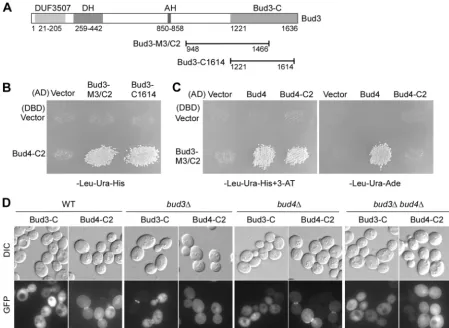
The anillin-related region of Bud4 interacts with the C-ter-minal region of Bud3.The anillin-related region of Bud4 localizes to the bud neck as well as on the plasma membrane. Because this region is critical for Bud4’s function in septin organization, we wanted to know how it targets to the bud neck. Bud4 is known to associate with Bud3in vivo(18). We therefore examined the in-teraction of the anillin-related region with several Bud3 segments (Fig. 5A) in a yeast two-hybrid assay. We found that the anillin-related region of Bud4 interacted with Bud3-M3/C2 (aa 948 to 1466) and Bud3-C1614 (aa 1221 to 1614) (Fig. 5BandC).
Full-length Bud4 also interacted with M3/C2 (Fig. 5C). Bud3-M3/C2 and Bud3-C1614 share the overlapping region from aa 1221 to 1466. Thus, the anillin-related region of Bud4 appears to interact with Bud3 via the C-terminal region from aa 1221 to 1466 of Bud3.
Interestingly, we found that the bud neck localization of the anillin-related region (Bud4-C2) disappeared in bud3⌬ and
bud3⌬bud4⌬cells, while its localization on the plasma membrane was unaffected (Fig. 5D), indicating that the bud neck localization of this region depends on Bud3. We previously reported that the C-terminal region of Bud3 (Bud3-C; aa 1221 to 1636) localized to the bud neck as a double ring in cells with medium to large buds (35). Remarkably, we found that the bud neck localization of Bud3-C was greatly diminished inbud4⌬andbud3⌬bud4⌬cells (Fig. 5D), suggesting that Bud3-C’s bud neck localization also depends on Bud4.
Together, our results show that the anillin-related region of Bud4 interacts with the C-terminal region of Bud3. The
C-termi-FIG 5Bud4-C2 interacts with the C terminus of Bud3. (A) Schematic representation of the domains of Bud3 and the locations of the Bud3-M3/C2 and Bud3-C1614 segments. The Dbl homology (DH) domain and the amphipathic helix (AH) are shown. (B) Bud4-C2 interacts with Bud3-M3/C2 and Bud3-C1614 in the yeast two-hybrid assay. Growth on the SC-Leu-Ura-His plate indicates the interaction between DBD and AD fusion proteins. Cells of strain pJ69-4␣ carrying pGBDU-C1 (vector, DBD) and pGBDU-BUD4-C2 were mated with cells of strain pJ69-4A carrying pOAD (vector, AD), pOAD-BUD3-M3/C2, and pOAD-BUD3-C1614. Diploids were replica plated to an SC-Leu-Ura-His plate and grown at 30°C for 3 days. (C) Bud3-M3/C2 interacts with full-length Bud4 and Bud4-C2 in the yeast two-hybrid assay. Cells of strain pJ69-4␣carrying pGBDU-C1 (vector, DBD) and pGBDU-BUD3-M3/C2 were mated with cells of strain pJ69-4A carrying pGAD-C1 (vector, AD), pGAD-BUD4, and pGAD-BUD4-C2. Diploids were replica plated onto an SC-Leu-Ura-His plate containing 3-AT (3-amino-1,2,4-triazole) and an SC-Leu-Ura-Ade plate and grown at 30°C for 3 days. (D) Localization of GFP–Bud3-C and GFP–Bud4-C2 in wild-type and mutant cells. Cells of strains YEF473A (wild type), YEF3570 (bud3⌬), YEF3572 (bud4⌬), and JGY781 (bud3⌬bud4⌬) carrying pUG36-BUD3-C or pBG2-BUD4-C2 were grown on SC-Ura medium before visualization. Bar, 5m.
on September 8, 2020 by guest
http://ec.asm.org/
nal regions of these two proteins may cooperate for bud neck targeting (septin association).
Bud4 may act together with Bud3 in septin organization dur-ing bud growth.Bud4 is thought to act together with Bud3 in the control of bud site selection at late G1stage of the cell cycle (13,17,
18). However, it is not clear whether Bud4 may act together with Bud3 in septin organization as well. We showed early in this study thatbud4⌬shs1⌬cells displayed defects in cell morphology and septin organization (Fig. 1AandB). Interestingly, we found that
bud3⌬shs1⌬cells also displayed elongated buds and cell chains when grown on YPD solid medium at a lower temperature. At 22°C, 62% ofbud3⌬shs1⌬cells examined (n⫽889) displayed elongated buds and 20% of cells formed cell chains (Fig. 6A). The extent of the defect was similar to that ofbud4⌬shs1⌬cells. Thus, it seems that Bud4 may act together with Bud3 in septin organi-zation during bud growth. A previous study showed that both
bud4⌬cdc12-6andbud3⌬cdc12-6cells were defective for growth
at 28°C, a temperature at whichcdc12-6cells could grow (22). We made an identical observation in our strain background (data not shown). In addition, we found that 100% ofbud4⌬cdc12-6and
bud3⌬cdc12-6cells examined (n⫽400) displayed dramatically
elongated buds at 28°C, whereas only 36% ofcdc12-6cells (n⫽
1,041) displayed elongated buds (Fig. 6B). These findings support the view that Bud4 and Bud3 may act together in septin organiza-tion. The interaction between the anillin-related region of Bud4 with Bud3’s C-terminal region may provide the basis for the func-tional cooperation between Bud4 and Bud3 in septin organiza-tion.
The anillin-related region of Bud4 is also the functional do-main for bud site selection.Bud4 is essential for axial bud site selection, as haploidbud4⌬cells could not bud in the axial pattern but instead budded in a bipolar pattern (7,13). Kang et al. (23) reported that both the central region and the C-terminal anillin-related region of Bud4 are required for Bud4’s function in bud site selection. However, neither of these two regions alone is sufficient
to carry out Bud4’s function in bud site selection (23). In contrast to their observation, we found that the anillin-related region is largely sufficient to carry out axial budding because Bud4-C2 (aa 1067 to 1447) largely rescued the axial budding defect (Table 2), suggesting that the anillin-related region is the functional domain for Bud4 in bud site selection. We observed that 41% of cells expressing Bud4-C2 (n⫽700) displayed a typical axial budding pattern, in which the bud scars were connected in a chain, while another 40% of the cells displayed an axial-like pattern, in which the bud scars were distributed at one pole but were not immedi-ately connected. There was some space between some of the bud scars (Table 2). When the budding pattern of those cells carrying only two bud scars was scored (8), 75% of cells expressing Bud4-C2 (n⫽156) exhibited the axial pattern, while 88% of cells expressing full-length Bud4 (n⫽100) and 4% of cells carrying the empty vector (n⫽100) exhibited the axial pattern. Because two-scar analysis monitors the fidelity of bud site selection for only one round of budding, this result supports the suggestion that C2 is largely functional in axial budding. Similarly, Bud4-⌬M1 (aa 1 to 621 plus 881 to 1447), which contains the anillin-related region but lacks TD1, behaved like Bud4-C2. In contrast, neither Bud4-N2 (aa 1 to 1066) nor Bud4-M1 (aa 623 to 880), two segments that carry TD1 but lack the anillin-related region, res-cued the axial budding defect (Table 2). We found that the Bud4 segment used by Kang et al. (23), which is here designated Bud4-C13 (aa 1082 to 1447), indeed completely failed to complement the axial budding defect ofbud4⌬cells (Table 2). The lack of function for Bud4-C13, which is 15 amino acids shorter than Bud4-C2, is likely due to the truncation of the putative nuclear export signal (NES), which leads to the retention of the protein in the nucleus (Fig. 2B), causing the protein to be unable to target to the bud neck.
Together, our results indicate that the C-terminal anillin-re-lated region of Bud4 is the functional domain for axial bud site selection. The central TD1 in Bud4 may increase the fidelity of bud site selection by the anillin-related region via restricting its local-ization to the bud neck.
DISCUSSION
Targeting mechanism of Bud4’s anillin-related region.In this study, we showed that, like human anillin and the fission yeast Mid1 and Mid2 (24,27,28, 44), the C-terminal anillin-related
TABLE 2Complementation of axial bud site selection defect ofbud4⌬
cells by full-length Bud4 and Bud4 segmentsa
Bud4 construct
% of cells expressing the following budding pattern
No. of cells Axial Axial-like Bipolar Random
Vector 8 72 20 200
Bud4 89 7 4 200
Bud4-N2 5 71 24 300
Bud4-C2 41 40 1 18 700
Bud4-C13 5 63 32 300
Bud4-C8 84 10 6 400
Bud4-⌬M1 34 50 5 11 500
Bud4-M1 2 79 19 300
apBG2 empty vector and pBG2-BUD4 segments were transformed into strain YEF3572
(bud4⌬). Cells with three or more bud scars were counted for determination of the budding pattern.
FIG 6Bud4 may act together with Bud3 in septin organization. (A) Cell morphology of strains YEF3570 (bud3⌬), YEF4603 (shs1⌬), and JGY3035 (bud3⌬shs1⌬). Cells were grown on YPD plates at 22°C for 6 days. (B) Cell morphology of strains YEF2218 (cdc12-6), JGY3040 (bud3⌬cdc12-6), and JGY3042 (bud4⌬cdc12-6) grown on an SC medium plate at 28°C for 1 day. Bars, 5m.
on September 8, 2020 by guest
http://ec.asm.org/
region of Bud4 is capable of targeting to the cell cortex and cleav-age furrow (bud neck). The only domain in the C-terminal region of anillin-related proteins with a known function is the PH do-main, which could interact with the negatively charged phosphoi-nositides in the plasma membrane via electrostatic interaction (45,46). For example, the PH domain of Bud4 binds specifically to phosphatidylinositol 3-phosphatein vitro(47). However, because the anillin PH domain itself is not sufficient, though it is necessary, for cleavage furrow targeting (24), as is the case for the PH do-mains of Bud4 and the fission yeast Mid2 (27,28; our unpublished data), the exact mechanism by which the C-terminal regions of anillin and its fungal homologues target to the cleavage furrow is not clear. On the basis of the findings of studies on other low-affinity PH domains, the targeting of anillin and fungal homo-logues to the cleavage furrow may require the cooperation of the PH domain with other domains in the protein (45) or may occur via oligomerization of the PH domain, as in the case of dynamin isoforms (48). In this study, we showed that the C-terminal tar-geting domain in Bud4, TD2, interacts with Bud3, another mem-ber of the axial landmark, for association with the septins at the bud neck. This demonstrated, for the first time, that a fungal an-illin homologue could cooperate with another protein for cleavage furrow targeting.
Role of Bud4 in septin organization.Bud4 is essential for the formation of two septin rings during cytokinesis (21–23). In this study, we showed that Bud4 is also required for septin organization during bud growth. Thus, Bud4 emerges as a new player in the organization of septin structures. However, the detailed mechanism of how Bud4 engages in septin organiza-tion is not clear.
We showed in this study that Bud4 contains two bud neck-targeting domains, TD1 and TD2, which could potentially bind to the septins. One clue about how Bud4 regulates septin organiza-tion may come from the TD2 domain. We observed that Bud4 TD2 is required and largely sufficient for the complementation of the elongated bud defect ofbud4⌬shs1⌬cells. Moreover, TD2 is absolutely required for Bud4’s function in the formation of two septin rings during cytokinesis. Thus, TD2 seems to be the major functional determinant of Bud4 in septin organization. Based on our observation that Bud4-TD2 interacts with the C-terminal re-gion of Bud3 (Bud3-C) and this interaction is crucial for targeting themselves to the bud neck, we speculate that Bud4-TD2 may initially loosely associate with the plasma membrane via the inter-action of its PH domain with phosphoinositides in the plasma membrane. The interaction between Bud4-TD2 and neighboring Bud3-C may create a binding surface for the septins, which not only helps to anchor themselves to the septin filaments but also helps to stabilize the septin ring. We showed previously that Axl2, the only transmembrane protein in the axial landmark, is impli-cated in septin organization during bud growth and cytokinesis, as
axl2⌬elm1⌬,axl2⌬gin4⌬, andaxl2⌬cla4⌬cells displayed syn-thetic morphological defects that included bud elongation and cell chain formation as well as a severe defect in septin organization at 24°C (17). Interestingly, the function of Axl2 in septin organiza-tion is largely mediated by its cytoplasmic tail, which localized to the bud neck, and this localization completely depends on the presence of both Bud4 and Bud3 (17). Therefore, we speculate that Bud4-TD2 and Bud3-C may cooperate to recruit Axl2 to the bud neck. This may help to stabilize the septin ring by linking the septins to the plasma membrane and/or cell wall because the bulk
N-terminal cadherin domain of Axl2 sticks out into the extracel-lular space.
Why is TD1 essential for Bud4’s function in the formation of two septin rings during cytokinesis, while it is largely dispensable for septin organization during bud growth? A recent study showed that the septin hourglass-to-double ring transition is accompa-nied by the loss of septin subunits from the hourglass and reorga-nization of the remaining subunits into the two septin rings (49). This process is also accompanied by a 90° change in septin fila-ment orientation from aligning to the mother bud axis to circling of the bud neck. During such a dramatic septin structure remod-eling process, TD1 may cooperate with TD2 to provide a stronger interaction with the septin filaments. This may help to prevent the loss of septin subunits during and after the hourglass-to-double ring transition.
Role of Bud4 in axial landmark assembly.Based on the de-pendency between these components for bud neck localization, we previously proposed that the axial landmark is assembled in the following order: the septins¡Bud4 and Bud3¡Axl1 and Axl2 (17). This model reflects that Bud4 cooperates with Bud3 in linking the axial landmark to the septins. Bud4 is known to inter-act with Bud3 (18). However, how the interinter-action is achieved is not understood. In this study, we showed that Bud4 and Bud3 interact with each other via their C termini and thus provided a mechanism for the functional cooperation between Bud4 and Bud3 in bud site selection. The interaction between the Bud4 C terminus (Bud4-C) and Bud3-C is apparently important for Bud3’s function in axial budding, because we showed previously that the N-terminal two-thirds of Bud3 is less efficient in axial budding than full-length Bud3 (35). Bud3 contains three targeting domains (aa 1 to 858, 841 to 1220, and 1221 to 1636) responsible for bud neck localization. Bud3-C (aa 1221 to 1636) happens to be the one that confers the most robust and the tightest bud neck association (35). When Bud3-C was removed, the rest of Bud3 (Bud3-NM) anchored poorly at the bud neck. The majority of protein then located on the entire plasma membrane and vacuoles (our unpublished data). We speculate that the interaction be-tween Bud4-C and Bud3-C may create a binding surface for the septins at the bud neck, which may lead to the efficient recruit-ment of Bud3 to the axial landmark complex. Thus, our study highlights the importance of the C terminus of Bud4 in the assem-bly of the axial landmark.
Bud3-C is unlikely the only region in Bud3 that interacts with Bud4, since Bud3-C is not absolutely required for Bud3’s function in axial budding (35). Bud4 may also interact with other parts of Bud3, such as the region from aa 1 to 858, which could partially function in axial budding (35). Future investigation is needed to test this possibility.
ACKNOWLEDGMENTS
We thank Erfei Bi, John R. Pringle, and Matthew Lord for kindly provid-ing yeast strains and plasmids.
This work was supported by the National Natural Science Foundation of China (grant no. 30871347 and 31370124) and the National Infrastruc-ture of Natural Resources for Science and Technology Program of China (no. NIMR-2014-8).
REFERENCES
1.Drubin DG, Nelson WJ.1996. Origins of cell polarity. Cell84:335–344. http://dx.doi.org/10.1016/S0092-8674(00)81278-7.
on September 8, 2020 by guest
http://ec.asm.org/
2.Nelson WJ.2003. Adaptation of core mechanisms to generate cell polar-ity. Nature422:766 –774.http://dx.doi.org/10.1038/nature01602. 3.Witte H, Bradke F.2008. The role of the cytoskeleton during neuronal
polarization. Curr Opin Neurobiol 18:479 – 487. http://dx.doi.org/10 .1016/j.conb.2008.09.019.
4.Chant J, Pringle JR. 1995. Patterns of bud-site selection in the yeast
Saccharomyces cerevisiae. J Cell Biol129:751–765.http://dx.doi.org/10 .1083/jcb.129.3.751.
5.Pringle JR, Bi E, Harkins HA, Zahner JE, De Virgilio C, Chant J, Corrado K, Fares H.1995. Establishment of cell polarity in yeast. Cold Spring Harbor Symp Quant Biol60:729 –744.http://dx.doi.org/10.1101 /SQB.1995.060.01.079.
6.Chant J.1999. Cell polarity in yeast. Annu Rev Cell Dev Biol15:365–391. http://dx.doi.org/10.1146/annurev.cellbio.15.1.365.
7.Chant J, Herskowitz I.1991. Genetic control of bud site selection in yeast by a set of genes that constitute a morphogenetic pathway. Cell65:1203– 1212.http://dx.doi.org/10.1016/0092-8674(91)90015-Q.
8.Flescher EG, Madden K, Snyder M.1993. Components required for cytokinesis are important for bud site selection in yeast. J Cell Biol122:
373–386.http://dx.doi.org/10.1083/jcb.122.2.373.
9.Fujita A, Oka C, Arikawa Y, Katagai T, Tonouchi A, Kuhara S, Misumi Y.1994. A yeast gene necessary for bud-site selection encodes a protein similar to insulin-degrading enzymes. Nature372:567–570.http://dx.doi .org/10.1038/372567a0.
10. Chant J, Mischke M, Mitchell E, Herskowitz I, Pringle JR.1995. Role of Bud3p in producing the axial budding pattern of yeast. J Cell Biol129:
767–778.http://dx.doi.org/10.1083/jcb.129.3.767.
11. Halme A, Michelitch M, Mitchell EL, Chant J.1996. Bud10p directs axial cell polarization in budding yeast and resembles a transmem-brane receptor. Curr Biol6:570 –579.http://dx.doi.org/10.1016/S0960 -9822(02)00543-2.
12. Roemer T, Madden K, Chang J, Snyder M. 1996. Selection of axial growth sites in yeast requires Axl2p, a novel plasma membrane glycopro-tein. Genes Dev10:777–793.http://dx.doi.org/10.1101/gad.10.7.777. 13. Sanders SL, Herskowitz I.1996. The Bud4 protein of yeast, required for
axial budding, is localized to the mother/bud neck in a cell cycle-dependent manner. J Cell Biol134:413– 427.http://dx.doi.org/10.1083 /jcb.134.2.413.
14. Versele M, Thorner J.2005. Some assembly required: yeast septins pro-vide the instruction manual. Trends Cell Biol15:414 – 424.http://dx.doi .org/10.1016/j.tcb.2005.06.007.
15. Oh Y, Bi E.2011. Septin structure and function in yeast and beyond. Trends Cell Biol21:141–148.http://dx.doi.org/10.1016/j.tcb.2010.11.006. 16. Gladfelter AS, Pringle JR, Lew DJ.2001. The septin cortex at the yeast mother-bud neck. Curr Opin Microbiol4:681– 689.http://dx.doi.org/10 .1016/S1369-5274(01)00269-7.
17. Gao X-D, Sperber LM, Kane SA, Tong Z, Tong AH, Boone C, Bi E.
2007. Sequential and distinct roles of the cadherin domain-containing protein Axl2p in cell polarization in yeast cell cycle. Mol Biol Cell18:2542– 2560.http://dx.doi.org/10.1091/mbc.E06-09-0822.
18. Kang PJ, Angerman E, Jung C-H, Park H-O.2012. Bud4 mediates the cell-type-specific assembly of the axial landmark in budding yeast. J Cell Sci125:3840 –3849.http://dx.doi.org/10.1242/jcs.103697.
19. Park H-O, Bi E.2007. Central roles of small GTPases in the development of cell polarity in yeast and beyond. Microbiol Mol Biol Rev71:48 –96. http://dx.doi.org/10.1128/MMBR.00028-06.
20. Kang PJ, Lee ME, Park H-O.2014. Bud3 activates Cdc42 to establish a proper growth site in budding yeast. J Cell Biol206:19 –28.http://dx.doi .org/10.1083/jcb.201402040.
21. Wloka C, Nishihama R, Onishi M, Oh Y, Hanna J, Pringle JR, Krauß M, Bi E.2011. Evidence that a septin diffusion barrier is dispensable for cytokinesis in budding yeast. Biol Chem392:813– 829.http://dx.doi.org /10.1515/BC.2011.083.
22. Eluère R, Varlet I, Bernadac A, Simon M-N.2012. Cdk and the anillin homolog Bud4 define a new pathway regulating septin organization in yeast. Cell Cycle11:151–158.http://dx.doi.org/10.4161/cc.11.1.18542. 23. Kang PJ, Hood-DeGrenier JK, Park H-O.2013. Coupling of septins to
the axial landmark by Bud4 in budding yeast. J Cell Sci126:1218 –1226. http://dx.doi.org/10.1242/jcs.118521.
24. Oegema K, Savoian MS, Mitchison TJ, Field CM. 2000. Functional analysis of a human homologue of theDrosophilaactin binding protein anillin suggests a role in cytokinesis. J Cell Biol150:539 –552.http://dx.doi .org/10.1083/jcb.150.3.539.
25. Piekny AJ, Maddox AS.2010. The myriad roles of anillin during cytoki-nesis. Semin Cell Dev Biol 21:881– 891. http://dx.doi.org/10.1016/j .semcdb.2010.08.002.
26. Kinoshita M, Field CM, Coughlin ML, Straight AF, Mitchison TJ.2002. Self- and actin-templated assembly of mammalian septins. Dev Cell
3:791– 802.http://dx.doi.org/10.1016/S1534-5807(02)00366-0. 27. Berlin A, Paoletti A, Chang F.2003. Mid2p stabilizes septin rings during
cytokinesis in fission yeast. J Cell Biol160:1083–1092.http://dx.doi.org/10 .1083/jcb.200212016.
28. Tasto JJ, Morrell JL, Gould KL.2003. An anillin homologue, Mid2p, acts during fission yeast cytokinesis to organize the septin ring and promote cell separation. J Cell Biol160:1093–1103.http://dx.doi.org/10.1083/jcb .200211126.
29. Gale C, Gerami-Nejad M, McClellan M, Vandoninck S, Longtine MS, Berman J.2001. Candida albicans Int1p interacts with the septin ring in yeast and hyphal cells. Mol Biol Cell12:3538 –3549.http://dx.doi.org/10 .1091/mbc.12.11.3538.
30. Paoletti A, Chang F.2000. Analysis of mid1p, a protein required for placement of the cell division site, reveals a link between the nucleus and the cell surface in fission yeast. Mol Biol Cell11:2757–2773.http://dx.doi .org/10.1091/mbc.11.8.2757.
31. Justa-Schuch D, Heilig Y, Richthammer C, Seiler S. 2010. Septum formation is regulated by the RHO4-specific exchange factors BUD3 and RGF3 and by the landmark protein BUD4 inNeurospora crassa. Mol Mi-crobiol76:220 –235.http://dx.doi.org/10.1111/j.1365-2958.2010.07093.x. 32. Si H, Rittenour WR, Xu K, Nicksarlian M, Calvo AM, Harris SD.
2012. Morphogenetic and developmental functions of theAspergillus nidulanshomologues of the yeast bud site selection proteins Bud4 and Axl2. Mol Microbiol85:252–270.http://dx.doi.org/10.1111/j.1365-2958 .2012.08108.x.
33. Guthrie C, Fink GR.1991. Guide to yeast genetics and molecular biology. Methods Enzymol194:1– 863.
34. Gao X-D, Caviston JP, Tcheperegine SE, Bi E.2004. Pxl1p, a paxillin-like protein inSaccharomyces cerevisiae, may coordinate Cdc42p and Rho1p functions during polarized growth. Mol Biol Cell15:3977–3985.http://dx .doi.org/10.1091/mbc.E04-01-0079.
35. Guo J, Gong T, Gao X-D.2011. Identification of an amphipathic helix important for the formation of ectopic septin spirals and axial budding in yeast axial landmark protein Bud3p. PLoS One6:e16744.http://dx.doi.org /10.1371/journal.pone.0016744.
36. James P, Halladay J, Craig EA.1996. Genomic libraries and a host strain designed for highly efficient two-hybrid selection in yeast. Genetics144:
1425–1436.
37. Longtine MS, McKenzie A, III, DeMarini DJ, Shah NG, Wach A, Brachat A, Philippsen P, Pringle JR.1998. Additional modules for ver-satile and economical PCR-based gene deletion and modification in Sac-charomyces cerevisiae. Yeast 14:953–961. http://dx.doi.org/10.1002 /(SICI)1097-0061(199807)14:10⬍953::AID-YEA293⬎3.0.CO;2-U. 38. Carroll CW, Altman R, Schieltz D, Yates JR, Kellogg D. 1998. The
septins are required for the mitosis-specific activation of the Gin4 kinase. J Cell Biol143:709 –717.http://dx.doi.org/10.1083/jcb.143.3.709. 39. Mino A, Tanaka K, Kamei T, Umikawa M, Fujiwara T, Takai Y.1998.
Shs1p: a novel member of septin that interacts with Spa2p, involved in polarized growth inSaccharomyces cerevisiae. Biochem Biophys Res Com-mun251:732–736.http://dx.doi.org/10.1006/bbrc.1998.9541.
40. Iwase M, Luo J, Bi E, Toh-e A.2007. Shs1 plays separable roles in septin organization and cytokinesis inSaccharomyces cerevisiae. Genetics177:
215–229.http://dx.doi.org/10.1534/genetics.107.073007.
41. Mortensen EM, McDonald H, Yates J, Kellogg DR.2002. Cell cycle-dependent assembly of a Gin4-septin complex. Mol Biol Cell13:2091– 2105.http://dx.doi.org/10.1091/mbc.01-10-0500.
42. Versele M, Thorner J.2004. Septin collar formation in budding yeast requires GTP binding and direct phosphorylation by the PAK, Cla4. J Cell Biol164:701–715.http://dx.doi.org/10.1083/jcb.200312070.
43. Osman MA, Konopka JB, Cerione RA.2002. Iqg1p links spatial and secretion landmarks to polarity and cytokinesis. J Cell Biol159:601– 611. http://dx.doi.org/10.1083/jcb.200205084.
44. Celton-Morizur S, Bordes N, Fraisier V, Tran PT, Paoletti A.2004. C-terminal anchoring of mid1p to membranes stabilizes cytokinetic ring position in early mitosis in fission yeast. Mol Cell Biol24:10621–10635. http://dx.doi.org/10.1128/MCB.24.24.10621-10635.2004.
45. Lemmon MA, Ferguson KM, Schlessinger J.1996. PH domains: diverse
on September 8, 2020 by guest
http://ec.asm.org/
sequences with a common fold recruit signaling molecules to the cell surface. Cell85:621– 624.http://dx.doi.org/10.1016/S0092-8674(00)81022-3. 46. Rameh LE, Arvidsson A-K, Carraway KL, III, Couvillion AD, Rathbun
G, Crompton A, VanRenterghem B, Czech MP, Ravichandran KS, Burakoff SJ, Wang D-S, Chen C-S, Cantley LC.1997. A comparative analysis of the phosphoinositide binding specificity of pleckstrin homol-ogy domains. J Biol Chem271:22059 –22066.
47. Yu JW, Mendrola JM, Audhya A, Singh S, Keleti D, DeWald DB, Murray D, Emr SD, Lemmon MA. 2004. Genome-wide analysis of
membrane targeting byS. cerevisiaepleckstrin homology domains. Mol Cell13:677– 688.http://dx.doi.org/10.1016/S1097-2765(04)00083-8. 48. Klein DE, Lee A, Frank DW, Marks MS, Lemmon MA. 1998. The
pleckstrin homology domains of dynamin isoforms require oligomeriza-tion for high affinity phosphoinositide binding. J Biol Chem273:27725– 27733.http://dx.doi.org/10.1074/jbc.273.42.27725.
49. Ong K, Wloka C, Okada S, Svitkina T, Bi E.2014. Architecture and dynamic remodelling of the septin cytoskeleton during the cell cycle. Nat Commun5:5698.http://dx.doi.org/10.1038/ncomms6698.
![FIG 1 Bud4 plays a role in septin organization during bud growth. (A) Cell morphology of strains YEF473A (wild type [WT]), YEF3572 (bud4�), YEF4603(shs1�), and JGY2737 (bud4� shs1�)](https://thumb-us.123doks.com/thumbv2/123dok_us/8649880.1726317/3.594.63.521.70.365/fig-plays-septin-organization-growth-cell-morphology-strains.webp)