A comparison of quality and satisfaction
experiences of patients attending chiropractic
and physician offices in Ontario
Edward R. Crowther,
BA, DC, MS, EdD, FCCS** Associate Professor, Division of Chiropractic, School of Health and Medicine International Medical University, No. 126 Jalan Jalil Perkasa 19, Bukit Jalil 57000 Kuala Lumpur, Malaysia
[email protected] 60129504264
Disclaimers: Nil
Institution Where Work Was Completed:
Department of Doctoral Studies, D’Youville College 320 Porter Avenue, Buffalo, New York, USA 14201
Sources of Support: The author received no funding support for the completion of this study. ©JCCA 2014
Introduction: Improving the quality of healthcare is a
common goal of consumers, providers, payer groups, and governments. There is evidence that patient satisfaction influences the perceptions of the quality of care received.
Methods: This exploratory, qualitative study described and analyzed, the similarities and differences in
satisfaction and dissatisfaction experiences of patients attending physicians (social justice) and chiropractors (market justice) for healthcare services in Niagara Region, Ontario. Using inductive content analysis the satisfaction and dissatisfaction experiences were themed to develop groups, categories, and sub-categories of quality judgments of care experiences.
Results: Study participants experienced both satisfying and dissatisfying critical incidents in the areas of standards of practice, professional and practice attributes, time management, and treatment outcomes. Cost was not a marked source of satisfaction or dissatisfaction.
Conclusion: Patients may be more capable of generating quality judgments on the technical aspects
Introduction : L’amélioration de la qualité des
soins de santé est un objectif commun pour les
consommateurs, les fournisseurs de soins, les payeurs et les gouvernements. Il est prouvé que la satisfaction des patients influe sur la perception de la qualité des soins reçus.
Méthodologie : Cette étude exploratoire et qualitative décrit et analyse les similitudes et les différences dans les expériences de satisfaction et d’insatisfaction des patients traités par des médecins (justice sociale) et des chiropraticiens (justice de marché) pour les services de soins de santé dans la région de Niagara, en Ontario. À l’aide d’analyses de contenu par raisonnement inductif, les expériences de satisfaction et d’insatisfaction ont été regroupées, catégorisées et sous-catégorisées par thème pour l’évaluation de la qualité de l’expérience de soins. Résultats : Les participants à l’étude ont connu des incidents critiques à la fois satisfaisants et insatisfaisants dans les domaines des normes de la pratique, des attributs professionnels et cliniques, de la gestion du temps, et des résultats du traitement. Le coût ne constituait pas une source importante de satisfaction ou d’insatisfaction.
Conclusion : Les patients sont peut-être davantage
Introduction
Much of our conceptualization of healthcare quality has come from the work of Donabedian.1 Published in 1980,
Donabedian’s Explorations in Quality Assessment and
Monitoring brought together broad acknowledgements of
early notions of healthcare quality. These included safety, accessibility, coordination of service delivery within and across systems, interpersonal skills of health profession-als, the technical abilities of health services providers, and cost. From these Donabedian developed a Unifying Model of Quality that defined healthcare as the manage-ment by a practitioner of a clearly definable episode of illness in a patient. This management, or “module of care” is characterized by three components; technical care, or the application of science and technology of healthcare to an episode of illness; the social and psychological man-agement of the patient and; amenities, those things that contribute to the comfort, promptness, courtesy, privacy and acceptability of healthcare.
Donabedian expanded his Unifying Model to include other components. While insufficient quantity of health-care services is a well-recognized concern, excess health-care delivery that provides no benefit or increases the risk of harm, is associated with poor quality. Cost remains in-extricably linked to quantity; as costs increase, the quan-tity of healthcare services decrease. Conversely, low-cost, or free healthcare services increase utilization and risk of harm from care that is useless or precludes the delivery of effective care. Three activities of healthcare delivery are considered to be linked to quality. Accessibility is achieved when care is easy to initiate and maintain. Fi-nancial, spatial, social and psychological factors contrib-ute to the ease or difficulty in accessing care. Effective coordination of care is achieved when there remain no in-terruptions in the delivery of successive modules of care within and across health disciplines and health systems.
Continuity is achieved with preservation of the orderly and reasonable evolution of care. Figure 1 considers the components and relationship of Donabedian’s Unifying Model of Quality.
While Donabedian considered healthcare quality to be “whatever you want it to be” he considered that the patient was solely responsible for rating the attributes of quality of care.2 The collective summation and balancing of these
attributes of care is considered patient satisfaction and is a reflection of the quality of care delivered. Satisfaction and quality are inextricably linked and interchangeable.
of medical and chiropractic care, particularly treatment outcomes and standards of practice, than previously thought.
(JCCA 2014;58(1):24-38)
k e y w o r d s: quality, satisfaction, chiropractic care
aspects techniques des soins médicaux et chiropratiques, en particulier sur les résultats de traitement et les normes de la pratique, que l’on pensait auparavant.
(JCCA 2014;58(1):24-38)
m o t s c l é s : qualité, satisfaction, soins chiropratiques
Figure 1
Donabedian’s Unifying Model has formed the basis for the development of a number of quality improve-ment initiatives in healthcare. In the United States, the Committee on the Quality of Health Care in America generated six aims for improvement in health services; safety, effectiveness, patient-centeredness, timeliness, ef-ficiency, and equity.3 In Canada, the “Romanow Report”
considered threats to health care delivery including ac-cessibility, coordination, cost and quality.4 The concepts
of quality in medicine and population health occupy a sig-nificant portion of the literature on healthcare quality. This is not the case in chiropractic. There remains a paucity of research exploring the chiropractic patient’s concept of quality. A number of studies of have con-sidered satisfaction with chiropractic and medical care in diagnostic related conditions such as low back pain5, 6,7,8,
asthma9, and management of their conditions in general10.
Quantitative satisfaction studies suggest that patients are satisfied with the interpersonal and psychosocial manage-ment of their problems through concern for their condi-tion, advice for self-management, explanation of treat-ment and accessibility to care. They were least satisfied with cost.
The direct comparison of quality in the delivery of medical and chiropractic services in Canada is difficult. The delivery of medical care in Canada occurs within a social justice contextwhere access to basic medical care is considered a right.11 As there is no limit to healthcare
service consumption when cost is removed government “planned rationing” limits access to services. This ra-tioning is consistent with current complaints with the Canadian healthcare system concerning access to a diag-nostic services and interventions.4 Conversely,
chiroprac-tic services are generally delivered in Canada within a market justice system. Subject to the laws of supply and demand, equilibrium is achieved when the capacity to pay for chiropractic services meets the ability of chiropractors to provide those services at a price.
In Ontario, both professions have been impacted in their ability to provide high quality care. For medicine this includes a lack of investment by governments in health care infrastructure and training sufficient number of physicians.12,13 For chiropractors it has been a chronic
overproduction of chiropractors for the marketplace, de-creased utilization of chiropractic services and competi-tion from other allied health professions.14
Against this contrasting backdrop of social and market justice delivery of medical and chiropractic services in Ontario, and within the theoretical framework of Don-abedian’s Unifying Model of Quality, this exploratory, qualitative study describes and analyzes the similarities and differences in satisfaction and dissatisfaction experi-ences of patients attending primary care physicians (so-cial justice) and chiropractors (market justice) for health-care services in Niagara Region, Ontario. Using induct-ive content analysis the satisfaction and dissatisfaction experiences are themed to develop groups and categor-ies of quality judgments of care experiences of patients. These groups and categories are considered in the light of Donabedian’s framework of technical skill, interpersonal skills, amenities, cost, accessibility, continuity and co-ordination.
Methods
Selection and Description of Participants
Recruitment of patient study participants and data collec-tion took place in 20 chiropractic offices in the Region of Niagara, Ontario. To insure the greatest exposure to potential study participants, only practitioners in full-time practice (greater than 15 hours per week) and who treat-ed in excess of 35 patients per week for greater than five years were invited to participate.15
Potential chiropractors were selected from the College of Chiropractors of Ontario Search Option webpage by location.16 The CCO database yielded 152 chiropractors
registered in the Niagara Region. Of these, 43 were not considered eligible for the study for a variety of reasons including suspensions, revoked licenses, resignations, ac-tive but non-practicing status, and inacac-tive and deceased status. Fourteen chiropractors were considered to be in-eligible due to potential conflict of interest with the re-searcher (ERC). Seventeen of the chiropractors were not eligible for inclusion as they had been in practice less than five years. Of the remaining 92 practitioners, 18 agreed to participate in the study. Two additional chiropractors were recruited from the adjacent Hamilton Region to par-ticipate in the study.
Population and Sample
of-fices were asked to participate in the study. No interviews were conducted at primary care physician offices.
The sample was a convenience sample of 200 patients attending for chiropractic treatment. Inclusion criteria required subjects to be aged 21 years or older; attended both a chiropractor and a family physician at least twice in the preceding year for examination or treatment and; consented to participate in the study.
Data Collection Methods
Patients who met the inclusion criteria and wished to par-ticipate in the study were given a Consent Form to review and sign. To avoid congestion and time delays in the daily flow of care delivery and impact perceptions of satisfac-tion, the remainder of data collection took place prior to or following the delivery of the chiropractic treatment. Basic demographic data was collected including age, gender, number of years as a chiropractic patient with most current practitioner, number of years as a medical patient with most current physician, and total average, annual out-of-pocket cost estimates for both chiropractic and medical visits.
The researcher (ERC) conducted a brief interview with each study participant using Flanagan’s Critical Incident Technique.17 Widely used in business, education, military
and healthcare settings, Critical Incident Technique (CIT) and related criteria is a systematic, inductive, open-end-ed procopen-end-edure for eliciting verbal or written information from respondents.18, 19 An incident is any observable
hu-man activity that is sufficiently complete to permit infer-ences and predictions to be made. A critical incident must satisfy five criteria: is the actual incident reported; was it observed by the reporter (study participant); were all relevant factors in the situation given; has the reporter (study participant) made a definite judgment regarding the criticalness of the incident and; has the reporter (study participant) made it clear just why she or he believes the incident was critical? Criteria One through Three address the validity of the experience. The remaining two criteria identify observed behavior that was significant and mean-ingful to the aim of the activity under study, and to gener-ate explicit reasons for those judgments.
Five pre-determined, adapted, semi-structured ques-tions were posed to each participant; think of a time when, as a chiropractic/physician patient, you had a satisfying/ dissatisfying care experience; when did the incident
hap-pen; exactly what happened; what specific circumstances led up to this care experience and; what resulted that made you feel that the care experience was satisfying/dis-satisfying?20 This was repeated until the study participant
was interviewed concerning a satisfying chiropractic care experience, dissatisfying chiropractic care experience, a satisfying medical care experience, and a dissatisfying medical care experience. The interviews were digitally recorded for transcription and content analysis. To stan-dardize and facilitate all aspects of the data collection and analysis processes, twenty test interviews were con-ducted, recorded, transcribed and reviewed prior to the experimental maneuverer.
Human Rights Protection
Full Institutional Review Board approval was re-ceived. This study employed methodology to insure the confidentiality of study participants and the anonymity of their data but allow for withdrawal from the study up to 72 hours after participation. To insure study participant privacy and confidentiality all interviews were conducted in a private setting within the chiropractic offices.
Treatment of Data
Recorded and transcribed interviews of study participants were reviewed and consensus achieved by two separate reviewers against the criteria to determine if the experi-ences were Critical Incidents.17 A third reviewer (ERC)
resolved disagreements between reviewers. Interviews considered not to be critical incidents were excluded from further analysis.
This study employed inductive content analysis as developed by Strauss.21 Interviews of satisfying and
cat-egory labels. Inter-rater agreement between the review-ers and the researcher was calculated. Validity was estab-lished at 80%.
Descriptive statistics were used to calculate means and percentages to describe the study group and the differ-ences in out-of-pocket costs and years of attendance at chiropractors and physicians. The n’s of each domain, group, category, and sub-category were analyzed using descriptive statistics to describe the differences between the two groups. The qualitative differences between the chiropractors and physician domains, groups, categories and sub-categories were explored.
A relative strength of differences scale was created to more effectively describe the levels of differences be-tween the percentages and n’s of the groups within the Satisfying and Dissatisfying Domains, Groups, Cat-egories and Sub-catCat-egories. It consisted of four relative strength levels; 0 – 4% difference represented no differ-ences between groups; 5 – 9% difference represented minimal differences between groups; 10 – 14% difference represented moderate differences between groups and; 15% or greater difference represented marked differences between groups.
Results
Study Group Description
In all, 197 participants were recruited from 20 participat-ing chiropractors. Of these 62% (n=122) were female; 38% (n = 75) were male. The mean age of the study par-ticipants was 55.0 years (SD + 16.1). Study parpar-ticipants, on average, had been patients of their family physicians for 15. 4 years (SD = 11.4), compared to 10.3 years (SD
= 9.1) for their chiropractors. When study participants
at-tended their family physicians they did so, on average, 3.9
(SD = 2.8) times per year. This is significantly lower than
the attendance at their chiropractors. On average, study participants attended their chiropractor 20.9 (SD = 19.4) times per year.
The mean annual cost for all study participants at-tending chiropractors was $355.70 (SD = $310.48). Sixty study participants incurred no costs for chiropractic ser-vices as visits were fully covered by a variety of insurers. Ten study participants incurred annual costs ranging from $20 to $120 at their physician’s for services charges.
Domain Development
In all, 197 study participants participated in the study pro-viding for 394 satisfying interviews. Ten interviews were excluded as they did not meet the criteria for a satisfy-ing critical incident: five each for satisfysatisfy-ing physician and satisfying chiropractic. The total n of the Satisfying Domain was reduced to 384, or 192 for each of the satis-fying physician and satissatis-fying chiropractic. There were 394 dissatisfying interviews in total. Ten interviews were excluded having not met the criteria for a dissatisfying critical incident: five each for dissatisfying physician and dissatisfying chiropractic. The total n of the Dissatisfying Domain was reduced to 384, or 192 for each of the dis-satisfying physician and disdis-satisfying chiropractic. The collection of satisfying and dissatisfying critical incidents were termed “domains”, a reflection of the highest taxo-nomic level.
Group Development Within The Satisfying and Dissatisfying Domains
Each critical incident transcript was reviewed using in-ductive content analysis. Six distinct, identical groups became clear within each of the Satisfying and Dissatis-fying Domains. For the SatisDissatis-fying Domain these includ-ed Satisfying Time Management, Satisfying Treatment Outcomes, Satisfying Standards of Practice, Satisfying Professional and Practice Attributes, Satisfying Cost, and Satisfying Gestalt Experiences. For the Dissatisfying Domain, this included Dissatisfying Time Management, Dissatisfying Treatment Outcomes, Dissatisfying Stan-dards of Practice, Dissatisfying Professional and Practice Attributes, Dissatisfying Cost, and Dissatisfying Gestalt Experiences. A number of interviews were gestalt in na-ture. Study participants had a general sense of whether they were satisfied, or dissatisfied, with their health care professional based on overall, general actions of their practitioners on every visit.
Category Development Within Satisfying Groups Within the Satisfying Domain, each Group was further reviewed to identify discrete categories. The satisfying groups, categories, labels and descriptions are found in Table 1.
Table 1:
Groups, Categories, Labels and Descriptions of the Satisfying Domains
Satisfying Domain Satisfying Groups Satisfying Categories
Satisfying Standards of
Practice A: Communicate a Diagnosis – establishing a timely and appropriate diagnosisB: Timely/Appropriate Referral – ability of HCP to refer to a medical specialist or other HCP C: Treatment – ability of HCP to provide timely and effective treatment
D: Education and Reassurance – education and comfort provided by HCP concerning their health E: Managing Multiple Health Concerns – ability of HCP to manage multiple complaints simultaneously F: Holism – willingness of HCP to practice or endorse a holistic approach to health
Satisfying Time Management A: Care Outside Hours – outside office hours or home visits B: Office Wait Times – wait times in office prior to seeing HCP C: Time With HCP – visit time spent with HCP
D: Office Contact to Appointment Time – ease or time required to contact HCP and book appointment Satisfying Treatment
Outcomes A: Positive Response to Treatment – satisfaction with improvement in symptoms and/or functionB: Full Resolution of Complaint – complete recovery in response to treatment Satisfying Professional and
Practice Attributes A: Professional Attributes – personal characteristic of HCP – caring, professional, smart, compassionate, trustworthy, kind, ethical, warm, re-assuring B: Accepting New Patients – willingness of HCP to accept as new patient
C: Heroic – lifesaving HCP conduct or management of extraordinary life threatening event D: Practice Attributes – general office environment – sense of friendliness, warmth E: Advocacy – effort of HCP to assist patient through complex health systems Satisfying Cost A: Cost – satisfaction with costs associated with care
Satisfying Gestalt Experiences B: Gestalt Experiences – delivery of an overall satisfying experience on each and every visit
Table 2:
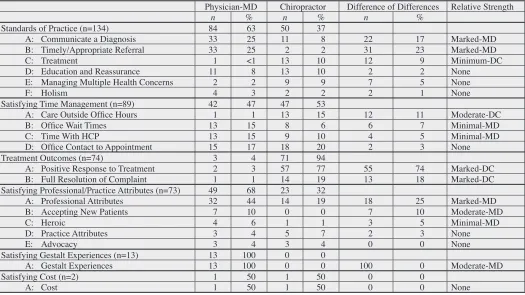
Categories, Differences, and Relative Strengths of Differences of the Satisfying Experience Domains
Physician-MD Chiropractor Difference of Differences Relative Strength
n % n % n %
Standards of Practice (n=134) 84 63 50 37
A: Communicate a Diagnosis 33 25 11 8 22 17 Marked-MD
B: Timely/Appropriate Referral 33 25 2 2 31 23 Marked-MD
C: Treatment 1 <1 13 10 12 9 Minimum-DC
D: Education and Reassurance 11 8 13 10 2 2 None
E: Managing Multiple Health Concerns 2 2 9 9 7 5 None
F: Holism 4 3 2 2 2 1 None
Satisfying Time Management (n=89) 42 47 47 53
A: Care Outside Office Hours 1 1 13 15 12 11 Moderate-DC
B: Office Wait Times 13 15 8 6 6 7 Minimal-MD
C: Time With HCP 13 15 9 10 4 5 Minimal-MD
D: Office Contact to Appointment 15 17 18 20 2 3 None
Treatment Outcomes (n=74) 3 4 71 94
A: Positive Response to Treatment 2 3 57 77 55 74 Marked-DC B: Full Resolution of Complaint 1 1 14 19 13 18 Marked-DC Satisfying Professional/Practice Attributes (n=73) 49 68 23 32
A: Professional Attributes 32 44 14 19 18 25 Marked-MD
B: Accepting New Patients 7 10 0 0 7 10 Moderate-MD
C: Heroic 4 6 1 1 3 5 Minimal-MD
D: Practice Attributes 3 4 5 7 2 3 None
E: Advocacy 3 4 3 4 0 0 None
Satisfying Gestalt Experiences (n=13) 13 100 0 0
A: Gestalt Experiences 13 100 0 0 100 0 Moderate-MD
Satisfying Cost (n=2) 1 50 1 50 0 0
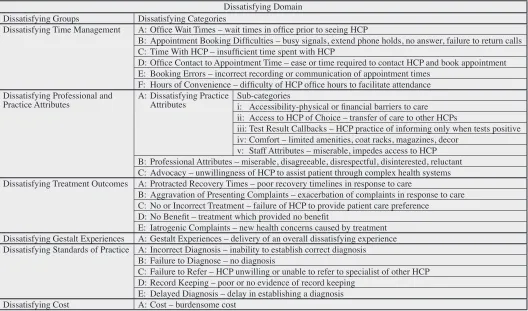
Category Development Within Dissatisfying Groups Within the Dissatisfying Domain, each Group underwent further content analysis into categories. In some instances these categories were similar to categories found within groups in the Satisfying Domain Groups. In some instan-ces additional, new categories emerged within each group not present in Satisfying Domain Groups. The Dissatisfy-ing groups, categories, subcategories, labels and descrip-tions are found in Table 3.
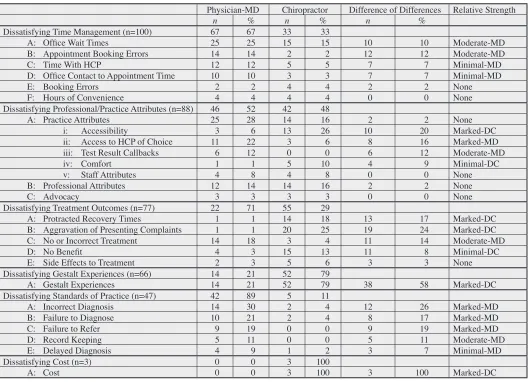
The frequency, percentages and relative strengths of the Dissatisfying Groups, Categories and Sub-categories are found in Table 4.
The validity of category labeling was challenged. Each of the two reviewers involved in the inclusion and exclu-sion of the interviews was asked to sort a series of critical incident interviews according to category, and sub-cat-egory labels. Thirty satisfying critical incident
transcrip-tions (15 physician, 15 chiropractic) and thirty dissatis-fying critical incident transcriptions (15 physician, 15 chiropractic) were allocated to Reviewer Number One and Number Two. Reviewer Number One correctly al-located 86% (n = 26) of the critical incidents to their re-spective categories and sub-categories. Reviewer Number Two completed a similar task correctly allocating 83% (n = 25) of the critical incidents to their respective categories and sub-categories. A pre-determined level of acceptabil-ity was considered to be 80%.
Calculations of Relative Strengths of Differences The relative strength of differences between n’s of phys-ician and chiropractic satisfying and dissatisfying cat-egories, groups and sub-groups was calculated using four relative strength levels as outlined in the methods. Results are highlighted in Table 2 and Table 4.
Table 3:
Groups, Categories, Sub-categories, Labels and Descriptions of the Dissatisfying Domain
Dissatisfying Domain Dissatisfying Groups Dissatisfying Categories
Dissatisfying Time Management A: Office Wait Times – wait times in office prior to seeing HCP
B: Appointment Booking Difficulties – busy signals, extend phone holds, no answer, failure to return calls C: Time With HCP – insufficient time spent with HCP
D: Office Contact to Appointment Time – ease or time required to contact HCP and book appointment E: Booking Errors – incorrect recording or communication of appointment times
F: Hours of Convenience – difficulty of HCP office hours to facilitate attendance Dissatisfying Professional and
Practice Attributes A: Dissatisfying Practice Attributes Sub-categoriesi: Accessibility-physical or financial barriers to care ii: Access to HCP of Choice – transfer of care to other HCPs
iii: Test Result Callbacks – HCP practice of informing only when tests positive iv: Comfort – limited amenities, coat racks, magazines, decor
v: Staff Attributes – miserable, impedes access to HCP B: Professional Attributes – miserable, disagreeable, disrespectful, disinterested, reluctant C: Advocacy – unwillingness of HCP to assist patient through complex health systems Dissatisfying Treatment Outcomes A: Protracted Recovery Times – poor recovery timelines in response to care
B: Aggravation of Presenting Complaints – exacerbation of complaints in response to care C: No or Incorrect Treatment – failure of HCP to provide patient care preference
D: No Benefit – treatment which provided no benefit
E: Iatrogenic Complaints – new health concerns caused by treatment Dissatisfying Gestalt Experiences A: Gestalt Experiences – delivery of an overall dissatisfying experience Dissatisfying Standards of Practice A: Incorrect Diagnosis – inability to establish correct diagnosis
B: Failure to Diagnose – no diagnosis
C: Failure to Refer – HCP unwilling or unable to refer to specialist of other HCP D: Record Keeping – poor or no evidence of record keeping
Discussion
The study participants in this research roughly mirror that which is known about utilization of chiropractic services in Ontario. This study population consisted of 62% fe-male and 38% fe-male in keeping with increased utilization among female patients. The mean age was 55.0 years (SD
= 16.1) and consistent with utilization by older
individ-uals. Large differences were seen in annual utilization. Study participants attended their physicians on average 3.9 (SD = 2.8) but their chiropractors 20.9 (SD = 19.4). This likely represents the nature of chiropractic practice where patients are often managed for chronic conditions and for supportive and wellness care.
In a market justice system cost is expected to be a sig-nificant constraint in utilization. Interestingly 60 partici-pants incurred no costs associated with attending their chiropractors having expenses covered by insurance car-riers or other agencies. The remainder paid, on average, anywhere from $200 to greater than $1,800 annually. Half of the study participants paid less than $200 annu-ally. Cost was considered by only three study participants to be dissatisfying. One participant voiced concern that the fees charged by their chiropractor were not consistent with the level of training required to become a chiroprac-tor and therefore undervalued. For physicians, where the assumption a social market would keep fees hidden, ten Table 4:
Categories, Sub-categories, Differences, and Relative Strengths of Differences of the Dissatisfying Experience Domains
Physician-MD Chiropractor Difference of Differences Relative Strength
n % n % n %
Dissatisfying Time Management (n=100) 67 67 33 33
A: Office Wait Times 25 25 15 15 10 10 Moderate-MD
B: Appointment Booking Errors 14 14 2 2 12 12 Moderate-MD
C: Time With HCP 12 12 5 5 7 7 Minimal-MD
D: Office Contact to Appointment Time 10 10 3 3 7 7 Minimal-MD
E: Booking Errors 2 2 4 4 2 2 None
F: Hours of Convenience 4 4 4 4 0 0 None
Dissatisfying Professional/Practice Attributes (n=88) 46 52 42 48
A: Practice Attributes 25 28 14 16 2 2 None
i: Accessibility 3 6 13 26 10 20 Marked-DC
ii: Access to HCP of Choice 11 22 3 6 8 16 Marked-MD iii: Test Result Callbacks 6 12 0 0 6 12 Moderate-MD
iv: Comfort 1 1 5 10 4 9 Minimal-DC
v: Staff Attributes 4 8 4 8 0 0 None
B: Professional Attributes 12 14 14 16 2 2 None
C: Advocacy 3 3 3 3 0 0 None
Dissatisfying Treatment Outcomes (n=77) 22 71 55 29
A: Protracted Recovery Times 1 1 14 18 13 17 Marked-DC
B: Aggravation of Presenting Complaints 1 1 20 25 19 24 Marked-DC C: No or Incorrect Treatment 14 18 3 4 11 14 Moderate-MD
D: No Benefit 4 3 15 13 11 8 Minimal-DC
E: Side Effects to Treatment 2 3 5 6 3 3 None
Dissatisfying Gestalt Experiences (n=66) 14 21 52 79
A: Gestalt Experiences 14 21 52 79 38 58 Marked-DC
Dissatisfying Standards of Practice (n=47) 42 89 5 11
A: Incorrect Diagnosis 14 30 2 4 12 26 Marked-MD
B: Failure to Diagnose 10 21 2 4 8 17 Marked-MD
C: Failure to Refer 9 19 0 0 9 19 Marked-MD
D: Record Keeping 5 11 0 0 5 11 Moderate-MD
E: Delayed Diagnosis 4 9 1 2 3 7 Minimal-MD
Dissatisfying Cost (n=3) 0 0 3 100
participants cited paying between $20 and $120 for “ad-ministrative fees” to cover future requests such as sick leave notes, form completion and file management. No participant cited the “free” cost of health care as a satisfy-ing incident for either chiropractic or medical services. Within the chiropractic experience a mixed model existed with participants having complete, partial or no coverage for costs. For some attending physicians unexpected out of pocket costs did occur.
When the satisfying critical incidents underwent in-ductive analysis a number of categories emerged. These included standards of practice, satisfying time manage-ment, treatment outcomes, satisfying professional and practice attributes, satisfying gestalt experiences and cost. Not surprisingly, the corollary is that the disfying incidents would mirror the categories from satis-fying domain. Indeed that was the case where critical incidents were themed around the similar categories of standards of practice, satisfying time management, trement outcomes, satisfying professional and practice at-tributes, satisfying gestalt experiences and cost. It is clear that study participants experienced both similar satisfying and dissatisfying experiences at both their physician and chiropractors around time management, professional and practice attributes, treatment outcomes, standards of prac-tice, gestalt experiences, and in some cases cost.
When applying Donabedian’s framework on the qual-ity of care that includes technical care, interpersonal care amenities, cost, quantity, continuity and coordination a number of observations are made.
Technical Component of Care Quality
Considering first the technical component of a module of care, the most prominent judgment on care quality is treat-ment outcomes. Almost exclusively, and overwhelmingly, study participants considered high quality chiropractic care to include either a full resolution of their complaints (marked difference) or a positive response to treatment (marked difference). Poor quality care was a result of pro-tracted recovery times (marked differences), aggravation of presenting complaints (marked difference), care that provided no benefit (minimal difference), or carried with it other iatrogenic side effects.
Almost absent among study participants was any judgment on high quality treatment outcomes from their physicians. In their absence, however, were a number of
poor quality judgments of physicians when they had no or incorrect treatment available (moderate difference). It may not be unreasonable to suggest that, for the most part, study participants have little expectation of their family physicians to address their immediate health concerns in a positive or negative way from treatment they are likely to deliver. The opposite for chiropractic practitioners is clear. Patients expect high quality intervention delivery and are unsatisfied when treatment fails to meet their ex-pectations. In the context of Donabedian’s framework, where care should maximize benefit and minimize risk, the study participant responses are surprising. Almost half of the satisfying experiences related to a reduction or resolution of symptoms while half of the dissatisfy-ing experiences are related to a failure to respond or re-solve symptoms, an exacerbation of presenting complaint or new iatrogenic complaints. Indeed, when it comes to chiropractic care study participants appear to have a more acute awareness of the quality of the technical compon-ents of care in ameliorating or aggravating their pain-re-lated conditions.
The second group that is firmly anchored in the tech-nical component of care is Standards of Practice. Com-prised of the key competencies of professional practice including ability to diagnosis, communicate a diagnosis, provide treatment options, initiate timely and appropriate referrals, maintain appropriate records, it is dominated by both high quality and poor quality judgments of care de-livered by physicians and, less so by chiropractors. When high quality judgments are awarded for physician care in this group, it is primarily for the ability of the physician to generate a diagnosis (marked difference) and to make timely and appropriate referrals (marked difference). When poor quality judgments are offered they are over-whelmingly for physicians in every category including delayed diagnosis (minimal difference), failure to diag-nosis (marked difference), generating incorrect diagnoses (marked difference), failing to refer (marked difference), and keeping inadequate records (moderate difference). Study participants clearly expect a high degree of com-petence in their physician to establish a diagnosis and make a timely and appropriate referral. They provide poor quality judgments when they fail to generate an accurate diagnosis in reasonable time, fail to refer, and fail to keep adequate records.
award-ed for variety in treatment options (minimal difference) and ability to manage multiple health concerns (minimal difference). Few study participants provided poor qual-ity judgments for failure to diagnosis, make timely and appropriate referrals, and keeping adequate records for chiropractic experiences. It might appear that study par-ticipants see a greater responsibility of their physicians to diagnose, refer, and keep adequate records. Chiroprac-tors, trained and regulated to be primary contact practi-tioners, are required to adhere to similar standards of practice activities as physicians in the areas of diagnosis, referral, and record keeping. This tends not to be a source of satisfaction and dissatisfaction and of expectation of study participants vis-à-vis their chiropractors.
Considering both the Treatment Outcomes and Stan-dards of Practice Groups within the technical components of care a number of things becomes clearer. Donabedian considered that by and large overall judgments of care quality were based on a patient’s perception of quality of care from the interpersonal and amenities domains. He considered that few patients had the capacity to rate the technical quality of care. For physician judgments in this study, participants were most satisfied with aspects of diagnosis and a referral to another provider for additional assessment and treatment. They were dissatisfied when, in their view, these expectations were not met. For qual-ity judgments concerning chiropractic care, in general, study participants were keenly aware of the success or failure of the interventions. As pain appeared to be the primary outcome, study participants were provided with a convenient benchmark to assess the high quality, or poor quality of treatment outcomes. Combined, these quality judgments represent almost 50% of all critical incidents reported in this study. There is some suggestion that pa-tients may make significantly more quality judgments concerning technical quality than originally considered by Donabedian.
Interpersonal Component of Care Quality
The second component of Donabedian’s framework con-sidered the interpersonal aspects of care. Most quality judgments in this study are found in the Professional and Practice Attributes. Once again, the overall frequencies of responses are primarily physician in nature. From an interpersonal perspective, study participants generated more high quality judgments in the area of professional
attributes (moderate difference) for their physicians. They were more likely, and often, to describe their physician as caring, compassionate, competent, kind, ethical, and available than their chiropractor (marked difference). By virtue of scope of practice physicians are more likely able to engage in heroic, life saving acts (minimal differences). When study participants confirmed poor quality judg-ments on their physicians it was on descriptions of pro-fessional attributes such as miserable, disagreeable, reluc-tant, drug pusher, disrespectful, disinterested, and a failure to advocate on their behalf (no difference). They expect their physicians to portray the requisite professional at-tributes and interpersonal skills and are dissatisfied when they fail to meet their quality expectations. With the ex-ception of some interest in high quality judgments around personal attributes such as kindness, compassionate, and dedicated quality judgments, attributes to chiropractors in this component of care are limited. Paradoxically study participants are more likely to raise concerns over profes-sional attributes of chiropractors describing them as lack-ing initiative, providlack-ing therapies of convenience to the chiropractor, intellectually condescending, prone to over treatment and overbilling and having ethical conflicts of interest around marketing and sales (no difference). Amenities Component of Care Quality
The third component of a module of care is amenities. Such amenities as warm and welcoming office environ-ments were proposed for both chiropractors and physician office environments but these were limited. Chiropractors were most likely to garner poor quality judgments on amenities with concerns over décor, climate control, and lack of simple office conveniences such as coat racks (no difference).
Cost
were however some other indicators of cost, supply and quality. Seven study participants considered that simply having their physician accept them as a patient was a high quality judgment. This might be considered a reflection of a system that has trained too few physicians for the popu-lation. It might also simply, and most probably, reflect a local variation is physician supply.
Although cost did not appear to represent a significant barrier to access to care for the chiropractic group this is reported with limitations given that this study, by its na-ture, sampled those study participants with the financial capacity to attend for chiropractic care. No study partici-pant voiced that the quality of their chiropractic care was compromised by cost and the ability to attend as frequent-ly as they wished. Cost for care for physicians, naturalfrequent-ly, within a social justice system, was not a source of poor quality judgments.
Accessibility, Continuity, Coordination
Overlapping the three components of technical, inter-personal, amenities and cost are accessibility, continu-ity, and coordination. Care is considered to be accessible when it is easy to initiate, and maintain with limited fi-nancial, spatial, social, and psychological factors are fac-tors that enhance or detract from accessibility. For chiro-practors, a number of poor quality judgments were cited around what might be considered to be physical access to care. This included a lack of disability access ramps and doorways, poor office maintenance, and snow removal. Outside of parking issues, physical access was not a qual-ity issue for physicians. Physicians were most likely to be plagued with poor quality judgments over access to their HCP of Choice. Given the emergence of Family Health Teams that, by design, recruit other health professionals such as nurse practitioners, it is more likely that study par-ticipants might encounter a circumstance where the phys-ician may not see them. This is compounded by a med-ical training system that places clerks and residents in the family physician and family health team offices. While it may not be unreasonable to think that study participants might be buoyed with the notion of their physician being involved in medical education, no study participant con-sidered that this enhanced the quality of their experiences. This is less likely to occur in the chiropractic realm. Only two chiropractic study sites incorporated other health pro-fessionals. These two sites were the principle source of
dissatisfaction where study participants were treated by physiotherapists or, on occasion, junior chiropractors. Given that chiropractic education programs have been un-able to develop community-training program for students, it is unlikely that study participants would have a quality concern in this regard.
Coordination is considered to be the process by which the elements of care are linked in overall design. Effective coordination is characterized by the lack of interruption in needed care, and the maintenance of the relatedness between successive sequences of care. The most frequent source of quality judgments concerning coordination can be considered the Time Management Group. For chiro-practors, most quality judgments were generated around the ease at which the office could be contacted and ap-pointments booked. Study participants were also enthusi-astic about the willingness of the chiropractor to provide care outside of published office hours or their willingness to perform home visits (moderate difference). An appre-ciable number of poor quality judgments were raised con-cerning office wait times in chiropractic offices. The re-mainder of the categories in this group generated greater numbers of quality judgments regarding physician inter-action. High quality judgments were awarded for ease of booking appointments, office wait times (minimal differ-ences), and time spent with their physician (minimal dif-ferences). While study participants awarded high quality judgments under these circumstances, they also awarded considerable poor quality judgments when physicians failed to make the booking of appointments an easy pro-cess (moderate difference), experienced delays in contact to appointment time (minimal differences), created what would be considered unrealistic office wait times (mod-erate differences) and spent too little time with patients (minimal differences). Study participants clearly gener-ated more quality judgments around time management and coordination of the continuum of care, at least within the family physicians office.
participants did consider a number of poor quality judg-ments around failure to refer (marked difference). Still, these were eclipsed by high quality judgments around the physician’s ability to make timely and appropriate refer-rals (marked difference) and coordinate care across other health care services and facilities and between other pro-viders and specialists. Indeed, some of these stories were extraordinary. Study participants described their phys-ician as the “quarterback who took charge”, or “sprung into action in a way I had never seen before”, and “made sure I got everything I needed right away” when they were faced with serious health threats. This is in stark contrast to an ongoing cultural awareness of a health system com-promised by dangerous wait times and shortages of phys-ician specialists. No study participant provided poor qual-ity judgments that could be considered indictments of the system in this regard. On the contrary, study participants had high praise for their physician’s ability to coordinate their care.
Finally, continuity remains the preservation of past findings, evaluations, and decisions and their use that promotes stability the overall objectives and methods of management. Outcomes of effective coordination and on-going continuity of care are considered by Donabedian to be accurate diagnosis, appropriate management, and enhanced patient satisfaction. Outside of concerns over record keeping (moderate difference), primarily a poor quality judgment of physicians, continuity did not appear to be a significant source of quality judgments.
Market Justice Implications
In this study it was considered that chiropractic services, not covered by a government health-funding plan, might behave as a market justice commodity. Physician service costs covered under government plans should behave as a social justice commodity. While this study did not expressly set out to determine if the differences seen be-tween the quality judgments of physicians and chiroprac-tors were directly related to the requirement to pay for care, it was anticipated that it would provide some infor-mation for consideration for future research.
Cost, which should be a consideration in any discus-sion around health services delivery, remarkably, generat-ed almost no satisfying or dissatisfying critical incidents; almost to the point where it might be considered a non-issue. Only three of 192 dissatisfying chiropractic critical
incidents chronicled concerns over out of pocket cost. No study participant voiced concerns that cost represented a potential barrier to access or created a burdensome finan-cial situation. This may be due to several reasons. First is the potential selection bias of study participants who must have attended their chiropractor for a minimum of one year to be eligible to participate in the study. The in-clusion requirements may not sample those study partici-pants for who cost may represent a potential barrier to access or be burdensome. Second are the overall costs. An analysis of annual costs paid for by study participants for chiropractic services suggests that 54% (n = 105) paid less than $200 per year for chiropractic care. Another 21% (n = 42) paid between $201 and $400. Another 10% (n = 19) paid between $401 and $600 annually. In all, 85% (n = 166) of study participants paid $600 or less an-nually for chiropractic services. This may not represent a sufficient cost to create dissatisfying critical incidents. Still, no study participant voiced satisfaction over the low cost of chiropractic treatment.
In market justice environments it might be expected that some measure of enhanced service be provided to position the competitor more strategically in the market-place. This does not appear to be the case. Chiropractic dissatisfying experiences were prevalent in the categor-ies of accessibility and comfort. These critical inci-dents included such concerns as limited parking, lack of wheelchair ramps, heavy doors that impeded access, lack of snow clearing, poor climate control, and absence of simple amenities such as coat racks. No such similar critical incidents were described concerning physician of-fices. This may be reflective of the 50% decreased earning capacity that Ontario chiropractors witnessed over the ten years from 1993 through 200314. There may simply not
be the financial resources available to continue to provide high quality practice facilities.
chiroprac-tors provide extra time with patients or limit office wait times as a service strategy within a market justice system. The patterns of satisfying and dissatisfying chiropractic experiences were similar to those of physicians.
Study Implications
The results of this study have implications for practice for both physicians and chiropractors in the Niagara Region and potentially generalizable to other regions.
For physicians, many poor quality judgments were passed in the Standards of Practice Categories. Study par-ticipants described that their physicians were often unable to diagnosis their problems, generated an incorrect diag-nosis, or failed to diagnosis at all. It must be remembered that this remains the study participant’s perception of their physician’s diagnostic abilities, not a confirmation of the inability to generate a diagnosis. Physicians must be seen to provide an adequate explanation around diag-nostic challenges and conundrums to insure that patients are given some confidence in their diagnostic abilities. Similarly physicians must provide adequate explanations of why referrals to specialists are typically not required. What may be self-evident to the physician around a lack of need for referral that requires no explanation may be seen as a failure to explain or refer by the patient. Phys-icians must be seen to be actively engaged in the record keeping process and conduct a regular review of clinical records to insure that patients have confidence in the pres-ervation of their clinical data. Many patients used to their physicians employing pen and paper records may find that electronic medical records provide little confidence for completeness.
Practice implications for chiropractors are significant. Results of this study suggest that while patients are par-ticularly satisfied concerning the outcomes of treatment, a large number of study participants reported a lack of re-sponse to care, protracted recovery, aggravation of com-plaints, and the emergence of new complaints following treatment. This suggests a greater negative response to care than what is currently thought and chiropractic titioners should be aware of this in their day-to-day prac-tice. Chiropractors should also be sensitive to criticisms over accessibility issues, amenities, and professional at-tributes as voiced by their patients.
Implications for Management
Both physicians and chiropractors perform aspects of practice management of varying quality. Both health disciplines experienced difficulties with time manage-ment and, overall, quality assurance and quality improve-ment. While some issues of time management may be due to patient volumes and, under some circumstances, short-ages of medical practitioners, most time management issues are a product of ineffective or no-existent process management. All time management categories, from ease of appointment booking, office contact to appointment time, office wait times, time with HCP, booking errors, and hours of convenience are outcomes of poor time man-agement. This represented a large source of poor quality judgments for both physicians and chiropractors. More effective time management methods would address many of these quality issues.
The fact that many of the dissatisfying critical incidents occur speaks to the lack of any quality improvement and quality assurance programs in any practitioner’s offices. It is not unreasonable to think that such issues as poor climate control, poor snow clearance, lack of coat racks, dissatisfaction with time management, pain and discom-fort from treatment, lack of advocacy, and access to HCP of choice would not be identified and addressed if even basic quality assurance/quality improvement initiatives were put in place.
Implications for Training
Recommendations for Future Research
The quality judgments provided by patients in this study are from patients who attend both physicians and chiro-practors. The results are not necessarily generalizable to patients who attend just physicians. In some ways the quality judgments of participants concerning their phys-icians may be influenced in some manner because they attend chiropractors. Still, the information and tested methodology from this study can be used as a platform for further explorations into quality in both physician’s and chiropractor’s offices.
For chiropractors, the results of this study suggest that further study is required in a number of areas. First is in the matter of treatment outcomes. Donabedian considered that the highest measure of healthcare care quality is care that provides the greatest benefit for the lowest risk. A high number of study participants reported no benefit from care, protracted recovery times, aggravation of pre-senting complaints, and side effects from treatment. The risks of serious injury from chiropractic treatment have been well documented but the results of this qualitative study suggest the potential for a much broader, previ-ously unrecognized consequence of chiropractic treat-ment. Second is the self-perception of chiropractors and how they see their role and identity as defined by training versus the perception of their patients. Chiropractors are trained as primary contact practitioners with a respon-sibility to diagnosis and refer as required. Results of this study suggested that chiropractic patients see their chiro-practors as “pain technicians” rewarding their practition-ers with high quality judgments when pain is managed ef-fectively, and awarding poor quality judgments when pain complaints are not addressed. Study participants provided few quality judgments around diagnosis and referral by their chiropractors. Instead, study participants generated a large number of quality judgments around their phys-ician’s activities in this regard. This is an unanticipated observation and requires some future consideration.
Limitations of the Study
A number of study limitations exist. The first is the gener-alizability of the results of this study to other jurisdictions. The results of this study are not necessarily generalizable to other regions within and outside of Ontario. Different payment systems, cultural differences and practitioner availability, among other factors, make generalizability
difficult. Second, critical incidents around costs and as-sociated results are limited. Only those individuals who met inclusion criteria, including ongoing chiropractic care greater than one year were included. By design, this creates a bias towards those individuals who can afford ongoing care. Third, the results may only be generalizable to those individuals who attend both a chiropractor and physician. There may be some inherent difference in qual-ity and satisfaction perspectives of patients who see both chiropractors and physicians over patients who see just physicians. And finally, there are those limitations associ-ated with qualitative, inductive studies. While this study did address issues of multiple coding, in part through the use of the label validity process there always remains the possibility of bias and subjectivity in the theming process. Respondent validation exercises were not designed into the process over concerns of demands on participants time.22
References
1. Donabedian. A. Explorations in quality assessment and monitoring. Ann Arbor, Michigan: Health Administration Press; 1980.
2. Donabedian A. Reflections on the effectiveness of quality assurance. In Palmer RH, Donabedian A, Povar GS. editors. Striving for quality in healthcare: an inquiry into policy and practice. Ann Arbor, Michigan: Health Administration Press; 1991.
3. Institute of Medicine. Crossing the quality chasm: a new health system for the 21st century. Washington, D.C.:
National Academy Press; 2001.
4. Romanow RJ. Building on values: the future of healthcare in Canada. National Library of Canada; 2002.
5. Coulter ID, Hurwitz EL, Adams A, Genoves B, Hays R, Shekelle P. Patients using chiropractors in North America: who are they and why are they in chiropractic care. Spine. 2002; 291-297.
6. Cherkin DC, MacCormack FA. Patient evaluations of low back pain care from physicians and chiropractors. Western J Med. 1989;351-355.
7. Carey TS, Garrett J, Jackman A, McLaughlin C, Fryer J, Smucker DR. (2010). The outcome ad costs of care for acute low back pain among primary care practitioners, chiropractors, and orthopedic surgeons. NEJM. 2010. 913-917.
9. Balon J, Aker PD, Crowther ER, Danielson C, Cox PG, O’Shaughnessy D, et al. (1998). A comparison of active and simulated chiropractic manipulation as adjunctive treatment for childhood asthma. NEJM. 1998; 339:1013-1020.
10. Gaumer G. Factors associated with patient satisfaction with chiropractic care: survey and review of the literature. J Manip Physiol Thera. 2005; 29: 455-462.
11. Darr K. Ethics in health services management. Baltimore: Health Professions Press. 1991.
12 Organization for Health Economic Co-operation and Development. 1999 Health Data. Paris. 2000.
13. Kral B. 2010. Physician Human Resources in Ontario: the Crisis Continues. Available from http://www.oma.org/ Shortage/Data/01crisis.asp.
14 Mior SA, Laporte A. Economic and resource status of the chiropractic profession in Ontario, Canada: a challenge or an opportunity. J Manip Physiol Thera. 2008: 31; 104-114. 15. Canadian Chiropractic Protective Association. Available
from http://www.ccpaonline.ca. 2009.
16. College of Chiropractors of Ontario. Available from www. cco.on.ca. 2010.
17. Flanagan JC. The critical incident technique. Psychological Bulletin. 1954; 51: 327-357.
18. Norman IJ, Redfern SJ, Tomalin DA, Oliver S. Developing Flanagan’s critical incident technique to illicit indicator’s of high and low quality nursing care from patients and their nurses. J Adv Nursing. 1992: 17; 590-600. 19. Fivers G, Fitzpatrick R. (2004). The Critical Incident
Technique Bibliography. Available from http://www.apa. org/pubs/databases/psycinfo/cit-intro.pdf. 2004.
20. Bitner MJ, Booms BH, Tetreault MS. The Service Encounter: diagnosing favorable and unfavorable incidents. J Marketing. 1990; 54; 71-84.
21. Strauss AL. Quantitative Analysis for Social Scientists. New York: Cambridge University Press. 1987.