Pokémon GO Forensics: An Android Application
Analysis
Joshua Sablatura1,* and Umit Karabiyik2*
1 Department of Computer Science, Sam Houston State Univeristy, Huntsville, Texas; [email protected] 2 Department of Computer Science, Sam Houston State University, Huntsville, Texas; [email protected] * Author to whom correspondence should be addressed.
Abstract: As the geolocation capabilities of smartphones continue to improve, developers have continued to create more innovative applications that rely on this location information for their primary function. This can be seen with Niantic’s release of Pokémon GO, which is a massively multiplayer online role playing and augmented reality game. This game became immensely popular within just a few days of its release. However, it also had the propensity to be a distraction to drivers resulting in numerous accidents, and was used to as a tool by armed robbers to lure unsuspecting users into secluded areas. This facilitates a need for forensic investigators to be able to analyze the data within the application in order to determine if it may have been involved in these incidents. Because this application is new, limited research has been conducted regarding the artifacts that can be recovered from the application. In this paper, we aim to fill the gaps within the current research by assessing what forensically relevant information may be recovered from the application, and understanding the circumstances behind the creation of this information. Our research focuses primarily on the artifacts generated by the Upsight analytics platform, those contained within the bundles directory, and the Pokémon Go Plus accessory. Moreover, we present our new application specific analysis tool that is capable of extracting forensic artifacts from a backup of the Android application, and presenting them to an investigator in an easily readable format. This analysis tool exceeds the capabilities of UFED Physical Analyzer in processing Pokémon GO application data.
Keywords: digital forensic tool, mobile application forensics, geolocation, Upsight, Pokémon GO, Pokémon GO Plus
1. Introduction
On July 6, 2016 Niantic, a subsidiary of Google, in conjunction with Nintendo and The Pokémon Company released Pokémon GO [1] a massively multiplayer online role playing and augmented reality game for mobile devices that is based upon the late 1990s Pokémon cartoon series, and the Nintendo Gameboy game series. The game which was built upon the same framework as Niantic’s earlier game, Ingress, utilizes the GPS capabilities provided by most smartphones to allow the user to locate, capture, and train virtual creatures within the real world. These creatures appear based on the physical location of the user, and the type of pokémon encountered.
Soon after its release Pokémon GO quickly became one of the most popular mobile applications on the market. Within just five days of its release Pokémon GO was installed on 10.8% of U.S. android phones [2]. Furthermore, based on application usage data from July 8th, users were spending an average of 43 minutes a day within the application [3]. According to the 2017 U.S. Cross-Platform Future in Focus report published by comScore, within just seven days of its release the popularity of Pokémon GO peaked at over 28.5 million daily unique visitors, and has since leveled out at around five million daily unique visitors in December 2016, with approximately 60% of its user base comprised of 18-34 year-old Millennials who grew up with the cartoon and game series [4]. This steep decline can largely be attributed to a lack of long term goals in the game, and certain features that were expected by the users such as the pokémon tracker, player-versus-player battling, and pokémon trading. However, despite these declining usage numbers Pokémon GO has generated over one
billion dollars in revenue since its launch [5], and as of April 2017, maintains a user base of 65 million monthly active users. These numbers are predicted to increase as Niantic has announced plans to release several long-awaited features including player-versus-player battling, and pokémon trading in a coming update [6]. Pokémon GO has also won several awards including The Game Award for Best Mobile/Handheld Game, and Best Family Game in 2016.
Pokémon GO was an immensely popular game that succeeded in increasing the physical activity of many people as it required them to go outside and walk around in order to find pokémon. A study that monitored users for 30 days shortly after the games release, estimated that on average users increased their activity by 1,473 steps while playing the game [7]. This surge of physical activity could be seen in news reports as hundreds of people flocked to sightings of rare pokémon within New York City’s Central Park [8], and Santa Monica Pier in California [9]. This huge surge of people taking to the outdoors to seek pokémon lead to some very interesting discoveries as was reported by the media in the case of a 19 year-old Wyoming girl who stumbled upon a dead body while searching for a water type pokémon by a river near her home [10]. Pokémon GO has also been attributed to helping two marines, who were visiting a pokéstop in Fullerton Park in California, catch a murder suspect after they noticed a suspicious man approaching a mom and her three kids [11].
However, not all of the news stories about Pokémon GO are positive in nature. In O’Fallon Missouri four armed robbers placed a lure module on a secluded pokéstop to lure in unsuspecting pokémon trainers [12]. There have also been numerous reports of distracted pedestrians being injured, and/or trespassing on private property or restricted areas to capture pokémon prompting the Joint Base Lewis-McChord military base near Tacoma, Washington to issue a warning to pokémon trainers [13]. Furthermore, it did not take pokémon trainers long to realize they could cover more ground by driving instead of walking. John Ayers of San Diego State University searched through social media posts on Twitter and examined news stories for evidence of people having accidents while driving and playing Pokémon GO during the course of 10 days shortly after the games release. The researchers discovered that there were 14 unique crashes, while approximately 18% of tweets indicated that a person was playing and driving, while 11% of tweets indicated that a passenger was playing [14]. In fact there have been numerous news reports of Pokémon GO players who have crashed their automobiles into a tree, parked police car, school, and at least one reported instance of a woman who was killed when a distracted driver playing Pokémon GO struck two pedestrians [15–18].
Because of Pokémon GO’s widespread popularity, propensity to be a distraction to pedestrians and divers, and its use as a tool to attract victims of armed robbery it is likely that a forensic investigator will encounter a mobile investigation where the data contained in the application will need to be analyzed. Unfortunately, since Pokémon GO is a new application little research has been conducted that focuses on understanding the forensically relevant artifacts found within the application, and the circumstances that surround their creation. This paper seeks to expand upon the current research in order to discover any forensically relevant information that may be contained in the Pokémon GO application, and develop an understanding of how this information was created by the application. This information may include corroborative evidence that may place a user at the location of a crime, or may support the idea that a user was distracted by the application while walking or driving. Furthermore, this research expands upon prior research by including the Pokémon GO Plus device, and examining the metadata contained within images generated by the application.
This research furthers the understanding of Pokémon GO application forensics by making the following contributions to the current state-of-the-art:
i) Identifies the most recent time frame in which the application was run in the foreground of a mobile device by examining the session information contained within theupsight.xmlfile. ii) Identifies the relative geolocation of the user at the end of the most recent time frame in which
iii) Identifies additional methods that can indicate user activity prior to and during the most recent time in which the application was run in the foreground of a mobile device by examining the timestamps of files contained in the bundles directory, the timestamp contained in the lastPushTokenRegistrationTimevalue, and the entries contained in the Pokémon Trainer’s "journal". iv) Determines the use of a Pokémon GO Plus accessory with the application by the presence of the
pgp.xmlfile. This artifact contains the MAC address of the device connected to the mobile device, and can be used to link a specific Plus accessory to the mobile device.
v) Determines the effects of the Pokémon GO Plus accessory on the artifacts that are generated by the application.
vi) Determines that no geolocation information can be found within the metadata of the images created with the in-game camera feature.
vii) Provides additional discussion pertaining to the geolocation information that can be found in the Cell ID values within the Crittercism logs of applications used prior to July 31, 2016.
viii) Develops an application specific analysis tool capable of extracting these artifacts from a backup of the Android application, and presenting them to an investigator in an easily readable format. This analysis tool exceeds the capabilities of UFED Physical Analyzer in processing Pokémon GO application data.
The contributions made by this paper can be used by forensic investigators to establish a timeline of user activity within the Pokémon GO application, establish the relative location of the user, and to determine if the user was utilizing a Pokémon GO Plus accessory. This information can be useful during investigations involving pedestrians or drivers that may have been involved in an accident that resulted in death or serious injury to themselves or others as a result of their failure to pay attention to their surroundings while playing the game. Using the information contained within the application the investigator is capable of determining if the application was running in the foreground of the mobile device at the time of the incident, and/or if additional indicators of game activity exist close to the time at which the incident occurred. Furthermore, the geolocation information contained within the application can be used in conjunction with the timestamp information to provide supporting evidence that an individual witnessed, or participated in a crime or incident. While this location information cannot specifically place an individual at a location, it can be used to support the idea that they were in the vicinity of the crime at the time it occurred, or it may be used to exclude them from the crime by indicating they were located elsewhere at the time of the incident.
The remainder of this paper is structured as follows. A description of the basic gameplay, discussion of forensically relevant artifacts that are expected to found within the game, and the gaps in the prior research are presented in Section2. Section3describes the methodology, and results of our analysis on the artifacts found in the application. The results of this analysis are used to develop an analysis tool that can extract this information from the application. Discussion on the tool we developed presented in Section4. Finally, concluding remarks and future work are discussed in Section 5.
2. Literature Review
Due to the limited research available on the forensic artifacts that can be found in the application a brief overview of Pokémon GO gameplay is presented in Section2.1. Section2.2describes the forensically relevant information that may be found within the application. Finally the gaps within the prior research are presented in Section2.3.
2.1. Pokémon GO: Gameplay
pokémon. During the encounter, the smartphone’s camera is used to superimpose an image of the pokémon into the physical world and the user is given the opportunity to capture the creature. The application includes an in-game camera that allows users to capture pictures of the pokémon they encounter.
Pokémon GO uses two in game locations that are tied to physical locations in the real world: Pokémon GymsandPokéstops. These locations correspond to public buildings, parks, or statues that exist in the real world. Pokémon gyms allow pokémon trainers, which belong to one of three different teams, to battle for control of the gym. On the other hand, pokéstops provide pokémon trainers with items such as pokéballs, potions, raspberries, incense, pokémon eggs, and lure modules. A pokéstop can be equipped with a lure module in order to attract pokémon to that location. This effect benefits, and is visible to all pokémon trainers in the area. Therefore, by placing a lure module on a pokéstop a user is not only going to attract pokémon, but will likely attract other trainers looking to benefit from its effects. This creates an interesting social component to the game, as users are likely to interact with each other at pokéstops, gyms, or as they are searching for pokémon.
Pokémon GO supports the Pokémon GO Plus accessory, which is a small Bluetooth low energy device that allows pokémon trainers to play the game without having to look at their smartphone. The device will notify a user when they are near a pokémon or pokéstop by vibrating and flashing an LED. The user can then push the button on the device to attempt to capture the pokémon or collect items from the pokéstop.
2.2. Forensically Relevant Artifacts
Maus et al. noted that many smartphone applications make use of geolocation information, and this information can be valuable to forensic investigators. However, because there is no standard format regarding how this information is stored, it can be difficult to extract valuable information from the application [19]. Based on the description of gameplay it becomes evident that Pokémon GO can provide a wealth of geolocation information; as not only is the user’s physical location used to determine the location of the pokémon trainer’s avatar within the game, but two key components of gameplay, pokémon gyms and pokéstops, are tied to physical locations. Therefore, any artifacts that reference a pokéstop, or a pokémon gym within the application can place the user at a specific location.
Other forensically relevant artifacts would include those that can indicate when the application was being used by the user. These could be timestamps of files that are modified during gameplay, or logs that indicate periods of user activity. Additional forensically relevant artifacts could be those that may indicate that a Pokémon GO Plus device was recently used, and any metadata found within the images created by the in-game camera.
2.3. Limitations of Prior Research
The most definitive work on the artifacts created by the Pokémon GO application comes from Cindy Murphy, the co-owner and president of Gillware Digital Forensics. This work focused on the artifacts that can be found in both iOS and android devices. Several.sqlitedatabases and.plistfiles were found in the iOS version of the application. The most forensically relevant data could be found within thecom.nianticlabs.pokemongo.plistfile that contained information that describes the user’s device, and username. Murphy also noted that the timestamps for the files within thebundlesdirectory appeared to correspond to game activity. Murphy also noted that thecom_upsightdirectory contained three SQLite databases that contained multiple.plistformatted entries that are believed to be related to a marketing and analytics platform for web and mobile application developers. The timestamps for these files also corresponded to user activity within the game.
version of the application contained several log files within the com.crittercism directory that are associated with the Apteligent (formally known as Crittercism) application performance monitoring system. These logs, known as breadcrumbs, allow the developer to create custom logs, and contained information such as application errors, pokémon encounters, caught pokémon, encounter updates, attempted encounters, and cell removals. Two interesting pieces of information were contained in these logs: Encounter IDs, and Cell IDs. The encounter ID number is a 19 digit number that is believed to be a 64 bit representation of the attributes of a specific pokémon. The cell ID number was a little more interesting as Murphy with the assistance of Warren Raquel discovered that this was a 19 digit integer that when converted into hexadecimal was a representation of a small region of the global map on a Hilbert Curve [21] that corresponds to the user’s geolocation.
Additional research in to the forensic artifacts found within Pokémon GO was conducted by The Security Sleuth [22]. This research focused only on android devices and used open-source acquisition and analysis tools. During the study the research arrived at the same conclusions about the artifacts found in the file system, the ability to recover the user’s email address in thecom.nianticalbs.pokemon.PREFS.xml file, and the information obtained from the log files in the com.crittercismdirectory. However, the researchers were unable to convert the cell ID number into physical GPS coordinates. Similarly, additional research was conducted by Head [23] that focused on both iOS and android devices. While Head was unable to translate the Cell ID numbers to physical GPS coordinates, this research corresponds to the findings presented by Murphy and The Security Sleuth.
During the course of this research, additional research on the artifacts contained within Pokémon GO was conducted by Lawson [24], who examined both iOS and android devices and focused on the artifacts that could be recovered from the application in three different states: (1) installed but never opened, (2) after one hour of game play, (3) after the application has been deleted. This research mentions that some geolocation information, and timestamps indicating game activity can be found within the upsight.xml, and upsgitht.db files within android applications. However, no additional research was conducted by Lawson to discover the circumstances behind this information’s creation. Furthermore, none of the prior research examines the artifacts created by the Pokémon GO Plus accessory, or the metadata contained within the images created by the in-game camera.
3. Forensic Analysis of Pokémon GO
The methodology used to conduct this analysis of the Pokémon GO application was twofold. First, the prior research conducted by Murphy was validated to identify the artifacts that can be recovered from the current version of the Pokémon GO application. Then based on these artifacts, a more detailed testing methodology was developed to assess the effect that different user actions have on these artifacts. Note that the scope of this research project is limited to the android version of the application run on Samsung Galaxy S6 and Samsung Galaxy S7 devices (the most recent devices at the time of research).
3.1. Data Acquisition Method
Reverse engineering the Pokémon GO application withjadxrevealed that the application manifest file does not specify a value for theallowBackupattribute. According to the android documentation the default for this attribute is "true" indicating that the application and all of its data is capable of being backed up usingandroid debug bridge (ADB). Therefore,ADBwas used to create a backup of thecom.nianticlabs.pokemongoapplication data. Once a backup of the application has been created, the information must be extracted from the backup file usingAndroid Backup Extractor. This will produce a compressed tar archive that contains all of the Pokémon GO application data within the apps/com.nianticlabs.pokemongodirectory.
This acquisition methodology imposes two limitations on this research. First, this method is only able to obtain the equivalent of a logical acquisition of the device. Therefore, any files that are deleted will not be recoverable during the analysis. Additionally, this acquisition method will only retrieve artifacts that reside within the Pokémon GO Application directory and data storage areas. Artifacts that are created by the android operating system and may reside in other areas of the device would not be acquired.
3.2. Preliminary Data Analysis
After the Pokémon GO application was installed on the Samsung Galaxy S6 device it was opened for the first time at 1:34 PM on January 17, 2017. During this time a new character was created with the username ’ForensicGuy1394’, and Charmander was captured as the starter pokémon. Three additional pokémon Exeggcute, Venonat, and Weedle were captured before the application was terminated at 1:56 PM on January 17, 2017. A full backup of the phone was taken usingADB. This backup was then extracted and analyzed to validate the prior research, and identify any forensically relevant information.
The findings of this preliminary data collection correlate with those presented by Murphy, with the exception of thecom.crittecismlogs within thef directory. These logs which contained a wealth of geolocation information were not discovered within the backup of the application. Reverse engineering the Pokémon GO application revealed numerous references to the Crittercism platform indicating that it is still included within the application, but has been disabled or is logging information to a remote server instead of writing the logs to the local device.
Based on the results of this analysis, there are several artifacts that could be useful to an investigator and could indicate when and where the application was being used. The first of these include the session information contained within the upsight.xml file. Using this information it may be possible to determine when the application was being used based on the session start timestamp, and last known session timestamp which corresponded to when the application was launched and terminated. This file also contained statistical information about the player such as experience points earned, player level, and the number of items and pokémon in the user’s possession. Other forensically relevant data includes the presence of geolocation information within theupsight.db file. The UNIX timestamp in thelastPushTokenRegistrationTime variable within thecom.upsight.android.googleadvertisingid.internal.registration.xmlfile which correlates with when the application was launched. The email address of the user is stored in the com.nianticlabs.pokemongo.PREFS.xmlfile, and the timestamps associated with the files are located in thebundlesdirectory. These files are believed to contain Unity 3D models for pokémon, items, and other assets in game. These models are downloaded dynamically as they are needed by the application and could therefore indicate user activity.
3.3. Targeted Data Analysis
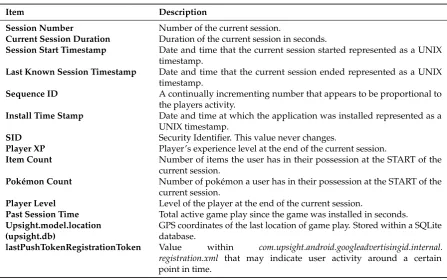
Table 1.Summary of data generated by Upsight
Item Description
Session Number Number of the current session.
Current Session Duration Duration of the current session in seconds.
Session Start Timestamp Date and time that the current session started represented as a UNIX timestamp.
Last Known Session Timestamp Date and time that the current session ended represented as a UNIX timestamp.
Sequence ID A continually incrementing number that appears to be proportional to the players activity.
Install Time Stamp Date and time at which the application was installed represented as a UNIX timestamp.
SID Security Identifier. This value never changes.
Player XP Player’s experience level at the end of the current session.
Item Count Number of items the user has in their possession at the START of the current session.
Pokémon Count Number of pokémon a user has in their possession at the START of the current session.
Player Level Level of the player at the end of the current session.
Past Session Time Total active game play since the game was installed in seconds. Upsight.model.location
(upsight.db)
GPS coordinates of the last location of game play. Stored within a SQLite database.
lastPushTokenRegistrationToken Value within com.upsight.android.googleadvertisingid.internal. registration.xml that may indicate user activity around a certain point in time.
the starting and ending location of the user on the data within the artifacts created by the Upsight platform, (3) gaining additional insight into each of the values contained within theupsight.xmlfile, and (4) to determine the effects of using the Pokémon GO Plus accessory on these artifacts. Appendix Adescribes the purpose, and actions taken prior to each dump of the application. It is important to note that encounters with previously caught pokémon are not recorded in this table.
Each of these dumps were extracted, and the information contained within theupsight.xmland upsight.dbfiles as well as thelastPushTokenRegistrationTimevalue were analyzed. During this analysis forensically important values, which can be found in AppendixB, were compared with their previous values from the prior dump, and were cross referenced with the actions taken by the user prior to generating the dump as shown in AppendixA.
A summary of the results of this analysis for the information generated by theUpsightplatform are found within Table1.
3.4. Upsight Session Information
Likewise, the last known session time values recorded within AppendixBfor Dumps 6, 7, 11, and 12 correlate to when the application was backgrounded (see AppendixA). This indicates that the last known session time value corresponds to when the application was terminated, or backgrounded by switching to another application, receiving a phone call, or by locking the device. In other words, the current session ends when the application is either terminated or backgrounded. If the application was backgrounded, and then brought back to the foreground a new session would start, and the session number would be incremented. Because the application was backgrounded twice during Dump4 the session number was incremented twice. Hence, instead of Dump4 having a session number of 6, the data in AppendixBindicates a value of 8.
Therefore, it is possible to define a session that is recorded in theupsight.xmlfile as the time in which the application was running in the foreground of the user’s mobile device. In other words, this corresponds to the most recent time when the application was actively played. This information can be used by a forensic investigator to provide definitive evidence of the last time the application was actively played by the user.
Furthermore, by examining the current session duration value given in Appendix B, and comparing this value to the session start and last known session time values, it becomes evident that this value represents the length of the current session in seconds. Likewise, by examining the past session time and current session time values, it becomes evident that the past session time value is a counter of the total time spent actively playing the game in seconds excluding the time spent in the current session.
3.4.1. Geolocation Information
Mapping the geolocation information found in the upsight.model.location record within the upsight.dbfile indicate that these coordinates approximate the last known location of the user at the end of the current session. This can be seen within Dump4, which initially started at the Catholic Student Center, and then ended by the Don Sanders Baseball Stadium. The coordinates in the Upsight database (30.71, -95.54) placed the user about 1,000 feet south of the true final location at the Don Sanders Stadium. Furthermore, if the application was backgrounded in one location before being terminated in another location the coordinates in the Upsight database will reflect the location where the application was backgrounded. This can be observed within Dump7, which started at the Catholic Student Center, and then proceeded to Walmart where the application was backgrounded. The application was then terminated 20 minutes later at another location. The coordinates within the Upsight database (30.71, -95.47) placed the user about 1,400 feet south of the true location within the Walmart parking lot.
A significant amount of precision is lost when these values are stored by the Upsight platform because they are rounded to two decimal places. Therefore, these values can be two to three blocks off from the user’s true last known location. These coordinates can be used by an investigator to place the user somewhere in the vicinity of an incident or location, but cannot be used as definitive evidence that a user participated in or witnessed the incident.
3.4.2. Gameplay Prior to Current Session
The timestamps of the files collected from the bundles directory may also be used by an investigator to develop a timeline that may indicate game activity prior to the most recent active session as indicated by information in theupsight.xmlfile. The timestamps of these files correspond to the times when new pokémon are encountered, or an update within the game has altered the 3D models, animations, or sounds for an existing pokémon. These files are downloaded dynamically during gameplay.
with the session start time of Dump1, but the value was never updated during the other six dumps which occurred in the same day. This value was still not updated during Dump8, which occurred on the following day. Furthermore, for Dumps 9, 10 and 11, which took place on March 19, this value contained a timestamp indicating that it was last updated on March 16, three days before the current gameplay session. Therefore, contrary to the research presented by Lawson this value cannot be used as an indicator of when the most recent game activity began. However, it could indicate prior activity.
It is also possible to determine a player’s activity by examining the pokémon trainer’s "journal" in the application. The "journal" records the 50 most recent pokémon encounters, and pokéstop visits. Unsuccessful visits to pokémon gyms do not appear to be recorded within the "journal" logs. Visits in which a pokémon trainer wins against the gyms opponents may be recorded too. However, due to the high combat strength of the pokémon that reside in gyms the logging of successful gym battles within the pokémon trainer’s "journal" was unable to be tested. The information within the "journal" should be checked after an image of the device has been acquired as this will cause the upsight information to be updated.
3.4.3. Pokémon GO Plus
Dumps 9, 10, 11, and 12 focused on determining the effects of the Pokémon Go Plus accessory on the artifacts generated by the application. The most notable artifact relating to the use of the Pokémon GO Plus accessory is the creation of thepgp.xmlartifact in thespdirectory. This artifact contains the Bluetooth MAC address of the device that was connected to the mobile application, and the Bluetooth encryption key. This file is only modified when the encryption key needs to be updated. The content of thepgp.xmlfile is shown below:
<?xml version=`1.0' encoding=`utf-8' standalone=`yes' ?> <map>
<string name="BT_KEY_98:B6:E9:0F:53:0C">HSYcDgN5pyxJFGwX7x0mbw== </string>
</map>
Furthermore, by comparing the session start, and last known session time values in Appendix Bwith their corresponding entries in AppendixA, it becomes evident that the device has no effect on these artifacts. As noted within AppendixA, during the data collection process for Dump10, the application had to be brought to the foreground at 4:50 PM to reconnect the Pokémon GO Plus accessory, and prior to terminating the application at 5:13 PM the application was briefly brought to the foreground when the screen was unlocked. This caused the Upsight session information to update as indicated by the session numbers, session start and end time values given in AppendixB.
This research indicates that the use of the Pokémon GO Plus accessory will prevent the download of additional "bundles" files, even for pokémon that are encountered for the first time. Instead, these files will be downloaded during the next session. However, it is still possible to determine a player’s activity by examining the pokémon trainer’s "journal" in the application.
3.5. Legacy Artifacts: Crittercism Logs
the application was installed prior to July 31, 2016. These logs may be relevant to an investigation, despite not being actively maintained by the application, depending on the investigation timeline.
These logs were analyzed for forensically relevant data, however because these logs are no longer generated by the application it is impossible to determine the exact circumstance behind their creation. Since these logs were created prior to engaging in this research the results of this analysis may not be completely accurate.
As indicated by Murphy’s research these logs were discovered within thef/com.crittercismdirectory inside of thecurrent_bcsandprevious_bcsdirectories. Each of these directories contains 50 files that may contain geolocation information encoded inside of the Cell ID numbers within the logs. Each log has a naming convention with the following format: 1.1469994833869.000000X, where X represents a sequentially incrementing number. According to the data collected from the Galaxy S7 phone, this Cell ID information can be discovered in two different logs: "Removing Cell ID" logs, and "Updating Encounter" logs. As indicated by Murphy, the Cell ID number is a 19 digit integer that should be converted into a hexadecimal number. This hex value, which is a representation of an area of the global map on a Hilbert Curve, can then be converted to GPS coordinates with the use of Google’s S2 geometry library.
Converting and mapping the Cell ID number found in the Galaxy S7 dump reveal that these logs date back to a trip to Tombstone, Arizona during the summer. During this trip a significant amount of time was spent visiting the shops along Allen St. and Fremont St., including the Old Tombstone Wild West Theme Park. The coordinates contained within the "Removing Cell ID" logs appear to occur on the edges of where the application was likely to be used. On the other hand, the coordinates in the "Updating Encounter" logs appear to correspond to areas where user activity is likely to have occurred. Analyzing the timestamps of these log files indicate that the log entries were created within 2 to 3 minutes of each other. This indicates that the information contained within these logs is a snapshot of the user’s activity. This snapshot may correspond to the latest activity of the user.
3.6. Image Metadata
As shown in AppendixA, during Dump4 two pictures were taken with the applications in-game camera during an encounter with a pokémon. The first image,IMG_2017-02-24-15473410.png, was a Wooper taken at the Intramural Fields. This was captured at 3:47 PM on February 24, 2017. The second image,IMG_2017-02-24-15513605.png, was a Weedle taken at Bowers Stadium. This image was captured at 3:52 PM on February 24, 2017.
Both of these images were analyzed with ExifTool as shown in Figure1, and Figure2. The file modification date/time information correlate with when the images were created. Furthermore, the file naming convention indicates the date in which the image was created. Additional metadata within the image indicates the size, compression algorithm used, bit depth, color type, filter, and the megapixels within the image. No metadata exists in those images that may provide additional geolocation information. The results of this analysis were confirmed by using other metadata extraction tools.
4. Pokémon GO: Forensic Analysis Tool
The findings from this research were used to create a tool that is capable of aiding an investigator in the analysis of a mobile device that contains the Pokémon GO application. This analysis tool is capable of creating an android backup of the device, and then analyzing the backup to present an overview of the forensically relevant data within the application.
Figure 1.Extracted metadata from IMG_2017-02-24-15473410.png.
requires the following dependencies: development version of OpenSSL; CMake; and SWIG. Our analysis tool also requires an internet connection in order to generate the maps containing geolocation information.
When the analysis application is launched, the investigator is presented with a welcome screen that provides them with a quick overview of the forensically relevant artifacts that can be found in the application, and a getting started section that covers the basic usage of the application. From the File Menu the investigator has several options to begin the analysis of a phone. This menu allows the investigator to perform the following actions:
• Capture Pokémon GO Backup:This obtains an ADB backup of only the Pokémon GO application from a target mobile device.
• Capture Full Backup:This obtains an ADB backup of the entire target mobile device.
• Create New Analysis from Backup: This creates a new case folder in the current working directory named after the selected android backup file. The android backup is then extracted to this directory, and the relevant forensic information is parsed from the application.
• Open Case Folder: This opens a case folder containing an extracted android backup file, and parses the relevant forensic information from the application.
In order to begin an analysis, the investigator must select the "Create New Analysis from Backup" option. This will prompt the investigator to select the android backup file they wish to use, and will create a case directory named after this file. The case directory contains anappsdirectory which is the uncompressed backup of the mobile device, amapsdirectory which contains all of the static maps generated by the analysis application, and the compressed tar archive that was extracted from the backup file.
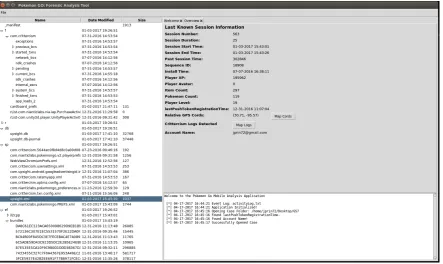
Once the application has finished processing the newly created case, an "Overview" tab is created within the application as shown within Figure A1 in Appendix C. This tab contains a consolidated view of all of the forensically relevant artifacts from the upsight.xml, upsight.db, com.nianticlabs.pokemongo.PREFS.xml, andcom.upsight.googleadvertisingid.internal.registration.xmlfiles. Using the information within this overview tab the investigator is able to determine when the last time the game was actively played by examining the Session Start and Session End Time values. This "Overview" tab also contains a button to map the relative GPS coordinates obtained from the Upsight database. If the application detects the presence of the Crittercism log files, then the option to map the geolocation information within these logs will also be presented to the investigator. When the investigator elects to map this information then a new tab is created as shown in FigureA2within AppendixC. This tab provides the investigator with the ability to alter the zoom level of the static map with the use of the "Zoom In" and "Zoom Out" buttons. Each map image is also stored in themaps directory of the case folder.
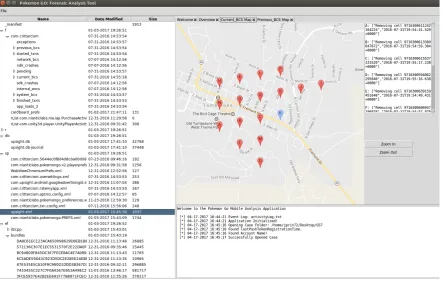
As shown in FigureA2of AppendixC, when the user maps the Crittercism logs a tab will be created for both thecurrent_bcsandprevious_bcsfolders. In these maps markers that originated from data in "Removing Cell" logs are represented with a red marker, while markers that originated from data in "Updating Encounter" logs are represented with a blue marker. As indicated in Section3.4the "Updating Encounter" log data provides a better approximation of the areas the user is likely to have played, while the "Removing Cell" logs appear to be clustered along the edges of the user’s location. Furthermore, each marker has a unique label that corresponds to an entry within the text box in the upper right corner of the tab. These entries correspond to the text in the log which generated that marker.
double clicking on the file in the file browser. This will open a new tab that displays the raw contents of the file. This allows the application to be more versatile in the event that artifacts within the Pokémon GO application are altered, or additional artifacts are discovered that contain forensically relevant information.
The Pokémon GO: Forensic Analysis Tool has a built in event viewer in the lower right of the application. This event viewer records all actions taken by the investigator as they conduct their analysis, and reports any problems that may arise. In addition to each log entry being recorded within the log viewer window, the logs are written to a text file calledactivityLog.txtwhich resides in the same directory as the analysis application.
5. Conclusion
Through this in depth analysis of the Pokémon GO application several forensically useful artifacts were discovered. We believe these findings could help an investigator develop a timeline of application use that could indicate that a user was distracted at the time of an incident, or could place the user around a particular location at a specific time. Most of these artifacts are created by the Upsight marketing and analytics platform, and can be found in the upsight.xml, and upsight.db files. By examining the data contained in theupsight.xmlfile it is possible to determine the start time, end time, and duration of the most recent session. This provides evidence of when the game was last actively run in the foreground of the user’s device. Furthermore, utilizing the location data contained within theupsight.dbfile it is possible to determine the last known relative location of the user during the most recent session. Because these artifacts are generated by the Upsight platform, it may be possible to apply the knowledge learned about the behavior of these artifacts to other applications that use this platform.
Game activity outside of the most recent session could potentially be determined by analyzing the timestamps of the files contained within the bundles directory. These files consist of Unity 3D models that are downloaded dynamically during gameplay from the server. Therefore, the timestamps from these files correspond to when new pokémon or items are encountered for the first time, or if an update has occurred and the pokémon or item animations/graphics have been altered. Furthermore, thelastPushTokeRegistrationTimevalue could also be used as an indicator of game activity. Finally, the pokémon trainer’s "journal" can be used to indicate recent game activity including pokémon encounters, and visits to pokéstops.
The use of a Pokémon GO Plus accessory can be determined by the presence of thepgp.xmlfile within thespdirectory in the application. This artifact contains the Bluetooth MAC address of the Pokémon GO Plus accessory, and the Bluetooth encryption key. Using the Bluetooth MAC address it is possible to determine which Pokémon GO Plus accessory was connected to the phone, as this should be unique for each device. This research has determined that the use of the Pokémon GO Plus accessory does not have any effects on the session information generated by the Upsight platform, or on the timestamps of the files within the bundles directory. In other words, provided the application was not brought back into the foreground of the mobile device, the Pokémon GO Plus accessory will not cause the session or geolocation information recorded by the Upsight platform to be updated. Furthermore, any new "bundles" required will be downloaded when the application is brought back into the foreground of the mobile device. Other forensically relevant information includes the email address of the account holder which can be found within theaccountNamevalue.
automatically presented to the investigator with Physical Analyzer was the email address associated with the user account. The session information contained within theupsight.xmlfile was not included within the time created by Physical Analyzer. Furthermore, the geolocation information in the upsight database was not presented to the investigator either.
Appendix A Actions taken prior to each dump of the application and their purposes
Data Dump Name Activity Notes
Dump1
Start:February 24, 2017 0:41 AM
Application required update and restart.
Updated to version 0.57.2Updated to version 0.57.2
Dump2
Start:February 24, 2017 1:36 PM Location:Apartment
Activity:
•Captured Pidgey @ 1:38 PM •Level 3
•Captured Pikachu @ 1:42 PM
Terminated Application:February 24, 2017 1:42 PM
This dump is designed to act as a baseline image for the application.
Dump3
Start:February 24, 2017 2:32 PM Location:Catholic Student Center Activity:
•Captured Hoppip @ 2:35 PM •Level 4
•Visited 4 pokéstops around St. Thomas Terminated Application:February 24, 2017 2:40 PM
Compared to the previous dump, the starting, and ending location for Dump3 has changed substantially.
A few pokémon were captured, and several pokéstops were visited to help determine the creation of new items within the bundles directory.
Dump4
Start:February 24, 2017 2:45 PM Location:Catholic Student Center Activity:
•Captured Sentret @ 2:47 PM •Captured Spinarak @ 2:48 PM •Captured Murkrow @ 2:55 PM •Level 5
•Captured Natu @ 3:03 PM •Captured Totodile @ 3:08 PM •Captured Wooper @ 3:09 PM •Captured Caterpie @ 3:11 PM
Backgrounded App:Phone call @ 3:14 PM Resumed App:3:30 PM
•Level 6
Backgrounded App:Locked screen @ 3:33 PM in front of Library
Resumed App:3:38 PM in triangle garden with Swing Statue
•Captured Jiggly Puff @ 3:41
• Picture with app camera at intramural fields @ 3:47 PM
• Picture with app camera at Bowers Stadium @ 3:51
•Captured Spearow @ 3:52 PM
Terminated Application:February 24, 2017 3:57 PM
Location:Don Sanders Stadium
This dump covers a large amount of ground, and backgrounds the application multiple times to help determine how the Upsight platform handles the creation of session information.
The starting location for this dump also varies significantly from the location in which the application was terminated.
Ending Statistics:
Pokémon in Possession: 56 Pokémon Eggs: 7
Items: 189
Dump5
Start:February 24, 2017 4:23 PM Location:Catholic Student Center Activity:•Transferred 31 pokémon •Visit pokéstop
Terminated Application:February 24, 2017 4:29
This dump takes place at the Catholic Student Center. The only actions that occurred was the transfer of 31 pokémon, and a pokéstop visit. This is to help determine how the pokémon count and item count variables are updated.
Dump6
Start:February 24, 2017 4:33 PM Location:Catholic Student Center Activity:
•Captured Kakunna @ 4:35 PM •Captured Staryu @ 4:36 PM
Backgrounded App:February 24, 2017 4:38 PM
Acquired Backup of App (Still running in background):February 24, 2017 4:41 PM Application restarted.•Visit Pokéstop Terminated Application:February 24, 2017 4:42 PM
This dump also takes place at the Catholic Student Center. A few pokémon were captured, and then the application was backgrounded and a backup was taken. This caused the application to restart.
Ending Statistics:
Pokémon in Possession: 30 Pokémon Eggs: 8
Items: 203
Caught Pokémon: 20 Seen Pokémon: 33
Dump7
Start:February 24, 2017 4:47 PM
Location: Catholic Student Center then drove to Walmart
Activity:
•Captured Marill @ 4:55 PM •Level 7
•Captured Horsea @ 4:57 PM
Backgrounded App:February 24, 2017 4:57 PM at Walmart
Terminated Application:February 24, 2017 5:19 at Apartment
This dump was started at the Catholic Student Center. The application was utilized while driving to Walmart. The application was then backgrounded at Walmart. The application was then terminated at the Apartment.
This was designed to help determine how the Upsight platform logs geolocation information, and generates session information.
Dump8
Start:February 25, 2017 3:40 PM
Terminated Application:February 25, 2017 3:40 PM
During this dump the application was started, and then quickly exited after it finished loading.
This is to help determine how the Upsight platform creates session information.
Dump9
Start:March 19, 2017 4:14 PM Connected Pokémon Go Plus device Terminated Application: March 19, 2017 4:15 PM
This dump was created to act as a baseline for testing the Pokémon GO Plus device.
Dump10
Start:March 19, 2017 4:43 PM Location:Apartment
Connected Pokémon GO Plus device Backgrounded App: 4:45 PM (locked phone)
Went driving around campus.
Visited numerous pokéstops and caught several pokémon with Pokémon GO Plus Reconnected Pokémon GO Plus:4:50 PM Terminated Application: March 19, 2017 5:13 PM after successful catch.
Location:One-way street by Library
This dump focuses on determining the effect that using the Pokémon Go Plus device has on the session information generated by the Upsight platform.
The starting and ending locations for the data acquisition very significantly.
Dump11
Start:March 19, 2017 7:09 PM Location:Apartment
Connected Pokémon GO Plus
Backgrounded App: March 19, 2017 7:12 PM
Caught numerous Pokémon at apartment with Pokémon GO Plus. Terminated Application:March 19, 2017 9:30 PM
This dump is focused on determining the effect that using the Pokémon Go Plus device has on the timestamps of files within the bundles directory.
There was no change in the starting and ending location of this dump.
Dump12
Start:April 13, 2017 3:20 PM Location:Apartment
Connected Pokémon Go Plus device. Backgrounded App:April 13, 2017 3:21 PM Activity:
•Captured Pokémon @ 3:35 PM •Captured Pokémon @ 3:37 PM •Captured Pokémon @ 3:42 PM
Terminated Application: April 13, 2017 3:53 PM
This dump was focused on determining the effect that using the Pokémon GO Plus device has on the Upsight session information.
All captured pokémon were recorded
Appendix C Pokémon GO: Forensic Analysis Tool
Figure A2.Pokémon GO: Map Crittercism Logs.
References
1. PokémonGO. Available online: http://pokemongo.nianticlabs.com/en/. (Accessed 9 April 2017)
2. Schwartz, J. Pokémon GO Compared to Other Popular Apps. Available online: https://www.similarweb.com/blog/pokemon-go-compared. (accessed 9 April 2017).
3. Schwartz, J. Pokémon GO: The Data Behind America’s Latest Obsession. Available online: https://www.similarweb.com/blog/pokemon-go. (accessed on 9 April 2017).
4. 2017 U.S. Cross-Platform Future in Focus. Available online: http://www.comscore.com/Insights/Presentations-and-Whitepapers/2017/2017-US-Cross-Platform-Future-in-Focus. (accessed on 9 April 2017).
5. Thier, D. Firm: ’Pokémon GO’ Has Made $1 Billion Since Launch. Available online:
https://www.forbes.com/sites/davidthier/2017/01/31/firm-pokemon-go-has-made-1-billion-since-launch/#433f79ba20e3. (accessed 9 April 2017).
6. Weinberger, M. The fad may be over, but Pokémon GO still has 65 million monthly active players. Available online: http://www.businessinsider.com/pokemon-go-65-million-monthly-active-players-2017-4. (accessed on 9 April 2017).
7. Althoff, T.; White, R.W.; Horvitz, E. Influence of Pokémon GO on physical activity: Study and Implications.
Journal of Medical Internet Research2016, vol. 18, no. 12.
8. Smith, D. Hundreds of people mobbed Central Park to catch a Vaporeon in Pokémon GO. Available online: http://www.businessinsider.com/pokemon-go-mob-runs-after-vaporeon-video-2016-7. (accessed on 9 April 2017).
9. Gilbert, B. This 40-second video will convince you that Pokémon GO is an insane phenomenon. Available online: http://www.businessinsider.com/pokemon-go-mob-runs-after-squirtle-video-2016-7. (accessed on 9 April 2017).
10. Bowerman, M. Woman discovers body while playing ’Pokémon Go’. [Online]. Available online:
11. Daye, A. Pokémon Go helps Marines to catch suspect. Available online: http://www.cnn.com/2016/07/13/us/pokmon-go-helps-marines-to-catch-suspect/. (accessed on 9 April 2017).
12. Miller, R. Teens used Pokémon Go app to lure robbery victims, police say. Available online:
https://www.usatoday.com/story/tech/2016/07/10/four-suspects-arrested-string-pokemon-go-related-armed-robberies/86922474/. (accessed on 9 April 2017).
13. Military base issues ’Pokémon GO’ warning. Available online:
http://www.foxnews.com/tech/2016/07/19/military-base-issues-pokemon-go-warning.html. (accessed on 9 April 2017).
14. Roberts, A. ’Pokémon Go’ Is A Major Distraction For Drivers According To A New Study. Available online: http://uproxx.com/gaming/pokemon-go-too-distracting-new-study/. (accessed on 9 April 2017). 15. Lahman, S. Pokémon Go player crashes his car into a tree. Available online:
https://www.usatoday.com/story/news/nation/2016/07/14/pokmon-go-player-crashes-his-car-into-tree/87074762/. (accessed on 9 April 2017).
16. Birch, N. This Distracted ’Pokémon Go’ Player Crashed Into A Police Car On Camera. Available online: http://uproxx.com/gammasquad/pokemon-go-police-car/. (accessed on 9 April 2017).
17. Pokémon Go player crashes car into school while playing game. Available online:
https://www.theguardian.com/australia-news/2016/jul/29/pokemon-go-player-crashes-car-into-school-while-playing-game. (accessed on 9 April 2017).
18. Inada, M. ’Pokémon Go’ - Related Car Crash Kills Woman in Japan. Available online: https://www.wsj.com/articles/woman-killed-in-pokemon-go-related-car-crash-in-japan-1472107854. (accessed on 9 April 2017).
19. Maus, S.; Hofken, H.; Schuba, M. Forensic analysis of geodata in android smartphones.Internation Conference on Cybercrime, Security and Digital Forensics2011.
20. Murphy, C. A Sneak Peek at Pokemon Go Application Forensics. Available online: https://digital-forensics.sans.org/blog/2016/08/09/a-sneak-peek-at-pokemon-go-application-forensics. (accessed on 9 April 2017).
21. Hilbert, D. On the continuous representation of a line on a surface part. Mathematical Annals38.3 (1891): 459-460.
22. Call me Ash Ketchum: Open Source Forensics with Pokemon Go. Available online:
https://www.security-sleuth.com/sleuth-blog/2016/8/13/call-me-ash-ketchum-open-source-forensics-with-pokemon-go. (accessed on 9 April 2017).
23. Head, N. Pokémon Go: An Introductory Forensic Study. Available online: https://www.intaforensics.com/2016/08/05/pokemon-go-an-introductory-forensic-study/. (accessed on 9 April 2017).