VALUE CREATION LOGICS: A UK
CASE STUDY
Yu-Chun Pan, Paul Jackson and Diana Limburg Business School, Oxford Brookes University, Oxford, UK.
[email protected]; [email protected]; [email protected]
Abstract
Value creation is the core purpose of organisations, and the Value Creation Logics (VCLs) describe how organisations create value for their customers through the provision of goods or services. VCLs can help organisations understand and model their business processes in order to fully utilise their resources and achieve optimal performances. Most organisations rely heavily on IS/IT for their value creation. Alignment between IS/IT and business strategies as well as with the VCLs thus plays a key role in the benefits realisation of IT investment. This paper investigates the empirical realisation of different VCLs, and the role of IS/IT therein, through a case study of a UK law firm. The findings show that the different types of value creation logics co-exist and that problems occur when the organisational structure does not support the various needs of the different logics. In order to support the logics, a Viable System Model-inspired organisational design is suggested. This is intended to drive the IS/IT strategy in order to support concurrently different value creation logics.
Keywords: Business-IT alignment, Value creation, Value chain, Value configurations,
Organisational design, Viable system model
1
Introduction
This paper investigates the realisation of different Value Creation Logics (VCLs), and
the role played in them by Information Systems (IS) and Information Technology (IT).
It analyses a case study of a UK law firm that has recently has implemented a range of
IS-related tools and methodologies in order to improve customer and business value.
The findings show that the different types of value creation logics co-exist and that
problems occur when the organisational structure does not support the various needs of
the different logics. Beer’s Viable System Model (Beer, 1979) is also used to examine
how better organisational design can be used to drive IS/IT strategy, and thus support
concurrently different value creation logics.
Before we introduce the notion of VCLs, however, it is important to define some basic
concepts related to organisational systems and value creation. From the organisational
semiotics perspective (Liu, 2000, Stamper, 2001), an organisation can be categorised
into a human activity system, information system and ICT system (Beynon-Davies,
executed by groups of people, and the IS emerges in response to the need for human
agents to communicate and coordinate with each other during numerous business
activities.
According to Porter (1985), the collection of activities performed in a firm exists to
design, produce, market, deliver and support its products or services as a ‘value chain’.
The value chain analysis has been one of the major approaches to analysing
organisations and how IT can support organisational performance. Since the advent of
value chain analysis, many researchers have developed alternative value creation logics
to reflect the various natures of business operations (Payne and Holt, 2001). It is widely
acknowledged that IS/IT plays an important role in supporting and enabling different
value creation logics (VCLs).
However, there is not much literature on how organisations can support value creation
through ensuring alignment of IS/IT with their VCLs. Hence, the aim of this paper is to
understand how organisations can align their IS/IT to the VCLs. Through a case study,
it will explore the various views on value creation, their empirical applications, their
implications for IS/IT and their organisational impact. Using VSM, an organisational
design to support alignment of value creation and IS/IT will then be proposed.
2
Business-IT Alignment & Viable System Model
Business-IT alignment looks at how well an organisation’s business and IT strategies
work with and support each other. Many researchers have highlighted the importance
of business-IT alignment for organisations in order to maximise the business benefits
of IT investments (Irani, 2002, Ward and Peppard, 2002). Organisations that
successfully aligned their business strategies with IT strategies can improve their
business performances (Tallon et al., 2000, Schwarz et al., 2010). The alignment can
also help organisations change their business infrastructure (Henderson and
Venkatraman, 1993) and obtain competitive advantages (Tallon and Pinsonneault,
2011). In order to develop an IT strategy that supports an organisation’s business
performance, it is essential to fully appreciate how the organisation operates.
This paper applies Beer’s Viable Systems Model to analyse the organisational context
of the VCLs. An organisation can be seen as a system with a defined boundary
composed of inputs, processes, and outputs, and contains distinctive parts that are
integrated to accomplish a shared goal (Senge, 1990). Such a system view enables
management to view the organisation in terms of the flows, processes and relationships,
designed to achieve optimal results (Seddon, 2008). Beer (1979) applied Ashby’s Law
of Requisite Variety (1956) to develop the concept of Viable System Model (VSM).
VSM views an organisation as a system that becomes viable by balancing the internal
and external factors. Each viable system is composed of five subsystems that have
specific roles and functions within an organisation (see Table 1). VSM has been widely
adopted to understand and design organisational structures and information systems in
various fields, such as complex systems and communications systems (Sun and Liu,
2011, Preece et al., 2013, Preece et al., 2014).
Table 1 Five systems of VSM (Beer, 1979)
Element System Descriptions
Operation System 1 The collection of operational units that perform primary tasks
Meta-system
System 2 The system that supports coordination between operational units in
system 1
System 3 The structure and control of operation, also provides an interface
with system 4 and 5
System 4 The system that interacts with and investigates environment and
develops future strategies and plans
System 5 The system that makes policy decisions and controls the
organisation as a whole
3
Value Creation Logics and IS/IT alignment
The creation of value is the main purpose of business operations. It consists of a process
that requires resources and activities to deliver benefits to customers. Porter (1985)
introduced the concept of value chain, which views the primary value-adding process
as a sequence of activities. Stabell and Fjeldstad (1998) argued that Porter’s value chain
analysis does not describe the value-adding activities in non-manufacturing industry,
and propose additional value configurations, including ‘value shop’ and ‘value
network’. The value chain, shop and network logic have been the genesis of many
researches on value creation. For example, Maglio and Spohrer (2008) define a service
system as a configuration of people, technologies, organisations and information that
are able to deliver value to relevant parties. Mele and Polese (2011) further define the
information and technologies. However, both service system and dynamic value
creation process are still in line with the principles of network logic. Johansson and
Jonsson (2012) investigate the chain and shop logics and further propose the ‘package
logic’. This new logic recognises that generic problems exist in business situations for
which organisations can provide packaged ‘underlying solutions’. Such solutions, say
the authors, can be customised and utilised across projects and customers, providing for
greater efficiency and economies of scale.
A further alternative approach is to categorise value creation into goods-dominant logic
(G-D logic) and service-dominant logic (S-D logic) (Vargo and Lusch, 2004, Lusch and
Vargo, 2006). G-D logic is based on the value-in-exchange concept, where producers
perform activities to create value for customers. S-D logic, on the other hand, is based
on the value-in-use perception, where value is fundamentally created and derived from
the integration and application of resources (Vargo et al., 2008). S-D logic and S-D
logic categorise value creation based on the views on how value is created, and they
provide an alternative way for organisations to understand their operations. However,
they do not describe the micro activities within the value creation process, and are not
suitable for the purpose of this paper in terms of categorising value-adding activities in
organisations.
This paper therefore focuses on four value creation logics, namely: chain, shop, network
and package logics, and their empirical applications in the case study organisation. Each
of the four logics defines how value is being created in different environments. The four
VCLs are summarised in Table 2. Based on Porter’s generic strategies (Porter, 1985),
Porter and Millar (Porter and Millar, 1985) suggest that IS/IT play an important part in
value creation through three key routes: help to improve the performance of separate
activities, improving linkages between activities, and to form linkages in the value
system (i.e. with other organisations). Following this line of thinking, Table 2 also
Table 2 Value Creation Logics (adapted from Stabell and Fjeldstad, 1998, and Johansson and Jonsson, 2012)
Value creation logics
Descriptions and characters IS/IT alignment focus
Chain logic
Create value through a sequence of
activities that transform inputs into final products
Value-adding activities are
performed in sequence and repetitively
Scale of operations and repetitive
delivery provide competitive advantages
IS/IT needs to support the flow
of materials and products between the activities and in the supply chain
Repetitive standard processes
are embedded in and enforced through IS/IT
Shop logic
Create value by solving each
customer problem with bespoke solutions
Value-adding activities are unique
to individual customers, and are less likely to be repeated and reused
Innovation and pure customisation
provide competitive advantages
IS/IT support access to
knowledge within and outside the organisation – be it tacit (in people) or explicit (stored)
IS/IT support problem definition
and solution delivery workflows (e.g. through project
management software) Network
logic
A network of people, technologies,
organisations and information co-create and deliver value through interactions
Value-adding activities are the
interactions between customers when facilitated by the network
Configuration of networks and
relationships in networks provide competitive advantages
IS/IT need to provide digital
network capabilities, within and outside the organisation
Package logic
Create value by providing packaged
solutions (based on generic problems) that can be customised and utilised across projects
Value-adding activities focus on the
gathering, decomposing and solving of problems
Development of re-usable
underlying solutions provides competitive advantages
IS/IT support the analysis of
recurring problems to recognise patterns
IS/IT support and reinforce the
workflow of packages from customer problem definition to delivery and follow-up
4
Method
The empirical study is primarily a qualitative case study based on participant
observation (Yin, 2003). A UK-based law firm was selected as the case study
organisation. This organisation is of particular interest due to the level of change in the
UK legal industry in recent years. Businesses in the legal industry need to improve their
adopting the techniques and technologies already widely used in other industries
(Ribstein, 2010, Susskind, 2013, Barton, 2014, Butler and Kobayashi, 2014,
Henderson, 2014). In the UK, since the advent of the Legal Service Act 2007,
non-lawyers have been allowed to enter the legal market, which consequently has increased
the level of competition. This change in particular was the driving force behind the
transformation of how law firms interact and create value for their customers. Studying
the implications of this transformation within the case organisation enables the
understanding of applications and impact of value creation logics in this organisation.
While generalizability from this singly case study is limited, there is some scope to
apply the findings more broadly as a range of different activities and VCLs can be found
within the one organisation.
The case study organisation offers a wide range of legal services to both business and
individual customers. It has over 250 employees across 3 geographical locations. The
first author started working with the case study organisation as an independent
consultant in January 2014 and has been there for over a year. As such, the case study
has benefited from the principle that data collected through observation in a natural
setting can provide a more accurate insight into organisations (Ghauri and Grønhaug,
2005). In addition to the observation, the first author conducted a number of
unstructured interviews with the lawyers in order to further understand how the legal
works were delivered. We will analyse the operations and use of IS/IT within the case
organisation with the different value creation logics, as well as organisational
structure’s impact on value creation logics.
5
Value Creation Processes: Findings from the Case Study
In order to understand the empirical applications of value creation logics, we analyse
how value creation logics describe the processes of delivering value to the customers
in the case study organisation. We focus how the organisation arranges its activities and
utilises its tangible and intangible resources to fulfil its customers’ requirements. Seven
of the key legal services offered by the case study organisation are analysed. The names
Table 3 Overview of services analysed
Service names Descriptions
Online divorce Customers get a divorce online without seeing lawyers. The processes are
managed online via IS, by legal caseworkers and customers themselves, to reduce the costs. This service normally only works for couples who jointly agree to a divorce and have a consent order.
Conventional divorce
Customers hire a lawyer to act for them to get a divorce. The process is normally managed by a lawyer and a legal support team. The lawyer discusses the situation with the customer and then designs and performs legal actions accordingly.
Residential conveyancing
Customers instruct lawyers to manage the transfer of the legal title of properties from one person to another. Lawyers act for either the seller or buyer and deal with all the issues arising during the transaction.
Online wills Customers fill an online questionnaire form to generate a will that is then
electronically checked and verified by a lawyer. The process is mainly performed by IS.
Conventional wills
Customers see a lawyer to discuss their situations and view relevant documents. The lawyer then drafts the wills for the customers based on the discussion and documents.
Commercial recovery
Companies instruct a law firm to recover the money or possessions owned by companies or individuals. The process is performed by a team of trained administrators and managed by team managers. The team follows a standard procedure for all the works.
Litigation Customers instruct a lawyer to resolve disputes. The lawyer investigates
the situation and negotiates with the other party on behalf of the customer. The process is often performed by junior lawyers and supervised by a senior lawyer.
These seven service offerings will be further analysed looking at three criteria: the
approach to solution development, the process flow design, and the level of
customisation. Solution development focuses on how the organisation approaches and
understands a customer’s legal problems and then delivers the solutions. It could
involve developing bespoke solutions for each customer, utilising and adapting generic
solutions to customers, or providing customers the standard solutions with little or no
adjustment. The process design perspective addresses how the value-adding activities
are organised and managed in relation to the resources. Customisation refers to the level
of adjustment made to the solutions around customers’ individual requirements. Based
on these criteria the operational model of the services was identified and categorised.
The characterisation of the seven services in relation to the three criteria is summarised
in Table 4.
Table 4 Service characters
Service
names Solution development Process design Customisation
Online divorce
Applies a
commercially available
Pre-defined standard divorce process flow
‘standard divorce process’ developed by IS vendors based on how a generic divorce works.
embedded in IS. Less qualified staff follow the procedure and manage the tasks.
customisation. Not suitable for customers that require
customisation.
Conventional divorce
Solutions are developed based on individual customers. The solutions are mostly one-off and hardly re-used. Only administrative elements of the solutions are reused, for example letter templates.
Lawyers’ knowledge and judgement are the main driving force of the process. Very few procedures or
structures are defined. Lawyers design the process for each customer.
Each piece of work is customised to
individual customers. There is a very high level of customisation in this type of legal service.
Residential conveyancing
The standard process flow has been identified in-house. This process was then embedded in IS. Lawyers follow the process in the IS and review and provide input as required.
The defined process flow provides guidelines on the sequence of required activities as well as inputs. Inputs need to be processed by qualified staff.
There is a low level of customisation in this service. Any
customisation is mainly related to customer contact points, rather than the actual service.
Online wills Lawyers define the
standard elements needed in a will based on existing wills. Pre-defined questions are used to help customers provide the
information required to draft a will.
The pre-defined questions are embedded in IS that allow customers to supply the main input. The IS also organises the information and drafts wills for qualified lawyers to check.
There is little customisation in the process of customers supplying information, but a medium level of customisation in the second part of the process where lawyers review the wills.
Conventional wills
Solutions are developed for each customer after identifying their situation. Some basic document templates are re-used.
Lawyers perform the relevant activities to gather information and draft wills. The activities are not structured nor documented.
A high level of customisation is applied in this service; each solution is drafted to customer’s
requirements.
Commercial recovery
Best practice is defined in-house via analysing and standardising the process. The process is performed repeatedly and in a large volume.
The process is structured and organised with allocated resources. Each team member is responsible for specific activities within the process.
There is very little customisation in this service. It is usually only applied to contact points to create a ‘personal touch’.
Litigation Solutions are
developed by experienced lawyers through analysing the
The process is designed and implemented by the lawyers as the legal
problems and proposing solutions. The development requires the expertise and skills of the lawyers. Very little of the process is re-used.
case progresses. There is no formal structure nor flow. The process is led by the lawyers, who usually have their preferred ways to tackle the legal work.
solutions are made-to-measure.
Legal tasks are traditionally heavily led by the experience and judgement of lawyers.
The lawyers investigate and analyse the customer’s problems, then develop and deliver
solutions that are bespoke to them. Each piece of legal work can be viewed as a
standalone project that is archived once the project finishes. The process requires a high
level of customisation, and is performed with very little automation or computer
support. Value is created through the problem-solving activities performed by lawyers.
The intense level of human capital required consequently keeps the cost of legal process
high. This type of process fits the principles of the shop logic, where value is created
through solving unique customer problems. The legal services in the case study
organisation following the shop logic include conventional divorce, conventional wills
and litigation.
Some of the other services, by contrast, benefit from the use of process modelling and
technologies. The case study organisation developed or purchased IS with embedded
business processes of certain legal services. The embedded processes are the result of
identifying common patterns of customer requirements and solutions. The IS here
provide a framework that specifies inputs for each part of the process. Although the
lawyers and legal assistants still need to process the documents and make necessary
adjustments during the process, the case study organisation benefits significantly from
the standardised process through a reduction of operation time. This type of service
follows the principle of package logic, as it focuses on developing generic solutions
that can be customised and re-used. The adoption of generic business process helps the
organisation better predict the time required to complete the work and consequently
allows better management of resources, e.g. individual capacity and workload. Services
of this type include online divorce, online wills and residential conveyancing.
Unlike other legal services, commercial recovery service are standardised to a high
in the case study organisation with the aim of increasing operational efficiency and
profitability. This effort led to the restructuring of the team and re-design of business
processes. The process is now broken down into smaller collections of activities with a
defined order. Instead of performing activities throughout the whole process,
individuals repeatedly perform specific collections of activities with the support of IS.
As a result, this service is delivered in a large volume and shorter lifecycle. The
repetitive delivery through following sequences of activities of this service
demonstrated how the chain logic was utilised to create value to the customers.
In summary, across the seven services we analysed, three of the value creation logics
were utilised in the case study organisation. No application of the ‘network’ logic was
identified. This could be related to the problem-solving nature of legal services.
Although the delivery of legal services has been standardised to some extent, it
normally does not involve a network of people and elements. IS/IT is utilised to
automate processes in departments that follow the chain and package logics. However,
the use of IS/IT is still relatively limited, especially in the area of knowledge
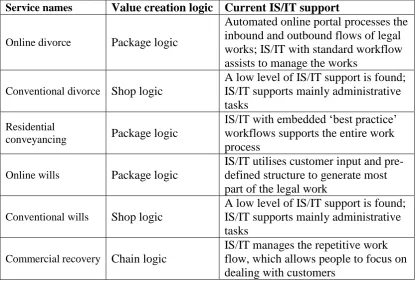
management and problem pattern analysis. Table 5 provides an overview of the
services, their value creation logics, and how IS/IT provides currently support to the
value creation.
Table 5 Value creation logics and current IS/IT support of analysed services
Service names Value creation logic Current IS/IT support
Online divorce Package logic
Automated online portal processes the inbound and outbound flows of legal works; IS/IT with standard workflow assists to manage the works
Conventional divorce Shop logic
A low level of IS/IT support is found; IS/IT supports mainly administrative tasks
Residential
conveyancing Package logic
IS/IT with embedded ‘best practice’ workflows supports the entire work process
Online wills Package logic
IS/IT utilises customer input and pre-defined structure to generate most part of the legal work
Conventional wills Shop logic
A low level of IS/IT support is found; IS/IT supports mainly administrative tasks
Commercial recovery Chain logic
Litigation Shop logic
A low level of IS/IT support is found; IS/IT supports mainly administrative tasks
6
Discussion and Conclusion
Building on the above, it is important to note that the case study organisation has
effectively sought to apply a ‘one size fits all’ approach to some aspects of work through
the provision of an IT-based legal case management systems (complete with embedded
standardised business processes). This aims to move the delivery of legal services from
the shop logic to the package logic or the chain logic to achieve cost-saving.
This approach has had various levels of success across different legal areas in the case
study organisation. Legal departments that process large volume of repetitive tasks,
such as commercial recovery, enjoy the efficiency and economy of scale. The success
encouraged the management to apply this method to other parts of the organisation too.
However, many lawyers claim that the embedded business processes are not suitable
for their customers and struggled to fully utilise the IS. This reaction is strongest in the
departments where value was created following the shop logic.
Due to the complex nature of customers’ requirements, certain types of legal services,
e.g. litigation, are likely to inherently need a reasonably high level of customisation.
However, this does not mean that only the shop logic can exist in the areas where
customisation is required. The package logic can be seen in some legal services through
the provision of generic solutions. These services follow a defined process but still
allow customisation, reducing the time and cost of solution development. Residential
conveyancing, for example, demonstrates how the defined pattern and project lifecycle
of legal service can help organisations to manage their resources more effectively.
In the case study organisation, there is a trend of shifting operation models away from
the shop logic. Due to the nature of legal service and the difference in customer
requirements, the package logic is more likely than the chain logic to be adopted in law
firms. The emergence and growing popularity of legal services that use IS to standardise
part of the process, such as online wills and online divorce, can be seen as part of this
However, the move to the package logic is no easy task. Johansson and Jonsson (2012)
state that the development resource, e.g. an R&D function, is vital to the success of the
package logic, and that the package logic requires a different organisational structure,
process and roles. Consequently, it also provides challenges to the strategic alignment
of IS/IT. The case study organisation, like most of the law firms in the UK, is structured
around the lawyers’ areas of expertise. The lawyers manage their value-adding
activities. All the departments and lawyers are supported by the firm-wide
administrative support functions. This high level of autonomy allows the lawyers to
perform their tasks in their preferred ways, but it also leaves the business operations in
silos. These silos allow very little lateral knowledge flow. Without the knowledge
sharing between operational areas, it is difficult to identify the patterns of customer
requirements and develop generic solutions. Furthermore, the central support does not
have a function to focus on the development of generic solutions. This might contribute
to the low level of IS/IT utilisation in knowledge management and problem pattern
analysis when IS/IT is mostly adopted to improve operational efficiency. The lack of
the R&D-like function leaves this task to operational teams that do not necessarily have
the time and skills for generic solution development. As a result, moving towards the
package logic is very time-consuming and difficult. As discussed above, providing
organisation-wide IS solutions has also proven to be problematic. The organisational
structure and the supporting IS strategy need to change in order to support the ability to
develop generic solutions, as required by the emerging package logic.
By reviewing the organisational structure against VSM, it was noticeable that system 4
did not exist in the case study organisation. System 4 plays a key role in understanding
the environment and proposing solutions, and it often provides the R&D function for
the organisation. A system 4-like function can support the move towards the package
logic by investigating the patterns of customer requirements and developing underlying
solutions accordingly. By placing this function between the management and the legal
teams, it also serves as the knowledge hub allowing forward, reverse and lateral
knowledge flows (see also Johansson and Jonsson, 2012). An organisational design
reflecting VSM can potentially support law firms to transform their value creation
logics to meet customer requirements in a more efficient way. Such a design should
IS/IT should support the knowledge flows, as well as the implementation of
standardised processes.
Future research at the case study organisation into detailed organisational design and
implementation, reflecting VSM, is intended to contribute to the understanding of the
relationship between value creation logics, organisational structure and IS/IT systems.
7
Acknowledgement
This project received financial support from the Knowledge Transfer Partnership
(KTP). KTP is funded by Innovate UK along with the other government funding
organisations.
8
References
Ashby, W. R. 1956. An Introduction to Cybernetics, London, Chapman & Hall. Barton, B. H. 2014. A glass half full look at the changes in the American legal market.
International Review of Law and Economics, 38, Supplement, 29-42. Beer, S. 1979. The heart of enterprise, Chichester, Wiley.
Beynon-Davies, P. 2009. The `language' of informatics: The nature of information systems. International Journal of Information Management, 29, 92-103. Butler, H. N. & Kobayashi, B. H. 2014. Unlocking the law: Building on the work of
Larry E. Ribstein. International Review of Law and Economics, 38, Supplement,
2-4.
Ghauri, P. N. & Grønhaug, K. 2005. Research methods in business studies: A practical guide, Pearson Education.
Henderson, J. C. & Venkatraman, N. 1993. Strategic alignment: Leveraging information technology for transforming organizations. IBM systems journal,
32, 4-16.
Henderson, W. D. 2014. From Big Law to Lean Law. International Review of Law and
Economics, 38, Supplement, 5-16.
Irani, Z. 2002. Information systems evaluation: navigating through the problem domain. Information & Management, 40, 11-24.
Johansson, M. & Jonsson, A. 2012. The package logic: A study on value creation and
knowledge flows. European Management Journal, 30, 535-551.
Liu, K. 2000. Semiotics in Information System Engineering, Cambridge, UK,
Cambridge University Press.
Lusch, R. F. & Vargo, S. L. 2006. Service-dominant logic: reactions, reflections and refinements. Marketing theory, 6, 281-288.
Maglio, P. P. & Spohrer, J. 2008. Fundamentals of service science. Journal of the Academy of Marketing Science, 36, 18-20.
Mele, C. & Polese, F. 2011. Key dimensions of service systems in value-creating networks. The science of service systems. Springer.
Porter, M. E. 1985. Competitive advantage : creating and sustaining superior performance, New York, Free Press.
Porter, M. E. & Millar, V. E. 1985. How information gives you competitive advantage.
Harvard Business Review.
Preece, G., Shaw, D. & Hayashi, H. 2013. Using the Viable System Model (VSM) to structure information processing complexity in disaster response. European Journal of Operational Research, 224, 209-218.
Preece, G., Shaw, P. D. & Hayashi, P. H. 2014. Application of the viable system model to analyse communications structures: A case study of disaster response in
Japan. European Journal of Operational Research.
Ribstein, L. E. 2010. The Death of Big Law [Online]. Available:
http://works.bepress.com/ribstein/22.
Schwarz, A., Kalika, M., Kefi, H. & Schwarz, C. 2010. A dynamic capabilities approach to understanding the impact of IT-enabled businesses processes and IT-business alignment on the strategic and operational performance of the firm.
Communications of the Association for Information Systems, 26, 4.
Seddon, J. 2008. Systems thinking in the public sector : the failure of the reform regime - and the manifesto for a better way, Axminster, Triarchy.
Senge, P. M. 1990. The fifth discipline : the art and practice of the learning organization, New York, Doubleday.
Stabell, C. B. & Fjeldstad, Ø. D. 1998. Configuring value for competitive advantage: on chains, shops, and networks. Strategic management journal, 19, 413-437.
Stamper, R. K. 2001. Organisational Semiotics: Informatics without the computer? In:
L. Kecheng, R. J. C., P. Bogh_Anderson and R. K. Stamper (ed.) Information,
Organisation and Technology: studies in organisational semiotics. Dordecht, Netherlands: Kluwer.
Sun, J.-F. & Liu, W.-Y. 2011. Design of Equipment Procurement Project Organization
Based on Viable Systems Model. Procedia Engineering, 24, 809-815.
Susskind, R. E. 2013. Tomorrow's lawyers: An introduction to your future, Oxford University Press Oxford.
Tallon, P. P., Kraemer, K. L. & Gurbaxani, V. 2000. Executives' perceptions of the business value of information technology: a process-oriented approach. Journal of Management Information Systems, 145-173.
Tallon, P. P. & Pinsonneault, A. 2011. Competing perspectives on the link between strategic information technology alignment and organizational agility: insights from a mediation model. Mis Quarterly, 35, 463-486.
Vargo, S. L. & Lusch, R. F. 2004. Evolving to a New Dominant Logic for Marketing.
Journal of Marketing, 68, 1-17.
Vargo, S. L., Maglio, P. P. & Akaka, M. A. 2008. On value and value co-creation: A
service systems and service logic perspective. European Management Journal,
26, 145-152.
Ward, J. & Peppard, J. 2002. Strategic planning for information systems, Chichester, Wiley.