Converting Group Key Agreement Protocol into
Password-Based Setting – Case Study
Ratna Dutta
Cryptography and Security Department, Institute for Infocomm Research 21 Heng Mui Keng Terrace, Singapore 119613.
Email: [email protected]
Abstract— Converting a secure group key agreement
pro-tocol into password-based setting is not a trivial task. The security of a password-based scheme hinges on preventing dictionary attack that enables an adversary to take advan-tage of the low entropy of human memorable passwords. In this paper, we make a case study considering the constant round group key agreement protocol DB proposed by Dutta-Barua, which is a simple variant of Burmester-Desmedt protocol BD. We present a simple and elegant contributory group key agreement in password-based setting derived from the protocol DB. We discuss several issues regarding the dif-ficulties of converting this DB protocol into password-based setting. We have made several modifications in the protocol DB and then enhance it to password-based setting. The security of the proposed scheme against dictionary attacks is in the ideal cipher model under Decision Diffie-Hellman (DDH) assumption. We analyze our protocol in the security framework formalized by Bellare et al. Our proposed scheme achieves efficiency over the work of Bresson et al. in terms of both computation and communication power.
Index Terms— password-based group key agreement, DDH
problem, dictionary attack
I. INTRODUCTION
Password-Based Group Key Agreement: A password-based group key agreement (GKA) protocol allows a group of users, who share only a low-entropy human-memorable password and communicating over an inse-cure public network, to agree upon a high-entropy session key among themselves. This session key can later be used to implement multi-cast sessions.
It is common knowledge that a user cannot remember long random numbers and he has to store a large secret, if necessary, into his system. This imposes an extra security burden and thus introduces a new point of weakness. Password-based setting seems to be a more realistic scenario and convenient to use as they do not require the use of more specialized hardware for storing or generating secret keys. The users simply remember a relatively low-entropy easily memorable password, say a 4 digit PIN number or a 6 character string. Also password-based GKA enables to establish a session key in the absence of public key infrastructures or pre-distributed symmetric keys and greatly simplifies the setup of distributed applications,
This paper is based on “Multi-Party Key Agreement in Password-Based Setting,” by Ratna Dutta, which appeared in the Proceedings of First Asia International Conference on Modelling and Simulation (AMS’07), March 2007. c2007 IEEE.
for instance, in a setup where the networking of all the devices are attached to a human.
There are several mission-critical applications of password-based group key agreement protocols in mili-tary and emergency rescue operations. Also these proto-cols are suitable for commercial applications like confer-encing, meeting and personal networking.
On the other hand, password-based protocols are al-ways subject to password-guessing attacks due to the low entropy of the passwords, where the attacker recovers the password and uses it to impersonate the legitimate user. In case of a failure, he can try with a different password guess and erase the previous guess. In on-line
guessing attack, the adversary needs to be present and
interact with the system during his attempt to impersonate a user. Such attacks cannot be completely ruled out for a real world adversary, but the damage caused by such attacks can be mitigated. The goal of password-based protocols is to restrict the adversary’s capability to the on-line case by limiting the the number of failed login attempts or imposing a minimum time interval between failed attempts.
A more serious threat against password-based proto-cols is off-line exhaustive search attack, also known as
dictionary attack. Since the passwords are drawn from
a relatively small and easily generated dictionary, the attacker may run through all the possible passwords in order to obtain partial information and to maximize his success probability in the off-line case. By off-line exhaustive search, the attacker may significantly reduce the number of password candidates. Low entropy feature of passwords makes the off-line exhaustive search attack very damaging as the attacker may get non-negligible chance of winning. A secure password-based protocol should resist at least this attack.
Our Contribution: The design of key agreement in password-based setting has been devoted much less at-tention in group setting and there is certainly a need for significant theoretical progress. It seems to be a non-trivial task to convert any GKA to password-based setting and establish strong provable security guarantees without making idealized assumptions.
case study considering the GKA protocol proposed by Dutta-Barua in [15]. They presented a constant round group key agreement protocol (DB), similar to Burmester-Desmedt [14], [22] group key agreement (BD). We en-hance the DB protocol into a password based GKA. We discuss several issues regarding the difficulties of converting this DB protocol in password-based setting. The straight-forward conversion of DB protocol by re-placing the signature scheme by a symmetric encryption scheme using the password as secret key does not enable the protocol to resist off-line dictionary attacks due to presence of several redundancies in the communication. We analyze this naive approach in a length. To re-move these redundancy, we make several modifications in the unauthenticated (version of DB) protocol presented in [15] and then apply encryption-based authentication mechanism using the password as a part of secret key to transform it into a secure password-based protocol that withstand dictionary attack. This yields our password-based scheme with security against dictionary attack in the ideal cipher model under DDH assumption.
On a more positive note, proposed protocol is efficient in terms of both computation and communication power as compared to the protocol of Bresson et al. [13]. The number of rounds required for our protocol is only 2. Each group member in the protocol performs at most 3 modular exponentiations,2n multiplications and/or divi-sions, 2 encryptions andn+ 1decryptions. Our proposed scheme being of constant round, the cost of computation does not linearly grow with the increase in the number of participants. A conference version of this work has already been published in preliminary form in [17]. The current manuscript is an extended version.
II. SURVEY ONPREVIOUSWORK
The area of password-based authenticated key exchange protocols has been the subject of a vast amount of work in the last few years due to its practical aspects. While the majority of the work deals with different aspects of 2-party key exchange [6], [9], [11], [18]–[20], only a few take into account the group key establishment withn >2 participants, and there is a need for significant theoretical progress.
In the 2-party case, perhaps the most well known Diffie-Hellman variant is the family of Encrypted Key Exchange (EKE) protocols by Bellovin and Merritt [7] that deals with off-line dictionary attacks for the first time. This work is very influential and became the basis for much future work in the area. Following it, a number of protocols for password-based key exchange have been proposed [20], [21], security of which are based on heuristic arguments. There are two proposals of formal models for password-based key exchange. One by Bellare, Pointcheval and Rogaway [6] which is based on [4], [5] and a second by Boyko, MacKenzie and Patel [9] follow-ing [26]. Bellare et al. proposed a 2-party password-based protocol in [6]. Bresson et al. [12] examined the security of 2-party AuthA password-authenticated key exchange
protocol standardized by IEEE P1363 Study Group. The security of all these schemes are both in the random oracle and the ideal cipher model. Using the multi-party simulatibility technique, Boyko et al. [9] and MacKenzie
et al. [25] presented protocols which are secure in the
random oracle model. Goldrich and Lindell [19] provided a protocol based on general assumptions and prove its security in the standard security model of [9]. Independent of this work, Katz, Ostrovsky and Yung [23] suggested a highly efficient password-authenticated key exchange protocol in the common reference string model. Gennaro and Lindell [18] further extended this work using more general smooth projective hash function primitives.
An extension of the 2-party case in [6] to multi-party setting is presented by Bresson et al. [13]. In [10], they proposed another password-based group key exchange protocol. These constructions are secure in the ideal ci-pher model and the total number of rounds is linear in the number of players, making the schemes impractical for large groups. Recently, several constant round password-based group key exchange protocols have been proposed in the literature by [2], [16], [24] which are quite efficient and are based on the Burmester-Desmedt [14], [22] group key agreement protocol, but their security analysis usually require the random oracle and/or ideal cipher models. Recently, two new constant round password-based group key exchange protocols have been proposed indepen-dently and concurrently by Abdalla et al. [3] and Bohli et
al. [8] with proof of security in the standard model. More
recently, Abdalla et al. [1] described a compiler that trans-forms any provably secure 2-party key establishment into a provably secure authenticated group key establishment with 2 or more rounds of communication in the common reference string model.
III. SECURITYMODEL
Now we briefly describe the formal security model of Bellare et al. [6] as standardized by Bresson et al. [12], [13] and refer the reader to [6], [12], [13] for more details. A protocolP for password-based group key agreement assumes that there is a set P ={U1, U2, . . . , Un} of n users (n is fixed), who share a low entropy secret pass-wordpwdrawn uniformly from a small dictionary of size N. The adversary is given control over all communication in the external network. We assume that users do not deviate from the protocol and adversary never participates as a user in the protocol. This adversarial model allows concurrent execution of the protocol among nusers. The interaction between the adversary A and the protocol participants occur only via oracle queries, which model the adversary’s capabilities in a real attack. These queries are as follows (ΠiU denotes the i-th instance of user U and skiU denotes the session key after execution of the protocol by ΠiU):
unused instance ΠiU to initiate the protocol by invoking Send(U, i,“Start”).
– Execute({(U1, i1), . . . ,(Un, in)}) : This query re-flects the adversary’s ability to passively eavesdrop on honest execution of password-based group key agreement protocol among unused instancesΠi1
U1, . . . ,Π in
Un and
out-puts the transcript of the execution. A transcript consists of the messages that were exchanged during the honest execution of the protocol.
– Reveal(U, i) : This unconditionally outputs session key skiU that has previously been accepted by instance
Πi
U. If the session key is not accepted, a valueNULL is
returned.
– Corrupt(U) : A gets back from this query pw, but does not get any internal data onU.
– Test(U, i) : A bit b ∈ {0,1} is chosen uniformly at random. The adversary is given skiU if b = 1, and a random session key ifb= 0.
We define the session identity sidiU for instance ΠiU to be sidiU := S = {(U1, i1), . . . ,(Un, in)} such that
(U, i) ∈ S and Πi1 U1, . . . ,Π
in
Un are involved in the
ses-sion to agree upon a common key. The sesses-sion identity uniquely identifies a session. Note that all the instances involved in a session have same session identity. We also assume that an instance of a user participates in at most one session. This means that the session identities of an instance for different sessions are mutually disjoint. We also define a boolean function acciU which is set to be
1 by ΠiU upon normal termination of the session and 0 otherwise.
Definition 3.1: The correctness of the protocol P means that if the instances Πi1
U1, . . . ,Π in
Un having same session identity accept, then the instances must conclude with the same session key. In other words, ifsidijUj =sidikUk
for1≤j, k≤nsuch thataccUjij = 1for1≤j≤n, then
skijUj =skikUk for1≤j, k≤n.
The Send, Execute, Reveal and Corrupt queries are asked several times, but Test query is asked only once and on a fresh instance. We say that an instance ΠiU is
fresh if
(a)noCorrupt(V)query (V ∈pidiU) before a query of the formSend(U, i,∗)orSend(U, j,∗)whereU∈pidiU, and
(b) Πi
U has computed a session key and neither ΠiU
nor its partners have been asked a Revealquery (i.e. the adversary queried neither Reveal(U, i)nor Reveal(U, j) with(U, j)∈sidiU, U∈ P).
Finally, adversary outputs a guess bit b. Such an adversary is said to win the game if b = b where b is the hidden bit used by the Test oracle. Let Succ denote the event that the adversaryAwins the game for a protocol P. We define AdvA,P :=|2 Prob[Succ]−1| to be the advantage of the adversary Ain attacking the protocol P where the probability space is over all the random coins of the adversary and all the oracles. We denote by AdvAKAP (t, qE, qS)the maximum advantage of any adversary attacking protocolP, running in timetand makingqE calls to theExecuteoracle andqS calls to the
U1 U2 · · · Un−1 Un
• • · · · • •
x1 x2 · · · xn−1 xn gx1 gx2 · · · gxn−1 gxn : round 1 KR
1
KL1 K
R
2 KL2 · · ·
KR n−1 KL
n−1 KR
n KnL : round 2
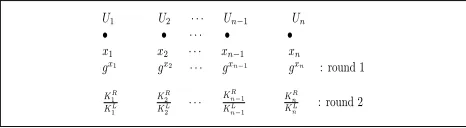
Figure 1. An execution of the protocol DB among nusers;KiL = gxi−1xi, KiR = gxixi+1; Ui transmits gxi in round 1 and
KiR KL i
in round 2; the session key is sk = K1RK2R. . . KnR =
gx1x2+x2x3+···+xnx1
Send oracle.
We adopt the following definition given by Gennaro-Lindell [18] for security of password-based key agreement protocols against dictionary attack:
Definition 3.2: A password based group key agreement protocolP is secure against dictionary attack if for every dictionaryD,
AdvAKAP (t, qE, qS)≤ qS
|D| +(l)
whereis a negligible function in the security parameter l of the system.
IV. PROTOCOL
Suppose a set of n≥3 users P ={U1, U2, . . . , Un} share a low entropy secret passwordpwdrawn uniformly from a small dictionary of size N and wish to establish a high entropy common session key among themselves. We consider the users U1, . . . , Un participating in the protocol are on a ring and Ui−1, Ui+1 are respectively the left and right neighbors of Ui for 1 ≤ i ≤ n with U0=Un, Un+1=U1 andUn+i is taken to be Ui. Quite
often we identify a user Ui with his instance ΠdiUi (for some unique integer di that is session specific) during a protocol execution. We denote byA|B the concatenation ofA, B.
Let G =g be a multiplicative group of some large prime orderqandG=G\ {1}. ThenG={gx|x∈Zq∗}. The passwordpwshared among the members of the group is used as a part of key for encryption/decryption. We use a secure block cipher (Ek,Dk)where Ek is a keyed permutation over a set S, Dk is the inverse of Ek andk is the key for encryption/decryption drawn from a key space of sizeN. The setS is of the formS={U|d|t|X : UserU with instance numberdsends tthmessageX ∈ G}.
A. DB : Unauthenticated GKA of [15]
The unauthenticated protocol DB presented in [15] in-volves two rounds and a key computation phase. The pro-tocol is executed as follows among nusersU1, . . . , Un.
1. (Round 1) Each userUi= ΠdiUi chooses randomly a private key xi ∈Zq∗, computes Xi =gxi and sends Xi to his neighborsUi−1, Ui+1.
right key KiR = Xixi+1, Yi = KiR/KiL and sends Yi to the rest of the users.
3. (Key Computation) Finally in the key compu-tation phase, Ui computes KRi+1, KRi+2, . . . , KRi+(n−1) as follows making use of his own right key KiR: KRi+1 =Yi+1KiR,KRi+2 =Yi+2KRi+1, . . . , KRi+(n−1)= Yi+(n−1)KRi+(n−2).
ThenUiverifies ifKRi+(n−1)is same as that of his left keyKiL(=KiR+(n−1)). If verification fails, thenUiaborts. Otherwise, Ui has correct right keys of all the users. Ui computes the session key skdiUi =KR1KR2 . . . KRn which is equal to gx1x2+x2x3+···+xnx1. Figure 1 illustrates the
protocol.
Complexity:Each user computes3 exponentiations (one in round 1 and two in round 2) and at most 2n−2 multiplications (n− 1 multiplications for recovery of all right keys and n−1 multiplications for session key computation).
B. KeyAgree: Modified Version of Protocol DB
The unauthenticated protocolKeyAgreedescribed in this section is the basis of our password-based scheme (pre-sented in the subsequent subsection) and is obtained by introducing certain modifications to the protocol DB.
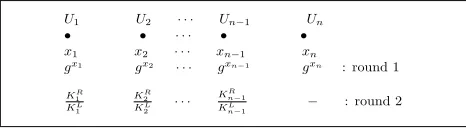
Like DB protocol, this protocol also involves two rounds and a key computation phase. An honest execution of the protocol proceeds as follows among user instances
Πd1 U1, . . . ,Π
dn
Un. Figure 2 illustrates the protocol.
Letstr(il)=Ui|di|l,1≤i≤n,l= 1,2.
1. (Round 1) At the start of the session, each userUi=
ΠdiUi chooses randomly a private keyxi ∈Zq∗, computes Xi = gxi and sends Ti = str(1)i |Xi to his neighbors Ui−1, Ui+1. In addition, user Un sends Tn = str(1)n |Xn to other participants involved in the session.
2. (Round 2) After this communication round is over, Ui receives Ti−1 = str(1)i−1|Xi−1 from Ui−1, Ti+1 = str(1)i+1|Xi+1 from Ui+1 and Tn = str(1)n |Xn from Un. User Ui aborts the protocol if any two of Xi−1, Xi and Xi+1 are same which take place with negligible probability. ElseUi extractsdn and computes his left key KL
i = Xixi−1 and right key KiR = Xixi+1. Each user Ui
for 1 ≤i ≤n−1 computesXi =KiR/KiL and sends Ti = str(2)i |Xi to the rest of the users while user Un remains passive (i.e. sends nothing) in the second round. We note that the right key ofUi is same as the left key ofUi+1.
3. (Key Computation) Finally in the key computation phase,UicomputesK1R, K2R, . . . , KnRas follows making use of his own left keyKiL and right keyKiR:
KR
i+j=Xi+jKiR+j−1 for1≤j≤n−i−1 KL
i−j=KiL−j+1/Xi−j for1≤j≤i−1
Point to note thatKiL−j =KiR−j−1 andK1L=KnR. Thus Ui recovers all the right keys KnR, KjR for 1 ≤ j ≤
n−1,j =i−1, iandUi himself knows KiR−1(=KiL)
U1 U2 · · · Un−1 Un
• • · · · • •
x1 x2 · · · xn−1 xn
gx1 gx2 · · · gxn−1 gxn : round 1 KR
1
KL
1
KR
2
KL
2 · · ·
KR
n−1
KL
n−1 − : round 2
Figure 2. An execution of the protocol KeyAgreeamong n users,
KiL =gxi−1xi, KiR =gxixi+1;Ui transmits str(1)i |gxi in round
1 and str(2)i |KKiRL
i in round 2;
Ui aborts if any two ofgxi−1,gxi;
gxi+1are same;Unsends nothing in round 2; the session key issk=
K1RK2R. . . KRn =gx1x2+x2x3+···+xnx1
and KiR. Then Ui computes the session key skdiUi = KR
1K2R. . . KnR which is equal to gx1x2+x2x3+···+xnx1.
User Ui also extracts instance numbersd1, . . . , dn from the received messages and sets his session identity siddiUi ={(U1, d1), . . . ,(Un, dn)}.
Complexity:Each user computes3exponentiations (1in round 1 and2in round 2) and at most2nmultiplications and/or divisions (including n multiplications for session key computation).
We now explore certain redundancies in the transmitted messages present in the protocol DB [15] which we re-moved in the protocolKeyAgreeby incorporating certain check steps and thereby aborting the protocol if such a situation occurs. Presence of any such redundancy in KeyAgree will cause the password-based scheme (de-scribed in the subsequent section) vulnerable to off-line dictionary attacks.
(a) Unlike DB protocol, each user Ui inKeyAgree, after first round communication, checks if any two of Xi−1, Xi andXi+1 are same and if so aborts the protocol.
Case (i): Xi−1 = Xi+1 : This implies KiL = KiR which in turn yields a redundancy Xi = 1.
Case (ii):Xi−1=Xi : This implicitly definesxi−1= xi. Then Xi−1 = KKiRL−1
i−1 =
gxi−1xi
gxi−2xi−1 and Xi = K R i KL
i = gxixi+1
gxixi−1. Now if in addition, it happens to be the case
that Xi−2 = Xi+1 (i.e. xi−2 = xi+1, probability of which is very small for two honest users Ui−2 and Ui+1), thenXi−1Xi= 1, another possible redundancy in
the transmitted messages of the protocol DB. An active adversary may interleave the messages during the protocol execution and manipulate the transmitted messages to create such a redundancy as follows: adversary simply replaces Xi+1 by a copy of Xi−2 (that he obtains by interleaving the protocol transmission) in the first round communication.
Case (iii):Xi=Xi+1: Arguing in a similar way as in case (ii), if Xi−1 =Xi+2 (i.e. xi−1 =xi+2, probability of which is negligible), then one obtains the redundancy relationXiXi+1= 1. This situation can be created by an active adversary by replacingXi+2by a copy ofXi−1at hand in the first round communication.
U1 U2 U3 . . . Un−1 Un
• • • . . . • •
pw pw pw . . . pw pw
x1 x2 x3 . . . xn−1 xn
Uicomputesstr(1)i =Ui|di|1 andTi=str(1)i |gxi
Epw|U1(T1) Epw|U2(T2) Epw|U3(T3) . . . Epw|Un−1(Tn−1)Epw|Un(Tn) : Round-1
Communications :UisendsEpw|Ui(Ti) toUi−1, Ui+1, 1≤i≤n−1 whereU0=Un, Un+1=U1 andUnsendsEpw|Un(Tn) toU1, U2, U3, . . . , Un−1
Uion decryption recoversgxi−1, gxi+1, 1≤i≤n,x0=xn, xn+1=x1
Uiaborts the protocol ifgxi−1=gxi+1or ifgxi=gxi−1or ifgxi=gxi+1
ElseUicomputesKiL=gxi−1xi,KiR=gxixi+1,str(2)i =Ui|di|2, 1≤i≤n,x0=xn, xn+1=x1
Ui, 1≤i≤ncomputesXi=KiR|KiL,Ti=str(2)i |Xi
Epw|U1
T1
Epw|U2
T2
Epw|U3
T3
. . . Epw|Un−1
Tn−1
- : Round-2
Communications :Ui, 1≤i≤n−1 sendsEpw|Ui
Ti
toUj, 1≤j≤n, j=i
Unremains passive (sends nothing) in this round
Ui, 1≤i≤non decryption recovers KR
j
KL
j, 1≤j≤n−1, j=i
Ui, 1≤i≤nrecoversKjR, 1≤j≤n, j=i
Uicomputes his session keysk di
Ui=K
R
1K2RK3R· · ·KnR−1KnR=gx1x2+x2x3+x3x4+···+xn−1xn+xnx1
and sets his session identitysiddi
Ui={(U1, d1), . . . ,(Un, dn)}
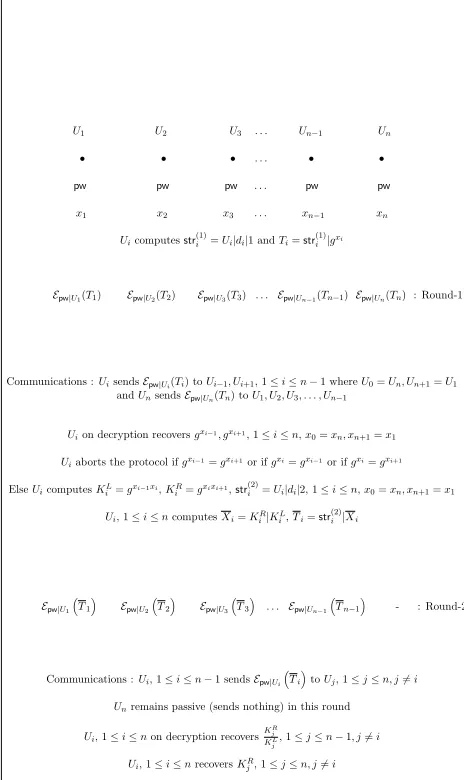
Figure 3. An execution of the protocol P−KeyAgree among n
users, KiL = gxi−1xi, KiR = gxixi+1; Ui transmits encryption
of str(1)i |gxi in round 1 and encryption of str(2)i |KKRiL
i
in round 2
under the encryption keypw|Ui;Uiaborts if any two ofgxi−1,gxi; gxi+1 are same; Un sends nothing in round 2; the session key is
sk=K1RKR2 . . . KnR=gx1x2+x2x3+···+xnx1
X1X2. . . Xn = 1. We are essentially removing this redundancy from the transmitted messages in the protocol KeyAgree by restricting Un from communicating in the second round.
An active adversary, manipulating the messages ex-changed during protocol execution, may be able to create other kind of redundancies. So while transforming the unauthenticated protocol DB into password-based setting, we should pay careful efforts to make an active adversary unable to get any advantage in guessing the password off-line. This is a non-trivial task.
U1 U2 U3 ··· Un−1 Un
• • • ··· • •
pw pw pw ··· pw pw
x1 x2 x3 ··· xn−1 xn
Epw(gx1) Epw(gx2) Epw(gx3) ··· Epw(gxn−1) Epw(gxn): round 1
Epw(KR1
KL 1) Epw(
KR 2
KL 2) Epw(
KR 3
KL 3) ··· Epw(
KR n−1
KL n−1) Epw(
KR n
KL n): round 2
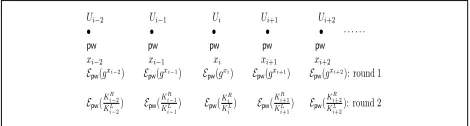
Figure 4. Naive password-based approach: a straight-forward conver-sion of the protocol DB to password-based setting among n users;
KiL = gxi−1xi, KiR = gxixi+1; Ui transmits gxi in round 1
and KKRiL
i in round 2; the session key is
sk = K1RK2R. . . KnR =
gx1x2+x2x3+···+xnx1
C. P−KeyAgree: Password-Based GKA
We now present our password-based group key agree-ment protocolP−KeyAgreethat is obtained by modify-ing the protocol KeyAgreeintroducing encryption-based authentication mechanism with the passwordpwas a part of the secret key. The protocol proceeds as follows among n instancesΠdU11, . . . ,ΠdnUn. An execution of the protocol amongn users is shown in Figure 3.
Letstr(il)=Ui|di|l for1≤i≤n,l= 1,2.
1. (Round 1) In the first round, each user Ui chooses randomly a private key xi∈RZq∗, computes Xi = gxi, encrypts Ti = str(1)i |Xi using pw|Ui as secret key to obtain Yi = Epw|Ui(Ti) and sends Yi to his neighbors
Ui−1, Ui+1. In addition, user Un sends Yn to other
participants involved in the session.
2. (Round 2) In the second round, each user Ui on receiving Yi−1, Yi+1 from his neighbors, decrypts Yi−1,Yi+1 with the respective decryption keyspw|Ui−1, pw|Ui+1 and obtains Ti−1 = stri(1)−1|Xi−1, Ti+1 = str(1)i+1|Xi+1 respectively. Ui aborts the protocol if any two of Xi−1,Xi andXi+1 are same which occurs with negligible probability. Else Ui extracts dn and computes his left keyKiL=Xixi−1and right keyKiR=Xixi+1. Each user Ui for 1 ≤ i ≤ n−1 computes Xi = KiR/KiL, Ti = str(2)i |Xi, Yi = Epw|Ui(Ti) and sends Yi to the
rest of the users in the second round.Un remains passive (i.e. sends nothing) in this round. We note that right key ofUi is same as the left key ofUi+1.
3. (Key Computation) Each user Ui on receiving Yj from Uj, 1 ≤ j ≤ n−1, decrypts Yj using pw|Uj as the decryption key to recover Xj and extracts instance number dj. User Ui then computes K1R, K2R,· · ·, KnR exactly as in the protocol KeyAgree (cf. section IV-B) making use of his own left keyKiL and right key KiR.
V. REDUNDANCIES ANDSECURITYISSUES
The procedureP−KeyAgreeis obtained by modifying the unauthenticated protocol KeyAgree by introducing encryption-based authentication mechanism. Note that each user Ui uses pw|Ui as encryption key. Only those users who have the knowledge of pw, would be able to decrypt the encrypted messages.
Ui−2 Ui−1 Ui Ui+1 Ui+2
• • • • • ···
pw pw pw pw pw
xi−2 xi−1 xi xi+1 xi+2
Epw(gxi−2) Epw(gxi−1) Epw(gxi) Epw(gxi+1) Epw(gxi+2): round 1
Epw(KiR−2
KL i−2) Epw(
KR i−1
KL i−1) Epw(
KR i
KL i) Epw(
KR i+1
KL i+1) Epw(
KR i+2
KL i+2): round 2
Figure 5. Dictionary attack to the password-based protocol in Figure 4;
Uican make use of the following redundancies for off-line dictionary attack where the transmitted messages over the public network are
encryptions of Xi = gxi and Xi = K R i KL
i = gxixi+1
gxixi−1 under the
password pw:(a)X1X2. . . Xn = 1,(b)if Xi−1 = Xi+1, then
Xi= 1,(c)ifXi−1=Xiand the adversary makes Xi−2=Xi+1 toUi, thenXi−1Xi= 1,(d)ifXi+1=Xiand the adversary makes
Xi+2=Xi−1 toUi, thenXi+1Xi= 1
not yield a secure password-based protocol and one can mount an off-line dictionary attack as follows: Observe that X1X2. . . Xn = 1. This redundancy enables an adversary to make the protocol vulnerable to dictionary attacks by guessing the password off-line and verifying whether the product of decrypted values in the second round communication is 1. If so, the adversary’s guess for password is correct. To prevent such attacks, we remove the redundancy in protocol KeyAgree by keeping Un inactive in this round. As a result, the key computation is appropriately modified. These are the points where the procedureKeyAgreediffers from the unauthenticated scheme DB of [15].
Note that the protocolKeyAgreeis aborted ifXi−1= Xi+1 which in turn implies KiL = KiR. This step is essential to disable an adversary from mounting off-line password guessing attack, because if the protocol proceeds with KiL = KiR for some i, then Xi = 1 (see Figure 4) and the corresponding publicly transmitted value is simply the encryption of a constant string. By maintaining a list, the attacker can exhaustively search for the password.
Also the protocol KeyAgree is aborted ifXi =Xi−1 or Xi = Xi+1. As discussed earlier in Section IV-B, an active adversary may manipulate the transmitted messages during protocol execution by Send query so thatXi−1Xi = 1(adversary simply replaces in the first round the ciphertext ofUi+1 by the ciphertext ofUi−2in the same round) or XiXi+1= 1 (adversary replaces the ciphertext of Ui+2 in the first round by the ciphertext of Ui−1 in the same round). Now if the encryption-based mechanism uses pw as the encryption key instead of pw|Uifor userUi (see Figure 4), then an active adversary in the on-line phase may manipulate the messages as described above, search exhaustively for the password by checking Xi−1Xi = 1 or XiXi+1 = 1 and thus mounts an off-line dictionary attack. To resist these type of manipulation-based redundancies, the encryption by user Ui is done using pw|Ui as the secret key instead ofpw.
VI. SECURITYANALYSIS
Theorem 6.1: [15] The unauthenticated protocol UP described in subsection IV-B is secure against passive
ad-versary under DDH assumption, achieves forward secrecy and satisfies the following:
AdvKAUP(t, qE)≤4 AdvDDHG (t) +8qE q
where AdvKAUP(t, qE) is the maximum advantage of any passive adversary attacking protocolUP, running in time t and making at most qE calls to the Execute oracle, t=t+O(|P| q
E texp)andtexp is the time required to perform an exponentiation in G.
Theorem 6.2: The password-based encrypted key agreement protocol PAP described in subsection IV-C satisfies the following:
AdvAKAPAP(t, qE, qE, qS)≤AdvKAUP(t, qE+qS n)+
q2
E
2|S|+ qS
N with t ≤ t + (|P|qE + qS)tPAP where tPAP is the time bound of the execution of PAP by any one of the n users, N is the size of the dictionary of all possible passwords and qE, qE, qS are respectively the maximum number of encryption/decryption, Executeand
Send queries an adversary may ask andS={U|d|t|X : U with instance numberdsends tth messageX ∈G}. Proof : Let A be an adversary which attacks the password-based protocolPAP. Using this we construct an adversary A which attacks the unauthenticated protocol UP. AdversaryAuses a listtlist. It stores pairs of session IDs and transcripts intlist. AdversaryAdraws a password pwfrom the set of all possible passwords to initialize the real attack and gives all the instances of users to A in order to cover concurrent execution of the protocol PAP. Suppose Encrypt is the event that A makes a Send query on a message that is encrypted by A itself by guessing the password. A simulates the encryption and decryption queries of A by maintaining two lists elist anddlist(initially empty) as follows, each of size at most qE and all the other oracle queries ofA are answered by
Ausing its own queries to the Executeoracle.
–Encryption query: For an encryption query Ek|U(X) such that a record (δ, k|U, X,Λ, Y) appears inelist(δis either 0 or 1 and Λ is either E orD), the answer is Y. Otherwise, a random ciphertext Y ∈ S of length|X| is chosen and the record (δ, k|U, X,E, Y) is added toelist whereδ∈ {0,1}. If the query comes from the simulator, δ is set to be0; else the query is directly asked by the adversary and δ is set to be1.
–Decryption query: For a decryption query Dk|U(Y) such that a record (δ, k|U, X,Λ, Y) appears in elist (δ is either 0 or 1 and Λ is either E or D), the answer is X. Otherwise,X ∈ S of length|Y| is chosen randomly. The record(k|U, Y,D, X)is added todlistand the record
(0, k|U, X,D, Y) is added to elist. Note that a record
(k|U, Y,D, X) appears in dlist if and only if Dk|U(Y) is asked first before the corresponding encryption query.
Now suppose there exists a record of the form
(1,pw|Ui, X,∗, Y) in elist such that A makes a Send query on Y. This means that the encryption query
Epw|Ui(X) is asked first before the corresponding
the form (0,pw|Ui, X,∗, Y) instead). Consequently, the record (pw|Ui, Y,D, X) does not appear in dlist. This impliesA gets the encryption capability by guessing the password andthe event Encryptoccurs.
Suppose Collision is the event that the permutation property (bijection) of block cipher(Ek|U,Dk|U)does not hold. Now since the encryption and decryption lists are at most of size qE, the probability that the permutation property of block cipher does not hold is at most q2E
2|S|. Hence Prob[Collision]≤ qE2
2|S|.
Let Bad=Encrypt∨Collision. If ever the event Bad occurs, adversary A aborts and outputs a random bit. Otherwise, A outputs whatever bit is eventually output byA. Note that since the passwordpwis selected byA, it can detect occurrence of the eventEncrypt. We provide details of oracle simulations below.
–Execute queries: Suppose A makes a query Execute({(U1, d1), . . . ,(Un, dn)}). It receives as output a transcript T of an execution of UP. It appends (S, T) to tlist. Adversary A then expands the transcript T for the unauthenticated protocol UP into a transcript T for the password-based protocol PAP according to the modification described in Section IV-C. A is able to do this since the passwordpwis chosen byAitself.Athen returns T toA.
–Send queries: The first send query that A makes to an instance is to start a new session. We will de-note such queries by Send0 queries. To start a ses-sion among unused instances Πd1
U1, . . . ,Π dn
Un, the
ad-versary has to make the send queries in any order: Send0(U1, d1,“start”), . . .Send0(Un, dn,“start”). When all these queries have been made, A sets S =
{(U1, d1), . . . ,(Un, dn)} and makes anExecutequery to
its own execute oracle. It receives a transcriptT in return and stores (S, T)in the list tlist. Let us denote the send queries of first and second round by Send1 and Send2 respectively. Note that Send0 and Send2 queries have no output. Assuming that the eventBad does not occur, any subsequent Send query (i.e., after a Send0 query) to an instance ΠiU is on a properly encrypted message. Note sinceEncryptdoes not occur, any attempt byA to encrypt and make aSend query will be detected and the protocol aborted. AdversaryAwould not be able to copy a correct message of a userUk and make aSendquery on behalf ofUl(l=k) as this would also be detected. So the Send query toΠiU is on a properly encrypted message.
A now performs the action to be done by ΠiU in the password-based protocol. This is done in the following manner: A first finds the unique entry (S, T) in tlist such that(U, i)∈S. Such a unique entry exists for each instance by assumption.Adecrypts the current incoming messages. Note that A can decrypt as he knows the passwordpw. From the transcriptT, adversaryAfinds the appropriate message, encrypts it to form the next public information with appropriate secret key of the formpw|U to be output byΠiU and returns it to A.
–Reveal/Test queries : Suppose A makes the query Reveal(U, i) or Test(U, i) to an instance ΠiU for which
TABLE I. PROTOCOL COMPARISON
Protocol Communication Computation
R BL PTP Exp Mul+ Enc Dec
Div
BCP [13] n n|e| 2n−2 2n - 1 2
Our prot. 2 2|e| 2n−2 3 2n 2 n+ 1
acciU = 1. At this point the transcript T in which
Πi
U participates has already been defined. Now A finds
the unique pair (S, T) in tlist such that (U, i) ∈ S. Assuming that the event Bad does not occur, T is the unique unauthenticated transcript which corresponds to the transcript T. ThenA makes the appropriate Reveal orTest query to one of the instances involved inT and returns the result to A.
As long asBaddoes not occur, the above simulation for
A is perfect. WheneverBadoccurs, adversaryA aborts and outputs a random bit. SoProbA,PAP[Succ|Bad] = 12. Using this, we obtainAdvA,UP≥AdvA,PAP−Prob[Bad]. The total number of Execute queries made by A is at most qE + qS/n, where qE is the number of Execute queries made by A. Also since AdvA,UP ≤ AdvKAUP(t, qE+qS/n)by assumption, we obtain:
AdvAKAPAP ≤ AdvKAUP(t, qE+qS/n) +Prob[Encrypt]
+Prob[Collision].
The event Encrypt occurs whenever a Send(U, i, Y) query is asked by the adversary A where a record of the form(1,pw|U, X,∗, Y)appears in elist. We note thatA may ask at most qS Send queries and so is able to build at most qS data (encryptions) by itself. Hence at most qS passwords it might have tried in the on-line guessing. Moreover, as long as the exponents from Zq∗ chosen by the users are random, the plaintexts to be encrypted are completely indistinguishable from random plaintexts drawn from the domain of the encryption function from the point of view of A. Hence an off-line exhaustive search on passwords will not get any bias on the actual password pw. So we have Prob[Encrypt] ≤ qSN. This yields the statement of the theorem.
VII.
Efficiency
Table 1 compares our protocol and Bresson et al.’s password-based group key agreement protocol (BCP) [13] where the following notations are used– n and R are the total number of users in a group and total number of rounds respectively; BL is the maximum bit length of encrypted messages sent per user, PTP, Exp, Mul, Divrespectively stands for maximum number of point-to-point communications, modular exponentiations, modular multiplications and divisions computed per user;Enc,Dec denote respectively the maximum number of symmetric key encryptions and decryptions performed per user; and
protocol requires only2rounds which makes our protocol efficient from communication point of view. Each user sends one message in each round. The maximum bit length of messages sent during protocol execution is at most2|e|Each group member performs at most3modular exponentiations, 2n multiplications and/or divisions, 1 division,2 encryptions andn+ 1decryptions.
VIII. CONCLUSION
We address the problem of designing password-based authenticated key establishment protocols. A case study is made regarding the difficulties of convering a GKA protocol into password-based setting considering the DB protocol [15] – a variant of the constant round GKA pro-tocol BD [14], [22]. The propro-tocol DB is finally enhanced into a password-based GKA which is proven to be secure against dictionary attack under DDH assumption in the ideal cipher model. We complement these results with a security analysis in the formal security model of Bellare
et al. [6] following the work of Bresson et al. [13].
REFERENCES
[1] M. Abdalla, J. -M. Bohli, M. I. G. Vasco and R. Stein-wandt. (Password) Authenticated Key Establishment: From 2-Party To Group. In proceedings of TCC 2007, LNCS 4392, pp. 499–514, Springer-Verlag, 2007.
[2] M. Abdalla, E. Bresson, O. Chevassut and D.
Pointcheval. Password-based Group Key Exchange in a Constant Number of Rounds. In proceedings of PKC 2006, LNCS 3958, pp. 427-442, Springer-Verlag, 2006. [3] M. Abdalla and D. Pointcheval, A Scalable Password-based Group Key Exchange Protocol in the Standard Model. Inproceedings of ASIACRYPT 2006, LNCS 4284, pp. 332–347, Springer-Verlag, 2006.
[4] M. Bellare and P. Rogaway. Entity Authentication and Key Distribution. In proceedings of Crypto 1993, LNCS 773, pp. 231-249, Springer-Verlag, 1994.
[5] M. Bellare and P. Rogaway. Provably Secure Session Key Distribution: The Three-party Case. In proceedings of STOC 1995, pp. 57-66, ACM Press, 1995.
[6] M. Bellare, D. Pointcheval, and P. Rogaway. Authenti-cated Key Exchange Secure Against Dictionary Attacks. In proceedings of Eurocrypt 2000, LNCS 1807, pp. 139-155, Springer-Verlag, 2000.
[7] S. M. Bellovin and M. Merritt. Augmented Encrypted Key Exchange : A Password-based Protocol Secure against Dictionary Attacks and Password File Compro-mise. In proceedings of ACM CCS 1993, pp. 244-250, ACM Press, 1993.
[8] J. -M. Bohli, M. I. G. Vasco and R. Steinwandt. Password-Authenticated Constant-Roung Group Key Es-tablishment with a common reference string. Available at http://eprint.iacr.org/2006/214.
[9] V. Boyko, P. MacKenzie and S. Patel. Provably Se-cure Password-authenticated Key Exchange using Diffie-Hellman. In proceedings of Eurocrypt 2000, LNCS 1807, pp. 156-171, Springer-Verlag 2000.
[10] E. Bresson, O. Chevassut and D. Pointcheval. A
Security Solution for IEEE 802.11’s Ad-Hoc Mode: Password Authentication and Group Diffie-Hellman Key Exchange. International Journal of Wireless and Mobile Computing (IJWMC), 2(1):413, 2007.
[11] E. Bresson, O. Chevassut and D. Pointcheval. New Secu-rity Results on Encrypted Key Exchange. In proceedings of PKC 2004, LNCS 2947, pp. 145-158, Springer-Verlag, 2004.
[12] E. Bresson, O. Chevassut and D. Pointcheval. Proof of Security for Password-based Key Exchange (IEEE P1363 AuthA Protocol and Extensions). In proceedings of ACM CCS 2003, pp. 241-250, ACM Press. [13] E. Bresson, O. Chevassut and D. Pointcheval. Group
Diffie-Hellman Key Exchange Secure Against Dictionary Attack. In proceedings of Asiacrypt 2002, LNCS 2501, pp. 497-514, Springer-Verlag, 2002
[14] M. Burmester and Y. Desmedt. A Secure and Efficient Conference Key Distribution System. In proceedings of Eurocrypt 1994, LNCS 950, pp. 275-286, Springer-Verlag, 1995.
[15] R. Dutta and R. Barua. Constant Round Dynamic Group Key Agreement. In proceedings of ISC 2005, LNCS 3650, pp. 74-88, Springer-Verlag, 2005
[16] R. Dutta and R. Barua. Password-Based Encrypted
Group Key Agreement. In the International Journal of Network Security (IJNS), Vol.3, No.1, pp. 23-34, 2006. [17] R. Dutta. Multi-Party Key Agreement in Password-Based Setting. In proceeding of First Asia International Confer-ence on Modelling & Simulation, (AMS’07), pp. 133-138, IEEE Computer Society Press, 2007.
[18] R. Gennaro and Y. Lindell. A Framework for Password-based Authenticated Key Exchange. In proceedings of Eurocrypt 2003, LNCS 2656, pp. 524-543, Springer-Verlag, May 2003.
[19] O. Goldreich and Y. Lindell. Session-key Generation us-ing Human Memorable Passwords only. In proceedus-ings of Crypto 2001, LNCS 2139, pp. 408-432, Springer-Verlag, 2001.
[20] S. Halevi and H. Krawczyk. Public Key Cryptography and Password Protocols. In ACM Transactions on Information and System Security, pp. 524-543, ACM Press, 1999.
[21] D. P. Jablon. Strong Password-only Authenticated Key Exchange. In SIGCOMM Computer Communication Review, 26(5), pp.5-26, 1996.
[22] J. Katz and M. Yung. Scalable Protocols for Authenti-cated Group Key Exchange. In proceedings of Crypto 2003, LNCS 2729, pp. 110-125, Springer-Verlag, 2003. [23] J. Katz, R. Ostrovsky and M. Yung. Efficient Password-authenticated Key Exchange using Human-Memorable Passwords. In proceedings of Eurocrypt 2001, LNCS 2045, pp. 475-494, Springer-Verlag, 2001.
[24] S. M. Lee, J. Y. Hwang and D. H. Lee. Efficient
Password-Based Group Key Exchange. In proceedings of TrustBus 2004, LNCS 3184, pp. 191-199, Springer-Verlag, 2004.
[25] P. MacKenzie, S. Patel and R. Swaminathan. Password-authenticated Key Exchange Based on RSA. In pro-ceedings of Asiacrypt 2000, LNCS 1976, pp. 599-613, Springer-Verlag, 2000.
[26] V. Shoup. On Formal Models for Secure Key Exchange. In IBM Technical Report RZ 3120, 1999.
Ratna Dutta has completed her B.Sc (Mathematics) in 1996