Volume-6 Issue-2
International Journal of Intellectual Advancements
and Research in Engineering Computations
Mechanical and durability properties of concrete by
partial replacement of fine aggregate by RFA and cement
by silica fume
K.Ragavi1, D.Sudhakar2, E.Jesuraj3, V.Bhuvaneshwari4, K.U.Mani Kandhan5
1234
(UG students, Civil engineering department, Pollachi Institute of Engineering and Technology, Tamilnadu, INDIA)
5(Assistant Professor, Civil engineering department, Pollachi Institute of Engineering and Technology, Tamilnadu, INDIA
Abstract:
In India, traditionally river sand is used as fine aggregate in concrete production. However, due to continuous exploitation of river sand, its availability has become scarce. Construction industry has started using alternate materials as fine aggregate. Out of which manufactured sand is one of the popularly used material as fine aggregate. Materials such as recycled concrete aggregate have issues of dumping and environmental pollution. These materials are viable alternatives for replacement of natural river sand. Recycled concrete, if used as coarse aggregate has problems of water absorption and reduction in strength. Hence, an attempt has been made in this research to use recycled concrete aggregate (RCA) as fine aggregate in concrete. Further, use of RCA as fine aggregate in concrete may reduce the compressive strength of concrete. Hence, it is proposed to use silica fume as a supplementary material in cement with Recycled Fine Aggregate (RFA) as fine aggregate. This study investigates the effect of silica fume and RFA on the mechanical characteristics of concrete mixtures. Mechanical properties and durability properties at 28 days are determined. Silica fume is added to cement in the range of 7.5% and 10% by weight of cement. Natural river sand is replaced with RFA (Recycled Fine Aggregate) in the range of 0%, 50%, 100% by weight of sand. From the study it is found that RFA could be used as alternative material for natural sand. However, as complete
replacement of RFA reduces the strength of concrete, silica fume addition is mandatory. A minimum of 7.5% silica fume is required to prevent strength loss in concrete.
Key words: Recycled fine aggregate (RFA), Silica Fume.
I. INTRODUCTION
Construction industry is facing actual shortage of natural fine aggregate. Hence, the industry has started using alternate aggregates. Manufactured sand, sintered flyash, bottom ash, recycled concrete fine aggregate and crushed steel slag are some of the alternative for river sand. Out of the above, manufactured sand is produced from natural stone or rocks. Manufacturing of sintered flyash, is time consuming and the quality of the aggregates depends on the quality control exercised during the sintering. Bottom ash, crushed steel slags are industrial by-products and viable alternative for river sand. In urban locations, dumping of demolition waste is a major problem and researchers have used demolition waste concrete as coarse aggregate and found that this material to decrease the compressive strength and reduce the demolition waste concrete as coarse aggregate. Hence, researches started using demolition waste concrete as fine aggregate is called RFA.
Research work carried out worldwide on replacement of sand with RFA is reported below. Compressive strength of the concrete decreases with increases in replacement of sand with RFA. 100% replacement of gives 33 N/mm2 strength at 28 days, which is 2% less than conventional concrete (32 N/mm2). By simultaneous replacement of RFA give more strength in period of 28 days with bonding agent of silica fume. Silica fume content of 7.5% and 10% at the weight of cement increases the strength of concrete.
In this work, it is proposed to replace sand completely with RFA. However, as this would reduce the strength by adding SCM in the mix. SCM will improve the strength of concrete. Metakaolin, flyash and silica fume are the most common SCM materials, it is learnt from literature that silica fume is the best among the available SCM, comparing the cost and performance
1.1Literature Review
Krishnamurthy Pandurangan and Rajendiran Arunpandian et.al.,(2017) In India, traditionally river sand is used as fine aggregate in concrete production. However, due to continuous exploitation of river sand, its availability has become scarce. Construction industry has started using alternate materials as fine aggregate. Out of which manufactured sand is one of the popularly used material as fine aggregate. Materials such as quarry dust and recycled concrete aggregate have issues of dumping and environmental pollution. These materials are viable alternatives for replacement of natural river sand. Recycled concrete, if used as coarse aggregate has problems of water absorption and reduction in strength. Hence, an attempt has been made in this research to use recycled concrete aggregate (RCA) as fine aggregate in concrete. Further, use of RCA as fine aggregate in concrete may reduce the compressive strength of concrete. Hence, it is proposed to use metakaolin as a supplementary cementitious material in concrete with Recycled Fine Aggregate (RFA) as fine aggregate. This study investigates the effect of metakaolin and RFA on the mechanical characteristics of concrete mixtures. Mechanical properties such as compressive strength, split tensile strength,
flexural strength at 7 and 28 days are determined. Metakaolin is added to cement in the range of 7.5% to 20% by weight of cement. Natural sand is replaced with RFA in the range of 0-100% by weight of sand. From the study it is found that RFA could be used as alternative material for natural sand. However, as complete replacement of RFA reduces the strength of concrete, metakaolin addition is mandatory. A minimum of 7.5% metakaolin is required to prevent strength loss in concrete. However, if RFA alone need to be used without addition of metakaolin, only 50% replacement of sand with RFA is recommended.
Devaraj P Kumbar and V D Gundakalle et.al.,
Concrete is prepared by mixing various constituents like cement, aggregates, water, etc. which are economically available. Concrete is a composite material composed of granular materials like coarse aggregates embedded in a matrix and bound together with cement or binder which fills the space between the particles and glues those together (NSA, 1982). Production of sand and gravel has increased at an annual rate of less than 1 percent. In essence the amount of crushed stone to be produced in the next 20 years will equal the quantity of all stone produced during the previous century, i.e., about 36.5 billion metric tons. Therefore the use of alternative sources for natural aggregates is becoming increasingly important (NSA, 1982). In the present study the mechanical properties of concrete by replacing cement with different percentages of Silica fume and aggregate by different percentages of Steel slag are studied. The results thus obtained are analyzed using Regression analysis. Results indicated that the replacement of cement by silica fume to the extent of 15% exhibited improved mechanical properties. Further, it has been also observed that with 15% replacement of cement by silica fume and replacement of natural aggregates by steel slag aggregates to the extent of 25% to 50% have shown improved strength compared normal concrete i.e. the concrete with 0% silica fume and 0% steel slag aggregates. Regression analysis has been carried out to compare the experimental results.
which the aggregate percentage is 60 to 70 % in concrete and from the above observation, it is computed to use the 20% Recycled plastic aggregate in concrete which does not affect the properties of concrete. From the above observation it is possible to use the plastic in concrete mix up to 20 % weight of coarse aggregate. Looking in to above aspect we come to the conclusion that plastic can be in cement concrete mix increase the % in plastic to increase the strength of concrete.
II. MATERIAL PROPERTIES
2.1 Cement
Cement is a binding material in concrete which binds the other material to forms a compact mass. In this project work, OPC 53 grade cement is used for experimental study.
Table 2.1 Properties of Cement
Fineness value 8.5
Consistency 29.5%
Initial setting time 32min
Specific gravity 3.17
2.2 Water
Water conforming to the requirements of IS 456-2000 is found be satisfactory for making concrete. In the present investigation, portable drinking water available in the industrial company was used for mixing and curing the paver block.
2.3 Coarse Aggregate
Locally available crushed stone aggregates of nominal size 10mm.wherever possible size of aggregate 10mm used in the project.
Table 2.2 Properties of Coarse Aggregate Description
of test
Test result obtained
Permissible limits as per IS:383-1970 Specific
gravity
2.71 Minimum 2.5
Fineness modulus
7.86
Unit weight (kg/m3)
1603
2.4 Fine Aggregate
A concrete with better quality can be made with sand consisting of rounded grains rather than angular grains. River or pit sand must be used but not used sea sand as it contains salt and other impurities. In this study, river sand has been used as fine aggregate.
Table 2.3 Properties of Fine Aggregate
Description of test
Test result obtained
Permissible limits as per IS 383:1970
Specific gravity
2.63 Minimum 2.5
Fineness modulus
3.06
Unit weight of sand (kg/m3)
1687
2.5 RFA (Recycled Fine Aggregate)
Recycling Fine Aggregate is the material under the process of converting waste conventional waste disposal that can save material and help to concreting without using of river sand. Concrete is a composite material composed of course and fine aggregate bonded together with a fluid cement hat hardens over time.
Table 2.4 Properties of RFA
S. No Test Properties RFA
1 Specific Gravity 2.51
2 Water absorption (%) 2.01
3 Bulk density(kg/m3) 1399 4 Fineness modulus 3.74
5 Zone 1
2.6 Slump Test
cement ratio need for concrete to be used for different works.
III. MIX PROPORTION
In this study, control mix was designed as per IS 10262:2009 for M25 grade. RFA is
replaced by river sand by 0%,50%and 100% also cement is replaced by 7.5% 10% Silica Fume by weight of concrete. The details of the mix proportions of concrete were given in following table 3.1.
Mix Proportion : 1:2: 3.6
Table 3.1Mix Design
Title Specification
Grade of Concrete M25 Type and Grade of
Cement
OPC 53 Grade
Size of Coarse Aggregate 10mm & 20mm
Specific Gravity of Coarse Aggregate
2.66
Specific Gravity of Fine Aggregate
2.63
W/C Ratio 0.5
Table 3.2 Mix Proportion Details
Mate rials
cem ent kg
Silic a fum e kg
% of RF A
Fin e agg reg ate kg
Coa rse agg reg ate
W ate r Lit
Cc 12 - - 25 40 5
M1 12 1 0,
50, 100
25 40 5
M2 12 2 0,
50 100
11, 25
40 5
IV. EXPERIMENTAL
METHODOLOGY
4.1 Compressive strength test
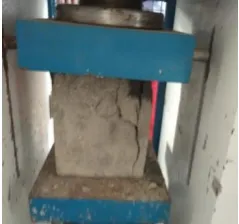
Fig 4.1 Compressive strength test
For cube compression tests on concrete, cube of size 150mm were employed. All the cubes were tested in saturated condition after wiping out the surface moisture from the specimen. For each trial mix, three cubes were tested at the age of 7, 14 and 28 days of carrying 400 tons capacity HELICO compression testing machine referred to BIS: 516-1959.
Table 4.1 Compressive Strength Test
Mix At 28 Days
(N/mm²)
M Conventional 30.83 M1 (7.5% of SF 0% of
RFA)
32.75
M2(7.5% of SF 50% of RFA)
34.367
M3(7.5% of SF 1000% of RFA)
32.567
M4(10% of SF 0% of RFA)
31.5
M5(10% of SF 50% of RFA)
30
M6(10% of SF 100% of RFA)
32.03
Fig 4.2 Compressive Strength Test
4.2 Split tensile test
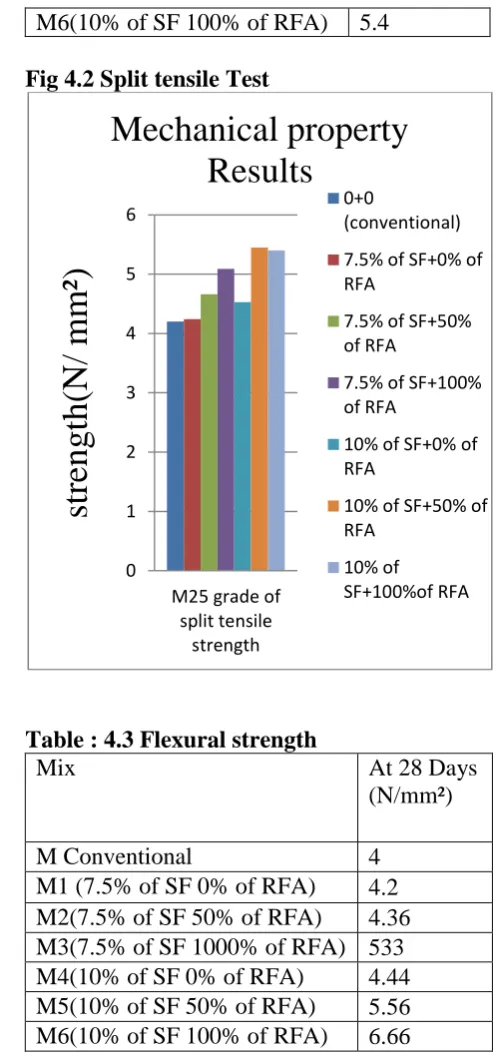
Tensile strength is one of the basic and important properties of concrete. The results are required for the design of concrete subject to transverse shear, torsion, shrinkage and temperature effects. Its value is also used in the design of pre-stressed concrete structures, liquid retaining structures, roadways and runway slabs.
Table : 4.2 split tensile strength
Mix At 28 Days
(N/mm²)
M Conventional 4.2 M1 (7.5% of SF 0% of RFA) 4.24 M2(7.5% of SF 50% of RFA) 4.66 M3(7.5% of SF 1000% of
RFA) 5.09
M4(10% of SF 0% of RFA) 4.53 M5(10% of SF 50% of RFA) 5.45
M6(10% of SF 100% of RFA) 5.4
Fig 4.2 Split tensile Test
Table : 4.3 Flexural strength
Mix At 28 Days
(N/mm²)
M Conventional 4
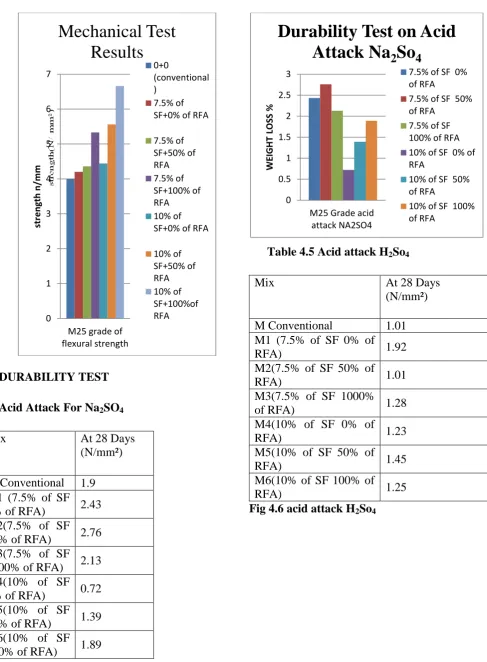
M1 (7.5% of SF 0% of RFA) 4.2 M2(7.5% of SF 50% of RFA) 4.36 M3(7.5% of SF 1000% of RFA) 533 M4(10% of SF 0% of RFA) 4.44 M5(10% of SF 50% of RFA) 5.56 M6(10% of SF 100% of RFA) 6.66
Fig no:4.3 Flexural strength Test
27 28 29 30 31 32 33 34 35
M25 grade of compressive strength
str
e
n
gth
N
/m
m
2
compressive test
0+0
(conventional)
7.5% of SF+0% of RFA
7.5% of SF+50% of RFA
7.5% of SF+100% of RFA
10% of SF+0% of RFA
10% of SF+50% of RFA
10% of SF+100%of RFA
0 1 2 3 4 5 6
M25 grade of split tensile
strength
strengt
h(N/
m
m
²)
Mechanical property
Results
0+0
(conventional)
7.5% of SF+0% of RFA
7.5% of SF+50% of RFA
7.5% of SF+100% of RFA
10% of SF+0% of RFA
10% of SF+50% of RFA
10% of
DURABILITY TEST
Acid Attack For Na2SO4
Mix At 28 Days
(N/mm²)
M Conventional 1.9 M1 (7.5% of SF 0% of RFA) 2.43 M2(7.5% of SF 50% of RFA) 2.76 M3(7.5% of SF 1000% of RFA) 2.13 M4(10% of SF 0% of RFA) 0.72 M5(10% of SF 50% of RFA) 1.39 M6(10% of SF 100% of RFA) 1.89
Fig 4.4 acid attack Na2So4
Table 4.5 Acid attack H2So4
Mix At 28 Days
(N/mm²)
M Conventional 1.01 M1 (7.5% of SF 0% of
RFA) 1.92
M2(7.5% of SF 50% of
RFA) 1.01
M3(7.5% of SF 1000%
of RFA) 1.28
M4(10% of SF 0% of
RFA) 1.23
M5(10% of SF 50% of
RFA) 1.45
M6(10% of SF 100% of
RFA) 1.25
Fig 4.6 acid attack H2So4
0 1 2 3 4 5 6 7
M25 grade of flexural strength
str
e
n
gth
n
/m
m
Mechanical Test
Results
0+0
(conventional )
7.5% of SF+0% of RFA
7.5% of SF+50% of RFA 7.5% of SF+100% of RFA 10% of SF+0% of RFA
10% of SF+50% of RFA 10% of SF+100%of RFA
0 0.5 1 1.5 2 2.5 3
M25 Grade acid attack NA2SO4
WE
IGH
T
LOS
S
%
Durability Test on Acid
Attack Na
2So
47.5% of SF 0% of RFA
7.5% of SF 50% of RFA
7.5% of SF 100% of RFA 10% of SF 0% of RFA
10% of SF 50% of RFA
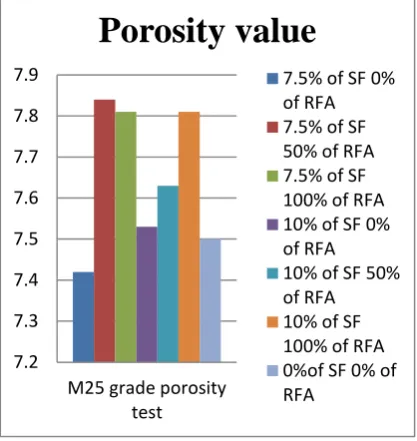
Table 4.6porocity Test
Mix At 28 Days
(N/mm²)
M Conventional 7.5 M1 (7.5% of SF 0% of
RFA) 7.84
M2(7.5% of SF 50% of
RFA) 7.52
M3(7.5% of SF 1000%
of RFA) 7.62
M4(10% of SF 0% of
RFA) 7.53
M5(10% of SF 50% of
RFA) 7.81
M6(10% of SF 100%
of RFA) 7.83
Fig 4.2 porosity Test
Fig 4.6 Porosity Test
V. RESULTS & DISCUSSION
Specific gravity of RFA higher than river sand.
Based on various researches it is observed that 10% replacement of silica fume generally gives maximum strength compared to conventional concrete.
This concrete more economical compared to conventional concrete using river sand.
Workability of the concrete goes on continuously increasing in the percentage of RFA.
Compressive strength of concrete is increased by addition of silica fume and RFA,
REFERENCE
A FERHAT BINGOL, Compressive Strength Of Light Weight Aggregate Concrete Exposed To High Temperature A.R.SANTHAKUMAR, “Concrete Technology” oxford university press 2007.
G. AMATO ,The Use Of Pumice Light Weight Concrete For Masonry Applications.
M.S SHETTY , Concrete Technology N. SIVA LINGA RAO, Properties Of
Aggregate Concrete With Cinder And Silica Fume Admixtur
0 0.5 1 1.5 2 2.5
M25 GRADE ACID ATTACK FOR H2SO4
we
ig
h
t
lo
ss
%
Durability Test on Acid
Attack on H
2So
47.5% of SF 0% of RFA
7.5% of SF 50% of RFA
7.5% of SF 100% of RFA
10% of SF 0% of RFA
10% of SF 50% of RFA
7.2 7.3 7.4 7.5 7.6 7.7 7.8 7.9
M25 grade porosity test
Porosity value
A.M.NEVILLE & J.J.BOOKS, “Concrete Technology” international student edition 1999, ISBN 981-35-840-4, Addison Wesley Longman Ltd. IS:383-1970 “Specification for Coarse
and Fine Aggregate from Natural Sources for Concrete”,(2nd
revision), BIS. New Delhi.
IS: 516-1959 “Method of test for strength of concrete”, BIS, New Delhi. IS: 2386 (part 3) -1963 “Methods Of