Effect of Implementation of Problem Solving Methods Practical Result based on
6-sigma Approach on Wastage Reduction
Masoume Saeedi
Master of Engineering Management and Productivity Systems Manufacturing Equipment Company
Abstract
Our environmental development in various aspects of life such as political, social, technological and cultural stemmed from widening of complexity, difficulty and lack of assurance in our society. Since revolution is the main factor in developing new opportunities as well as new challenges in modern world, so it has been seen that companies and firms need to modern methods, solutions and insight to meet these risks properly; hence they would be able to take their times in order to wipe out the possible threats posed to their organizational framework. The way companies choose to meet these challenges is creative problem solving and renovation as well as appropriate organizational context to able them to turn the creativity into renovation. Problem solving is the most complex part in every decision-making procedure, and it has been defined as an important cognitive trend which needs to combination of some fundamental and typical skills. In cases a creature or an artificial intelligence does not recognize the road from one situation to the best one will pose the question under study. Companies are born in the form of a creature; they grow and behave in various ways. In this case MAPNA Group also needs to utilize problem-solving insight. On the view of necessity, problem-solving project has been set up in the company and it has been tried in this paper to expound the execution procedures aiming achievements in improved methods for doing jobs and to lay the foundation in order to effective performance of strategically management(scheduling).It has been accompanied with insight improvement and drawing attention of manager`s support, teaching the way to recognize and define problems truly, performing statistical strategies of problem solving with the aim of reducing wastage based on 6-sigma concept and paving the way to perform solutions effectively. Therefore the findings are propagation of teamwork culture and promotion of productivity, presenting a theory to solve general, complex and private problems in the form of compiling Problem Solving Gardens and compiling in-home auditing method of problem solving in this organization and changing organizational pattern from functional approach into the process approach. Also Wastage reduction in delayed times and raw materials consumed in production and also cutting the number of nonconforming product and the time dedicated to solving a problem. Basic instructions for the preparation of a paper for the PSST Conference are presented. This document is itself an example of the desired layout and can be used as a template. The document contains information for all formats, type sizes, and typefaces in required styles, without need to define any. Style rules are provided to explain how to handle equations, units, figures, tables, abbreviations, and acronyms. Sections are also devoted to the preparation of acknowledgments, references, and authors' biographies. The English abstract is limited to 180 words in one or two paragraphs, and cannot contain equations, figures, tables, or references. It should concisely state what was done, how it was done, principal results, and their significance.
Keyword:
Problem solving, 6-sigma, Statistical strategies, wastage reduction, performing method of problemsolving in STS.co, problem-solving auditing, renovation
1-Introduction
As result, quality, quantity, and speed of organizational functions should be improved. In making Sepahan equipment during strategic program development and after collecting issues from different department concluded current processes of organization don’t meet strategic purposes, so business process and procedure should be improved as an effective tool to increase efficiency and obtain strategic purposes, then discovering and solving available problems in processes which have been understood by managers and experts is initial step to solve main problem of process improvement. As result, organization have established a technique namely Problem Solving Gardens (PGS) to improve work procedures in the departments using promoting personnel ability to identify and solve work and expertize problems as well as implementing effective strategic management in the organization by involving experts in process issue and freeing up more time for managers to solve main strategic problem. Applied methodology in this study is a process to identify and solve organizational problems which is derived from six sigma thinking. The organization can improve processes, realize strategic purposes and finally identify and remove waste resources using this method and problem solving. Solving some problems cause to create organizational wasting can increase productivity and profitability using this method. When this technique is used as tool and a culture, using excellence discussion and resource and credits could realize excellence purposed of the organization.
2- Six Sigma Approach
According to the results of Pennsylvania University, Six Sigma is defined as effective implement and focusing on qualitative techniques and principles aims having appropriate and without error of performance in the business. Six-sigma is a statistical approach to solve problems, change management culture, thinking method to improve quality, reduce cost, and improve customer’s satisfaction and royalty. Six-Sigma is a structured management method to utilize data and can be used in all aspects of business. Six-Sigma is not a statistical method, but statistic is used as tool in Six Sigma to interpret and explain data. The results of this technique in the organizations are cost, error, and time reduction to implement periodic work and reduce wasting as well as increasing productivity and efficiency.
3- Wastes
Sources of losses and wastes are a clue to identify organizational problems, reduce costs and increasing value-added in the organization; therefore, competition and production are increased in the organization. Any wasting, discarded pieces, bad usage, high dispersion, unused and discarded material, wasting material, overrun, destroying material, craps, garbage, rubbish, surplus material and non- used material are defined as wasting. Process improvement and identifying problems to determine wasting resource were done in Sepahan equipment building. Among all kinds of identified waste like low quality in purchase, intermediate / interaction management, transportation, movement, surplus processing, waiting time, machinery shortage, surplus production, repair and failure of machinery and human resource, this project led to reduce wasting in the field of purchase quality, processing, waiting time, interactions, and human resource.
4-Identifying, Analyzing, and Problem Solving in PGS Method
Identifying problem appropriate and solving them by appropriate solving problems is done in this regard. Therefore, lack of guidance pattern maybe makes some problems in problem solving. Based on General Jorge S. Paton opinion “if you tell people where to go, but don’t say how to go, they are surprised. Therefore, an organized pattern is needed to solve problems in the organization. In order to identify, analyze and solve identified problems, PGS instructions have been designed in the organization and problems have been solved by a comprehensive method.
Problem solving steps are done using define, measure, analyze and improve and control steps which are named Gardens. In addition, in order to assure accuracy of team performance based on instruction and evaluation progress percent over the time, auditing checklist related to each step (appendix 1) was designed and problem solving team have been evaluated based on auditing schedule. Based on PSG instruction to build Sephan equipment in management and expert organizational department, main problems were identified and prioritized and below steps are done to solve problems.
4-1 Definition
In this step, problem is expressed and explained completely, also importance and necessity of problem solving is surveyed. In order to implement this step, “problem solving project charter” (appendix 2) should be completed and below topics should be explained in the charter:
4-1-1 problem title: in this section, the title and purpose of problem solving is started by improvement action. The applied improvement actions in problem solving are increasing or decreasing and in some cases are holding constant.
4-1-2: Problem number, date, revision number, date of revision: in this section, related number to problem, time of completing project charter and re-edit of charter as well as edition time are shown.
4-1-3: problem solving: team should be agreed in one opinion to establish problem solving and obtain a concept and complete explanation of problem solving which is significant using operational definition. In order to uniform and determine problem solving, smart expression is discussed; it means specified, measurement, achievable, result oriented and time bounded.
4-1-4: explain the importance of problem: in this section, importance and necessity of problem should be specified and explained, so people are convinced to use problem solving to save time and cost.
4-1-5: financial advantages of problem solving: in this section, economic advantages of problem solving are determined for organization. If problem solving is shown with a number, problem is turned to a business care.
4-1-6: explain desirable settlement and problem purpose: this determines focus and direction and facilitated solution evaluation.
4-1-7: explain index and criteria or acceptable limits: in this section, completing problem charter below phases is implemented:
Operational definition of index
The indexes which are improved using problem solving are operational definition and the method, the unit of measure; criteria and the current value are explained. Acceptable criterion for each index is distinguished by analyzing available date or patterning same cases.
Drawing tree diagram
In this phase, tree diagram tool is used to divide primary problems to smaller problems and the original scope of problem is determined using Pareto diagram and the results of this phase.
Drawing Pareto diagram
After dividing problems to smaller problems, Pareto diagram is used to specify importance of problem components
4-1-8: macro Timing: set the start and end of the project, given the scope and size of the Problem.
4-1-9: Introducing team of problem solving: After setting out the nature of the Problem, it is necessary to assign experts to solve problem.
4-1-10: Verification and approval of the project: after approving above cases and certainty of the cases in “problem solving project charter”, this issue is verified and approved by director manager to implement next stages.
4-2 Measure
In this section, data and information in problems are specified and final result of data is summarized. This section consists of drawing different diagrams based on available data and aimed to statistical analysis of these diagrams in the next phases.
4-2-1 Measurement tool
Run Chart diagram: this diagram is used to show data changing in a time period or to compare other variable.
Time Series: this diagram is used to present and survey changes of a variable during time period.
Histogram diagram: abundance is shown in this diagram and centralized and scattering indexes of data are estimated and data abundance and normal distribution are compared.
4-3- Analysis
Analysis purpose is to determine potential reason and influencing factor on problem indexes and selecting root reasons of problems. In order to identify root causes, brainstorming sessions was hold and main problem was determined by analyzing Pareto diagram, so all cases which influence on indexes are listed. In the brainstorming session, the given causes should be soluble. In a meeting to discover potential reasons, best situation is absence of managers. In brainstorming meeting, all potential causes are identified and categorized in personnel, material, environment, measurement tool and machinery and procedure groups. After categorizing, these groups are shown by a Fish Bone diagram and then root causes related to each group are selected through following.
Selecting all causes: if number of unknown causes is less than 3, screening known causes is not needed and all causes are considered as root causes.
Analysis of outliers: analyzing drawn diagrams, points which are placed in abnormal situation are identified and causes are extracted thorough documents. Root causes are some causes which are specified in abnormal points. Run chart and Box Plot are important tools in this field.
Counting frequency of each occurrence in each potential cause: number and documents of frequencies have been found by file searching. More frequency shows that this cause could be a root cause.
FMEA method: in this method, intensity, occurrence and discovering of risk number of potential causes are determined and root causes are extracted through comparing these numbers by Pareto diagram.
Flowchart: drawing work flowchart and using experts opinion, time and place of caused are specified on flowchart. This method is useful to prioritize causes
Benchmarking: in some cases, benchmarking is used to specify root causes among same cases of superior businesses.
Expertized opinion: most important causes are selected using experts opinions among potential causes.
4-4 Control and Improvement
Complete understanding of root causes, appropriate solutions are provided by member. Selecting root solutions is done among all appropriate solutions which have provided by team members. In order to obtain these solutions, a brainstorming session is held by management. After final determination of root causes, implementing risk of such solutions are analyzed and an action plan is prepared and implemented to act selected solutions.
5- Comparison of PSG Method and Six Sigma Approach
Notes which are regarded in PSG designing and establishing is to select and implement a method to be implemented by experts in addition to improvement realization. By regarding organizational strategies in the shortest time, PSG method can facilitate maximum acceptable results. In addition to given cases, time and budget limitation are regarded in this field. While, implementing six sigma project needs to long-term culture making in addition to high budge.
Six sigma approach is concerned on customer’s requirements and satisfaction identify wasting and error source, while PSG method focuses on identifying and removing wasting resources in the work event. PGS method is less complex form problem solving approach and is based on six sigma concepts. Similarity between these two methods is improvement. Tennet believes six sigma focuses on customer and profitability, statistical techniques and methodology to improve processes; two latter cases are considered in PSG method. In addition, using different step of designing and implementing six sigma technique with DMADV approach consist of Define, Measure, Analyze, Design and verify and DMAIC approach I defined by replacing two latter stage with improve and Control. Best tool to analyze and measure data is statistical technique PSG which is main tool of analysis in the six-sigma. In other prospective, administrative team and task is simulated in PSG method.
In PSG project, facilitator of problem solving is determined which are same administrative managers of six sigma and responsible to implement projects in organizational department, facilitating and prioritize projects based on commercial purposes, basing and implementing training programs, selecting and coaching team members and estimating projects progress. Finally, training approach and knowledge discovering in the six sigma is reflected in PSG method.
6-PSG Implementation
6-1 Defining Organizational Problems
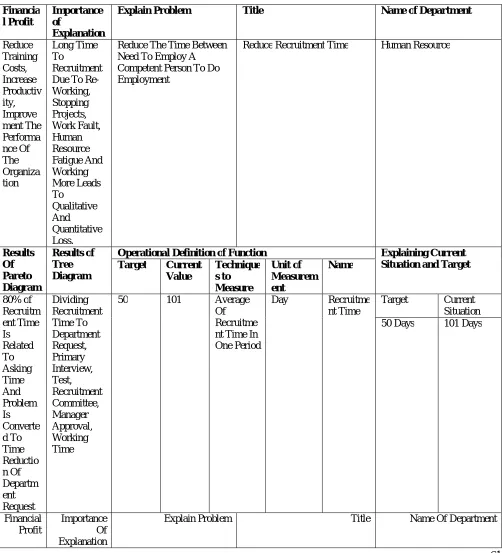
Based on PGS methods in organizational departments, main problems are determined based on table (1)
Table 1: Determined Problems
Name of Department
Title Explain Problem
Importance of
Explanation
Financia l Profit
Human Resource
Reduce Recruitment Time
Reduce The Time Between Need To Employ A Competent Person To Do Employment
Long Time To
Recruitment Due To Re-Working, Stopping Projects, Work Fault, Human Resource Fatigue And Working More Leads To
Qualitative And Quantitative Loss. Reduce Training Costs, Increase Productiv ity, Improve ment The Performa nce Of The Organiza tion
Explaining Current Situation and Target
Operational Definition of Function
Results of Tree Diagram
Results Of Pareto Diagram
Name Unit of Measurem ent Technique s to Measure
Current Value Target
Current Situation
Target Recruitme nt Time Day
Average Of Recruitme nt Time In One Period 101
50 Dividing
Recruitment Time To Department Request, Primary Interview, Test, Recruitment Committee, Manager Approval, Working Time 80% of Recruitm ent Time Is Related To Asking Time And Problem Is Converte d To Time Reductio n Of Departm ent Request
101 Days
50 Days
Name Of Department Title
Explain Problem Importance
Of Explanation Financial
Technical And Engineering
Reduce The Mismatch Technology To Operations Technology
Reduction Rework On The Project's Primary, Manufacturing And Assembly Technology Removing Mismatch Led To Remove Wasting Like Traffic In Engineering And Technical Department, Stopping Production And Unemployme nt Of Personnel, High Wasting, Depreciation Of Machinery And Equipment, Storage Cost And Repair Defective Parts In Addition To Reduce Wasting, 10 Billion Rial Was Saved . Explaining Current Situation And Target
Operational Definition of Function Results of Tree Diagram Results Of Pareto Diagram Name Unit of Measurem ent Technique s To Measure Current Value Target Current Situation Target Mismatch Between Available Technolo gies and Running Technolo gies Number of Mismatche s Compare Line Existing Technolog y In Workshop Projects An Average Of 20 Mismatc hes Per The Project An Average Of 4 Mismatc hes Per The Project Share Problem to Reduce Nonconform ance on All New Projects The High Number Of Non-Complia nce (80% Of Total Non-Complia nce) On The Project Exhaust Turbo An Average Of 20 Mismatch es Per The Project An Average of 4 Mismatches Per The Project
Name Of Department Title Explain Problem Importance Of Explanation Financia l Profit
System Unit and Ict
Reduce Time Of Servicing to Users
Reducing The Response Time To The Users Of The Services Provided By The Unit Ict (Including Identifying And Resolving Problems With Hardware,
Information Saving Device, Prevent High Price In The Market Due To Sending Information For Contractor With Delay X C = Price ، H = Applied Hour To Respondi ng ، M = Mean Income Of An Expert In One Hour ، X = Coefficie nt Of Unemplo yment Personne l Explaining Current Situation and Target
Operational Definition of Function Results of Tree Diagram Results Of Pareto Diagram Name Unit of Measurem ent Technique s To Measure Current Value Target Reque st Current Value Target Respondi ng Time To Sending Informati on By Ict Hour Estimating The Difference Of Respondin g Time To Request Time Based On Current Situation Based On Target Situation Dividing Problem To Requests Like Kind Of Service, Software, Hardware 80% Of Requests Like Services And 80% Of Software Request, Data Transfer, Printer And Fax Softwa re 39 26 Transf er Data 28.5 19 Printer And Fax 38.5 19
Name of Department Title Explain Problem Importance Of Explanation Financia l Profit Building Projects
Reduce Wasting In Turbo-Compressor Project
Reduce Wasting Row Material In Turbo-Compressor Project Reducing Wasting In The Turbo- Compressor Project Led To Decrease Purchasing Price Of Row Material 13.848.0 00 Rial In One Hour Was Saved And Based On Contract 415.440. 000 Rial Explaining Current Situation And Target
Operational Definition of Function Results of Tree Diagram Results Of Pareto Diagram Name Unit of Measurem ent Technique s To Measure Current Value Target Price of Wasting In The Current Price of Wasting In The Target Weight Of Wasting Kilogram Total Weight of Project 14214 13645 Dividing Wasting Reduction 80 % Of
Situation Situation Wasting Problems To Wasting Reduction Of Structure, Exhaust, Enclosure FFU Related To Exhaust And Main Problem Is To Reduce Wasting. 346200000 Rial 323352000ri al
Name of Department Title Explain Problem Importance Of Explanation Financia l Profit
Quality Control Department
Reducing NCR Products
Discovering Basic Causes Of NCR Products And Removing Reduce Price Induced By NCR Which Reduce Hidden And Unexplained Cost Which Lead To Missing Customers Reduce Estimate d Cost For NCR In One Hour Is More Than 130.000. 000 Explaining Current Situation And Target
Operational Definition Of Function Results of Tree Diagram Results Of Pareto Diagram Name Unit of Measurem ent Technique s To Measure Current Value Target Mean Of NCR In Current Month Mean Of NCR In Current Hour Target Number Of NCR Number Estimating Mean Of NCR In One Hour 64 91 Dividing NCR To Dimensional Group, Welding, Color, Material, Contractor 80 NCR % Related To The Three Dimensio nal, Welded And Painted, The Main Aim Is To Discover And Remove The Causes Of This Ncr 8 5
Name Of Department Title Explain Problem Importance Of Explanation Financia l Profit Production Department
Reduce Waste, Raw Materials
The Savings, And In Consideratio n Of The Potential For Improvement , This The Project Will Prove To Be Necessary .
Of
Consuma bles
Explaining Current Situation And Target
Operational Definition of Function
Results of Tree Diagram
Results Of Pareto Diagram
Name Unit of Measurem ent Technique s To Measure
Current Value Target
The Value Of The Materials Used In Its Current State The Value Of The Materials Used In Its Target State
Deviation Of Color Consumpt ion Percent Estimate
Deviance Of Color Consumpti on To Initial Estimate 29
19 Raw
Materials And Consumable Materials Are Divided Into Two Groups Based Materials
80%Of Waste In The Productio n Of Consume r Products (Paints, Electrode s And Filler And Stone
Page (
1500000000 0
1381500000 0
Deviation Of Rock Consumpt ion Percent Estimate
Deviance Of Rock Consumpti on To Initial Estimate 15
5
Deviation Of Electrode Consumpt ion Percent Estimate
Deviance Of Electrode Consumpti on To Initial Estimate 5
3
Name of Department
Title Explain Problem
Importance Of
Explanation
Financia l Profit
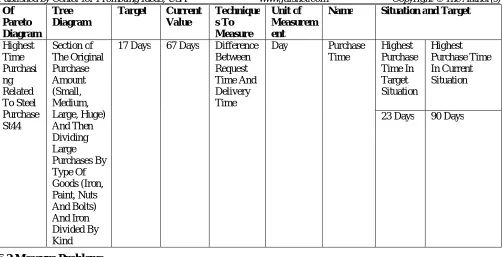
Purchase Department
Reduce Time Of Purchasing
Reduce Time Between Issue And Request And Delivery Time
Planning And Ordering And Final Purchase Is So
Important, Because Earlier Lead To Reduce Cash And Increase Maintain And Repair Price And Decrease Project Event
It Is Not Estimate d
Explaining Current Operational Definition of Function
Situation and Target
Name Unit of Measurem ent Technique s To Measure
Current Value Target Tree
Diagram
Of Pareto Diagram
Highest Purchase Time In Current Situation
Highest Purchase Time In Target Situation
Purchase Time Day
Difference Between Request Time And Delivery Time 67 Days
17 Days Section of
The Original Purchase Amount (Small, Medium, Large, Huge) And Then Dividing Large Purchases By Type Of Goods (Iron, Paint, Nuts And Bolts) And Iron Divided By Kind Highest
Time Purchasi ng Related To Steel Purchase St44
90 Days 23 Days
6-2 Measure Problems
Based on PSG method, all related data to gathering problems in analysis stage is drawn. When there is no document and evidence to survey data, database, and worksheet are designed and will use in the future. Most important diagrams which have feedback and have been used include Box Plot and Run Chart. In all problems, data changing in different time and in some cases were analyzed by secondary variable which shows increase or decrease data current data and documents were extracted. These documents are used in analysis step to extract causes. One of advantages of Box Plot is to represent outlier points in all data. Since, abnormal cases shows influencing factor and inform causes, drawing these diagrams identify outliers and available documents to utilize in the next stages. Drawn diagrams are related to appendix (3)
6-3 Analysis of Problems
In analysis stage, documents related to abnormal data which are determined in the drawn diagrams have been surveyed. In order to investigate these documents and extracting potential causes, all experts in problem solving team should participate in brainstorming sessions and regard to requirements like people freedom to explain thoughts. All people opine their ideas and these opinions are shown at the end of meeting in form of cause and effect diagram. The sample of cause and effect diagram is related to appendix (4)
Each of problems solving team used one or several method to extract root causes based on the tools to measure data. Sample of the used tool in each problem is based on Table (2)
Table (2): method to discover root causes
Problem
Extraction method in root causes
Reduce recruitment time
Analyzing outlier and high variance data in Box Plot diagram
Reduce the mismatch Technology to Operations Technology
Analyze outlier in Box Plot diagram and Prioritize potential causes through FMEA
Reduce time to servicing users
Analyze outlier in Box Plot diagram and Prioritize potential causes through FMEA
Reduce waste in the project of Turbo-Compressors
Prioritize potential causes through FMEA
reduction NCR product
Prioritize potential causes through FMEA
Reduce waste of raw materials
Survey abnormal point in diagram and using production personnel opinion and benchmarking successful samples
Reduce time of purchasing
Survey abnormal point in diagram and using experts opinion
In the analysis level, all causes which were explained in cause and effect diagram were selected to solve problems.
6-4 Problem Improvement and Control
Finding causes of problems is effective when possible and administrative solutions are identified and implemented using organized planning and this is realized in improvement process. Problem solving team are selected based on a brainstorming session with management presence, they offer all possible solutions and then select best solution based on risk analysis, then a solution is approved and converted to a plan. Sub activities are identified and human resources related to each activity are introduced. Problem solving facilitators are responsible to follow activities in improvement process. One of most important note to solve a problem completely is to evaluate solutions in different time periods. Therefore, determined indexes have been evaluated for 6 month problems after implementing solution and are continued if any progress is shown. Building training institute and educating trainee, establishing website, Feasibility and timing project to employ human resource to reduce time to employ and reduce reworking, surplus working and increasing personnel satisfaction, modifying worksheets, presence of experts in production site to train and reduce technology volume and reduce wasting, preparing training book for computer users, holding annually test and encourage superior individual to increase knowledge, informing computer uses to prevent problems, prepare review instruction to reduce waste and time in computer systems, increasing knowledge of managers, increasing control of production, visiting site and powers to fined importance of quality of project, auditing contractor based on important parameter in the organization, fixed time working and human resource, periodic test of welding to reduce NCR products and wasting, contracting long-term to supplier, identify supplier and collect information to reduce purchasing time and prevent delay in the projects.
7- Conclusion
The results of this project in the organization have been investigated indifferent aspects. Development and broadcasting cultural and training problems in the field of problem solving techniques, also capacity of the problems in the organization, developing teamwork culture, creativity and innovation and using individual and team strategies, more saving compared to individual strategies, changing organizational behavior and pattern from task attitude to process attitude, decrease time to solve problems are PSG results. Other aspects include develop and promote level of organizational productivity, promote qualitative, scientific and expertize performance of expert team. Therefore, improving work process and saving costs and removing factors like wasting like bad quality of purchase, surplus processing, waiting time, interaction and human resource should be created. Results of problem solving showed reduction of training cost, improvement of organizational performance, saving induced by decreasing technology mismatch and NCR products and time to respond service request of ICT and reducing purchasing time. One of result of PSG implementation was obtained in Sepahn equipment and is generality approve of this method to solve social and organizational problems. Lack of a comprehensive method to analyze risk, not estimating discovering number in FMEA is PSG limitation which would be regarded in future researches.
Appendix 1
Name of problem solving project : name of auditing team:
date of audit
Standard clause Auditing issues
Efficiency
of documents
Implemented
Objective evidence (positive and negative (
QMS EMS
OHSAS Yes
No Yes No
According to PSG Does auditing department determine and
define problems to understand others?
According to PSG If Rial value is estimated by problem
solving? If Rial value is effective?
According to PSG Is operational definition of index and
variables done to express desirable situation?
According to PSG Is purpose of problem solving is shown in the
According to PSG Is tree diagram used to divide problem to
smaller problems?
According to PSG Is Pareto diagram used to dividing smaller
department?
According to PSG Is there any edition in problem solving team?
According to PSG
Do data summarize on Run chart, time series, box plot and histogram? Does need analysis done on drawn diagram?
According to PSG
If data categorization is clear in diagrams? Is there more explanation based on drawn diagram?
According to PSG
Is there any abnormal situation in drawn diagrams?
According to PSG
Is analysis done if there is abnormal data?
According to PSG
Is there any action to draw and present to produce data or design form?
According to PSG
If brainstorming session are formed in problem rooting?
According to PSG
If given opinion in brainstorming session (personnel, material, environment, machinery, measure and method) are distinguished?
According to PSG
If distinguished cases are drawn on cause and effect diagram?
According to PSG
Is related documents installed on story abroad? Is department problems identified?
According to PSG
Do potential causes induced by brainstorming specify? Is root cause identified among potential causes?
According to PSG
If available methods (analysis of outlier, occurrence counting, FMEA, flowchart and benchmarking) are used to identify causes?
According to PSG
Is document available to identify root cause? Are root causes listed in the table?
According to PSG
Is brainstorming done to determine appropriate solutions for root causes?
According to PSG
Are appropriate solution listed in the table? Does manager identify root solution?
According to PSG
Is risk analysis done for root solution?
According to PSG
Do related solutions distinguish to smaller activities? Does human and time determine for activity?
According to PSG
Does promotion percent of related activities are estimated?
According to PSG
Does documents and evidence available to implement solutions with promotion percent? Does related index determined to measure?
According to PSG
Does current value of indexes show project promotion? Does related documents available to estimated indexes and problem improvement?
Appendix 2 Name of Problem
Reduce Recruitment Time Related Diagram
Name of Problem
Reduce The Mismatch of the Technology to Operations Technology
Reduce Time of Purchasing Related Diagram
Name of Problem
Reduce Time of Service to Users Related Diagram
Name of Problem
Reduce NCR Product Related Diagram
Name of Problem
Reduce Wastes Of Raw Materials Consumption
Related Diagram
14 13 12 11 10 9 8 7 6 5 4 3 2 1 300 250 200 150 100 50 Observation ti m e
Number of runs about median: 8
Expected number of runs: 8.0
Lo ngest run about median: 4
App rox P-Value for Clustering: 0.500
App rox P-Value for Mixtures: 0.500
Numb er of runs up o r down: 8
Expected number o f runs: 9.0
Longest run up or down: 4
Ap prox P -Value for Trend s: 0.248
Ap prox P -Value for Oscillation: 0.752
Run Chart of time
12000 8000 4000 5 35 30 25 20 15 10 5 0 time(min) Fr e q u e n c y Mean1151 StDev2368 N 45
Histogram of time(min)
Normal Printer & Fax
20000 16000 12000 8000 4000 5 60 50 40 30 20 10 0 timed F re q u e n c y Mean1896 StDev 3929 N 95
Histogram of timed
Normal SoftWare 15000 12000 9000 6000 3000 5 80 70 60 50 40 30 20 10 0 t ime Fr e q u e n c y Mean971.2 StDev 2293 N 104
Histogram of time
Normal Data Transfer star t mos aheb
e av aliye
moa yena
t pez eshk
i MD exam
dar k hast vah ed com mite 200 150 100 50 0 SHAKHES d a y
Boxplot of day
300 250 200 150 100 50 t im e
Boxplot of time
25 20 15 10 5 0 -5 5 4 3 2 1 0 NCR Fr e q u e n c y Mean10.75 StDev6.690 N 12
Histogram of NCR
Normal RANG PEYMANKAR MATERIAL JOOS H ABAD 10 8 6 4 2 0 NCR TYPE N O .
References
Ezzedine, Morteza, Aqajani, Rahman, understanding and problem solving in organizations, Volume I, Avaye Ghalam Publication, 2010
Lilly, Mohammad Hossein; Haerizadeh, Kheiriye Begum, creative thinking and creative problem solving, Volume I, Ney Publication, 2009
Khan MokhtariBahram, Introduction to Understanding problem solving tools as the result of teamwork, Volume I, Training and Industrial Research of Iran, 2008
James M, Higenz, Ahmed Pour. Mahmoud, Entrepreneurship: 101 creative problem solving techniques, Amir Kabir Institute Publications, Eighth Edition, Tehran, 2009
Pete Pande, Larry Holpp, Translation by Nournesa, Rasoul., Salehipour, Amir, Saghaei Abbas, What is Six Sigma? House Quality Tehran Institute publication, Second Edition, 2005
Mary A.Williams , Steve Pautz, Translation by Nournesa, Rasoul., Ayouzian, Majid, Saghaei Abbas, Six Sigma and Minitab 14, Termeh Institute publication, First Edition, 2005
Norman R.F. Maiera, L. Richard Hoffmana.; “Organization and creative problem solving ”, www.sciencedirect.com,9 May 2007 (U. Michigan).
Joanna Mamona-Downs , Martin Downs.; “The identity of problem solving”, Department of Mathematics, University of Patras, Campus - RIO, Patras 26500, www.sciencedirect.com, 5 October 2005 (Greece) T.B. Ward.; “problem solving”, www.sciencedirect.com .5 August 2011 (University of Alabama, Tuscaloosa, AL,
USA).
Satya S. Chakravorty.; “Six Sigma programs: An implementation model”, www.sciencedirect.com .Received 19 April 2008; Accepted 15 January 2009. Available online 26 January 2009.(USA)