Shikha. World Journal of Engineering Research and Technology
A NOVEL TEXT ANNOTATION TOOL FOR FORMATIVE
ASSESSMENT
Dr. Shikha Sarkar*
Director, Glasgow, Scotland.
Article Received on 09/10/2019 Article Revised on 30/10/2019 Article Accepted on 21/11/2019
ABSTRACT
Formative assessment is the idea of enabling continual feedback on the
efficacy of learning alongside the teaching activities throughout the
course of instruction. By contrast, summative assessment is the act of
judging the efficacy of learning after the course of instruction. Formative assessment gives
diagnostic feedback during and throughout the instruction period so that the teacher can
address weaknesses in learning in a personalized manner. This is all the more important in
today’s world for the following reasons:
1. With the ever-more competitive job market, the human cost of falling behind education is
very high. Since the number of job-seekers outnumber the number of jobs,[16] it is not
enough to have a qualification, one needs to be thoroughly competent.
2. With the ever-dwindling attention span due to smartphone driven distractions (as studied
in[12] and[13]), it is crucial to see that short periods of inattention or distraction doesn’t get
to jeopardize the learning efficacy.
3. For best results in quality, schools, colleges and Universities need to compete like
private-sector service providers, and therefore teachers need to find every possible avenue
to ensure learning excellence.
This paper outlines some challenges and possible strategies using a text annotation tool ‘the
Spectral editor’ [5] for formative assessment in the context of computing science pedagogy.
World Journal of Engineering Research and Technology
WJERT
www.wjert.org
SJIF Impact Factor: 5.924*Corresponding Author Dr. Shikha Sarkar
INTRODUCTION
Summative assessment can be used to inform learning by working in groups, peer assessment
of work, individual tests, quiz etc.[21] It plays the following important roles:
1. Motivating students to put an effort so as not to do poorly in the assessment.
2. Quantifying the learning and performance characteristics of the student, which may be
used in subsequent selection criteria.
Summative assessment however has the limitation that it does not play a role in addressing
the specific needs of individual students over the duration of instruction. Despite best efforts
towards standardization, every student is different. The diversity is not just in innate traits but
also in the spectrum of life experiences, concept-repertoire, vocabulary, and perceptions
about objects and issues[20] (discusses the effect of socio-economic differences in college
students). This diversity inevitably manifests in variations in learning efficacy. Let alone the
diversity, a brief span of inattention or distraction or absence can make a student miss out on
a crucial concept that is critical to understanding the subsequent material.
When feedback is only marks or grades, students do not benefit from the feedback. Feedback
improve learning when it gives each pupil specific guidance on strengths and weaknesses.[22]
This is where formative assessment helps by continually providing the crucial diagnostic
feedback that helps the teacher identify an individual student’s weaknesses without relying on
the low-likelihood event that the student seeks help proactively. The effectiveness of
formative assessment is a proven fact, and has been widely documented in the literature (e.g.
in[1,14,15]), and has been in widespread use in school-level pedagogy. The key change in the
current times is that distraction is more prevalent, thanks to ever-present smartphones (as
studied in[12] and[13]). On the positive side, there are new media and technologies available for
formative assessment (e.g. online quizzes where automated gradual hints can be provided
without demanding teacher’s personal involvement). E-learning courses are particularly
amenable to formative assessment on a large scale, as is evidenced by the quizzes on online
learning websites like khanacademy.org,[7] courser,[9] udemy[8] etc. A good study of
effectiveness of formative assessment in the context of E-learning is presented in.[4]
In particular, the teaching of computing science can benefit immensely from internet
technologies by way of formative assessment. For example, for logic and programming
assignments, the output can be automatically checked against output corresponding to inputs
judges”,[6]
and admittedly give a very limited feedback - whether the program works or not
for the test cases. A teacher curated, and personalized feedback is also necessary because not
all aspects can be automatically assessed. Multiple-choice questions can be checked by an
online checker (as reported in[10,11]), but automated free-text checking is not yet fully feasible
in current technology. Thus, while fully automated feedback is not really feasible for
assessment tasks with free-form answers (e.g. tasks like essays and stylistic and design
aspects of programming), considerable improvement is possible in ergonomics of the
feedback delivery process.
The following section describes a multi-media enriched innovative text annotation
environment that can ergonomically enhance formative assessment.
A text editing/annotation environment for formative assessment
In computing science assessments, the tasks frequently involve writing programs or parts
thereof. Programs are traditionally written in plain text format. It can ease the job of giving
quick feedback if the text environment allows a way of annotating the text with comments,
audio, video, pictures, etc. For example, using such a multi-media feedback tool, the teacher
or lecturer is able to highlight a part of the code/text and press a button to start recording
audio of her verbal feedback on that part of the code. The audio would be saved with a tiny
button widget next the selected text, which the student can play back on a laptop, phone or
tablet. The efficacy of audio-visual feedback was studied in[19] and it was found to be more
effective and appealing to students than the traditional written feedback. Such a multimedia
annotation environment called “the spectral editor” was developed by the author and reported
in.[5] Although its primary purpose was code-comprehension and inspection in a software
industry setting (on the lines of similar work reported in[2] and[3]), it can equally serve as a
feedback tool for formative assessment in computing science classes.
The spectral editor[5] was developed as a desktop application, so that it would involve an
additional upload process to make the annotated text available online to the student. Such a
tool would be more convenient as a web application (perhaps as a plugin to the moodle
system as presented in[17,18]) so that the teacher can provide feedback from a phone or tablet
(e.g. while travelling on a train).
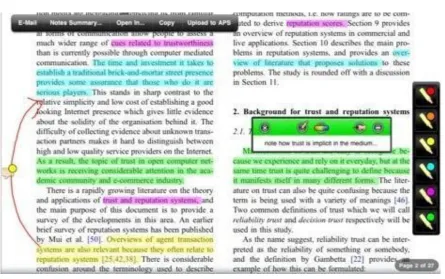
Fig. 1 shows a screenshot from a text annotation tool with features/palettes similar to the tool
like MS Word doc, PDF, and webpages. Since[5] makes such features available for plain text,
it makes the feedback process of formative assessment both richer (i.e. multimedia enriched)
and convenient for computing science pedagogy.
Fig. 1: A document annotation tool.
Following are a few examples of annotations done on formative assessment tasks using the
tool presented in[5]:
https://jm21.s3.amazonaws.com/Shikha/SamMaj2019/dimers_annotated.html.
https://jm21.s3.amazonaws.com/Shikha/KFergu205/finalCoursework.html.
https://jm21.s3.amazonaws.com/Shikha/Gho200/calculator_coursework.html.
https://jm21.s3.amazonaws.com/Shikha/KWard200/calc_interface.html.
REFERENCES
1. Paul Black and Dylan Wiliam, Assessment in classroom learning, Assessment in
Education, 1998; 5(1): 7-74.
2. Alastair Dunsmore, Comprehension and visualization of object-oriented code for
inspections. Empirical Foundations of Computer Science (EFoCS), University of
Strathclyde, Glasgow, 1998.
3. Paul Anderson and Tim Teitelbaum: Software inspection using code-surfer In
4. S. M. Jacob, B. Issac: Formative Assessment and its E-learning Implementation,
arXiv:1410.4675, ICE 2005, Singapore, 2005; 258-263.
5. Shikha Sarkar, et al, Rich text code format enhancing comprehension, Indian Journal of
Computer Science and Engineering, Aug-Sep 2018; 9(4).
6. Steven Skiena, Programming Challenges, Springer New York (online judge URL is
currently https://uva.onlinejudge.org, in case the URL changes, it may be found by
searching “UVA online judge” on google), 2003.
7. DiSalvo, B.B.M.B., Khan academy gamifies computer science. In Proc. 45th ACM
Techn. Symp. Comput. Sci. Educ, 2014; 39-44.
8. Cetina, I., Goldbach, D. and Manea, N., Udemy: A Case Study In Online Education And
Training. Revista Economică, 2018; 70(3).
9. Adams, S., Is coursera the beginning of the end for traditional higher education?.
Leadership, 2012; 4: 31PM.
https://www.immagic.com/eLibrary/SOURCE/GENPRESS/F120717A.doc.
10.Roberts, T.S., January. The use of multiple choice tests for formative and summative
assessment. In Proceedings of the 8th Australasian Conference on Computing Education-
Australian Computer Society, Inc.. 2006; 52: 175-180.
11.Nicol, D., E‐assessment by design: using multiple‐choice tests to good effect. Journal of
Further and higher Education, 2007; 31(1): 53-64.
12.McCoy, B., Digital distractions in the classroom: Student classroom use of digital devices
for non-class related purposes, 2013.
13.McCoy, B.R., Digital distractions in the classroom phase II: Student classroom use of
digital devices for non-class related purposes, 2016.
14.Konopasek, L., Norcini, J. and Krupat, E., Focusing on the formative: building an
assessment system aimed at student growth and development. Academic Medicine, 2016
91(11): 1492-1497.
15.Moss, C.M. and Brookhart, S.M., Advancing formative assessment in every classroom: A
guide for instructional leaders. ASCD. Book, 2019.
16.Office of National Statistics (2019): Report on UK employment rate:
https://www.ons.gov.uk/employmentandlabourmarket/peopleinwork/employmentandemp
loyeetypes/bulletins/employmentintheuk/september2019
18.Caputi, V. and Garrido, A., Student-oriented planning of e-learning contents for Moodle.
Journal of Network and Computer Applications, 2015; 53: 115-127.
19.McCarthy, J., Evaluating written, audio and video feedback in higher education
summative assessment tasks. Issues in Educational Research, 2015; 25(2): 153.
20.Stephens, N.M., Brannon, T.N., Markus, H.R. and Nelson, J.E., Feeling at home in
college: Fortifying school‐relevant selves to reduce social class disparities in higher
education. Social issues and policy review, 2015; 9(1): 1-24.
21.Laveault, D., & Allal, L., Implementing Assessment for Learning: Theoretical and
Practical Issues. In D. Laveault & L. Allal (Eds.), Assessment for Learning: Meeting the
Challenge of Implementation Cham: Springer International Publishing, 2016;
https://link.springer.com/chapter/10.1007/978-3-319-39211-0_1.