Background: Nepal has made a significant progress in reducing child mortality. However, the annual rate of
reduction in neonatal mortality is not satisfactory. As safeguarded by constitution of Nepal and to address neonatal
mortality due to poverty and inequity, government has introduced free newborn care (FNC) package. This study aims
to assess the status of FNC services in all the public hospitals.
Methods: Child Health Division organized 5 workshops region-wise with the theme of newborn care services in
March/April 2018 to cover all the public hospitals in the country. A template was designed comprising of duration
of FNC implementation, number of newborns admitted since implementation, morbidities pattern, and number of
babies served. It was circulated and all hospitals were advised to fill it and present in the review. Later, the data were
compiled and analyzed.
Results: Only 58 presentations out of 93 participated hospitals were included in this study. The total admitted cases
were 8564 newborns. The common causes of admission were neonatal sepsis (44.5%) followed by asphyxia (14.29%)
and hyperbilirubinemia (11.4%). A total of 1573 neonates received services of FNC package C, 3722 package B, 3081
received package A. The main challenges faced in implementation reported were lack of infrastructure and human
resources to provide services and the reimbursement is not enough.
Conclusions:
Free newborn care is a new initiative taken to reduce neonatal mortality. This package is very
helpful to serve sick newborns. However, the package should be revised taking into consideration the appropriate
reimbursement and extra staffs to provide this service.
Keywords: Free newborn care; government efforts; health services.
Free Newborn Care Services: A New Initiative in
Nepal
Gambhir Shrestha,1 Prajwal Paudel,1 Parashu Ram Shrestha,1 Shambhu Prasad Jnawali,1 Deepak Jha,1 Tek Raj Ojha,1 Bikash Lamichhane1
1Child Health Division, Department of Health Services, Ministry of Health and Population, Government of Nepal, Kathmandu, Nepal.
Correspondence:
Gambhir Shrestha, Child Health Division, Department of Health
Services, Ministry of Health and Population, Kathmandu, Nepal. Email: gamvir.stha@
gmail.com, Phone: +9779841654909.
ABSTRACT
J Nepal Health Res Counc 2018 Jul-Sep;16(40): 340-4
INTRODUCTION
The under-five mortality rate in Nepal was 39 deaths per 1000 live births (LB) in 2016, a reduction from 61 deaths per 1000 LB in 2006.1 With the remarkable progress in child survival, Nepal has been able to achieve Millennium Development Goals of reducing under-five mortalities. Efforts made in the past through CB-IMNCI, National Immunization Program, Nutrition program and safe motherhood program have contributed to achieve this result.2,3 Similarly, neonatal mortality rate of Nepal was 21 deaths per 1000 LB in 2016 from 33 deaths per 1000 LB in 2006.1 Newborn death and stillbirth remain a major challenge in developing countries.4 One of the barriers to newborn care is poverty, inequity in care, underserved and hard-to-reach population. As safeguarded by the constitution of Nepal and to address this barrier, Government of Nepal has introduced free
newborn care (FNC) service package in public hospitals in fiscal year 2072/73.5 This package states that all government hospitals provide free services to newborns from admission to the treatment. Its main objective is to prevent any sorts of deprivation to health care services of the newborn due to poverty.5 This study aimed to summarize the overall status of FNC program in the public hospitals.
METHODS
Child Health Division (CHD) organized “Annual Review of Newborn Care services” in March/April 2018. Five workshops in each development regions were carried out to cover all the public hospitals to assess the condition of newborn care services and the status of free newborn care in Nepal. The ultimate goal of the FNC package is to increase access to newborn care services and hence reduce newborn deaths.5 The FNC program makes the
DOI: http://dx.doi.org/10.3126/ jnhrc.v16i3.21435
Original
provision of disbursing cost of care to respective health institutions required for providing free care to inpatient sick newborns. As per the FNC Guideline, the cost per care will be disbursed in line with the packages of care provided by the institutions (Table 1).5
The package 0 referred to the newborn care activities on government’s free health services and package A are
offered through the newborn corners in the birthing centers. The last two packages are meant for special newborn care unit (SNCU) and the neonatal intensive care unit (NICU). For the purpose of keeping the up-to-date record of service data, the hospitals offering free newborn care package were provided ‘In-patient Sick Newborn Registers’.
Table 1. Free Newborn Care Package Adopted from “Nisulka Nawajaat Shishu Upachar karyakram Karyabidhi Nirdeshika 2074”.
Package Services Reimbursement
Package 0 • Resuscitation • KMC
• Antibiotics as per IMNCI protocol
No Cost
Package ‘A’
• Medicines-Antibiotics and other drugs as per National Neonatal Clinical Protocol, NS, RL, 5% dextrose, 10% dextrose, 1/5 NS with 5% or 10% dextrose, Potassium chloride, Adrenaline, Buro set, IV Canula
• Laboratory services- Blood TC, DC, Hb, Micro ESR, CRP, Blood Sugar, blood grouping, Serum Bilirubin (total and direct).
• Oxygen Supply by hood box /nasal prong • X-ray / USG
Rs. 1000
Package ‘B’
• Photo therapy
• Laboratory Services- Blood culture, RFT (Sodium, Potassium, Urea createnine), Serum calcium
• Lumber Puncture and CSF Analysis
• Medicine- Dopamine, Dobutamine, Phenobarbitone, Phenytoin, Midazolam, calcium Gluconate, Aminophylene
• Bubble CPAP (Continuous Positive Airway Pressure)
Rs. 2000
Package ‘C’
• NICU Admission (Must)
• NICU bedside Ultrasonography (USG) • NICU bedside Portable X-Ray
• Lab: ABG, Magnesium, Chloride, Serum Osmolarity, Urine Specific Gravity, Urine Electrolyte
• Double Volume Exchange Transfusion, Blood transfusion • Medicine: Caffine
• Mechanical Ventilation
Rs 5000
A template was developed by experts before this review to evaluate the newborn care services including the FNC. This template comprised of the duration of FNC implementation by the hospital, number of newborn admitted since implementation of FNC, morbidities pattern, number of babies served through different packages of FNC. It also included challenges and recommendation for the program for successful implementation. All the public hospitals were invited in this review respective of the development regions. Later, the presentations were compiled and reported. Those hospitals with completed format were included in this study and those hospitals who have not initiated free
newborn care services were excluded from this study. The data covered in this study ranged from 6 months to 1.5 years because the duration of implementation of the free new born care services varies in different hospitals. This study aimed to summarize the overall status of free newborn care program in the public hospitals.
RESULTS
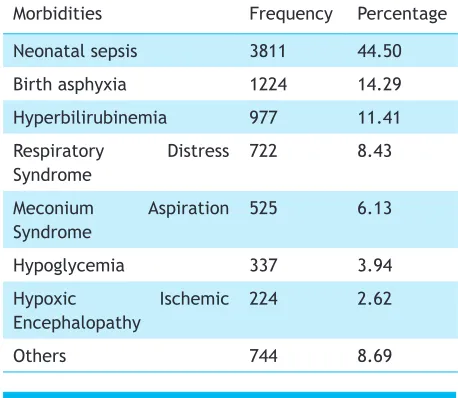
Of which, the most common cause of admission was neonatal sepsis (44.5%) followed by asphyxia (14.29%), hyperbilirubinemia (11.4%), and respiratory distress syndrome (8.4%). Others comprised of mainly low birth weight cause (Table 3). 1573 neonates received services of FNC package C, 3722 package B, 3081 received package A (Table 4).
Table 2. Number of public hospitals participated in the review and included in the study.
Development Regions
No. of hospitals participated
No. of hospitals included
Eastern 22 12
Central 22 8
Western 17 13
Mid-western 18 15
Far-western 14 10
Total 93 58
Table 3. Morbidities pattern of admitted newborns.
Morbidities Frequency Percentage
Neonatal sepsis 3811 44.50
Birth asphyxia 1224 14.29
Hyperbilirubinemia 977 11.41
Respiratory Distress Syndrome
722 8.43
Meconium Aspiration Syndrome
525 6.13
Hypoglycemia 337 3.94
Hypoxic Ischemic Encephalopathy
224 2.62
Others 744 8.69
Table 4. Number of newborns served through free newborn care services.
Package Number of newborn served*
Amount reimbursed to the hospital (in NRs)
A 3081 3081000
A+B 3722 11166000
A+B+C 1573 12584000
O 188 0
The main challenges faced during implementation of FNC were lack of infrastructure, equipment, inadequate human resources and laboratory facilities. For the reimbursement of the package cost, the hospital has to co-ordinate with the local level is another challenge which the implementing hospitals feel cumbersome.
Many hospitals have not started the FNC since they were reluctant with the package and are not oriented. The participants also raised the issue of extra human resources in SNCU and NICU. Similarly, hospitals especially tertiary level hospitals presented that the cost of care allocated by the government for free newborn care package was insufficient for package C mainly. The average duration of stay of newborn in these tertiary level hospitals were much higher than others. This may have increased the cost of care. They also praised that SNCU training is very effective for the neonatal care and should be expanded to encompass all the medical professions. This package has served many newborns whose parents wouldn’t have been able to treat if FNC didn’t existed.
DISCUSSION
The progress made by Nepal in reducing under-5 mortality from 61 deaths per 1000 live births in 2006 to 39 deaths per 1000 live births in 2016 has been appreciated by international community.1,6 Since a large proportion of under 5 mortalities is still occupied by newborn deaths, investment for improving the survival of newborns through universal access to evidence-based intervention is vital.2 As indicated by various evidences, extra efforts are necessary in overcoming barriers to accelerate the reduction in neonatal mortality.7 Nepal has committed to Sustainable Development Goal (SDG) to reduce under five and neonatal mortality rate to 28 and 12 per 1000 live births by 2030. As safeguarded by constitution of Nepal and to reduce the inequity in care due to poverty, FNC has been introduced.
A significant number of newborn were served through this package. This new innovative package will definitely help to reduce the neonatal mortality rate. However, the challenges remain as per the sustainability of the program by the hospitals especially those of tertiary hospitals. For this, the package should be revised on a periodic basis taking into consideration the cost of reimbursement and fulfillment of the human resources. The main causes of admission in this study were neonatal sepsis, birth asphyxia and hyperbilirubinemia which in accordance with other studies conducted in Nepal.8-10
This year 2074/75, the government has provided SNCU equipment to 21 district hospitals and NICU equipment to 11 tertiary hospitals. Previously, there were only few SNCUs and NICUs. In the near future the government has missioned all district hospitals to be fully equipped with SNCU services and all zonal and above hospitals to be fully equipped with NICU instruments.11 These two programs along with the quality improvement of the services will help the government to achieve its SDG goals.
Acceleration in reduction of under-five and neonatal mortalities calls for extra efforts in overcoming existing barriers. One of the barriers is timely and proper management of referral cases from peripheral health facilities to districts hospitals.12 Facility based integrated management of neonatal and childhood illness (FB-IMNCI) is crucial in bridging the existing gap in management of complicated neonatal and childhood illnesses and conditions. FB-IMNCI is predicted to enable district level health workers to manage childhood cases referred from lower level health institutions.13,14 This package will be delivered to the medical doctors, nurses and paramedics working in emergency and pediatric departments.14 Those cases referred by Community based-IMNCI (CB-IMNCI) will be tackled by FB-IMNCI. With the gradual implementation of this package, further improvement in neonatal and child health can be expected. Simultaneously, efforts are also being made to enhance the knowledge and skills of the neonatal health care providers. Comprehensive newborn care training package for level II hospital care has been developed by CHD in order to provide training to medical officers working in the hospitals providing level II care services.15 The main aim of this training is to transfer the skills of pediatrician to the medical officers. Similar training program has been developed by National Health Training Centre for the nurses working in the same settings.16
Improving the quality of maternal and newborn care is one of the strategic pillar of the Global Every Newborn Action Plan.7 There are substantial gaps in quality of care in the neonatal care services. The next step is to ensure that the clinical protocol is used and implemented at the health facility to provide quality service provision and hence reduction in the neonatal mortality. To ensure this, CHD with support from UNICEF has been piloting Nepal Perinatal Quality Improvement Project in 12 hospitals.17 Quality Improvement checklist tool for newborn care has recently been finalized and it will be implemented next year. Various studies showed that neonatal sepsis is the main cause of admission and mortality in Nepal.18 Nepal Demographic Health Survey 2016 has shown that most of the sick children seek care from private sector.1
CHD with support from Save the Children is piloting a project where medical shopkeepers are oriented on the treatment protocol of possible severe bacterial infection (PSBI) in neonates.
The strength of this study is that it comprised a large data of many public hospitals. However, the limitation is that the hospitals started FNC package in different period and hence we cannot provide clear picture of prevalence of morbidities in a given time period. Also, we cannot ascertain the accuracy of the data provided by the hospitals.
CONCLUSIONS
Free newborn care package with capacity building of health workers is very effective in improving the health care services. However, the challenges of sustainability of the package should be timely solved for the effective implementation. The revision of the package should be considered promptly keeping into consideration the cost of reimbursement and the availability of human resources for newborn care.
ACKNOWLEDGEMENTS
The authors would like to thank all the staffs of participating hospitals, Regional Health Directorates, District (Public) Health Offices and Child Health Division. Views presented in this article are of the authors and not of the organizations they represent.