An Empirical Investigation of Implementing Pattern Recognition
Applications in Executive Career Success
Mariam DEDABRISHVILI * Davit DATUASHVILI **
Abstract
As for information technology advancement plays significant role into many other fields of sciences, the demand for sufficient software increases. In previous work we outlined the usage of pattern recognition applications in one of the branch of psy-chology known as Physiognomy. Using face recognition applications we distinguished different types of persons and tried to demonstrate importance of personal types. In this present work there is discussion on pattern recognition algorithms as a tool of object detection. If in previous paper there was highlighted the possible reasons of students’ low GPA rate at University, here in this article we try to apparent why successful people are successful. Face characteristic traits and image processing techniques together can propose better future for human life.
Keywords: Pattern Recognition, Physiognomy, Face Coding Algorithms, Physiognomic typologies, Educational Systems
Introduction
Career success is much more than just finding a job and not being fired. True career success combines
skill, motivation, determination, and personality to
cre-ate a livelihood that is fulfilling as well as financially
rewarding. Each of these things can be weighted dif-ferently by people, but they are all in there somewhere if you have a truly successful career.
If you take on a career that does not suit your personality type and provide some sense of personal
fulfillment, you will constantly struggle to stay motivat -ed and enthusiastic about your job. If you take on a
career that fits to your personality type, you will have far fewer troubles staying motivated, fulfilling your re
-sponsibilities and feeling satisfied with your job. Even during difficult times and the inevitable challenges of life, if your career fits well with your personality you
will do well. Psychologists talk about the period of life estimation, when people start to evaluate their life pri-marily based on the career successfulness after age forty. When result is negative self-appraisal is low and then depression starts (Spremulli, 2006).
Our career impacts our personal life. This is
evi-dent from the following: we tend to define who we are
by what we do. We will say, I am a nurse, a teacher, a secretary and immediately everyone knows where
we fit into the community. For this reason our choice
of work says something about us. It gives some indi-cation about our abilities, background and the things which are important to us. These are the ways in which society judges us. How society criticizes us has
a direct effect on how we view ourselves and therefore on our personal life.
Sometimes we choose particular job because it seemed the right one, prestigious and well paid. If, however, we are not suited to that type of work and it makes us miserable it is safer to give it up and try something less sought after but which suits our abili-ties. These decisions affect our peace of mind, wel-fare and sense of right. (Redfern, 2010)
Similarly, the role of choosing right profession at universities was demonstrated in previous paper, where low Grade Point Average (GPA) was supposed as a consequence of mismatching between personal type and selected careers.
The paper is structured as follows: Section II out-lines the personal characteristics towards the suc-cessful career and its literature roots. Section III de-scribes the future extraction using pattern recognition techniques; as for last section evaluation of research results on successful people is completed.
Review of Literature
Efforts to help people identify appropriate careers can
be traced to the fifteenth century, and by the nine
-teenth century at least sixty five books had been pub
-lished on the topic. (Zytowski, 1972). The first voca -tional guidance program emerged in San Francisco in 1888 – in Cogswell High School – and subsequently
* Research Assistant , Faculty of Computer Technologies and Engineering, International Black Sea University, Tbilisi, Georgia. E-mail: [email protected]
in high school in Detroit in 1897 (Brewer, 1942). How-ever, the roots of career development theory did not merge until Frank Parsons (Jones, 1994) advanced the three-step “formula”: a) Gathering information about yourself; b) Gathering information on the many dimensions of various career options; c) Putting the pieces together to reach a good decision. Parsons’s schema for successfully choosing a career cannot be
called a theory in the strict sense, but it was the first
conceptual framework for career decision making and
became the first guide for career analysts.
In the wise choice of vocation there are three broad factors: 1) a clear understanding of yourself, your atti-tudes, abilities, interests, ambitions, resources, limita-tions, and knowledge of their causes; 2) a knowledge of the requirements, conditions of success, advantag-es and disadvantagadvantag-es, compensation, opportunitiadvantag-es, and prospects in different lines of work; 3) true reason-ing on the relations of these two groups of facts.
Parsons (Jones, 1994) believed that if people ac-tively engage in choosing their vocations rather than allow chance to operate in the hunt for a job, they are
more satisfied with their careers, employers, costs de
-crease and employees’ efficiency in-creases.
Career development theories are explanations of how people develop certain traits, personalities, and
self-percepts and how these developments influence
decision making. (Brown, 2002)
Career success can be defined as the real or per -ceived achievements individuals have accumulated as a result of their work experiences. (Judge D. M., 1995). Most research has divided career success into extrinsic and intrinsic components. Extrinsic success is relatively objective and observable and typically consists of highly tangible outcomes such as pay and ascendancy (Jaskolka, 1985). Conversely, intrinsic
success is defined as individuals’ subjective appraisal
of their success and is most commonly expressed in terms of job, career, or life satisfaction (Gattiker, 1988) (Judge D. M., 1995).
A number of investigations confirm the idea that
extrinsic and intrinsic career success can be assessed as relatively independent outcomes, as they are only moderately correlated (Judge T. A., 1994).
Intrinsic career success is measured in several distinct ways. The most common marker for intrinsic career success is a subjective rating of one’s satisfac-tion with one’s career.
Starting from the premise that personality can be related to numerous work-relevant outcomes; it is worth considering how personality traits might have an effect on careers. To this end, that Figure 1 represents the most important and empirically supported linkages between personality and career-relevant outcomes personality leads individuals to possess certain jobs both through the process of attraction to the jobs of interest as well as by leading organizations to select certain individuals.
Personality also influences individual performance
on the job in a way that will lead to higher compen-sation, new job responsibilities, and promotions into
higher organizational ranks. Finally, personality influ -ences the ways in which individuals engage in social interactions at work.
Data Visualization: Sammon Mapping
Data visualization is itself a large field and covering it
in a single paper is not possible. Nevertheless, some issues concerned with high-dimensional and non-vectorial data are relevant for pattern recognition and are discussed here. Graphically representing one or
Figure1
Figure2
Finding the minimum of an elliptical paraboloid. Left: a percpective view of the paraboloid. Right: a view from the xz-plane. Starting from point A, the optimal adaptation of the x-coordinate alone leads to point B, which is the angular point of the pa
-rabola in the plane passing through A and being parallel to xz-plane. However, in search for the paraboloid minimum M, this approach overshoots it. The same holds for y-axis.
two-dimensional vectors in a Cartesian coordinate system is the most straightforward possibility, easily done with a pencil and paper. With modern comput-ers and graphics software, three-dimensional data can also be successfully visualized. From four di-mensions on and for data other than vectors, more sophisticated techniques have to be used. If the data come from a metric space, the following idea can be pursued: Each datum is to be projected onto a lower-dimensional space (typically two-lower-dimensional) in such way that the distances between the projections are as close as possible to the distances between the original
points. If the input space metric correctly reflects the
data structure, the structure remains preserved in the mapping. As a consequence, one can easily visually inspect the mapped vectors and infer properties of the original data: similarities, clusters etc.
Sammon’s non-linear mapping (Sammon, 1969) is the earliest implementation of this idea and a number of improvements have been proposed, like distance mapping (Duin, 1999) or curvilinear component anal-ysis (J.A. Lee, A robust nonlinear projection, 2000) among others. However, the original Sammon’s meth-od still prevails in practice, and scientists can rely on a number of software implementations, many of them freely available (T. Kohonen, 1996), (Murtagh, 1992), (Ripley, 2001). The mapping has become an estab-lished tool in data analysis, with applications from doc-ument retrieval, as reported in the Sammon’s original paper, to logo-therapy (A. Hatzis, 1996) and molecular
biology (Agrafiotis, 1997) to name just few.
To reach an approximate solution, Sammon pro-posed minimizing the following criterion ( Figure 2 ).
Only by taking into account both axes simultane-ously, the optimal step size can be computed.
Only by taking into account both axes simultane-ously, the optimal step size can be computed.
Finally, in the fourth case, the parabola is convex, but with the angular point below zero. Here, no obvi-ous favorite exists and it is a matter of design which of the above three adaptation steps is chosen. Newton’s rule is the most conservative, leading to smaller steps and consequently to slower convergence but also less oscillations, whereas jumping directly into the parab-ola’s angular point is the most radical choice with op-posite consequences.
Overview of Clustering
The general assumption behind clustering is that the
data form more or less identifiable groups (clusters),
such that a certain degree of commonness is higher inside the groups than between them. Distance-based methods assume that the commonness is somehow
reflected in the distance between data – the lower the
distance, the higher the commonness. The primary task of clustering is to identify the data forming clus-ters, e.g. by enumerating them and listing all data be-longing to the same cluster. Often, additional informa-tion is provided, for example: where are the clusters centers, what are their boundaries, which shapes do the clusters have, and so on.
The insight obtained by clustering can already be helpful by itself, but it can also support further process-ing steps. For example, a comprehensive summary about data, their distribution and shape can reveal relevant features and give clues about meaningful
pa-rameter settings for classification or about the applica
-bility of different classification algorithms.
consid-Figure3
Four cases of error function shape and its quadratic approximation. From left to-right: (1) error function is locally convex and the angular point of the approximation is above zero; (2) current minimum estimate is in the inflexion point and the parabola degenerates to a line; (3) concave error function; (4) convex error function and the angular point of the parabola is below zero.
er clusters to be equal, in the sense that they com-pete each other. In other words, the data structure is
considered flat. Other categories are hierarchical al -gorithms: they assume data to form nested clusters, so each cluster can contain subclusters, each of them can contain further subclusters and so on. For certain applications, hierarchical clustering is a very natural representation and conceptually easy to understand. For example, relationships between species in biology are most naturally explained in terms of hierarchical families, subfamilies etc. Also, pattern recognition al-gorithms can be divided into three clusters: clustering,
classification and function approximation algorithms; clustering consists of flat and hierarchical algorithms
and so on. However, computational complexity of hi-erarchical algorithms is usually much higher than for
the flat ones.
An important and still largely unsolved question concerns the number of clusters to derive. Some al-gorithms, most prominently K-means, return a
user-specified number of clusters, regardless of their va -lidity. It is then the user’s responsibility to specify a meaningful number. Another possibility is to rely on a criterion function. For example, one can take the crite-rion function of the form:
(
)
2 11
, ,
k
K
e k
k x C
J
d x
N
= ∈µ
=
∑∑
(1)
where C1, C2 ,…….. Ck are the disjoint sets of points
x, each represented by μ_k. The criterion J_e can be minimized by choosing optimal K and μ_k’s. The
purpose is to minimize the quadratic deviation of the data from the cluster centers. Clearly, the minimum is reached when each datum is the center of its own cluster, since the distance would always be zero. A reasonable number of clusters can be found itera-tively. The above criterion function falls monotonically with the increasing number of clusters, but beyond a certain value - the natural number of clusters – it falls
only insignificantly. Such a function assumes spheri -cal clusters and prefers clusters of similar sizes to
diverse-sized clusters. Also, the choice of distance
measure influences the outcome.
Other criterion functions can be defined, each
having its own advantages and disadvantages. The main problem, however, is the computational
com-plexity: the problem of finding the optimal partition is
NP-hard (Johnson, 1979). There are an exponential number of possible partitions and an exact algorithm would have to check a large part, if not all of them
in order to find the solution. Therefore, a number of
heuristics have been proposed, aimed at achieving an acceptable computation time. The basic idea is to start with a reasonable guess for the number of clusters and their positions and to iteratively improve the val-ues. Like all iterative approaches, this one is prone to local minimums.
Methodology
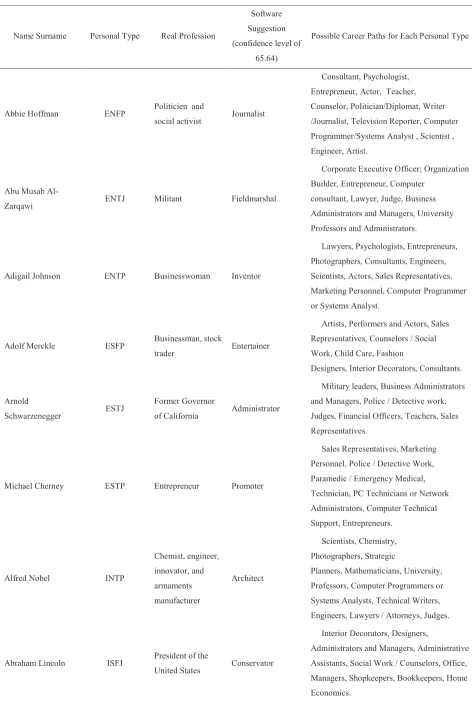
The methodology is relied on the sample data taken from the population of successful people. Based on the Physiognomy theories for sixteen types of humans there exist different activities. We took a group of
suc-cessful people in variety of fields. By employing spe -cial physiognomy detector system (known as “Digital Physiognomy”), we were able to measure suitability of suggested and real professions. The program takes a picture and through the special factor, indicates per-sonal type and suggests right professions. Besides, we gathered information on person’s real and all suit-able activities throughout the sixteen types of persons.
Thus, the experiment was divided into two parts, firstly
we compared suggested and real professions (primar-ily, based on the software derived information) and secondly, we determined how properly these people have chosen their professions according to their
per-sonal type in wide range of proposed fields.
See Table 1.
For the outcomes we used an input in digital form, namely 0 and 1 and correspondingly we were able
to define proportion of each consequence to total in
Table 1.Overview of Real and Possible Career Paths on the Example of Famous People
Name Surname Personal Type Real Profession
Software Suggestion (confidence level of
65.64)
Possible Career Paths for Each Personal Type
Abbie Hoffman ENFP Politicien and
social activist Journalist
Consultant, Psychologist, Entrepreneur, Actor, Teacher, Counselor, Politician/Diplomat, Writer /Journalist, Television Reporter, Computer Programmer/Systems Analyst , Scientist , Engineer, Artist.
Abu Musab
Al-Zarqawi ENTJ Militant Fieldmarshal
Corporate Executive Officer; Organization Builder, Entrepreneur, Computer
consultant, Lawyer, Judge, Business Administrators and Managers, University Professors and Administrators.
Adigail Johnson ENTP Businesswoman Inventor
Lawyers, Psychologists, Entrepreneurs, Photographers, Consultants, Engineers, Scientists, Actors, Sales Representatives, Marketing Personnel, Computer Programmer or Systems Analyst.
Adolf Merckle ESFP Businessman, stock
trader Entertainer
Artists, Performers and Actors, Sales Representatives, Counselors / Social Work, Child Care, Fashion
Designers, Interior Decorators, Consultants.
Arnold
Schwarzenegger ESTJ
Former Governor
of California Administrator
Military leaders, Business Administrators and Managers, Police / Detective work, Judges, Financial Officers, Teachers, Sales Representatives.
Michael Cherney ESTP Entrepreneur Promoter
Sales Representatives, Marketing Personnel, Police / Detective Work, Paramedic / Emergency Medical, Technician, PC Technicians or Network Administrators, Computer Technical Support, Entrepreneurs.
Alfred Nobel INTP
Chemist, engineer, innovator, and armaments manufacturer
Architect
Scientists, Chemistry, Photographers, Strategic
Planners, Mathematicians, University, Professors, Computer Programmers or Systems Analysts, Technical Writers, Engineers, Lawyers / Attorneys, Judges.
Abraham Lincoln ISFJ President of the
United States Conservator
Interior Decorators, Designers,
the matching of type and professions to each sample data.
We used general formulas of standard deviation and mean (average), those are very important tools in statistic and mathematics and they are calculated according the following way:
1. Sample mean
/
x
=
∑
x n
(2)
2. Sample variance
(
) (
2)
2
/
1
s
=
∑
x x
−
n
−
(3)
As for Standard deviation it is determined as a square root of variance.
Conclusion
The presented investigation gave promising results as it showed 78% of positive outcome in matching of real profession and personal type (see Figure 4). As for the relationship among real and software pro-posed professions did not coincide to each other with high levels of accuracy which can be explained as the cause of limited varieties of suitable professions into the program. Moreover, in order to declare if personal type and real profession are suitable we required to check all possible recommended professions for each personal type.
In overall the paper demonstrates a brief review of special techniques in pattern recognition in order
to provide better future for human life. We defined the
role of personality in prosperous career and attempted to strengthen the hypothesis via the investigation on studying successful people’s personality and career choice. Further research on enlarged number of
sam-ples can better approximate our result by employing the weight factor and standard deviation.
The research showed that most successful people in the world have selected suitable professions to their personality and hence this fact can be considered as one of the key of success which provides the answer of remarkable question: why successful people are successful.
Reference
A. Hatzis, P. G. (1996). Optical logo-therapy - (OLT). A computer based speech training system for the visualisation of articulation using connectionist techniques. IOA, (pp. 299-306).
Agrafiotis, D. (1997). A new method for analyzing
pro-tein sequence relationships based on Sammon maps. Protein Science, 287-293.
Aizerman, M. A. (1964). The probability problem of pattern recognition learning and the method of potential functions. Automation and Remote Control, (pp. 1175–1190).
Anil K. Jain, R. P. (2004). Introduction to Pattern Rec-ognition. Oxford, UK: Oxford University Press. Baudat, G. a. (2000). Generalized discriminant analysis using a kernel approach. Neural Com-putation 12(10), (pp. 2385–2404).
Bishop, C. M. (2006). Pattern Recognition and Machine Learining. Springer.
Boser, B. E. (1992). A training algorithm for optimal margin
classifiers. Proceedings Fifth Annual Workshop Image 4
on Computational Learning Theory (COLT), ACM, (pp. 144–152).
Bremner D, D. E. (2005). Output-sensitive algorithms for computing nearest-neighbor decision boundaries. Discrete and Computational Geometry, 33(4), (pp. 593–604).
Brewer, J. M. (1942). History of vocational guidance, origins and early development.
Brown, D. (2002). Career choice and development, fourth edition.
Chandra, K. W. (1976). Bounds for the string matching problem. Journal of the Association for Com-puter Machinery, 13:16.
D. Conte, P. F. (2003). Graph Matching Applications In Pattern Recognition And Image Processing . ICIP. IEEE.
Dedabrishvili, M. (2013). Physiognomy Determination Based on Facial Traits and Pattern Recognition Usage Approach. Euro-American Conference for Academic Disciplines & Creativity. Prague.
Duin, R. P. (1999). Relational discriminant analysis. Pattern Recognition Letters, 20(11).
E. Pekalska, D. D. (June 1999.). A new method of gene-ralizing Sammon mapping with application to algorithm speed-up. Proceedings ASCI’99, 5th Annual Conference of the Advanced School for Computing and Imaging the National Academy of Sciences (pp. 221-228). ASCI, Delft, The Netherlands: In M. Boasson, J.A. Kaandorp, J.F.M Tonino, and M.G. Vosselman, editors.
Eyad Elyan, H. U. (2009). Automatic 3D Face Recog-nition Using Fourier Descriptors. IEEE.
G. Prabhu Teja, S. R. (2012). Face Recognition using Subspaces Techniques. IEEE.
Gattiker, U. E. (1988). Predictors for managers’ career mobility, success, and satisfaction. Human rela-tions, 41(8).
H. Ritter, T. M. (1990). Eine Einführung in die Neuroin-formatik Selbstorganisierender Netzwerke. Neuronale Netze. Addison Wesley.
Hart, T. C. (1967). Nearest neighbor pattern
classifi-cation. IEEE Transactions on Information Theo-ry, IT-13(1), (pp. 21-27).
Hirshberg. (1975). A linear space algorith for comput-ing maximal common subsequences. (pp. 341-343). Communications of the ACM.
J.A. Lee, A. L. (2000). A robust nonlinear projection. pp. 13-20 .
J.A. Lee, A. L. (2000). A robust nonlinear projection. In ESANN’2000 Proceedings - European
Sympo-sium on Artificial Neural Networks (pp. 13-20 ).
D-Facto public.
J.W. Sammon, J. (1969). A nonlinear mapping for data structure analysis. IEEE Transactions on com-puters, (pp. 401-409).
Jaskolka, G. B. (1985). Measuring and predicting mana-gerial success. Journal of Vocational Behavior, 26(2).
Johnson, G. a. (1979). Computers and Intractability.
Jones, L. K. (1994). Frank Parsons’ contribution to career counseling. Journal of Career Develop-ment, 20(4).
Judge, D. M. (1995). An Empirical Investigation of The Predictors of Executive Career Success. Per-sonnel Psychology, 48(3).
Judge, T. A. (1994). Job and life attitudes of male ex-ecutives. Journal of Applied Psychology, 79(5).
Kohonen, T. (1982). Self-organized formation of topo-logically correct feature maps . Biological Cy-bernetics, (pp. 59-69 ).
Kohonen, T. (1985). Median strings. Pattern Recogni-tion Letters, (pp. 309-313).
Kohonen, T. (1995). Self-Organizing Maps. Berlin Hei-delberg: Springer.
Lavater, J. C. (1789-93). Essays on Physiognomy; for the Promotion of the Knowledge and Love of Mankind. London.
MacQueen, J. (1967). Proceedings of the 5th Berkeley Symposium on Mathematical Statistics and Pro-bability, volume 1 (pp. 281-297). Berkeley and Los Angeles: University of California Press.
Mika, S. G. (1999). Fisher discriminant analysis with kernels . Neural Networks for Signal Processing IX, IEEE., (pp. 41–48).
Montagu, J. (1994). The expressions of the passions:
the origin and influence of Charles Le Brun’s
‘Conférence sur l’expression générale et par-ticulière‘. New Haven: Yale University Press.
Murtagh, F. (1992). Multivariate data analysis software and resources page.
Paterson, M. a. (1980). faster algorithm computing string edit distance. Journal of Computer and System Sciences, 18-31.
Redfern, R. (2010). Impact of Career Choices Work and Personal Life.
Ripley, W. N. (2001). Modern applied statistics with S-PLUS; R versions of software.
Roth, V. a. (2000). Nonlinear discriminant analysis using kernel functions. Advancesin Neural Informa tion Processing Systems, Volume 12. MIT Press.
Sammon, J. W. (1969). A nonlinear mapping for data structure analysis. Computers, IEEE Transac-tions, 100(5).
Sankoff, K. a. (1983). An antology of algorithms and concepts for sequence. Time Warps, String Ed-its, and Macromolecules: the Theory and Prac-tice of Sequence Comparison, Reading MA. Addison-Wesley: In David Sankoff and Joseph B. Kruskal, editors.
Schölkopf, B. a. (2002). Learning with Kernel. MIT Press.
Schölkopf, B. A.-R. (1998). Nonlinear component analysis as a kernel eigenvalue problem . Neu-ral Computation 10(5), (pp. 1299–1319).
Shawe-Taylor, J. a. (2004). Kernel Methods for Pat tern Analysis. Cambridge University Press.
Spremulli, M. (2006). Personality Principles of Career Success.
Stanton, M. O. (2003). Physiognomy. Kessinger Publishing.
T. Kohonen, J. H. (1996). SOM PAK: The Self-Organ-izing Map program package. Helsinki : Helsinki University of Technology, Laboratory of Com-puter and Information Science,.
Tianhong Fang, X. Z. (2011). 4D Facial Expression Recognition. IEEE.
Ukkonen. (1985). Algorithms for approximate string matching. Information and Control, 100-118.