Tanwani et al. World Journal of Engineering Research and Technology
WEIGHT VERSUS COMPRESSIVE STRENGTH OF CONCRETE
CYLINDERS MADE BY PARTIAL REPLACEMENT OF COURSE
AGGREGATES FROM OLD CONCRETE
Sagar Tanwani1* and Bashir Ahmed Memon2
1
Graduate Engineer, Quaid-e-Awam University of Engineering, Science & Technology.
2
Professor, Department of Civil Engineering, Quaid-e-Awam University of Engineering,
Science and Technology.
Article Received on 30/04/2016 Article Revised on 19/05/2016 Article Accepted on 09/06/2016
ABSTRACT
Growing demand of construction of new particularly tall buildings to accommodate the increasing population specially in urban centers around the globe has not only posed the problem of increasing consumption of natural aggregates but also created problem of dealing the demolishing waste. The best way of dealing this waste is the reuse of it in the new construction. This research work made use of this demolishing waste and prepared 90 cylinders of standard size. 50% replacement of natural coarse aggregates is done
with coarse aggregates from old concrete. All the cylinders are made using 1:2:4 mix with 0.55 water cement ratio. 30 cylinders are made using no compaction whereas rest of the
cylinders are made using compaction by table vibrator and rodding in equal proportion. After 28-day curing weight followed by the evaluation of compressive strength is done. The obtained results are tabulated and analyzed using trend line analysis to predict the second order equations. Independent equation is developed for each mode of compaction. The developed equations are then used to predict the compressive strength using weight of the cylinders. It is found that the predicted compressive strength is in good agreement with the experimental values with error from 0.1% to 0.25%. Based on the obtained results it is hoped that the research work will provide good estimate of compressive strength of concrete
World Journal of Engineering Research and Technology
WJERT
www.wjert.org
SJIF Impact Factor: 3.419*Corresponding Author
Sagar Tanwani
cylinders made using 50% replacement of natural aggregates with coarse aggregates from old concrete if the weight of the cylinder is available.
KEYWORDS: Cylinders, old concrete, weight, compressive strength, trend line analysis.
1. INTRODUCTION
Growing need of accommodation particularly in the urban centers have posed serious problem of space and associated infrastructure. Shortage of space can be overcome by constructing tall buildings in place of short height buildings but this leads to huge quantum of demolishing waste and consumption of greater volume of natural aggregates. Demolishing waste on other side also poses problem of dumping it. Thus a good strategy might be the used of this demolished waste in new construction. Several attempts have been made by different scholars to study the properties of this waste. Although wide scatter in the obtained results is evident from the literature yet successful use of the material is also observed. This shows that still good quantum of work is required before reaching a conclusion about the usage of the material. Compressive strength of concrete made by using demolished waste either as partial replacement of fine or coarse aggregates is the important property which cannot be compromised. Standard mode of evaluation of compressive strength is destructive testing of concrete specimen which required laboratory setup. To avoid it non-destructive testing is adopted but the offset in obtained results is evident and must be handled carefully. However non-destructive testing gives good idea of the parameter being studied. It also requires dedicated equipment for the purpose. An alternative to all this is the simulation / analytical
model. Several attempts have already been made by different scholars to establish relationship between different properties of fresh and hardened concrete using regression analysis, artificial neural network, fuzzy logic and other techniques.
Therefore, this research work presents the relationship between weight and compressive
strength of concrete cylinders made with partial replacement of coarse aggregates with coarse aggregates obtained from old concrete. For the purpose 50% replacement[1-5] of natural coarse
discarded. All the cylinders are prepared using 1:2:4 mix with water cement ration of 0.55. This water cement ratio is used to ensure workability of concrete as suggested by Memon et al.[15] Ordinary Portland cement, crush of maximum 1-inch size and hill sand are used in preparation of concrete cylinders along with coarse aggregates from old concrete. Old concrete was first hammered to smaller pieces followed by sieving to maximum of 1-inch size. All the specimen prepared following the standard procedures and cured for 28 days. After curing weight of all the specimen is recorded and then all of the specimen are tested in universal load testing machine for compressive strength. The obtained results are then
tabulated. The specimen with strength difference of 15% or more then discarded.
Thereafter the regression analysis is used to predict the equation giving relationship between the weight and compressive strength. It is observed that second order equation gives better equation than linear, log, trigonometric etc. The predicted compressive strength values using developed equation shows maximum of 0.53% error in case of cylinders with rodding and minimum of 0.25% error in case of specimen compacted using table vibrator. Hence it may
be concluded that the equation developed in this research work may confidently be used to find the compressive strength when weight of concrete cylinder is known.
2. LITERATURE REVIEW
Although several attempts have been made by different scholars to develop relationship between different properties of fresh and hardened concrete to simplify the material testing work, yet wide scatter in the results may be observed in the literature. In the following related
state of art literature is summarized which shows that still there is room to carry out more research work before to reach at sound conclusions.
Sagoe[6] in his research work studied performance of concrete made with commercially produced recycled aggregates using varying percentages of these aggregates. Based on their
results they found significant increase of up to 12% in the strength. They concluded that recycled aggregates have promising effect on the compressive strength of concrete if
improved grading is adopted at laboratory and crushing plant scale.
Umoh et al[7] in their research work used periwinkle shell ash as partial replacement of cementitious material and studied the effect on compressive strength and modulus of elasticity by comparing its established relation with an existing model. They used 0 to 40%
properties. Based on their finding the authors concluded that the relation between compressive strength and static modulus of elasticity fitted into existing model for normal weight concrete.
Noguchi [8] in one of his research work developed relationship between modulus of elasticity and compressive strength of high strength concrete. In another work presented by same author[9] practical equation to predict modulus of elasticity of the concrete is developed. However, in comparison to actual work scatter can be observed in the results.
Omran and Chen[10] attempted to develop method which can predict the compressive strength of green concrete using artificial neural network. In their presented work they remained successful in predicting the results for the examples/cases presented, which need further verification for other cases.
Nowak and Rakocsy[11] also presented statistical model for compressive strength of lightweight concrete. In their research work they presented successive examples to validate their idea.
Rasa et al[12] used feed-forward back-propagation type artificial neural network for the prediction of density and compressive strength properties of the cement paste portion of concrete mixtures. The 28-day compressive strength and Saturated Surface Dry (SSD) density values are considered as the aim of the prediction.
They used 600 specimens, out of which 350 were used to train the network and the network is tested using the remaining 250 pairs. Obtained results indicate that the density and compressive strength of concrete cement paste can be predicted much more accurately using the ANN method compared to existing conventional methods, such as traditional regression analysis, statistical methods, etc.
Al-Sahawneh[13] in their research work presented shear sliding model to predict correction
Hamidian et al[14] used pulse velocity technique to assess the strength and quality of high strength and light weight concrete. In their study the authors used several concrete mix design with ages of 7, 28 and 90 days. Based on their finding they concluded that ultrasonic pulse velocity technique to assess concrete strength and quality was a good choice.
Charmichael[15] in his project tested regular strength concrete specimen at early age (16 days curing) for modulus of elasticity, poison’s ratio and compressive strength. Based on the
obtained results the author found refined version of the existing ACI relationship between modulus of elasticity and compressive strength. The author also reported moderately accurate relationship between compressive strength and time as well as a loose relationship between Young’s modulus and time.
Murali et al[16] conducted research work to establish empirical relationship between impact energy and compressive strength of fiber reinforced concrete. The authors used regression analysis to develop the relationship and found that the developed model gives better results than drop weight test method.
Gul et al[17] in their research work developed the relationship between ultrasound pulse velocity and compressive strength of mineral admixture cement mortars. They used silica fume, fly ash and blast furnace slag as the mineral admixtures as partial replacement of cement in varying percentages from 30% to 70%. Based on the obtained results the authors found that for above mentioned admixtures the relationship between ultrasound pulse velocity and compressive strength is exponential and gives better results for blast furnace slag.
3. SPECIMEN DESCRIPTION AND TESTING
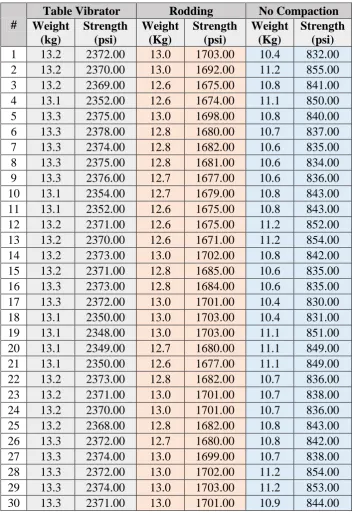
Table 1: Weight and compressive strength of concrete cylinders
#
Table Vibrator Rodding No Compaction
Weight (kg) Strength (psi) Weight (Kg) Strength (psi) Weight (Kg) Strength (psi)
1 13.2 2372.00 13.0 1703.00 10.4 832.00 2 13.2 2370.00 13.0 1692.00 11.2 855.00 3 13.2 2369.00 12.6 1675.00 10.8 841.00 4 13.1 2352.00 12.6 1674.00 11.1 850.00 5 13.3 2375.00 13.0 1698.00 10.8 840.00 6 13.3 2378.00 12.8 1680.00 10.7 837.00 7 13.3 2374.00 12.8 1682.00 10.6 835.00 8 13.3 2375.00 12.8 1681.00 10.6 834.00 9 13.3 2376.00 12.7 1677.00 10.6 836.00 10 13.1 2354.00 12.7 1679.00 10.8 843.00 11 13.1 2352.00 12.6 1675.00 10.8 843.00 12 13.2 2371.00 12.6 1675.00 11.2 852.00 13 13.2 2370.00 12.6 1671.00 11.2 854.00 14 13.2 2373.00 13.0 1702.00 10.8 842.00 15 13.2 2371.00 12.8 1685.00 10.6 835.00 16 13.3 2373.00 12.8 1684.00 10.6 835.00 17 13.3 2372.00 13.0 1701.00 10.4 830.00 18 13.1 2350.00 13.0 1703.00 10.4 831.00 19 13.1 2348.00 13.0 1703.00 11.1 851.00 20 13.1 2349.00 12.7 1680.00 11.1 849.00 21 13.1 2350.00 12.6 1677.00 11.1 849.00 22 13.2 2373.00 12.8 1682.00 10.7 836.00 23 13.2 2371.00 13.0 1701.00 10.7 838.00 24 13.2 2370.00 13.0 1701.00 10.7 836.00 25 13.2 2368.00 12.8 1682.00 10.8 843.00 26 13.3 2372.00 12.7 1680.00 10.8 842.00 27 13.3 2374.00 13.0 1699.00 10.7 838.00 28 13.3 2372.00 13.0 1702.00 11.2 854.00 29 13.3 2374.00 13.0 1703.00 11.2 853.00 30 13.3 2371.00 13.0 1701.00 10.9 844.00
cylinders. The cylinders are prepared following the standard procedures and cured for 28 days.
After curing weight of all the specimen is recorded and then all of the specimen are tested in universal load testing machine for compressive strength. Table 1 gives the details of weight and compressive strength of all cylinders for all modes of compaction. In case of compaction by table vibrator average compressive strength of 2367.30 psi with minimum of 2348.00 psi and maximum of 2378.00 psi is recorded. The values reduced by 28.68% in average when rodding is used for compaction. (Average = 1688.27 psi, minimum = 1671.00 psi, maximum = 1703.00 psi). Compressive strength values in comparison to results of cylinders compacted with table vibrator reduced by 64.4% when no compaction was used. (Average = 841.93 psi, minimum = 830.00 psi, maximum = 855.00 psi).
4. RESULTS AND DISCUSSION
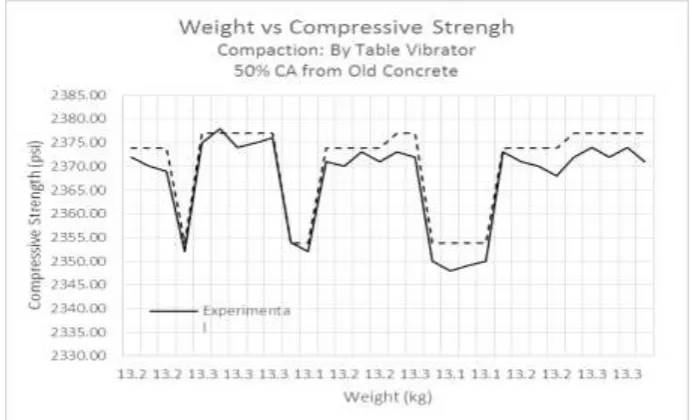
The weight and compressive strength results presented in previous section are then analyzed using trend line capabilities of Microsoft excel. Results of weight and compressive strength of cylinders prepared using compaction by table vibrator are plotted with weight in x-axis and compressive strength in y-axis as shown in figure 1. Then trend line analysis is done using several option in turn. The best fit is achieved by quadratic polynomial given as under
y = -845.35x2 + 22433x – 146448 (1)
Figure 1: Weight vs compressive strength for cylinders made using table vibrator.
Figure 2: Graphical comparison of experimental and predicted compressive strength
(TV)
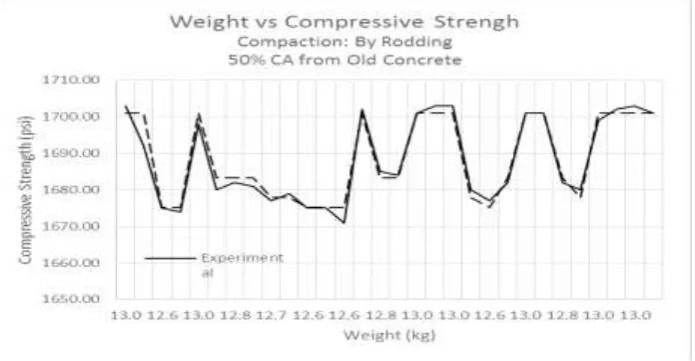
The same strategy was adopted to develop the equation for the results of cylinders made using rodding. Figure 3 shows graphically the results of weight vs compressive strength along with trend line fit. The equation obtained is listed as under.
y = 121.77x2 - 3052.7x + 20807 (2)
respectively. Figure 4 gives graphical comparison of the experimental and predicted strength of the cylinders.
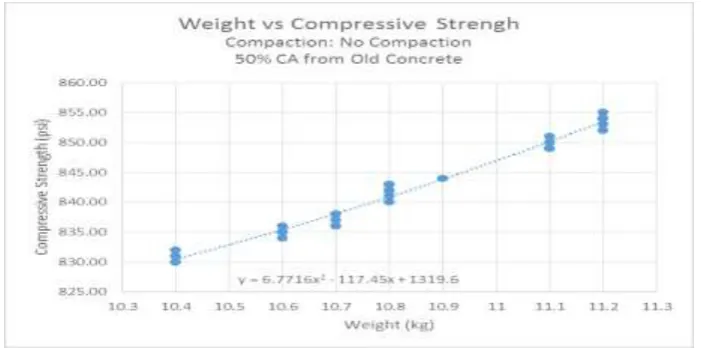
Weight and compressive strength results of cylinders made using no compaction are plotted in figure 5. Again quadratic fit after several attempts with different other options proved the best fit. The equation obtained is given as under
y = 6.7716x2 - 117.45x + 1319.6 (3)
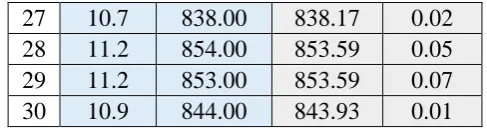
Using this equation compressive strength is reevaluated and listed in table 4 along with experimental results of compressive strength and percentage error in comparison to predicted results of compressive strength. Similar to earlier cases figure 6 shows graphical comparison of the experimental and predicted strength of the cylinders for this case. NC in figure 6 represents the cylinders made using no compaction.
Figure 3: Weight vs compressive strength for cylinders made using rodding.
Figure 5: Weight vs compressive strength for cylinders made using no compaction.
Figure 6: Graphical comparison of experimental and predicted strength (NC).
Table 2: Experimental and predicted values of compressive strength of cylinders
compacted using table vibrator.
#
Experiment Predicted
Weight (Kg)
Strength (psi)
Strength (psi)
Error (%)
11 13.1 2352.00 2353.79 0.08 12 13.2 2371.00 2373.82 0.12 13 13.2 2370.00 2373.82 0.16 14 13.2 2373.00 2373.82 0.03 15 13.2 2371.00 2373.82 0.12 16 13.3 2373.00 2376.94 0.17 17 13.3 2372.00 2376.94 0.21 18 13.1 2350.00 2353.79 0.16 19 13.1 2348.00 2353.79 0.25 20 13.1 2349.00 2353.79 0.20 21 13.1 2350.00 2353.79 0.16 22 13.2 2373.00 2373.82 0.03 23 13.2 2371.00 2373.82 0.12 24 13.2 2370.00 2373.82 0.16 25 13.2 2368.00 2373.82 0.25 26 13.3 2372.00 2376.94 0.21 27 13.3 2374.00 2376.94 0.12 28 13.3 2372.00 2376.94 0.21 29 13.3 2374.00 2376.94 0.12 30 13.3 2371.00 2376.94 0.25
Table 3: Experimental and predicted values of compressive strength of cylinders
compacted using rodding.
#
Experiment Predicted
Weight (Kg) Strength (psi) Strength (psi) Error (%)
19 13.0 1703.00 1701.03 0.12 20 12.7 1680.00 1677.99 0.12 21 12.6 1677.00 1675.19 0.11 22 12.8 1682.00 1683.24 0.07 23 13.0 1701.00 1701.03 0.00 24 13.0 1701.00 1701.03 0.00 25 12.8 1682.00 1683.24 0.07 26 12.7 1680.00 1677.99 0.12 27 13.0 1699.00 1701.03 0.12 28 13.0 1702.00 1701.03 0.06 29 13.0 1703.00 1701.03 0.12 30 13.0 1701.00 1701.03 0.00
Table 4: Experimental and predicted values of compressive strength of cylinders made
with no compaction.
#
Experiment Predicted
Weight (Kg) Strength (psi) Strength (psi) Error (%)
27 10.7 838.00 838.17 0.02 28 11.2 854.00 853.59 0.05 29 11.2 853.00 853.59 0.07 30 10.9 844.00 843.93 0.01
Table 5: Average compressive strength for all modes of compaction.
Mode of Compaction
Average Compressive Strength (psi)
Experimental Predicted Error (%)
Table vibrator 2367.30 2370.39 0.13 Rodding 1688.27 1688.64 0.02 No compaction 841.93 841.98 0.006
5. CONCLUSION
In this research work relationship between weight and compressive strength of concrete cylinders made with 50% replacement of natural coarse aggregates with coarse aggregates
from old concrete is developed. Total of 90 cylinders are cast using 1:2:4 mix with 0.55 water-cement ratio. The cylinders are cast using three modes of compaction viz. compaction by table vibrator, rodding and no compaction. After curing first weight of cylinders is recorded then compressive strength is evaluated using UTM. Weight and compressive strength results are then analyzed using trend line analysis and three independent second order equations are developed for three modes of compaction. Developed equations are then used to reevaluate and compare the compressive strength. It is found that the predicted compressive strength is in good agreement to experimental values with 0.01 to 0.25 percent error. Based on the obtained results, it is hoped that the research work will provide good idea of compressive strength of concrete cylinders if the weight of the cylinder is known.
6. REFERENCES
1. Memon B A, “Recent Developments on Use of Demolised Concrete as Coarse Aggregates”, International Journal of Emerging Technology and Innovative Engineering,
January 2016; 2(1).
2. Oad M and Memon B A, “Compressive Strength of Concrete Cylinders using Coarse Aggregates from Old Concrete”. Proceedings of First National Conference NCCE, 2013 –
2014 (Modern Trends and Advancements), April 2014; 28 – 29: 21 – 43.
3. Memon B A and Bhatti G S, 2014. Flexural Behavior of Beam made by Partial Replacement of Natural Aggregates with Coarse Aggregates from Old Concrete.
4. Bhatti A A and Memon B A, 2014. Strength, Deflection and Cracking Behavior of Concrete Slab Using Demolished Concrete as Coarse Aggregates. International Journal of Engineering Sciences & Research Technology., 2014; 3(6): 492 – 506.
5. Buller A H and Memon B A, 2014. Effect of Fire on Strength of Concrete Cubes with RCA as Coarse Aggregates. 1st National Conference on Civil Engineering (NCCE 2013-14) - (Modern Trends and Advancements), April 2014; 28th – 29th.
6. Sagoe-Crentsil, K K, Brown T, and Taylor A H, “Performance of Concrete Made with Commercially Produced Recycled Aggregate”, Cement and Concrete Research, 2001;
31(5): 707 – 712.
7. Umoh A A, Olusola K A, “Compressive Strength and Static Modulus of Elasticity of Periwinkle Shell Ash Blended Cement Concrete”, International Journal of Sustainable
Construction Engineering & Technology, 2012; 3(2).
8. Noguchi T, “Relationship between compressive strength and modulus of elasticity of High-Strength Concrete”, University of Tokyo, Japan.
9. Noguchi T, Tomosawa F, Nemati K M, Chiaia B M, and Fantilli A P, “A Practical Equation for Elastic Modulus of Concrete”, ACI Structural Journal/September-October
2009.
10.Omran B A and Chen Q, “Prediction of Compressive Strength of “Green” Concrete Using Artificial Neural Networks”, 50th
ASC Annual International Conference Proceedings, Associated Schools of Construction, 2014.
11.Nowak A S, Rakoczy A M, “Statistical Model for Compressive Strength of Lightweight Concrete”, Architecture Civil Engineering Environment, 2011.
12.Rasa E, Ketabchi H and Afshar M H, “Predicting Density and Compressive Strength of Concrete Cement Paste Containing Silica Fume Using Artificial Neural Networks”,
Transaction A: Civil Engineering, Sharif University of Technology., September 2009; 16(1): 33 – 42.
13.Al-Sahawneh E I, “Size Effect and Strength Correction Factors for Normal Weight Concrete Specimens under Uniaxial Compression Stress”, Contemporary Engineering
Sciences, 2013; 6: 1 – 4, 57 – 68.
15.Carmichael R P, “relationships between young’s modulus, compressive strength, poison’s ratio, and time for early age concrete”, ENGR 082 Project Final Report, Swarthmore College, Department of Engineering, May 2009.
16.Murali G, Santhi A S and Ganesh G M, “Empirical Relationship between the Impact Energy and Compressive Strength of Fiber Reinforced Concrete”, Journal of Industrial
and Scientific Research, July 2014; 73: 469 – 473.
17.Gul R, Ramazan T and Guversin T, “Compressive Strength and Ultra Sound Pulse Velocity of Mineral Admixture Mortars”, Indian Journal of Engineering and Material