E X P R E S S P A P E R
Open Access
Deep residual coalesced convolutional
network for efficient semantic road
segmentation
Igi Ardiyanto
*and Teguh Bharata Adji
Abstract
This paper proposes a deep learning-based efficient and compact solution for road scene segmentation problem, named deep residual coalesced convolutional network (RCC-Net). Initially, the RCC-Net performs dimensionality reduction to compress and extract relevant features, from which it is subsequently delivered to the encoder. The encoder adopts the residual network style for efficient model size. In the core of each residual network, three different convolutional layers are simultaneously coalesced for obtaining broader information. The decoder is then altered to upsample the encoder for pixel-wise mapping from the input images to the segmented output. Experimental results reveal the efficacy of the proposed network over the state-of-the-art methods and its capability to be deployed in an average system.
Keywords: Residual coalesced network, Deep learning, Road segmentation
1 Introduction
Unlike the traditional object detection and classification which globally works on an image or a patch, the scene segmentation is a pixel-wise classification which requires more accurate boundary localization of each object and area inside the images. For instance in case of the road scene segmentation, one needs to precisely separate the sidewalk for the pedestrian from the road body.
The semantic road scene segmentation, which is the part of the general image segmentation problems, attracts a lot of researchers for providing the best solution. Early works mostly depend on the pixel-wise hand-crafted fea-tures (e.g., [1]) followed by conditional random field (e.g., [2, 3]), the usage of dense depth map [4], or exploitation of the spatio-temporal parsing [5] for achieving the best acccuracy.
Since the rise of deep learning for object classification [6], several attempts were done for designing a deep net-work architecture for the image segmentation problem. Most of them follow the encoder-decoder architecture style (e.g., [7–9]). Another approach takes advantage of the image patch and spatial prior [10] for attaining better
*Correspondence: [email protected]
Department of Electrical Engineering and Information Technology, Universitas Gadjah Mada, Jl. Grafika No.2, Yogyakarta, Indonesia
scene segmentation. Except [9] which tries to build a small model size network, all of the above works are suffered from either very large network size or slow inference time which make them inconvenient for practical applications. Here, we aim to establish a compact and effective net-work for segmenting the road scene. Our approach is inpired by ResNet [11] which utilizes residual blocks, allowing it to be stacked into a very deep architecture without huge degradation problem. In the heart of our proposed architecture, three different types of convolu-tional layers are simultaneously coalesced in a residual fashion and stacked it into an encoder-type network for altering the receptive field. Hence, more variational func-tions are enabled to obtain richer information from the images. Subsequently, a decoder with a lesser architecture followed by a fully connected convolutional (Full Conv.) layer is appended to upsample the encoder and fine-tune the output.
Our contributions are twofold. First, we introduce a coa-lesced style of the convolutional layers with the residual-flavored network to build an efficient model for the semantic road segmentation. Subsequently, we exhibit an asymmetric encoder-decoder network for reducing the model size even more, unlike the conventional symmetric approach used by the previous methods, e.g., SegNet [8].
The rest of this paper is organized as follows. Section 2 explains the overall architecture of the proposed RCC-Net. Evaluations against several state-of-the-art meth-ods are described in Section 3. We then conclude the paper and give some future directions of the research in Section 4.
2 Proposed network architecture
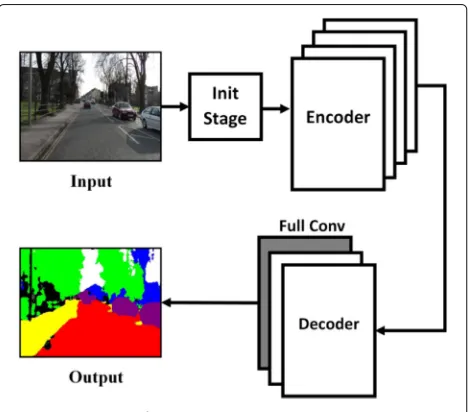
Our proposed RCC-Net is established in a deep encoder-decoder manner. The target is to create a pixel-wise clas-sification which maps each pixel of the input images into corresponding semantic class of the road objects. Figure 1 expresses the full architecture of the RCC-Net.
2.1 Initial stage
The idea of constructing small feature maps in the early stage of the network was heavily inspired by [9] and [12]. For this purpose, a max pooling, an average pooling, and 3×3 convolution layers with 13 filters are concatenated, creating a total 19 dimensional feature maps. Figure 2 rep-resents the initial stage of the RCC-Net. Using these set-tings, the first stage of the RCC-Net is expected to reduce the dimensionality of the input images while extracts the relevant features for the next stages.
2.2 Residual coalesced convolutional blocks
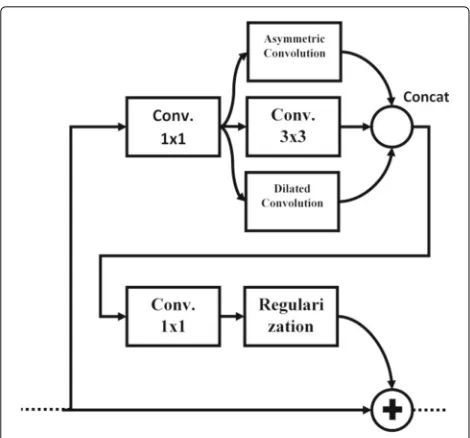
As the core of our network, we introduce the residual coa-lesced convolutional (RCC) block which is intemperately instigated by Inception [13] and ResNet [11] architectures. The RCC module is composed by projection-receptive-projectionsequences with skip connection. The projection parts are realized by 1×1 convolution, while the receptive section consists of a coalesced three different convolu-tional layers.
Fig. 1Architecture of RCC-Net
Fig. 2Initial stage of RCC-Net
The 1×1 convolution is meant to aggregate the activation of each feature in the previous layer. It is eminent for infering the networks with different input size. An ordinary, an asymmetric [12], and a dilated [14] convolution layers are subsequently appended in a parallel fashion. This coalesced style is motivated by an assumption that each type of con-volution layer contributes different receptive field. By coalescing them, it is expected to have a wider function to be learned, thus increasing the amount of feature information.
LetX∈Rnbe then-dimensional input of the coalesced convolution andwij ∈ Ri×j is the i×jconvolution ker-nel. The corresponding feature output for the coalesced convolution can be denoted by
M=
⎡ ⎢ ⎢ ⎣w ij∗X
ordinary
w1j ∗X
asymmetric
wij∗dX
dilated
⎤ ⎥ ⎥
⎦ (1)
where the last term is the dilated convolution with the dilation factor d. Figure 3 shows the RCC module formation.
Actually, it is interesting to investigate the proper way to combine the convolutional layers. In the experimental section, we will show how the change on its combination, by summing and concatenating them, will affect the entire network results.
Fig. 3Residual coalesced convolutional modules
of RCC modules for regularization. A skip connection imitating the ResNet [11] is coupled for one RCC module. A max-pooling layer is subsequently appended between each stage for downsampling the input.
2.3 Decoder
The decoder is constructed by stacking the same RCC modules as the encoder, except the coalesced convolu-tional part is now replaced by a deconvoluconvolu-tional layer and the number of stages is decreased. This setting is moti-vated by [9], where the role of the pixel recognition should be done mostly by the encoder. The task of the decoder is merely to upsample the output of the encoder and adjust the details. A fully connected convolutional (Full Conv.) layer is thus appended behind the decoder for performing pixel-wise mapping.
As summary of the proposed network, Table 1 exhibits the configuration of the RCC-Net, with 3-channel input images and 11 classes of the road scenes.
3 Results and discussions
In this section, the efficacy of our proposed architecture is demonstrated against several state-of-the-art methods on the road scene segmentation problems. All implementa-tions of the proposed algorithm were done on a Linux PC (Ubuntu 16.04, Core i7, 32 GB RAM), with a GTX 1080 GPU and Torch7. Training was performed using Adam optimization [15] for 200 epoch with learning rate 10e-3, momentum 0.9, and batch size 8.
3.1 CamVid dataset benchmark
The performance of the proposed RCC-Net architec-ture is benchmarked on CamVid road scene dataset [16],
Table 1Configuration of RCC-Net
Stages Convolution # RCC
Ordinary Asymmetric Dilated
Input 3×480×360 n/a
Initial 19×240×180 n/a
Encoder 1 3×3 5×1; 1×5 2;4;8;16;32 5
Encoder 2 3×3 5×1; 1×5 2;4;8;16;32 5
Encoder 3 3×3 7×1; 1×7 2;4;8;16;32 5
Decoder 1 3×3 deconvolution 3
Decoder 2 3×3 deconvolution 2
Full Conv. 11×480×360 n/a
which consists of 367 training and 233 testing images with the resolution of 480× 360. The CamVid dataset has 11 classes depicting different objects which frequently appear on the street, such as road, cars, pedestrian, and building. Table 2 shows the comparison of sev-eral state-of-the-art methods on the CamVid road scene dataset.
From Table 2, the proposed RCC-Net (concatenated version) exceeds the existing state-of-the-art methods in four different class categories and the overall class aver-age accuracy. Three-out-four winning categories consti-tute the small area and objects with lesser training data. It means our proposed method is capable for capturing objects which are difficult to segment. The best class aver-age accuracy and a comparable intersection-over-union (IoU) imply the RCC-Net has a high consistency for achieving good results in each category.
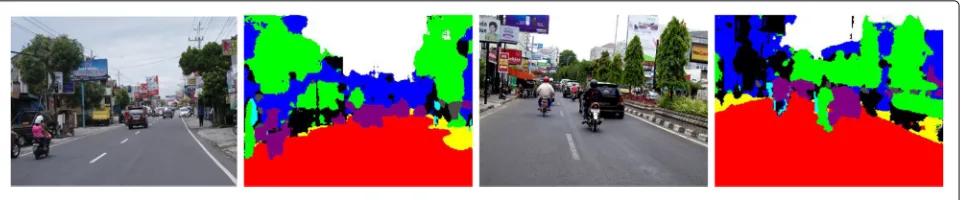
One notable result is that the RCC-Net has the best capability for recognizing the sidewalk. It is very impor-tant for an autonomous car to differentiate the road and the sidewalk, so that the safety of the pedestrians are guar-anteed. Figure 4 depicts some examples of the RCC-Net prediction output on the test set of the CamVid dataset.
As we have noted in the previous section, it is intriguing to examine different ways of coalescing the convolutional layers. Both summing and concatenated convolutional layers of the RCC-Net surpass the other methods. Never-theless, the concatenated version of RCC-Net has advan-tages over the summing one. One interesting result is the pedestrian segmentation of the summing version of the RCC-Net achieves the highest accuracy (70.6%). This fact may lead to a promising application in the future research, e.g., to determine the salient regions for the pedestrian detection.
3.2 Test on wild scene
Table 2Comparison on the CamVid dataset [16] using 11 road scene categories (in percent)
Method Sky Building Road Sidewalk Car Pedestrian Bicyclist Tree Fence Column-pole Sign-symbol Class avg. Class IoU
Local label descriptor [1] 88.8 80.7 98 12.4 16.4 1.09 0.07 61.5 0.05 4.13 n/a 36.3 n/a
Boosting+pairwise CRF [2] 94.7 70.7 94.1 79.3 74.4 45.7 23.1 70.8 37.2 13 55.9 59.9 n/a
Boosting+detection+CRF [3] 96.2 81.5 93.9 81.5 78.7 43 33.9 76.6 47.6 14.3 40.2 62.5 n/a
Dense depth map [4] 95.4 85.3 98.5 38.1 69.2 23.8 28.7 57.3 44.3 22 46.5 55.4 n/a
Super parsing [5] 96.9 87 95.9 70 62.7 14.7 19.4 67.1 17.9 1.7 30.1 51.2 n/a
SegNet-basic [8] 91.2 75 93.3 74.1 82.755 16 84.6 47.5 44.8 36.9 62 47.7
SegNet [8] 92.4 88.8 97.2 84.4 82.1 57.1 30.7 87.349.3 27.5 20.5 65.2 55.6
ENet [9] 95.1 74.7 95.1 86.7 82.4 67.2 34.1 77.8 51.7 35.4 51 68.3 51.3
RCC-Net (sum) 95.2 70.1 94.1 90.1 82.6 70.6 45.7 81.2 51 52.3 35.4 69.8 52.6
RCC-Net (concatenated) 94.3 71.8 92.6 92.7 79.3 57.7 65.6 80.5 35.7 57.4 59.4 71.5 53.3 The bold values show the highest accuracy for each category
model obtained from the previous CamVid benchmark. From Fig. 5, the RCC-Net produces qualitatively good segmentations, even for the scenes which are heavily clut-tered. It also means the proposed network is able to transfer the model information to the new environment.
3.3 Computation time and model size
On GTX 1080, the RCC-Net took 25.5 ms for the for-ward inference of 480×360 images, including fetching and displaying the image. It is also able to run one inference on a car-deployable mini PC Zotac EN-761 in 67.5 ms with the network size of 4.9 MB, which draws out the power consumption around 62.4 watt. It means the pro-posed network is fast and small enough to enable the Advanced Driver Assistance System (ADAS). We plan to
run the network on a GPU-based embedded system, such as NVIDIA Jetson TK1 for further investigation1.
4 Conclusions
An efficient and compact solution for solving the semantic road segmentation problem has been presented. By coa-lescing different types of convolutional layers and stacking them in a deep residual network style, we achieve the high-quality results on the semantic road segmentation with relatively small model size, surpassing the existing state-of-the-art methods. In the future, we would like to examine the performance of our RCC-Net on the boarder problems, such as medical images and other challenging image segmentation dataset, for understanding its capa-bilities to solve more general segmentation applications.
Fig. 5RCC-Net results on wild scenes
Endnote
1The progress of RCC-Net performance on the
embed-ded system can be seen at http://te.ugm.ac.id/~igi/?page_ id=826
Acknowledgements
This work was supported by AUN-SEED Net Collaborative Research for Alumni (CRA) Project.
Authors’ contributions
IA performed the primary development and analysis for this work and the initial drafting of the manuscript. TBA played an essential role in development of this work and editing the paper. All authors read and approved the final manuscript.
Competing interests
The authors declare that they have no competing interests.
Publisher’s Note
Springer Nature remains neutral with regard to jurisdictional claims in published maps and institutional affiliations.
Received: 20 February 2017 Accepted: 7 March 2017
References
1. Yang Y, Li Z, Zhang L, Murphy C, Hoeve JV, Jiang H (2012) Local label descriptor for example based semantic image labeling. In: Proc. of European Converence on Computer Vision (ECCV). pp 361–375 2. Sturgess P, Alahari K, Ladicky L, H.S.Torr P (2009) Combining appearance
and structure from motion features for road scene understanding. In: Proc. of British Machine Vision Conferenve (BMVC)
3. Ladicky L, Sturgess P, Alahari K, Russell C, Torr PHS (2010) What, where and how many? Combining object detectors and CRFs. In: Proc. of European Converence on Computer Vision (ECCV). pp 424–437 4. Zhang C, Wang L, Yang R (2010) Semantic segmentation of urban scenes
using dense depth maps. In: Proc. of European Converence on Computer Vision (ECCV). pp 708–721
5. Tighe J, Lazebnik S (2013) Superparsing. Int J Comput Vision (IJCV) 101(2):329–349
6. Krizhevsky A, Sutskever I, Hinton GE (2012) Imagenet classification with deep convolutional neural networks. In: Proc. of NIPS. pp 1097–1105 7. Long J, Shelhamer E, Darrell T (2015) Fully convolutional networks for
semantic segmentation. In: Proc. of IEEE Computer Vision and Pattern Recognition (CVPR). pp 3431–3440
8. Badrinarayanan V, Kendall A, Cipolla R (2015) Segnet: a deep convolutional encoder-decoder architecture for image segmentation. arXiv: 1511.00561 9. Paszke A, Chaurasia A, Kim S, Culurciello E (2016) Enet: a deep neural
network architecture for real-time semantic segmentation. arXiv: 1606.02147v1
10. Brust CA, Sickert S, Simon M, Rodner E, Denzler J (2015) Convolutional patch networks with spatial prior for road detection and urban scene understanding. In: Proc. of VISAPP
11. He K, Zhang X, Ren S, Sun J (2015) Deep residual learning for image recognition. arXiv: 1512.03385
12. Szegedy C, Vanhoucke V, Ioffe S, Shlens J, Wojna Z (2015) Rethinking the inception architecture for computer vision. arXiv: 1512.00567 13. Szegedy C, Liu W, Jia Y, Sermanet P, Reed S, Anguelov D, Erhan D,
Vanhoucke V, Rabinovich A (2015) Going deeper with convolutions. In: Proc. of IEEE Computer Vision and Pattern Recognition (CVPR). pp 1–9 14. Yu F, Koltun V (2015) Multi-scale context aggregation by dilated
convolutions. arXiv: 1511.07122
15. Kingma D, Ba J (2014) Adam: a method for stochastic optimization. arXiv: 1412.6980
16. Brostow GJ, Shotton J, Fauqueur J, Cipolla R (2008) Segmentation and recognition using structure from motion point clouds. In: Proc. of European Converence on Computer Vision (ECCV). pp 44–57
Submit your manuscript to a
journal and benefi t from:
7Convenient online submission
7Rigorous peer review
7Immediate publication on acceptance
7Open access: articles freely available online
7High visibility within the fi eld
7Retaining the copyright to your article
![Table 2 Comparison on the CamVid dataset [16] using 11 road scene categories (in percent)](https://thumb-us.123doks.com/thumbv2/123dok_us/845426.1582249/4.595.59.538.525.706/table-comparison-camvid-dataset-using-scene-categories-percent.webp)