3623
Network Slicing And Performance Analysis Of 5g
Networks Based On Priority
S.Jayalakshmi, N.Sangeetha, S.Swetha, Dr.T.Ananth kumar
Abstract: Network slicing is a foremost critical aspect of the advanced 5 G cellular network connectivity. It offers the separation of the single physical network into numerous digital networks so one can attain particular targets inclusive of safety, mobility, and the monitoring of the network. The main problem of isolating slices by prioritization is fixes by using the end-to-end network slimming principle of 5 G networks to reduce latency and to improve the performance for excessive-priority applications. The effects of experiments with the NS-3 simulator demonstrate demands for latency and efficiency improvements..
Index Terms: Network Slicing; 5G cellular Network; Isolation of Slice; mm-wave; end-to-end network; NS-3 Simulator; Network slicing; —————————— ————————
1.
INTRODUCTION
The fifth era of the cell structures named next to 4G is 5G and is suggested to be transmitted as the following media transmission standard in the year 2020 [1]. From the system execution perspective, cutting suggests that each 5G cut needs to have its own arrangement of distributed assets, this angle presents an oddity in the administration of system assets in versatile frameworks. Surely, in the past ages of portable systems, the assets to be doled out to every application were chiefly radio assets, while in the 5G organize, assets speak to both radio and center system [2], by methods for computational and capacity abilities notwithstanding the over-the-air information rate. A 5G cell system was examined due to the exponential growth of remote data administration driven by the multi-faceted Internet and keen gadgets. The test for cutting edge devices is to maintain high performance and QoS in the unreliable radio links (upline and downlink) [3]. The destinations by 5G incorporate the production of empowering advancements for vertical ventures, for example, yet not constrained to transport (car), social insurance, industrial facilities of things to come (or industry 4.0), vitality, media, amusement [4]. This pattern is required to extend later on as it tends to be seen by the virtualization institutionalization patterns [5]. The quantity of system associated remote gadgets will arrive at multiple times the total populace [6]. Moreover, the use of a huge value of remote radio heads (RRHs) Connected to focal preparation hubs (example: mist) is all too imaginary with the fast rear-haul (RRHs) [7]. There are not many issues with the current LTE [8] engineering: I) unified information stream: every one of the information goes through the Packet Data Network Gateway (PGW), ii) incorporated checking, control isn't versatile and is costly, iii) base stations and framework are hard to arrange and redesign, iv) the present executions of portable systems depends on particular equipment based system hardware which is hard to oversee and almost difficult to alter.
A. Network Slicing End-to-End
In the year 2020, 5G is committed to providing an extraordinary range of administrations and applications which can have different preconditions for the functionality of 5 G structure and main implementation. For a portable system administrator, 5G ought to turn into from start to finish (E2E) adaptable, versatile, request situated framework to meet the different prerequisites. The E2E system cutting in 5G is considered as a key main thrust to accomplish this difficult objective. E2E system cutting is an intelligent system that gives explicit system abilities and system qualities with sensible seclusion. It is cross-area innovations that may length crosswise over access arrange (A), transport, organize (TN), and center system (CN) and terminal spaces. Every one of these areas involves capacities, stages, and conventions just as assets. This makes system cutting require new intuition in framework engineering and plan.
B. Summary of MMWAVE Communication
The mm-wave interchanges of 5G versatile systems are used for the purpose of creating a correspondence limit by misuse of the gigantic mm-wave group (30-300) GHz range measurement, which complies with the 5 G standard [9]. The basic application of NS-3 Lena module mm-wave gadgets was used [10], including a spread and channel model, the physical layer, the MAC layer. The NS-3 module is available from mm-wave [11]. The mm-mm-wave channel can capture spatial groups, travel components, drawings of reception devices, calculations on the physical surface layer of the structure. Factual bunches, physical estimates [12], or the beams following [13] are available to demonstrate channel methods. At the MAC layer, the transmission by mm-Wave mac class, which is the basic limit of this layer, of information bundles from upper layers on the system into the physical layer, and the opposite is completed [14]. At our work, we are updating mm-wave as the basic 5 G distance correspondence technology entertainer.
2.
LITERATURE
REVIEW
Many questions related to the problem of mobile devices as regards idleness, performance as well as reliability by organizing apps. Beginning from Long Term Evolution (LTE), [15] proposed remote system virtualization that has a plan to cut up to designate physical squares to various specialist co-ops to boost asset use. The use of the affirmation check element that carries out the iterative cut supply calculation to alter less caught needs while not taking into account the global asset use is another way to cope with illumination and to ————————————————
S. Jeyalakshmi is working as Assistant Professor in the department of Computer Science & Engineering, IFET college of Engineering, Villupuram. Email: [email protected]
increase the rates of virtualized devices depending on their channel state.[16],[17] suggested for spreading assistance on the scheme when the supply of the system does not affect the entire administration in a cell in which the organization limits, improved the use of resources. The designers suggested a new heuristic confirmatory check element to gradually assign system assets to multiple cuts to increase customer satisfaction, taking into consideration the needs of reductions. In addition, [18] a joint asset and revenue closing model have been suggested that assets can be allocated to network reductions to enhance per system reduction and expansion system revenue compliance.
3. METHODOLOGY
System cutting should be actualized in a start to finish way to meet assorted assistance necessities. Each cut may have its very own system design and protocols. 5G system cutting incorporates cutting the 5G radio access arranges (RAN), 5G center system, and even end-client gadgets. 5G RAN cutting can be actualized through legitimate deliberation of physical radio assets (for example, range) and physical equipment (for example, a base station). SDN and NFV can design the virtual system assets deftly, which incorporate system data transfer capacity, server preparing ability, and system component handling ability, to construct the center system cuts for explicit help prerequisites. RAN cuts and center system cuts can either be devoted to a class of administration clients or shared between different classes of administration clients. To give an indistinguishable cut to a particular help, a typical capacity — the cut choosing capacity — is required. It's in charge of choosing RAN, and a center system cuts to shape the end-to-end slice. From the RAN perspective, the fundamental assignment of the RAN cut is to accomplish the sharing and adaptable administration of range assets. Hence, the product characterized RAN is a promising way to deal with executes RAN cutting. The sharing of radio assets between various cuts can be practiced by booking led by the controller in software-defined RAN. The controller can distribute radio assets to a cut by administration demand qualities, for example, traffic load. In addition, distinctive radio access techniques for RAN cuts are required as far as different assistance prerequisites. For instance, other than the versatile broadband access in the conventional cell organizes, the basic correspondence cut in 5G needs low-inactivity radio access. Likewise, the usage of RAN cutting needs coherent disintegrations of RAN capacities to make sense of which capacities are normal capacities and which capacities are furnished with explicit hardware. 5G center system cutting can give sensible custom-made systems to various administrations or verticals in a coordinated and versatile style. The key advancements of center system cutting are SDN and NFV. SDN innovation can be used to isolate the central control and data planes with the aim of autonomously transmitting the control aircraft and information plane. The control plane can be brought together to encourage the board, while the information plane can be disseminated. For instance, the information plane in a system cut for low-inertness administrations can be conveyed on the system edge in blend with the MEC innovation. NFV innovation can give the essential VNFs to the information plane of the center system cuts, as indicated by the administration type. These VNFs can be scaled on-request as the administration changes powerfully. NFV represents system capacities virtualization, RAN represents radio access system, and SDN represents
programming characterized organizing, as shown in Figure 1.
Fig. 1. Representation of network classifiaction
A. Proposed System
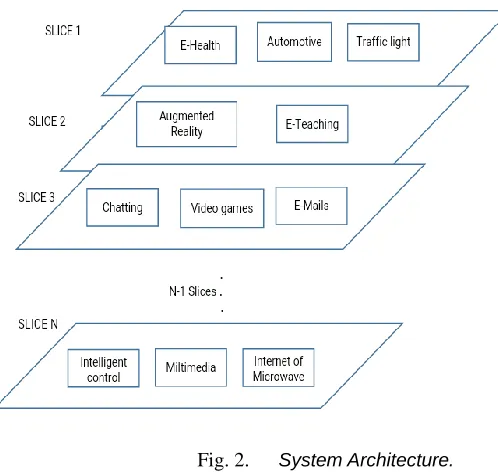
Our arrangement is to schedule a scheme of cuts using the NS-3 module of 5G mm-wave; each cut depends on the implementation it will fulfill, as shown in Figure 2, where Slice-1 requires slice N that is the least needed.
Fig. 2. System Architecture.
B. Evaluation of Performance in 5g Network
3625
through the noteworthy Shannon hypothesis, Csum=∑∑ Bi log2 (1+Pi/Np)
Where the data transmission capability of the ith channel is Bi, ith channel sign intensity is Pi, and the commotion control Np is indicated. Equation, Csum is clearly similar to all sub-channels and heterogeneous structures with the whole boundary of all outer frames. To expand Csum we can develop system integration (through HEMI, spatial equilibrium, [12], etc.), transmission capability (by CSU, interchange mm-wave, VLC [10], multi-standard CSU) In addition we can develop system integration by heterogeneous structures with MCs, microcells, and cells (MF, transfers, MFEMETOCell [12], etc.).
4. CHALLENGES IN 5G TESTING
The key provocations identified in the accompanying project are quickly presented with the evaluation, testing, and approval of the 5G frameworks. Estimation and demonstrating of the proliferation channels: The central test to estimating and displaying the engendering channel is principal because of the utilization of higher frequencies and different transfer speeds, together with a lot bigger reception apparatus clusters. Remote traffic growth calls for additional ranges (e.g., greater frequencies in the mm-wave) and the promotion of progress, for instance, enormous MIMO scale and hubs densification, leading to fresh necessities of a channel estimating/showing in space. The main difficulties and reflections to estimate and demonstrate the 5 G channels can be described as follows [14].
Effective and reasonable estimation: Because estimation data are important for the necessary increases/adjustments of the accessible engendering models, the estimating approach should capture various recurrences, spatial consistency, 3D (for example, height) and round waves, such as the D2D / M2 M and small cell correspondences. Similarly, for indoor and outdoor operating conditions, it should be estimated for mm-wave (example 60 GHz or more) and consider practical use-cases (example swarmed areas, vehicle/carriageways, etc.).
Spatial disseminations and portability: The existing models of the channel are dropped, e.g., for each link, the dissipating situation is precautionary. Be that as it may, since the thickness of connections is relied upon to increment in 5G frameworks, it is critical to display these connections in a predictable way, which can likewise intrinsically bolster the heterogeneous versatility conduct of various system hubs.
Large-scale receiving wire clusters and the mmwave correspondence: It’s imagined that 5G frameworks shall utilize extremely huge scale reception apparatus exhibits for mandate correspondence. With regard to this mandate, present channel models need to be improved in terms of accurate objectives as well as the flow of the metro. In addition, these huge radio wire shows need to display the circular wave rather than the estimate of the usual airwave [14]. In order to achieve variety and spatial multiplexing gains, mm-wave frequencies (in particular at 60 GHz) are recommended. However, the characteristics, for instance, are not exceptional and require further assessment, as are deeply fixed rakish characteristics and unseen pathway misfortune.
5. SIMULATION OF RESULTS
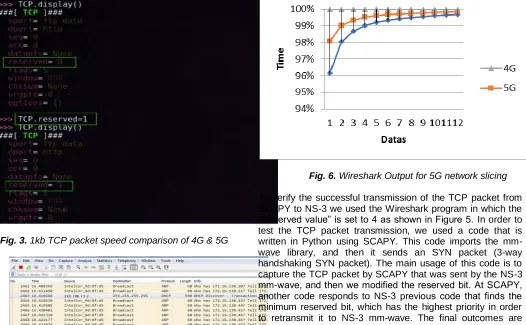
The key scenario sends the parcel from the client to the server, and in the middle, a shift will take place to deliver the packages to the server. The client sends data to the switch towards the beginning, SCAPY changes its reserved byte and then sends the parcel back to the switch. The switch then moves the structured parcel to the server and reacts with ACK or NAK. The mm-wave and switch open flow combination is not updated by the NS-3 test scheme, and we used a SCAPY-Python instead of the switch. As the reproductive results show, we have the mm-wave ring that means that we are shooting on a 5 G channel that provides somewhere in the 30 and 300 GHz range of recurrence. TCP parcel transmitted by speed testing and somewhere in the fields of 4G and 5G technologies is demonstrated in table 1. Scapy device allows the customer to change any item that they want in the package and send the parcel again. Scapy device enables customers to send information packets to change them and to send it back, as shown in Figure 3 and Figure 4. We used SCAPY to specify the byte reserved with the necessary tag. As in Figure 5, the "TCP.display)" (order shows TCP bundle bits in the subtleties, the pieces that we have held want to be changed, and they are set to 1 instead of 0 using "TCP.reserved=1" in parallel structures.
Table- I: Delays comparison between 4 G and 5 G systems of the TCP packet transmission and receipt
4G 5G
Source IP 192.168.13.2 192.168.13.2 Destination IP 192.168.13.1 192.168.13.1 Sent to a moment
(Seconds) 2.0005 2.00369
Received in
moment (Seconds) 2.699s 1.062 Source IP 192.168.13.1 192.168.13.1 Destination IP 192.168.13.2 192.168.13.2 Sent to a moment
(Seconds) 2.0005 2.00369
Received in
Fig. 3. 1kb TCP packet speed comparison of 4G & 5G
Fig. 4. Chart for TCP packet speed comparison of 4G & 5G
Fig. 5. SCAPY Results
Fig. 6. Wireshark Output for 5G network slicing
To verify the successful transmission of the TCP packet from SCAPY to NS-3 we used the Wireshark program in which the ―Reserved value‖ is set to 4 as shown in Figure 5. In order to test the TCP packet transmission, we used a code that is written in Python using SCAPY. This code imports the mm-wave library, and then it sends an SYN packet (3-way handshaking SYN packet). The main usage of this code is to capture the TCP packet by SCAPY that was sent by the NS-3 mm-wave, and then we modified the reserved bit. At SCAPY, another code responds to NS-3 previous code that finds the minimum reserved bit, which has the highest priority in order to retransmit it to NS-3 mm-wave. The final outcomes are shown as the code on the left indicates a reversed packet transmission, which implies that the transmission depends on the reserved bit. SCAPY has received the TCP transmitted packet in the right order at the right side of Figure 6, meaning that the top priority bit= 1 packet is first served by the customer who starts transmission paying little attention to their age season.
6.
CONCLUSION
A new approach is presented in this paper to improve the performance in 5 G networks with network slicing. Our strategy is a priority-driven entry control system that takes inter-and intra-slice priorities into account and provides resources. Network slice design has opened the way for many apps by providing a priority layer in the network to each implementation, decreasing unnecessary network congestion, which impacts critical apps operating on the network. Our design supports the latency, performance, and availability requirements for mobile operators to provide 5 G services. In our future job, we are going to attempt to introduce the NS-3 mm-wave supported OpenFlow switch module with an IoT device that has a distinctive SCAPY address to change the byte reserved for each customer or application.
REFERENCES
3627
[2]Cheng-Xiang Wang, Fourat Haider, Xiqi Gao, Xiao-Hu You, Yang Yang, Dongfeng Yuan, Hadi Aggoune, Harald Haas, Simon Fletcher, and Erol Hepsaydir. Cellular architecture and key technologies for 5g wireless communication networks. IEEE Communications Magazine, 52(2):122– 130, 2014.
[3] NGMN Alliance. 5g white paper. Next generation mobile networks, white paper, 2015.
[4]Ravi Kokku, Rajesh Mahindra, Honghai Zhang, and Sampath Rangarajan. Cellslice: Cellular wireless resource slicing for active ran sharing. In Communication Systems and Networks (COMSNETS), 2013 Fifth International Conference on, pages 1–10. IEEE, 2013.
[5]Pablo Caballero Garc´es, Xavier Costa P´erez, Konstantinos Samdanis, and Albert Banchs. Rmsc: a cell slicing controller for virtualized multi-tenant mobile networks. In Vehicular Technology Conference (VTC Spring), 2015 IEEE 81st, pages 1–6. IEEE, 2015.
[6]Young Han Kim et al. Slicing the next mobile packet core network. In Wireless Communications Systems (ISWCS), 2014 11th International Symposium on, pages 901–904. IEEE, 2014.
[7]C. Song et al., "Hierarchical edge cloud enabling network slicing for 5G optical fronthaul," in IEEE/OSA Journal of Optical Communications and Networking, vol. 11, no. 4, pp. B60-B70, April 2019. doi: 10.1364/JOCN.11.000B60.
[8]D. Sattar and A. Matrawy, "Optimal Slice Allocation in 5G Core Networks," in IEEE Networking Letters, vol. 1, no. 2, pp. 48-51, June 2019. doi: 10.1109/LNET.2019.2908351.
[9]A. Farrel, "Recent Developments in Service Function Chaining (SFC) and Network Slicing in Backhaul and Metro Networks in Support of 5G," 2018 20th International Conference on Transparent Optical Networks (ICTON), Bucharest, 2018, pp. 1-4.
[10]T. Ananth Kumar and R. S. Rajesh, "Towards power efficient wireless NoC router for SOC," 2014 International Conference on Communication and Network Technologies, Sivakasi, 2014, pp. 254-259. doi: 10.1109/CNT.2014.7062765.
[11]Marco Mezzavilla, Sourjya Dutta, Menglei Zhang, Mustafa Riza Akdeniz, and Sundeep Rangan. 5g mmwave module for the ns-3 network simulator. In Proceedings of the 18th ACM International Conference on Modeling, Analysis and Simulation of Wireless and Mobile Systems, pages 283–290. ACM, 2015.
[12]Theodore S Rappaport, George R MacCartney, Mathew K Samimi, and Shu Sun. Wideband millimeter-wave propagation measurements and channel models for future wireless communication system design. IEEE Transactions on Communications, 63(9):3029–3056, 2015.
[13]Nor Fadzilah Abdullah, Djamal Berraki, Araz Ameen, Simon Armour, Angela Doufexi, Andrew Nix, and Mark Beach. Channel parameters nd throughput predictions for mmwave and lte-a networks in urban environments. In Vehicular Technology Conference (VTC Spring), 2015 IEEE 81st, pages 1–5. IEEE, 2015.
[14]Menglei Zhang, Marco Mezzavilla, Russell Ford, Sundeep Rangan, Shivendra Panwar, Evangelos Mellios, Di Kong, Andrew Nix, and Michele Zorzi. Transport layer performance in 5g mmwave cellular. In Computer
Communications Workshops (INFOCOM WKSHPS), 2016 IEEE Conference on, pages 730–735. IEEE, 2016. [15] Mahmoud I Kamel, Long Bao Le, and Andr´e Girard. Lte
wireless network virtualization: Dynamic slicing via flexible scheduling. In 2014 IEEE 80th Vehicular Technology Conference (VTC2014-Fall), pages 1–5. IEEE, 2014. [16]Saeedeh Parsaeefard, Vikas Jumba, Mahsa Derakhshani,
and Tho Le- Ngoc. Joint resource provisioning and admission control in wireless virtualized networks. In 2015 IEEE Wireless Communications and Networking Conference (WCNC), pages 2020–2025. IEEE, 2015. [17]Sonia Ben Rejeb, Nidal Nasser, and Sami Tabbane.
Admission control strategies and qos evaluation based on mobility in lte. In 2013 IEEE Global Communications Conference (GLOBECOM), pages 4883–4888. IEEE, 2013.