IJSRR, 8(2) April. – June., 2019 Page 952
Research article Available online www.ijsrr.org
ISSN: 2279–0543
International Journal of Scientific Research and Reviews
Fuzzy Particle Swarm Optimization Based Feature Learning Vector
P. Lavanya
Department of Information Technology Kg College of Arts and Science Coimbatore.
ABSTRACT:
Data mining is the process of analyzing data from the different huge amount of data to
increasing the cost, revenue and useful information from the databases. Data mining is applied
successfully in the business background, weather forecast, medicine, transportation, healthcare,
insurance, and government. The clustering is an unsupervised learning without predefined class
identifiers and it is a process of partition the data set into several groups based on the similarity
which done by their distance. Most researchers were used the Euclidean distance that obtained by
differentiating between centroid and data item. The data sets have many features that’s all features
are not important to solving the clustering problems. In this circumstance, assign weights to their
features that improving the performance of clustering accuracy and reducing its computational time.
In this present work, Feature Weighted Fuzzy Particle Swarm Optimization (FW-PSO) algorithm
used to solve unsupervised classification and the this algorithm produced superior result than Fuzzy
Particle Swarm Optimization.
KEYWORDS:
Data Mining, Euclidean Distance, Clustering, Feature Weighted Fuzzy ParticleSwarm Optimization
*Corresponding author:
P.Lavanya
Department of Information Technology
Kg College of Arts and
IJSRR, 8(2) April. – June., 2019 Page 953
1. INTRODUCTION
Data mining is one of the most1important research fields that are due to the development of
both computer hardware and software technologies, which has imposed organizations to depend
heavily on these technologies.
Knowledge Discovery in Databases process or KDD is an interdisciplinary subfield of
computer science, is the computational process of discovering patterns in large data sets to connect
with the algorithms and methods of KDD2, artificial intelligence, machine learning, statistics, and
database systems.
1.1 Clustering in Soft computing Methods
This section further discusses the important usefulness of soft-computing methods in
clustering tasks.
1.1.1 Fuzzy Clustering
Conventional clustering approaches are generating partitions. In a partition, each instance
belongs to one and only one cluster. Hence, the clusters in a hard clustering9 are disjointed. Fuzzy
clustering extends this notion and suggests a soft clustering schema. In this case, each pattern is
associated with every cluster using some sort of membership function, namely, each cluster is a
fuzzy set of all the patterns.
Larger membership values indicate higher confidence in the assignment of the pattern to the
cluster. A hard clustering can be obtained from a fuzzy partition by using a threshold of the
membership value. The most popular fuzzy clustering algorithm is the fuzzy c-means (FCM)
algorithm3.
Even though it is better than the hard K-means algorithm at avoiding local minima, FCM can
still converge to local minima of the squared error criterion. The design of membership functions is
the most important problem in fuzzy clustering; different choices include those based on similarity
decomposition and centroids of clusters. A generalization of the FCM algorithm has been proposed
through a family of objective functions.
1.1.2 Evolutionary Techniques
Evolutionary Techniques are called as the optimization technique that’s stochastic general
purpose methods for solving optimization problems. Since, Clustering problem can be defined as an
IJSRR, 8(2) April. – June., 2019 Page 954 evolutionary operators and a population of clustering structures to converge into a globally optimal
clustering.
2. RELATED WORK
The clustering analysis is very big problem specially in large data set. The clustering
analysis means it will divide the given data into certain classes according to the main attribute
of the dataset, thus the item of class to have the same or similar meaning. The Clustering
algorithm has some drawback for example K-mean have drawback in searching for optimal
solution8. It is very difficult to find the cluster center. Consider the drawbacks and limitation of
single clustering technique, research has developed optimization algorithm to overcome the
drawbacks of clustering technique.
Due to the limitation of the k-mean algorithm the PSO will used for overcome the k-mean
drawback. The drawback of K-mean is to initialization of cluster center. This is one of the
disadvantages of the k- mean. To overcome this advantages the PSO algorithm was used , using
PSO it will find the cluster center will generated initial piratical are optimized to maintain the final
cluster center4.
Mussels Wandering Optimization algorithm will used for finding the optimal path of
clustering. It is one of the important algorithm related to the Swarm intelligence. It is one of the new
effective global optimization algorithms7.
In c-mean clustering the cluster center have used to form the cluster and then it will
extended to fuzzy c-mean algorithm that is related to the concept of the fuzziness in order to
handling the overlapping class in the real data set and then it will extended to the rough fuzzy
c-mean algorithm. It will solved the uncertainty problem of the data set.
In cluster analysis, some of the features of a given data set may fall in higher relevance than
others. For avoid this issue, Feature-Weighted Fuzzy C-Means (FWFCM) approaches are helpful in
recent years. An Improved FWFCM (IFWFCM)5 is overcome the certain deficiencies in the existing
FWFCMs, e.g., the elements in a feature-weight vector cannot be adaptively adjusted during the
training phase and also the update formulas of a feature-weight vector cannot be derived analytically.
3. PROPOSED STUDY:
Fuzzy clustering is a fundamental operation used in unsupervised clustering organization,
automatic topic extraction, and information retrieval. This investigates presents an optimization to
IJSRR, 8(2) April. – June., 2019 Page 955 approach involving Swarm intelligence based algorithm, Fuzzy Particle Optimization (PSO)
combined with its weight values for important features to evaluate for high dimensional clustering.
Fuzzy clustering Problem can be formally defined as below :
i. A membership value calculated by
1
1
n m i j i i
j n
m i j i
o
z
ii. A desired number of clusters k, and
an objective function that evaluates the quality of a clustering, we want to compute an assignment
that minimizes the objective function.
1 1
c n
w
m ij ij
j i
J
d
3.1 Particle Swarm Optimization:
Particle swarm optimization (PSO) is a population based stochastic optimization technique
inspired by bird flocking and fish schooling6 that was originally designed and introduced by
Kennedy and Eberhart in 1994. The particle swarm optimization is uses iterative practice to find
several better solution fitness functions in a search space.
In PSO, the potential solutions are called particles and they fly through the problem space by
following the in progress optimum. The algorithm flow in PSO starts with a population of particles
whose positions corresponds to the potential solutions for the studied problem, and velocities are
randomly initialized in the search space.
In each iteration, the search for optimal position is personal best position and global best
position. The personal best position, pbest, is the best position the particle has visited and gbest is the
best position the swarm has visited since the first time step.
A particle’s velocity and position are updated as follows.
V (t+1) = w. V (t).c r1 1(pbest(t)-X(t)+c r2 2(gbest(t)-X(t)) k=1,2…P (3.1)
X (t+1) =X (t) +V (t+1) (3.2)
where X and V are position and velocity of particle respectively, w is inertia weight, c1 and
c2 are positive constants, called acceleration coefficients which control the influence of pbest and
gbest on the search process, P is the number of particles in the swarm, r1 and r2 are random values
IJSRR, 8(2) April. – June., 2019 Page 956
Each particle keeps track of its coordinates in the problem space which are associated with
the best solution.Which coincides with the best fitness value called pbest. Find the best solution form
whole best values are called global best mentions by gbest. The PSO is a very attractive by means
least amount parameters only.
3.2. Fuzzy Particle Swarm Optimization For Fuzzy Clustering:
A modified particle swarm optimization for TSP10 called Fuzzy Particle Swarm Optimization
(FPSO) proposed by Peng et al. In which method, the position and velocity of particles redefined to
represent the fuzzy relation between variables. In this sub-section we describe this method for fuzzy
clustering problem.
In FPSO algorithm,’ X’ the position of particle, shows the fuzzy relation from set of data
objects, o{ ,o o1 2,....,on}to set of cluster centers, z{ ,z z1 2,...., }zn , X Can be expressed as follows:
11 1 1 c n nc X (3.3)
In which μij is the membership function of the ith object with the jth cluster with constraints
stated Eq. (3.1) and Eq. (3.2) therefore we can see that the position matrix of each particle is the
same as fuzzy matrix μ in FCM algorithm. Also the velocity of each particle is stated using a matrix
with the size n rows and c columns the elements of which are in range between -1 and 1. We get the
Eq. (3.11) and Eq. (3.12) for updating the positions and velocities of the particles based on the
matrix.
V (t+1) = w V (t) c r1 1 (pbest(t) X(t) c r2 2 (gbest(t)- X(t)) k=1,2…P (3.4)
X (t+1) =X (t) V (t+1) (3.5)
After updating the position matrix, it may violate the constraints given Eq. (3.1) and Eq.
(3.2). So it is necessary to normalize the position matrix. First we make all the negative elements in
matrix to become zero. If all elements in a row of the matrix are zero, they need to be re-evaluated
using series of random numbers within the interval between 0 and 1, and then the matrix undergoes
the following transformation without violating the constraints:
11 1 1 1
1 1 1 1 1 / / / / c c
j c j
j j
c c
n nj nc nj
IJSRR, 8(2) April. – June., 2019 Page 957
In FPSO algorithm the same as other evolutionary algorithms, we need a function for
evaluating the generalized solutions called fitness function. In this paper below equation is used for
evaluating the solutions.
2
1 1
(
)
c n
m
m ij ij
i j
J
u
d
(3.7)( ) m K f X
J
(3.8)
Therein K is a constant and Jm is the objective function. The smaller isJm, the better is the
clustering effect and the higher is the individual fitness f (X).
A clustering algorithm that automatically assign the weights to the attributes or even selects a
proper subset for working out. The feature weights assigning to dataset is done in the form of the
feature selection.
In present study, tries to combine clustering and feature selection by pushing the feature
selection method into the clustering algorithm can be turned into a feature selection method by
simply applying a weight threshold to the computed feature weights.
Dataset has many features, since, in a large amount of the real world problems, each features
are not measured to be equally important. For example, iris dataset has four features such as sepal
length, sepal width, petal length, petal width. Standard dataset take more computational time, hence,
reducing computing time and increase accuracy of clustering algorithms. In present study solve
aforementioned drawback used to feature learning vector which incorporated weight value with its
distance function.
Assign the weights to each feature for given dataset to increase the accuracy and reducing the
computational time by means of proposed feature learning vector combined with particle swarm
optimization[10, 26] is called FW-PSO (Feature Weight-Particle Swarm Optimization).
Euclidean distance referred as follows,
2
( )
ij j ij
d z o (3.9)
The feature learning weight vector performed based on weighted Euclidean distance referred
as follows,
2
( )
ij k j ij
d w z o (3.10)
Hence, we construct objective function based on weighted distance,
2
1 1
(
)
c n
w m w
m ij ij
i j
J
u
d
IJSRR, 8(2) April. – June., 2019 Page 958 Following constrains are define the weight value into normalization form as follows,
1
1
s k k
w
(3.12)
1 1
s n ij k j
u
n
(3.13)FW-FPSO Algorithm:
Step 1: Initialize the parameters including population size P, c1, c2, w, and the maximum
iterative count.
Step 2: Create a swarm with P particles (X, pbest, gbest and V are n× c matrices).
Step 3: Initialize X, V, pbest for each particle and gbest for the swarm.
Step 4: Calculate the cluster centers for each particle using as follows,
1
1
n m ij i i
j n
m ij i
o
z
Step 5: Calculate the distance value using Eq. (3.10).
Step 6: Calculate the fitness value of each particle using by Eq. (3.8). Step 7: Calculate pbest for each particle.
Step 8: Calculate gbest for the swarm.
Step 9: Update the velocity matrix for each particle using by Eq. (3.4).
Step 10: Update the position matrix
for each particle using by Eq. (3.5).
Step 11: If terminating condition is not met, go to step 4.
The termination condition in proposed method is the maximum number of iterations or no
improvement in gbest in a number of iterations.
4. EXPERIMENTAL ANALYSIS:
4.1 Clustering Validation Technique
The aim of clustering validation is to evaluate the clustering results by finding the best
partitions that fits the underlying data. Thus, cluster validity is used quantitatively evaluate the
IJSRR, 8(2) April. – June., 2019 Page 959
4.2 Objective Functions
Clustering is a generally applied for data exploration while least labeled data obtainable. An
objective function of clustering11 algorithm is tries to minimize or maximize of a function such that
the clusters are obtained when the minimum or maximum is achieved are all the same. The clustering
algorithms its performance generated from the given objective functions with a number of examples.
2
1 1
(
)
c n
w m w m ij ij
i j
J
u
d
(4.1)The performances of the clustering algorithms are work out by objective function for well
known datasets. The objective functions of every clustering algorithm are considered into three
values such as worst, average and best. The best performance of the every clustering algorithm is
considered if best value is high value otherwise its performance is low. The clustering algorithms, its
performance are calculated by average value from overall iteration.
4.3 Partition Coefficient Index
The partitions coefficient index obtained maximum value of cluster structure is considered as
optimal value of algorithms. This is defined as follows9,
2
1 1
1
n cij i j
PCI
u
n
(4.2)
4.4 Partition Entropy Index
The partition entropy index obtained minimum value is optimal solutions that is defined as
follows,
1 1
1
log (
)
n c
ij b ij
i j
PEI
u
u
n
(4.3)
4
.5 Parameter Settings
In order to improve the performance of the Fuzzy Particle Swarm Optimization and Feature
Weight – Fuzzy Particle Swarm Optimization, need to select their parameters appropriately. The
performance of the algorithms produced better outcomes for their best parameter values as
following: c1 =c2=2.0, P =10, w=0.9, Maximum iterations =100, r1=r2=0.1 to 0.9, Weight exponents
IJSRR, 8(2) April. – June., 2019 Page 960
4.6 Datasets
Fisher’s iris data set, which consists of three different species of iris flower. For each species,
50 samples with four features were collected.
Wine data set, which consists of 178 object and 3 classes, each type has 13 features.
4.7 Experimental Result
The Fuzzy Particle Swarm Optimization and the proposed feature weighted learning- Fuzzy
Particle Swarm Optimization its individual performance analysis for each dataset is demonstrate in
table 1 and its average performance demonstrate in table 2, that are implemented using MATLAB.
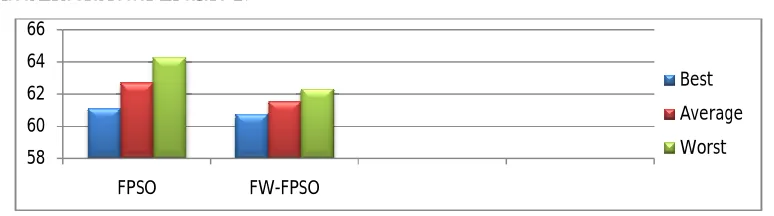
Table: 1 Performance Analysis of Fuzzy Clustering Algorithms Methods Iris(150,3,3) Wine(178,3,2)
Best Average Worst Best Average Worst
FPSO 61.12 62.70 64.28 74.60 116.58 158.56
FW-FPSO 60.76 61.54 62.33 53.14 55.49 56.74
In table 1, the performance of proposed clustering algorithms such feature weight- fuzzy
particle swarm optimization algorithms shows better accuracy then existing algorithm. That is
highlighted in bold letter in table 1.
Figure 1: Performance Of Iris Dataset For Clustering
The clustering algorithms have to apply successfully for iris dataset. Fuzzy Particle Swarm
Optimization and that the proposed Feature Weighted Fuzzy Particle Swarm Optimization
Algorithms its performances are demonstrated in figure 1. That the proposed method is shows the
superior result compared with existing algorithms such as fuzzy particle swarm optimization.
Figure 2 is shows performance of clustering algorithms for wine datasets. In which, that the
proposed Feature Weight- Fuzzy Particle Swarm Optimization has formed high accuracy than Fuzzy
Particle Swarm Optimization.
58 60 62 64 66
FPSO FW-FPSO
Best
Average
IJSRR, 8(2) April. – June., 2019 Page 961
Figure 2: Performance Of Wine Dataset For Clustering
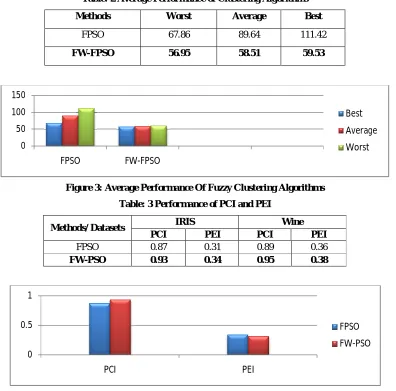
The average performance of the used algorithms are demonstrated in table 2, in case of
average performance also produced better results in term of feature weight fuzzy particle swarm
optimization. The figure 3 demonstrates average performance of the clustering algorithms in
graphical representation form.
Table: 2 Average Performance of Clustering Algorithms Methods Worst Average Best
FPSO 67.86 89.64 111.42
FW-FPSO 56.95 58.51 59.53
Figure 3: Average Performance Of Fuzzy Clustering Algorithms Table: 3 Performance of PCI and PEI
Methods/ Datasets IRIS Wine PCI PEI PCI PEI
FPSO 0.87 0.31 0.89 0.36
FW-PSO 0.93 0.34 0.95 0.38
Figure 4: Performance Of The PCI And PEI For Iris Datasets
0 50 100 150 200
FPSO FW-FPSO
Worst Average Best
0 50 100 150
FPSO FW-FPSO
Best
Average
Worst
0 0.5 1
PCI PEI
FPSO
IJSRR, 8(2) April. – June., 2019 Page 962
Figure 5: Performance Of The PCI And PEI For Iris Datasets
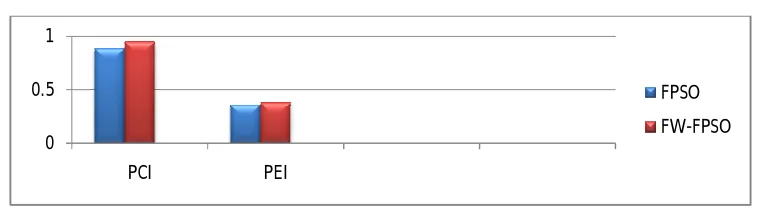
In table 3, demonstrate performance of the proposed algorithm in order to achieve by
Partition Coefficient Index and Partition Entropy Index for all dataset what was used in
experimental. Figure 4 and Figure 5 shows graphical representation of the clustering algorithms for
all used datasets.
4.8 Discussions
The fuzzy clustering algorithms are applied for well known standard datasets, such as iris and
wine data to calculate the performance of the used algorithms such as fuzzy particle swarm
optimization and proposed feature weight – fuzzy particle swarm optimization. The clustering
algorithms are implemented by MATLAB 2015b.
CONCLUSION
The classification based on unsupervised approach plays vital role in data mining and
machine learning community. There are many unsupervised classification algorithms have been
introduced by various researcher for different applications. Each approach has its own advantages
and disadvantages. In present work, the Feature Weighted - Fuzzy Particle Swarm Optimization
algorithm is proposed to overcome the demerits of the Fuzzy Particle Swarm Optimization.
Experimental conducted over two well known data sets, Iris and Wine. The computational results
show that the proposed Feature Weighted- Fuzzy Particle Swarm Optimization is efficient and can
reveal very prominent results in term of their objective values.
REFERENCES
1. C. Borgelt, "Feature weighting and feature selection in fuzzy clustering," in Fuzzy Systems,
FUZZ-IEEE (IEEE World Congress on Computational Intelligence). IEEE International
Conference on, 2008; 838-844.
2. Y. Yafan, Z. Dayou, and H. Lei, "Improving fuzzy c-means clustering by a novel
feature-weight learning," in Computational Intelligence and Industrial Application, 2008. PACIIA'08.
Pacific-Asia Workshop on, 2008; 173-177.
0 0.5 1
PCI PEI
FPSO
IJSRR, 8(2) April. – June., 2019 Page 963
3. D. S. Yeung and X. Wang, "Improving performance of similarity-based clustering by feature
weight learning," IEEE transactions on pattern analysis and machine intelligence, 2002; 24:
556-561,.
4. J. C. Bezdek, R. Ehrlich, and W. Full, "FCM: The fuzzy c-means clustering algorithm,"
Computers & Geosciences, 1984; 10:191-203
5. F. Xu, W. Chen, and L. Yang, "Improved particle swarm optimization for realistic portfolio
selection," in Software Engineering, Artificial Intelligence, Networking, and
Parallel/Distributed Computing, 2007. SNPD 2007. Eighth ACIS International Conference
on, 2007; 185-190.
6. E. Mehdizadeh and R. Tavakkoli-Moghaddam, "A Fuzzy Particle Swarm Optimization
Algorithm for a Cell Formation Problem," in IFSA/EUSFLAT Conf., 2009;1768-1772.
7. C.-C. Hung, S. Kulkarni, and B.-C. Kuo, "A new weighted fuzzy C-means clustering
algorithm for remotely sensed image classification," IEEE Journal of Selected Topics in
Signal Processing, 2011; 5: 543-553,.
8. H.-J. Xing and M.-H. Ha, "Further improvements in feature-weighted fuzzy c-means,"
Information Sciences, 2014; 267: 1-15,.
9. J. Han, J. Pei, and M. Kamber, Data mining: concepts and techniques: Elsevier, 2011.
10.E. Mehdizadeh, "A fuzzy clustering PSO algorithm for supplier base management,"
International Journal of Management Science and Engineering Management, 2009; 4:
311-320,.
11.KrissnaPriya.R., “A Improved Classification of Network Traffic using Adaptive Nearest
cluster Based Classifier”, International Journal of Computer Trends and Technology