3011
Mobile Data Performance Analysis Through Live
ATT
Dr. Akella Satyanarayana
Abstract :Now a day’s feedback for almost every product became common for better growth of their E-commerce growth, the E-commerce people try to know the customer's satisfaction about their products by many methods. One of the best methods of collecting customer's feedback is survey by mobile where customer service representatives(CSR) can interact with customers through phone calls and also record to analyze the customer's feedback and collect the data. The main issue of this data analysis through recorded files is a large amount of storage is required to store the audio data. This results increased costs, maintaining the software and hardware systems and manage a database system. In this paper we can directly convert the calls made to customers into text files using audio to text (ATT) algorithm and analyze these text data using Hadoop and MapReduce Framework for improving their future purchasing behavior.
Keywords: Analysis; Big data; Call data; ATT,E-commerce;
————————————————————
1.
INTRODUCTION
Audio data [1] is the best way to communicate with others. It is noth- ing but expressing our feelings in vocalized form with others. Audio data is a combination of words, sentences and phrases and paragraphs. Each word is formed with combination of consonants and vowels this is known as phonetic combination. Phonetic is defined as the study of the audio data sounds which are generated by the human with their different organs like mouth, throat, nasal, cavities, sinus and lungs. There are some important methods to follow for converting audio data to text that is Audio data recognition, audio data analysis, audio data authentication. For getting better accurate data we have to follow these methods. Audio data Recognition [2] is also known as "automatic audio data recognition" (ADR), "audio data to text" (ATT) or "mobile audio data recognition". It is used to identify a limited number of words and phrases with the help of machine or program or web applications in particular spoken language, converting audio data to human readable format Figure 1. It works on acoustic and language modeling where Acoustic modeling [3] is used to represent the relationship between audio signals and phonemes (one unit of sound). Language modeling provides probability distribution over word sequences for accuracy of data and It is used to differentiate the words which is having similar sounds.
Fig. 1: Converting audio data to human readable format.
Audio data recognition is mainly divided into two types called as spokespeople dependent & spokespeople Independent. Spokespeople dependent systems are mainly useful to recognize a particular user's voice those who are trained the system. This is more accurate than spokespeople independent because Spokespeople dependent system is static in nature where this system consists of a limited number of words and phrases. So, it is very easy to recognize the words. Spokespeople dependent systems are commonly observed in dictation software. Spokespeople Independent systems are mainly useful to recognize everyone's voice, so there is no need to "train" the system. This sys- tem is very difficult to develop
because every person has its own voice and the word pronunciations are also different from others, high expensive, less accuracy than spokespeople dependent systems, more flexible than spokespeople dependent system, dynamic in nature. Spokespeople dependent systems are commonly observed in both telephone services and interactive voice response systems. Using Audio data analysis [4], we remove unwanted properties from audio data signals. Audio data signal is denoted by S(n). This method is used to remove unnecessary repetitions of data in the audio data signals S(n) and to simplify the audio data signals in Figure 2. It provides accuracy to audio data signal and It simplifies the explanation of phonetics.
Fig. 2: Analyzing the audio data.
is forgetting passwords or password hacking by hackers to access our data. For more security consider voice is an authenticate because everyone having a unique voice. There are two methods which are used for voice authentication they are a) text-based method: It is used for some specified words which may also having verbal passwords; b) text-independent method: It is used for every word which are spoken to recognize individuals. Figure 3 represents identification of user's voice with the characteristics like sound frequencies, velocity of audio data, pronunciation of word etc.
Fig. 3: Authentication on voice.
2.
RELATED WORK
Betul KARAKUS, Galip AYDIN [6] were proposed distributed call monitoring system for call center agents here the main goal of this paper is that to convert the recorded files in to text file for getting accurate data by the customers using Apache Hadoop but the main issue of this paper is that the large number of recorded files were stored it requires large amount of storage, provides security for recorded files and giving unique id for each and every recorded file it consumes time. J.P. Shim , J. Koh , S. Fister , H. Y. Seo [7] had analyzed the cus- tomer's call data through text files where text files were converted from recorded files and they used phonetic search technology to the recorded files for getting accurate output. The main issue of this paper is that they were maintained a large number of recorded files. Audio data is one of the best ways of communication which is in form of sounds which are generated by humanbeings and some animals and It is nothing but combination of words/phrases/sentences. Each word includes either vowel or consonants. Paul Lamere, Philip Kwok, Bhiksha Raj, Rita Singh, Evandro Gouvea, Peter Wolf, Joe Woelfel [8] used sphinx4 framework for better accuracy of recognizing audio data. In this paper they compared number of implementations in different modules where frontend supports MFCC, PLP and LPC, Linguist supports various lan- guage models and some other techniques like FST, N gram and CFG, the most important primary module is decoder it includes implementation of search manager, viterbi and some other parallel searches. After comparing various implementations Sphinx4 tool provides better accuracy and speed than those modules. Paul Lamerel, Philip Kwok, William Walker, Evandro Gouvea, Rita Singh, Bhiksha Raj, Peter Wolf [12] were explained about decoder' functionality which were included in sphinx4. The main challenge of this paper is Sphinx4 is static language model and it is not optimized on bigram and trigram tasks at submitting time. So, they were included some techniques like graph constructions mainly for multi-level parallel decoding using multiple features by not using the MM compounds, search algorithm like viterbi, Token stack decoding for maintaining multiple paths effectively in
search process, Designing a general language graph of MM from language models and grammars from multiple standard methods such as a potential piece between tree and flat search structures for better performance of speed and accuracy. Saptarshi Boruah, Subhash Basishtha [13] were giving basic in- formation about MM that how it is works and what is the im- portance of MM. In past few years ago for audio data recognition was handled by Dynamic time wrapping but that more complicat- ed in continuous audio data recognition MM is used in audio data recognition for producing audio data and it captures the temporal elasticity and rigorous framework for better result. Sphinx4 is also follows MM.
3.
Audio data to Text (ATT)
There are many ways of communication to exchange the information. In this, the communication through audio data is very effective because by this way of communication human effectively exchanges their information. In this paper we are converting the audio data to text for getting accurate data. Sphinx4 is an Open Source Audio data Recognition library tool which works in java [9]. It is the Markov Model(MM) [10] based Audio data Recognition system. Sphinx4 provides an interface to convert the audio data to text by using CMU Sphinx acoustic mod- els. It is used to identify spokespeoples, to adapt models like generate acoustic feature files, convert send-ump and mdef files, updating and recreating acoustic files, to align existing audio data to text over time stamping.
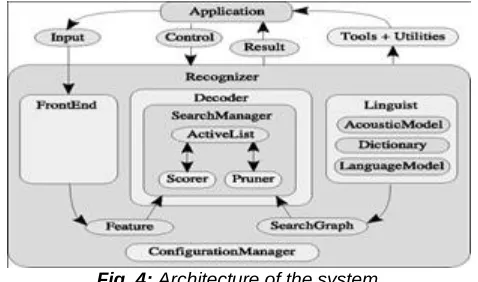
Fig. 4: Architecture of the system.
In Figure 4 the architecture is basically divided into three primary modules in the Sphinx-4 framework those are Front End, Decoder, and Linguist.
Front End
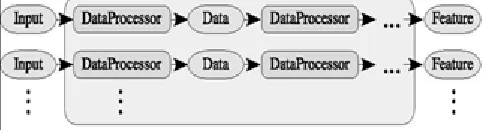
3013 Fig. 5: Architecture of Front End.
According to Figure 5, the front end contains one or more parallel chains with communicating signal processing module is known as Data Processors. Simultaneous computations are done by the different parameters from the input signals with the help of multiple chains and also decode is also done by parameters such as PLP, MFCC, and also through video. In Front End framework, Data Processors implements signal processing techniques includes: Reading from a variety of input formats for batch mode operation means run file automatically with no interface. Reading from the system audio input device for live mode operation like microphone is essential. Pre emphasis and windowing with a raised cosine transform (e.g., Hamming and Hanning windows). It also contains discrete Fouri- er transform (via FFT), mel frequency filtering, bark frequency warping, discrete cosine transforms (DCT), linear predictive encoding (LPC), end pointing, cepstral mean normalization (CMN), mel-cepstra frequency coefficient extraction (MFCC) and perceptual linear prediction coefficient extraction (PLP).
Configuration Manager
Configuration manager system has two primary purposes: Which components are to be used in the system and determining the detailed configuration of each of these components. Configu- ration file is used to configure in sphinx4. Configuration file maintain the Information of each component. The component connections mean how each component is con- nected to other one. The detailing configuration on each compo- nent.
Linguist
Linguist [12] is used to represent and manage the search space by decoder and it also generates the search graph and it can hide the complexities which are involved in graph during the generating graph. Linguist consists three components those are language model which is used to create language structure, Dictionary is used by linguist for better pronunciation, mapping the words into sequence of Acoustic Model elements. The main intension of the- se components for constructing the search graph.
Language Model:
This module produces word level language structure. It can be represented in form of plugins. These are two ways stochastic N- gram model and graph-driven grammar where stochastic N-gram model performs probability for words and observe the previous (n-
1) words. Where N-gram model represents as direct graph where each node represents as word each arc represents probability of word transition.
Language model consists of different formats such as simple word list grammar (grammar which is in form of list of words). Java Audio data API Grammar: It defines a
Backus-Naur Form style, works at any platform, works with any vendor.
Language Model grammar: This Grammar is based on statistical language model. It generates each grammar node for one word and it works effectively with single or double items in n-gram of up to approximately 1000 words. Finite State Transducer grammar: This grammar supports finite state transducer in ARPA format.
Example: I 5
F 0 4.30259
T 0 5 plank 2.60951 Explanation:
I - initial node, so "I 5" where 5 is the initial node.
F - final node, e.g., "F 0 4.30259" 0 is indicates final node and the probability at node 0 is 4.30259 (in -ln).
T - transition, "T 0 5 plank plank 2.60951" means "transitioning from node 0 to node 5, the output is plank and the machine is now in the node plank, and the probability associated with the transition is 2.60951 (in -ln)".
• SimpleNGramModel: This model is based on ASCII N-Gram models in the ARPA format. This model is satisfying no optimizes memory usage, so it is used for small files
• Large Trigram Model: This model is based on N-Gram models by the CMU Cambridge Statistical Language Modeling Toolkit. This model optimizes memory storage, it used for large files of
>=100MB.
Dictionary
Dictionary is useful for word pronunciations in the language mod- el. It breakdown word into sequence of sub words and it also al- lows word classification, to be in single word in multiple classes. Sphinx-4 provides interface of Dictionary to support the CMU Pronouncing Dictionary.
Acoustic Model
Acoustic model provides mapping between MM and audio data in form of unit. We all know that Linguist divides word into se- quence of sub words in form of units then pass these units to acoustic model and may retrieve MM graphs which are associat- ed to those units these are performed to construct the search graph. This MM graphs are directed graph in this each node represents MM state and each arc represent transition probability from one state to another state in MM. By using MM acoustic can easily have supplied in various topologies. It can share various compo- nents at every level component such as transition matrices, Gauss- ian mixtures, mixture weights.
Decoder
This is main recognition part where considering features from front End and using search graph which are conjunct by linguist to generate main result. The decoder block consists of a pluggable "search manager" and Search manager contains sub-components like Active List, scorer, pruner for simplifying the process. In decoder block search manager is main component.
Search manager
is belonging to non- emitted one. Search manager is not fixed to any implementations like linguist module. It follows token-passing algorithm.
i. Active List: It contains set of active tokens depend on time. These tokens are to be sorted in form of list. ii. Pruner: The main function of pruner is that collecting garbage in java. It removes the unwanted terminal token's path from Ac- tivelist. Also, it identifies unshared tokens which is not used, al- lows the garbage collector to recover the associated Memory.
iii. Scorer: It is used to access the features depend on time. By using the mathematical calculations for computing the scorer.
4.
IMPLEMENTATION
Algorithm:
Input: Audio data from microphones Output: text file Step 1: Speak some word/phrases in microphones.
Step 2: Sphinx4 tool detects the audio data and recognizes the words/phrases.
Step 3: Get the output in form of text.
Step 4: Comparing the words/phrases whether it is exact word or not.
Step 5: If it generates exact words then save this text as text file. Step 6: Else go to Step 2.
Process:
First create a java project. Import Sphinx4-core.jar and Sphinx4- data.jar files in this project. Add grammar file with ". gram" ex- tension it contains words, phrases and sentences. Add Sphinx4- core-1.00-javadoc jar file in library. Then create configuration object in main class, it contains Acoustic model, Dictionary, Lan- guage model. In Live Audio data Recognition we will use grammar file instead of Language model. Create Live Audio data Recognizer object to recognize the audio data. Pass in configuration object. Nowrecognition process has started by using start Recognition() meth- od. For audio data analysis we use get Hypothesis() method. Get an output in form of text file. Figure 6 represents the process of creating an object which is named as "Configuration" and how it passes to the recognizer. The created configuration object used for creating and importing the required files.
Fig. 6: Creating Configuration object.
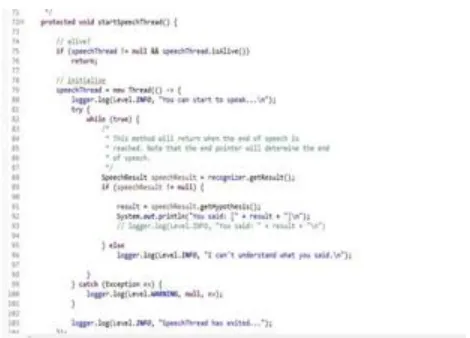
After creating a configuration object, the recognition process in Figure 7 was started. This process is useful to take our audio data through micro phone and then start the processes.
Fig. 7: Live Audio data Recognition.
Figure 8 represents get Hypothesis() method in audio data Result object for checking that what type of audio data is giving by the user. This method uses the recognizer to display the accurate result to the user.
Fig. 8: GetHypothesis() method in Audio dataResult object.
Fig. 9: Save output from console to text file.
3015 English, India-English, Hindi, etc. It is helpful to identify the
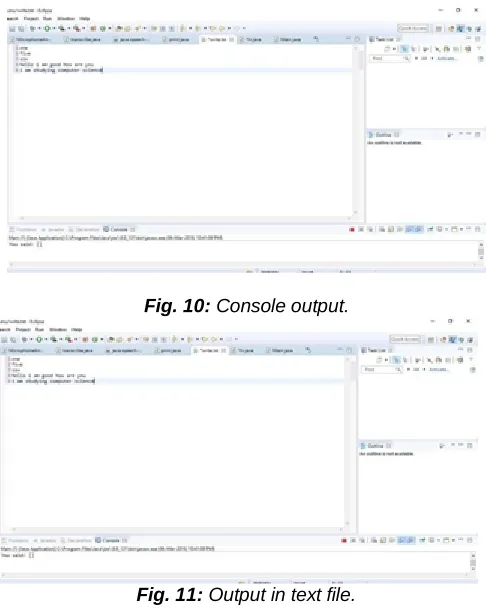
spokes peoples, maintaining dictionary having large vocabulary. The main idea of this paper is to convert audio data to text with more accuracy So we are trying to improve our code or will use another method for getting better result. The output is generated in both console and text file where, Fig- ure 10 represents the output in console and Figure 11 represents the output which is generated in text file.
Fig. 10: Console output.
Fig. 11: Output in text file.
5.
CONCLUSION
In this paper we proposed to convert call data into text files. So, there is no need to store recorded files by this we can reduce the space, no need to provide any security for recorded files, reduces the cost and time. Here for converting audio data to text we are using sphinx4 library It is used in java platform where it is easy to understand. Sphinx4 supports so many languages like US English, India-English, Hindi, etc. It is helpful to identify the spokes peoples, maintaining dictionary having large vocabulary. The main idea of this paper is to convert audio data to text with more accuracy So we are trying to improve our code or will use another method for getting better result.
REFERENCES
[1] https://en.wikipedia.org/wiki/Audio data.
[2] https://en.wikipedia.org/wiki/Audio data_recognition. [3] http://searchcrm.techtarget.com/definition/audio
data-recognition.
[4] https://en.wikipedia.org/wiki/Voice_analysis. [5]
http://whatis.techtarget.com/definition/voice-authentication.
[6] Betul Karakus, Galip Aydin, "Call center performance
Evaluation Using Big Data
Analytics",ISNCC,IEEEXplore,2016.
[7] J.P.Shim , J.Koh , S.Fister , H.Y.Seo, " Phonetic Analytics Tech- nology and Big Data: Real-World Cases", Communication of ACM, (2016).
[8] Willie Walker, Paul Lamere, Philip Kwok, Bhiksha Raj, Rita Singh, Evandro Gouvea, Peter Wolf, Joe Woelfel, "Sphinx-4: “A flexible open source framework for audio data recognition", (2004).
[9]http://citeseerx.ist.psu.edu/viewdoc/download?doi=10.1.1 .119.4395 &rep=rep1&type=pdf.
[10] Saptarshi Boruah, Subhash Basishtha, "A study on MM based audio data recognition system", IEEE Xplore, (2013).
[11]http://www.gavo.t.utokyo.ac.jp/~kuenishi/java/sphinx4/e du/cmu/sp hinx/frontend/FrontEnd html.