“Cheryl” Information Technology As A Media To
Enhance Competitive Advantages In E-Commerce
Whedy Prasetyo, Kartika, Rochman Effendi, Indah Purnamawati, Resha Dwi Ayu Pangesti Mulyono
Abstract: “CHERYL” is the use of technology aimed to guarantee the smooth-run of businesses for Small and Medium Enterprises (SMEs). This research applied “CHERYL” information technology to create competitive advantages for an SME, namely Kopi Makmur based on the utilization of e-commerce technology. The utilization of e-e-commerce technology in Kopi Makmur was studied through qualitative method with case study in system application. The study was conducted by direct observation and in-depth interviews. The results showed that Computer-Based Information System (CBIS) contained problem solving data. “CHERYL” work sequence provided the identification of relationship between the system implementation, from start to finish, with the conditions encountered. This study used problem-oriented approach based on the system. This orientation produced efficiency, precision, convenience, as well as benefit of e-commerce information that was needed to achieve competitive advantages.
Index Terms: “CHERYL” information technology, problem-oriented approach, e-commerce, competitive advantage —————————— ——————————
1.
INTRODUCTION
THIS study was inspired by SMEs problem in utilizing technology to support the success of their activities and by daily opinion of Kompas (Indonesian national newspaper) on May 7, 2015 and January 11, 2018 which stated that the role of financial analysis in human life was changing. The financial arithmetic skills required in today’s life are different from those of previous centuries with the availability of accurate and fast computers in calculating a series of sums or complex analytical operations. Therefore, financial calculation skills in the present era are expected to prioritize problem solving and reasoning skills rather than calculation and formula. The above message is well illustrated through the “Cheryl” problem that went in viral in cyberspace within weeks of 2015 & 2018. “Cheryl” is an effort to utilize technology in achieving competitive advantages. Here is the story of “CHERYL” related to e-commerce business. Albert and Bernard had just become friends with Cheryl and they wanted to know the progress of the business she was doing and across the country. Cheryl then provided business choice with computer or manual calculation, needed time more than 24 hours, and could identify whether the business was known by public or not, or whether the business was creative, innovative, accurate, effective and economical or otherwise. The four questions were used to establish the resulting product. Therefore, Albert and Bernard knew that technology was needed in establishing business success. Thus, will they ignore the use of technology in business environment? Advances in information technology make it even easier to access information anywhere on the internet. One of the influential media in the internet era is online sale, which make transactions and saving costs easier than ever. In addition, online sale acts as an effective promotional media for local products because the media itself is widely accessed by the public as long as they are connected to the internet. The development of information technology causes the role changes from manual to digital role. The role of information technology systems concist of
efficient, effective, economical to strategic role. Because of its strategic role, the information technology system is called a strategic weapon (competitive weapon) that is capable of being used as a powerful tool to compete in business field (Ward and Joe, 2002; Jogiyanto, 2006; Al Fatta, 2007). The reason is because of the competitive advantages as cited by Hariadi (2003), can be obtained from a better company position compared to its competitors. SMEs can get competitive advantages if the selected strategies can be implemented and executed properly. One effective way to implement and execute a strategy is to use information technology systems (Hidayati and Winarno, 2015; Sulistyorini, Royanti and Yunianto, 2015).
Further, according to Dewanti, Ina and Simbolon (2013); Sulistyorini, Royanti and Yunianto (2015); Hidayati and Winarno (2015), information technology (IT) is an interconnected system that has a management control so that it can have centralized authority and function to produce information. In forming the system, IT consists of Hardware, Software, information, data, applications, communication and human that serves to create information. Basically, it consists of conditions that can support the development of micro-small and medium enterprises in Indonesia. The above statement is in line with Utami and Triyono (2013), Sakdiyah (2016), as well as Acemoglu, et.al (2016) on the use of technology in business. They claim that the use of technology for online business in small and medium enterprises is the ultimate solution to simplify the planning, implementation and control of the organization. This ease of information of outsiders and trust is the key in utilizing online technology systems. Utilization of social media means ("e") is one of the online media that many visitors and many users find as a useful marketing medium of all products, which makes services in the current era is not a new problem, because one of the purposes of media usage is a source of business information that is widely used by the community, either from the bottom to top of hierarchy (Sakdiyah, 2016; Grazzi, Jacoby and Treibich, 2016). The explanation above explains the formulation and purpose of this study, namely how to show the realism of harmonious imagination of “CHERYL” message in the business success through the use of e-commerce for Small and Medium Enterprises “W” in Malang. The use of information technology (e-commerce) is to provide success and accuracy in developing products. As explained by Wati (2013), Wiyani and Prabowo (2013) and Sulistyorini, Royanti and Yunianto (2015), e-commerce is a business done with ————————————————
1511 electronic media and also social media, technology that serves
to market goods and advertise goods more easily and with a great cost. Technological advances can also encourage local products to be accepted at national and international markets. The use of technology provides analytical skills for inductive reasoning and Imagery Intelligence (or image intelligence), how problems and information known to be formulated systematically need creativity (Prasetyo, 2004). Furthermore, the problem sends a message that advanced language proficiency such as understanding text which is absolutely required in the endeavor. Maybe we have difficulties in using the technology precisely because of the ability to understand the text is lacking. In fact, language proficiency and true reason is closely linked with the utilization of Information System and Information Technology Strategy in achieving competitive advantages.
2 LITERATURE REVIEW
2.1 Information System Strategy
“CHERYL” is the use of technology aimed to guarantee the smooth-run of businesses for Small and Medium Enterprises (SMEs). According to Jogiyanto (2015), he stated that nowadays, the community must have 80% of business knowledge and interact (oriented to) with humans in emphasizing competition and 20% of technical knowledge in using the technology. The application of IS and IT can be utilized optimally through an IS/IT strategy that aligns with the company’s business strategy (Al Fatta, 2007; Wedhasmara, 2014). Optimal utilization is required for the investments incurred for IS/IT to meet company needs and provide measurable benefits in achieving organizational goals and objectives (Madnick, and Wang, 2008). Furthermore, Jogiyanto (2015) and Huiban, et.al (2018) distinguished between IS and IT strategy. IS strategy is used to answer “what?” question, which emphasizes the application of information systems required by the organization. While the IT strategy is used to answer “how?” question, which put more emphasis on the selection of technology, infrastructure, and special skills. For example, an organization implementing Executive Information System in the marketing field will affect the vertical flow of information within the company. The upper management has greater access to information and reduces the dependence of information resources on middle management. Telecommunication networks as information technology applications allow information to flow easily and quickly between different departments and divisions. Figure 1 below shows the relationship between IT strategy, IS strategy and business strategy.
Figure 1 - The relationship between IS, IT and business strategies
Source: (Ward dan Joe, 2002)
The picture above shows that business strategy, IS strategy and IT strategy are interrelated. Business strategy is determined by company management to achieve business objectives which then determine the things needed with IS strategy in business achievement of business goals. Then to be able to meet these needs, IT strategy is formulated.
In determining the IS/IT strategy in the effort of achieving the vision and mission of the organization, it is necessary to understand the organization’s business strategy. The understanding includes an explanation of why a business is run, what are the business objectives and where will the business direction be, when will the goal be achieved, how to achieve goals and whether there are changes that must be done. Therefore, in building an IS/IT strategy, we must be able to align the IS/IT strategy with the organization’s business strategy (Wedhasmara, 2014).
2.2 Information System and Information Technology Strategy Planning
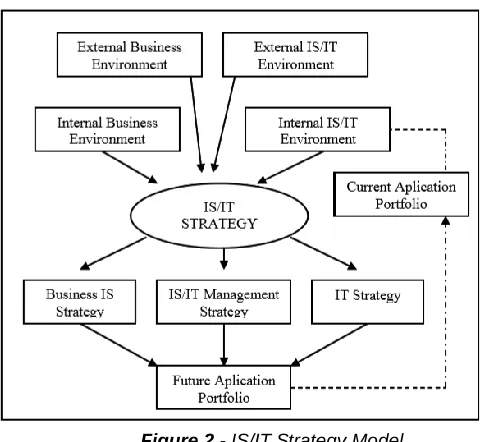
The plan provides competence capabilities that can make it a unique power and resource. This competence as stated by Hariadi (2003) and Jogiyanto (2006) and Huiban, et.al (2018) is directed to gain a competitive advantage. Excellence is based on key success factors on important indicators of competitive ability and competitive advantage. Both of these conditions are based on the potential of using information technology systems. In addition, the strategic planning of IS/IT also explains various tools, techniques, and frameworks for management to align IS/IT strategies with business strategy, even seeking new opportunities through innovative technology (Ward and Joe, 2002). Ward and Joe (2002) explain the IS/IT strategic planning through a scheme below.
Figure 2 - IS/IT Strategy Model
The figure above shows the IS/IT strategy of an organization is influenced by business external environment, IS/IT external environment, business internal environment, IS/IT internal environment . Then these environmental factors are used as a source in determining strategies related to IS business strategy, IS/IT management strategy and IT strategy. These three strategies produce future portfolio applications that will be used by organizations that are then compared to portfolio applications currently applied in organizations or companies. IS/IT strategy applied by the company according to Jogiyanto (2015) is expected to improve company performance, so that the company’s competitive advantage can also be improved. If applied optimally, IS and IT can be used as one tool to achieve these two things that can facilitate the business achievement of company objectives.
3 METHOD
This qualitative research was a case study in order to show the realistic model of harmonious imagination of the “CHERYL” message in the business success through the use of e-commerce for technology optimization to support the success of Small and Medium Enterprises (SMEs), specifically SME named Kopi Makmur in Banyuwangi Regency in carrying out its business. Kopi Makmur have not been optimal in utilizing technology as a medium of production, marketing and advertising media in order to spur the development of local products for Banyuwangi coffee in order to encourage regional
progress and the economy of the community. The use of information technology (e-commerce) gave a room for the SME to gain competitive advantage. The study was conducted by direct observation and in-depth interviews (Creswell, 2007, 2015; Bungin, 2010; Basrowi and Soenyono 2004). Direct observation was done in the implementation of the use of information technology. Furthermore, the interview was conducted with Mr. Suwandi and Mr. Riyanto as the business owners. Interview was conducted to reveal the utilization and problems in the implementation of such technology. These observations and interviews presented an intimate atmosphere and answers spontaneously, which gave a “unique” value and is very valuable for this research. The interview took place over three months, namely from July 20 to October 22, 2018.
4 RESULTS
AND
DISCUSSION
The application of strategic information technology system ensures the sustainability of business competitive advantage (Jogiyanto, 2006). Utilization of Information System in the business as stated by business owner of Kopi Makmur, namely Mr. Suwandi is stated below: Tak bisa dipungkiri lagi Mas...online itu membuat berbagai kemudahan dalam berusaha. Mau gak mau saya harus melek1 dan ikut menyadari lho...lah gimana eranya memang harus seperti ini maka usaha pun juga begini. [It can’t be denied that...online technology makes everything easier, especially in running a business. I have no choice but to be aware (with the online technology) and to realize that business should folllow and be developed according to the development of technology.] The above statement is in line with the explanation of Martin et.al (2015) and King and Teo (2001), who stated that the usefulness of information technology is a level in which a person believes, that the use of a particular subject, in this case information technology, provides benefits expected by users of information technology in carrying out its duties, and will be able to improve the performance of the person’s work. Measurement of the benefits of information technology is based on the frequency of use and the diversity of applications in operation. In this research, it was mentioned that individuals will use information technology if they already know the positive benefits gained when using it. From the definition, it can be concluded that the use of information systems can trigger or create competence for people who use it in business competition. Moreover, Zhang, Changqing, and Qian (2012), Hidayati and Winarno (2015), and Muskanan (2014) explain the interest in utilizing information systems as an expression of one’s desire to utilize sustainable information systems. Conditions are based on the assumption that individuals have access to information, which is influenced by social factors, perceived consequences, and effect. Interest in the use of information systems developed from the model of Unified Theory of Planned Behavior (UTAUT), which is influenced by several factors such as performance expectations, business expectations, social factors and facilitating conditions. In UTAUT, interest is a function of two basic determinants, namely subjective attitudes and norms. From the statement of Mr. Suwandi and some opinions of experts who have been stated above, it can be concluded that the benefits of information technology is a level where the use of a subject, meaning that information technology can help or improve
1513 performance for those who use it. Interest in the use of
information technology can arise from a sense of wanting to appear in a person. This sense to utilize information technology is triggered by several factors, among which are performance expectations, business expectations, social factors and facilitating conditions, feelings, and perceived consequences. Therefore, with the development of the era, the use of “CHERYL” information technology needs to be considered because it can create competence for individuals who want to use, apply, and develop it.
4.1. Managing Information System to Achieve Competitive Advantages
Indrayani (2011) and Jogiyanto (2015), and Acemoglu, et.al (2016) explained that the information system is collected from various data that is managed and processed as automatic as possible and is adequate with tools and methods. This process produces the necessary information and provides maximum benefits for the implementation of business activities. In an organization, the application of information systems within an organization is intended to provide information support from various levels of management. In this era, the information system developed is focused on electronic based information systems. This condition refers to the explanation of the dialog below: Whedy : Membuat dan memanfaatkan media online menjadikan mudah atau menjadikan keruwetan? [In your opinion, does creating and utilizing online media give you advantage like making everything easier or give you disadvantage like making everything more complex than before?] Suwandi : Memang kalau kasat mata semakin canggih karena memakai elektronik dan cepat namun tidak ruwet kalau melek teknologi. [In plain view, creating and using online media can be seen as something that is more sophisticated because it utilizes electronic technology and is very fast. Moreover, I personally think that it is not complex at all, especially for people who is aware with technology.] Whedy : mulai dari merencanakan sampai membayangkan keberhasilan bisa ya Pak...ha...ha...[Do you think that technology can be used for planning your business until imagining your success, Sir? ha...ha...] Riyanto : iso...ae Pak Whedy ini lha...gimana Mas saya mampu menata usaha sampai menjual dan memasarkan bahkan memenuhi keinginan pelanggan secara tepat. Gerak ini yang membuat usaha tepat sasaran seperti panah. [Well, I am able to organize business to sell and market the products, and even meet the customer’s expectation appropriately, I think technology contributes to this success. Technology makes the business targeting the right goal like an arrow.] Kartika : membuat Hp dan komputer jadi sahabat usaha yang tahu...Bapak mau kan. [Technology makes smartphones and computers seem like business friends who know about... what Mr. Suwandi wants, is that right?] Suwandi : iya...benar Ibu bagaimana saya mampu mengoperasikan pelayanan yang tepat dengan mengurangi protes pelanggan dan kehilangan. Jadi usaha mudah untuk dimonitor dan dilihat kurangnya apa...namanya...evaluasi ya Mas. [Yes, that’s right. Technology helps me to provide appropriate services to customers and reduce the number of complaints from the customers] Resha : Iya...Pak Wandi semakin up to date lho. [Yes...I think Mr. Wandi is more up to date with technology now.] Suwandi : up to date usaha dan memanfaatkan teknologi yang mau tak mau harus mau dan dilakukan...wis beda erane usaha bersama teknologi Hp, jadi cepet dan tepat.
line with Mr. Suwandi’s statement below: Komputer yang digunakan hanya merupakan alat untuk menjalankan mekanisme kemudahaan dalam bekerja lho. Usaha yang dijalankan ini membutuhkan data yang bersumber dari apa yang menjadi masalah dalam upaya mencapai kemudahaan. Kemudahaan yang didapatkan dari keinginan saya untuk memudahkan saja. Sekali lagi Mas...ini hanya cocok untuk usaha saya tidak untuk yang lain. [The computer used is only a tool to run the convenience mechanism at work. This business requires data that comes from what becomes a problem in an effort to seek a convenience. The convenience is gained from my desire to make everything simple and easy. Again... this is only suitable for my business, not for others.] The mechanism of the above statement shows that the use of information technology is based on business needs. This condition indicates that CBIS in “CHERYL” contains data from the completed issue. The basic problem is a system approach that is oriented to the problem. Such a problem approach requires an understanding of efficiency, accuracy and convenience as well as the usefulness of information needed in the search for problem solving based on conceptual design of a predefined database because this achievement provides conceptual efficient thinking in the development of database design that contains records of business problem solving. Issues in “CHERYL” are tailored to the database capabilities within the created DBMS framework.
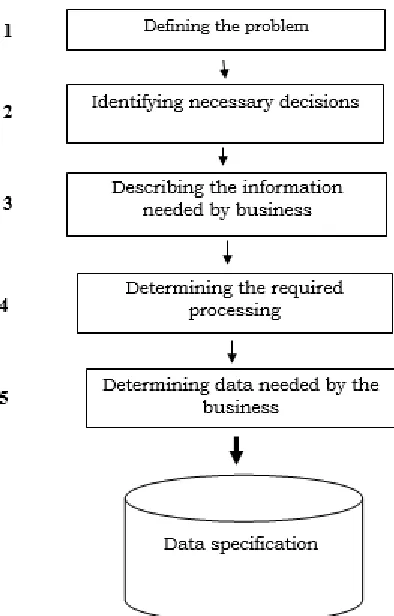
The “CHERYL” database provides data collection of all business documents and services in digital form. Implementation through the application of data that leads to the on-line system, i.e. the data captured is directly inserted into the information technology system. This is as stated by Mr. Suwandi below: Konteks data itu Mas...yang berarti memasukkan data ke sistem on line, misalnya pengendalian persediaan dan penjadwalan produksi sebagai masalah yang dihadapi maka saya...yang harus menggunakan bahasa program untuk mengimplementasikan dan mengoperasikan aplikasi akuntansi dan operasionalnya. Era...informasi akuntansi dan operasional dalam pengambilan keputusan. Oleh karena itulah...pelatihan dan pendampingan seperti ini membuat pemasukan data usaha dapat lebih mudah. Dukungan memasukkan data menjadi penting di samping melek pengetahuan teknologi informasi...ha...ha...ha. [Data context means entering the data into the online system, such as inventory control and production scheduling as a problem that I face. The data must use the program language to implement and operate the accounting and operational applications. Now is the era of accounting and operational information in decision making. Therefore, training and mentoring like this makes the entry of business data easier. Support for entering data is important in addition to the knowledge literacy of information technology ... ha ... ha ... ha.] Mr. Suwandi’s review and statement to utilize the data in “CHERYL” CBIS gives effort based on problem orientation. The problem-oriented approach can be illustrated below:
Figure 3 - “CHERYL” in Problem-Oriented Approach
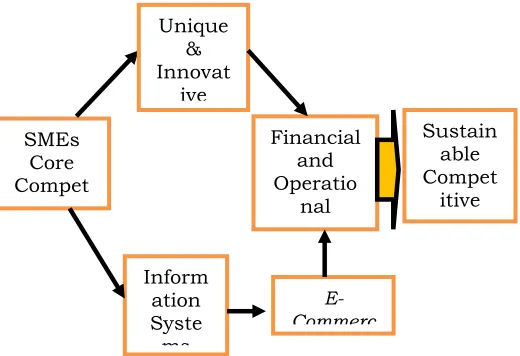
1515 Figure 4 - “CHERYL” Information Technology As
A Media To Enhance Competitive Advantages in E-Commerce
4.2. Ilustration of “CHERYL” Implementation
4
CONCLUSION
The utilization of “CHERYL” information technology gives awareness to Kopi Makmur in using e-commerce technology to develop its business. This technology is based on the condition of the problems encountered. The goal is to provide the ability to use the appropriate Computer-Based Information System (CBIS). This ability provided integration between innovation, creativity and e-commerce information systems for core business competencies. The core business competencies includecompetitive advantage over efficiency, accuracy and convenience and the usefulness of information needed to solve problems. In achieving the competitive advantages, it can be done based on conceptual database design that have been determined to face competition.
6.
REFERENCES
[1] Acemoglu, D., Akeigit, U., Hanley, D., & Kerr, W. (2016). Transition to Clean Technology. J Political Econ, 124(1), 52-104.
[2] Ackerberg, D. A., Caves, K., & Frazer, G. (2015). Identification Properties of Recent Production Function Estimators. Econometrica, 83(6), 2411-2451.
[3] Al Fatta, H. (2007). Analisis dan Perancangan Sistem Informasi untuk keunggulan bersaing perusahaan dan organisasi modern. Yogyakarta: Penerbit Andi.
[4] Basrowi, M., & Soenyono. (2004). Teori Sosiologi Dalam Tiga Paradigma. Surabaya: Penerbit Yayasan Kampusina. [5] Bungin, B. (2010). Analisis Data Penelitian Kualitatif: Pemahaman Filosofis dan Metodologis ke Arah Penguasaan Model Aplikasi. Jakarta: PT Raja Grafindo Persada. Jakarta.
[6] Creswell, J. W. (2007). Qualitative Inquiry and Research Design: Choosing Among Five Approaches. California: SAGE Publications, Inc.
[7] Creswell, J. W. (2015). Qualitative Inquiry and Research Design: Choosing Among Five Approaches. Translated by Lazuardi, A. L. Yogyakarta: Penerbit Pustaka Pelajar. [8] Dewanti, R., Ina, M., & Simbolon, F. (2013).
Pengembangan Model Daya Saing UMKM Batik Melalui ECS. Jurnal Binus Business Review, 4(1), 41-57.
[9] Grazzi, M., Jacoby, N., & Treibich, T. (2016). Dynamics of Investment and Firm Performance: Comparative Evidence From Manufacturing Industries. Empirical Economics, 51(1), 125-179.
[10]Hall, J. A. (2012). Accounting Information Systems. California: South-Western College Publishing.
[11]Hariadi, B. (2003). Strategi Manajemen: Strategi Memenangkan Perang Bisnis. Malang: Penerbit Bayumedia Publishing.
[12]Hidayati, L. N., & Winarno, W. (2015). Peran perempuan dalam mengadopsi Teknologi Informasi dan mengembangkan usaha kecil menengah batik. HUMANIORA, 19(1).
[13]Hollanders, S., Anita, E. L., Denna., & Cherrington, J. O. (2014). Accounting Information Tecnology and Business Solutions. Boston: Irwin Mc.Graw Hill.
Financial and Operatio
nal Performa
nce
Sustain able Compet
itive Advant
ages Inform
ation Syste
ms
E-Commerc
e
SMEs Core Compet
encies
Unique & Innovat
ive Product
[14]Huiban, J. P., Mastromarco, C., Musolesi, A., & Simioni, M. (2018). Reconciling the Porter Hypothesis with the traditional paradigm about environmental regulation: a nonparametric approach. Jounal of Productivity Analysis, 50(3), 85-100.
[15]Indrayani, E. 2011. Pengelolaan Sistem Informasi Akademik Perguruan Tingi Berbasis Teknologi Informasi dan Komunikasi (TIK). Jurnal Penelitian Pendidikan, 12(1), 11-25.
[16]Jogiyanto, H. M. (2015). Sistem Informasi Strategik Untuk Keunggulan Kompetitif: Memenangkan Persaingan dengan Sistem Teknologi Informasi. Yogyakarta: Penerbit ANDI OFFSET.
[17]Jumaili, S. (2005). Kepercayaan terhadap teknologi sistem informasi baru dalam evaluasi kinerja individual. Kumpulan Materi Simposium Nasional Akuntansi VIII. Solo, 15-16.
[18]King, J., & Teo, C. (2001). Key Dimensions of Facilitators and Inhibitors for the Strategic Use of Information Tecnology. Journal of Management Information Systems, 12(4), 35-53.
[19]Madnick, S. E., & Wang, Y. R. (2008). Evolution towards Strategic Applications of Database through Composite Information Systems. Journal of Management Information System, 5-6.
[20]Martin., et.al. (2015). Manging Information Technology: What Managers Need to Know. New Jersey: Prentice Hall Inc.
[21]Muskanan, M. (2014). The Effectiveness of The Internal Controlling System Implementation in Fiscal Decentralization Application. ICAS, 181-193.
[22]Prasetyo, W. (2004). Model Data dan Desain Database Di Dalam Kerangka Database Management System. Paper. Disampaikan dalam diskusi peranan Sistem Informasi Akuntansi, Pascasarjana Ilmu Akuntansi Unibraw. Malang, 24 April.
[23]Romney, M. B., & Steinbart, P. J. (2015). Accounting Information Systems. New Jersey: Prentice Hall International Inc.
[24]Sakdiyah, H. (2016). Konstribusi Jaringan Sosial Facebook sebagai media komunikasi pemasaran bisnis online (studi pada facebook page batik madura). Wacana EQUILIBERIUM, 2(1),
[25]Sulistyorini, P., Royanti, N. I., & Yunianto, E. (2015). Pengaruh adopsi e-commerce terhadap keberhasilan usaha (studi kasus pedagang batik di pasar grosir setono). Jurnal Litbang Kota Pekalongan, 7(1), 103-121.
[26]Surendro, K. (2007). Pemanfaatan Enterprise Architecture Planning untuk Perencanaan Strategis Sistem Informasi. Jurnal Informatika, 8(1), 1-11.
[27]Utami, A. D., & Triyono, R. A. (2013). Pemanfaatan Blackberry Sebagai Sarana Komunikasi Dan Penjualan Batik Online Dengan Sistem Dropship Di Batik Solo 85. Speed-Sentra Penelitian Engineering dan Edukasi, 3(3). [28]Ward, J., & Joe, P. (2002). Strategic Planning for
Information System. England: John Wiley & Sons Ltd. [29]Wati, E. S. (2013). Pengaruh Persepsi Pengusaha Atas
Informasi Akuntansi Serta Penyelenggaraan Dan Penggunaan Informasi Akuntansi Terhadap Keberhasilan UMKM (Unpublished Thesis). Universitas Muhammadiyah Surakarta, Centre Java.
[30]Wedhasmara, A. (2014). Langkah-Langkah Perencanaan Strategis Sistem Informasi Dengan Menggunakan Metode
Ward and Peppard. Jurnal Sistem Informasi, 1(1),
[31]Wiyani, F., & Prabowo, N. A. (2013). Peningkatan Daya Saing Bisnis “Batik Kahuripan” Melalui Sistem Penjualan Berbasis E-Commerce. Seruni-Seminar Riset Unggulan Nasional Inoformatika dan Komputer.