61
Characterization, Combustion, Emission And
Performance Analysis Of Palm Stearin Biodiesel
On A Direct Injection Diesel Engine
Cijil B. John, Dr. S. Antony Raja
Abstract: The world’s demand on fossil fuel reserves is increasing rapidly and at the present rate of consumption, it is estimated that the world will soon be facing a severe energy crisis due to the exhaustion of fossil fuel resources. This paper is aimed at investigating the feasibility of using Palm Stearin Methyl Ester (PSME) as a fuel alternative for CI engines. The fatty acid profile of PSME was found using GCMS. Various blends of biodiesel were taken for experiments and their combustion, emission and performance characteristics of the engine were compared. The experiment was conducted on a Kirloskar TV1 VCR Engine at a standard Compression Ratio 17.5:1. The use of biodiesel blends reduces the frictional losses and thereby raises the engine’s mechanical efficiency. It is also evident that Palm Stearin biodiesel reduces Hydrocarbon (HC) and Carbon monoxide (CO) emissions. Thus, Palm Stearin biodiesel is found suitable for use as a possible fuel alternative to petro-diesel.
Index Terms: Biodiesel, Characterization, CI-Compression ignition, Combustion, Compression ratio, Emission, GC-MS, Palm Stearin Oil Methyl Ester, Performance
—————————— ——————————
1 INTRODUCTION
The understanding about the effects of using fossil fuel is increased nowadays and the rise in oil prices forces us to think about alternate renewable fuels. The renewable alternative fuel doesn’t cause much pollution because it can be obtained from environmental friendly resources. Since, CI engines have high fuel and thermal efficiency it could be used in transportation & agricultural sectors; several researches are carried out for exploring different fuels for CI engines and to diminish the pollution level emitted from CI engines [1]. Many researchers suggested biodiesel is the best alternative fuel due to its profitability, sustainability and eco-friendly nature [2]. Non-consumable Seed oil like Karanja, Neem, Pongamia, etc. can be utilized for producing biodiesel. High density, viscosity and low calorific value of these oils restrain from using them directly as a fuel in engines. To remove the glycerol component, transesterification process should be performed. Edible and non-edible vegetable oils are investigated widely based on the Performances, emissions and environmental aspects for biodiesel. Blends of Palm Stearin biodiesel can be fed to the diesel engine without any changes, which decreases the harmful emissions from the engines. The most promising alternative – biodiesel fuel, obtained from vegetable oils is considered and the experimental investigations demonstrate that the thermal and mechanical efficiencies of the engine using biodiesel were higher than those for normal diesel [3]. Methyl ester obtained from fish oil is investigated, which improves the combustion because of increased content of oxygen present in the fuel blend [4]. Transesterification process of neem oil is explained and their blends are found to illustrate higher BTE than diesel [5]. Turpentine oil has better viscosity and volatility than Jatropha oil methyl ester, so it’s blended with Jatropha biodiesel. The above blend is found to produce significantly low emissions [6]. The testing is conducted by blending of Petroleum diesel with
canola-safflower biodiesel and oxygenated fuel as an additive [7]. Due to minimal availability and need for transesterification process, the biodiesel extraction from vegetable/animal fat is considered as an issue [8]. Researches show that biodiesel from Lemon grass oil exhibit higher viscosity, lower cetane number and inferior heating values when compared to other biodiesels [9]. Biodiesels extracted from plant oils are more economical, which makes them potentially better alternatives to conventional diesel when used in an IC engine [10].
On a life cycle basis, Carbon-dioxide emissions could be reduced to 78% by the usage of biodiesel when compared to normal diesel [11]. CO2 emissions may get decreased by using biodiesel fuels because the biodiesel producing species (plants) ingests CO2 through photosynthesis. Better performance in the engines inclusive of low HC and CO emissions can be obtained when biodiesel is blended with pure diesel [12]. Investigations show different ranges of exhaust emissions for HC and CO with Rapeseed biodiesel fuel when compared to pure diesel; a 50% minimization in CO emissions for rapeseed fuel was reported [13]. It is agreed in many researches that non-edible sources make better feedstocks for biodiesel production than edible ones [14]. Palm stearin oil (PSO) is the non-consumable portion of palm oil. The raw material for producing the palm stearin methyl ester is widely accessible in Southeast Asia and India. Another vital point which is in favour of utilizing palm stearin biodiesel is that it does not make a debate between food and fuel. India being a developing nation cannot manage to prepare fuels from edible sources as it creates a conflict between food and fuel. Palm stearin biodiesel used in this study is obtained from non-edible oil sources. The viscosity of Palm Stearin Methyl Ester (PSME) is lesser when compared with palm biodiesel. In this paper, the behaviour of the test engine which includes its emission, performance & combustion characteristics are explored by utilizing diverse blends of PSME with diesel fuel.
2
MATERIALS
AND
METHODS
2.1 Transesterification of Palm Stearin Oil
Special attention has been given for biodiesel nowadays because it has vast environmental advantages and is manufactured from a renewable resource; hence the depletion ————————————————
Cijil B. John, Research Scholar, Department of Mechanical Engineering, Karunya Institute of Technology and Sciences, Coimbatore114, TN., E-mail: [email protected]
62
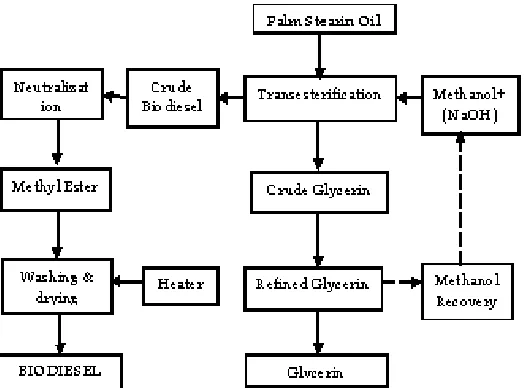
of this source is not nearby. Biodiesel produced by using transesterification method of natural oils and fats is the better choice when compared with other methods of manufacturing biodiesel because this process gives lesser viscosity. The transesterification procedure & glycerol recovery are two methods considered in terms of manufacturing cost. The manufacturing cost is lesser for the continuous transesterification process due to less reaction time and better capacity for production. The method of producing palm stearin biodiesel by adopting a transesterification process is described by [15]. The process of manufacturing Palm Stearin biodiesel (methyl ester) is explained in the flow chart given below.
Figure 1: Transesterification of Biodiesel from Palm Stearin Oil
The fatty acid content found in Palm Stearin oil is approximately around 8.5%; hence it needs to undergo transesterification procedure to convert palm stearin into palm stearin methyl ester (biodiesel). Transesterification was carried out with methanol and NaOH at a molar ratio (1:6). The methoxide solution along with palm stearin oil was transferred into a container and boiled up to 65deg C. When the reaction was completed; the products were permitted to settle down by 2 layers. The topmost layer which consists of methyl ester (biodiesel) was parted from the bottom layer which consists of glycerin. The excess methanol was removed and recovered by distilling the upper layer, followed by washing the methyl esters with hot water to remove the remaining traces of glycerin. Then, the final product was dehydrated for one hour in the stream of hot air. Finally, 76 ml of Palm Stearin biodiesel was obtained with 93.70% efficiency of transesterification process.
2.2 Biodiesel Characterization
The Fatty Acid Methyl Ester profile (FAME) of Palm Stearin methyl ester is discovered analytically by conducting GC-MS to identify the various constituents present in the fuel sample. The standard reference samples are analyzed to get the calibration curves of FAME existing in the palm stearin methyl ester. FAME’s is tested by GC-MS which is armed with higher energy collision persuaded dissociation related scanning unit, letting structural investigation. In Agilent 7673 auto liquid sampler, Gas Chromatography is performed in Agilent 6890 with the use of electronic pressure control. The identification of compounds is made by connecting with MS-Data Processing
Software. The Measurement of spectra is done in a mass range of 1 to 1000 m/z at 6000 resolution with extreme standardized mass (1500 Daltons). The lipid portion is re-suspended in n-hexane, which helps for silica gel column chromatography. The carotenoid portions are confined by aliphatic hydrocarbon through the column of fatty acid. Hydrocarbon fraction is sent through the lipid constituents in the hydrocarbon portion, which are determined by GC-MS. The section determining 1μl is auto-inserted into the system at 300deg. C by a split-less injector.
2.3 Preparation of fuel blend
Palm Stearin Methyl Ester (PSME) was blended with diesel in various proportions (10% to 50% by volume) for testing in engines. A distinct emulsifier is used to combine both diesel and PSME in molecular form. Following are the fuel blends used:
1. B10 –90% Diesel + 10% PSME 2. B20 –80% Diesel + 20% PSME 3. B30 -70% Diesel + 30% PSME 4. B40 –60% Diesel + 40% PSME 5. B50 –50% Diesel + 50% PSME 6. Normal Diesel
2.4 Fuel properties
Physio-chemical properties of Palm Stearin biodiesel compared with raw Palm Stearin oil and normal Diesel are shown in Table 1.
TABLE1
PHYSIO CHEMICAL PROPERTIES OF FUELS
Parameter Diesel
Palm Stearin Oil Palm Stearin Methyl Ester Method
Density@150C
(g/cc) 0.832 0.912 0.882 I.S:1448(PART-16) Kinematic
Viscosity@400C (cSt)
3.7 - 5.67 I.S:1448(PART-25)
Flash Point (0C) 60 290 65 I.S:1448(PART-21)
Fire Point (0
C) 65 300 75 I.S:1448(PART-21)
Cloud Point (0C) -12 38 22 I.S:1448(PART-10)
Pour Point (0
C) -16 32 9 I.S:1448(PART-10)
Iodine value by
Wiji’s method -- 48.68 47.06 I.S:548(PART-1) – 1964 Calculated Cetane
Index 42 - 49 38.24 47.53 ASTM D 976-91 Gross Calorific
Value (kcal/kg)
10,707.
45 8933 9244 I.S:1448(PART-6)
Sulphur Content
(%) 0.05 0.15 0.13 I.S:1448(PART-33)
Conradson Carbon
residue (%) -- 0.32 0.35
I.S:1448(PART-122)
Boiling Point (0C) 180 -
360 196 102 I.S:1448(PART-18)
3 EXPERIMENTAL
SETUP
63
facility for varying the compression ratio, injection pressure and EGR flow rates) coupled to a dynamometer (Eddy current type). It also has some essential components for combustion pressure, crank-angle, temperatures, air and fuel flow, load and temperature measurements. The transfer of signals can be achieved by the use of a data acquisition device which transfers high-speed data to the computer. The experimental setup comprises of stand-alone panel box which has a twin fuel reservoir, fuel measuring unit, pressure measuring manometer, transmitters, air box, piezo powering unit, and process indicator. For measuring purposes the devices such as calorimeter, Rotameters are used. Measurement of the diesel injection, which is computerized, has been provided which is optional. Fig.2 demonstrates the experimental setup taken for study and its configurations are tabulated in Table 2. Where,
T1 --> Inlet temperature of engine coolant T2 --> Outlet temperature of engine coolant T4 --> Outlet temperature of calorimeter coolant T5 --> Outlet temperature of engine exhaust gases T6 --> Outlet temperature of exhaust gases from calorimeter
Figure 2: Test Engine Setup
TABLE 2
ENGINE SPECIFICATIONS
Make & Model Kirloskar, TV1, Four Stroke, VCR, Multi fuel engine
Compression Ratio 12:1 to 18:1
No. of cylinder Single
Fuel Petrol/ Diesel
Rated Speed 1500 rpm
Rated Output 3.5kW
Starting Crank
Method of Cooling Water-cooled
Dynamometer Eddy Current
Stroke Length 110 mm
Cylinder diameter 87.5mm
4 RESULTS
AND
DISCUSSION
4.1 Gas Chromatography – Mass Spectrometry Analysis
GC-MS is utilized to classify the quantification of Fatty Acid Methyl Esters of Palm stearin biodiesel which is being explained in this study. Hydrocarbon combining is distinguished as < C15, C15-C20, C20 - C30 and > C30 regarding the retaining time of standard HC such as Arachidic acid methyl ester, Palmitic acid, margaric acid, Bovinic acid, myristic acid, Polymic acid, Palmitoleic acid, Methyl palmitoleate acid, Oleic acid. The examination proves that the
occurrence of 9 main fatty acids amid C15:0 and C21:0.
Figure 3: GC-MS Spectrum of Palm Stearin Biodiesel
Amongst the subsequent fatty acids, short chain HC amid C16:0 and C18:0 consist of a composition which is the main mass section. GC-MS Spectra of PSME biodiesel is displayed in Figure 3. The changes in various characteristics such as combustion, performance, and exhaust emission with output power are obtained graphically and conversed below.
4.2 PERFORMANCE ANALYSIS
The analysis of engine performance provides knowledge regarding the consumption of fuel by the diesel engine. The combustion analysis provides sufficient information on the phenomenon of combustion when the fuel-air blend is burnt in the cylinder.
4.2.1 Brake Thermal Efficiency (BTE)
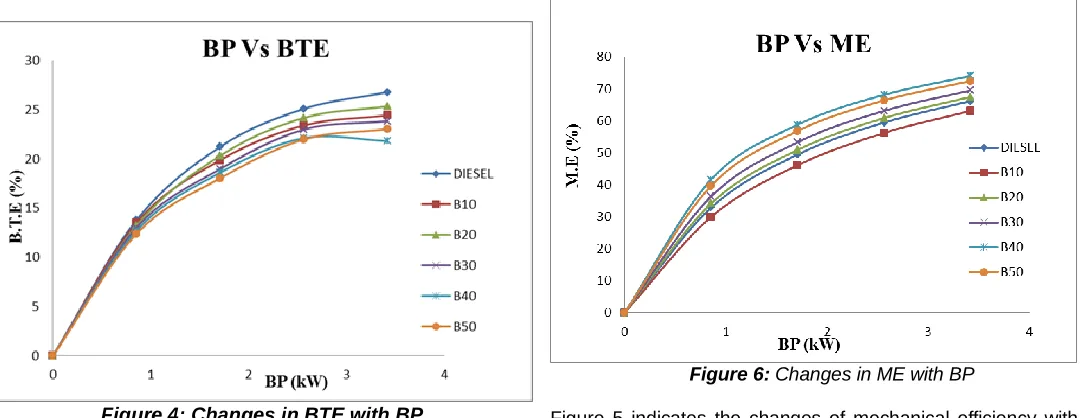
64 Figure 4: Changes in BTE with BP
4.2.2 Specific Fuel Consumption (SFC)
SFC indicates the quantity of fuel expended by the engine for delivering unit power output. Figure 5 visualizes the changes in SFC for diesel & different biodiesel blends with variation of output power.
Figure 5: Changes in SFC with BP
The SFC of an engine is inversely correlated to the output (brake) power produced. As load increases, the output (brake) power generated by the engine also increases to the rated value. Therefore, fuel usage is better and the fuel consumption rate is reduced drastically at 100% load. Diesel recorded the lowest Specific fuel Consumption of 0.30 kg/kWhr followed by B20 (0.326 kg/kWhr), B10 (0.333 kg/kWhr), B30 (0.351 kg/kWhr), B50 (0.374 kg/kWhr) & B40 (0.389 kg/kWhr). The reduced heating value of palm stearin methyl ester raises fuel consumption for biofuel blends and hence leads to an increase in SFC.
4.2.3 Mechanical Efficiency (M.E)
The ratio of brake power generated in an engine to the indicated power developed in the cylinder (by the combustion of fuel) is defined as mechanical efficiency.
Figure 6: Changes in ME with BP
Figure 5 indicates the changes of mechanical efficiency with different brake power for various blends of biodiesel & diesel. When the frictional power developed in an engine is less, higher mechanical efficiency is obtained. Biodiesel fuel has better lubricating features than normal diesel. Usage of biodiesel blends results in reduced frictional power (frictional losses) and thereby the engine’s M.E is improved. From the above graph, Blend 40 shows the greatest mechanical efficiency (74.02%) than diesel (66.15%).
4.3 EMISSION ANALYSIS
The emission study investigates the measurement of fuel impact by the IC engine on the atmosphere.
4.3.1 Carbon monoxide emissions (% vol.)
The CO emission with changes in output power for normal diesel and PSME blends are displayed in Figure 7. CO is formed from the incomplete process of oxidation/ combustion of the hydrocarbon fuel. During complete combustion, the carbon molecules present in the hydrocarbon fuel gets fully converted into CO2 through oxidation. The CO emission decreases with load, as visualized in the above figure. From the graph it is clear that at 100% engine load, the CO emissions of PSME B50 (0.18%), PSME B40 (0.20%), PSME B30 (0.21%), PSME B20 (0.23%), and PSME B10 (0.24%) are less when compared to Diesel (0.25%). The diminished CO emissions may be a result of the higher O2 content present in
65 Figure 7: CO Emissions with Brake power
4.3.2 Hydrocarbon emissions (ppm)
The emission (HC) of the diesel engine is based on the fuel concentration & its combustion characteristics. The HC emission level with brake power variation for pure diesel and PSME blends is displayed in Figure 8.
Figure 8: HC Emissions with Brake power
It is noticed that emission (HC) is decreased by 25ppm with biodiesel B40 blend at 100% load. On observing the graph, the blend B40 produces less HC emission than other blended fuels and diesel at full load. More complete combustion is obtained owing to the O2 existing in the PSME fuel blends.
4.3.3 NOx Emissions (ppm)
At extremely high temperatures developed during combustion, the nitrogen present in atmospheric air and the oxygen react together to form NOx emissions. NOx emissions can be a significant source of air pollution leading to global warming phenomenon. NOx emission from an engine is based on the concentration of O2, time taken for the combustion process and its temperature.
Figure 9: NOx Emissions with Brake power
The NOx emissions for diesel and PSME blends at different brake powers are demonstrated in Figure 9. Above figure proves the emission of nitrogen oxides is directly correlated to the proportion of biodiesel present in the fuel blends. The maximum emission of NOx is observed for biodiesel blend B50 (516ppm) and is minimum with diesel (414ppm) at full load. It can be observed that as the percentage of PSME in the fuel blend increases, the nitrogen oxide emissions from the CI engine also increases due to increased combustion rate leading to higher combustion temperatures.
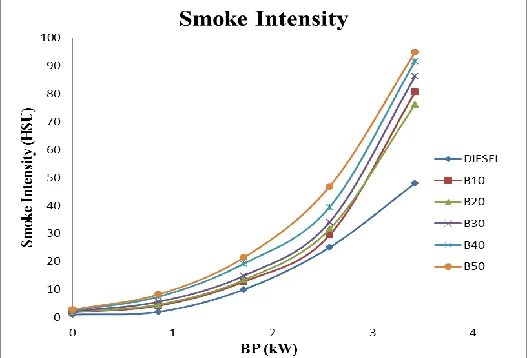
4.3.4 Smoke Intensity (Hatridge Smoke Units)
The smoke intensity for diesel and PSME blends are displayed in Fig. 10. The lowest smoke emissions are observed with diesel usage (48HSU) followed by PSOME B20 (76.20 HSU), B10 (80.60 HSU), B30 (86.20 HSU), B40 (91.60 HSU) and B50 (94.80 HSU). Smoke emissions from an engine mainly consist of solid particles of Carbon, often referred to as soot. When the combustion zone is not having sufficient oxygen molecules, the fuel oxidation will not be done properly and smoke will be formed in the exhaust. Even though PSME is an oxygenated fuel, poor fuel atomization resulting from increased viscosity of the PSME may be the cause for increased Smoke emissions as displayed in the above figure. All the tested blends show that the smoke emissions are proportional to the output power.
66 4.4 COMBUSTION CHARACTERISTICS
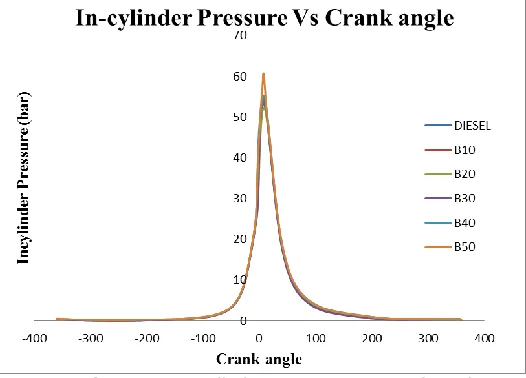
4.4.1 In-cylinder Pressure
Figure 11 displays the changes of in-cylinder pressure with CA for biodiesel blends as related to Diesel at 100% load. B50 recorded the highest cylinder pressure of 60.67 bar, followed by B40 (55.3 bar), B30 (54.66 bar), B10 (54.27 bar), Diesel (53.33 bar) and B20 (52.31bar) at 100% load.
Figure 11: In-cylinder Pressure vs. Crank angle
The biodiesel consists of more oxygen which causes the peak pressures to be much greater than that for normal diesel.
4.4.2 Heat Release Rate (HRR)
Figure 12 illustrates the changes of net HRR in accordance with CA at full load. The HRR are 43.46 J/deg.CA, 42.52 J/deg.CA, 41.77 J/deg.CA, 40.37 J/deg.CA, 37.11 J/deg.CA & 35.55 J/deg.CA for B20, B50, B40, B30, diesel & B10 respectively. PSME blend B20 recorded the highest value of net HRR. The HRR for biodiesels exceed that of Petro-Diesel by virtue of the increased O2 concentration of biodiesel that
supports more complete combustion.
Figure 12: Net Heat Release Rate vs. Crank angle
5
CONCLUSION
The investigation on diesel-PSME blends as the fuel in a Compression Ignition engine is being concluded. The following are the main findings of the study;
BTE is inversely proportional to the concentration level of biodiesel in the blends, and the BTE of B20 (25.35%) is quite comparable to diesel (26.79%). Diesel fuel provides the highest conversion efficiency of fuel energy into brake power.
SFC for diesel (0.30 kg/kWhr) is lower than the SFC for PSME biodiesel fuels at 100% (full) load conditions. PSME B20 fuel blend recorded the lowest SFC (0.325 kg/kWhr) among the biodiesel blends at the standard compression ratio (17.5:1).
For biodiesel fuels, the in-cylinder temperatures and pressures are comparatively greater because of enhanced combustion rates compared to petro-diesel. For the biodiesel blend B50, the peak pressure noticed is 60.67 bars at 10o aTDC.
Heat Release rates for PSME biodiesel blends exceeds the rates for petro-diesel due to enhanced combustion rates resulting from greater fuel oxygen content. The highest HRR was observed for B20 blend (43.46 J/deg.CA) at 80 bTDC.
The emission of CO and HC are significantly decreased by the use of PSME fuel blends. B50 recorded minimum CO emissions (0.185%) while B40 recorded the least HC emissions (51 ppm) at full load. Smoke and NOx emissions are directly proportional to concentration of PSME fuel blends. The lowest value of Smoke and NOx emissions were recorded by Petro-Diesel (414ppm and 48 HSU respectively). When Palm Stearin biodiesel blends are fed to CI
engines, the HC and CO emissions are decreased significantly while the combustion characteristics and performance characteristics are enhanced.
When certain emission control strategies like Exhaust Gas Recirculation (EGR) are employed, emissions of NOx from the engine could be reduced tremendously. The research work shall be conducted with more parameters like variation of compression ratio, injection pressure and timing, preheating of intake air and exhaust gas recirculation in future.
6.
ACKNOWLEDGMENT
The authors would like to acknowledge the services rendered by SAIF Lab, IITM for providing the GC-MS results, Italab Private Limited, Chennai for the fuel properties and Hindustan Institute of Technology and Science, Chennai for providing the engine test facilities.
7. REFERENCES
[1] Ng, Jo-Han, Hoon Kiat Ng, and Suyin Gan, "Advances in Biodiesel Fuel for Application in Compression Ignition Engines." Clean Technologies and Environmental Policy 12, no. 5: 459-493, 2010.
67
[3] Srithar, K., K. Arun Balasubramanian, V. Pavendan, and B. Ashok Kumar. "Experimental Investigations on Mixing of Two Biodiesels Blended with Diesel as Alternative Fuel for Diesel Engines", Journal of King Saud University-Engineering Sciences 29, no. 1: 50-56, 2017.
[4] Gharehghani, Ayatallah, Mostafa Mirsalim, and Reza Hosseini, "Effects of Waste Fish Oil Biodiesel on Diesel Engine Combustion Characteristics and Emission." Renewable Energy 101: 930-936, 2017.
[5] Jayashri N., Ajay Kumar Kaviti, and Arun Kumar Daram, "Analysis of Performance and Emission on Compression Ignition Engine fuelled with Blends of Neem Biodiesel." Egyptian Journal of Petroleum 26, no. 4: 927-931, 2017.
[6] Dubey, Pankaj, Rajesh Gupta, "Effects of Dual Bio-fuel (Jatropha biodiesel and Turpentine oil) on a Single Cylinder Naturally Aspirated Diesel Engine without EGR." Applied Thermal Engineering 115: 1137-1147, 2017.
[7] Alptekin, Ertan, "Emission, Injection and Combustion Characteristics of Biodiesel and Oxygenated Fuel Blends in a Common Rail Diesel Engine." Energy 119: 44-52., 2017. [8] Meher, L.C, D. Vidya Sagar, and S.N. Naik, "Technical Aspects
of Biodiesel Production by Transesterification—A Review." Renewable and Sustainable Energy Reviews 10, no. 3: 248-268, 2006.
[9] Sathiyamoorthi R. and G. Sankaranarayanan, "Effect of Antioxidant Additives on the Performance and Emission Characteristics of a DICI Engine using Neat Lemongrass Oil– Diesel Blend.", Fuel 174: 89-96, 2016.
[10]Murari Mohon Roy, Wilson Wang, and Justin Bujold, "Biodiesel Production and Comparison of Emissions of a DI Diesel Engine Fueled by Biodiesel–Diesel and Canola Oil–Diesel Blends at High Idling Operations." Applied Energy 106: 198-208, 2013. [11]Huynh L.H., N. S. Kasim, and Y. H. Ju, "Biodiesel Production
from Waste Oils‖. Biofuels: Alternative Feedstocks and Conversion Processes. 375-392., 2011.
[12]Veltman, Matthias K., Prashanth K. Karra, and Song-Charng Kong, ―Effects of Biodiesel Blends on Emissions in Low Temperature Diesel Combustion‖. No. 2009-01-0485. SAE Technical Paper, 2009.
[13]Krahl, Jürgen, Axel Munack, Olaf Schröder, Hendrik Stein, and Jürgen Bünger, "Influence of Biodiesel and Different Designed Diesel Fuels on the Exhaust Gas Emissions and Health Effects." SAE transactions: 2447-2455, 2003.
[14]Arjun B. Chetri, Martin S. Tango, Suzanne M. Budge, K. Chris Watts, and M. Rafiqul Islam, "Non-edible Plant Oils as New Sources for Biodiesel Production.", International Journal of Molecular Sciences 9, no. 2: 169-180, 2008.