Patterns of Comorbidity, Functioning, and Service Use
for US Children With ADHD, 2007
WHAT’S KNOWN ON THIS SUBJECT: Attention-deficit/
hyperactivity disorder (ADHD) is known to be associated with a range of mental health and neurodevelopmental comorbidities, but the pattern of these comorbidities and their relationship to child and family functioning and service use at the population level investigated has not been found in previous studies.
WHAT THIS STUDY ADDS: Two-thirds of US children with ADHD have comorbid conditions. Social and educational functioning declines with more comorbidities and cross-sector service use and need for care coordination increase. Management of ADHD should be tailored to each child’s neurodevelopmental profile.
abstract
OBJECTIVE:To determine patterns of comorbidity, functioning, and service use for US children with attention-deficit/hyperactivity disor-der (ADHD).
METHODS:Bivariate and multivariable cross-sectional analyses were conducted on data from the 2007 National Survey of Children’s Health on 61 779 children ages 6 to 17 years, including 5028 with ADHD.
RESULTS:Parent-reported diagnosed prevalence of ADHD was 8.2%. Children with ADHD were more likely to have other mental health and neurodevelopmental conditions. Parents reported that 46% of children with ADHD had a learning disability versus 5% without ADHD, 27% vs 2% had a conduct disorder, 18% vs 2% anxiety, 14% vs 1% depression, and 12% vs 3% speech problems (allP⬍.05). Most children with ADHD had at least 1 comorbid disorder: 33% had 1, 16% had 2, and 18% had 3 or more. The risk for having 3 or more comorbidities was 3.8 times higher for poor versus affluent children (30% vs 8%). Children with ADHD had higher odds of activity restriction (odds ratio: 4.14 [95% confidence interval: 3.34 –5.15]), school problems (odds ratio: 5.18 [95% confi-dence interval: 4.47– 6.01]), grade repetition, and poor parent-child communication, whereas social competence scores were lower and parent aggravation higher. Functioning declined in a stepwise fashion with increasing numbers of comorbidities, and use of health and edu-cational services and need for care coordination increased.
CONCLUSIONS:Clinical management of ADHD must address multiple co-morbid conditions and manage a range of adverse functional outcomes. Therapeutic approaches should be responsive to each child’s neurodevel-opmental profile, tailored to their unique social and family circumstances, and integrated with educational, mental health and social support ser-vices.Pediatrics2011;127:462–470
AUTHORS:Kandyce Larson, PhD,a,bShirley A. Russ, MD,
MPH,a,cRobert S. Kahn, MD, MPH,dand Neal Halfon, MD,
MPHa,b,e
aUCLA Center for Healthier Children, Families, and Communities,
Los Angeles, California;bDepartment of Pediatrics, David Geffen
School of Medicine, University of California, Los Angeles;
cDepartment of Academic Primary Care Pediatrics, Cedars-Sinai
Medical Center, Los Angeles, California;dDivision of General and
Community Pediatrics, Cincinnati Children’s Hospital Medical Center, University of Cincinnati College of Medicine, Cincinnati, Ohio; andeDepartment of Health Services, School of Public
Health, University of California, Los Angeles, California
KEY WORDS
ADHD, health outcomes, children
ABBREVIATIONS
ADHD—attention-deficit/hyperactivity disorder NSCH—National Survey of Children’s Health FPL—federal poverty level
CI—confidence interval OR—odds ratio
www.pediatrics.org/cgi/doi/10.1542/peds.2010-0165
doi:10.1542/peds.2010-0165
Accepted for publication Nov 24, 2010
Address correspondence to Kandyce Larson, PhD, UCLA Center for Healthier Children, Families, and Communities, 10990 Wilshire Blvd, Suite 900, Los Angeles, CA 90024. E-mail: [email protected]
PEDIATRICS (ISSN Numbers: Print, 0031-4005; Online, 1098-4275).
Copyright © 2011 by the American Academy of Pediatrics
FINANCIAL DISCLOSURE:The authors have indicated they have no financial relationships relevant to this article to disclose.
Attention-deficit/hyperactivity disor-der (ADHD) is 1 of the most common cognitive and behavioral disorders currently diagnosed in US children of school age,1with an estimated annual
societal cost of $34 billion to $52 bil-lion.2Children with ADHD have elevated
problems in many areas, including ac-ademic functioning and strained so-cial and family relationships.3,4Studies
also show that children with ADHD commonly exhibit additional mental health and neurodevelopmental co-morbidities, including learning disabil-ities,5–7epilepsy,8tic and
communica-tion disorders,9–11conduct disorder,4,12
anxiety,13,14and depression.15Presence
of comorbidities has, in turn, been as-sociated with poorer functioning in so-cial and educational domains.14,16–19
However, most existing studies of chil-dren with ADHD have been conducted on clinic-based or small-scale commu-nity samples that are not representa-tive of the general population of chil-dren in the US and do not use adequate samples to measure the effect of mul-tiple comorbidities.20
It is essential to understand patterns of comorbidity, functioning, and ser-vice use among children with ADHD so services can be designed to meet the population’s needs, and clinicians can be optimally responsive to patterns of illness they are likely to encounter in practice. Understanding the functional impact of ADHD also provides an indi-cation of how well the existing system of care is performing. This study uses data from the 2007 National Survey of Children’s Health (NSCH) to examine patterns of comorbidity, functioning, and service use for US children with ADHD. We chose comorbid conditions based on prior studies suggesting pos-sible associations with ADHD and mea-sures of function and service use that best encompassed health, education, and social domains. This is the first US population-based study to examine
as-sociations between ADHD and a com-prehensive set of comorbidities, and to address the relationship between mul-tiple comorbidities and functioning and service use. We hypothesized that comorbidities would be highly preva-lent among children with ADHD, and that each additional comorbidity would be associated with worse func-tioning and greater service use across health, educational, and social do-mains.
METHODS
Sample
The 2007 NSCH was conducted by the National Center for Health Statistics as a module of the State and Local Area Integrated Telephone Survey. The NSCH used a stratified random-digit-dial sampling design to achieve a nation-ally representative sample of 91 642 parents of children aged 0 to17. One child was randomly selected from each household, and a detailed tele-phone interview was conducted with the parent or guardian who knew the most about the child’s health and health care. Interviews of⬃30 min-utes were conducted in English and Spanish. The overall weighted re-sponse rate (American Association for Public Opinion Research rate 4) was 51.2%, assuming that telephone numbers that rang with no answer or were busy on all call attempts were nonresidential.
The study sample includes 64 076 chil-dren ages 6 to 17 from the NSCH. The sample was further restricted to in-clude only individuals with no missing data on the study covariates, except household income, which was multiply imputed by National Center for Health Statistics statisticians and applied to our analyses.21This produces a sample
size ofN⫽61 779 children. There is a small amount of variability in sample size for different functioning and ser-vice use measures because of missing
data on the outcome. The sample size never dipped below 59 941. A total of 5028 children were available for the analyses that examine factors associ-ated with outcomes for children with ADHD.
To produce population-based esti-mates, data records were assigned a sampling weight. NSCH weights were designed to minimize bias by incorpo-rating adjustments for various forms of survey nonresponse, including post-stratification so the sample matches population control totals on key demo-graphic variables obtained from the American Community Survey. Addi-tional details on the NSCH design are reported elsewhere.21This study was
exempted by the University of Califor-nia, Los Angeles, institutional review board.
Measures
ADHD and Comorbid Disorders
Parents were asked if a doctor or health care provider ever told them that their child had ADHD, and if so, if their child currently had ADHD. Chil-dren were identified as having ADHD if parents responded “yes” to both ques-tions. Ten potential comorbid disor-ders were identified in the same manner: learning disability; conduct disorder; anxiety; depression; speech problems; autism spectrum disorder; hearing problems; epilepsy or sei-zures; vision problems; and Tourette’s syndrome.
Child and Family Functioning
sometimes; 3: usually; 4: always) of how often the child does the following: shows respect for teachers and neigh-bors; gets along well with other chil-dren; tries to understand others’ feel-ings; and tries to resolve conflicts. Items were summed to create a com-posite, with higher scores indicating more competence. This scale has strong internal validity, good reliabil-ity, and predicts other indicators of positive behavior.22
The Aggravation in Parenting scale23
measures stress in parenting by ask-ing how often the child was much harder to care for than others, does things that really bothers them, and made them feel angry (0: never; 1: rarely; 2: sometimes; 3: usually; 4: al-ways). Items were summed to create a scale ranging from 0 to 12. This mea-sure has been used across multiple previous studies and has good reliabil-ity and construct validreliabil-ity.23 Scales
were analyzed as continuous and as indicators of low social competence (bottom 20%; score ⬍ 12) and high parent aggravation (top 20%; score⬎ 4). Parent-child communication was assessed by parent report of how well they can “share ideas or talk about things that really matter.” Responses were dichotomized as “very well/ somewhat well” versus “not very well/ not well at all.”
Service Use
Measures of health and educational ser-vice use include parent report of any pre-ventive health visit in the past year, any mental health visit in the past year, and whether the child received special edu-cation. Parents also reported if they needed “extra help arranging or coordi-nating care” across different service providers in the previous year.
Study Covariates
Study covariates include household in-come (⬍100% federal poverty level [FPL], 100 –199% FPL, 200 –299% FPL,
300 –399% FPL, andⱖ400% FPL), fam-ily structure, race/ethnicity, highest parent education, child age in years, child gender, and global child health status.
Analysis
All statistical analyses were per-formed using Stata 11.0 (Stata Corp, College Station, TX). Survey estimation procedures were applied, and the Taylor-series linearization method ad-justed the SEs for the complex survey design. 2 tests were calculated to
compare prevalence of comorbid dis-orders for children with ADHD versus those without, and relative risks were adjusted for sociodemographics. For children with ADHD, we constructed a comorbidity index, which counts the total number of comorbid conditions (range: 0 –3 or more).
Child and family functioning and ser-vice use were analyzed in relation to the presence of an ADHD diagnosis and the number of comorbid conditions.2
and analysis of variance tests were used to evaluate differences between children with and without ADHD, and also to examine associations between comorbidity and functioning and ser-vice use for children with ADHD. Logis-tic and linear regression models added controls for sociodemograph-ics and global child health status.
RESULTS
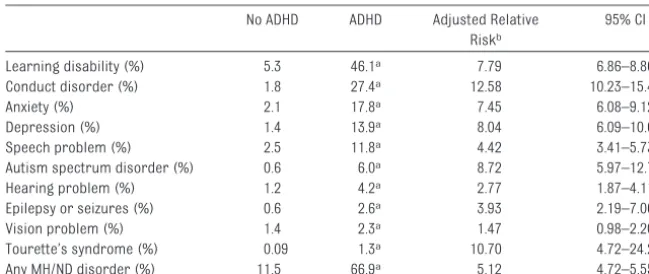
ADHD Prevalence and Comorbidity Parent-reported diagnosed prevalence of ADHD for all children ages 6 to 17 was 8.2% (95% confidence interval [CI]: 7.7– 8.7), corresponding with more than 4010 000 cases nationwide. Children with ADHD were more likely to also have each of 10 other mental health and neu-rodevelopmental disorders (Table 1). For example, 46% of children with ADHD had a learning disability versus 5% without ADHD, 27% vs 2% had a con-duct disorder, 18% vs 2% anxiety, 14% vs 1% depression, and 12% vs 3% speech problems. Nine of the associa-tions remained significant after ad-justment for sociodemographics. In to-tal, 67% of children with ADHD had at least 1 other reported mental health/ neurodevelopmental disorder (com-pared with 11% in the population with-out ADHD). Among children with an ADHD diagnosis, 33% had 1 comorbid disorder, 16% had 2, and 18% had 3 or more (Fig 1).
Sociodemographics of ADHD Prevalence and Comorbidity Parent-reported diagnosed prevalence of ADHD was higher for children in lower income households and families headed by single mothers (Table 2). The income gradient in ADHD prevalence was less TABLE 1 Prevalence of Comorbid Disorders for Children With ADHD Versus Those Without
(N⫽61 779)
No ADHD ADHD Adjusted Relative
Riskb
95% CI
Learning disability (%) 5.3 46.1a 7.79 6.86–8.86
Conduct disorder (%) 1.8 27.4a 12.58 10.23–15.48
Anxiety (%) 2.1 17.8a 7.45 6.08–9.12
Depression (%) 1.4 13.9a 8.04 6.09–10.62
Speech problem (%) 2.5 11.8a 4.42 3.41–5.73
Autism spectrum disorder (%) 0.6 6.0a 8.72 5.97–12.72
Hearing problem (%) 1.2 4.2a 2.77 1.87–4.11
Epilepsy or seizures (%) 0.6 2.6a 3.93 2.19–7.06
Vision problem (%) 1.4 2.3a 1.47 0.98–2.20
Tourette’s syndrome (%) 0.09 1.3a 10.70 4.72–24.23
Any MH/ND disorder (%) 11.5 66.9a 5.12 4.72–5.55
aP⬍.05 for2test.
bRelative risks were adjusted for child age, gender, race/ethnicity, parent education, household income, and family
steep than the gradient for
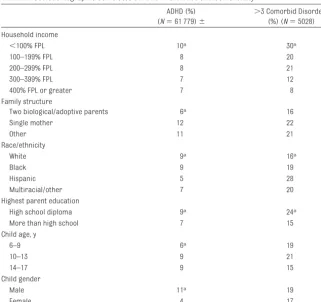
comorbid-ity. Children in poor families were ⬃1.4 times more likely to have an ADHD diagnosis than were children with incomes at 400% FPL or greater (10% vs 7%). The risk for having 3 or more comorbid conditions among chil-dren with ADHD was 3.8 times higher for poor versus most affluent children
(30% vs 8%). Separate analyses (not
shown) indicated each comorbid con-dition except anxiety and epilepsy, and Tourette’swas more common for poor children. Hispanic children were less likely than were white children to have an ADHD diagnosis, but more likely to have comorbid conditions. Comorbid-ity did not vary by child age or gender.
Associations Between ADHD, Comorbid Conditions, and Functioning
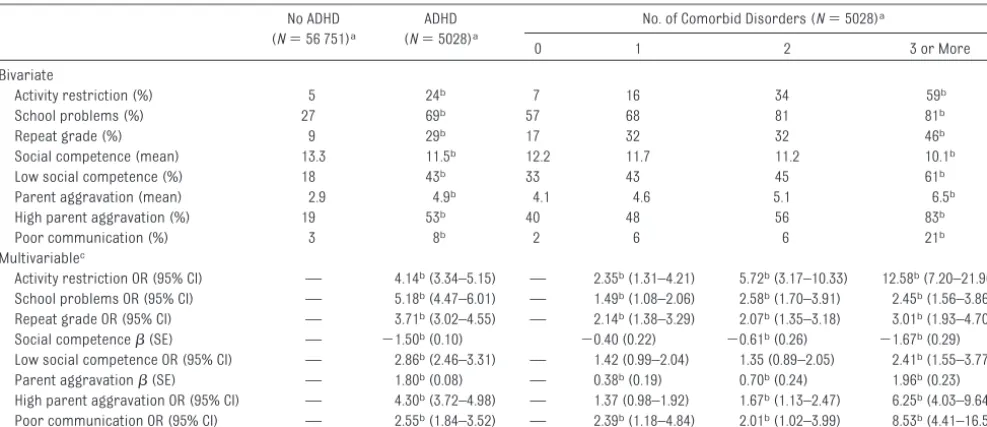
Children with ADHD had more reported problems across every indicator of functioning (Table 3). For example, 69% of parents with children who had ADHD were contacted about school problems, compared with 27% of other parents. Twenty-nine percent of chil-dren with ADHD had repeated a grade, compared with 9% of children without ADHD. Average parent aggravation scores were 4.9 for those with ADHD versus 2.9 for those without (53% vs 19% classified in high range).
Child and family functioning was dis-tributed by the number of comorbid disorders for children with ADHD. Chil-dren with ADHD and 3 or more comor-bid disorders exhibited severe deficits in functioning. For example, 59% of these children had an activity restric-tion, 81% had problems in school, 46% repeated a grade, 61% had low social competence, and 83% had parent ag-gravation scores classified as high.
Associations between ADHD and func-tioning remained significant in ad-justed regression models. Children with ADHD had higher odds of activity restriction (odds ratio [OR]: 4.14 [95% CI: 3.34 –5.15]), school problems (OR: 5.18 [95% CI: 4.47– 6.01]), grade
repeti-tion, and poor communication,
whereas social competence scores were lower and parent aggravation higher. For children with ADHD, the odds/ of poorer functioning creased in a step-wise fashion with in-creasing numbers of comorbidities (see Table 3). For example, compared with children with ADHD and no comor-bid conditions, children with 3 or more comorbid disorders had the highest odds of activity restriction (OR: 12.58 [95% CI: 7.20 –21.96]), whereas chil-dren with 2 (OR: 5.72 [95% CI: 3.17–10.33]) and 1 comorbid disorder
33% 33%
16% 18%
0 5 10 15 20 25 30 35 40 45
Zero One Two Three or more Number of comorbid disorders
Per
c
e
n
ta
g
e
of ch
il
dre
n
FIGURE 1
Percentage of children with ADHD who have comorbid disorders (N⫽5 028).
TABLE 2 Sociodemographic Correlates of ADHD Prevalence and Comorbidity
ADHD (%) (N⫽61 779)⫾
⬎3 Comorbid Disorders (%) (N⫽5028) Household income
⬍100% FPL 10a 30a
100–199% FPL 8 20
200–299% FPL 8 21
300–399% FPL 7 12
400% FPL or greater 7 8
Family structure
Two biological/adoptive parents 6a 16
Single mother 12 22
Other 11 21
Race/ethnicity
White 9a 16a
Black 9 19
Hispanic 5 28
Multiracial/other 7 20
Highest parent education
High school diploma 9a 24a
More than high school 7 15
Child age, y
6–9 6a 19
10–13 9 21
14–17 9 15
Child gender
Male 11a 19
Female 4 17
(OR: 2.35 [95% CI: 1.31– 4.21]) had in-termediate odds.
Income Gradients in Functioning Among those with ADHD, functioning was consistently lower for children in lower-income households (see Table 4). For example, children with ADHD who lived in poverty had a 44% preva-lence of grade repetition, compared with 19% for those who had family in-comes of 400% FPL or greater. Among poor children with ADHD, 52% had low social competence scores versus 34% for the most affluent. These associa-tions remained significant with
con-trols for sociodemographics (not shown).
Associations Between ADHD, Comorbid Conditions, and Service Use
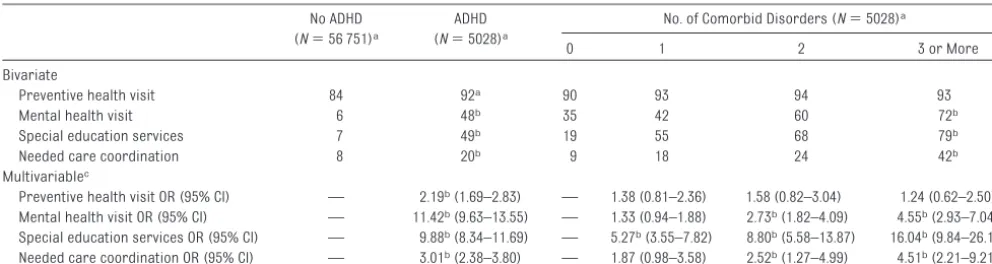
Children with ADHD consistently used more health, mental health, and edu-cation services than did other children (Table 5). Separate analyses (not shown) indicated that children with ADHD had higher health and mental health service use than did children with any other mental health or neuro-developmental disorder. Among chil-dren with ADHD, mental health and
ed-ucation service use increased with each additional comorbid condition. For example, odds of special education use increased by 5.27 (95% CI: 3.55– 7.82) with 1 comorbidity, 8.80 (95% CI: 5.58 –13.87) with 2, and 16.04 (95% CI: 9.84 –26.14) with 3. Most children with ADHD plus 3 or more comorbidities used each service, and nearly half of parents (42%) reported a need for more assistance with care coordina-tion among the providers.
DISCUSSION
In 2007, ADHD was diagnosed for 8.2% of school-aged children in the US, cor-responding to slightly more than 4 mil-lion cases nationwide. ADHD was sig-nificantly associated with all 10 mental health and neurodevelopmental condi-tions studied. The majority (67%) of children with ADHD had at least 1 other comorbidity. Almost one-fifth of chil-dren with ADHD had complex clinical pictures, with 3 or more comorbidi-ties. The odds of poorer functioning, use of health and education services, and need for care coordination creased in a step-wise fashion with in-TABLE 3 Bivariate and Multivariable Associations Between ADHD, No. of Comorbid Disorders, and Child and Family Functioning
No ADHD (N⫽56 751)a
ADHD (N⫽5028)a
No. of Comorbid Disorders (N⫽5028)a
0 1 2 3 or More
Bivariate
Activity restriction (%) 5 24b 7 16 34 59b
School problems (%) 27 69b 57 68 81 81b
Repeat grade (%) 9 29b 17 32 32 46b
Social competence (mean) 13.3 11.5b 12.2 11.7 11.2 10.1b
Low social competence (%) 18 43b 33 43 45 61b
Parent aggravation (mean) 2.9 4.9b 4.1 4.6 5.1 6.5b
High parent aggravation (%) 19 53b 40 48 56 83b
Poor communication (%) 3 8b 2 6 6 21b
Multivariablec
Activity restriction OR (95% CI) — 4.14b(3.34–5.15) — 2.35b(1.31–4.21) 5.72b(3.17–10.33) 12.58b(7.20–21.96)
School problems OR (95% CI) — 5.18b(4.47–6.01) — 1.49b(1.08–2.06) 2.58b(1.70–3.91) 2.45b(1.56–3.86)
Repeat grade OR (95% CI) — 3.71b(3.02–4.55) — 2.14b(1.38–3.29) 2.07b(1.35–3.18) 3.01b(1.93–4.70)
Social competence(SE) — ⫺1.50b(0.10) ⫺0.40 (0.22) ⫺0.61b(0.26) ⫺1.67b(0.29)
Low social competence OR (95% CI) — 2.86b(2.46–3.31) — 1.42 (0.99–2.04) 1.35 (0.89–2.05) 2.41b(1.55–3.77)
Parent aggravation(SE) — 1.80b(0.08) — 0.38b(0.19) 0.70b(0.24) 1.96b(0.23)
High parent aggravation OR (95% CI) — 4.30b(3.72–4.98) — 1.37 (0.98–1.92) 1.67b(1.13–2.47) 6.25b(4.03–9.64)
Poor communication OR (95% CI) — 2.55b(1.84–3.52) — 2.39b(1.18–4.84) 2.01b(1.02–3.99) 8.53b(4.41–16.52)
aSample size varies slightly across different child and family functioning measures because of missing data on the outcome. bP⬍.05. Bivariate results are based on2tests for dichotomous outcomes and analysis of variance for continuous outcomes.
cModels include controls for child age, gender, race/ethnicity, parent education, household income, family structure, and global child health status.
TABLE 4 Income Gradients in Child and Family Functioning Among Those With ADHD (N⫽5028)a
Functional Health Outcomes
Household Income Level
Below 100% FPL
100–199% FPL
200–299% FPL
300–399% FPL
400% FPL or Greater
Activity restriction (%) 31 28 24 17 17b
School problems (%) 77 72 66 71 61b
Repeat grade (%) 44 32 32 17 19b
Social competence (mean) 10.9 11.3 11.5 11.4 12.1b
Low social competence (%) 52 46 46 41 34b
Parent aggravation (mean) 5.3 5.0 4.8 4.8 4.5b
High parent aggravation (%) 58 59 53 52 45b
Poor communication (%) 10 9 7 10 3b
creasing numbers of comorbidities. These results have important implica-tions for the organization and delivery of health care services for children with ADHD.
The parent-reported diagnosed preva-lence of ADHD from the 2007 NSCH is comparable with that obtained in other studies, and matches more di-rect assessment from the National Health and Nutrition Examination Sur-vey, 2001 to 2004 (8.7%).24,25 Rates of
comorbidities reported in the litera-ture have varied widely, owing to dif-fering definitions of comorbid condi-tions, ages of the study cohorts, and origin of samples.13,26,27Our estimate of
a 67% comorbidity rate is consistent with 2 clinical samples in the US and Canada in which approximately two-thirds of children reported comorbid conditions.13,17These findings support
an emerging view that “pure” ADHD, in the absence of comorbidities, occurs in a minority of cases,26,28even in
pop-ulation samples.29Rates of specific
co-morbidities including learning disabil-ities,30–33 anxiety,31,34 depression,34,35
and conduct disorder,31–34 were
broadly within the ranges currently re-ported from regional and clinical samples.
We observed steep social gradients for comorbidities. Poor children with ADHD had close to 4 times the risk of 3
or more comorbid conditions com-pared with the most affluent. Few studies examine ADHD comorbidity for poor children, although 1 study of Finnish adolescents found more co-morbid externalizing disorders.16
Find-ings are consistent with a broader lit-erature demonstrating that multiple health vulnerabilities, including physi-cal health problems and psychosocial conditions like ADHD, tend to cluster together for children from families with lower socioeconomic status.36– 40
Because children from low-income families typically have less access to health services, “over-diagnosis” of co-morbidities in poorer children with ADHD is unlikely. One plausible expla-nation is that ADHD and other exam-ined conditions could have certain common etiologic factors (eg, genetic susceptibility,41,42 maternal stress,43,44
and prenatal smoke exposure44,45) that
are more prevalent in families with lower income.
Consistent with previous literature, children with ADHD had more prob-lems across a wide range of school, social, and family functioning indica-tors.4,46,47This study is novel in showing
steep gradients, with each additional comorbid disorder associated with worse functioning across all domains, even controlling for sociodemograph-ics. Children with ADHD and 3 or more
comorbidities, corresponding to more than 700 000 children nationally, had particularly severe functional deficits. The very high prevalence of school problems (81%) and grade repetition (46%) indicates that existing manage-ment strategies are falling short of meeting the needs of these children. Grade repetition may substitute for more customized, proactive individual interventions. High parent-child com-munication problems and parent ag-gravation indicate that families need additional supports to maintain good quality relationships with their chil-dren and might benefit from individual and family counseling.48–50
The relationship between family income and functioning in children with ADHD has not been well studied; however, more hyperactivity and peer problems have been reported in children from lower income households.4 We found
steep income gradients in social and ed-ucational functioning for children with ADHD. Reasons underlying these gradi-ents were beyond the scope of this study, but the relative contributions of access to health and educational interventions, and presence of comorbidities need ad-ditional research.
Our findings have several implications for practice. First, comprehensive screening for other problems that oc-cur with ADHD is necessary, and treat-TABLE 5 Health and Educational Service Use by ADHD Status and No. of Comorbid Disorders
No ADHD (N⫽56 751)a
ADHD (N⫽5028)a
No. of Comorbid Disorders (N⫽5028)a
0 1 2 3 or More
Bivariate
Preventive health visit 84 92a 90 93 94 93
Mental health visit 6 48b 35 42 60 72b
Special education services 7 49b 19 55 68 79b
Needed care coordination 8 20b 9 18 24 42b
Multivariablec
Preventive health visit OR (95% CI) — 2.19b(1.69–2.83) — 1.38 (0.81–2.36) 1.58 (0.82–3.04) 1.24 (0.62–2.50)
Mental health visit OR (95% CI) — 11.42b(9.63–13.55) — 1.33 (0.94–1.88) 2.73b(1.82–4.09) 4.55b(2.93–7.04)
Special education services OR (95% CI) — 9.88b(8.34–11.69) — 5.27b(3.55–7.82) 8.80b(5.58–13.87) 16.04b(9.84–26.14)
Needed care coordination OR (95% CI) — 3.01b(2.38–3.80) — 1.87 (0.98–3.58) 2.52b(1.27–4.99) 4.51b(2.21–9.21)
aSample size varies slightly across different service use measures because of missing data on the outcome. bP⬍.05. Bivariate results are based on2tests.
ment profiles should be tailored by co-morbidity status and levels of functional impairment in home and school settings.51–54Current AAP
guide-lines call for assessment and manage-ment of comorbidity with ADHD.55,56
Most physicians report screening for common comorbidities such as de-pression,57 but only 20% agree that
they are adequately trained to treat children with ADHD and comorbidity.58
A need for more supports to establish a chronic disease management ap-proach also is suggested by studies, including written intervention plans tailored to each child’s neurodevelop-mental profile and protocols for follow-up monitoring/assessment of functioning.58,59Children from families
with a lower socioeconomic status had more comorbidity and impaired func-tioning, which indicates more inten-sive assessment and treatment from the start to help manage their illness are needed. Finally, health and educa-tional service use increased for chil-dren with ADHD and multiple comor-bidities, and nearly half of parents reported a need for more care coordi-nation with complex comorbidity. These findings reinforce a need for greater integration of primary care with mental health, education, and so-cial services.60– 62
Study limitations include parent re-port and the cross-sectional nature of
the data, which precludes inferences about cause. The parent-reported di-agnosed prevalence of ADHD was con-sistent with estimates using other methods; however, we could not gauge the possible rate of false-positives or false-negatives in the sample. Parent reports have been widely used in the literature,63– 66 and our comorbidity
patterns were similar with clinical and regional studies. This gives us confi-dence our results are valid represen-tations of comorbidity and related con-sequences for children diagnosed with ADHD in the US. Our study did not ad-dress medication use or specific be-havioral interventions, and we could not determine whether ADHD devel-oped before or after onset of the co-morbid conditions. Our study is novel in demonstrating steep increases in impairment and service use with mul-tiple comorbidities, and future re-search should expand this by examin-ing costs. Study strengths include the large, nationally representative sam-ple and data on a wide range of comor-bidities, affording a unique opportu-nity to explore relationships between comorbidities, functioning, and ser-vice use at the population level.
CONCLUSIONS
Professionals and parents need to be aware of the high prevalence of mental health/neurodevelopmental
comor-bidities among school-aged children with ADHD in the United States. Pat-terns of worsening function with in-creasing numbers of comorbidities re-flect the challenge of meeting the needs of children with complex clinical pictures within the current system of care. Comparative effectiveness studies of primary care treatment strategies for ADHD in children have been identified as an Institute of Medicine priority.67Our findings
indi-cate that such studies are urgently needed. Testing innovative models of care integration across health, men-tal health, educational, and social do-mains would be a fruitful area of research to determine the best man-agement approach, especially for those children at greatest risk of poorer function.60– 62,68–71
ACKNOWLEDGMENTS
This work was supported in part by funding to Dr Halfon from the Maternal and Child Health Bureau of the Health Resources and Services Administra-tion Interdisciplinary Maternal and Child Health Training Program (2 T76M600014:11) and to Dr Larson from the National Institutes of Health Loan Repayment Program.
We also thank Ms Louba Aaronson and Ms Amy Graber, who assisted with data analysis and manuscript preparation.
REFERENCES
1. Banerjee TD, Middleton F, Faraone SV. Envi-ronmental risk factors for attention-deficit hyperactivity disorder.Acta Paediatr. 2007; 96(9):1269 –1274
2. Pelham WE, Foster EM, Robb JA. The eco-n o m i c i m p a c t o f a t t e eco-n t i o eco-n - d e fi c i t / hyperactivity disorder in children and ado-lescents. J Pediatr Psychol. 2007;32(6): 711–727
3. Currie J, Stabile M. Child mental health and human capital accumulation: the case of ADHD.J Health Econ. 2006;25(6):1094 –1118
4. Strine TW, Lesesne CA, Okoro CA, et al. Emo-tional and behavioral difficulties and im-pairments in everyday functioning among
children with a history of attention-deficit/ hyperactivity disorder.Prev Chronic Dis. 2006;3(2):A52
5. Pastor PN, Reuben CA. Diagnosed attention deficit hyperactivity disorder and learning disability: United States, 2004 –2006.Vital Health Stat 10. 2008;(237):1–14
6. August GJ, Garfinkel BD. Comorbidity of ADHD and reading disability among clinic-referred children.J Abnorm Child Psychol. 1990;18(1):29 – 45
7. Mayes SD, Calhoun SL. Learning, attention, writing, and processing speed in typical children and children with ADHD, autism, anxiety, depression, and
oppositional-defiant disorder.Child Neuropsychol. 2007; 13(6):469 – 493
8. Tai YM, Chiu HW. Comorbidity study of ADHD: applying association rule mining (ARM) to National Health Insurance Database of Tai-wan.Int J Med Inform. 2009;78(12):e75– e83
9. Freeman RD. Tic disorders and ADHD: an-swers from a world-wide clinical data set on Tourette syndrome.Eur Child Adolesc Psychiatry. 2007;16(1 suppl):15–23
10. Geurts HM, Embrechts M. Language profiles in ASD, SLI, and ADHD.J Autism Dev Disord. 2008;38(10):1931–1943
comorbid speech sound disorder and spe-cific language impairment are at increased risk for attention-deficit/hyperactivity dis-order.J Abnorm Child Psychol. 2008;36(2): 151–163
12. Scahill L, Schwab-Stone M, Merikangas KR, Leckman JF, Zhang H, Kasl S. Psychosocial and clinical correlates of ADHD in a commu-nity sample of school-age children.J Am Acad Child Adolesc Psychiatry. 1999;38(8): 976 –984
13. Elia J, Ambrosini P, Berrettini W. ADHD characteristics: I. Concurrent comorbidity patterns in children & adolescents.Child Adolesc Psychiatry Ment Health. 2008;2(1)
14. Bowen R, Chavira DA, Bailey K, Stein MT, Stein MB. Nature of anxiety comorbid with attention deficit hyperactivity disorder in children from a pediatric primary care set-ting.Psychiatry Res. 2008;157(1–3):201–209
15. Ostrander R, Crystal DS, August G. Attention deficit-hyperactivity disorder, depression, and self- and other-assessments of social competence: a developmental study.J Ab-norm Child Psychol. 2006;34(6):773–787
16. Hurtig T, Ebeling H, Taanila A, et al. ADHD and comorbid disorders in relation to family en-vironment and symptom severity.Eur Child Adolesc Psychiatry. 2007;16(6):362–369
17. Klassen AF, Miller A, Fine S. Health-related quality of life in children and adolescents who have a diagnosis of attention-deficit/ hyperactivity disorder. Pediatrics. 2004; 114(5). Available at: www.pediatrics.org/ cgi/content/full/114/5/e541
18. Nijmeijer JS, Minderaa RB, Buitelaar JK, Mulligan A, Hartman CA, Hoekstra PJ. Attention-deficit/hyperactivity disorder and social dysfunctioning. Clin Psychol Rev. 2008;28(4):692–708
19. Spencer TJ. Issues in the management of patients with complex attention-deficit hy-peractivity disorder symptoms.CNS Drugs. 2009;23(suppl 1):9 –20
20. Stein RE. Measurement of ADHD outcomes: implications for the future.Ambul Pediatr. 2007;7(suppl 1):140 –143
21. Blumberg SJ, Foster EB, Frasier AM, et al. Design and operation of the National Survey of Children’s Health, 2007. National Center for Health Statistics.Vital Health Stat 1. 2009; in Press
22. Blumberg S, Carle C, O’Connor K, Moore K, Lippman L. Social competence: develop-ment of an indicator for children and ado-lescents.Child Ind Res. 2008;1:176 –197
23. Macomber J, Moore K. Benchmarking Mea-sures of Child and Family Well-being in the 1997 NSAF: Report No. 6. Washington, DC: The Urban Institute; 1999
24. Froehlich TE, Lanphear BP, Epstein JN, Bar-baresi WJ, Katusic SK, Kahn RS. Prevalence, recognition, and treatment of attention-deficit/hyperactivity disorder in a national sample of US children.Arch Pediatr Adolesc Med. 2007;161(9):857– 864
25. Bloom B, Cohen RA, Freeman G. Summary health statistics for US children: National Health Interview Survey, 2007. National Cen-ter for Health Statistics.Vital Health Stat 10. 2009;239:1– 80
26. Ostrander R, Herman K, Sikorski J, Mascen-daro P, Lambert S. Patterns of psychopa-thology in children with ADHD: a latent pro-file analysis.J Clin Child Adolesc Psychol. 2008;37(4):833– 847
27. Furman L. What is attention-deficit hyperac-tivity disorder (ADHD)?J Child Neurol. 2005; 20(12):994 –1002
28. Gillberg C, Gillberg IC, Rasmussen P, et al. Coexisting disorders in ADHD: implications for diagnosis and intervention.Eur Child Adolesc Psychiatry. 2004;13(suppl 1): 180 –192
29. Kadesjö B, Gillberg C. The comorbidity of ADHD in the general population of Swedish school-age children.J Child Psychol Psychi-atry. 2001;42(4):487– 492
30. Jensen PS, Martin D, Cantwell DP. Comor-bidity in ADHD: implications for research, practice, and DSM-V.J Am Acad Child Ado-lesc Psychiatry. 1997;36(8):1065–1079
31. Spencer T, Biederman J, Wilens T. Attention-deficit/hyperactivity disorder and comor-bidity.Pediatr Clin North Am. 1999;46(5): 915–927, vii
32. Spencer TJ. ADHD and comorbidity in child-hood.J Clin Psychiatry. 2006;67(suppl 8): 27–31
33. Spencer TJ, Biederman J, Mick E. Attention-deficit/hyperactivity disorder: diagnosis, lifespan, comorbidities, and neurobiology. Ambul Pediatr. 2007;7(suppl 1):73– 81
34. Angold A, Costello EJ, Erkanli A. Comorbidity. J Child Psychol Psychiatry. 1999;40(1): 57– 87
35. Daviss WB. A review of comorbid depression in pediatric ADHD: etiology, phenomenology, and treatment.J Child Adolesc Psychophar-macol. 2008;18(6):565–571
36. Starfield B. Childhood morbidity: compari-sons, clusers, and trends.Pediatrics. 1991; 88(3):519 –526
37. Newacheck PW, Stoddard JJ. Prevalence and impact of multiple childhood chronic illnesses.Pediatrics. 1994;124(1):40 – 48
38. Starfield B, Riley AW, Witt WP, Robertson J. Social class gradients in health during ado-lescence.J Epidemiol Community Health. 2002;56(5):354 –361
39. Starfield B, Robertson J, Riley A. Social class gradients and health in childhood.Ambul Pediatr. 2002;2(4):238 –246
40. Van den Akker M, Buntinx F, Metsemakers JFM, Knottnerus JA. Multimorbidity in gen-eral practice: prevalence, incidence, and determinants of co-occuring chronic and recurrent diseases. J Clin Epidemiology. 1998;51(5):367–375
41. Cole J, Ball HA, Martin NC, Scourfield J, McGuffin P. Genetic overlap between mea-sures of hyperactivity/inattention and mood in children and adolescents. J Am Acad Child Adolesc Psychiatry. 2009;48(11): 1094 –1101
42. Coghill D, Banaschewski T. The genetics of attention-deficit/hyperactivity disorder. Ex-pert Rev Neurother. 2009;9(10):1547–1565
43. Grizenko N, Shayan YR, Polotskia A, Ter-Stepanian M, Joober R. Relation of maternal stress during pregnancy to symptom sever-ity and response to treatment in children with ADHD. J Psychiatry Neurosci. 2008; 33(1):10 –16
44. Rodriguez R, Bohlin G. Are maternal smok-ing and stress dursmok-ing pregnancy related to ADHD symptoms in children?J Child Psychol Psychiatry. 2005;46(3):246 –254
45. Froehlich TE, Lanphear BP, Auinger P, et al. Association of tobacco and lead exposure with attention-deficit/hyperactivity disor-der. Pediatrics. 2009;124(6). Available at: www.pediatrics.org/cgi/content/full/124/ 6/e1054
46. Barbaresi WJ, Katusic SK, Colligan RC, Weaver AL, Jacobsen SJ. Long-term school outcomes for children with attention-deficit/hyperactivity disorder: a population-based perspective. J Dev Behav Pediatr. 2007;28(4):265–273
47. Loe IM, Feldman HM. Academic and educa-tional outcomes of children with ADHD. Am-bul Pediatr. 2007;7(suppl 1):82–90
48. Daly BP, Creed T, Xanthopoulos M, Brown RT. Psychosocial treatments for children with attention deficit/hyperactivity disorder. Neuropsychol Rev. 2007;17(1):73– 89
49. Smith BH, Waschbusch DA, Willoughby MT, Evans S. The efficacy, safety, and practical-ity of treatments for adolescents with attention-deficit/hyperactivity disorder (ADHD).Clin Child Fam Psychol Rev. 2000; 3(4):243–267
50. Wolraich ML, Wibbelsman CJ, Brown TE, et al. Attention-deficit/hyperactivity disorder among adolescents: a review of the diagno-sis, treatment, and clinical implications. Pe-diatrics. 2005;115(6):1734 –1746
children with comorbid psychiatric illness. Curr Opin Pediatr. 2003;15(5):476 – 482
52. Reiff MI, Stein MT. Attention-deficit/hyperac-tivity disorder evaluation and diagnosis: a practical approach in office practice. Pedi-atr Clin North Am. 2003;50(5):1019 –1048
53. Stein MT, Perrin JM. Diagnosis and treat-ment of ADHD in school-age children in pri-mary care settings: a synopsis of the AAP practice guidelines.Pediatr Rev. 2003;24(3): 92–98
54. Foster EM, Jensen PS, Schlander M, et al. Treatment for ADHD: is more complex treat-ment cost-effective for more complex cases?Health Serv Res. 2007;42(1 pt 1): 165–182
55. American Academy of Pediatrics Committee on Quality Improvement and Subcommittee on Attention-Deficit/Hyperactivity Disorder. Clinical practice guideline: diagnosis and evaluation of the child with attention-deficit/hyperactivity disorder.Pediatrics. 2000;105(5):1158 –1170
56. American Academy of Pediatrics Committee on Quality Improvement and Subcommittee on Attention-Deficit/Hyperactivity Disorder. Clinical practice guideline: treatment of the school-aged child with attention deficit/ hyperactivity disorder.Pediatrics. 2001; 108(4):1033–1044
57. Chan E, Hopkins MR, Perrin JM, Herrerias C, Homer CJ. Diagnostic practices for atten-tion deficit hyperactivity disorder: a na-tional survey of primary care physicians. Ambul Pediatr. 2005;5(4):201–208
58. Wolraich M, Bard DE, Stein MT, Rushton JL,
O’Connor KG. Pediatricians’ attitudes and practices on ADHD before and after the de-velopment of ADHD pediatric practice guide-lines.J Atten Disord. 2010;13(6):563–572
59. Epstein JN, Langberg PK, Mainwaring BA, Luzader CP, Stark LJ. Community-wide inter-vention to improve the attention-deficit/ hyperactivity disorder assessment and treatment practices of community physi-cians.Pediatrics. 2008;122(1):19 –27
60. Arons BS, Katz-Leavy J, Wittig AC, Wayne Holden E. Too young for ADHD: the potential role of systems of care.J Dev Behav Pediatr. 2002;23(suppl 1):S57– 63
61. American Academy of Child and Adolescent Psychiatry Committee on Health Care Ac-cess and Economics Task Force on Mental Health. Improving mental health services in primary care: reducing administrative and financial barriers to access and collabora-tion.Pediatrics. 2009;123(4):1248 –1251
62. Committee on Psychosocial Aspects of Child and Family Health and Task Force on Mental Health. The future of pediatrics: mental health competencies for pediatric primary care.Pediatrics. 2009;124(1):410 – 421
63. Altarac M, Saroha E. Lifetime prevalence of learning disability among US children. Pedi-atrics. 2007;119(suppl 1):S77–S83
64. Blanchard LT, Gurka MJ, Blackman JA. Emo-tional, developmental, and behavioral health of American children and their families: a report from the 2003 National Survey of Children’s Health. Pediatrics. 2006;117(6). Available at: www.pediatrics. org/cgi/content/full/117/6/e1202
65. Gurney JG, McPheeters ML, Davis MM. Pa-rental report of health conditions and health care use among children with and without autism: National Survey of Chil-dren’s Health.Arch Pediatr Adolesc Med. 2006;160(8):825– 830
66. Kogan MD, Blumberg SJ, Schieve LA, et al. Prevalence of parent-reported diagnosis of autism spectrum disorder among children in the US, 2007. Pediatrics. 2009;124(5): 1395–1403
67. Institute of Medicine Committee on Compar-ative Effectiveness Research Prioritization. Initial National Priorities for Comparative Effectiveness Research. Washington, DC: National Academies Press; 2009
68. Foy JM, Earls MF. A process for developing community consensus regarding the diag-nosis and management of attention-deficit/ hyperactivity disorder.Pediatrics. 2005; 115(1). Available at: www.pediatrics.org/ cgi/content/full/115/1/e97
69. Kelleher KJ, Campos JV, Gardner WP. Man-agement of pediatric mental disorders in primary care: where are we now and where are we going?Curr Opin Pediatr. 2006;18(6): 649 – 653
70. Wolraich ML, Bickman L, Lambert EW, Sim-mons T, Doffing MA. Intervening to improve communication between parents, teachers, and primary care providers of children with ADHD or at high risk for ADHD.J Atten Dis-ord. 2005;9(1):354 –368
DOI: 10.1542/peds.2010-0165 originally published online February 7, 2011;
2011;127;462
Pediatrics
Kandyce Larson, Shirley A. Russ, Robert S. Kahn and Neal Halfon
Services
Updated Information &
http://pediatrics.aappublications.org/content/127/3/462
including high resolution figures, can be found at:
References
http://pediatrics.aappublications.org/content/127/3/462#BIBL
This article cites 62 articles, 11 of which you can access for free at:
Subspecialty Collections
al_issues_sub
http://www.aappublications.org/cgi/collection/development:behavior Developmental/Behavioral Pediatrics
following collection(s):
This article, along with others on similar topics, appears in the
Permissions & Licensing
http://www.aappublications.org/site/misc/Permissions.xhtml
in its entirety can be found online at:
Information about reproducing this article in parts (figures, tables) or
Reprints
http://www.aappublications.org/site/misc/reprints.xhtml
DOI: 10.1542/peds.2010-0165 originally published online February 7, 2011;
2011;127;462
Pediatrics
Kandyce Larson, Shirley A. Russ, Robert S. Kahn and Neal Halfon
ADHD, 2007
Patterns of Comorbidity, Functioning, and Service Use for US Children With
http://pediatrics.aappublications.org/content/127/3/462
located on the World Wide Web at:
The online version of this article, along with updated information and services, is
by the American Academy of Pediatrics. All rights reserved. Print ISSN: 1073-0397.