Lincoln
University
Digital
Thesis
Copyright
Statement
The
digital
copy
of
this
thesis
is
protected
by
the
Copyright
Act
1994
(New
Zealand).
This
thesis
may
be
consulted
by
you,
provided
you
comply
with
the
provisions
of
the
Act
and
the
following
conditions
of
use:
you
will
use
the
copy
only
for
the
purposes
of
research
or
private
study
you
will
recognise
the
author's
right
to
be
identified
as
the
author
of
the
thesis
and
due
acknowledgement
will
be
made
to
the
author
where
appropriate
you
will
obtain
the
author's
permission
before
publishing
any
material
from
the
thesis.
Developing New Guidelines
for Riverfront Development
in Malaysia
A thesis
submitted in partial fulfilment
of the requirements for the Degree of
Doctoral of Philosophy
at
Lincoln University
by
Azlina Binti Md. Yassin
Lincoln University
ii
Abstract of a thesis submitted in partial fulfilment of the
requirements for the Degree of Doctoral of Philosophy.
Abstract
Developing New Guidelines
for Riverfront Development
in Malaysia
by
Azlina Binti Md. Yassin
Rivers and water are valuable natural resources for human life, for the environment and for
national development. A riverfront development is already a well-established phenomenon
internationally. In Malaysia, as the economy began to develop in the 1980s, so did the use of
land along many of the riverfronts. The pressure of new technology coupled with urban
population growth and urbanisation began to force a transition from water dependent
industries to a variety of non-water dependent urban developments. Residential riverfront
development has taken advantage of the land made available by changed land use and has
incorporated the water amenities as a feature or “selling point” of the development. The
development of riverfront land has occurred with limited federal, state, or municipal planning
guidance and in some cases has added a cost in terms of flooding and pollution. Although
some riverfront development projects continue to remain profitable and also maintain a
successful public access component, many have not.
The aim of the current study is to identify the current practices of riverfront development in
Malaysia and to evaluate the strengths and weaknesses of the regulations associated with
riverfront development in Malaysia, and any subsequent barriers to development. This will
allow guideline recommendations to be formulated to help ensure more sustainable
development in crucial riverfront locations throughout Malaysia in the future. Data and
information to undertake this research was obtained from in-depth interviews with
iii followed by a survey of property development companies through postal and email
questionnaires (quantitative phase).
The results show that the most of the interviewees and the property development companies
are familiar with waterfront development even though not directly involved in these projects.
Only limited numbers of them are familiar with guidelines for riverfront development, while
the rest have inadequate information about them. The majority of the interviewees and the
property development companies do not support the riverfront development guidelines for
many reasons such as weakness in policy administration and external interference. The
findings also identified eighteens attributed to be used in assisting developers when
undertaking riverfront development project in the future. This information will be used to
develop recommended guidelines for best practice riverfront development in Malaysia.
Keywords: Guidelines for riverfront development, Riverfront, Riverfront development,
iv
Acknowledgements
In the name of Allah, Most Gracious, Most Merciful.
Alhamdulillah, with His Blessings I have successfully completed this thesis.
Completion of this thesis would not have been possible without the help of my supervisors,
family and friends.
First of all, I would like to express my immense gratitude to my supervisor, Professor Sandy
Bond, for her willingness to take up the role as my supervisor, for her tireless reviewing and
commenting on the thesis, which resulted in many valuable comments and for her enduring
support.
A special note of heartfelt thanks goes to my associate supervisor, Associate Professor John
McDonagh, for his willingness to share knowledge and his assistance in helping me to
complete the thesis.
I sincerely thank Professor Chris Eves, previously my supervisor and a professor at Lincoln
University, who is now Professor of Property Economics at Queensland University of
Technology, Brisbane, for his guidance in setting the direction of the study and constructive
comments on early drafts.
I would also like to thank members of the Commerce Division, who have been instrumental in
providing a pleasant, warm and stimulating environment. In particular, I wish to thank Ms.
Annette Brixton, Personal Assistance to the Dean, for her continuing assistance at many
stages of this study, and to Dr. David Cohen, convenor of the Postgraduate Committee, for his
continuing support.
The financial support received from the Malaysian Ministry of Higher Education, the
University Tun Hussein Onn Malaysia and Lincoln University is gratefully acknowledged.
A big thanks must also be extended to all parties who participated in this research, for their
generous help in providing valuable information.
I would also like to extend my heartfelt thanks to all my colleagues and the Canterbury
Lincoln University Malaysian Post Graduate Society (CLUMPS) for their valuable advice,
v Most of all, I would like to thank my husband, Mahfouz Mohd Dom, for his enduring
encouragement and support. A big hug must go to my daughter Betty and to my son Adam,
and Adha who was born during the course of this study, for their understanding and patience.
Last but not least, a big thanks to my family for their never-ending support and
encouragement.
The faith, love and support I have received from my supervisors, family and friends have
given me the ongoing courage and motivation needed to complete this thesis. Without the
vi
Table of Contents
Abstract... ... ii
Acknowledgements ... iv
Table of Contents ... vi
Glossary of Terms ... xi
List of Tables... ... xii
List of Figures... ... xiv
Chapter 1 Thesis Introduction ... 1
1.1 Introduction ... 1
1.2 Motivation for Conducting the Research ... 3
1.3 Research Questions ... 4
1.4 Objectives of the Research ... 5
1.5 Significance and Contribution of the Research ... 5
1.6 Scope of the Research ... 6
1.7 Organisation of the Thesis ... 6
1.8 Operational Framework ... 7
1.8.1 Research Activities ... 8
Chapter 2 Waterfront Redevelopment: Issues, Trends and Principles ... 11
2.1 Introduction ... 11
2.2 Waterfront and Waterfront Development ... 12
2.2.1 Why the Waterfront? ... 14
2.2.2 Waterfront: From Vibrant to Vacant ... 16
2.2.3 Waterfront Redevelopment: Moving Waterfronts from Vacant to Vibrant ... 16
2.2.4 The Term “Waterfront” and “Waterfront Development” in this Research ... 18
2.3 An Evolution of Waterfront Development ... 19
2.4 Actors in the Waterfront Development Process ... 19
2.5 Successful Waterfront Development Projects ... 23
2.5.1 Principles for Successful Waterfront Development ... 25
2.5.2 Principles for Sustainable Waterfront Development ... 27
2.5.3 Sustainable Governance of Waterfront Development ... 28
2.6 Chapter Summary ... 31
Chapter 3 The Emergence of Waterfront Development in Malaysia ... 32
3.1 Introduction ... 32
3.2 The River and Its Economic Importance ... 33
3.3 Urbanisation in Malaysia ... 34
3.3.1 Emerging Urbanisation of Malaysia ... 35
3.3.2 Urbanisation and Demographic Changes in Malaysia ... 37
3.3.3 Urbanisation and the Economy of Malaysia ... 38
vii
3.3.5 Urbanisation and the Environment in Malaysia ... 40
3.4 Land Development Process in Malaysia ... 44
3.4.1 Land Development Stages and Main Actors ... 45
3.5 An Evolution of Waterfront Development in Malaysia ... 48
3.6 Governance for Waterfront Development in Malaysia ... 51
3.6.1 Regulations Related to Waterfront Development in Malaysia ... 53
3.6.2 Guidelines for Development Related to Rivers and River Reserves ... 57
Chapter 4 Methodology and Use of the Mixed Methods Research Strategy ... 61
4.1 Introduction ... 61
4.2 Research Objectives ... 61
4.3 Research Design ... 61
4.4 Motivation for Using the Mixed Methods Research Strategy ... 62
4.5 The Sequential Exploratory Mixed Methods Design ... 64
4.5.1 The Qualitative Phase: A Case Study Approach ... 68
4.5.1.1 Motivation for Using the Case Study Approach ... 68
4.5.1.2 Case Study Design ... 70
4.5.1.3 Case Study Area ... 72
4.5.1.4 Description of Case Study Areas ... 74
4.5.1.5 Preparation and Collection of Data ... 84
4.5.1.6 Data Analysis ... 86
4.5.2 The Quantitative Phase: A Survey Approach ... 88
4.5.2.1 Sampling Method ... 88
4.5.2.2 The Questionnaire Design: A Self-administered Questionnaire ... 90
4.5.2.2.1 The Questionnaire Structure: Closed-ended Questions ... 91
4.5.2.3 The Pilot Study ... 93
4.5.2.4 The Questionnaire Distribution Process... 94
4.5.2.5 Data Analysis Techniques ... 96
4.5.2.5.1 Descriptive Statistics ... 96
4.5.2.5.2 Exploratory Factor Analysis (EFA) ... 96
Tests for Determining the Appropriateness of Factor Analysis ... 97
Factor Extraction ... 98
4.5.2.5.3 T-test Analysis ... 99
4.5.2.5.4 Correlation ... 99
4.6 Some Considerations before Beginning the Analysis of the Data ... 99
4.6.1 Internal Reliability of the Data ... 99
4.6.2 Normality of the Distribution in the Data... 100
viii
Chapter 5 Qualitative Results – Survey Interviews ... 103
5.1 Introduction ... 103
5.2 Response Rate ... 103
5.3 Waterfront Development in Malaysia ... 105
5.3.1 Waterfront Development in Malaysia – the Past ... 105
5.3.2 Waterfront Development in Malaysia – the Present... 107
5.3.2.1 Waterfront Development – Demand and Supply ... 110
5.3.2.2 Successful Waterfront Development and Obstacles to Achieving this112 5.3.2.3 Waterfront Development – in the Future ... 113
5.3.2.4 The Waterfront Development Process in Malaysia ... 113
5.3.2.5 Parties Involved in Waterfront Development in Malaysia ... 114
5.3.2.6 Governance in Waterfront Development in Malaysia ... 115
5.3.3 Waterfront Development Effects in Malaysia ... 117
5.3.4 Regulations Associated with Waterfront Development in Malaysia ... 119
5.3.5 Recommendations for Best Practice for Waterfront Development in Malaysia 123 Chapter 6 Quantitative Method – Questionnaire Results ... 126
6.1 Sample and Response Rates ... 126
6.2 Profile of Property Development Companies ... 127
6.3 Descriptive Statistics ... 128
6.3.1 Waterfront Development Projects ... 128
6.3.2 Waterfront Development: Reasons for Applying for Waterfront Development130 6.3.3 Successful Waterfront Development ... 131
6.3.4 Regulations and Guidelines Related to Waterfront Development ... 133
6.3.4.1 Effectiveness of Guidelines for Riverfront Development ... 136
6.3.5 Recommendations on the Statements for Waterfront Development Guidelines137 6.4 Cross Tabulation Analysis ... 139
6.4.1 Years of Operation and whether the Company Undertakes Waterfront Development or not ... 139
6.4.2 Number of Employees and whether the Company Undertakes Waterfront Development or not ... 140
6.4.3 Years of Operation and Percentage of Waterfront Development Projects ... 140
6.4.4 Number of Employees and the Percentage of Waterfront Development Projects ... 141
6.5 T-Test Analysis ... 142
6.5.1 T-test on the Statements for Waterfront Development Guidelines between Two Groups of Respondents ... 142
6.6 Exploratory Factor Analysis ... 143
6.6.1 Tests for Determining the Appropriateness of Exploratory Factor Analysis .... 144
ix
6.6.1.2 Bartlett‟s Test of Sphericity ... 144
6.6.1.3 Kaiser-Meyer-Olkin Measure of Sampling Adequacy ... 144
6.6.2 Results of Exploratory Factor Analysis ... 144
6.6.2.1 Latent Root Criterion ... 145
6.6.2.2 Percentage of Variance Criterion ... 145
6.6.2.3 Scree Test Criterion... 146
6.6.2.4 Factor Rotation ... 146
6.6.2.5 Interpretation of the Exploratory Factor Analysis ... 146
6.6.2.6 Reliability ... 150
6.7 T-test Analysis on Six Factor for Waterfront Development Guidelines between Two Groups of Respondents ... 151
6.8 Correlation ... 152
6.9 Discussion ... 153
6.9.1 Research Objective One: Current Practices for Waterfront Development in Malaysia. ... 153
6.9.2 Research Objective Two: An Overseas Approach to Waterfront Development with Emphasis on Guidelines Available. ... 157
6.9.2.1 Wellington‟s Waterfront, New Zealand ... 157
6.9.2.1.1 Governance of Wellington‟s Waterfront ... 158
6.9.2.1.2 Objectives and Principles of Wellington‟s Waterfront .. 160
6.9.2.2 Singapore‟s Riverfront, Singapore ... 163
6.9.2.2.1 Singapore‟s Riverfront, Singapore ... 163
6.9.2.2.2 Characteristics of Singapore‟s Riverfront ... 164
6.9.2.2.3 Key Strategies for Redevelopment of Singapore‟s Riverfront ... 166
6.9.3 Research Objective Three: Evaluation of Current Regulations and Guidelines Related to Waterfront Development in Malaysia. ... 167
6.9.4 Research Objective Four: Recommendations for New Guidelines towards More Sustainable Development of Waterfronts in Malaysia. ... 169
6.10 Summary ... 174
Chapter 7 Summary and Recommendations ... 176
7.1 Summary ... 176
7.2 Research Limitations ... 181
7.3 Conclusion and Recommendations ... 182
7.3.1 Recommendations for Best Practice for Waterfront Development in Malaysia 182 7.3.2 Recommendations for Future Research ... 183
References... 185
Appendix A – Objectives and Function of the Institutions Involved in Waterfront Development in Malaysia ... 203
x
Appendix C – Approval Letter and Research Pass ... 210
Appendix D – Invitation Letter for Conducting Interviews ... 212
Appendix E – List of Property Development Companies ... 213
Appendix F – Survey Questionnaire ... 221
Appendix G – Invitation Letter for Conducting Survey Questionnaire ... 229
Appendix H – Normality of the Distribution in the Data ... 230
Appendix I – List of Property Development Companies Who Participated in the Survey ... 233
xi
Glossary of Terms
To clarify terms used in this thesis a list of definitions of selected terms is provided below.
“Bursa Malaysia” is an exchange holding company approved under Section 15 of the Capital
Markets and Services Act 2007. Bursa Malaysia operates a fully-integrated exchange, offering
the complete range of exchange-related services including trading, clearing, settlement and
depository services (Bursa Malaysia, 2009).
“Sustainable development” is defined as “development that meets the needs of the present
without compromising the ability of future generations to meet their own needs.” (Brundtland
Commission, 1987).
“The waterfront” refers to land fronting on to water (Dong, 2004). Different words were used
to replace the term waterfront: city port, harbour front, riverside, river edge, water edge and
riverfront (Hoyle, 2002; Hussein, 2006; Mann, 1973; Tunbridge & Ashworth, 1992; Watson,
1986). The water itself is any type of water body such as a lake, the ocean, a river or a stream
of all sizes (Breen & Rigby, 1994, p. 10). The waterfront zone is an area endowed with
special characteristics and includes ecological, economic and social characteristics (Costanza,
1999).
“Waterfront development” usually refers to land reclaimed from water in order to create an
extension of existing city centres (Butuner, 2006). Breen and Rigby (1994, 1996) considered
that waterfront development may not necessarily need to directly front water, but may need
only to look as if it is attached to the water. Waterfront development in this research refers
particularly to any development in front of river areas.
“Waterfront governance” refers to the management system that consists of the legal and
institutional frameworks necessary to maximise the benefits provided by the water zone and
to minimise the conflicts and negative effects of activities (Post & Lundin, 1996). Every stage
of the waterfront development process (setting objectives, planning and implementation) will
involve as wide a spectrum of interest groups as possible to balance the diverse uses of the
xii
List of Tables
Table 2.1 : Special characteristics of a waterfront zone... 13
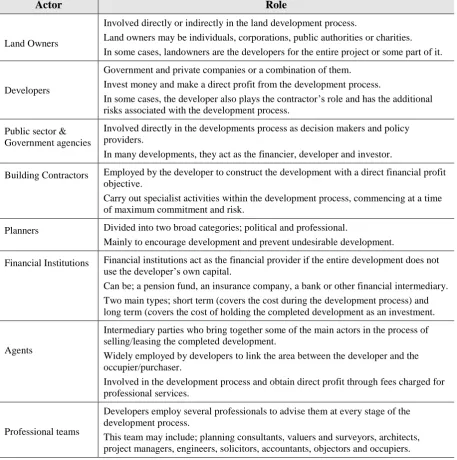
Table 2.2 : Actors involved in the land development process ... 20
Table 2.3 : Stakeholders in the waterfront development process... 21
Table 2.4 : Examples of successful waterfront development projects ... 23
Table 2.5 : Elements for successful waterfront development ... 26
Table 2.6 : Principles for sustainable waterfront development ... 28
Table 2.7 : Principles for the sustainable governance of natural and social resources ... 29
Table 2.8 : Principles for the sustainable governance of the waterfront ... 30
Table 3.1 : Economic value of rivers in Malaysia ... 34
Table 3.2 : Urban and rural population in Malaysia (1950-2030) ... 35
Table 3.3 : Land use effects ... 41
Table 3.4 : The development stages and associated actors ... 46
Table 3.5 : Examples of riverfront development projects in Malaysia ... 50
Table 3.6 : Related law, policies and guidelines related to waterfront development in Malaysia ... 56
Table 3.7 : Criteria for guidelines for riverfront development ... 58
Table 4.1 : Characteristics of case studies areas ... 73
Table 4.2 : Details of Kuching Riverfront development project ... 77
Table 4.3 : Description of the Malacca Waterfront development project ... 81
Table 4.4 : Internal reliability of areas in the questionnaire using interval scales ... 100
Table 4.5 : Test of normality – Skewness and Kurtosis ... 101
Table 5.1 : Composition of the interviews ... 104
Table 5.2 : Significance of rivers ... 105
Table 5.3 : Transformation factors for waterfront areas ... 108
Table 5.4 : Success factors for international waterfront projects ... 109
Table 5.5 : Reasons for having Waterfront development ... 111
Table 5.6 : Level of successful waterfront development and obstacles ... 113
Table 5.7 : Reasons for ineffective governance for waterfront development ... 117
Table 5.8 : Waterfront development – positive and negative effects ... 118
Table 5.9 : Regulations associated with waterfront development in Malaysia ... 120
Table 5.10 : Guidelines for riverfront development – effectiveness levels ... 122
Table 5.11 : Guidelines for riverfront development – factors for ineffective guidelines ... 123
Table 5.12 : Statements for waterfront development guidelines... 125
Table 6.1 : Profile of property development companies ... 127
xiii Table 6.3 : Reasons for applying for waterfront development by property development
companies ... 130
Table 6.4 : Successful implementation of waterfront development ... 132
Table 6.5 : Factors for unsuccessful implementation of waterfront development ... 133
Table 6.6 : Regulations and guidelines for waterfront development – respondents‟ levels of awareness ... 134
Table 6.7 : Sufficient regulations and guidelines for waterfront development ... 135
Table 6.8 : Enforcement of regulations for waterfront development ... 136
Table 6.9 : Effectiveness of guidelines for riverfront development... 137
Table 6.10 : Statements about waterfront development guidelines ... 138
Table 6.11 : Cross tabulation between years of operation and whether the company undertakes waterfront development ... 140
Table 6.12 : Cross tabulation between number of employees and whether the company undertakes waterfront development ... 140
Table 6.13 : Cross tabulation between the years of operation and the percentage of waterfront development projects ... 141
Table 6.14 : Cross tabulation between the number of employees and the percentage of waterfront development projects ... 141
Table 6.15 : T-test on the statements for waterfront development guidelines between two groups of respondents ... 142
Table 6.16 : Bartlett's test of Sphericity ... 144
Table 6.17 : Eigenvalues and the explained percentage of variance... 145
Table 6.18 : Factor analysis results: Principal Component extraction ... 149
Table 6.19 : Reliability test – Cronbanch‟s Alpha Coefficient ... 150
Table 6.20 : T-test on six factors for waterfront development guidelines between two groups of respondents ... 152
Table 6.21 : Correlation matrix table ... 153
Table 6.22 : Key principles for Wellington‟s Waterfront ... 160
Table 6.23 : Characteristics of Singapore‟s Riverfront ... 165
Table 6.24 : Key strategies for development of Singapore‟s Riverfront ... 166
Table 6.25 : Guidelines for riverfront development for Malaysia ... 171
Table 7.1 : Objectives and function of the institutions involved in waterfront development in Malaysia ... 203
Table 7.2 : List of property development companies ... 213
Table 7.3 : List of property development companies who participated in the survey ... 233
Table 7.4 : Correlation matrix ... 239
xiv
List of Figures
Figure 1.1 : Research strategy ... 10
Figure 2.1 : Pattern of waterfront development ... 19
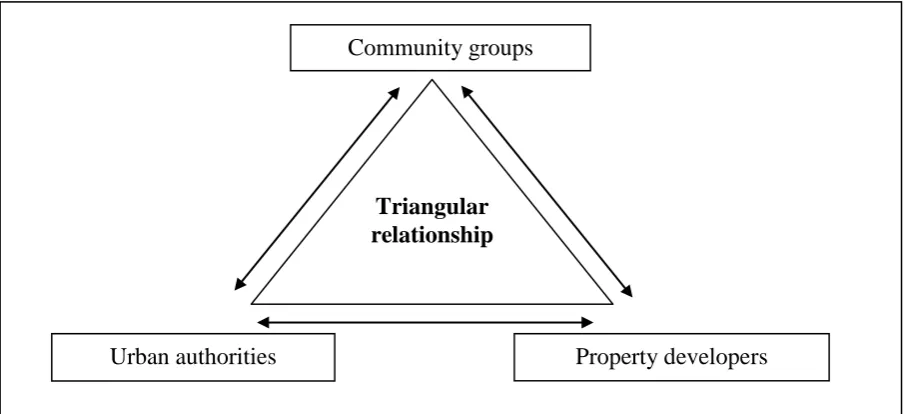
Figure 2.2 : Participants in waterfront development – Triangular direction ... 22
Figure 2.3 : Participants in the waterfront development – Quadripartite direction ... 22
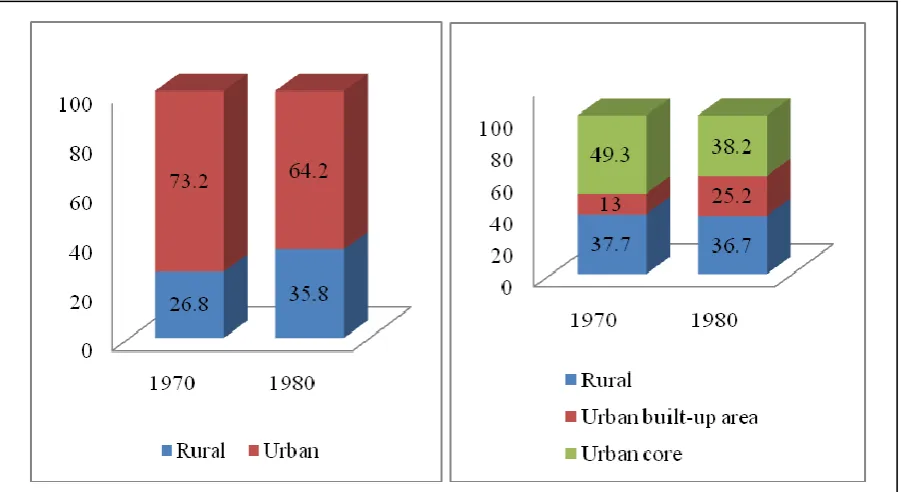
Figure 3.1 : Distribution of population by stratum in Malaysia, 1970 and 2000 ... 36
Figure 3.2 : Population growth in Malaysia between 1950 and 2010 ... 37
Figure 3.3 : Diversification of Malaysian exports ... 39
Figure 3.4 : Malaysian economy ... 39
Figure 3.5 : River basins water quality index, Malaysia (1998-2005) ... 42
Figure 3.6 : Land development process in Malaysia ... 47
Figure 3.7 : Institutional frameworks for land and water resource development in Malaysia ... 53
Figure 4.1 : Mixed methods procedure – data collection and analysis ... 67
Figure 4.2 : Stages involved in conducting case studies ... 71
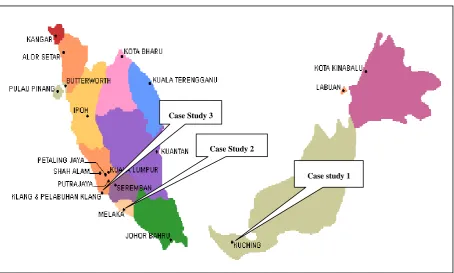
Figure 4.3 : Location map of the case study areas ... 72
Figure 4.4 : Location map of Sarawak Riverfront, Malaysia ... 74
Figure 4.5 : Layout for the Kuching Waterfront development ... 76
Figure 4.6 : Location map of State of Malacca, Malaysia. ... 78
Figure 4.7 : Layout for Malacca Waterfront development ... 80
Figure 4.8 : Location map of Selangor, Malaysia ... 82
Figure 4.9 : Map of Glenmarie Cove, Selangor ... 83
Figure 4.10 : Summary of data analysis ... 87
Figure 4.11 : Sampling procedure used in this research ... 89
Figure 6.1 : Scree test criterion... 146
1
Chapter 1
Thesis Introduction
This chapter provides the background for this study. It begins with a brief introduction to the
riverfront development phenomenon in Malaysia. Research goals and objectives are defined
and general research questions addressed. At the end of this chapter, the overall thesis
framework is presented.
1.1
Introduction
Rivers and water are valuable natural resources for human life, the environment and national
development. Hussein (2006) defined a river as “a copious stream of water flowing in a
channel to the sea, a lake or another river”. Mann (1973), however, sees a river as the “last
open valley of the urban terrain, the last remaining path where man may re-establish his rights
of access and enjoyment.”
Almost 71% of the earth‟s surface is covered by water (Lalli & Parsons, 1993). Water plays
an essential role in people‟s lives and has long been recognised as one of humanity‟s most
important natural resources. In addition, as one of nature's most essential resources, water is
widely used by people for settlement, public spaces and for recreation (Zhang, 2002). Despite
the importance of rivers for settlement and public space, their biodiversity and traditional
importance as sources of primary and secondary production, the contribution of rivers to
energy cycles is now becoming better appreciated (Costanza, et al., 1999; Lalli & Parsons,
1993; Zhang, 2002). Indeed, the allure of water is powerful and universal.
The unique location of rivers at the interface between water and the land initiated the
evolution of human society along the riverfront (Dong, 2004). History shows that many early
human settlements owe their origin and prosperity to water and waterfronts, and including
riverfronts, generally represent the focal point of settlements as a whole (Hoyle & Pinder,
1992). For example, in the history of human civilisation, Uruk, Eridu and Ur (to name a few)
emerged as early settlements about 6000 years ago in Mesopotamia. Moreover, Babylon also
developed and grew along the Tigris and Euphrates Rivers, recognised as very fertile valleys
(Macionis & Parrillo, 2001).
Waterfronts are also important for transport and trade. Konvitz (1978) indicates that from
2 facilitating economic growth at different rates. Therefore, the strong relationship between the
waterfront and human society was established very early, and has been discussed extensively
in the literature (see for example: Herzog, Herbert, Kaplan, & Crooks, 2000; Hoyle & Pinder,
1992; Wrenn, 1983).
The close association between cities and water has been known since the beginning of
civilisation as most major cities are located on or near, a water body of some type. For
example, the Yellow River, the Indus, the Euphrates and the Nile are the earliest main cities
developed along rivers. The trend continues with many modern major cities developing along
waterways such as Paris, London, New York and Tokyo (Dong, 2004). Moreover, for
example in the United States, only six out of the 75 largest cities are not located on a
significant body of water (Breen & Rigby, 1994). It can be seen from these examples that
both water and the cities they serve constitute a fundamental element in the spatial
organisation of economies and societies (Hoyle & Pinder, 1992).
Historically, the emergence of waterfront development in many countries was significantly
associated with the maritime industry (Hoyle, 2001). Port cities have been characterised by
innovation, enterprise and economic development. The establishment of port cities brought
increased prosperity to the urban waterfront communities worldwide.
After waterfronts had been abandoned for a long time for different reasons, the waterfront
redevelopment phenomenon began in the early 1960s. Even though waterfront cities are
synonymous with port cities, Hoyle (2001) explains that the emergence of waterfront
redevelopment is mainly but not exclusively associated with maritime activity. The
phenomenon grew in the 1970s, accelerated in the 1980s (Breen & Rigby, 1994) and
continues to the present day. So, viewed historically, urban waterfront development has
undergone cycles of change over the years and the latest pattern is the conversion of major
areas of industrial, shipping and transportation to more public endeavours such as residential
and recreational.
Over the decades, many cities have successfully made this transition and the waterfront
redevelopment phenomenon is popular throughout the world. Although the scale and type of
redevelopment of waterfronts varies from city to city due to the patterns of original
development, the basic physical configuration and urban form of each waterfront city should
continue to respond to new and changing demands, while attempting to maintain its heritage
3
1.2
Motivation for Conducting the Research
Urban waterfront development is already a well-established phenomenon internationally. Due
to the decline of harbour sites and waterfront industrial areas in the second half of the 20th
century, urban waterfront redevelopment started in North America, most notably, with
Baltimore‟s Inner Harbour in the 1970s and has gradually spread to Europe and elsewhere
since the 1980s (Gospodini, 2001). Many waterfronts have been transformed from working
industrial ports into commercial, recreational and tourist areas. In addition, private developers
began making profits by exploiting the waterfront‟s ambience in the marketing of their
projects. As a result of both private initiative and public involvement, cities have gained
valuable benefits from the redevelopment projects such as new parks, walkways and other
recreational facilities (Craig-Smith & Fagence, 1995) . They provide a unique opportunity to
reconnect what is special and remarkable about the river and to achieve a more sustainable
and enjoyable quality of life.
After gaining independence in 1957, Malaysia struggled to achieve urbanisation and focused
more on infrastructure developments (Menon, 2009). Similarly as with many other countries,
the increase in population size in urban areas was faster than in rural areas. In fact, urban
population growth in urban areas during the third period of urbanisation (1970 to 2000),
especially after restructuring the boundaries of urban areas, increased rapidly, from 26.8% to
61.8% (Jaafar, 2004). The extended growth of urban areas is also a sign of the healthy
Malaysian economy.
The rapid development and urbanisation over decades caused the Malaysian government to
start including many waterfront areas in future development with the focus on more
recreational use, while private property developers concentrated more on mixed-use
development. The Kuching Riverfront, the Malacca Waterfront, the Glenmarie Cove
Riverfront and the Kingfisher Cove Riverfront (to name a few) are examples of development
projects that apply waterfront redevelopment phenomena in Malaysia. To date, interest in
waterfront property is booming even when offered at high prices, as people want to live close
to the water for recreation and aesthetic reasons.
However, in some cases, the implementation of these waterfront projects is driven more by
investment needs rather than by community and environmental needs, with developers neither
taking part in nor contributing to the government goals of sustainable water use. In addition,
4 government, is having a negative impact environmentally and socially such as water pollution
and crime (Ali & Nawawi, 2009; Latip, Heath, Shamsuddin, Liew, & Vallyutham, 2010).
The intensification of waterfront development in other countries, has led to increasing
academic interest, reflected in a series of international conferences and major publications
focusing on different aspects of the phenomenon (See for example Acosta, 1990; Breen &
Rigby, 1994; Gaffen, 2004; Goodwin, 1999; Gospodini, 2001; Hoyle & Pinder, 1992; Hoyle,
Pinder, & Husain, 1988; Latip, et al., 2010; Tsukio, 1984; Wrenn, 1983).
However, in Malaysia, waterfront development and associated environmental and social
issues have not gained the same level of attention. According to Ali and Nawawi (2009),
studies of urban waterfront development cases in Malaysia only emerged in the 1990s, and
then they only assessed the social impact on waterfront environments. Therefore, this research
aims to bring a new vision to waterfront development by incorporating economic
development goals with community goals and the government‟s desire to achieve successful
development practices. Incorporating the environmental, economic and social aspects with
adaptable related regulations for waterfront development is the way to develop successful
waterfront development practices that will benefit the population and subsequently, enhance
the economic success of waterfront locations.
1.3
Research Questions
Understanding the waterfront development processes, recognising the players involved and
identifying the critical factors affecting them will lead to practical models of waterfront
development guidelines, with an emphasis on environmental, economic and social aspects. In
order to accomplish those objectives, the following questions need to be answered:
(1) What are the past and current situations and the extent of waterfront development
practice in Malaysia?
(2) How is waterfront development being adopted by other countries, especially developed
countries?
(3) What variables determine “successful” waterfront development overseas and are these
relevant and able to be applied in Malaysia?
5
(5) What are the mechanisms for the implementation of waterfront development at the level
of the developer and the policy maker in Malaysia?
1.4
Objectives of the Research
The main reason for conducting this study is to improve the information about waterfront
development in Malaysia, with an emphasis on the associated guidelines. This information
will then be used to recommend new waterfront development guidelines to achieve more
successful outcomes. The research objectives of this study are to:
(1) Identify current practices of waterfront development in Malaysia.
(2) Examine the approach taken overseas to waterfront development with an emphasis on
available guidelines (for example, the Wellington Waterfront, New Zealand and the
Singapore‟s Riverfront, Singapore).
(3) Evaluate the current regulations and guidelines related to waterfront development in
Malaysia.
(4) Develop and recommend new guidelines towards more sustainable development of the
waterfront in Malaysia.
1.5
Significance and Contribution of the Research
The first contribution of this study is to the body of knowledge about how to achieve best
practice waterfront development specifically in the Malaysian context. With this attention on
best practice, neighbourhoods can be reconnected to the water and to each other, the water
quality can be improved and biodiversity can be rehabilitated. Waterfronts are valuable
economic resources that should be conserved and managed appropriately.
The second contribution is to inform and educate Malaysian policy makers responsible for the
control, development and administration of waterfront developments. These policy makers
need to understand the importance of best practice waterfront development and how the
critical aspects of waterfront development can be adopted and addressed through policy
intervention. By explicitly considering the interactions and mechanics of waterfront
development from an organisational, developmental and local context point of view, policy
6 future waterfront development maximises the social, cultural, environmental and economic
aspects of the community.
The aim of the study is to provide guidelines for waterfront development. This study is also
important for property developers as they can play a significant part in the quest for
environmentally and ecologically successful waterfront development.
1.6
Scope of the Research
Waterfront development in this research refers specifically to the development of the
riverfront. This study focuses on any riverfront development use such as residential,
mixed-use development or recreational.
The exclusion of the waterfront development types, for example coastal development, is
because in Malaysia, the coastal areas are generally managed in a sectoral in nature (Hussein,
2008; Mokhtar & Aziz, 2003). The executive and legislative functions relating to coastal zone
management has determined by Federal Constitution 1957, either been delegated to Federal
and State government or remained partly shared by both, with local authorities sometimes
acting as a channel for the Federal and State government. This management approach is based
on a tiered structure between the Federal and State Governments and the Local Authorities. At
each level of government there are staffs responsible for playing the management roles of
planning and coordination, implementation and enforcement, and developmental roles, within
their jurisdictions.
This research aims to develop and recommend guidelines to be applied to riverfront
development with consideration being given to environmental, economic, social and
community impacts. In order to achieve this aim, the research will focus on guidelines and
any strategies that may lower the barriers for implementing and encouraging best practice for
waterfront development in Malaysia.
1.7
Organisation of the Thesis
This thesis will be organised into seven chapters. First, the current chapter introduces the
topic and outlines, in very broad terms, the objectives and contribution the research makes.
Following this chapter, the next two chapters focus on the literature review which comprises
two main areas: the general practice of waterfront development (Chapter Two) and the
7 overview of contemporary perspectives and issues as well as guidelines about successful
waterfront development.
Chapter Four discusses the methods to be employed and the reasons for adopting more than
one method as part of the research strategy. General background information and the context
of the selected case studies, data collection procedures and data analysis are provided in this
chapter. The chapter will also address reliability and validity issues related to data, as well as
the sampling and design. From this, a working model is established to provide a basic
framework for the research.
The following two chapters cover the analysis of the data which integrates and synthesises the
data from a variety of sources as presented in the previous chapter (Chapter Four). Initially,
the analysis will be divided into two chapters and will be conducted sequentially; the case
study analysis – interviews and document reviews (Chapter Five) followed by the survey
questionnaire analysis (Chapter Six). The interview data will be analysed using EXCEL and is
followed by a questionnaire, the developments of which was based on the qualitative findings.
The survey questionnaire data will then be analysed using the Statistical Package for Social
Science (SPSS) software. Descriptive statistics, T-test analysis, Exploratory Factor Analysis
(EFA) and Correlation techniques are used. These findings will provide the basis for
developing the waterfront development guidelines for Malaysia. Finally, using the research
objectives as set out in Chapter One, the data will be discussed and interpreted in detail in the
last section of Chapter Six.
This research then concludes with a discussion of the research limitations, the implications
and with recommendations for future research (in Chapter Seven).
1.8
Operational Framework
A three-stage research strategy is adopted in this study. This research starts by identifying the
research problems, posing the research questions and setting the research objectives. This is
followed by a review of the literature related to waterfront development, in order to develop
the key issues. Conference papers, proceedings and theses, either in journals or from the
internet, will be reviewed. The literature review will also include studies about successful
implementation of waterfront development internationally. Based on the information
generated from the literature review, the research questions and objectives of the study will be
8 The second stage of the research is the data gathering stage. The first part of the second stage
focuses on qualitative data collection. This involves a case study approach, selecting
waterfront development projects implemented in Malaysia. Semi-structured interviews and
document reviews are employed in this phase of the research with an emphasis on historical,
current and future practices of waterfront development in Malaysia. Special attention is given
to the guidelines associated with waterfront development as well as impacts resulting from the
development. Respondents are selected from government officers at each level of government
who are involved in selected waterfront projects, as well as property developers and
waterfront communities. The final part of the interviews asks for recommendations from the
respondents about guidelines for best practices for waterfront development in Malaysia.
The second part of the second stage involves quantitative data gathering. This includes the use
of questionnaires that are based on the qualitative findings generated in the first part. The
focus of the survey is to confirm the findings revealed from the first part of the data
collection. Stratified sampling techniques are used to identify respondents for the survey
questionnaire. Finally, 91 property development companies listed under Bursa Malaysia are
selected for participation in this survey.
The final stage (third stage) of the research involves developing the guidelines for waterfront
development in Malaysia. These guidelines are developed based on the findings revealed in
the second stage (from both the interviews and the questionnaires).
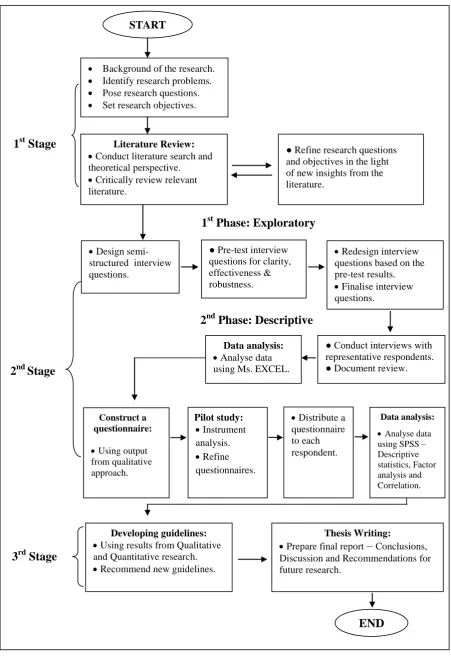
A schematic illustration of the details of the research strategy planned for and implemented in
the study is presented in Figure 1.1.
1.8.1 Research Activities
The overall activities involved in this research are as follows:-
(1) Identification of the research problem.
(2) Literature review – collecting relevant literature published locally and internationally.
(3) Refining the research questions – based on information generated from the literature
review.
(4) Preparation and design of the semi-structured interview questions to explore the
9
(5) Pre-testing the interview questions to ensure clarity, effectiveness and robustness.
(6) Redesigning the interview questions based on pre-test feedback.
(7) Conduct interviews with selected respondents and review documents associated with
waterfront development.
(8) Analyse the interview output and documents reviewed using EXCEL.
(9) Constructing the questionnaire based on the first phase (qualitative) findings – and
preparation for the second phase of the data collection (descriptive approach).
(10) Distribute the questionnaire to selected respondents through stratified sampling by mail
and electronic mail (e-mail).
(11) Data entry and data analysis – enter the quantitative data into the computer using SPSS
software.
(13) Recommend new guidelines for waterfront development in Malaysia.
(14) Prepare for thesis writing.
(15) Submit the thesis.
(16) Seminars – the final recommendations of the research will be disseminated to relevant
policy makers.
(17) Publish – findings will be reported locally and internationally through publications in
10 Figure 1.1: Research strategy
START
Background of the research.
Identify research problems.
Pose research questions.
Set research objectives.
Literature Review:
Conduct literature search and theoretical perspective.
Critically review relevant literature.
1st Stage ● Refine research questions
and objectives in the light of new insights from the literature.
Design semi- structured interview questions.
● Pre-test interview questions for clarity, effectiveness & robustness.
Redesign interview questions based on the pre-test results.
Finalise interview questions.
● Conduct interviews with representative respondents. ● Document review.
Data analysis:
Analyse data using Ms. EXCEL.
Construct a questionnaire:
Using output from qualitative approach.
Distribute a questionnaire to each respondent.
2nd Stage
1st Phase: Exploratory
2nd Phase: Descriptive
Data analysis:
Analyse data using SPSS – Descriptive statistics, Factor analysis and Correlation.
Developing guidelines:
Using results from Qualitative and Quantitative research.
Recommend new guidelines.
3rd Stage
END Thesis Writing:
11
Chapter 2
Waterfront Redevelopment: Issues, Trends and Principles
“Wherever in the world, as an incident of the highway and wharves along its riverbanks, a city has provided opportunity for the people to walk and sit under pleasant conditions where they can watch the water and the life upon it, where they can enjoy the breadth of outlook and the sight of the open sky and the opposite bank and the reflections in the stream, the result has added to the comeliness of the city itself, the health and happiness of the people and their loyalty and local pride.”
(Torre, 1989)
The aim of this literature review is to become familiar with some theoretical perspectives on
waterfront development. The chapter begins with an introduction to the importance of the
waterfront and then outlines the definitions of waterfront and waterfront development. Next,
information on the evolution of waterfront development, the waterfront development process
and the principles behind successful waterfront developments practices is covered. The
implications and effects of the transition of waterfront areas from ports and shipping industry
domination to multidimensional uses such as recreational, mix-use and housing, is discussed.
The last section summarises the chapter.
2.1
Introduction
Water has been a valuable natural resource from the time of the growth of early settlements
up until the present day. When considering its various functions, for example for
transportation and trading, for agricultural production and as natural defence, water has long
been recognised as a most important natural resource for human life, for the environment and
for national development. Therefore, in many countries around the world, the water edge
areas developed earlier than other areas and became a favourable location for the development
of cities (Wrenn, 1983).
At the end of the 19th century waterfront areas were places where settlements originated and
were dominated by industrial activities. According to Craig-Smith & Fagence (1995), for the
last 200 years waterfronts were mostly used for manufacturing, for water supplies, for
drainage, for sewage treatment plants and for electricity generation. However, due to several
factors such as rapid industrialisation, improved shipping technologies and changes in society
with the need for increased recreational activities, new port zones have been required to cater
12 developed and port facilities in the centres of cities began to move to outer city zones and
consequently, large amounts of unused property along the waterfronts were left (Breen &
Rigby, 1994; Butuner, 2006; Peter, 1993).
In the second half of the 20th century, particularly in the 1970s, waterfront redevelopment
emerged, with numerous waterfront areas undergoing a transition from abandoned spaces to
commercial, residential and recreational areas (Bruttomesso, 1993; Butuner, 2006; Sairinen &
Kumpulainen, 2006). For example, Maryland began its famous redevelopment project
converting old and underused waterfront properties into economically viable space. Inspired
by this successful story of a waterfront redevelopment initiative, many other small and large
scale developments followed; for example, in Sydney, Australia, London (UK) and in
Portland, Grand Haven and Michigan (USA) (Breen & Rigby, 1994). Bear in mind that most
of the waterfront redevelopment throughout the world shares some common goals such as
redefining the waterfront‟s position in the urban context, remaking the urban image,
regeneration of the economy and improving social patterns (Butuner, 2006; Sairinen &
Kumpulainen, 2006).
Clearly, waterfront redevelopment over the decades has changed waterfronts in terms of
layout, function, uses and social patterns. Increasing demand for recreational activities
became a determinant in the development of waterfronts, and waterfronts were mostly
designed as new public open spaces of cities that were totally different from their former
structures.
In the next section, the definition and early history of the waterfront is discussed, followed by
a look at the future of waterfront development as well as a brief discussion about the
principles behind successful waterfront development practices internationally.
2.2
Waterfront and Waterfront Development
The waterfront is a zone of interaction between urban development and the water and a
waterfront area is considered to be a unique and irreplaceable resource where it interfaces
between land, water, air, sun and productive plants (Wrenn, 1983). Moreover, Zhang (2002)
characterised waterfronts as a place integrating land with water and having a natural attraction
to people. In fact, water edges are most attractive water features for human settlement and in
13 A more detailed definition by Guo (1998, as cited in Dong, 2004, p. 7) describes a waterfront
as the point of interface where land and water meet, within 200 to 300 metres from the water
line and 1-2 kilometres of the land site and within 20 minutes walking distance. By being an
interface between land and water, the waterfront zone is an area endowed with special
characteristics. The special features and functions of waterfront areas are described in Table
2.1 below.
Table 2.1: Special characteristics of a waterfront zone
Characteristic Description
Ecological The waterfront zone is a dynamic area with frequently changing
biological, chemical and geological attributes.
The waterfront zone includes highly productive and biologically diverse ecosystems that offer crucial nursery habitats for many marine species.
Economic The waterfront contributes significantly to human welfare, both
directly and indirectly and, therefore represents a significant portion of the total economic value of the planet.
Social The waterfront zone is socially important for global transportation,
open access and common property and is a unifying element in the cultures of each country.
(Source: Costanza, 1999)
In the development context, waterfront development have various interpretations depending
on the characteristics of the sites and the cities (Dong, 2004). Butuner (2006) sees waterfronts
as land to be reclaimed from water in order to create an extension of existing city centres.
Breen and Rigby (1994, 1996) considered that waterfront development may not necessarily
need to directly front water but may need only to look as if it is attached to the water. They
believed that a property with a commanding view of water, can be considered as a waterfront
property. Similarly, Ryckbost (2005) sees waterfronts as any property that has a strong visual
or physical connection to water with the water itself being any type of water body such as a
lake, the ocean, a river or a stream of all sizes (Breen & Rigby, 1994, p. 10).
For example, in China, developers classified two types of waterfront development. The first is
called a “borrowed” water view which integrates buildings into an existing water system and,
14 water body (Murray, 2003). In this context, by being an interface between land and water, a
waterfront is considered an important resource that offers great opportunities to a city.
Therefore, waterfront development is best represented as a development directly fronting
water for any purpose and the water components can include river deltas, coastal plains,
wetlands, beach and dunes, lagoons and other water features.
The following sections will discuss the changing structure of waterfront characteristics and
their integration with city development.
2.2.1 Why the Waterfront?
Over recent decades, waterfront development and redevelopment have evolved with a focus
on historic preservation and recreation. During this time government and private sectors have
begun to incorporate waterfront planning and design into their development projects. In
particular, the patterns of development are changing by connecting land, water and air and
landscape aesthetics to land development planning. According to Gaffen (2004), the growing
focus on redeveloping urban waterfronts can be attributed to several factors, that include:
(1) Awareness of the natural environment and smart growth
Increased awareness of the natural environment along the water areas and preservation of
waterfront resources gave a new direction to new aspects of waterfront redevelopment. The
increased awareness of the natural environment has significantly helped to improve the
quality of the natural environment as well as improve water quality and subsequently,
encouraged many uses at waterfronts such as recreational activities and water based
entertainment.
In addition, local governments are starting to re-examine the importance of smart growth,
particularly the minimisation of urban sprawl, a proven culprit in many pollution problems. In
order to achieve the objectives of smart growth, developers are required to follow approaches
that include the provision of mixed land uses, taking advantage of compact building design,
developing a range of housing opportunities and choices, fashioning walk-able
neighbourhoods, preserving open spaces, strengthening and directing development towards
existing communities, making development decisions that are predictable, fair and
cost-effective and encouraging community and stakeholder collaborations in development
15
(2) Preservation and adaptive reuse
Many cities throughout the world have been developed at the waterfront. With the
preservation and adaptive reuse (regeneration) of abandoned historic buildings, vacant
waterfronts space and adjacent areas along the waterfront has been an increase a property
values and an improvement in the waterfront environment and neighbourhoods. Also, the
preservation and regeneration of abandoned buildings and vacant waterfront spaces has
enhanced the waterfront community identity and encouraged community pride.
(3) Federal assistance
The redevelopment of waterfronts requires large amounts of funds. The development also
requires a major change in the pattern of use and the image of the waterfront. A stronger focus
by government institutions on urban renewal has made possible much waterfront development
and redevelopment. Federal governments can assist waterfront development and
redevelopment through the management and provision of sufficient funds. For example,
according to Wrenn (1983), federal government can encourage waterfront development
through taxation policies such as tax incentives, special tax districts, tax abatements and tax
increment financing.
(4) Tourism industry
Waterfront areas have special features that are able to attract local residents and also tourists
around the world. The growing popularity of waterfronts contributed income to the local
government. Increased numbers of visitors and increased demand on the facilities and
accommodation is a main contributor to waterfront development and redevelopment.
Therefore, maintaining the number of visitors and the beauty of waterfront environments is
important for enhancing the tourist industry.
(5) Recreation activities
One of the special characteristics of waterfront areas is that they offer opportunities for
outdoor recreation. The growing popularity of water based entertainment and increased
demand for recreation areas from the public has triggered governments to develop and
16 2.2.2 Waterfront: From Vibrant to Vacant
Historically, a location close to a water area was an important factor in the decision to locate a
settlement. There were several advantages of the water location such as for fulfilling basic
human needs of transport and for drinking water and for trade development. In many
riverfront cities, the water was used mainly for the transportation of goods and so the
waterfront became focal points for related activities such as trade, industry, drainage, sewage
treatment and recreation, as well as for human settlement.
The improvement in shipping technology, the changes in society, the expansion of city sizes,
and the industrial revolution (from the 18th to the 20th centuries) resulted in a decline in the
value of waterfronts (Butuner, 2006; Tsukio, 1984). In the mid 20th century, all industrial
activities and port facilities were moved to the outer zones of cities and the waterfront was no
longer economically or environmentally attractive, except for shipping, storage and heavy
manufacturing (Butuner, 2006; Craig-Smith & Fagence, 1995). Less dependence on the
waterfront industries reinforced the decline of waterfronts, from a position as the economic
heart of the city to becoming eyesores and subsequently, to the disappearance of the
integrated port-city model of the 19th century (Craig-Smith & Fagence, 1995; Dong, 2004).
These areas were abandoned for many years until local governments began to recognise
waterfronts as areas with potential for development. Increasing demand for recreational
activities, coupled with this development potential became determinants in the redevelopment
process. The next section discusses how the redevelopment took place in many abandoned
waterfront areas.
2.2.3 Waterfront Redevelopment: Moving Waterfronts from Vacant to Vibrant
“With renewed interest in revitalizing their waterfronts, many cities are turning their attention to parks and green spaces as critical elements to success.”
(Greco, 2008)
After decades of remaining abandoned, governments decided to initiate a massive
redevelopment of waterfront properties (Ryckbost, 2005) and consequently, initiated the
world-wide era of waterfront revitalisation. The urban waterfront redevelopment phenomenon
of our time began in the 1960‟s, bloomed in the 1970s, accelerated in the 1980s (Breen &
Rigby, 1994) and continues to the present day. Most of the waterfront redevelopment has
17 The first attempt at a waterfront revitalisation process emerged in the 1960s in Baltimore and
was followed by Boston and San Francisco (USA), and from the 1970s to 1980s, waterfront
development was specifically focused on North America and Europe. Experience from these
successful examples contributed to a rapid spread of interest in this development concept, to
cities in Australasia and Japan (Breen & Rigby, 1994; Hoyle, 2001). Moreover, some Newly
Industrialising Countries (NICs), Islamic Cities and Less Economically Developed Countries
(LDCs) commenced looking at potential waterfront development in the 1990s (Hoyle, 2002).
Waterfront areas have undergone a large transition (See Breen & Rigby, 1994; Hudson,
1996), with the current waterfront redevelopment trend attributable to a number of factors,
namely: (1) Technological changes post World War II, which led to the abandonment of
thousands of hectares of land along waterfront areas, (2) The historic preservation movement,
(3) Heightened environmental awareness and water clean- up, (4) Consistent pressure to
redevelop central city areas, and (5) Public (state, federal, and municipal) urban renewal and
related assistance (Craig-Smith & Fagence, 1995; Hoyle & Pinder, 1992; Sairinen &
Kumpulainen, 2006). These factors have combined and brought about dramatic changes to
abandoned waterfronts (or their earliest uses for shipping, storage and ship building) to
contemporary waterfronts for present and future generations (Butuner, 2006; Sairinen &
Kumpulainen, 2006).
The scale and purpose of waterfront redevelopment are different in each city due to the
original pattern of the cities and their development. Basically, most waterfront revitalisation
throughout the world have similar aims namely, redefinition of the waterfront in the urban
context, the re-imaging of the urban city and the regeneration of the economy (Butuner,
2006).
As a result of the shift to post-industrial economies and after governments removed the
negative effects of abandoned waterfronts such as pollution, waterfronts became suitable land
to build on for recreation and leisure, with tourism becoming the most popular concept for
contemporary waterfront. The benefits of this transition included the generation of income
from the private development and growing the tourism industry with the flow on to the
community through a stronger economy and access to the new amenities such as recreational
facilities (Acosta, 1990; Butuner, 2006; Craig-Smith & Fagence, 1995; Krausse, 1995;