University of Pennsylvania
ScholarlyCommons
Publicly Accessible Penn Dissertations
2016
A Novel Iterative Algorithm for Solving Nonlinear
Inverse Scattering Problems
Howard Levinson
University of Pennsylvania, [email protected]
Follow this and additional works at:http://repository.upenn.edu/edissertations
Part of theApplied Mathematics Commons
This paper is posted at ScholarlyCommons.http://repository.upenn.edu/edissertations/1843
For more information, please [email protected]. Recommended Citation
Levinson, Howard, "A Novel Iterative Algorithm for Solving Nonlinear Inverse Scattering Problems" (2016).Publicly Accessible Penn
Dissertations. 1843.
A Novel Iterative Algorithm for Solving Nonlinear Inverse Scattering
Problems
Abstract
We introduce a novel iterative method for solving nonlinear inverse scattering problems. Inspired by the theory of nonlocality, we formulate the inverse scattering problem in terms of reconstructing the nonlocal unknown scattering potential V from scattered field measurements made outside a sample. Utilizing the one-to-one correspondence between V and T, the T-matrix, we iteratively search for a diagonally dominated scattering potential V corresponding to a data compatible T-matrix T. This formulation only explicitly uses the data measurements when initializing the iterations, and the size of the data set is not a limiting factor. After introducing this method, named data-compatible T-matrix completion (DCTMC), we detail numerous improvements the speed up convergence. Numerical simulations are conducted that provide evidence that DCTMC is a viable method for solving strongly nonlinear ill-posed inverse problems
with large data sets. These simulations model both scalar wave diffraction and diffuse optical tomography in three dimensions. Finally, numerical comparisons with the commonly used nonlinear iterative methods Gauss-Newton and Levenburg-Marquardt are provided.
Degree Type
Dissertation
Degree Name
Doctor of Philosophy (PhD)
Graduate Group
Applied Mathematics
First Advisor
Vadim A. Markel
Keywords
Inverse Problems, Nonlinear Iterations, Scattering
Subject Categories
A NOVEL ITERATIVE ALGORITHM FOR SOLVING
NONLINEAR INVERSE SCATTERING PROBLEMS
Howard Levinson
A DISSERTATION
in
Applied Mathematics and Computational Science
Presented to the Faculties of the University of Pennsylvania in Partial
Fulfillment of the Requirements for the Degree of Doctor of Philosophy
2016
Supervisor of Dissertation
Vadim A. Markel, Associate Professor of Radiology and
Bioengineer-ing
Graduate Group Chairperson
Charles L. Epstein, Thomas A. Scott Professor of Mathematics
Dissertation Committee:
Philip T. Gressman, Professor of Mathematics
Vadim A. Markel, Associate Professor of Radiology and
Bioengineer-ing
ABSTRACT
A NOVEL ITERATIVE ALGORITHM FOR SOLVING NONLINEAR INVERSE
SCATTERING PROBLEMS
Howard Levinson
Vadim Markel
We introduce a novel iterative method for solving nonlinear inverse scattering
problems. Inspired by the theory of nonlocality, we formulate the inverse
scatter-ing problem in terms of reconstructscatter-ing the nonlocal unknown scatterscatter-ing potential
V from scattered field measurements made outside a sample. Utilizing the
one-to-one correspondence between V and T, the T-matrix, we iteratively search for
a diagonally dominated scattering potential V corresponding to a data compatible
T-matrix T. This formulation only explicitly uses the data measurements when
initializing the iterations, and the size of the data set is not a limiting factor. After
introducing this method, named data-compatible T-matrix completion (DCTMC),
we detail numerous improvements the speed up convergence. Numerical simulations
are conducted that provide evidence that DCTMC is a viable method for solving
strongly nonlinear ill-posed inverse problems with large data sets. These simulations
model both scalar wave diffraction and diffuse optical tomography in three
dimen-sions. Finally, numerical comparisons with the commonly used nonlinear iterative
Contents
1 Introduction 1
2 Theory 6
2.1 Scattering Theory . . . 6
2.2 Nonlinear Reconstructions . . . 12
2.2.1 Landweber Iteration . . . 15
2.2.2 Gauss-Newton Method . . . 16
2.2.3 Levenburg-Marquardt Method . . . 17
2.2.4 Nonlinear Conjugate Gradient . . . 18
2.3 T-matrix . . . 19
3 The Data-Compatible T-matrix Completion Algorithm 22 3.1 Motivation . . . 22
3.2 The Experimental T-matrix . . . 27
3.3 Iteration Cycle . . . 33
3.4.1 Fast Rotations and Data-Compatibility . . . 39
3.4.2 Fast T →D Transformation (Option 1) . . . 42
3.4.3 Fast T →D Transformation (Option 2) . . . 44
3.4.4 Streamlined Iteration Cycles . . . 46
3.5 Variations and Improvements . . . 49
3.5.1 Starting From an Initial Guess . . . 49
3.5.2 Reciprocity . . . 49
3.5.3 Regularization . . . 50
3.5.4 Choice of Diagonal Approximation . . . 52
3.5.5 Accounting for Sparsity . . . 53
3.5.6 DCTMC in the Inverse Regime . . . 54
4 DCTMC in the Linear Regime 60 4.1 Formulation of Linearized DCTMC . . . 60
4.2 Analysis of Linearized DCTMC . . . 62
5 Simulations and Results 69 5.1 Three-dimensional Scalar Wave Diffraction . . . 69
5.1.1 Discretization . . . 73
5.1.2 Iteration Process . . . 81
5.1.3 Small Target Reconstructions . . . 92
5.2 Improved Reconstructions . . . 106
5.2.1 DCTMC Starting from Linear Reconstruction . . . 107
5.2.2 Using Reciprocity of Sources and Detectors . . . 111
5.2.3 Putting it All Together . . . 118
5.3 Three-Dimensional Diffuse Optical Tomography . . . 120
5.3.1 Regularization and Noise Suppression . . . 123
5.3.2 Iteration Process . . . 125
5.3.3 Reconstructions . . . 127
6 Comparison of DCTMC and other Nonlinear Iterative Methods 132 6.1 Analysis of a Toy Problem . . . 132
6.2 Simulations of DCTMC vs. Newton-type Methods . . . 146
6.2.1 Noiseless Reconstructions . . . 148
6.2.2 Noisy Reconstructions . . . 152
List of Tables
3.1 Runtimes for different computational shortcuts . . . 49
5.1 Small target susceptibilities and estimated phase shifts . . . 84
List of Figures
2.1 Illustration of the imaging geometry . . . 11
3.1 Diagram of matrix sizes . . . 29
3.2 Known elements of experimental T-matrix . . . 33
3.3 Irregular shape of known entries . . . 34
3.4 DCTMC flowchart . . . 38
3.5 Schematic illustration of fast rotations . . . 41
5.1 Targets for scalar wave diffraction simulations . . . 83
5.2 Near-field zone reconstructions for the small target . . . 94
5.3 Intermediate-field zone reconstructions for the small target . . . 96
5.4 Far-field zone reconstructions for the small target . . . 96
5.5 Convergence data for the small target . . . 101
5.6 Near-field zone reconstructions for the large target . . . 104
5.8 Comparison of the reconstructions of the large target with different
stopping points . . . 105
5.9 Comparison of different starting points for the iteration process . . 107
5.10 Convergence data for the case χ0 = 0.00175 comparing the original
guess and the linear reconstruction guess . . . 109
5.11 Convergence data for the case χ0 = 0.175 comparing the original
guess and the linear reconstruction guess. . . 109
5.12 Convergence data for the caseχ0 = 1.75 comparing the original guess
and the linear reconstruction guess . . . 110
5.13 Convergence data for the case χ0 = 0.0175 comparing the original
process and using reciprocity of sources and detectors. . . 112
5.14 Reconstructions with varying degrees ofR, the radius of row-summing114
5.15 Convergence data of ηχ for varying radii of row-summing . . . 115
5.16 Convergence data of ηχ for varying radii of row-summing, with or
without weight function . . . 116
5.17 Reconstructions with varying degrees ofR, the radius of row-summing,
with or without weight function . . . 117
5.18 Improved reconstructions for the small target in the near-field zone 119
5.19 Convergence data of ηχ comparing improved reconstructions versus
5.20 Convergence data of ηΦ comparing improved reconstructions versus
original near-field small target reconstructions . . . 121
5.21 Convergence data of comparing improved reconstructions versus orig-inal near-field small target reconstructions for χ0 = 1.75 . . . 121
5.22 Targets for DOT simulations . . . 124
5.23 Reconstructions of the far target . . . 128
5.24 Convergence plots for the “far” target. . . 129
5.25 Reconstructions of the near target . . . 131
5.26 Convergence plots for the “near” target. . . 131
6.1 Schematic illustration of setup for toy problem . . . 133
6.2 Convergence regions of toy problem as series . . . 138
6.3 A comparison of iterative solvers with close initial guess . . . 143
6.4 A comparison of iterative solvers with far initial guess . . . 144
6.5 A comparison of iterative solvers with guess close to GN local minimum144 6.6 A comparison of iterative solvers with guess close to DCTMC local minimum . . . 145
6.7 Small target . . . 147
6.8 Noiseless reconstructions for all three methods . . . 150
6.9 Convergence data for the noiseless reconstructions from all three methods . . . 151
Chapter 1
Introduction
Inverse scattering problems (ISPs) are a topic of interest in many fields. With
ap-plications from geophysics to medical imaging, the common goal of reconstructing
one or more unknown characteristics from the produced scattered field of an object
allows one to gain knowledge of what is inside an opaque region in a
nondestruc-tive manner. This can be extremely valuable information, and modern examples
include diffuse optical tomography [3, 11], diffraction tomography [15, 21], electrical
impedance tomography [2, 13, 27], electromagnetic imaging (near-field [7, 8, 16] and
far-field [9, 53]), and seismic tomography [28, 29]. All of these methods share the
restriction that scattered field measurements can only be made on the boundary or
exterior to the object of interest.
In theory, if the scattering properties of the object are known ahead of time, it
multiple source waves scatter after making contact. This is the forward scattering
problem, which is of limited use in tomography, as the scattering effect cannot be
known ahead of time. The inverse problem is more critical, and is in general much
more difficult.
Inverse scattering problems are well known to be ill-posed [40]. As defined by
Hadamard, this implies that the inverse problem fails to have a unique solution,
fails to have a solution at all, or the solution does not depend continuously on the
measured data. It is common for an ill posed problem to suffer from more than one
of these deficiencies. When one cannot make direct measurements inside the sample
(as is the case for ISPs), it is typically impossible to uniquely determine a solution.
Moreover, once one takes into account the potentially robust noise present in any
scattering data measurements, it is clear that finding a reasonable solution is no
easy task.
To handle this ill-posedness, suitable regularization techniques must be applied.
Popular choices such as Tikhonov regularization sacrifice exactness to restore
exis-tence, uniqueness, and stability of solutions [18]. With an appropriate regularization
scheme, a reasonably precise solution can be found for many difficult ISPs.
Further complicating matters is the fact that many ISPs are nonlinear [44, 47]. A
major contributing factor to this nonlinearity is the presence of multiple scatterings.
One cannot blindly use the superposition principle to independently reconstruct
potentially strong scattering effect between the two scatterers. This nonlinearity
adds significant difficulties to any solution process, as the well-developed class of
linear solvers may not be applicable.
Linear approximations can be useful in many instances of ISPs, but many
prob-lems contain large levels of nonlinearity, and true nonlinear methods must be
em-ployed. While there are several analytic inversion approaches (such as the inverse
Born series [38, 39]) and Bayesian inference nondeterministic methods [51] that
have their merits, the class of nonlinear iterative algorithms are a popular choice
for approaching ISPs. With an iterative approach, regularization can be added as a
realization of continuous regularization strategies, or as a rule for determining the
stopping index. Three-dimensional inverse scattering problems can be a significant
computational undertaking, and iterative methods often can provide reasonable
results in a reasonable amount of computation time.
The most conventional choices of nonlinear iterative algorithms are the family
of variants on Newton’s method [25]. These methods search for a descent direction
at each iteration that moves closer to the desired result. Unfortunately, this search
for a descent direction has the serious drawback of requiring access and the use of
all available data points at each iteration. With the heavy computational workload
associated with many of these problems, one does not want to take too many data
measurements that will significantly slow down the solution process.
accurate results. As mentioned there is strong ill-posedness present due to the
re-striction on where data measurements can be made. One of the key tools to combat
this ill-posedness is the ability to make a significant number of data measurements.
In diffuse optical tomography for example, it is not totally uncommon to expect
data sets on the order of 109 to obtain acceptable resolution [12, 31, 32, 50]. Thus
with these nonlinear iterative techniques, it seems one must always balance the need
for additional data measurements to supply enough information, with the
associ-ated increase in computation time.
This thesis introduces a novel nonlinear iterative algorithm named data-compatible
T-matrix completion (DCTMC). Motivated by the need for efficient algorithms
that can solve large three-dimensional ill-posed ISPs in a reasonable amount of
time, DCTMC is not limited by the number of data measurements taken. That
is, adding additional data points does not significantly increase the computational
load of each iteration. In fact, the data set is only explicitly used once to initialize
the iterations, and the subsequent processes that utilize the data are
inconsequen-tial operation-wise in comparison with the other operations. Thus, DCTMC has
the potential to be faster and more accurate than the current choices for nonlinear
iterative methods.
The remainder of this thesis is organized as follows. We begin in Chapter 2 with
to solve the related inverse problem. Next in Chapter 3 we introduce the
data-compatible T-matrix completion algorithm, as well as many computational
short-cuts and improvements. In Chapter 4, we provide several important results
associ-ated with the linearized DCTMC algorithm. We test the DCTMC algorithm with
substantial simulations in Chapter 5 that model scalar wave diffraction and diffuse
optical tomography. Lastly, we compare DCTMC analytically and numerically to
standard nonlinear iterative methods in Chapter 6 followed by a final summary in
Chapter 2
Theory
2.1
Scattering Theory
The background information on scattering theory in this section is based on the work
in [20, 41]. The goal of any forward scattering problem is to compute the resulting
field produced by the interaction of an incident wave and an inhomogeneous object
compared to background. We state this general physical situation by
Lu(r) =q(r), (2.1.1)
where L is a linear operator, u(r) is the physical field, and q(r) is the induced
source at a location r. We are working in the frequency domain, and while both
u and q contain the frequency ω as an argument, this argument is dropped as
we consider the case of fixed frequency. The dependence between the field and
For example, varying the frequency is important in several types of time domain
problems, but for our purposes it will be ignored.
We can write L = L0 − V, where L0 is the linear operator governing the
field without an added inhomogeneous scattering region. Here, V is the scattering
potential, or interaction operator, which models the interaction between the field
and the obstacle. It is assumed that V is compactly supported in a finite scattering
volume.
Thus, absorbing the known term L0u into the induced source term q, we can
write the relationship between the field and the induced source by
Q(r) = V(r)u(r) . (2.1.2)
In this sense, the incident wavefield interacts with the potential generating the
in-duced source Q. While scattering theory can be very general, potential scattering
describes many problems of interest in electromagnetics, optics, and acoustics.
Ig-noring the vectorial nature of electromagnetic wave fields, the literature provides
the general form for the scattering potential
V(r) =k20[1−n2r(r)], (2.1.3)
where nr(r) is the relative index of refraction which measures the ratio of the index
of refraction of the scatter to the index of refraction of the background material.
That is,
nr(r) = n(r)
n0
Keep in mind that we are still suppressing the frequency argument, which is present
iin all terms in the equation above. For a fixed frequencyω, the constant
wavenum-ber in (2.1.3)k0 is defined ask0 = (ω/c)n0(ω). In this view, the scattering potential
is completely defined by its complex index of refraction.
The field produced from the forward scattering problem must satisfy the
inho-mogeneous Helmholtz equation, that is
[∇2+k20]u(r) = V(r)u(r) , (2.1.5)
where we have replaced the source term on the right-hand side by (2.1.2). Reducing
the field u into a decomposition of the incident and scattered fields, we obtain
u=uinc+uscatt , (2.1.6)
where we conclude that the incident field satisfies the homogeneous Helmholtz
equa-tion. This is assumed despite the fact that the incident field will in all likelihood be
propagated through a background medium that is not equal to free space. In this
sense, the incident field will satisfy the inhomogeneous Helmholtz equation.
How-ever, as the source is separated from the scatter, the incident field uinc satisfies the
homogeneous Helmholtz equation within the compact scattering region. An explicit
example of solving the inhomogeneous Helmholtz equation for the scattered field
will be provided in Section 5.1.1. For now, we will return to symbolic notation to
maintain generality.
We writeuinc =G0q, whereG0 is the unperturbed Green’s function which is the
V = 0. We will denote the complete Green’s function of the system by G=L−1.
Thus, the total field can be written as u = Gq. It is worth highlighting the fact
that G exists whenever the forward problem has a solution. Now, acting on both
sides of the equation (2.1.1) by the unperturbed Green’s functionG0, we obtain the
Lippman-Schwinger integral equation in symbolic form
u=u0+G0V u . (2.1.7)
Rearranging terms, we can then obtain the solution for the scattered field by
uscatt= (G−G0)q =G0(I−V G0)−1V G0q . (2.1.8)
We now turn to the inverse scattering problem where we are interested in
recon-structing the scattering potential V. To have a chance of reconstructing V with a
reasonable amount of accuracy, it is imperative to have multiple views of the
scat-tering potential. That is, multiple scatscat-tering experiments must be performed with
different incident fields. Single experiments can be used for inverse source problems,
but the extra information provided from multiple scattering experiments is crucial
for the reconstruction process. To that end, we obtain data measurements by
mea-suring the scattered field at detector locations rd. Then, to obtain multiple views,
we can propagate waves through the medium from localized sourcesq(r) =δ(r−rs),
changing the location of rs for each experiment. We will denote the set of sources
by Σs and the set of detectors used by Σd. Then, by collecting the measurements
of two variables Φ(rd,rs). Looking back at equation (2.1.8), we see that replacing
q by each point source, the equation
G0(I−V G0)−1V G0 =Φ (2.1.9)
holds for restricted values of r and r0. That is, the operator G0 is the same
oper-ator all three times in the equation above, but each kernel G0(r,r0) has different
restrictions. For the first operator multiplication, r∈Σdandr0 ∈Ω, where Ω is the
scattering sample. The last operator multiplication is restricted by r ∈Ω,r0 ∈Σs.
Finally, the operator G0 that both has an operator multiplication and inversion is
restricted solely within the sample, r,r0 ∈Ω. Thus, the inverse scattering problem
can be stated as reconstructing the unknown interaction operator V from a data
function Φ measured outside the sample. The inverse problem is clearly nonlinear.
While Φ is theoretically measured continuously across the surfaces Σs and Σd,
it is impossible to do this in practice. One can only measure the scattered field
at a finite number of points, and likewise can only illuminate the sample from a
finite number of point sources. In this regard, the operator equation (2.1.9) must be
discretized to allow any numerical or analytical solving to take place. Thus, after
discretizing the sample, we consider the matrix equation
A(I−VΓ)−1V B =Φ . (2.1.10)
In equation (2.1.10), we have replaced the three instances of G0 by matrices of
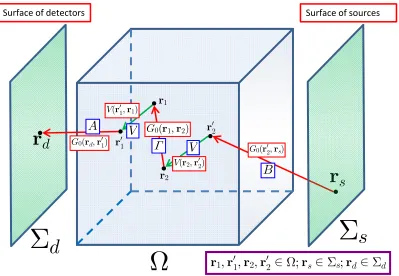
!
d
!
s
r
d
r
s
G0(rd,r01)!"#$%&'(#')&*&%*("+ !"#$%&'(#'+(!"%&+
r
1,
r
01,
r
2,
r
02;
r
s!
s;
r
d!
dG0(r1,r2) V(r01,r1)
V(r2,r02)
G0(r02,rs)
r01
r1
r2
V
r02
V
A
B
Figure 2.1: Illustration of the imaging geometry. The matrices A, B, Γ and V
are the discretized operators in (2.1.10) and are depicted in blue frames. The
restricting and sampling of the kernels G0(r,r0) and V(r,r0) are demonstrated by
the endpoints of the arrows. The multiple scattering depicted corresponds to the
second order term G0V G0V G0in the formal power-series expansion of the left-hand
side in (2.1.9). Note that in the local limit of the potential V(r,r0) the two green
arrows contract to two vertexes at r1 =r01 and r2 =r02.
manner. A is restricted from the detectors to the sample, B is restricted from the
sources to the sample, and Γ is restricted within the sample itself. An example of
this is shown in Figure 2.1. While the slab geometry example in this figure is the
main geometric setup we will be investigating in our later simulations, the above
formulation is general and does not require any specific shape for the surface of
detectors or sources, or the sample. The only physical requirement is that there is
Equation (2.1.10) is not only general with respect to the geometric setup of
the problem and the discretization choices, but is very general in regards to its
application to scattering theory. The geometry matrices A, B, and Γ are all
theo-retically known, and encompass all of the information of the physical model. Since
the elements of the matrix Φ are all acquired experimentally, the only unknown in
(2.1.10) is the scattering potential V. It is important to note that this equation
cannot be solved simply by matrix inversion, as the matrices A andB are typically
of low rank. In fact, the invertibility of these matrices coincides with performing
measurements within the sample, which is a strict violation of the problem. We
now turn to methods for recovering the interaction operator V.
2.2
Nonlinear Reconstructions
Oftentimes, a linearization of the ISP is an acceptable method for solving this inverse
scattering problem. For these methods, a linearizing transformation is applied to
the data function on the right-hand side of (2.1.10) to simplify the forward problem
to be linear in terms of the unknown interaction matrix V, namely
AV B=L[Φ] . (2.2.1)
Moreover, it is conventional to assume that the interaction matrix is strictly
diag-onal, and such by combining the geometry matrices A and B into the matrix K
vector ψ, one obtains the linear equation
Kv =ψ . (2.2.2)
This equation can then be solved for v using any linear equation solver. We will
discuss more linearizing techniques in Sections 4.1 and 5.1.
Another approach to solving inverse scattering problems is to use one of
sev-eral known nonlinear techniques for reconstructing the interaction matrix. These
approaches intend to reconstruct the images with greater accuracy as compared to
linear solvers which make approximations that can significantly reduce the accuracy
of the model. However, nonlinear methods are more computationally intensive than
linear solvers. For that reason, there are many practical scenarios when a linear
re-constructions are acceptable. But when the results obtained from the linearization
of the ISP is not worthy of its application, one must increase the computational
load and use a nonlinear method.
The most popular approach to solving nonlinear inverse scattering problems is
to use Newton’s method or one of its variants. This section will review the idea
behind these mainstream approaches. These methods are reviewed in more detail in
[1, 17, 30]. However, it is worth keeping in mind alternative nonlinear methods such
as the inverse Born series, where the reconstruction is an analytically computable
result directly from the data, and several non-deterministic approaches based on
Bayesian inference.
of equation (2.1.10) and rewrite the ISP in the form F[v] = 0, where v are the
diagonal entries of V and F is the nonlinear functional that relates the scattering
potential to the data. This can be alternatively written as AT B = ˜F[v] which
can more clearly elucidate the relationship the nonlinear functional ˜F has with the
data. From here, one thinks of the inverse scattering problem as an optimization
problem. The solution ˆv is found by minimizing an objective function
ˆ
v = arg min
v Ψ(v). (2.2.3)
In most cases, it is common to treat this objective function Ψ as the statement of
a nonlinear least squares problem, that is
Ψ(v) =
Ns
X
i=1
Nd
X
j=1
[Φc(v)−Φm] , (2.2.4)
where Φm is the measured data for specific source and detector pair, and Φc(v)
is the calculated data for that same pair given a scattering potential within the
vector v. We denote the number of sources and detectors used as Ns and Nd
respectively. Then starting from an initial guessv0, the forward problem for Φc(v0)
is calculated, and then based on the specific minimization scheme, our guess is
updated by vk+1 =vk+γkdk, where dk is a descent direction, and γk is a step size.
Oftentimes in the literature γk = 1, as the step size is typically independent of the
method used to determine the descent direction. However, one can always add an
optimization step that conducts a line search for a useful value of γk. That is,
γk= min
We will now mention some of the most commonly used methods to determine the
direction dk.
2.2.1
Landweber Iteration
Landweber iteration is a special case of steepest descent, in which constraints are
placed on the step size γk. Thus, dk =−∇Ψ(v). Numerically, defining the residual
column vector R(v) with entries
ri(v) = Φci(v)−Φmi , (2.2.6)
allows us to express the gradient of the objective function as the product
∇Ψ(v) =J(v)TR(v), (2.2.7)
where J is the Jacobian matrix defined as
J(v) =
∂r1(v)
∂v1 . . .
∂r1(v)
∂vN
..
. . .. . . .
∂rM(v)
∂v1 . . .
∂rM(v)
∂vN . (2.2.8)
Here, N is the number of discretized elements in the sample, and M = NdNs
is the total number of data points. Thus, Landweber iteration can be succinctly
summarized as
vk+1 =vk−J(v)TR(v) . (2.2.9)
While steepest descent algorithms are well known for converging from very far
is rarely used directly in practice.
2.2.2
Gauss-Newton Method
A faster and more popular method for nonlinear optimization is the Gauss-Newton
iteration method. While steepest descent used only first-order derivatives,
Gauss-Newton uses an approximation to the second derivative. We begin with the
first-order Taylor approximation to the gradient of the objective function
∇Ψ(vk+1) = ∇Ψ(vk+dk)≈ ∇Ψ(vk) +∇2Ψ(v
k)dk . (2.2.10)
Thus as the objective function is minimized when this equation is equal to zero, we
are interested in solving the set of equations
∇2Ψ(vk)dk=−∇Ψ(vk) , (2.2.11)
for the Gauss-Newton direction dk. The term∇2Ψ(vk) is the Hessian operator and
can be calculated as
∇2Ψ(vk) = 2J(vk)TJ(vk) +
M
X
m=1
Nv
X
i=1
Nv
X
j=1 ri(v)
∂rm(v) ∂vi∂vj
. (2.2.12)
In practice, the second term requires a very lengthy calculation, and is in fact
typically much smaller than the first. Therefore, Gauss-Newton method uses the
approximation
∇2Ψ(v
This combined with the previous result∇Ψ(vk) = 2J(vk)TR(vk), we obtain a set of
linear equations to solve for the search direction, namely
J(vk)TJ(vk)dk =J(vk)TR(vk). (2.2.14)
Gauss-Newton can converge much quicker than steepest descent, but fails to
con-verge for initial guesses not close to the desired result. However if an initial guess
is sufficiently close, convergence is quadratic.
2.2.3
Levenburg-Marquardt Method
The Levenburg-Marquardt method is a popular nonlinear iterative algorithm that
balances the benefits of both steepest descent iteration and Gauss-Newton method.
In its purest form, a positive diagonal matrix is added to the approximation to the
Hessian on the left-hand side of (2.2.14). Most commonly this diagonal matrix is
chosen to be a multiple of the identity matrix, giving the set of linear equations
governing this method to be
(J(vk)TJ(vk) +λkI)dk =J(vk)TR(vk) . (2.2.15)
This choice closely resembles the well-known Tikhonov regularization and is in fact
equivalent to iteratively regularized Gauss-Newton. For very small values of the
damping parameterλk, the direction is clearly very close to the direction obtained by
pure Gauss-Newton. However, larger values of λk suppresses the second derivatives
is closer to steepest descent. Thus, the choice of λk can be modified each iteration –
if it is known that our intermediate result is reasonably close to correct, λk should
be made small to have near quadratic convergence behavior a la Gauss-Newton. If
we can be reasonably sure we are far away, a larger value of λk would be preferred
for a larger convergence radius.
2.2.4
Nonlinear Conjugate Gradient
The last common nonlinear reconstruction technique we will review is nonlinear
conjugate gradient. Regular conjugate gradient is a linear iterative method for
solving symmetric positive definite linear systems. Convergence is guaranteed for
the linear case in at most n iterations, where n is the size of the system, and
acceptable results can be found much faster depending on the spectrum of the
matrix involved. For completeness sake (and as this algorithm is used later in the
simulated linear reconstructions) this algorithm for solving the equation Kv = ψ
goes as follows for an initial guess v0:
1. r0 =Kv0−ψ
∆v0 =−r0
2. While krkk> do
(a) αk = r
T krk
∆vT kK∆vk
(c) rk+1 =rk+αkK∆vk
(d) βk+1 =
rT k+1rk+1
rT krk
(e) ∆vk+1 =−rk+1+βk+1∆vk; k =k +1
Nonlinear conjugate gradient method can then be directly obtained from its linear
counterpart by removing all instances of the residual rk from the above algorithm
and replacing it with ∇Ψ(vk).
2.3
T-matrix
The T-matrix is defined as the operator that relates the complete and unperturbed
Green’s functions through the Dyson equation
G=G0+G0T G0 . (2.3.1)
A simple inspection of equation (2.1.8) solves for this operator as
T = (I−V G0)−1V . (2.3.2)
Another interesting way of looking at the T-matrix is to define the transition
op-erator which maps incident waves into the product of the interaction opop-erator and
the total wavefield [14, 46]. That is,
and if we multiply both sides of the Lippman Schwinger (2.1.7) equation by the
scattering potential V, we obtain
T u0 =V u0+V G0T u0 , (2.3.4)
or equivalently
T =V +V G0T (2.3.5)
Again solving this equation for T we arrive precisely at the definition in (2.3.2).
From the definition of the transition operator, one can conclude that the scattering
amplitude outside of the sample is proportional to the boundary value of the
T-matrix over a sphere. Thus, scattering amplitude can be determined directly from
the T-matrix, but not vice versa. Clearly the T-matrix completely determines the
scattering operator through the one-to-one correspondence in (2.3.2), but merely
knowing the scattering amplitudes only determines the scattered field outside of the
sample. Thus, one can think of the inverse scattering problem as computing the
T-matrix from some analytic continuation of the scattering amplitudes. However,
there is no stable method to accomplish this.
As an actual discretized matrix, the relationship between the T-matrix and V
is written as
T = (I−VΓ)−1V =V(I−ΓV)−1 . (2.3.6)
Clearly, the T-matrix is symmetric. The inverse operation in equation (2.3.6) is
From (2.3.6), we can calculate that
V = (I+TΓ)−1T =T(I+ΓT)−1 . (2.3.7)
Thus, we have a one-to-one correspondence between the transition matrix and the
interaction matrix. Knowledge of either of these matrices fully determines the
Chapter 3
The Data-Compatible T-matrix
Completion Algorithm
3.1
Motivation
We now turn towards the crux of this these – introducing the novel nonlinear
itera-tive method, data compatible T-matrix completion. Before detailing the specifics of
the algorithm, it is worth discussing the desire for additional methods to approach
nonlinear inverse scattering problems. All of the methods reviewed in Section 2.2
calculate an objective function which depends on all available data measurements,
and is subsequently minimized using one of the previous schemes. In its naive form,
computationally implementing any of these methods at least require storage of the
andNv is the number of discretized elements one wants to reconstruct. And then for
say Gauss-Newton, one also requires the matrix multiplication JTJ, which requires
O(M2Nv) operations. This calculation quickly becomes unwieldy as the number of
data measurements increases. This is clearly unwanted, as one of the major tools
we have to solve inverse scattering problems is the ability to conduct multiple
ex-periments and obtain very large data sets. However, with traditional methods one
must balance the benefits from additional data measurements versus the increased
computational workload.
It would be dishonest to leave out the fact that there exist more efficient methods
for generating and multiplying these large Jacobian matrices, and thus run faster
than O(M2Nv). Adjoint methods such as in [4, 5, 43] can take advantage of the
sparse nature of the Jacobian matrix in a manner where the Jacobian matrix is never
explicitly computed. But while there are certainly computational improvements one
can make when using these Newton methods, one cannot escape the fact that the
computational workload increases as our data set increases as well.
There is substantial evidence that inverse scattering problems of interest require
strongly overdetermined data sets in order to obtain accurate results [36, 37]. For
example, to obtain optimal lateral resolution for diffuse optical tomography in the
slab geometry with 100×100 grid cross-sections, one needs on the order of 300×300
panels of sources and detectors on either side of the sample. This set up produces
size of the discretization mesh, and is the limiting factor for mainstream nonlinear
approaches. This relative magnitude of the size of the overdetermined data set
holds for many other ISPs of interest.
There has been a great deal of interest in both acquiring these large data sets,
and experimentally determining the optimal size of data sets for DOT [6, 31, 50].
Noise and severe ill-posedness can warrant a reduction in the optimal size of the data
set, as one can reach the limit of resolution, and especially noisy data measurements
are better off left discarded. However, the majority of these works use linearized
reconstruction techniques to be able to handle the large data sets efficiently. Thus,
it is certainly desirable to develop nonlinear techniques that will forgo these linear
approximations that reduce accuracy, but can still reconstruct from large data sets
with reasonable computing time.
This is the main goal of DCTMC – to present a nonlinear solver in which
in-creasing the size of the data set has a negligible impact on computation time. The
descriptions of the Newton type solvers in Section 2.2 are very clear in that the
unknown interaction matrix from the forward matrix equation (2.1.10) is treated
as being strictly diagonal and can thus be reduced to a column vector. This comes
from the theory of locality, which states that certain physical properties or events
at a specified point r are only influenced by the field present within a finite radius
never zero, the radius of influence ` is typically small enough (often on the atomic
scale which is much smaller than any discretization mesh), that the forced diagonal
structure of V is accurate.
DCTMC relaxes this locality restriction, and allows our iterative process to
search for nonlocal interaction operators as well. For example, Ohm’s law in local
electrodynamics isJ(r) =σ(r)E(r). Relaxing this to nonlocal electrodynamics, the
current density J(r) is given by
J(r) = Z
V(r,r0)E(r0)d3r0 , (3.1.1)
where V is the integral interaction operator as in (2.1.2). Now we consider the
Calderon problem where we want to find the conductivity σ(r) from voltage drop
measurements taken after two electrodes inject direct current. Finding a nonlocal
kernel V(r,r0) from 3.1.1 that is consistent with the voltage drop measurements
can be simple as this problem is very underdetermined – the degrees of freedom of
V(r,r0) is much larger than the size of the data set. But for the exact same reason,
V(r,r0) cannot be determined uniquely. What we have accomplished so far by
generalizing the linear relationship between the current density and electric field to
a nonlocal setting is the ability to find many solutions that are compatible with the
data. The question remains, how can we narrow down to our desired solution? Keep
in mind that our generalization to the nonlocality of V was only a mathematical
trick, we still expectV to be local to some degree, that isV(r,r0)→0 when|r−r0|>
conductivity can be obtained from the integral operator by σ(r) = R
V(r,r0)d3r0.
Our search out of our data consistent solutions is narrowed down to a search for an
approximately diagonal nonlocal kernel V(r,r0). The concept for DCTMC can be
summarized as:
(1) An initialization step where a class of kernels V(r,r0) that are compatible
with the data is formed. This initialization is the only place when the data
measurements are explicitly used. Moreover, the size of the data set is not a
limiting factor for defining this class of data compatible solutions.
(2) Then we iteratively reduce the off-diagonal norm of V(r,r0) while ensuring
that all iterations of V(r,r0) remain compatible with the data.
(3) Once the ratio of the off-diagonal and diagonal norms ofV(r,r0) is sufficiently
small, we have found our diagonally dominated data-compatible interaction
operate. We then compute the local interaction σ(r) =R V(r,r0)d3r0. This is
the final solution to the nonlinear ISP.
While this motivation was stated for electrical impedance tomography, its statement
is very general and can be applied to many other inverse scattering problems. The
fact that (1) above is the only time the data is used (and is not limiting) highlights
the potential advantages of this algorithm.
Lastly of note, the T-matrix from Section 2.3 plays a crucial role in the DCTMC
problems [33, 52]. These methods are source and detector independent, as the
computation of the T-matrix gives the forward solution for any source and
de-tector arrangement. The mainstream Newton approaches typically utilize finite
difference and finite element methods for the forward problem, which must be run
for each source independently. However, finite element methods generate sparse
matrices which allow for some of the reductions mentioned required for Jacobian
calculations. The trade off for working with source/detector independence is that
computing the T-matrix as in (2.3.6) requires inverting a dense matrix. This
one-to-one correspondence between the interaction operator V and the T-matrix plays
an important role in DCTMC.
3.2
The Experimental T-matrix
We return to the discretized forward equation for the scattering problem
A(I−VΓ)−1V B =Φ , (3.2.1)
but now substituting in equation (2.3.6) to obtain the forward equation
AT B =Φ , (3.2.2)
which is a linear equation in T. It is worth taking some time to discuss the relative
sizes of all matrices in equation (3.2.2). The volume is discretized into Nv voxels,
it is clear that the inequality
Ns, Nd Nv NsNd (3.2.3)
must hold if there is any hope of solving the inverse problem with reasonable
accu-racy. The first inequality is generally true due to the nature of most problems of
in-terest, namely that it is impossible to take enough useful measurements to perfectly
determine a solution. The second inequality states that we need an overdetermined
system to handle the ill-posedness involved. So while this inequality holds true in
general, it is useful to consider the order of the values used throughout this paper.
As in the setup in Fig. 6.1, let the measurement planes Σs and Σdbe identical, with
both sources and detectors scanned on L×Lsquare grids. The sample is discretized
with the same pitch as the source/detector grids on an L×L×L cubic grid. Then,
Ns =Nd=L2,Nv =L3, andNsNd=L4, which certainly satisfies condition (3.2.3)
for reasonable values of L.
The dimensions of all matrices in equation (3.2.2) are shown in Fig. 3.1. For
all of the reasons mentioned, we can assume that A and B are not invertible.
However, since we have rewritten the forward equation to be linear equation in
our fundamental unknown T, we can fully utilize the knowledge of pseudoinverses.
This will lead us to the definition of the experimental T-matrix, which is the central
concept to DCTMC.
The idea is to find a condition on T that completely satisifies equation (3.2.2).
T
=
â
â
Nv Nv Nv NvN
dN
sN
sN
dB
A
Figure 3.1: Schematic block diagram of equation (3.2.2). Nv is the number of
discretized voxels, while Nd and Ns are the numbers of detectors and sources
re-spectively.
A and B. That is,
A=
Nd
X
µ=1
σµAfµA gµA
, B=
Ns
X
µ=1
σµBfµB gµB
, (3.2.4)
where σAµ are the singular values of A, and fµA
are the left singular vectors of A
of length Nd and
gµA
are its right singular vectors of lengthNv. This is similar for
B, but with the left singular vectorsfµB
being of length Nv and the right singular
vectors gµB
being of length Ns. Note that the summations in (3.2.4) have upper
indicies of Nd and Ns, due to our assumption that Nd, Ns ≤Nv (all singular values
of larger index thanNdorNsare identically equal to zero). Now using orthogonality
of singular vectors and rearranging our forward equation, we obtain the entrywise
condition
where we have the following entrywise definitions:
˜
Tµν ≡
gµA|T|fνB
, 1≤µ, ν ≤Nv ; (3.2.6a)
˜
Φµν ≡
fµA|Φ|gνB
, 1≤µ≤Nd , 1≤ν ≤Ns . (3.2.6b)
We now letRAbe theNv×Nvunitary matrix formed by the column singular vectors
|gA
µiand RB be theNv×Nv unitary matrix formed by the column singular vectors
|fB
µi. Then, the first line of equation (3.2.6) implies with the unitary property that
˜
T =R∗AT RB and T =RAT R˜ ∗B . (3.2.7)
Note that even though this transformation from T to ˜T is invertible, it is not a
conventional rotation due to the fact that RA 6= RB in general. We now call the
matrixT that has been used thus far the T-matrix inreal-space representation, while
the “rotated” matrix ˜T is named the T-matrix insingular-vector representation. We
could name Φ˜ and Φsimilarly, albeit using different unitary matrices (of dimension
Nd×Nd and Ns×Ns). But to avoid confusion, since Φ˜ is not a recurring aspect of
the DCTMC algorithm, we refrain from explicitly defining these “rotations”.
Returning to the equivalent singular-vector representation forward equation
(3.2.5), we see that we can numerically reduce this constraint to
˜
Tµν =
1 σA µσνB
˜
Φµν , if σµAσνB > 2 ;
unknown , otherwise .
(3.2.8)
where we have used the conventional notation that σµA and σµB are equal to zero
reg-ularization parameter to deal with numerical imprecisions. With infinite precision,
equation (3.2.8) results in NsNd known values, but for an appropriate choice of
larger than the smallest positive floating-point constant of computational precision,
it is certainly possible for this equation to give less than NsNdknown values in the
T-matrix in singular-vector representation.
However many known entries results from equation (3.2.8) summarizes the
en-tirety of our knowledge based solely on the data. But we know these entries are
correct in singular-vector space with great certainty. In fact, since these entries fully
(or nearly, depending on the choice of) represent the data, any choice or
modifica-tion to the unknown values will have negligible impact on the error of the forward
equation (3.2.2) when the T-matrix is rotated back to real-space. This is precisely
our definition of data-compatability: a T-matrix is called data-compatabile if when
it is rotated to the basis of singular functions, it agrees with all known values from
equation (3.2.8).
In general, we can expect this equation to result in a number of known entries
not much less than or equal to NsNd. However, from inequality (3.2.3), we know
that NsNd Nv2, which implies that we only know a very small number of the
total entries of ˜T. For our previous estimated values of these dimensions, we have
NsNd/Nv2 = 1/L2, which is certainly a small fraction of known entries for large L.
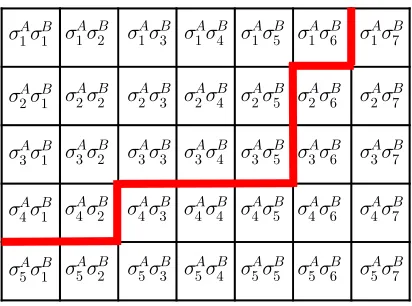
We can arrange the singular values of A and B in descending order, and such the
MA×MB, where MA ≤ Ns and MB ≤ Nd. This is schematically shown in Figs.
3.2. The region of known elements can be of a general shape contained in this
rect-angular block, but we will assume it is rectrect-angular. Furthermore, in all numerical
simulations, the region was indeed rectangular. It is not complicated to include
irregular shapes (see Figure 3.3), but it adds nothing to the discussion.
We can now define the experimental T-matrix Texp as the matrix that satisfies
the forward equation (3.2.2) in the minimum norm sense with smallest norm kTk2.
We can calculate Texp in one of two ways. The first method, which was hinted at
before, is to calculate
Texp =A+ΦB+ , (3.2.9)
where A+ and B+ are the Moore-Penrose pseudoinverses. Then to obtain ˜Texp in
singular-vector space, one needs to perform the necessary rotation as in equation
(3.2.7). An equivalent method is to work directly in singular-vector representation,
defining ˜ Texp µν = 1 σA µσνB
˜
Φµν , if σµAσνB > 2 ;
0 , otherwise .
(3.2.10)
which is setting all unknown entries to be identically equal to zero. It is worth
noting that even though ˜Texp is sparse, the same is not necessarily true of Texp.
Perhaps even more important to note, is the fact that by this definition Texp is
not necessarily symmetric, even though it is theoretically known that the correct
T
à
exp
=
ûAöûB÷
à
ö ÷
T
à =
!"#"$%"!"#"$%"
!"#"$%"
!"#"$%"
!"#"$%" ûAöûB÷
à
ö ÷
MA
MB
MA
MB
Figure 3.2: Left panel: Known elements of ˜T in singular-vector representation
computed from the data by using (3.2.8) are organized inside the shaded block in the upper left-hand corner. Elements outside of this shaded block are not known
and completely independent of the data. Right panel: The experimental T-matrix,
Texp, the minimum norm solution to (3.2.2). This is equivalent to setting the
un-known elements of ˜T to zero.
inherent to the algorithm, we can easily ensure symmetry. We are now ready to
proceed to defining the basics of the iterations.
3.3
Iteration Cycle
There are two main conditions to be met:
(i) The T-matrix must be data-compatible
(ii) The corresponding V-matrix must be diagonally dominated
Our goal is to “complete” the matrix ˜T in singular-vector space by filling in the
unknown elements in a way that the corresponding interaction matrix V in real
space is diagonally dominant. By using the one-to-one correspondence between the
T-matrix and the interaction matrix V, and the invertible rotations between real
ûA 1û B 1 û A 1û B 2 û A 1û B 3 û A 1û B 4 û A 1û B 5 û A 1û B 6 û A 1û B 7 ûA 2û B 1 û A 2û B 2 û A 2û B 3 û A 2û B 4 û A 2û B 5 û A 2û B 6 û A 2û B 7 ûA 3û B 1 û A 3û B 2 û A 3û B 3 û A 3û B 4 û A 3û B 5 û A 3û B 6 û A 3û B 7 ûA 4û B 1 û A 4û B 2 û A 4û B 3 û A 4û B 4 û A 4û B 5 û A 4û B 6 û A 4û B 7 ûA 5û B 1 û A 5û B 2 û A 5û B 3 û A 5û B 4 û A 5û B 5 û A 5û B 6 û A 5û B 7
Figure 3.3: A more general shape of known elements of the experimental T-matrix, as compared with Figure 3.2. The elements above the thick red line satisfy the
condition σµAσνB > 2. Assuming that the singular values σAµ and σµB are arranged
in the descending order, the boundary line can only go from left to right and from bottom to top if followed from the left-most boundary of the matrix. One can easily
obtain a rectangular shape by excluding the elements σ4Aσ1B,σ4Aσ2B, andσ1Aσ6B, but
this is not necessary.
by alternatively ensuring conditions (i) and (ii).
We now explicitly define a number of operators that will ease in the description
of the algorithm. We letT[·] be the nonlinear operators that computes the T-matrix
from a given interaction matrix by the previous definition (2.3.6)
T[V] = (I−VΓ)−1V , (3.3.1)
which is also invertible (as discussed in Section 2.3) with the form
T−1[T] = (I +TΓ)−1T . (3.3.2)
Note that both of these functionals have Γ as a parameter, and can act on any
Nv ×Nv matrix. However, they are only intended to be used for the appropriate
and singular-vector representations and its inverse R−1[·] by
R[T] =R∗AT RB , R−1[ ˜T] =RAT R˜ B∗ . (3.3.3)
Again, these operators can act on any Nv×Nv matrix, but have been written with
the parameter of intended use. The definition of this operator also presupposes that
the rotation matrices have already been calculated, and thus the SVD representation
of A and B. With these same assumptions, we define the masking operators M[·]
and N[·]:
M[ ˜T]
µν ≡
0, σµAσνB> 2 ;
˜
Tµν , otherwise .
N[ ˜T]
µν ≡ ˜
Tµν , σµAσνB > 2 ;
0, otherwise .
(3.3.4)
with the point that M[ ˜T] +N[ ˜T] = ˜T. Then the method of enforcing
data-compatibility of ˜T can be defined through the overwriting operator O[·] by
O[ ˜T]≡ M[ ˜T] + ˜Texp = ˜T − N[ ˜T] + ˜Texp . (3.3.5)
The operator literally leaves all “unknown” elements unchanged, and forcibly
over-writes the “known” entries.
Finally, we define the operatorD[·], which calculates the diagonal approximation
to an Nv ×Nv matrix. We will begin by defining this operator by
D= (D[V])ij ≡δijVii , (3.3.6)
which is perhaps the simplest method of defining a related diagonal matrix by
in a similar manner. We can certainly choose alternate definitions forD[·] andO[·],
which we will later discuss and justify our final choices. For now, overwriting and
diagonalizing are done by forcibly changing any entry that is not desired.
With these definitions in hand, we can now elaborate on the iterative algorithm
DCTMC. We assume that the SVD decompositions of the geometry matricesAand
B have been precomputed, along with the experimental T-matrix ˜Texp. Let k = 1,
and our initial guess ˜T1 = ˜Texp. Then the algorithm runs as follows:
1: Tk=R−1[ ˜Tk]
This transforms the T-matrix from singular-vector to real-space
representa-tion. Both ˜Tk and Tk are data-compatible.
2: Vk=T−1[Tk]
This gives k-th approximation to the interaction matrix V. Vk is
data-compatible but not diagonal. Compute the off-diagonal and diagonal norms
of Vk. If the ratio of the two is smaller than a predetermined threshold, exit;
otherwise, continue to the next step.
3: Dk =D[Vk]
Compute the diagonal approximation to Vk, denoted here by Dk. Dk is
diag-onal but not data-compatible.
4: Tk0 =T[Dk]
Tk, Tk0 is no longer data-compatible.
5: ˜Tk0 =R[Tk0]
Transform Tk0 to singular-vector representation. Here ˜Tk0 is still not
data-compatible.
6: ˜Tk+1=O[ ˜Tk0]
Advance the iteration index by one and overwrite the elements of ˜Tk0 that are
known from data with the corresponding elements of ˜Texp. This will restore
data-compatibility of ˜Tk+1. Then go to Step 1.
These steps illustrate a method for iteratively ensuring data-compatibility of the
T-matrix and diagonal dominance of the interaction matrix V. A flowchart of these
iterations is shown in Figure 3.4. While these enforcements are “exclusive or” in
the boolean sense that only one of them is guaranteed to be true at any point in
the algorithm, the goal is that convergence will lead to an acceptable result on both
fronts.
3.4
Computational Complexity and Shortcuts
In terms of computational complexity, Steps 1, 2, 4, and 5 are dominant, all with
complexityO(Nv3). In this section however, we will present computational shortcuts
to reduce the number of steps with complexity O(Nv3). The first shortcut for fast
!"!#$%&'!"()*+,-#&!".(/ 0+'.+1+2"!"(%23,45 k
T
!"!#$%&'!"()*+,-#&!".(/ 0+'.+1+2"!"(%23,04 kT
(!6%2!*,(2"+.!$"(%2#$%&'!"(# )*+,-#&!".(/0+'.+1+2"!"(%23,04
T
k(!6%2!*,(2"+.!$"(%2#$%&'!"(# )*+,-#&!".(/
0+'.+1+2"!"(%23,45
T
k!"!#$%&'!"()*+ (2"+.!$"(%2,&!".(/ 7%88#9(!6%2!*: 0+'.+1+2"!"(%23,04 k
V
(!6%2!*,(2"+.!$"(%2, &!".(/ 72%",9!"!#$%&'!"()*+: 0+'.+1+2"!"(%23,04 kD
!"#$%&$'()'*+,$'-"$+$."/,!"#$%&$'0)'*+,$'T D
+/'
T
!
1+$+ *.#,$'.$2#+$."/ &3,24&2/$ .$2#+$."/, 51'"6'A+/7'B1.Rà1
2.T à1
3
.
D
4.T8 ! 2 '9 " $$ :2 / 2 %;
5
.
R
6
.
O
k
k
+ 1
<=.$'.6'%"/7.$."/ .,'>2$
Figure 3.4: Basic flowchart of the DCTMC iteration process for the case when
the iterations start with an initial guess of ˜Texp. The operations for the numbered
implementation. The second shortcut which reduces computation time from the
T-matrix to the interaction matrixV is certainly useful for the definition presently
used of D[·] in (3.3.6), but may be needed to be eschewed when using alternative
definitions for the diagonal matrix approximation operator.
3.4.1
Fast Rotations and Data-Compatibility
The first shortcut combines steps 5, 6, and 1 into one step that enforces
data-compatibility by overwriting without rotating all entries to singular-vector space
and back. These steps are listed below, with their computational complexity as
well as their complexity based on the estimated values with discretization into grid
size L.
5 : T˜k0 =R[Tk0] O(Nv3) =O(L9) ,
6 : T˜k+1 =O[ ˜Tk0] ≤O(NdNs) =O(L4) ,
1 : Tk+1 =R−1[ ˜T
k+1] O(Nv3) =O(L9) .
Steps 1 and 5 are obviously the dominant steps, with Step 6 only needing to access
and overwrite a maximum ofNsNdentries (and potentially less depending on desired
precision). It is natural to combine these three steps, due to the fact that the
bookend rotations are linear. Combining these three steps in one results in
Tk+1 =R−1[O[R[Tk0]]] =R
−1hR[T0
k]− N[R[T
0
k]] + ˜Texp
i
where the second equality has inputted the second definition of O[·] in (3.3.5) and
the fact that R[Texp] = ˜Texp. Now we can distribute the operator R−1 across due
to linearity, which results in the expression
Tk+1 =Tk0 +Texp − R−1[N [R[Tk0]]] . (3.4.2)
This expression is identical to Steps 5, 6, and 1, but we still need to be able to reduce
R−1[N [R[T0
k]]] to show any computational improvements. This is not difficult, as
(3.4.2) has replaced O[·] in (3.4.1) with N[·], which turns any matrix into a sparse
matrix. Therefore, it is reasonable to expect that R−1[N[R[T0
k]]] can be computed
in fewer than O(Nv3) operations.
Let us first consider the operation N[R[T]]. As the masking operator N sets
all entries not in the upper left MA×MB submatrix to zero, there is no need to
calculate all entries in the rotation R[T]. Therefore we define the Nv ×MA
ma-trix PA by the first MA columns of RA, and similarly PB by the first MB columns
of RB. Then, N[R[T]] = PA∗T PB which now has computational complexity of
O(min(MA, MB)Nv2) which is a reduction over the original computational
complex-ity of O(Nv3) by a minimum ofO(L) under our estimates. Identical reasoning allows
us to expand to the full expression
R−1[N[R[Tk0]]] =PA(PA∗T PB)PB∗ , (3.4.3)
which has the same computational complexity of O(min(MA, MB)Nv2). It is clear
= â â
T
P
ãA
P
B= â â
T
R
ãA
R
BR
[
T
]
N
[
R
[
T
]]
N
MA
MB
0 0
0
0
0
0
0
0
0
MA
MB
Figure 3.5: Schematics of computing N[R[T]]. Matrices PA and PB are obtained
from RA and RB by setting all columns to zero except for the first MA and MB
columns, respectively.
any sense. Therefore, it would be inefficient to premultiply these matrices and set
QA = PAPA∗ and QB = PBPB∗ and calculate QAT QB. Using this premultiplication
would clearly still have complexity O(Nv3). Therefore, the evaluation of (3.4.3)
should be calculated in the order implied by the parentheses to gain an improvement.
Putting all of this together, we obtain the shortcut for fast rotations combing Steps
5, 6, and 1 by
Tk+1 =Tk0 +Texp−PA(PA∗T
0
kPB)PB∗ . (3.4.4)
With this shortcut, it is no longer necessary to store the full matrices of RA and
RB in memory. We only need to precompute and store PA and PB. Since Texp is
3.4.2
Fast
T
→
D
Transformation (Option 1)
We now consider another shortcut that will quickly calculate the related interaction
matrix V to the T-matrix and simultaneously find its diagonal approximation D.
This shortcut can be thought of as not a pure shortcut to the algorithm, but as an
alternative definition to the closest diagonal approximation operator D[·] that runs
faster. Our previous definition was to compute V that perfectly corresponds to T,
but is most likely not diagonally dominated. Then we set all off diagonal terms to
zero to arrive at our diagonal approximation. Put alternatively, we seek a diagonal
matrix D that minimizes kV −Dk2. However, we can also search directly for the
nearest diagonal matrix D that corresponds to T. From (2.3.7), we have
T =D+DΓT , (3.4.5)
which we can solve as a classical minimization problems, stated as
min
D diagonalkT −D−DΓTk2 . (3.4.6)
We can explicitly solve problem (3.4.6) to arrive at the solution:
Dij =δij
Tii+ [(ΓT)
∗
T]ii
1 + [(ΓT)∗+ (ΓT) + (ΓT)∗(ΓT)]ii . (3.4.7)
While we have arrived at a nice closed-form solution to (3.4.6), at first glance it
seems like this evaluation still requires O(Nv3) operations, which is not an
improve-ment over the original method which required the inverse an Nv×Nv matrix. The
issue seems to be the calculation of the product ΓT, however, we are able to
the matrix Λ = ΓT, and look back at the computational shortcut for fast rotations
as stated in (3.4.4). We can multiply both sides of the equation by Γ to obtain
ΓTk+1 =ΓTk0 +ΓTexp−ΓPA(PA∗T
0
kPB)PB∗ , (3.4.8)
or using the natural extension of the definition of Λ,
Λk+1 = Λ0k+ Λexp−(ΓPA) (PA∗Tk0PB)PB∗ . (3.4.9)
The matrix ΓPA can be precomputed at the start, as well as the matrix Λexp =
ΓTexp, so the only remaining issues is how to obtain Λ0k. If this matrix can be easily
obtained, then the computational complexity of (3.4.9) is identical to the complexity
of the previous shortcut, namely O(min(MA, Mb)Nv2). It is a reasonable question if
the computation of Λ0k requires a new matrix multiplication, due to the fact that
ΓTk0 has not been used previously. However, it can be precomputed without any
additional cost in the previous step of the algorithm. From the definition of T[·] in
(3.3.3), we have
Tk0 =Dk(I−ΓDk)−1 . (3.4.10)
which results in
Λ0k =ΓDk(I−ΓDk)−1 = (I−ΓDk)−1−I , (3.4.11)
when both sides of (3.4.10) are left-multiplied by Γ. Thus,as we already need to
calculate this inverse matrix, we are able to obtain Λ0k simply by subtracting off of
1: Compute the product∆k≡ΓDk, which is fast because Dk is diagonal.
2: Compute the inverse Sk≡(I−∆k)−1, which has the complexity of Nv3.
3: ComputeΛ0k=Sk−I [as follows from (3.4.11)].
4: ComputeTk0 =DkSk [as follows from (3.4.10)], which is again fast becauseDk
is diagonal.
Thus, in this shortcut to go directly from T to D, we have eliminated all steps in
this process requiringNv3 operations, leaving only the calculation in item 2 inverting
(I−∆k) as required to go from the interaction matrix V to the T-matrix.
3.4.3
Fast
T
→
D
Transformation (Option 2)
We now present another alternative for the diagonal approximation Dk to an
in-teraction matrix that also allows for computational improvements over the original
method. We define the operator D[·] as:
Dij =
PNv
k=1Vik i=j
0 i6=j ,
(3.4.12)
which sums over all rows to the diagonal. This fits in with the conceptual
under-standing of DCTMC in terms of working in a nonlocal framework. Returning to
the example used in 3.1, the nonlocal version of Ohm’s law is generalized from the


![Figure 3.5: Schematics of computing N [R[T]]. Matrices PA and PB are obtainedfrom RA and RB by setting all columns to zero except for the first MA and MBcolumns, respectively.](https://thumb-us.123doks.com/thumbv2/123dok_us/9333836.1467932/53.612.175.465.83.286/figure-schematics-computing-matrices-obtainedfrom-setting-mbcolumns-respectively.webp)