
Changes in composition and structure of water hyacinth based on various pretreatment methods
12
0
0
Full text
(2) PEER-REVIEWED ARTICLE. bioresources.com. lignocellulosic material for bioenergy production (Rezania et al. 2016, 2018). The accurate analysis of the composition of WH can affect the overall economy of the process (Uday et al. 2016; Guna et al. 2017). According to Karimi and Taherzadeh (2016), it is necessary to have an accurate and reliable analysis to evaluate the biofuel production based on the carbohydrate content before and after pretreatment. It is important to evaluate the effects of the deconstruction of lignin, cellulose, and hemicellulose. Compositional analysis of these components can show how they have been removed or changed (Brandt et al. 2013). In untreated biomass, the polymers of cellulose, hemicellulose, and lignin are linked as a strong structure. In addition, various changes in the physical and chemical structures of lignocellulosic materials occur using different pretreatment methods. Selecting or designing a suitable pretreatment method can overcome this complicated structure by splitting up the recalcitrant characteristics of lignocellulose biomass (Sasmal and Mohanty 2018). Different cost-effective pretreatment methods have been identified based on the types and structures of lignocellulosic biomass (Barua and Kalamdhad 2017). The effectiveness of these pretreatments depends on the physical structure, the chemical composition of the biomass, and the pretreatment conditions (Sindhu et al. 2016). Sun et al. (2016) stated that the glucosidic bonds of hemicellulose and cellulose are sensitive to acid and can be partially solubilized to further improve the accessibility of enzymes to cellulose. As studied by several authors, combined pretreatments are more effective than a single method for the WH biomass. For instance, Barua et al. (2017) reported that the electrohydrolysis pretreatment of WH resulted in the reduction of lignin and crystallinity due to the disruption of the molecular structure. In another study, the degree of lignin removal and the cellulose conversion of WH efficiently increased using ultrasound-assisted IL pretreatment and sodium dodecyl sulfate (Chang et al. 2017). Zhang et al. (2018) found that the combined microbial pretreatment with dilute acid was an effective pretreatment method for WH hydrolysis. In this instance, the microbial was responsible for delignification, which was followed by the breakdown of hemicellulose via dilute acid. In the process of ethanol production from lignocellulose, the biomass recovery yield of pretreatment is also an important factor. A low glucose yield can be obtained due to a low biomass recovery yield, which implies the loss of cellulose during pretreatment. It can be assumed that the low biomass yield causes a high removal of lignin and overdegradation of the cellulose fibers (Tye et al. 2016). Therefore, the selected pretreatments were chosen to compare the efficiency of alkali and acid (as the most used two pretreatments methods), microwave-assisted (as a combined method), and IL (as rarely used method for WH biomass). Hence, the novelty of this study is to evaluate the effectiveness of selected pretreatment methods on the composition and structure of WH based on scanning electron microscopy (SEM) images and the biomass recovery rate.. EXPERIMENTAL Materials Water hyacinth preparation The WH plants were collected from a natural pond. The leaves were separated and washed with distilled water, then chopped into small pieces (approximately 1 cm to 2 cm), blended to small particles (approximately 3 mm to 5 mm), sun-dried for one day at an outside temperature of 28 °C and humidity of 60%, and then stored in plastic bags for Rezania et al. (2019). “Pretreated water hyacinth,” BioResources 14(3), 6088-6099.. 6089.
(3) bioresources.com. PEER-REVIEWED ARTICLE. further use. The chemicals used, such as sodium hydroxide (NaOH) and sulfuric acid (H2SO4) were analytical grade reagents. The ionic liquid (IL) solution was obtained from Sigma Aldrich (St. Louis, MO, USA). Methods Different pretreatment methods In this study, four types of pretreatments were performed: acid, alkali, IL, and microwave-alkali. The pretreatment specifications were like those in a previous study (Rezania et al. 2019). The alkali pretreatment was performed at four different concentrations of NaOH (4%, 5%, 6%, and 7%) at 110 °C and a pH of 5. A total of 5 g of biomass sample and 10 mL of NaOH were mixed together. The mixture of biomass and alkali was left to soak for 1 h and was treated for 10 min at 150 °C inside a furnace (CFMD; Changshin Science, Seoul, South Korea). The hydrolysate was collected using the filtration method. For the acid pretreatment, 5 g of WH was mixed with 50 mL of dilute sulfuric acid at 4%, 5%, 6%, and 7% (v/v) and autoclaved at 120 °C for 15 min. Then, the treated biomass was neutralized with the addition of calcium hydroxide and filtered with a 0.45-µm Whatman membrane filter (Sigma-Aldrich, Seoul, South Korea). The IL pretreatment was performed by mixing 51 mL of 1-ethyl-3-methylimidazolium acetate ([EMIM][Ac]) and 3 g of WH in a 17:1 ratio at a pH of 8. The solution was heated and stirred at 120 °C and incubated for 60 min, 90 min, 120 min, and 150 min of retention time. To regenerate the WH, an equal volume of deionized water was added to the WH and solvent solution and the precipitation quickly occurred. The sample was centrifuged and the supernatant containing IL was removed and used. Then, the precipitate was washed using deionized water. Finally, the regenerated WH was filtered and oven-dried at 60 °C for 48 h (forced convection oven, Seoul, South Korea). The microwave-alkali pretreatment was conducted in a WX-4000 microwave digestion system (Zhejiang Scientific Instruments & Materials, Hangzhou, China). In this pretreatment, the WH was treated with 1.0% (w/v) NaOH solution for 24 h at 45 °C in a shaker at 120 rpm. The treated WH was then heated for 1 min, 4 min, 7 min, and 10 min at 420 W in a microwave oven (Sanyo Super Shower Wave 900W; Sanyo Denki America, Inc., Torrance, CA, USA) (Xia et al. 2013). Imaging analysis by SEM The microscopic structure conditions and surface morphology of the dry WH before and after pretreatment were evaluated using SEM (JSM-6390LV; JEOL USA, Peabody, MA, USA). The dried WH sample was mounted and coated with platinum, using an ion sputter coater (MCM-100; Nano-images, Suwon, South Korea). For each sample, the SEM photos were taken in two different magnifications of 1 K and 4 K (Ang et al. 2015). Compositional analysis of WH The cellulose, hemicellulose, and lignin of the WH were measured according to Van Soest et al. (1991). The biomass recovery rate of the WH for each pretreatment was calculated according to Eq. 1, 𝐵𝑖𝑜𝑚𝑎𝑠𝑠 𝑟𝑒𝑐𝑜𝑣𝑒𝑟𝑦 𝑟𝑎𝑡𝑒 (%) = 𝐵𝑖𝑜𝑚𝑎𝑠𝑠 𝑤𝑒𝑖𝑔ℎ𝑡 𝑏𝑒𝑓𝑜𝑟𝑒 𝑡𝑟𝑒𝑎𝑡𝑚𝑒𝑛𝑡 (𝑔)− 𝐵𝑖𝑜𝑚𝑎𝑠𝑠 𝑤𝑒𝑖𝑔ℎ𝑡 𝑏𝑒𝑓𝑜𝑟𝑒 𝑡𝑟𝑒𝑎𝑡𝑚𝑒𝑛𝑡(𝑔) 𝐵𝑖𝑜𝑚𝑎𝑠𝑠 𝑤𝑒𝑖𝑔ℎ𝑡 𝑏𝑒𝑓𝑜𝑟𝑒 𝑝𝑟𝑒𝑡𝑟𝑒𝑎𝑡𝑚𝑒𝑛𝑡 (𝑔). × 100. Rezania et al. (2019). “Pretreated water hyacinth,” BioResources 14(3), 6088-6099.. (1). 6090.
(4) PEER-REVIEWED ARTICLE. bioresources.com. RESULTS AND DISCUSSION Structural Analysis of WH Based on SEM Images The untreated WH As shown in Fig. 1, the untreated WH had a well-shaped fibril with a rigid lignin structure coated surface. Thi et al. (2017) reported a firm and highly ordered structure in untreated WH biomass using SEM. Due to the stripping of WH cell wall due to the hydrolytic enzyme action, crude enzymes caused severe destruction of the fiber microstructure that improved the overall surface area and enzyme accessibility.. 𝟏𝟎 𝝁𝒎. Fig. 1. The SEM image of the untreated WH at 1000x magnification. SEM analysis of pretreated WH by different methods Figure 2 shows the SEM images of the different pretreatment methods.. Fig. 2. SEM images of the different pretreatments at 1000x magnification: a) alkali-treated WH, b) acid-treated WH, c) microwave-alkali-treated WH, and d) IL-treated WH. Rezania et al. (2019). “Pretreated water hyacinth,” BioResources 14(3), 6088-6099.. 6091.
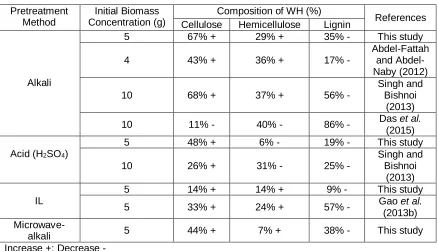
(5) PEER-REVIEWED ARTICLE. bioresources.com. Based on the SEM images after alkali pretreatment, the WH structure weakened and many granules appeared on the surface while the cell’s content, such as organelles, were removed (Fig. 2a). There are several possible reasons for this, such as the separation of structural linkages between the lignin and carbohydrates, the disruption of the lignin structure, and an increased internal surface area due to the interaction with NaOH. In the acid-treated WH sample, the moisture was retained, and the dilute acid penetrated through the substrate. The acid treatment disrupted the structure of the WH and no linear structure of fibers in the biomass were observed (Fig. 2b). These results confirmed that the acid tended to interact with the cellulose component rather than the lignin due to the specific structure of WH. Similarly, Rezania et al. (2017b) observed the loss of the WH’s structural integrity after the acid pretreatment by H 2SO4. Thi et al. (2017) reported that the pretreatment of WH by H2SO4 caused compression of the carbohydrate content with a major collapse of cellulose. As shown in Fig. 2c, the WH structure became thinner and striated due to the microwave-alkali pretreatment, which caused degradation of the lignocellulose structure. In contrast to the acid treatment, the alkali treatment had a direct effect on lignin components, which thereafter enabled high exposure of WH cellulose and hemicellulose. Microwave-assisted alkali-treated WH showed many channels with widths of approximately 10 μm on particle surfaces, which implied that the lignin structure broke due to the reaction with alkali and irradiations (Cheng et al. 2014). Lin et al. (2015) indicated that a microwave-heated alkali pretreatment successfully disrupted the WH structure by increasing the surface area. As discussed by Brandt et al. (2013), the IL pretreatment affected the crystallinity, thereby altering the structure of the cellulosic biomass. After the IL treatment of WH, many pores and holes appeared due to the disruption of the biomass structure. It seemed that the WH structure dramatically changed due to lignin removal by the IL pretreatment (Fig. 2d). It has also been reported that IL pretreatment has only a moderate effect on the composition of biomass (Tan et al. 2011). Compositional Analyses of the WH After Different Pretreatments The untreated WH consisted of 16.4% ± 0.35% cellulose, 32.7% ± 0.14% hemicellulose, and 5.7% ± 0.05% lignin, as reported in previous research (Rezania et al. 2019). Narra et al. (2017) reported 38.01% ± 1.26% cellulose, 24% ± 0.74% hemicellulose, and 9.50% ± 0.84% lignin in WH dry matter. In another study, Madian et al. (2019) reported 31.71%, 19.08%, and 3.90% of cellulose, hemicellulose, and lignin in the WH biomass, respectively. Table 1 shows the effect of different pretreatments on the carbohydrate and lignin content of the WH, based on the published studies. After the alkali pretreatment, the cellulose and hemicellulose content increased by 67% and 29%, respectively, which was two times higher than the untreated sample. Meanwhile, this pretreatment removed lignin by 35%. Similarly, Singh and Bishnoi (2013) observed an increase in the cellulose and hemicellulose content and a reduction in the lignin content after alkali treatment of the WH. This is due to the effect of alkali treatment on monosaccharides and carbohydrates, which are favorable for ethanol production. However, the removal of lignin was due to the solubilization in the alkali aqueous solution. Based on the results, the alkali-treated WH had the highest level of hemicellulose compared to all of the pretreatment methods. This may have been due to the reservation of carbohydrates and the effective lignin removal by NaOH (Lai et al. 2017). Therefore, it was concluded that. Rezania et al. (2019). “Pretreated water hyacinth,” BioResources 14(3), 6088-6099.. 6092.
(6) bioresources.com. PEER-REVIEWED ARTICLE. the hydrolysis of both cellulose and hemicellulose in the alkali-pretreated WH led to a better carbohydrate yield. Table 1. Chemical Composition of the Pre-treated WH Pretreatment Method. Initial Biomass Concentration (g) 5. Composition of WH (%) Cellulose Hemicellulose Lignin 67% + 29% + 35% -. 4. 43% +. 36% +. 17% -. 10. 68% +. 37% +. 56% -. 10. 11% -. 40% -. 86% -. 5. 48% +. 6% -. 19% -. 10. 26% +. 31% -. 25% -. 5. 14% +. 14% +. 9% -. 5. 33% +. 24% +. 57% -. 5. 44% +. 7% +. 38% -. Alkali. Acid (H2SO4). IL Microwavealkali Increase +; Decrease -. References This study Abdel-Fattah and AbdelNaby (2012) Singh and Bishnoi (2013) Das et al. (2015) This study Singh and Bishnoi (2013) This study Gao et al. (2013b) This study. In comparison to this study, Abdel-Fattah and Abdel-Naby (2012) obtained a lower lignin content and a higher carbohydrate content after the alkali pretreatment of the WH (Table 1). The high removal of lignin affected the carbohydrate content of the WH biomass as well, because carbohydrates are lost as a byproduct. In this study, the acid pretreatment decreased the lignin content 19%, decreased the hemicellulose content 6%, and increased the cellulose content 48%. Similarly, a reduction in the hemicellulose and lignin content and an increase in the cellulose content of the WH after the acid pretreatment was reported by Singh and Bishnoi (2013). In this study, a lower hemicellulose and lignin content and a higher cellulose content were obtained. The high cellulose content was due to the disruption of the WH structure by acid. Table 1 shows that the highest lignin removal was 38% using the microwave-alkali pretreatment, while the lowest was 9% by the IL pretreatment. For the IL pretreatment, a high lignin removal (49.2%) was reported using 1-N-butyl-3-methyimidazolium chloride ([Bmim]Cl) and dimethyl sulfoxide at 120 °C for 120 min (Gao et al. 2013b). The microwave-alkali pretreatment increased the hemicellulose content by 7%, while the IL pretreatment increased the hemicellulose content 14%. Both the microwave-alkali and the IL pretreatments increased the cellulose as much as 44% and 14%, respectively. In contrast, Gao et al. (2013a) obtained higher increases in the carbohydrate content and lignin removal using [C4mim]Cl at 120 °C with a 4 h retention period. The low lignin removal by [EMIM][Ac] in this study may have been due to the low ratio of applied IL or specific integration between the IL and the WH structure. Xia et al. (2013) reported that microwavealkali pretreatment drastically decreased the lignin and cellulose content of the WH biomass. They found that the weight percentage of the residual lignin slightly decreased. Rezania et al. (2019). “Pretreated water hyacinth,” BioResources 14(3), 6088-6099.. 6093.
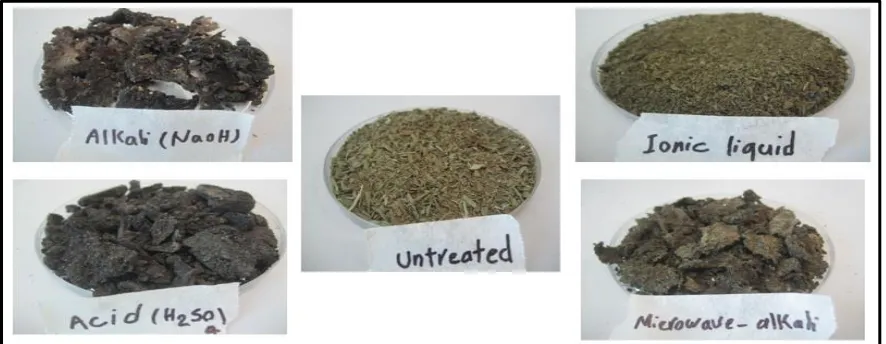
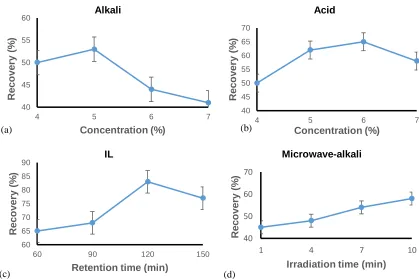
(7) PEER-REVIEWED ARTICLE. bioresources.com. from 92% at 120 °C to approximately 78% above 160 °C. The expansion of the lignin structures was caused by the microwave irradiation. The physical changes of WH biomass after different pretreatments Figure 3 shows the effect of each pretreatment on the physical shape of the WH biomass. The untreated WH was dark green and smooth in shape, which changed to black and became tough in the structure after alkali and acid pretreatment. The microwave-alkali pretreatment changed the structure of the WH to semi-rigid and turned the color to light green. After the IL pretreatment, the WH biomass became smoother and the color change was negligible.. Fig. 3. The physical changes of the WH after the different pretreatments. Biomass recovery rate The biomass recovery rate after pretreatment is an important parameter. After lignocellulose is pretreated, it needs to be recovered in the form of either biomass, sugar, or lignin (Gogoi and Hazarika 2017). The results for the biomass recovery rate after the different pretreatment methods are shown in Fig. 4. The recovery of the WH biomass was calculated based on the dry weight basis before and after each type of pretreatment. The highest recovery rate in the alkali pretreatment was 50% w/w, 53% w/w, 44% w/w, and 41% w/w via the 4%, 5%, 6%, and 7% concentrations of NaOH, respectively (Fig. 4a). Therefore, an increased NaOH concentration decreased biomass recovery. In contrast, the acid pretreatment had no substantial effect on the biomass losses during pretreatment. The biomass recovery for the acid-pretreated WH was 50%, 62%, 65%, and 58% (w/w) when applying 4%, 5%, 6%, and 7% H2SO4, respectively (Fig. 4b). This confirmed that increasing the acid concentration from 4% to 6% led to a slightly increased biomass recovery rate. According to Xia et al. (2013), increasing the acid pretreatment time from 5 min to 45 min caused the weight percentage of the residual WH biomass to decrease 22% with a 55% dry weight biomass recovery rate. After the IL pretreatment, the biomass recovery rate was 65%, 68%, 83%, and 77% (w/w) in 60 min, 90 min, 120 min, and 150 min retention time, respectively (Fig. 4c). These results confirmed that by increasing the IL pretreatment retention time of the WH, the biomass recovery rate increased. This may have been due to the regeneration of biomass for the interaction of the WH biomass with the IL solution. The IL pretreatment had the highest biomass recovery rate and the lowest lignin removal rate, which may have been Rezania et al. (2019). “Pretreated water hyacinth,” BioResources 14(3), 6088-6099.. 6094.
(8) bioresources.com. PEER-REVIEWED ARTICLE. due to the specific structure of the WH used in this study. It should be noted that the lignin and carbohydrate content of the WH was dependent on where the WH originated from (Rezania et al. 2017a). A lower IL pretreatment dose may have been more effective in obtaining WH with low lignin content. As reported by Gao et al. (2013b), the recovery of the IL-pretreated WH was more than 90% for 120 min, which was higher than the results obtained in this study. In contrast, Xu et al. (2016) found only 58.5% biomass recovery after the pretreatment of WH by [Emim][Ac] for 180 min. Alkali. 60. Acid. Recovery (%). Recovery (%). 70 55 50 45. 65 60 55 50 45. 40 4. 5. (a). 40. 7. (b). Concentration (%). Recovery (%). 85 80 75 70 65 60. 90. 5. 6. 7. Concentration (%) Microwave-alkali. 60. (c). 4. IL. 90. Recovery (%). 6. 120. Retention time (min). 70 60 50 40 1. 150. 4. 7. 10. Irradiation time (min) (d). Fig. 4. WH recovery rate of the a) alkali pretreatment, b) acid pretreatment, c) IL pretreatment, and d) microwave-alkali pretreatment. Table 2. Physio-chemical Effects of the Different Pretreatment Methods on the Structure of the WH Biomass WH Biomass Untreated. Compositional Analysis Recovery Rate Appearance/Color ----Smooth, dark green. Structural Analysis SEM Linear. Alkali-treated. Low. Tough, black. Granular. Microwave-alkali-treated. Moderate. Semi-rigid, light green. Thin and linear. Acid-treated. Moderate. Tough, black. Discrete. IL-treated. High. Smooth, green. Perforated. As shown in Fig. 4d, the rate of biomass recovery of the microwave-alkali treated WH was 45%, 48%, 54%, and 58% (w/w) after 1 min, 4 min, 7 min, and 10 min of irradiation, respectively. The microwave-alkali pretreatment had no substantial effect on the biomass losses, while the alkali pretreatment reduced the WH recovery rate. Therefore, it seemed that the irradiation from the microwave had a stronger effect on the WH recovery Rezania et al. (2019). “Pretreated water hyacinth,” BioResources 14(3), 6088-6099.. 6095.
(9) PEER-REVIEWED ARTICLE. bioresources.com. rate than the NaOH. The compositional analysis of the different pretreated WH samples supported the result through the reduction of lignin and the absence of crystalline cellulose. Table 2 shows the physical, compositional, and structural changes of the WH biomass due to the different types of pretreatment methods. In summary, a good justification for the efficiency of different pretreatment methods was obtained based on the results of the physical, compositional, and structural analyses of WH.. CONCLUSIONS 1. The highest cellulose and hemicellulose content of WH was obtained after alkali pretreatment followed by acid, microwave-alkali, and IL. 2. Based on the SEM images, the acid totally disrupted the linear structure, while many granules appeared on the surface of the WH after alkali pretreatment. The amorphous and porous structure appeared after the IL pretreatment. After the microwave-alkali pretreatment, the WH structure became weaker and more linear. 3. The highest biomass recovery rate (83%) was obtained after the IL pretreatment at 120 min of retention time, while the lowest biomass recovery rate (41%) was obtained after the alkali pretreatment with a 7% NaOH concentration. 4. The IL pretreatment method was not effective due to the low generation of carbohydrates for WH biomass, then, more investigation and optimization on the parameters for this method is recommended. 5. Future studies should focus on developing new pretreatment methods to increase the efficiency of energy production from biomass.. ACKNOWLEDGMENTS The authors gratefully acknowledge the financial supports from the National Research Foundation of Korea "Basic Research Program in Science and Engineering (NRF-2016R1D1A1B03930797) and Korea Ministry of Environment as “The SEM (Subsurface Environment Management) projects; 2019~”.. REFERENCES CITED Abdel-Fattah, A. F., and Abdel-Naby, M. A. (2012). “Pretreatment and enzymic saccharification of water hyacinth cellulose,” Carbohydrate Polymers 87(3), 21092113. DOI: 10.1016/j.carbpol.2011.10.033 Ang, S. K., Abidah, Y., Abd-Aziz, S., and Madihah, M. S. (2015). “Potential uses of xylanase-rich lignocellulolytic enzymes cocktail for oil palm trunk (OPT) degradation and lignocellulosic ethanol production,” Energy & Fuels 29(8), 5103-5116. DOI: 10.1021/acs.energyfuels.5b00891 Barua, V. B., and Kalamdhad, A. S. (2017). “Effect of various types of thermal pretreatment techniques on the hydrolysis, compositional analysis and Rezania et al. (2019). “Pretreated water hyacinth,” BioResources 14(3), 6088-6099.. 6096.
(10) PEER-REVIEWED ARTICLE. bioresources.com. characterization of water hyacinth,” Bioresource Technology 227, 147-154. DOI: 10.1016/j.biortech.2016.12.036 Barua, V. B., Raju, V. W., Lippold, S., and Kalamdhad, A. S. (2017). “Electrohydrolysis pretreatment of water hyacinth for enhanced hydrolysis,” Bioresource Technology 238, 733-737. DOI: 10.1016/j.biortech.2017.04.016 Brandt, A., Gräsvik, J., Hallett, J. P., and Welton, T. (2013). “Deconstruction of lignocellulosic biomass with ionic liquids,” Green Chemistry 15(3), 550-583. DOI: 10.1039/C2GC36364J Chang, K.-L., Han, Y.-J., Wang, X.-Q., Chen, X.-M., Leu, S.-Y., Liu, J.-Y., Peng, Y.-P., Liao, Y.-L., and Potprommanee, L. (2017). “The effect of surfactant-assisted ultrasound-ionic liquid pretreatment on the structure and fermentable sugar production of a water hyacinth,” Bioresource Technology 237, 27-30. DOI: 10.1016/j.biortech.2017.02.044 Cheng, J., Wang, X., Huang, R., Liu, M., Yu, C., and Cen, K. (2014). “Producing ethanol from water hyacinth through simultaneous saccharification and fermentation with acclimatized yeasts,” BioResources 9(4), 7666-7680. DOI: 10.15376/biores.9.4.76667680 Das, S., Bhattacharya, A., Haldar, S., Ganguly, A., Gu, S., Ting, Y. P., and Chatterjee, P. K. (2015). “Optimization of enzymatic saccharification of water hyacinth biomass for bio-ethanol: Comparison between artificial neural network and response surface methodology,” Sustainable Materials and Technologies 3, 17-28. DOI: 10.1016/j.susmat.2015.01.001 Gao, J., Chen, L., Yan, Z., and Wang, L. (2013a). “Effect of ionic liquid pretreatment on the composition, structure and biogas production of water hyacinth (Eichhornia crassipes),” Bioresource Technology 132, 361-364. DOI: 10.1016/j.biortech.2012.10.136 Gao, J., Chen, L., Yuan, K., Huang, H., and Yan, Z. (2013b). “Ionic liquid pretreatment to enhance the anaerobic digestion of lignocellulosic biomass,” Bioresource Technology 150, 352-358. DOI: 10.1016/j.biortech.2013.10.026 Gogoi, G., and Hazarika, S. (2017). “Coupling of ionic liquid treatment and membrane filtration for recovery of lignin from lignocellulosic biomass,” Separation and Purification Technology 173, 113-120. DOI: 10.1016/j.seppur.2016.09.019 Guna, V., Ilangovan, M., Prasad, M. G. A., and Reddy, N. (2017). “Water hyacinth: A unique source for sustainable materials and products,” ACS Sustainable Chemistry & Engineering 5(6), 4478-4490. DOI: 10.1021/acssuschemeng.7b00051 Harun, M. Y., Radiah, A. B. D., Abidin, Z. Z., and Yunus, R. (2011). “Effect of physical pretreatment on dilute acid hydrolysis of water hyacinth (Eichhornia crassipes),” Bioresource Technology 102(8), 5193-5199. DOI: 10.1016/j.biortech.2011.02.001 Karimi, K., and Taherzadeh, M. J. (2016). “A critical review of analytical methods in pretreatment of lignocelluloses: Composition, imaging, and crystallinity,” Bioresource Technology 200, 1008-1018. DOI: 10.1016/j.biortech.2015.11.022 Kaur, M., Kumar, M., Sachdeva, S., and Puri, S. K. (2018). “Aquatic weeds as the next generation feedstock for sustainable bioenergy production,” Bioresource Technology 251, 390-402. DOI: 10.1016/j.biortech.2017.11.082 Lai, C., Tang, S., Yang, B., Gao, Z., Li, X., and Yong, Q. (2017). “Enhanced enzymatic saccharification of corn stover by in situ modification of lignin with poly (ethylene glycol) ether during low temperature alkali pretreatment,” Bioresource Technology 244(Part 1), 92-99. DOI: 10.1016/j.biortech.2017.07.074 Rezania et al. (2019). “Pretreated water hyacinth,” BioResources 14(3), 6088-6099.. 6097.
(11) PEER-REVIEWED ARTICLE. bioresources.com. Lin, R., Cheng, J., Song, W., Ding, L., Xie, B., Zhou, J., and Cen, K. (2015). “Characterisation of water hyacinth with microwave-heated alkali pretreatment for enhanced enzymatic digestibility and hydrogen/methane fermentation,” Bioresource Technology 182, 1-7. DOI: 10.1016/j.biortech.2015.01.105 Madian, H. R., Sidkey, N. M., Elsoud, M. M. A., Hamouda, H. I., and Elazzazy, A. M. (2019). “Bioethanol production from water hyacinth hydrolysate by Candida tropicalis Y-26,” Arabian Journal for Science and Engineering 44(1), 33-41. DOI: 10.1007/s13369-018-3247-6 Narra, M., Divecha, J., Shah, D., Balasubramanian, V., Vyas, B., Harijan, M., and Macwan, K. (2017). “Cellulase production, simultaneous saccharification and fermentation in a single vessel: A new approach for production of bio-ethanol from mild alkali pre-treated water hyacinth,” Journal of Environmental Chemical Engineering 5(3), 2176-2181. DOI: 10.1016/j.jece.2017.04.043 Rezania, S., Alizadeh, H., Park, J., Din, M. F. M., Darajeh, N., Ebrahimi, S. S., Saha, B. B., and Kamyab, H. (2019). “Effect of various pretreatment methods on sugar and ethanol production from cellulosic water hyacinth,” BioResources 14(1), 592-606. DOI: 10.15376/biores.14.1.592-606 Rezania, S., Md Din, M. F., Kamaruddin, S. F., Taib, S. M., Singh, L., Yong, E. L., and Dahalan, F. A. (2016). “Evaluation of water hyacinth (Eichhornia crassipes) as a potential raw material source for briquette production,” Energy 111, 768-773. DOI: 10.1016/j.energy.2016.06.026 Rezania, S., Md Din, M. F., Mohamad, S. E., Sohaili, J., Taib, S. M., Yusof, M. B. M., Kamyab, H., Darajeh, N., and Ahsan, A. (2017a). “Review on pretreatment methods and ethanol production from cellulosic water hyacinth,” BioResources 12(1), 21082124. DOI: 10.15376/biores.12.1.Rezania Rezania, S., Md Din, M. F., Taib, S. M., Mohamad, S. E., Dahalan, F. A., Kamyab, H., Darajeh, N., and Ebrahimi, S. S. (2018). “Ethanol production from water hyacinth (Eichhornia crassipes) using various types of enhancers based on the consumable sugars,” Waste and Biomass Valorization 9(6), 939-946. DOI: 10.1007/s12649-0179883-3 Rezania, S., Md Din, M. F., Taib, S. M., Sohaili, J., Chelliapan, S., Kamyab, H., and Saha, B. B. (2017b). “Review on fermentative biohydrogen production from water hyacinth, wheat straw and rice straw with focus on recent perspectives,” International Journal of Hydrogen Energy 42(33), 20955-20969. DOI: 10.1016/j.ijhydene.2017.07.007 Sasmal, S., and Mohanty, K. (2018). “Pretreatment of lignocellulosic biomass toward biofuel production,” in: Biorefining of Biomass to Biofuels, S. Kumar and R. K. Sani (eds.), Springer, Cham, Switzerland, pp. 203-221. Sawatdeenarunat, C., Nam, H., Adhikari, S., Sung, S., and Khanal, S. K. (2018). “Decentralized biorefinery for lignocellulosic biomass: Integrating anaerobic digestion with thermochemical conversion,” Bioresource Technology 250, 140-147. DOI: 10.1016/j.biortech.2017.11.020 Sindhu, R., Binod, P., and Pandey, A. (2016). “Biological pretreatment of lignocellulosic biomass– An overview,” Bioresource Technology 199, 76-82. DOI: 10.1016/j.biortech.2015.08.030 Singh, A., and Bishnoi, N. R. (2013). “Comparative study of various pretreatment techniques for ethanol production from water hyacinth,” Industrial Crops and Products 44, 283-289. DOI: 10.1016/j.indcrop.2012.11.026 Rezania et al. (2019). “Pretreated water hyacinth,” BioResources 14(3), 6088-6099.. 6098.
(12) PEER-REVIEWED ARTICLE. bioresources.com. Sun, S., Sun, S., Cao, X., and Sun, R. (2016). “The role of pretreatment in improving the enzymatic hydrolysis of lignocellulosic materials,” Bioresource Technology 199, 4958. DOI: 10.1016/j.biortech.2015.08.061 Tan, H.-T., Lee, K.-T., and Mohamed, A. R. (2011). “Pretreatment of lignocellulosic palm biomass using a solvent-ionic liquid [BMIM]Cl for glucose recovery: An optimization study using response surface methodology,” Carbohydrate Polymers 83(4), 1862-1868. DOI: 10.1016/j.carbpol.2010.10.052 Thi, B. T. N., Ong, L. K., Thi, D. T. N., and Ju, Y.-H. (2017). “Effect of subcritical water pretreatment on cellulose recovery of water hyacinth (Eichhornia crassipe),” Journal of the Taiwan Institute of Chemical Engineers 71(C), 55-61. DOI: 10.1016/j.jtice.2016.12.028 Tye, Y. Y., Lee, K. T., Wan Abdullah, W. N., and Leh, C. P. (2016). “The world availability of non-wood lignocellulosic biomass for the production of cellulosic ethanol and potential pretreatments for the enhancement of enzymatic saccharification,” Renewable and Sustainable Energy Reviews 60, 155-172. DOI: 10.1016/j.rser.2016.01.072 Uday, U. S. P., Choudhury, P., Bandyopadhyay, T. K., and Bhunia, B. (2016). “Classification, mode of action and production strategy of xylanase and its application for biofuel production from water hyacinth,” International Journal of Biological Macromolecules 82, 1041-1054. DOI: 10.1016/j.ijbiomac.2015.10.086 Van Soest, P. J., Robertson, J. B., and Lewis, B. A. (1991). “Methods for dietary fiber, neutral detergent fiber, and nonstarch polysaccharides in relation to animal nutrition,” Journal of Dairy Science 74(10), 3583-3597. DOI: 10.3168/jds.S00220302(91)78551-2 Xia, A., Cheng, J., Song, W., Yu, C., Zhou, J., and Cen, K. (2013). “Enhancing enzymatic saccharification of water hyacinth through microwave heating with dilute acid pretreatment for biomass energy utilization,” Energy 61, 158-166. DOI: 10.1016/j.energy.2013.09.019 Xu, F., Chen, L., Wang, A., and Yan, Z. (2016). “Influence of surfactant-free ionic liquid microemulsions pretreatment on the composition, structure and enzymatic hydrolysis of water hyacinth,” Bioresource Technology 208, 19-23. DOI: 10.1016/j.biortech.2016.02.027 Zhang, Q., Wei, Y., Han, H., and Weng, C. (2018). “Enhancing bioethanol production from water hyacinth by new combined pretreatment methods,” Bioresource Technology 251, 358-363. DOI: 10.1016/j.biortech.2017.12.085 Article submitted: March 12, 2019; Peer review completed: April 12, 2019; Revised version received: May 5, 2019; Accepted: June 1, 2019; Published: June 12, 2019. DOI: 10.15376/biores.14.3.6088-6099. Rezania et al. (2019). “Pretreated water hyacinth,” BioResources 14(3), 6088-6099.. 6099.
(13)
Figure

Related documents
Ad- ministration of galantamine beginning at 1 month of age in nonobese diabetic (NOD) mice significantly delayed the onset of hy- perglycemia, attenuated immune cell infiltration
Soy milk: Soy naturally contains some probiotic benefits, but new soy milk products on the market have added extra live cultures 8.. Dark chocolate: Dark
In the present study, 68% of the farmers housed their calves in individual pens and 28% used group pens with or without an automatic milk feeding system.. In earlier, small, surveys
In this study we found that the predicted protein from the aldo–keto reductase (AKR) superfamily encoded by the YALI0F18590g gene is an erythrose reductase, which plays
A study was designed to determine if the presence of vitamin E deficiency during the first week of life played a contributory role in the shortened red cell life span observed in the
Funding for some of the sensors and satellites that provide data to the SEC is already provided by other agencies, such as NASA and the Air Force, but NOAA’s SEC is the national
Facing the trend of world economic integration, banking activities are not only under economic pressure but also under increasing pressure from criminals related to banking
