E. A r c h a e o l o g i c a l R e s e a r c h
1. Palaeolithic and Mesolithic Periods
b y H E R M A N N S C H W A B E D I S S E N , K ö l n l)
With 1 figure
This paper is based upon the following classification of the cultures of the Pleistocene a n d Postglacial p e r i o d : A r c h a e o l i t h i c P a l a e o l i t h i c L o w e r Palaeolithic M i d d l e Palaeolithic U p p e r Palaeolithic E a r l y U p p e r Palaeolithic M i d d l e U p p e r Palaeolithic L a t e U p p e r Palaeolithic Final U p p e r Palaeolithic M e s o l i t h i c P r o t o - N e o l i t h i c
T h e A r c h a e o l i t h i c encompasses the period of the oldest recognizable man-m a d e tools before the a p p e a r a n c e of the true handaxes. A s far as the typification of the tools is possible, they are p a r t l y pebble tools. The division o f pebble tools into choppers a n d chopping tools is not very s a t i s f a c t o r y ; one should rather speak of unifacially and bifacially w o r k e d pebble tools. In those areas where pebbles were not a v a i l a b l e , tools of different types were m a d e from slab-like or irregularly s h a p e d stone material. O n e could include all the tools of this early phase under the heading " C o a r s e T o o l s " , or even better, " E l e m e n t a r y T o o l s " . G e o l o g i c a l l y , the Archaeolithic p e r i o d occupies a long a n d not yet sufficiently defined p e r i o d between the end Tertiary and the Mindel G l a c i a t i o n .
T h e L o w e r P a l a e o l i t h i c is the period from the first a p p e a r a n c e of the true though p a r t l y crude h a n d a x e s up to the beginning of the L e v a l l o i s technique in the evol v e d Acheulian. T h e " C l a c t o n i a n " also belongs to this same period. It has a l r e a d y a p p e a r e d in certain areas at the same time as the oldest h a n d a x e s . Whether it is merely an a c c o m p a n y i n g - i n d u s t r y of the early h a n d a x e s of the A b b e v i l l i a n and the e a r l y Acheulian, or embodies an independent culture, is not clear at the present moment. In the last years, few researchers h a v e , in m y opinion rightly, pronounced it as an independent culture. G e o l o g i c a l l y , the L o w e r Palaeolithic should cover the p e r i o d between the H o l s t e i n Inter glacial (perhaps also the last phase of M i n d e l ) and the e a r l y to middle phase of Riss.
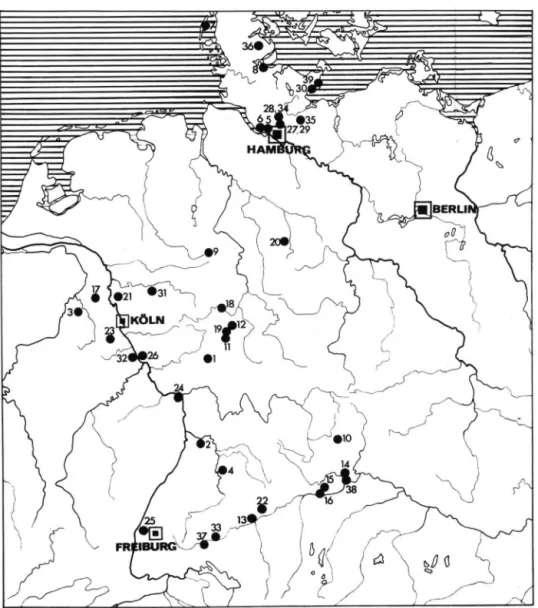
Fig. 1. The most important excavated sites, referred in the text. 1) Münzenberg near Butzbach
2) Mauer/Heidelberg
3) Palenberg near Geilenkirchen 4) Steinheim on the Murr 5) Hamburg-Eidelstedt 6) Wittenbergen near Hamburg 7) Nösse (Sylt), Morsumcliff 8) Eckernförde, Schleswig-Holstein 9) Stukenbrock near Sennestadt 10) Hunas, district Hersbruck 11) Reutersruh, district Schwalmstadt 12) Lenderscheid, district Schwalmstadt 13) Große Grotte near Blaubeuren 14) Sesselfelsgrotte at Neu-Essing 15) Speckberg near Meilenhofen 16) Weinberghöhlen near Mauern 17) Rheindahlen near Mönchengladbach 18) Buhlen, district Waldeck
19) Rörshain near Ziegenhain
20) Lebenstedt-Salzgitter, Niedersachsen
21) Hochdahl, district Düsseldorf-Mettmann 22) Vogelherd/Lonetal
23) Lommersum, district Euskirchen 24) Linsenberg/Mainz
25) Munzingen
26) Gönnersdorf, district Neuwied 27) Meiendorf, district Stormarn 28) Stellmoor, district Stormarn 29) Poggenwisch, district Stormarn 30) Grömitz, district Ostholstein 31) Martinhöhle near Letmathe 32) Martinsberg near Andernach 33) Zigeunerfels near Sigmaringen 34) Pinnberg near Ahrensburg
35) Duvensee near M ö l l n , Schleswig-Holstein 36) Satrup, district Schleswig
37) Jägerhausgrotte near Beuron 38) Altessing, district Kehlheim 39) Rosenhof near Grube, Ostholstein
T h e M i d d l e P a l a e o l i t h i c is the period from the a p p e a r a n c e of the Levallois technique to the d i s a p p e a r a n c e of the Mousterian groups. T h e L e v a l l o i s i a n does not a p p e a r to represent a n independent culture, but merely a technique. G e o l o g i c a l l y , the M i d d l e Palaeolithic roughly covers the p e r i o d from middle Riss to early or middle Würm, extending almost to the so-called " W ü r m I / I I Interstadial". Besides the L e v a l l o i s techni que displayed by certain groups, increasing differentiation is characteristic of the Middle Palaeolithic. It is expressed in the a p p e a r a n c e of numerous tool-groups including: L a t e Acheulian, U p p e r Acheulian, M i c o q u i a n with several sub-groups (Inventory T y p e s ) , T a y a c i a n , Weimarian, Mousterian of Acheulian Tradition, C h a r e n t i a n , J a b r u d i a n , M i c r o -Mousterian etc. a n d the v a r i o u s groups of leaf points ( B l a t t s p i t z e n ) .
T h e U p p e r P a l a e o l i t h i c , in which Homo sapiens in the narrower sense emerges, is distinguished archaeologically b y the a p p e a r a n c e of slender b l a d e cultures, bone a n d antler tools, the a p p e a r a n c e of art as well as clearly recognizable religious representations. In general an increasing differentiation in all spheres of life begins in the U p p e r Palaeolithic. T h i s applies t o tools a n d weapon techniques, the character of settle ments as well as to m a n ' s intellectual manifestations. G e o l o g i c a l l y , the U p p e r P a l a e o lithic lies between the W ü r m I / I I Interstadial a n d the Y o u n g e r D r y a s period. Its end terminates the Palaeolithic a n d coincides with the end of the G l a c i a l Period.
T o the E a r l y U p p e r P a l a e o l i t h i c belong p r i m a r i l y the Aurignacian a n d the Perigordian, a n d , t o the M i d d l e U p p e r P a l a e o l i t h i c in particular the G r a v e t t i a n and, in western E u r o p e , the Solutrean. The M a g d a l e n i a n belongs to the L a t e U p p e r P a l a e o l i t h i c . T o the F i n a l U p p e r P a l a e o l i t h i c (also called Endpalaeolithic) belong the different penknife (Federmesser)-groups such as Romanellian, A z i l i a n , Tjonger g r o u p , Rissen g r o u p , Wehlen group etc. a n d furthermore, the tanged-p o i n t (Stielstanged-pitzen) cultures such as the B r o m m e / L y n g b y g r o u tanged-p , the Ahrensburg groutanged-p a n d the Swiderian, to n a m e a few.
T h e M e s o 1 i t h i c begins with the P o s t - G l a c i a l . It is especially characterized b y geometric microliths a n d , in the north a n d northwest of E u r o p e , also b y flint axes. T h e a p p e a r a n c e of bone a n d antler axes of v a r i o u s forms is remarkable as is a l s o the a p p e a r ance of canoes. T h e E a r l y M e s o l i t h i c , b r o a d l y speaking, comprieses the P r e -B o r e a l , the M i d d l e M e s o l i t h i c , the -Boreal, a n d the L a t e M e s o l i t h i c , the first half of the A t l a n t i c .
In the second half of the Atlantic, the Ertebölle-Ellerbek culture of the north emerges. It includes certain N e o l i t h i c culture elements a n d m a y be interpreted as p a r t l y P r o t o -N e o l i t h i c .
T h e A r c h a e o l i t h i c
Conditions in C e n t r a l E u r o p e a r e less favourable for the discovery of tools from m a n ' s earliest history than in E a s t A f r i c a a n d the J o r d a n V a l l e y , areas of volcanic activity a n d its corresponding sedimentation during the early Pleistocene. T h e cultural remains from man's early history are revealed through volcanic activity a n d a stratigraphie clas sification of the finds is possible. Whilst E u r o p e a n finds from this p e r i o d exist; in the south of France, for e x a m p l e , from the Vallonet cave, which can be p l a c e d (DE L U M L E Y 1 9 6 3 ) geologically in the V i l l a f r a n c a ; in R o m a n i a some pebble tools a r e known (Infor mations P. S A M S O N ) from the basin deposits of the later Villafranca a t O l t e t z ; in H u n g a r y the site of Verteszollos, lying in fresh-water limestone a n d systematically e x c a v a t e d
b y L . V E R T E S ( 1 9 6 5 ) can be d a t e d to M i n d e l ; and in B o h e m i a ( Z E B E R A 1 9 6 4 / 6 5 ) a pebble
tool series also from the Mindel period has been recovered. In all, few corresponding finds from western Central E u r o p e are present. H o w e v e r , these finds discovered in the post-war years are of considerable significance for the prehistory of E u r o p e .
In H e s s e n , H . K R Ü G E R together with O . B O M M E R S H E I M h a v e found several sites with pebble tools in the area of Gießen, of which the most i m p o r t a n t is Eiloh near Münzen berg. T h e excavation of H . K R Ü G E R (1959) a t Eiloh has unearthed a continuous p a v e ment-like horizon of pebbles a n d pebble t o o l s of various types, which he interprets as a living floor. Unfortunately, the geological d a t e is not certain. E . S C H Ö N H A L S (personal communication) considers the possibility of a Mindel T e r r a c e remains at E i l o h . In this case, the p e b b l e tools could be Mindel or later. This question can perhaps be clarified by a coherent geological m a p p i n g of the area, which is presently being carried out.
In R h e i n l a n d - P f a l z , in the area of N a h e ( K R Ü G E R 1 9 6 8 ) , H . B E L L has assembled a series of p e b b l e tools.
A t the well-known find s p o t of Homo heidelbergensis in Mauer, A . R U S T has been endeavouring since the 1950's t o recover a r t e f a c t s from the deposit containing the human mandible. H e has devoted a monograph to these finds and has assigned them t o a " H e i delberg s t a g e " . Though nearly half a dozen p e b b l e tools are included, the m a j o r i t y of the artefacts from the deposit a r e m a d e from s l a b - l i k e stone m a t e r i a l . It is but n a t u r a l as in the sand a n d in the bone-bearing H o m o d e p o s i t , mostly irregularly shaped stones and slab-like q u a r t z i t e occurs a n d seldom pebbles. R U S T ' S assessment of the H e i d e l b e r g finds has been criticized diversely, therefore v a r i o u s remarks upon this important p r o b l e m are necessary here.
The artefacts of quarzite-sandstone are n a t u r a l l y not as easy to analyse as those of flint; the necessary criteria of human w o r k m a n s h i p are m o r e difficult to recognize. But along the former course of the Neckar n e a r Mauer, p e o p l e were living a n d working during this period, as is demonstrated by the find of the m a n d i b l e . The result of their h a n d i w o r k , namely the tools, ought to be f o u n d in the bone-bearing deposit from which the m a n d i b l e of Homo heidelbergensis originates. This w a s also the starting-point of R U S T ' S reflections. And when no flint was a v a i l a b l e , raw materials found in the locality were used. This is applicable especially to all periods of m a n ' s early history, a realization which should have by now become familiar. Practical experiments have shown that the quartzite-sandstone from M a u e r is in fact q u i t e serviceable for tool-making a n d in some cases also highly suitable. Essentially the p r o b l e m lies in the p o o r typification of early tools a n d in the recognition of human w o r k m a n s h i p , especially in tools m a d e from coarse stone material and a l s o which were r o l l e d and weathered. There are fewer p r o b lems in d e a l i n g with classic p e b b l e tools. T h e problems are much greater a n d p a r t l y in-solvable w i t h tools made of other raw m a t e r i a l s .
As t o the typification, finds allocated b y R U S T to his " H e i d e l b e r g s t a g e " are by no means missing. A p a r t from simple scrapers, some having a bulb and a bulb negative, R U S T especially differentiates between the " N a s e n s c h a b e r " a n d the "Querhobel".
F r o m the "Nasenschaber" has arisen the question of whether such forms could be chipped solely by natural forces, namely b y pressure on one face ( R E G E N H A R D T 1 9 7 0 ) . It is quite conceivable that these or similar f o r m s exist as a result of pressure f r o m natural forces in one direction, within moraines or g r a v e l s . On the other hand, there are corre sponding artefacts in the f o r m of "Zinken" o r " G r o b z i n k e n " , m a d e from b l a d e s , flakes or natural nodules in the U p p e r Palaeolithic a n d the Neolithic. Unquestionably, " N a s e n -schaber" also exist in old a n d reliable a s s e m b l a g e s ( Z I E G E R T 1 9 6 9 ) . The " Q u e r h o b e l " at Mauer a p p e a r again and a g a i n , always in the same form — an alternately c a r v e d - o u t cutting e d g e placed a p p r o x i m a t e l y transverse t o the surface. T h e question is whether it can be accidental that certain forms are r e p e a t e d l y produced by natural agencies; on the one h a n d , b y pressure on o n e face — as the "Nasenschaber", a n d on the other hand, at the v e r y s a m e site, by alternate pressure on o p p o s i n g faces — as the " Q u e r h o b e l " .
A further observationis of significance in examining the finds from M a u e r . A . R U S T a n d the author w e r e able to e x c a v a t e a closed-complex of flakes and other artefacts from a limited area in the bone-bearing d e p o s i t . This a s s e m b l a g e will be published shortly b y
R U S T .
With regard t o R U S T ' S conception o f his " H e i d e l b e r g s t a g e " , one recalls what A . C . B L A N C , the discussion-chairman at the International C o n g r e s s on Prehistory in H a m b u r g , 1 9 5 8 , emphasized: "Throughout his research in J a b r u d a n d the discovery of U p p e r Palaeolithic sites in the H a m b u r g region, Alfred R U S T h a s demonstrated so much intuition that, through his rich experience, he is p r o b a b l y in a d v a n c e of us in his h a n d l i n g of human artefacts."
R U S T ' S suggestions in this sphere should be taken u p , thoroughly a n d seriously examined, a n d f o l l o w e d up by m o d e r n research methods. H e r e a comparative-statistical a n a l y s i s of the forms in a numerically large collection o f material from artefact-bearing a n d artefact-absent sites, considered geologically similar, could possibly bring some p r o gress. It is natural t h a t the criteria o f human w o r k m a n s h i p cannot be based upon the numerous traits o f the tools of later periods. T h e determination of artefacts and n o n -artefacts is also impossible with the a i d of only one attribute. A d e q u a t e attribute-com binations must be w o r k e d out for the archaeological Palaeolithic which, indeed, must b e claimed for a single artefact. Meaningful use should be made of modern statistical methods.
Indeed it must be noted with astonishment that a l m o s t no younger colleague is in clined to devote himself to this difficult yet urgent research problem. O n e exception a p p e a r s to be in the w o r k of W. D . L A N G B E I N , who, at the instigation of G . R I E K , has p r e p a r e d a (not yet published) dissertation on the very o l d finds from Schnaitheim (Würt temberg). A p a r t f r o m A . R U S T research into the Archaeolithic has otherwise remained in
t h e hands of a m a t e u r archaeologists such as J . H E R M A N N (inf.) and A . F O R S T M A Y E R ( 1 9 7 3 ) .
But, precisely the development of n e w methods of evalution leading to comprehension of the tools — the remains from the earliest periods of h u m a n history — in so far as they a r e open to possible examination, is n o t only interesting, but of the u t m o s t significance in the achievement o f decisive progress in this sphere (cf. also F E U S T E L 1 9 7 0 ) .
T h e geological classification of the M a u e r finds a p p e a r s to be clear. T h e bone-bearing deposit with the m a n d i b l e should, on t h e evidence of f a u n a , be placed in the G ü n z M i n -del-Interglacial.
Another site of the Archaeolithic p e r i o d is " P a l e n b e r g " , north of Aachen, investigated b y J . Itermann ( H E R M A N N 1 9 7 0 ) . I f the tool character of the classic "Nasenschaber" a n d of several other tools from the same deposit could be effectively c o r r o b o r a t e d by further finds, it would be the oldest Eurpean Palaeolithic site, namely from the U p p e r Pliocene. B e f o r e a comprehensive evalution of the site is made, it should first be further investigated. Unfortunately, the discoverer of the site, J . H E R M A N N , h a s recently died.
T h e L o w e r P a l a e o l i t h i c
Until recently there was no certain evidence for the L o w e r Palaeolithic within the F e d e r a l Republic of G e r m a n y . A single handaxe has long been in existence from Stein-heim on the R i v e r M u r r (Württemberg), the site of Homo steinStein-heimensis ( H E R M A N N 1 9 6 2 ,
S C H W A B E D I S S E N 1 9 7 0 ) .
T h e h a n d a x e w a s discovered b y J . H E R M A N N a n d , according to its stratigraphical position, it is the o n l y o l d e r h a n d a x e i n C e n t r a l E u r o p e , G U E N T H E R ( 1 9 7 0 ) dated it within the Mindel-Riss Interglacial, n a m e l y , in Holstein. E v e n if the
Stein-heim h u m a n skull also belongs to the s a m e interglacial, there need be no direct temporal connection between the t w o . Beyond this, one or another of the numerous h a n d a x e s from Hessen m a y correspond typologically w i t h those of the Abbevillian, but without an attendant-stratigraphy, precise dating is n o t yet possible.
M o s t remarkable is the increasing n u m b e r of C l a c t o n i a n sites in northwest Central E u r o p e , especially in the Federal R e p u b l i c . In the 1 9 2 0 ' s , O . K . P I E L E N Z h a d already discovered 2 assemblages in H a m b u r g - E i d e l s t e d t : at " J u n g b r u n n e n " a n d a t "Großen B e h n k a m p " , during e x p o s u r e work. G . S C H W A N T E S r e g a r d e d these as L e v a l l o i s i a n and called them "Eidelstedt s t a g e " ( S C H W A N T E S 1 9 3 4 ) . O. K . P I E L E N Z allotted these finds to
the C l a c t o i a n ( P I E L E N Z 1 9 6 1 ) .
G e o l o g i c a l l y , the former site is dated before or early in the S a a l e G l a c i a t i o n , and the artefact from "Großen B e h n k a m p " should originate from an involuted weathering hori zon of S a a l e Glaciation. According to the material still a v a i l a b l e (part of it was lost during the w a r ) , and from the d r a w i n g s of the finds, C l a c t o n i a n is indisputably re presented.
After the Second W o r l d War, A . R U S T published the comprehensive material from Wittenbergen which lies on the steep b a n k of the Elbe, north of H a m b u r g ( R U S T 1 9 6 2 ) . The finds in question are from the collection of G . S T E F F E N S . A m o n g s t these is to be found a c o m p l e x , undoubtedly belonging to the C l a c t o n i a n . Furthermore, material preserved in four other collections confirms the C l a c t o n i a n character of the site. All the finds will be presented in a publication prepared by the author.
Geologically, the artefacts lie in the l o w e r p a r t of a till which is covered b y peat of the E e m p e r i o d (cf. G R U B E in R U S T 1 9 6 2 ) . According to the statements of several collec tors, p a r t of the finds c o u l d certainly h a v e been recovered from the section of the till. The tools b y no means originated only f r o m the foot of the steep bank. T h e s e belong to the period before the last p h a s e of R i s s - ( S a a l e ) G l a c i a t i o n . T h e y can, however, be rework ed and belong to the H o l s t e i n Interglacial.
A further Clactonian assemblage comes from N ö s s e on the island S y l t . T h e site is not far from the Morsum Cliffs and lies u n d e r a thin capping bed of silt. T h e a g e of the silt is not certain but may p o s s i b l y be determined by pollen analysis. The finds lie in a gravel horizon under the silt. T h e s e artefacts will also be presented in the above-mentioned publication.
P I E L E N Z ( 1 9 7 0 ) and others ( B A U D E T 1 9 7 0 ) have placed the numerous finds collected on the B a l t i c coast in the Clactonian, which indicates the presence of a Clactonian habitus. T h e dating of these finds is still problematic because they have not yet been re covered from a geologically datable d e p o s i t . Whilst p a r t of the flint artefacts from the Ertebölle period and the Neolithic of the north also show v e r y archaic features ( S C H W A B E -DISSEN 1 9 6 8 ) , the classification of these finds must be regarded as uncertain. T h i s need not mean t h a t no old finds or possible C l a c t o n i a n can be found on the B a l t i c coast. A site now being investigated b y us, at Eckernförd B a y , m a y clarify matters. A t the base of a 1 2 m. thick section lie stratified clays, which, according to R . S C H Ü T R U M P F , belong to the p r e - E e m Interglacial. Artefacts recovered thus far have s u p p o s e d l y been buried under these interglacial clays. T h e investigations, carried out in association with R . S C H Ü T R U M P F and v a r i o u s geologists, has not yet been c o n c l u d e d .
At this point, another site should be mentioned, which w a s discovered b y W. A D R I A N ( 1 9 6 9 ) on the southern s l o p e of the T e u t o b u r g Forest near Stukenbrock, not far from Bielefeld. Besides the p e b b l e tool like implements, the finds also include artefacts of C l a c tonian similarity. The geological dating of the finds, which lie both on a n d in the Riss sands, has not yet been determined.
In conclusion, it can be affirmed on the grounds of new research that the Clactonian was not confined only to northern F r a n c e and E n g l a n d , but was also distributed in the northwest continental area. When one includes several central German sites such as Wal-lendorf and Wangen ( T O E P F E R 1 9 6 8 ) it extended into the middle of C e n t r a l Europe.
T h e only comprehensive e x c a v a t i o n of a Lower Palaeolithic site in West Germany is that of H u n a s near Hersbruck in F r a n c o n i a ( H E L L E R 1 9 6 6 ) , where a c a v e choked with rubble was exposed b y quarrying operations. In an investigation carried out by Fl. H E L L E R in association with W. S E S S L E R , a s t r a t i g r a p h y was uncovered containing rich palaeonto-logical material and also artefacts. A m o n g the latter no h a n d a x e s are to be found. Tools with a flake character predominate. T h e exact archaeological assignment of this stone industry is yet to be settled. The palaeontological remains in conjunction with the strati g r a p h y indicate that the site belongs p r i m a r i l y to the Riss G l a c i a t i o n .
T h e M i d d l e P a l a e o l i t h i c
Since the 1 9 6 0 ' s , the opening u p of the Middle Palaeolithic has become the central point of Palaeolithic research in the Federal Republic of G e r m a n y . In 1 9 6 0 G . B O S I N S K I completed a m o n o g r a p h on the M i d d l e Palaeolithic in western Central Europe. This publication, which a p p e a r e d several years ago ( B O S I N S K I 1 9 6 7 ) , presented the then-k n o w n material, a n d an archaeological as well as a chronological classification were at tempted. The w o r k i n g out of groups a n d inventory should especially be mentioned. Besides this, the M i c o q u i a n was shown for the first time to be separate a n d predominately h a n d a x e culture with various sub-groups. The distribution centered m a i n l y in the high lands of Central a n d Southern E u r o p e . G . B O S I N K I ' S m o n o g r a p h represents an important basis for research into the M i d d l e Palaeolithic
T h e above-mentioned m o n o g r a p h is supplemented by a study by H . S C H W A B E D I S S E N on the distribution of the handaxes in Central E u r o p e ( S C H W A B E D I S S E N 1 9 7 0 ) . Thereby it becomes evident that, in contrast to the earlier opinion of A N D R E E ( 1 9 3 9 ) , western C e n t r a l Europe belongs to the distribution area of the h a n d a x e culture, at least in its later phases. Furthermore, it now a p p e a r s that an area formerly held to be without finds, such as Hessen, t o d a y represents a central distribution area of handaxes, thanks to the efforts of A . L U T T R O P P . O f the thousand or so h a n d a x e finds in Central E u r o p e , half belong to Hessen. This is m a i n l y because A . L U T T R O P P has d r a w n attention to quartzite as a raw material. The distribution of quartzite handaxes extends into the R h i n e l a n d and the Palatinate.
O n e of L u t t r o p p ' s assemblages, that of Reutersruh, has been published in a m o n o g r a p h by B O S I N S K I a n d L U T T R O P P ( 1 9 7 1 ) . Further finds from Hessen, especially that of Lenderscheid, still a w a i t publication. In N o r t h G e r m a n y the number of sites of hand-axes has also greatly increased.
Besides the comprehensive publications, a whole series of excavations belong to the M i d d l e Palaeolithic.
In 1 9 6 0 , G . R I E K began e x c a v a t i o n s in the "Großen G r o t t e " near Blaubeuren. The in vestigations, which were continued until 1 9 6 4 , p r o v i d e d the following stratigraphy
( W A G N E R 1 9 7 2 ) :
At the bottom, Acheulian with Levallois technique A layer with few artefacts of M i c o q u e character Mousterian of L a Q u i n a t y p e
Mousterian of another type, mostly with leaf points (Blattspitzen) This last layer I I is the richest in finds.
While the geological classification of the b a s a l layer should be confirmed as R i s s - W ü r m Interglacial, that of the subsequent layers remains unclear. T h e y should belong to an early period of Würm. The layer with a b u n d a n t leaf points (Blattspitzen) belongs to the period after the cold m a x i m u m in Würm I, forming the transition to the W ü r m I / I I In terstadial, which is in accordance with the a p p e a r a n c e of early leaf points ( B l a t t s p i t z e n ) . The layers predominated b y leaf points between the Mousterian and the W ü r m I / I I Interstadial are the most interesting.
In 1964 L . F . Z O T Z began an excavation at the "Sesselfelsgrotte" near the A l t m ü h l t a l in N e u - E s s i n g ( Z O T Z 1970). Since 1967 it h a s been directed by G . F R E U N D a n d investiga tions are still being carried out ( F R E U N D 1 9 6 8 — 7 0 ) . The numerous archaeological levels descend from the Mesolithic through an E p i p a l a e o l i t h i c and a late U p p e r Palaeolithic to a richly p r o v i d e d Middle Palaeolithic. In the lower levels, interesting Microlithic tools appear ( F R E U N D 1968), a n d artefacts of L e v a l l o i s technique excluding h a n d a x e s . A s to the character of the lower artefact levels, nothing final can be stated until w o r k on the remaining levels is completed. A similar situation exists with regard to the geological classification of the levels. T h e Sesselfelsgrotte a l r e a d y appears to be a significant site of the subdivision of the Palaeolithic. E s p e c i a l l y the Middle Palaeolithic levels with M i c o -quian connections containing bifacial artefacts a n d Microlithic tools promise to widen our knowledge of the period and its sub-divisions.
To this can be added the research p r o j e c t undertaken by H . M Ü L L E R - B E C K , whose purpose is the correlation of the stratigraphy of "Speckberg" (near Meilenhofen) a n d that of the "Weinberghöhle" near Mauern ( M Ü L L E R - B E C K 1973).
Both sites lie on the southern slopes of the Franconian A l p s facing the D a n u b e in the area of N e u b u r g a. d. D o n a u a n d are only 10 k m a p a r t . Speckberg is an open air site and the Weinberghöhlen are c a v e settlements. T h e project was founded to correlate the stratigraphies in order to obtain a complete relative cultural sequence for the a r e a and perhaps also for a larger region. There are several difficulties, such as the absence of a continuous stratigraphy at Speckberg. The settlement levels are scattered over the p l a t e a u of the north depression ( N o r d m u l d e ) and on the slope of Speckberg. M Ü L L E R - B E C K writes: "At Speckberg it is a question of condensed horizons which allow no fine archaeo logical interpretation." T o begin with, the different levels at Speckberg, i.e. the settlement sites, must be placed in relation to one another a n d then the whole Speckberg stratigriphy must be connected to that of the Weinberg caves. M Ü L L E R - B E C K (1973) has undertaken the a t t e m p t e d correlation but is himself a w a r e of its hypothetical nature, p a r t i c u l a r l y a s " . . . the preservation of the faunal remains at Spedsberg is very b a d . "
N o particular opinion c a n be expressed about this interesting project before the analysis has been completed. Incidentally, o n e m a y recall the difficulties encountered in the correlation of the phases of Hengelo a n d D e h n e k a m p in H o l l a n d with t h a t of the south of G e r m a n y and c a v e sedimentation layers, because of the varying nature of the regions.
In the Rhineland, the loess site of " R h e i n d a h l e n " near Mönchengladbach h a s become well-known, thanks to the recovering of finds during the Second World War by E . K A H R S . In 1949 K . J . N A R R carried out and published the results of a short e x c a v a t i o n ( N A R R 1951). In 1964 the Institut für Ur- und Frühgeschichte of the University of C o l o g n e (Köln) undertook an e x c a v a t i o n there u n d e r the direction of G . B O S I N S K I . This is still in progress. T h e importance of Rheindahlen lies in the superimposition of several cultural layers in the loess. At the b a s e is found a recently recognized a n d still poorly documented cultural layer containing artefacts of L e v a l l o i s type. (BOSINSKI SC B R U N N A C K E R 1 9 7 3 ) . The third find-layer from the base produced f e w artefacts which cannot be assigned to any
of the existing inventory types. T h e depression 3 , 7 0 x 2 , 9 0 m, interpreted by G . B O S I N S K I as a dwelling pit, should be noted. T h e fourth layer from the base a n d the uppermost of all was in a redeposited area. A c c o r d i n g to B O S I N S K I , its artefacts are typologically similar t o those of the inventory type " B a l v e TV".
The geological interpretation of the section a n d the geo-chronological classification of the find-layers p r o v i d e several difficulties, as "Rheindahlen" lies in an area of A t l a n tic climate. A c c o r d i n g to the present analysis of the profile by K . B R U N N A C K E R ( B O S I N S K I & B R U N N A C K E R 1 9 7 3 ) , the lower l a y e r of Levallois character was a c c o r d e d to the begin ning of the Riss Glaciation a n d the layer a b o v e , with "Rheindahlen-type" artefacts, p l a c e d in the m i d d l e of Riss. The third layer should belong to the end of the R i s s - W ü r m Interglacial. This geological classification is not completely in accord with the classifica tion of the a c c o m p a n y i n g artefats. Perhaps the recently begun excavations at Rheindahlen c a n contribute to a further elucidation of the geological position of the different cultural levels.
At " R ö r s h a i n " , a site near Ziegenhain (Hessen), discovered b y A . L u t t r o p p , e x c a v a tions were undertaken in 1 9 6 5 a n d more recently in 1 9 7 2 for the Institut für U r - u n d
Frühgeschichte, C o l o g n e , by G . B O S I N S K I ( L U T T R O P P & B O S I N S K I 1 9 6 7 ) . A t the b a s e of a
layer 1 — 1 , 3 m thick, composed of a mixture of loess-loam and sand, a n d covered b y a continuous b a n d of clay, was found a rich layer of finds containing M i d d l e Palaeolithic artefacts. It is p r o b a b l y the richest site in Central E u r o p e ; one square metre of the cul tural layer yielded nearly 1 0 0 0 artefacts.
Among the finds, t w o assemblages can be differentiated; one with h a n d a x e s belonging t o the Acheulian a n d a second which includes h a n d a x e s and Micoquian " F a u s t k e i l b l ä t ter", as well as leaf points (Blattspitzen).
The significance of " R ö r s h a i n " lies in the opportunity given to G . B O S I N S K I to p u t f o r w a r d the inventory type " R ö r s h a i n " , which should lie between the Micoquian a n d the Altmühl groups of leaf point (Blattspitzen) cultures ( B O S I N S K I 1 9 7 3 ) . This also casts some light on the evolution of the leaf p o i n t cultures. E x a c t geological dating is unfortunately impossible and is h a r d l y to be expected from the new excavations.
On the outskirts of the village "Buhlen", near the E d e r B a r r a g e , a site was discovered on a stepped ridge of Permian D o l o m i t e , projecting into the valley, with Middle P a l a e o lithic stratified cultural layers. A t the foot of the ridge lies a site of similar age which is in terspersed with fluviatile sediments. A t the site, discovered by the geologist J . K U L I C K , the excavations were directed by G . B O S I N S K I in 1 9 6 6 / 6 7 and 1 9 6 9 for the Institut für Eir und Frühgeschichte.
An inventory w a s ascertained from the lowest cultural layer including a h a n d a x e a n d Levallois flakes. A more exact archaeological classification of this layer is not yet possible. T h e same holds true for the next younger layer, containing large L e v a l l o i s points a n d L e v a l l o i s cores. T h e layer above this is very rich in material, containing Micoquian finds. These are similar to the "Klausennische" inventory t y p e , but exhibit peculiarities, especi a l l y the so-called " P r a d n i c knife". T h e best c o m p a r a b l e forms are to be found in the Polish caves near C r a c o w .
The topmost layer once again exhibits the considerable use of the L e v a l l o i s technique a n d also yields numerous scraper t y p e s . In general, the inventory is of the type " B a l v e I V " .
The significance of the site, for which a thorough preliminary report is a v a i l a b l e ( B O S I N S K I et al. 1 9 7 3 ) , lies in the evidence of a M i c o q u i a n facies with " P r a d n i c k n i v e s " , formerly unknown in Germany. In a future excavation it would be important to elucidate the lowest cultural horizon. The geological-palaeontological analysis is not yet complete.
T h e presence of a band of volcanic tuff is significant, as is that of a rich rodent f a u n a in almost all layers.
After the w a r , A . T O D E w a s able to e x c a v a t e the important M i d d l e Paleolithic site of "Lebenstedt-Salzgitter" on the N o r t h G e r m a n Plain ( T O D E et al. 1 9 5 3 ) . Unfortunately, the m o n o g r a p h has not yet been published. T h e site lies on the s l o p e of a river v a l l e y and was discovered b y dredging. T h e find-layer is 4 — 6 m below the surface. The deposition of the finds below the water-level, p a r t l y in gyttja, has preserved the organic material excellently.
T h e f a u n a is well-represented; plant remains are also preserved and further pollen analysis w a s possible. A m o n g the bone tools, a winged a r r o w h e a d and several d a g g e r like w e a p o n s , 6 0 — 7 0 cm long, m a d e from m a m m o t h ribs, are notable. A s to human remains, it w a s possible to recover p a r t of a skull.
The flint artefacts include handaxes of an e v o l v e d type, leaf points (Blattspitzen) and scrapers of v a r i o u s kinds, as well as artefacts of Levallois technique. Although the in dustry-assemblage shows individual traits, there is nothing to indicate that this assem blage is not homogeneous (cf. K L E I N S C H M I D T , in T O D E 1 9 5 3 ) . F r o m the finds of Leben stedt G . B O S I N S K I has established a " L e b e n s t a d t - g r o u p " representing his younger Ach eulian.
In the d a t i n g of the " L e b e n s t e d t - S a l z g i t t e r " site, geologists, palaeontologists, and pollen analysts are of the same opinion: a p e r i o d of early Würm, perhaps an interstadial, is to be considered. This could be confirmed by several 1 4C - d a t e s c. 5 0 , 0 0 0 B P . These
results obtained from gyttja a n d w o o d possibly point to the B r ö r u p - I n t e r s t a d i a l . Further details can be expected in the m o n o g r a p h .
If the finds from "Lebenstedt-Salzgitter" r e a l l y represent a younger Acheulian phase, and of this there can be no d o u b t at Lebenstedt, then this phase should in general terms be dated early Würm. But the m a n y previously obtained dates w o u l d tend to contradict this. T h e well-known Acheulian or Acheulian-like sites such as those at " H e r n e " or "Ternsche" ( A N D R E E 1 9 3 9 ) a n d in the Leine a r e a near H a n n o v e r ( J A C O B - F R I E S E N 1 9 4 9 ) h a v e hitherto been placed within the Riss ( S a a l e ) Glaciation. Indeed, dating seems to be uncertain a n d requires checking. The whole of Central E u r o p e is lacking in e x c a v a t e d Acheulian sites with reliable dates. River g r a v e l does not p r o v i d e the best basis. F r o m the archaeological point of view, it seems questionable whether all the sites with evolved Acheulian types in Central E u r o p e really belong to one group a n d one period including Lebenstedt. It appears that Lebenstedt represents a young g r o u p , precisely the younger Acheulian of the early W ü r m period, which is preceeded b y an earlier p h a s e of late Acheulian.
In order to test this hypothesis, a section w a s recently cut through the loess at " H o c h d a h l " ( N e a n d e r t h a l ) , location of the well-known h a n d a x e s , but the geological interpretation is not yet completed ( S C H W A B E D I S S E N 1 9 7 0 ) .
When w e survey the research into the M i d d l e Palaeolithic in the Federal R e p u b l i c of G e r m a n y since the war, we see that a large a m o u n t of activity has taken place in the form of comprehensive studies a n d excavations, which, when all the excavation results are published, m a y signify notable progress. A substantial contribution has undoubtedly been
the w o r k of G . B O S I N S K I .
T h e U p p e r P a l e o l i t h i c
While investigation through excavation lies in the forefront of palaeolithic research into M i d d l e Palaeolithic, the same does not a p p l y to the U p p e r Palaeolithic. E v i d e n c e
for the A u r i g n a c i a n comes from many caves, especially in Southern Germany. O n l y one really excellent c a v e site is t o be found in the Federal Republic, namely, V o g e l h e r d in Lonetal ( R I E K 1 9 3 4 ) . Indeed, this site with its a n i m a l sculptures hold an outstanding international reputation. A t this point, a new sculpture from L o n e t a l , namely a h u m a n figure, is w o r t h y of mention. It w a s discovered a m o n g the e x c a v a t i o n finds from " H o h -lenstein-Stadel" near U l m and w a s put together by J . H A H N . It is 2 8 , 1 cm high. This largest known A u r i g n a c i a n sculpture shows a completely individual style. T h e best illustration of it is found in H A H N 1 9 7 0 . A m o n g the A u r i g n a c i a n loess sites in Central Europe, o n l y that of Breitenbach near Zeitz ( G e r m a n Democratic R e p u b l i c ) deserves mention. Recently J . H A H N found an Aurignacian site in loess at L o m m e r s u m in the Rhineland, which is important because of its westerly location and also because of its bone preservations. These are rare in central and western Europe ( H A H N 1 9 7 3 ) . Its assignment in A u r i g nacian is assured b y the flint technology and a 1 4C - d a t e of 3 3 4 2 0 1 5 0 0 ( G r N = 6 1 9 1 ) .
Certainly, the q u a n t i t y of tools is still small; however, the e x c a v a t i o n is not yet c o m pleted. A western Central E u r o p e a n counterpart to K r e m s and Willendorf w o u l d un doubtedly be desirable.
We are further indebted to J . H A H N for a comprehensive study, " T h e Aurignacian in Central and E a s t e r n E u r o p e " , a dissertation at the U n i v e r s i t y of C o l o g n e ( K ö l n ) . In this dissertation, H A H N has re-catalogued and presented nearly the w h o l e find material of Central and E a s t e r n E u r o p e . T h e comparison with the French material is important a n d is known by the author from his studies with F . B O R D E S . H A H N ' S w o r k will p r o v i d e an important basis for further research into the A u r i g n a c i a n in general. Publication of the monograph is in p r e p a r a t i o n ; a s u m m a r y is being printed ( H A H N 1 9 7 3 ) .
The extent to which classic P e r i g o r d i a n is present in C e n t r a l Europe remains an open questian. Until now o n l y layer 4 of the "Ilsenhöhle" near R a n i s in T h u r i n g i a is available for discussion ( A N D R E E 1 9 3 9 , fig. 2 1 4 ) . N o new material has been a d d e d to this sphere.
The situation of the G r a v e t t i a n is similar. Its presence in Central E u r o p e is beyond doubt, as demonstrated b y the loess site of "Linsenberg" within the present city-limits of M a i n z . H A H N ( 1 9 7 1 ) has recently published the finds. It remains to be considered whether the finds from " M a u e r n " , which B Ö H M E R S ( 1 9 5 1 ) refer to as L o w e r M a g -d a l e n i a n , represent a G r a v e t t i a n . Furthermore there are a number of cave s t r a t a and single loess sites which m a y be considered G r a v e t t i a n . In particular, several as yet unpublished loess sites could p r o v i d e the inception for a more intensive investigation of the G r a v e t t i a n . Such an u n d e r t a k i n g would be i m p o r t a n t in clarifying the connections with the West G r a v e t t i a n or with the East G r a v e t t i a n . T h e presence of a few " g r a v e t t e s " (Gravette Points) is not sufficient ground for seeing P a v l o v i a n , as in the finds from Speckberg ( M Ü L L E R - B E C K 1 9 7 3 ) . A p a r t from that, until now, neither a P a v l o v i a n , nor an East G r a v e t t i a n , nor a West G r a v e t t i a n have been clearly distinguished.
Whereas the S o l u t r e a n in France and S p a i n represents a special facies a n d is absent from C e n t r a l E u r o p e , the M a g d a l e n i a n is represented in Central E u r o p e . H o w e v e r , C e n t r a l E u r o p e seems to h a v e played no essential role in the earlier d e v e l o p ment of this facies.
There are a l m o s t no sites in the Federal R e p u b l i c which m a y be placed in the o l d phase, namely in early or middle Magdalenian. U n d o u b t e d l y , archaic features are to be seen at two or three sites (cf. S C H W A B E D I S S E N 1 9 5 4 , fig. 1 0 1 a ) , but a definite classification is not possible. T h e same is true of the site of " M u n z i n g e n " at Kaiserstuhl, which is covered by 4 m loess ( P A D T B E R G 1 9 2 5 ) . Recent geological investigations by G U E N T H E R ( 1 9 6 8 ) have shown that the o v e r - l y i n g loess deposit is secondary. T h e archaeological
in-ventory indicates neither an early nor a middle M a g d a l e n i a n . This is also the case with the lower M a g d a l e n i a n from Mauern ( B Ö H M E R S 1 9 5 1 ) . In general, the majority of M a g dalenian sites in Central E u r o p e belong to the late M a g d a l e n i a n . This is true of the numerous sites within the Federal R e p u b l i c as well as of those in Thuringia, especially the Kniegrotte, ö l k n i t z and Saaleck ( A N D R E E 1 9 3 9 ) , and the c a v e site of P e k a r n a in M o r a v i a n K a r s t area. Formerly Petersfels near Engen in H e g a u ( P E T E R S 1 9 3 0 ) w a s the richest and most important site in West G e r m a n y . H o w e v e r , since the beginning of the investigations at Gönnersdorf in 1 9 6 8 b y G . B O S I N S K I , and which are still continuing, this site must be regarded as the most important of the late M a g d a l e n i a n in Central E u r o p e .
T h e site of "Gönnersdorf" lies on the edge of the N e u w i e d basin, barely 2 0 k m north west of the city of K o b l e n z . It is an open air site covered by a thin layer of loess a b o v e which lies pumice deposit. The pumice deposit, which is 1 — 1 , 5 m thick, originates from an eruption of the Laacher See V o l c a n o . It belongs to the Alleröd period and p r o v i d e s a "terminus ante q u e m " . T h e archaeological finds lie in the 2 0 — 3 0 cm thick p r i m a r y a n d p a r t i a l l y loamed loess. A b o v e the loess there is a thin humus layer which led to p a r t i a l foaming of loess. T h e humus layer m a y h a v e been formed in the early to middle A l l e r ö d or in the preceeding oscillation. While certain indications of a B ö l l i n g date for the cultur al layer are present, a reliable date can only be expected from 1 4C dating. It is g e o l o g i c
a l l y noteworthy that during the settlement p e r i o d and shortly afterwards loess still drifted over the site — a much discussed question (cf. N A R R 1 9 5 3 ) . T h e bone remains are important for p a l a e o n t o l o g y . The fact that the m a m m o t h still lived in the R h i n e l a n d at this time deserves to be mentioned.
Of the archaeological finds and structures, the following should be mentioned: 1 ) groundplans of dwellings, 2 , 5 — 5 m in diameter, and two of 6 and 1 0 m diameter 2 ) flint tools, among them, backed blades though without end retouch, and no pen
knives (Federmesser)
3 ) bone points of various types, fragment of a harpoon and of a 'baton de c o m m a n d -dement' a n d bone needles
4 ) ornaments: perforated teeth and p e r f o r a t e d snails (some from the Mediterranean area), b e a d s of fossilized wood, including a necklace of m o r e than 3 0 w o o d e n beads, a n d the incisors of red deer, etc.
5 ) about 2 0 0 perforated discs, some with engravings
6 ) a r t :
a) 1 5 stylized female figurines out of antler, ivory, bone, or slate
b) engravings on slate plaquets with d r a w i n g s of female forms, animals ( m a m moth, w i l d horse, rhinoceros, wolf, lion, auroch, bison, deer, fish, a n d birds) and of non-figurative designs (circles, cross, bundles of lines)
Geologically, the significance of " G ö n n e r s d o r f " lies in the relatively exact d a t i n g to the period before m i d d l e Alleröd and in the youngest phase of loess formation. P a l a e o n -tologically its importance lies in securing the a c c o m p a n y i n g fauna, a n d archaeologically, in the evidence for dwellings, in the acquisition of a closed tool-inventory of the L a t e M a g d a l e n i a n a n d in the numerous examples of art (figurines and engravings) which, in p a r t , a d d to the faunal range.
T h e engravings connect our area with Western E u r o p e . G ö n n e r s d o r f gives an indi cation that crucial finds from the M a g d a l e n i a n need not only be expected from caves but also from open air sites. The open air site of Gönnersdorf contributes essentially t o the characterizing of the L a t e M a g d a l e n i a n in Central E u r o p e .
G e o g r a p h i c a l l y , L a t e M a g d a l e n i a n is w i d e l y distributed throughout Central E u r o p e , as shown by m a p s (cf. S C H W A B E D I S S E N 1 9 5 4 , fig. 1 0 1 b, principally c a v e sites). Whether
the impression that the M a g d a l e n i a n infiltrated C e n t r a l Europe from the west during its later phase is correct, must be elucidated by further research.
During the O l d e s t D r y a s p e r i o d a culture a p p e a r e d on the northwest European plain diverging from the M a g d a l e n i a n , namely the H a m b u r g i a n . Its m o r p h o l o g y and distribu tion have been w o r k e d out in the works of S C H W A N T E S (1934), R U S T (1937, 1 9 4 3 ) , a n d S C H W A B E D I S S E N ( 1 9 3 8 ) . In this respect, the e x c a v a t i o n s conducted b y A . R U S T during the 1930's in the H a m b u r g area at "Meiendorf" a n d " S t e l l m o o r " were decisive. In these ex cavations, the L a t e Palaeolithic w a s unearthed, using modern scientific archaeological methods and thereby heralding a new epoch. R U S T resumed his excavations in the p o s t w a r years a n d considerably augmented our k n o w l e d g e of the H a m b u g i a n c u l t u r e through his in investigations of the sites at Borneck, Poggenwisch, a n d Hasewisch ( R U S T 1958).
At all three sites, it was possible to demonstrate for the first time the presence of L a t e Palaeolithic dwellings in the s h a p e of round tent ground plans c. 5—6 m in diameter. These discoveries g a v e impact to the identification of Palaeolithic dwelling ground p l a n s in Central a n d West Germany as well as in France.
Another i m p o r t a n t result is the evidence for a younger p h a s e of the H a m b u r g i a n culture. With the a i d of pollen analysis, carried out by R . S C H Ü T R U M P F , the site of P o g genwisch could be dated to the O l d e s t D r y a s immediately before the Bölling Oscillation. According to pollen analysis, Meiendorf and Stellmoor belong to the full Oldest D r y a s (cf. S C H Ü T R U M P F , in R U S T 1 9 5 8 ) . Finds of the later H a m b u r g i a n culture of the P o g g e n wisch type were secured by B R Ü C K N E R (1970, p . 3 6 5 f, fig. 114) from the steep b a n k on the Baltic coast near G r ö m i t z . T h e s e were covered by till. G e o l o g i c a l l y , this means that before Bölling, or, what is m o r e probable, in the ensuing O l d e r D r y a s (absolute date 10,000 B . C . ) , the glaciers must h a v e a d v a n c e d once again into the B a y of Lübeck, so that the site w a s covered on their retreat by till u p to 4 metres thick.
Furthermore, the conjecture that the H a m b u r g i a n culture could be subdivided into phases, which h a d been based on typological comparisons, was confirmed by the e x c a v a tions at Poggenwisch ( S C H W A B E D I S S E N 1938 and 1 9 4 9 ) .
The chronological relationship of the H a m b u r g i a n culture to the Magdalenian has to be further clarified. If the late M a g d a l e n i a n at Gönnersdorf is not datable before the Bölling Oscillation, then H a m b u r g i a n is clearly older. This has been assumed b y R U S T (1937) and S C H W A B E D I S S E N ( 1 9 3 8 ) . It might, in fact, be contemporary with the M i d d l e M a g d a l e n i a n .
As to the distribution of the H a m b u r g i a n , the a r e a m a p p e d by SCHWABEDISSEN ( 1 9 4 4 , Plate 125) has since been enlarged, especially b y new sites in H o l l a n d (BÖHMERS 1970, p. 13, fig. 9) a n d those in L o w e r S a x o n y ( N O W O T H N I G 1963). It extends from the sou thern part of J u t l a n d to the Midhighlands a n d in the west, as far as the lower course of the Rhine. T h e w o r k of A . R U S T in the Ahrensburg-Meiendorf Tunnel valley a r e a has recently been resumed by G . T R O M N A U . The results of his e x c a v a t i o n s of different settle ment sites lying on mineral soils of the Tunnel v a l l e y are in the process of being printed.
With the A l l e r ö d Oscillation, which seems to signify a r e m a r k a b l e period at the end of the Ice A g e , a number of archaeological industry assemblages emerge in the north western p a r t of the European continent and b e y o n d . These are the P e n k n i f e (Feder messer) and the T a n g e d P o i n t (Stielspitzen) c u l t u r e s , each having several sub groups.
Since 1938, H . S C H W A B E D I S S E N has published a series of articles introducing the finds of new sites in N o r t h e r n G e r m a n y , the N e t h e r l a n d s , and N o r t h e r n Belgium. T h e y are
g r o u p e d together as the penknife (Federmesser) civilizations a n d a r e regarded as a t y p e of the Final M a g d a l e n i a n (SCHWABEDISSEN 1 9 4 4 a, 1 9 4 4 , 1 9 5 1 ) . T h e whole material has also been published in a single monograph ( 1 9 5 4 ) .
Since then, the sites of "Martinshöhle" near L e t h m a t h e (Westphalia), " M a r t i n s b e r g " near Andernach on the Rhine, and " P r o b s t f e l s " near Beuron (Baden-Württemberg) h a v e confirmed the relationship with the M a g d a l e n i a n . T h e connections with the M a g d a l e n i a n h a v e become evident firstly, through the e x c a v a t i o n a t Gönnersdorf, from which pen knives (Federmesser) a r e absent, a n d which lies in loess, therefore must be dated a s true L a t e M a g d a l e n i a n , a n d secondly, from the newly submitted report by B O S I N S K I and H A H N ( 1 9 7 2 ) about the finds of Martinsberg, which includes penknives.
In the geographical distribution between N o r t h e r n Belgium a n d Holstein v a r i o u s groups c a n be distinguished: the T j o n g e r group in N o r t h e r n Belgium a n d the N e t h e r lands, the Rissen g r o u p lying between Western H o l l a n d a n d the H a m b u r g area, a n d the Wehlen group in northeastern Lower S a x o n y and southeastern Holstein.
T h e chronological position of the Penknife (Federmesser) groups has also been esta blished in the p o s t - w a r period. The site of Rissen yielded t w o sections: Rissen 1 4 , with an overlying bed of finds of the Y o u n g e r D r y a s Ahrensburgian culture, a n d R i s s e n B o m -bentrichter, with an underlying bed of gyttja, d a t e d b y pollen analysis a n d 1 4C methods
to the Alleröd ( S C H W A B E D I S S E N a n d S C H Ü T R U M P F ) . A t Borneck near Ahrensburg, the Wehlener group could similarly be d a t e d t o the A l l e r ö d period ( R U S T 1 9 5 8 : contribution by S C H Ü T R U M P F , p . 1 1 ff.). Lastly, the site of Usselo near Enschede, H o l l a n d , belonging to the Tjonger group, also was dated in the Alleröd p e r i o d ( H E I J S Z E L E R 1 9 4 7 ) .
Concerning the history of settlement, the a p p e a r a n c e of numerous sites during the A l l e r ö d period is very interesting. The i m p r o v e d climate of the Alleröd, with the changes in flora a n d fauna, evidently made the N o r t h G e r m a n a n d the Dutch L o w l a n d s v e r y attractive to man. This w a s not only the case for the L o w l a n d s of northwestern E u r o p e but also generally for the open air a r e a a n d for the H i g h l a n d s of western a n d central E u r o p e . Since the establishment of penknife groups in northern G e r m a n y , corresponding groups h a v e been identified in several regions of P o l a n d , Chechoslovakia and S w i t z e r l a n d . T h e A z i l i a n of F r a n c e a n d the R o m a n e l l i a n of N o r t h I t a l y can also be included. These two groups can also be d a t e d to the A l l e r ö d .
While we know something of the dwelling-types of the Penknife civilizations —
S C H W A B E D I S S E N has identified a hut d e p r e s s i o n a t R i s s e n ( 1 9 5 4 , p . 3 7 , fig. 2 1 / 2 2 ) a n d
R U S T likewise a hut foundation m a d e of stones ( 1 9 5 8 , p . 4 6 ff., figs. 1 3 , 1 4 ) — a n e x c a v a t i o n of a Penknife (Federmesser) site in the l o w l a n d area with bone a n d antler m a terial a n d possible evidence of art is still lacking.
Concerning the stratigraphical relationship of the Penknife culture a n d the L a t e M a g d a l e n i a n , W. T A U T E recently published an i m p o r t a n t cave section at "Zigeunerfels" near Sigmaringen, in which a Late M a g d a l e n i a n w a s covered b y several Penknife layers ( T A U T E 1 9 7 2 , p . 2 9 ff., plus fig.).
Concerning the history of settlement, the opening u p of the Penknife groups in the north a n d northwest of our continent a n d in v a s t regions of E u r o p e is one of the most i m p o r t a n t results of prehistoric research in the last decades. It can clearly be seen h o w m a n took possession o f the open air a r e a shortly before the end of the Ice A g e , i.e. in the A l l e r ö d Oscillation.
D u r i n g the Alleröd period, the s o - c a l l e d B r o m m e / L y n g b y group is t o be found in
Jut
land a n d on the D a n i s h coast and is t o b e included in the T a n g e d Point cultures (Stiel-spitzen). There is also indication of interlocking with the Penknife civilizations in the 23 Eiszeitalter u. Gegenwartsouthern p a r t of J u t l a n d . Besides the large, tanged points of B r o m m e / L y n g b y type, penk nives and backed blades are found on m a n y sites. This m a y indicate that these civili zations were contemporary. T h e dating of B r o m m e on Seeland to the Alleröd is certain. Furthermore, at the Pinnberg excavations near Ahrensburg, a B r o m m e / L y n g b y complex could also be d a t e d by pollen analysis to the A l l e r ö d period ( S C H Ü T R U M P F , in R U S T 1 9 5 8 ) .
The Y o u n g e r D r y a s , which brought a cold recession, is, strictly speaking, the period of the T a n g e d Point (Stielspitzen) groups in the N o r t h G e r m a n , Dutch, and Polish L o w lands. T h e best-known is the Ahrensburg group which is distributed between the N e t h e r lands and the region of Berlin (cf. T A U T E 1 9 6 8 , M a p 1 0 7 ) and which was first revealed in the e x c a v a t i o n s of A . R U S T ( 1 9 4 3 ) . E x c e p t for the above-mentioned investigation by G . T R O M N A U at Ahrensburg — Meiendorf Tunnel V a l l e y — no other significant e x c a v a tions during the p o s t - w a r years have been recorded. T h e complete material from northern Central E u r o p e , supplemented by that from his own e x c a v a t i o n s , was pressented and methodically dealt with in a comprehensive m o n o g r a p h by T A U T E ( 1 9 6 8 ) . H i s w o r k lays the foundation of further research in this field. Whether or not one accepts all of T A U T E ' S sub-groups — for which the material is insufficient or incomplete — the merits of the m o n o g r a p h still stand.
T h e M e s o l i t h i c
Before we turn to the details of the Mesolithic, a few w o r d s on the dividing line bet ween the Palaeolithic and the Mesolithic are relevant. In northern, central a n d other parts of E u r o p e , the line is d r a w n after the Ahrensburg or its contemporary culture. Consequently, the division lies, in geological/geo-botanical/palaeolontological terms, after the Y o u n g e r D r y a s and coincides with the conventionally accepted end of the Ice A g e . In southwestern E u r o p e , a b o v e all in France, there is a tendency to regard the cultures of the A l l e r ö d , i.e. the Azilian, as already E p i - p a l a e o l i t h i c or early Mesolithic.
N a t u r a l l y , the A l l e r ö d does not signify a division between the Pleistocene a n d the H o l o c e n e in geological terms as in the following Y o u n g e r D r y a s period a m a r k e d cold recession ensued noticeable even in the central a n d southern French pollen profiles and also in the fauna. A general development began only after the Y o u n g e r D r y a s , which has led to present conditions.
The next point of interest to archaeology is that man's w a y of life and his culture were firmly embedded in and influenced by his environment. T h e cultural remains from the Alleröd a n d the Y o u n g e r D r y a s periods are also more closely connected to the P a l a e o lithic, while in the Pre-Boreal a development of tool techniques and a cultral history be gan leading to present conditions. A n exhaustive and detailed discussion of the a b o v e
question is f o u n d in two publications by S C H W A B E D I S S E N ( 1 9 6 1 / 6 4 and 1 9 7 1 ) .
The e x c a v a t i o n s at Pinnberg in the Ahrensburg-Meiendorf area carried out by A . R U S T in 1 9 3 7 / 3 8 and published in a monograph ( R U S T 1 9 5 8 ) lead us to the questions of transi tion from Palaeolithic to Mesolithic and the development of early Mesolithic cultures. At Pinnberg, the ground plans of huts and the evidence of the oldest core and flake axes are important.
I m m e d i a t e l y after the war, H . S C H W A B E D I S S E N took over the excavations at the well-known m o o r site of " D u v e n s e e " in southern Holstein — originally begun by G . S C H W A N
T E S and K . G R I P P ( S C H W A B E D I S S E N 1 9 4 9 ) . These investigations were continued by K . B O K E L
-MANN in an e x c a v a t i o n in 1 9 6 6 / 6 7 . H e has since assembled a n d evaluated the results of his own a n d all previous excavations in this a r e a in his dissertation ( B O K E L M A N N 1 9 6 9 ) . Although a m o n o g r a p h has not yet been published, a s u m m a r y has appeared ( B O K E L M A N N
K . B O K E L M A N N w a s able to w o r k o u t five different living areas, of which the most i m p o r t a n t (area 1 ) belongs to the beginning of the B o r e a l , according t o pollen analysis
b y R . S C H Ü T R U M P F (in B O K E L M A N N 1 9 6 9 ) . T h e 1 4C - d a t e s lie c. 7 0 0 0 B . C . O n e of the m o s t
i m p o r t a n t results o f B O K E L M A N N ' S research is the archaeological a n d pollen analytical evidence for "floating islands" as they existed in the living area 1 with one hut built on a flooring of wooden logs and bank. Pieces of w o o d a n d flint artefacts on the former "floating islands" a n d below could be fitted together. R . S C H Ü T R U M P F (loc. cit.) was able to show by pollen analysis that the p e a t o f the " i s l a n d " a n d the underlaying gyttja were of the same date. J . T R O E L S - S M I T H w a s t h e first to p r o d u c e evidence for "floating islands" a n d n o w this can be e x a c t l y demonstrated b y archaeological methods.
Furthermoore, B O K E L M A N N w a s able t o confirm the independence of the Schleswig-H o l s t e i n area a n d those adjoining it in the south a n d east from the M a g i e m o s e g r o u p in the north. I n accordance w i t h the present state of research, it is no longer possible to term all Mesolithic sites with bone and antler implements as Magiemose irre spective of the flint inventory. Unfortunately, this still often happens. Moreover, B O K E L -M A N N distinguished a n older and a younger Duvensee g r o u p . The Duvensee living areas 1 a n d 2 belong to the older group.
T h e question attached to the D u v e n s e e finds is whether a genetic relationship exists between them a n d those of the next p h a s e of cultural development, the Oldesloe p h a s e (in J u t l a n d , the G u d e n a a Culture). G . S C H W A N T E S p l a c e d the Oldesloe a t the beginning of the Atlantic. P r o o f of this has long been wanting. Recently t w o Oldesloe sites were e x c a v a t e d in the p e a t - b o g s of the S a t r u p h o l m M o o r , district Schleswig. These were the sites o f "Fasaneninsel" a n d "Rüde 2 " , with its w o o d a n d bone tools ( S C H W A B E D I S S E N 1 9 5 7 / 5 8 ) . According t o the pollen a n a l y s i s , the latter actually belongs t o the early A t lantic, roughly at the end of pollen zone V I I I a, according t o O V E R B E C K - S C H M I T Z .
So, between the Duvensee phase a n d the dated O l d e s l o e sites, there is a considerable space of time. Moreover, the blade technique in Oldesloe is very fine a n d contrasts with the flint techniques in Duvensee. T h e S a t r u p sites evidently represent a later Oldesloe phase. B O K E L M A N N is certainly correct in assuming that there are several phases of devel opment within the O l d e s l o e group. In t h e Duvensee, different phases of delevopment must a l s o be reckoned with during the B o r e a l ; its earlist phase is not y e t known. T h e question of a genetic relationship between Duvensee a n d Oldesloe must, for the present, remain open, since e x c a v a t i o n s of a later Duvensee a n d an earlier O l d e s l o e site a r e lacking.
In southern G e r m a n y , the excavation o f various c a v e sites by W. T A U T E has p r o v i d e d i m p o r t a n t information about the development of the Mesolithic between the A l p s a n d the R i v e r M a i n . One is the already-mentioned "Zigeunerfels" cave ( T A U T E 1 9 7 2 ) where an early Mesolithic lies a b o v e the various Penknife (Federmesser) layers. T h e second c a v e site of special importance is the " J ä g e r h a u s G r o t t e " near Beuron. H e r e W. T A U T E un covered a series of Mesolithic cultural l a y e r s with a closed stratigraphy ( T A U T E 1 9 6 7 ) . Until then, a stratigraphie succession for the Central E u r o p e a n Mesolithic w a s missing, m a k i n g T A U T E ' S e x c a v a t i o n results all t h e more improtant. Even though the cultural succession at " J ä g e r h a u s G r o t t e " m a y contain certain local characteristics, the stratigra p h y still provides an important base for further research into the Mesolithic in southern G e r m a n y .
It should be a d d e d that W. T A U T E h a s written his " H a b i l i t a t i o n " on the E n d p a l a e o -lithic a n d Meso-lithic in southern G e r m a n y . T h e first p a r t of this is in print ( T A U T E 1 9 7 1 ) . Furthermore, S. K . A R O R A is working on the West G e r m a n Mesolithic as a dissertation for the U n i v e r s i t y of C o l o g n e ( K ö l n ) . This w o r k is almost finished. Thus, investigations into the Mesolithic in western Central Europe h a v e been completed.
T h e P r o t o - N e o l i t h i c
As with the above-discussed transition Palaeolithic/Mesolithic, the transition from Mesolithic to Neolithic is of special interest to prehistoric research. It means a change in living styles: from that of the hunter, fisher, collector nomadic life to that of the farmer, living in permanent village-like settlements. Interest in the evolution of the N e o l i t h i c is so widespread because an economic a n d cultural phase was begun which has practically continued up to the present time. The problem to be elucidated here is whether the N e o lithic culture, first emerging in the N e a r E a s t spread from there by folk movements or a r r i v e d in E u r o p e by g r a d u a l cultural diffusion from the Mesolithic cultures, or whether both factors p l a y e d a role in certain areas.
O n several of his e x c a v a t e d sites in southern G e r m a n y ( J ä g e r h a u s , Falkensteinhöhle, Lautereck), W. T A U T E found Neolithic elements in a Mesolithic milieu.
In another area, namely the north, Neolithic influences a p p e a r to be more tangible, e. g. in the so-called Ellerbek-Ertebölle culture of Schleswig-Holstein. The so-called " K j ö k k e n m ö d d i n g e r " or kitchen middens of the Ertebölle culture in D e n m a r k were and still are placed in the Mesolithic. In Schleswig-Holstein there are no kitchen middens but inland-settlements a p p e a r on rivers or lakes, and also on the Baltic coast. A l t h o u g h the kitchen middens in D e n m a r k represent a special phenomenon, the groups in Schleswig-Holstein are chiefly referred to as Ellerbek-Ertebölle.
N e w light has been cast on this g r o u p b y the excavations of H . S C H W A B E D I S S E N on the S a t r u p h o l m M o o r between Schleswig a n d Flensburg (SCHWABEDISSEN 1 9 5 7 / 5 8 ) and on the Baltic coast at Rosenhof in the Lübeck B a y ( S C H W A B E D I S S E N & S C H Ü T R U M P F 1972). Domesticated animal a p p e a r in all Ellerbek settlements and, according to the in vestigations of G . N o b i s , these are m a i n l y cattle and pigs. Besides this, all pollen profiles from the Ellerbek period analysed by R . S C H Ü T R U M P F p r o d u c e d clear examples of cereal pollen, admittedly only 1 — lV2°/o. In addition, ashwood s p a d e s and pottery are present. As regards the pottery, clear Neolithic elements are recognizable at Rosenhof. Besides this, several broken pieces of pick or a d z e - l i k e (Schuhleistenkeil) stone tools are also present.
Everything points to the fact that c. 4 0 0 0 B . C . and shortly thereafter, in a period in which full Neolithic cultures (late B a n d k e r a m i k , Stichbandkeramik, early R ö s s e n ) were w i d e s p r e a d throughout E u r o p e , more a n d more Neolithic elements penetrated the origin a l l y Mesolithic cultural milieu and altered it in the direction of the Neolithic, so that the Ellerbek group can no longer be refered to as Mesolithic but as Proto-Neolithic.
The e x c a v a t i o n at Rosenhof has p r o d u c e d one further important result ( S C H W A B E -D I S S E N / S C H Ü T R U M P F 1972). B y means of several sections, it w a s shown that the Ellerbek site at Rosenhof had definitely lain on the shore of a former b a y of the Baltic S e a — the D a h m e B a y . The refuse from the settlement lies in unequivocal sea sediment, as shown
b y R . S C H Ü T R U M P F (loc. cit.).
This Ellerbek shore l a y c. 3,50 m below present sea level, thereby excluding subsidence of the settlement layer which lies on till. This means that the level of the B a l t i c Sea c. 4 0 0 0 — 3 6 0 0 B . C . w a s some 3,50 m lower than today. D a t e s obtained by 1 4C methods
during c. 3000 and 2 0 0 0 B . C . p r o v i d e further reference points for the v a r i a t i o n in sea levels, at least in the area of the D a h m e B a y .
It appears that under favourable conditions it is possible to obtain dates for important geological questions such as sea-transgressions by archaeological methods.
In general, the necessity for more direct interdisciplinary participation of all the branches of quaternary research, including prehistoric archaeology, is becoming more a p p a r e n t . This contribution is intended to further this end.