Prognostic value of PD –L1 expression in patients with primary
solid tumors
Xiao Xiang
1, Peng-Cheng Yu
2, Di Long
2, Xiao-Li Liao
1, Sen Zhang
2, Xue-Mei You
1,
Jian-Hong Zhong
1and Le-Qun Li
11Department of Hepatobiliary Surgery, Affiliated Tumor Hospital of Guangxi Medical University, Nanning 530021, China 2Department of Colorectal Anal Surgery, The First Affiliated Hospital of Guangxi Medical University, Nanning 530021, China Correspondence to: Le-Qun Li, email: [email protected]
Jian-Hong Zhong, email: [email protected], [email protected]
Keywords: primary solid tumors; programmed death ligand 1; overall survival; meta-analysis
Received: March 22, 2017 Accepted: December 13, 2017 Published: December 22, 2017
Copyright: Xiang et al. This is an open-access article distributed under the terms of the Creative Commons Attribution License 3.0
(CC BY 3.0), which permits unrestricted use, distribution, and reproduction in any medium, provided the original author and source are credited.
ABSTRACT
Programmed death-ligand 1 (PD-L1) is thought to play a critical role in immune escape by cancer, but whether PD-L1 expression can influence prognosis of patients with solid tumors is controversial. Therefore, we meta-analyzed available data on whether PD-L1 expression correlates with overall survival (OS) in such patients. PubMed, EMBASE and other databases were systematically searched for cohort or case-control studies examining the possible correlation between PD-L1 expression and OS of patients with solid tumors. OS was compared between patients positive or negative for PD-L1 expression using scatter plots, and subgroup analyses were performed based on tumor type and patient characteristics. Data from 59 studies involving 20,004 patients with solid tumors were meta-analyzed. The median percentage of tumors positive for PD-L1 was 30.1%. OS was significantly lower in PD-L1-positive patients than in PD-L1-negative patients at 1 year (P = 0.039), 3 years (P < 0.001) and 5 years (P < 0.001). The risk ratios of OS (and associated 95% confidence intervals) were 2.02 (1.56-2.60) at 1 year, 1.57 (1.34-1.83) at 3 years and 1.43 (1.24-1.64) at 5 years. Similar results were obtained in subgroup analyses based on patient ethnicity or tumor type. The available evidence suggests that PD-L1 expression negatively affects the prognosis of patients with solid tumors. PD-PD-L1 might serve as an efficient prognostic indicator in solid tumor and may represent the important new therapeutic target.
INTRODUCTION
Immune co-stimulatory and co-inhibitory receptors
determined the functional outcome of T cell receptor
(TCR) signaling and immune surveillance [1]. Tumors can
modulate the interactions between inhibitory receptors and
ligands to scape immune responses [2, 3]. For example,
the co-inhibitory receptor programmed cell death 1
(PD-1) plays a key role in cancer immune, especially in the
immune escape phase [4]. PD-1 can be expressed in
activated CD4 + and CD8 + T cells, but also in some
natural killer cells and B cells [5]. When PD-1 binds to the
ligand PD-L1 (B7-H1) expressed on the surface of tumors,
it strongly inhibits the production of T cells and cytokines
[6, 7], promoting tumor cell growth and immune escape
[8, 9].
PD-L1 also plays a key role in binding to PD-1
receptors expressed on activated T cells in T cell
co-suppression and depletion [9–11]. PD-L1 expressed
on tumor cells promotes tumor cell-specific T cell
inactivation or apoptosis, leading to tumor cell growth
and exacerbation of tumor immune escape [12]. PD-L1
is expressed in many types of human cancers, including
in esophageal, gastrointestinal, pancreatic, breast, lung
www.impactjournals.com/oncotarget/
Oncotarget, 2018, Vol. 9, (No. 4), pp: 5058-5072
and kidney cancers [10–14]. Clinical trials suggest that
blocking the PD-1/PD-L1 interaction using anti-PD-1
antibodies can be effective against several different
malignancies, including melanoma, lung cancer, kidney
cancer and bladder cancer [15–19].
In addition to serving as a therapeutic target,
PD-L1 may also be useful as a prognostic biomarker [22].
However, whether PD-L1 expression is associated with
worse prognosis for patients with primary solid tumors
remains controversial [20–22]. Therefore we
meta-analyzed all available evidence to address this question
comprehensively.
RESULTS
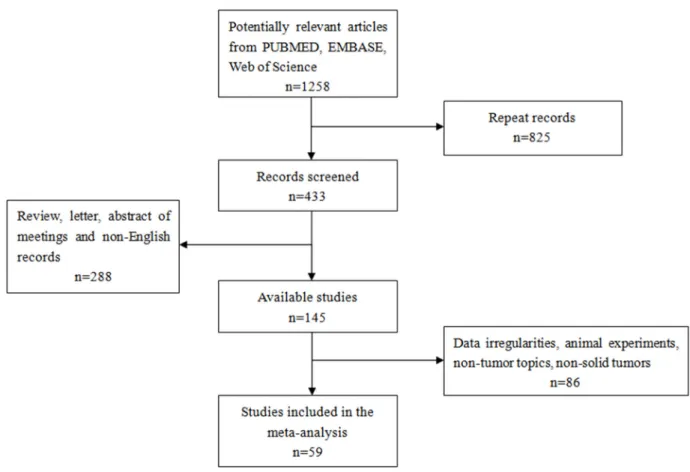
A total of 1,258 records were retrieved from
PUBMED, EMBASE, Web of Science and EBSCO
(Figure 1). After excluding 825 duplicate publications,
we reviewed the abstracts and titles of the remaining 433
articles. This led to the exclusion of another 288 records
that were not original research articles published in
English. The remaining articles were read in full, leading
to the exclusion of 86 records because they did not deal
with human patients or solid tumors, or because they
failed to report adequate outcomes data. In the end, 59
articles were included in the meta-analysis.
Key features of the 59 studies are summarized in
Table 1; 35 studies involved Asian populations and 24
involved non-Asian populations. The studies analyzed
20,004 patients from China [23–41], France [42], New
Zealand [43, 44], Brazil [45], Australia [46], Canada [47,
48], Italy [49], Germany [50, 51], United States [52–65],
Japan [66–74], South Korea [75–78], Switzerland [79] and
Taiwan [80, 81]. PD-L1 expression, which was analyzed
in similar ways across all studies, was characterized
as positive in 6,028 patients and negative in the
remaining 13,976. One third of the studies (19) involved
gastrointestinal tumors, while the remaining 40 involved
other types of tumors. Altogether 11 malignancies were
represented in the patient population: breast cancer (5
studies), renal cell carcinoma (7), colorectal cancer (3),
esophageal cancer (3), gastric cancer (7), hepatocellular
carcinoma (7), Merkel cell carcinoma (3), small cell lung
cancer (11), oral squamous cell carcinoma (5), pancreatic
cancer (3), and urinary tract epithelial cell carcinoma (4).
Table 1: Characteristics of studies included in the meta-analysis
Study Country Tumor type Characteristic Age Gendermale /female No. patients positive/ negative for PD-L1 PD-L1-positive OS (%) PD-L1-negative OS (%) P 1-yr 3-yr 5-yr 1-yr 3-yr 5-yr Qin 2015 China Breast cancer Primary 47(21-84) - 189/681 100 85 81 100 98 92 <0.001
Sabatier
2015 France Breast cancer Primary
≤50: 1288 1021 (28%)
267 (31%) >50: 3207
- 1076/4378 97 90 82 97 90 81 0.070
Muenst 2014 Switzerland Breast cancer Primary 63.8 ± 14.2 - 152/498 90 55 37 98 85 80 <0.001
Baptista
2016 Brazil Breast cancer Primary
≤50: 176 1021 (28%)
267 (31%) >50: 204
107/82 98 90 85 100 96 93 0.030
Beckers 2016 Australia Breast cancer Primary - - 123/38 96 92 81 96 73 65 0.035
Droeser 2013 Italy Colorectal cancer Primary 69.9 (30–96) 741/673 669/1420 84 71 61 72 48 37 <0.001
Shi SJ 2013 China Colorectal cancer Primary 59.8 ± 12.5 91/116 64/143 75 54 42 90 72 61 0.017
Zhu 2014 China Colorectal cancer Primary
≤50: 54 1021 (28%) 267 (31%) >50: 47 53/48 55/46 - - 62 - - 80 0.051 Krambeck
2007 USA carcinomaRenal cell Primary
≤65: 54 1021 (28%) 267 (31%) >65: 47 150/148 70/228 78 62 48 91 83 76 <0.005 Thompson
2005 Canada carcinomaRenal cell Primary - - 103/196 84 67 52 93 87 84 <0.001
Thompson
2007 Canada carcinomaRenal cell Primary
≤65: 138 1021 (28%)
267 (31%) >65: 129
177/90 142/267 88 68 - 94 85 - 0.004
Abbas 2016 Germany carcinomaRenal cell Primary 63 (31–88) 116/61 37/140 85 57 47 92 75 66 0.005
Choueiri
2014 USA carcinomaRenal cell Primary 59 (24–81) 55/46 11/90 72 48 48 98 95 85 <0.001
Thompson
2004 USA carcinomaRenal cell Primary - - 87/109 87 62 - 95 92 - <0.001
Thompson
2006 USA carcinomaRenal cell Primary - - 73/233 78 51 42 95 90 83 <0.001
Ohigashi
2005 Japan Esophageal cancer Primary
≤65: 24 1021 (28%)
267 (31%) >65: 17
32/9 18/41 60 18 18 88 53 45 0.001
Tanaka 2016 Japan Esophageal cancer Primary 62.6 ± 10.0 157/33 53/127 61 30 25 79 56 51 0.001
Chen 2014 China Esophageal cancer Primary
≤65: 51 1021 (28%) 267 (31%) >65: 48 76/23 79/20 100 44 17 83 44 37 0.675
(Continued )
Study Country Tumor type Characteristic Age Gendermale / female No. patients positive/ negative for PD-L1 PD-L1-positive OS (%) PD-L1-negative OS (%) P 1-yr 3-yr 5-yr 1-yr 3-yr 5-yr Loos 2011 Germany Esophageal cancer Primary - - 37/64 79 51 32 96 82 69 <0.001
Shohei 2016 Japan carcinomaGastric Primary 67 ± 14 75/30 28/105 84 41 10 91 63 51 0.022
Geng 2015 China carcinomaGastric Primary
≤65: 65 1021 (28%)
267 (31%) >65: 35
61/39 65/100 72 41 29 87 61 37 0.026
Hou 2014 China carcinomaGastric Primary
≤58: 55 1021 (28%)
267 (31%) >58: 56
75/36 70/111 78 46 32 93 77 68 <0.001
Wu 2006 Sweden carcinomaGastric Primary
≤65: 64 1021 (28%) 267 (31%) >65: 38 75/27 43/102 75 38 30 98 71 64 0.001 Tamura
2015 Japan carcinomaGastric Primary 66.1 (17-89) 305/126 128/303 90 65 49 94 78 64 0.001
Zheng 2014 China carcinomaGastric Primary
≤60: 42 1021 (28%)
267 (31%) >60: 38
62/18 33/47 86 65 52 91 69 53 0.636
Qing 2015 USA carcinomaGastric Primary
≤60: 42 1021 (28%)
267 (31%) >60: 38
72/35 54/107 81 28 18 93 47 27 0.004
Gao 2009 China Hepatocellular carcinoma Primary 52 (18-81) 204/36 60/180 70 42 39 83 57 49 0.029
Jung 2016 South Korea Hepatocellular carcinoma Primary
≤53: 44 1021 (28%)
267 (31%) >53: 41
69/16 23/62 43 19 17 90 69 59 <0.001
Kan 2015 China Hepatocellular carcinoma Primary
≤50: 56 1021 (28%) 267 (31%) >50: 72 108/20 105/23 30 5 0 50 15 10 0.001 Umemoto
2015 Japan Hepatocellular carcinoma Primary 64 ± 10 71/9 37/43 74 51 40 80 73 71 0.051
Zeng 2011 China Hepatocellular carcinoma Primary 53.1(35–68 109/32 31/32 38 - - 85 - - 0.000
Gabrielson
2016 USA Hepatocellular carcinoma Primary 61 (30–86) 50/15 30/35 85 85 - 53 45 - 0.029
Wu 2009 China Hepatocellular carcinoma Primary 48, 23–75 65/6 35/36 81 54 40 97 83 71 0.014
Azuma 2014 Japan Lung cancer Primary 66 (39-82) 91/73 82/164 - - 38 - - 56 0.039
Chen 2012 China Lung cancer Primary
≤54: 23 1021 (28%) 267 (31%) >54: 17 26/14 69/120 71 11 - 85 48 - <0.001
(Continued )
Study Country Tumor type Characteristic Age Gendermale / female No. patients positive/ negative for PD-L1 PD-L1-positive OS (%) PD-L1-negative OS (%) P 1-yr 3-yr 5-yr 1-yr 3-yr 5-yr Cooper 2015 USA Lung cancer Primary - 477/201 628/678 95 73 62 84 54 44 0.023
Jiang 2015 China Lung cancer Primary
≤60: 15 1021 (28%)
267 (31%) >60: 64
39/40 50/79 100 91 84 83 74 70 0.042
Kim 2015 South Korea Lung cancer Primary 65 (45–81) 33/8 89/331 65 38 27 78 49 49 0.570
Mu 2011 China Lung cancer Primary - - 58/109 87 20 - 95 38 - <0.005
Velcheti
2014 USA Lung cancer Primary
≤70: 232 1021 (28%)
267 (31%) >70: 80
260/37 56/155 78 43 27 87 61 51 0.028
Yang 2014 Taiwan Lung cancer Primary
≤70: 132 1021 (28%)
267 (31%) >70: 31
54/109 65/163 98 93 91 98 87 83 0.027
Zhang 2014 China Lung cancer Primary
≤58: 73 1021 (28%)
267 (31%) >58: 70
84/59 70/143 84 71 53 97 89 77 0.002
Song 2016 China Lung cancer Primary <60: 207≥60: 178 198/187 186/199 99 71 40 99 79 52 0.069
Inamura
2016 Japan Lung cancer Primary ≥60: 172<60: 96 142/126 43/225 85 69 55 95 81 71 0.019
Chen 2009 China Pancreatic cancer Primary <60: 61≥60: 55 76/23 18/40 32 8 - 84 58 17 0.001
Nomi 2007 Japan Pancreatic cancer Primary - - 20/51 48 12 - 78 24 - 0.016
Wang 2010 China Pancreatic cancer Primary - 40/10 23/40 87 8 - 100 33 - <0.001
Gadiot 2011 Netherlands Merkel cell carcinoma Primary - 36/27 16/63 - 51 37 - 68 52 0.200
Hino 2010 Japan Merkel cell carcinoma Primary 68.84 ± 2.85 38/21 34/59 - - 52 - - 81 0.040
Taube 2012 USA Merkel cell carcinoma Primary - 76/74 57/150 - - 84 - - 61 0.330
Boorjian 2008 USA Urinary tract epithelial cell carcinoma Primary - 259/59 39/314 58 51 43 91 82 67 0.005 Nakanishi 2006 Japan Urinary tract epithelial cell carcinoma Primary - 47/18 46/65 86 68 57 100 100 100 0.021
Wang 2009 China epithelial cell Urinary tract
carcinoma Primary - 31/5 36/50 91 68 - 100 100 - 0.020
Xylinas 2014 USA epithelial cell Urinary tract
carcinoma Primary
65.9
(60.5e72.2) 244/58 76/226 83 66 63 95 82 69 0.020
(Continued )
PD-L1 expression and OS across all studies
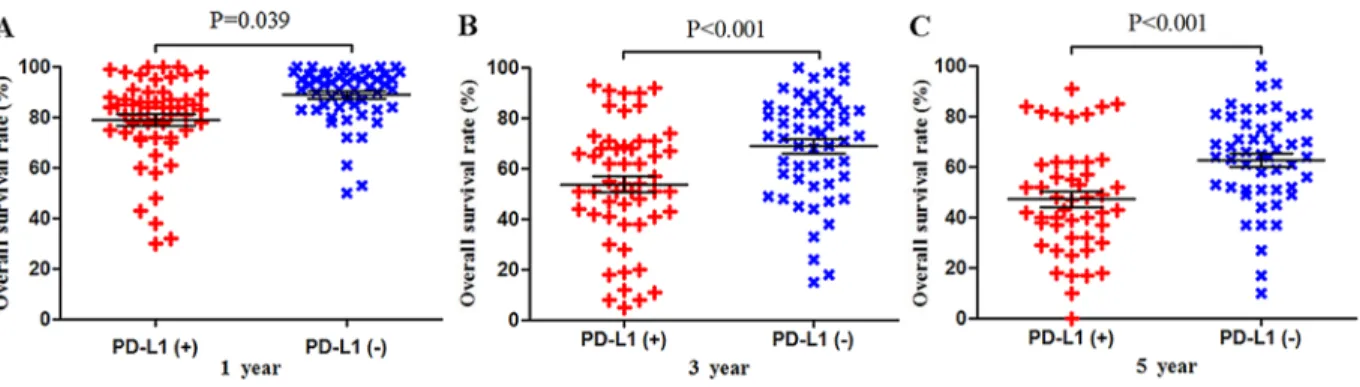
Meta-analysis of data from all 59 studies showed
that the median OS rate was significantly lower in
PD-L1-positive patients than in PD-L1-negative patients at 1
year (P = 0.039), 3 years (P < 0.001) and 5 years (P <
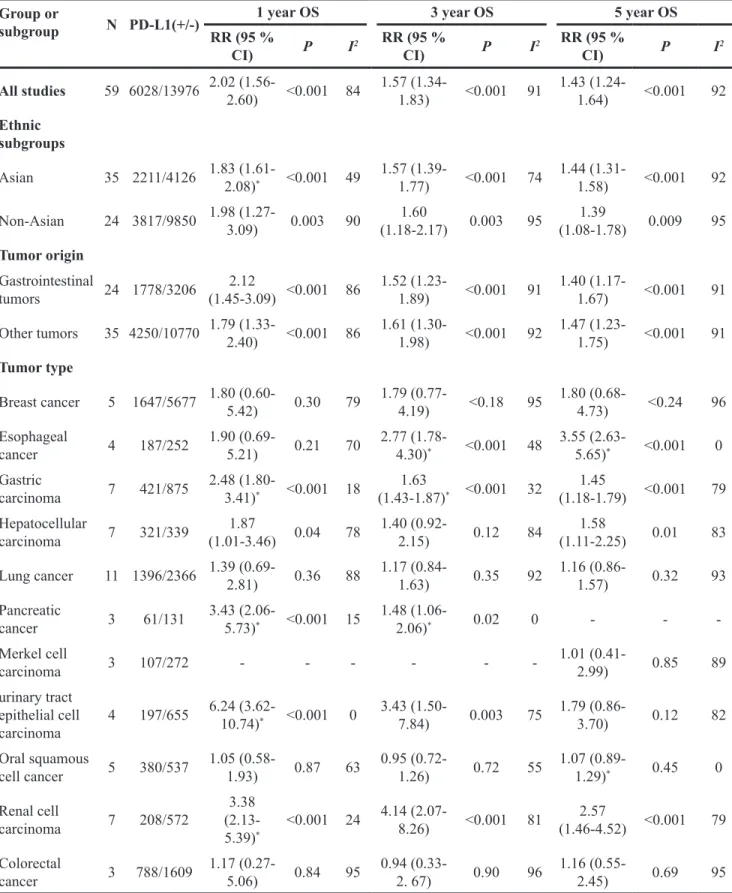
0.001; Figure 2). The RR for OS at the three time points
(and associated 95% confidence intervals [CIs]) were 2.02
(1.56-2.60), 1.57 (1.34-1.83) and 1.43 (1.24-1.64) (Table
2 and Figure 2).
Subgroup analysis by tumor type
Given the significant heterogeneity in the
meta-analysis involving all 59 studies, we performed a series
of subgroup analyses to eamine the possible correlation
between PD-L1 expression and OS. PD-L1 expression was
associated with worse 1-year OS for the following types
of solid tumor (Table 2): gastric cancer, 2.48 (1.80-3.41);
renal cell carcinoma, 3.38 (2.13-5.39); and hepatocellular
carcinoma, 1.87 (1.01-3.46). PD-L1 expression was
associated with worse 3-year OS for the following cancers:
esophageal cancer, 2.77 (1.78-4.30); gastric cancer, 1.63
(1.43-1.87); pancreatic cancer, 1.48 (1.06-2.06); and
renal cell carcinoma, 4.14 (2.07-8.26). PD-L1 expression
was associated with worse 5-year OS for esophageal
cancer, 3.55 (2.63-5.65); gastric cancer, 1.45 (1.18-1.79);
hepatocellular carcinoma, 1.58 (1.11-2.25); and renal cell
carcinoma, 2.57 (1.46-4.52).
Among the subset of 4,984 patients with
gastrointestinal tumors, 1,778 (35.6%) were
PD-L1-positive and 3,206 (64.4%) were PD-L1-negative. PD-L1
expression was associated with significantly worse OS at
1 year (P = 0.004), 3 years (P = 0.005), and 5 years (P
= 0.002; Figures 3 and 7). The corresponding RRs and
95% CIs were 2.12(1.45-3.09), 1.52 (1.23-1.89), and 1.40
(1.17-1.67) (Table 2).
Among the subset of 4,309 patients with
non-gastrointestinal tumors, 2,298 (53.3%) were
PD-L1-positive and 1,404 (59.3%) were PD-L1-negative. PD-L1
expression was associated with significantly worse OS at
1 year (P = 0.017), 3 years (P = 0.010) and 5 years (P
= 0.003; Figures 4 and 8). The corresponding RRs and
95% CIs were 1.79 (1.33-2.40), 1.61 (1.30-1.98), and 1.47
(1.23-1.75) (Table 2).
Subgroup analysis by patient ethnicity
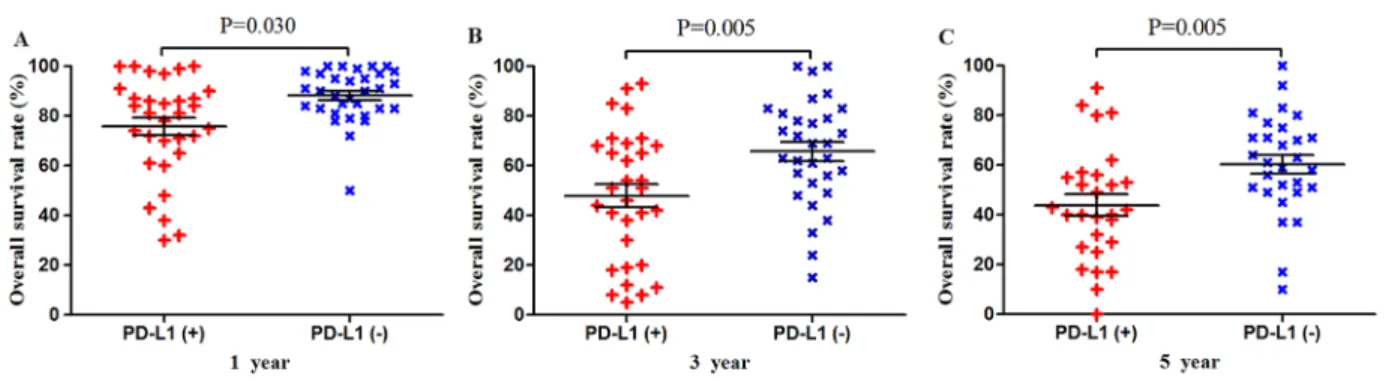
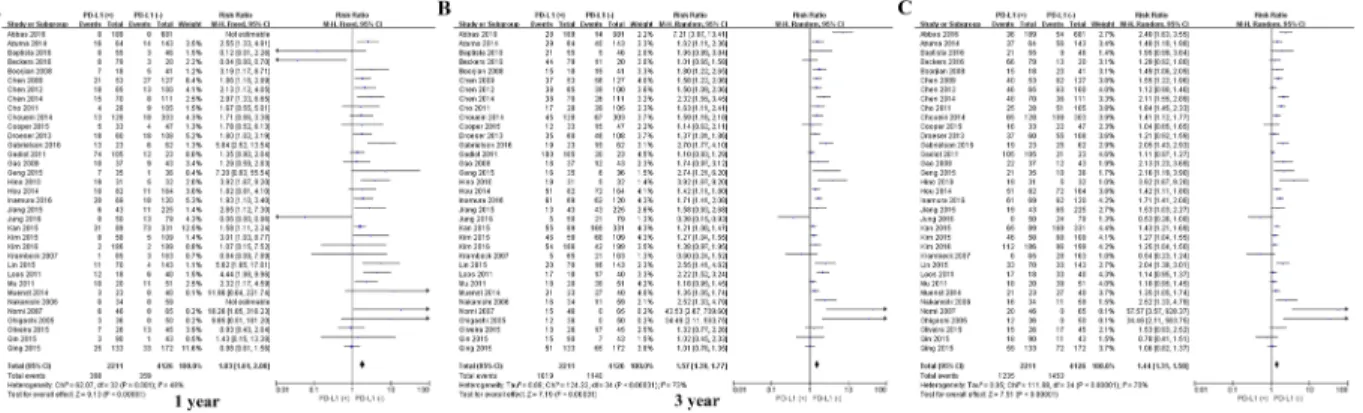
Among the subset of 6,337 Asian patients, 2,211
were PD-L1-positive and 4,126 were PD-L1-negative.
PD-L1 expression was associated with significantly lower
OS at 1 year (P = 0.030), 3 years (P = 0.005) and 5 years
(P = 0.005; Figures 5 and 9). The corresponding RRs and
95% CIs were 1.86 (1.61-2.08), 1.57 (1.39-1.77), and 1.44
(1.31-1.58) (Table 2).
Among the subset of 13,667 non-Asian patients,
3,817 were positive and 9,850 were
PD-L1-negative. PD-L1 expression was associated with
significantly lower OS at 1 year (P = 0.048), 3 years (P
= 0.040) and 5 years (P = 0.024; Figures 6 and 10). The
corresponding RRs and 95% CIs were 1.98 (1.27-3.09),
1.60 (1.18-2.17), and 1.39 (1.08-1.78) (Table 2).
Study Country Tumor type Characteristic Age Gendermale / female No. patients positive/ negative for PD-L1 PD-L1-positive OS (%) PD-L1-negative OS (%) P 1-yr 3-yr 5-yr 1-yr 3-yr 5-yr
Kim 2016 South Korea squamous cell Oral
cancer Primary 65 (45–81) 33/8 90/43 97 83 80 98 83 75 0.625
Lin 2015 Taiwan squamous cell Oral
cancer Primary
<56: 162
≥56: 143 236/69 133/172 81 62 56 81 62 58 0.225
Cho 2011 South Korea squamous cell Oral
cancer Primary <59: 20 ≥59: 25 32/13 26/45 72 51 43 72 63 63 0.012 Oliveira 2015 USA Oral squamous cell cancer Primary <60: 62 ≥60: 34 85/11 47/96 81 47 - 61 18 - 0.044
Ukpo 2013 USA squamous cell Oral
Table 2: Meta-analysis of possible associations between PD-L1 expression and overall survival in patients
with solid tumors
Group or
subgroup
N PD-L1(+/-)
RR (95 %
1 year OS
3 year OS
5 year OS
CI)
P
I
2RR (95 %
CI)
P
I
2RR (95 %
CI)
P
I
2All studies
59 6028/13976 2.02 (1.56-
2.60)
<0.001 84
1.57 (1.34-
1.83)
<0.001
91 1.43 (1.24-
1.64)
<0.001
92
Ethnic
subgroups
Asian
35 2211/4126 1.83 (1.61-
2.08)
*<0.001 49
1.57 (1.39-
1.77)
<0.001
74 1.44 (1.31-
1.58)
<0.001
92
Non-Asian
24 3817/9850 1.98 (1.27-
3.09)
0.003
90
(1.18-2.17)
1.60
0.003
95
(1.08-1.78)
1.39
0.009
95
Tumor origin
Gastrointestinal
tumors
24 1778/3206
(1.45-3.09) <0.001 86
2.12
1.52 (1.23-
1.89)
<0.001
91 1.40 (1.17-
1.67)
<0.001
91
Other tumors
35 4250/10770 1.79 (1.33-
2.40)
<0.001 86
1.61 (1.30-
1.98)
<0.001
92 1.47 (1.23-
1.75)
<0.001
91
Tumor type
Breast cancer
5 1647/5677 1.80 (0.60-
5.42)
0.30
79
1.79 (0.77-
4.19)
<0.18
95 1.80 (0.68-
4.73)
<0.24
96
Esophageal
cancer
4
187/252
1.90 (0.69-
5.21)
0.21
70
2.77 (1.78-
4.30)
*<0.001
48 3.55 (2.63-
5.65)
*<0.001
0
Gastric
carcinoma
7
421/875
2.48 (1.80-
3.41)
*<0.001 18
(1.43-1.87)
1.63
*<0.001
32
(1.18-1.79) <0.001
1.45
79
Hepatocellular
carcinoma
7
321/339
(1.01-3.46) 0.04
1.87
78
1.40 (0.92-
2.15)
0.12
84
(1.11-2.25)
1.58
0.01
83
Lung cancer
11 1396/2366 1.39 (0.69-
2.81)
0.36
88
1.17 (0.84-
1.63)
0.35
92 1.16 (0.86-
1.57)
0.32
93
Pancreatic
cancer
3
61/131
3.43 (2.06-
5.73)
*<0.001 15
1.48 (1.06-
2.06)
*0.02
0
-
-
-Merkel cell
carcinoma
3
107/272
-
-
-
-
-
-
1.01 (0.41-
2.99)
0.85
89
urinary tract
epithelial cell
carcinoma
4
197/655
6.24
(3.62-10.74)
*<0.001
0
3.43 (1.50-
7.84)
0.003
75 1.79 (0.86-
3.70)
0.12
82
Oral squamous
cell cancer
5
380/537
1.05 (0.58-
1.93)
0.87
63
0.95 (0.72-
1.26)
0.72
55 1.07 (0.89-
1.29)
*0.45
0
Renal cell
carcinoma
7
208/572
3.38
(2.13-5.39)
*<0.001 24
4.14
(2.07-8.26)
<0.001
81
(1.46-4.52) <0.001
2.57
79
Colorectal
cancer
3
788/1609 1.17 (0.27-
5.06)
0.84
95
0.94 (0.33-
2. 67)
0.90
96 1.16 (0.55-
2.45)
0.69
95
N, number of studies; OS, overall survival; RR, risk ratio; 95% CI, 95% confidence interval
*
These meta-analyses were performed using a fixed-effects model. All other meta-analyses were performed using a
DISCUSSION
While studies published more than a decade ago
established that PD-L1 promotes cancer immune escape
[82, 83] and that blocking PD-L1 can improve the
anti-tumor efficacy of anti-anti-tumor responses [84–86], whether
PD-L1 expression by solid tumors negatively affects
patient prognosis remains unclear. Here we reviewed 59
studies involving 20,004 patients with 11 types of solid
tumors and found strong evidence that PD-L1 expression
is associated with significantly lower OS at 1, 3 and 5
years. This effect was observed in meta-analyses involving
Figure 2: Scatter plot of OS at 1, 3 and 5 years for patients positive or negative for PD-L1 expression.
Data come from the entire patient population.Figure 3: Scatter plot of OS at 1, 3 and 5 years for patients positive or negative for PD-L1 expression.
Data come from the subset of patients with gastrointestinal tumors.Figure 4: Scatter plot of OS at 1, 3 and 5 years for patients positive or negative for PD-L1 expression.
Data come from the subset of patients with non-gastrointestinal tumors.all patients as well as several subgroups of patients
stratified by ethnicity and tumor type.
PD-L1 positive expression is associated with viral
infection and chronic inflammation [87]. Expression of
PD-L1 and/or PD-1 has been described for numerous types
of cancers associated with viral infection [88], including
polycyclic virus-associated Merkel cell carcinoma [89],
hepatitis B virus-associated hepatocellular carcinoma [33],
human papillomavirus-associated head and neck cancer,
and Epstein-Barr virus-related nasopharyngeal carcinoma
[90]. In patients with hepatocellular carcinoma, PD-L1
expression was significantly higher in tumor macrophages
than in matched normal tissues, and expression correlated
with tumor grade [25].
Our results are consistent with previous reports
that PD-L1 expression is associated with worse 5-year
outcome in patients with gastrointestinal carcinomas
such as esophageal cancer and gastric cancer [70, 79] as
well as colorectal cancer [25]. The precise mechanisms
whereby PD-L1 expression may worsen prognosis are
unknown; When PD-1 binds to the ligand PD-L1
(B7-H1) expressed on the surface of tumors, PD-1 has been
shown to promote tumor cell-specific T cell inactivation
or apoptosis [12].
The results of this meta-analysis should be
interpreted cautiously because of several limitations.
One is the lack of a standardized assay and cut-off value
for classifying patients as PD-L1-positive. This may
help explain the high heterogeneity observed across the
included studies. Another limitation is our exclusion
of gray literature, which may have increased the risk of
publication bias and selection bias.
Despite these limitations, this large meta-analysis
provides strong evidence that expression of PD-L1
may be a meaningful index for predicting prognosis
in a wide variety of patients with solid tumors. These
findings justify more focused prognostic studies in
well-defined patient populations in which a panel of clinically
relevant outcomes beyond only OS are considered.
Figure 5: Scatter plot of OS at 1, 3 and 5 years for patients positive or negative for PD-L1 expression.
Data come from the subset of Asian patients.Figure 6: Scatter plot of OS at 1, 3 and 5 years for patients positive or negative for PD-L1 expression.
Data come from the subset of non-Asian patients.Figure 7: Forrest plot of OS at 1, 3 and 5 years for patients positive or negative for PD-L1 expression.
Data come from the subset of patients with gastrointestinal tumors.Figure 8: Forrest plot of OS at 1, 3 and 5 years for patients positive or negative for PD-L1 expression.
Data come from the subset of patients with non-gastrointestinal tumors.Figure 9: Forrest plot of OS at 1, 3 and 5 years for patients positive or negative for PD-L1 expression.
Data come from the subset of Asian patients.Figure 10: Forrest plot of OS at 1, 3 and 5 years for patients positive or negative for PD-L1 expression.
Data come from the subset of non-Asian patients.MATERIALS AND METHODS
Literature search
PubMed, EMBASE, Web of Science and EBSCO
were searched through 15 January 2017 to identify cohort
and case-control studies examining the relationship
between PD-L1 expression and prognosis of patients
with solid tumors. The following search terms were used:
programmed death-ligand 1, PD-L1, B7-H1, CD274 and
solid tumor.
Inclusion and exclusion criteria
To be included in our meta-analysis, studies had
to involve (1) primary solid tumors in human patients;
(2) The main content of the articles is to analyze the
relationship between the expression of PD-L1 and the
prognosis of solid tumors in patients; (3) a
hospital-based or population-hospital-based case-control or cohort design,
regardless of sample size; (4) immunohistochemical assay
of PD-L1 expression as high and low PD-L1 expression;
(5) all patients underwent surgery; and (6) adequate
reporting of overall survival (OS) data. When eligible
studies involved overlapping patient populations, only
the most recent or complete report was included. Studies
were excluded if they were letter, summary of meeting and
review; if they were published in a language other than
English; or if they failed to report adequate data; or they
investigated metastatic tumors. Gray literature (Reports
and papers that were not published in PubMed, EMBASE,
Web of Science and EBSCO) was not included into this
study. Reference lists within identified articles were also
searched manually to identify additional articles.
Meta-analysis outcomes
The primary outcome in the meta-analysis was OS.
This outcome was compared between patients showing
high or positive PD-L1 expression and patients showing
low or no expression, as defined within the individual
studies.
Data collection
Two researchers (P.-C.Y, X.X) independently
screened studies for inclusion. Disagreements were
resolved by discussion and, when necessary, consultation
with a third author (S.Z). The first author's name, year of
publication, country, number of patients, and tumor type
were extracted from each study, and OS results for 1, 3 and
5 years were extracted from tables or Kaplan-Meier curves.
Statistical analysis
Forest plots of OS were generated using RevMan
5.3 (Cochrane Collaboration, Copenhagen, Denmark).
pooled data using Mantel-Haenszel random-effects
meta-analysis, unless no statistically heterogeneity, in
which case fixed-effects meta-analysis was performed.
Statistical heterogeneity in meta-analyses was assessed
using Cochrane's Q and I
2statistics. Survival results
were analyzed using scatter plots generated in Prism 5
(Graphpad Software, San Diego, USA). The results for
different patient groups were compared using the log-rank
test. The threshold of statistical significance was defined
as P < 0.05.
Author contributions
X.X, J.-H.Z and L.L conceived the study;
P.-C.Y collected and analyzed the data; X.X drafted the
manuscript; all authors have read and approved the final
version to be published.
CONFLICTS OF INTEREST
The authors have declared that no competing
interests exist.
FUNDING
This work was supported by Guangxi University
of Science and Technology Research Projects
(KY2015LX056), the Self-Raised Scientific Research
Fund of the Ministry of Health of Guangxi Province
(Z2016512, Z2015621, Z2015601, GZZC15-34,
Z2014241), the Graduate Course Construction Project of
Guangxi Medical University (YJSA2017014), and the the
National Science and Technology Major Special Project
(2012ZX10002010001009).
REFERENCES
1. Chen L, Flies DB. Molecular mechanisms of T cell co-stimulation and co-inhibition. Nature reviews. Immunology. 2013; 13:227-242.
2. Perez-Gracia JL, Labiano S, Rodriguez-Ruiz ME, Sanmamed MF, Melero I. Orchestrating immune check-point blockade for cancer immunotherapy in combinations. Current Opin Immunol. 2014; 27:89-97.
3. Xiang X, Qin HG, You XM, Wang YY, Qi LN, Ma L, Xiang BD, Zhong JH, Li LQ. Expression of P62 with hepatocellular carcinoma involving hepatitis B virus infection and aflatoxin B1 exposure. Cancer Med. 2017; 6:2357-2369
4. Hanahan D, Weinberg RA. The hallmarks of cancer. Cell. 2000; 100:57-70.
5. Freeman GJ, Long AJ, Iwai Y, Bourque K, Chernova T, Nishimura H, Fitz LJ, Malenkovich N, Okazaki T, Byrne MC, Horton HF, Fouser L, Carter L, et al. Engagement of the PD-1 immunoinhibitory receptor by a novel B7
family member leads to negative regulation of lymphocyte activation. J Exp Med. 2000; 192:1027-1034.
6. Latchman Y, Wood CR, Chernova T, Chaudhary D, Borde M, Chernova I, Iwai Y, Long AJ, Brown JA, Nunes R, Greenfield EA, Bourque K, Boussiotis VA, et al. PD-L2 is a second ligand for PD-1 and inhibits T cell activation. Nat Immunol. 2001; 2:261-268.
7. Jin HT, Ahmed R, Okazaki T. Role of PD-1 in regulating T-cell immunity. Curr Top Microbiol Immunol. 2011; 350:17-37.
8. Zha Y, Blank C, Gajewski TF. Negative regulation of T-cell function by PD-1. Crit Rev Immunol. 2004; 24:229-237. 9. D’Incecco A, Andreozzi M, Ludovini V, Rossi E,
Capodanno A, Landi L, Tibaldi C, Minuti G, Salvini J, Coppi E, Chella A, Fontanini G, Filice ME, et al. PD-1 and PD-L1 expression in molecularly selected non-small-cell lung cancer patients. Br J Cancer. 2015; 112:95-102. 10. Faraj SF, Munari E, Guner G, Taube J, Anders R, Hicks
J, Meeker A, Schoenberg M, Bivalacqua T, Drake C, Netto GJ. Assessment of tumoral PD-L1 expression and intratumoral CD8+ T cells in urothelial carcinoma. Urology. 2015; 85:703.e701-706.
11. Yamane H, Isozaki H, Takeyama M, Ochi N, Kudo K, Honda Y, Yamagishi T, Kubo T, Kiura K, Takigawa N. Programmed cell death protein 1 and programmed death-ligand 1 are expressed on the surface of some small-cell lung cancer lines. Am J Cancer Res. 2015; 5:1553-1557. 12. Mazel M, Jacot W, Pantel K, Bartkowiak K, Topart D,
Cayrefourcq L, Rossille D, Maudelonde T, Fest T, Alix-Panabières C. Frequent expression of PD-L1 on circulating breast cancer cells. Mol Oncol. 2015; 9:1773-1782. 13. Chang YL, Yang CY, Lin MW, Wu CT, Yang PC. PD-L1
is highly expressed in lung lymphoepithelioma-like carcinoma: a potential rationale for immunotherapy. Lung Cancer. 2015; 88:254-259.
14. Tsai KK, Zarzoso I, Daud AI. PD-1 and PD-L1 antibodies for melanoma. Hum Vaccin Immunother. 2014; 10:3111-3116.
15. Brower V. Anti-PD-L1 antibody active in metastatic bladder cancer. Lancet Oncol. 2015; 16:e11.
16. Gettinger S, Herbst RS. B7-H1/PD-1 blockade therapy in non-small cell lung cancer: current status and future direction. Cancer J. 2014; 20:281-289.
17. Xiang X, Zhong JH, Wang YY, You XM, Ma L, Xiang BD, Li LQ. Distribution of tumor stage and initial treatment modality in patients with primary hepatocellular carcinoma Clin Transl Oncol. 2017; 19:891-897
18. Barbee MS, Ogunniyi A, Horvat TZ, Dang TO. Current status and future directions of the immune checkpoint inhibitors ipilimumab, pembrolizumab, and nivolumab in oncology. Ann Pharmacother. 2015; 49:907-937.
19. McDermott J, Jimeno A. Pembrolizumab: PD-1 inhibition as a therapeutic strategy in cancer. Drugs Today (Barc). 2015; 51:7-20.
20. Gunturi A, McDermott DF. Nivolumab for the treatment of cancer. Expert Opin Investig Drugs. 2015; 24:253-260. 21. Errico A. Immunotherapy: PD-1-PD-L1 axis: efficient
checkpoint blockade against cancer. Nat Rev Clin Oncol. 2015; 12:63.
22. Zhong JH, Luo CP, Zhang CY, Li LQ. Strengthening the case that elevated levels of programmed death ligand 1 predict poor prognosis in hepatocellular carcinoma patients. J Hepatocell Carcinoma. 2017; 4:11-13.
23. Qin T, Zeng YD, Qin G, Xu F, Lu JB, Fang WF, Xue C, Zhan JH, Zhang XK, Zheng QF, Peng RJ, Yuan ZY, Zhang L, Wang SS. High PD-L1 expression was associated with poor prognosis in 870 Chinese patients with breast cancer. Oncotarget. 2015; 6:33972-33981. https://doi.org/10.18632/ oncotarget.5583.
24. Shi SJ, Wang LJ, Wang GD, Guo ZY, Wei M, Meng YL, Yang AG, Wen WH. B7-H1 expression is associated with poor prognosis in colorectal carcinoma and regulates the proliferation and invasion of HCT116 colorectal cancer cells. PLoS One. 2013; 8:e76012.
25. Zhu J, Chen L, Zou L, Yang P, Wu R, Mao Y, Zhou H, Li R, Wang K, Wang W, Hua D, Zhang X. MiR-20b, -21, and -130b inhibit PTEN expression resulting in B7-H1 over-expression in advanced colorectal cancer. Hum Immunol. 2014; 75:348-353.
26. Chen L. Co-inhibitory molecules of the B7-CD28 family in the control of T-cell immunity. Nat Rev Immunol. 2004; 4:336-347.
27. Geng Y, Wang H, Lu C, Li Q, Xu B, Jiang J, Wu C. Expression of costimulatory molecules B7-H1, B7-H4 and Foxp3+ Tregs in gastric cancer and its clinical significance. Int J Clin Oncol. 2015; 20:273-281.
28. Hou J, Yu Z, Xiang R, Li C, Wang L, Chen S, Li Q, Chen M, Wang L. Correlation between infiltration of FOXP3+ regulatory T cells and expression of B7-H1 in the tumor tissues of gastric cancer. Exp Mol Pathol. 2014; 96:284-291. 29. Zheng Z, Bu Z, Liu X, Zhang L, Li Z, Wu A, Wu X, Cheng
X, Xing X, Du H, Wang X, Hu Y, Ji J. Level of circulating PD-L1 expression in patients with advanced gastric cancer and its clinical implications. Chin J Cancer Res. 2014; 26:104-111.
30. Gao Q, Wang XY, Qiu SJ, Yamato I, Sho M, Nakajima Y, Zhou J, Li BZ, Shi YH, Xiao YS, Xu Y, Fan J. Overexpression of PD-L1 significantly associates with tumor aggressiveness and postoperative recurrence in human hepatocellular carcinoma. Clin Cancer Res. 2009; 15:971-979.
31. Kan G, Dong W. The expression of PD-L1 APE1 and P53 in hepatocellular carcinoma and its relationship to clinical pathology. Eur Rev Med Pharmacol Sci. 2015; 19:3063-3071.
32. Wu K, Kryczek I, Chen L, Zou W, Welling TH. Kupffer cell suppression of CD8+ T cells in human hepatocellular
carcinoma is mediated by B7-H1/programmed death-1 interactions. Cancer Res. 2009; 69:8067-8075.
33. Zeng Z, Shi F, Zhou L, Zhang MN, Chen Y, Chang XJ, Lu YY, Bai WL, Qu JH, Wang CP, Wang H, Lou M, Wang FS, et al. Upregulation of circulating PD-L1/PD-1 is associated with poor post-cryoablation prognosis in patients with HBV-related hepatocellular carcinoma. PLoS One. 2011; 6:e23621.
34. Chen YB, Mu CY, Huang JA. Clinical significance of programmed death-1 ligand-1 expression in patients with non-small cell lung cancer: a 5-year-follow-up study. Tumori. 2012; 98:751-755.
35. Jiang L, Wang L, Li PF, Zhang XK, Chen JW, Qiu HJ, Wu XD, Zhang B. Positive expression of programmed death ligand-1 correlates with superior outcomes and might be a therapeutic target in primary pulmonary lymphoepithelioma-like carcinoma. OncoTargets Ther. 2015; 8:1451-1457.
36. Mu CY, Huang JA, Chen Y, Chen C, Zhang XG. High expression of PD-L1 in lung cancer may contribute to poor prognosis and tumor cells immune escape through suppressing tumor infiltrating dendritic cells maturation. Med Oncol. 2011; 28:682-688.
37. Song Z, Yu X, Cheng G, Zhang Y. Programmed death-ligand 1 expression associated with molecular characteristics in surgically resected lung adenocarcinoma. J Transl Med. 2016; 14:188.
38. Zhang Y, Wang L, Li Y, Pan Y, Wang R, Hu H, Li H, Luo X, Ye T, Sun Y, Chen H. Protein expression of programmed death 1 ligand 1 and ligand 2 independently predict poor prognosis in surgically resected lung adenocarcinoma. OncoTargets Ther. 2014; 7:567-573.
39. Chen XL, Yuan SX, Chen C, Mao YX, Xu G, Wang XY. [Expression of B7-H1 protein in human pancreatic carcinoma tissues and its clinical significance]. [Article in Chinese]. Ai zheng. 2009; 28:1328-1332.
40. Wang L, Ma Q, Chen X, Guo K, Li J, Zhang M. Clinical significance of B7-H1 and B7-1 expressions in pancreatic carcinoma. World J Surg. 2010; 34:1059-1065.
41. Wang Y, Zhuang Q, Zhou S, Hu Z, Lan R. Costimulatory molecule B7-H1 on the immune escape of bladder cancer and its clinical significance. J Huazhong Univ Sci Technolog Med Sci. 2009; 29:77-79.
42. Sabatier R, Finetti P, Mamessier E, Adelaide J, Chaffanet M, Ali HR, Viens P, Caldas C, Birnbaum D, Bertucci F. Prognostic and predictive value of PDL1 expression in breast cancer. Oncotarget. 2015; 6:5449-5464. https://doi. org/10.18632/oncotarget.3216.
43. Gadiot J, Hooijkaas AI, Kaiser AD, van Tinteren H, van Boven H, Blank C. Overall survival and PD-L1 expression in metastasized malignant melanoma. Cancer. 2011; 117:2192-2201.
44. Muenst S, Schaerli AR, Gao F, Däster S, Trella E, Droeser RA, Muraro MG, Zajac P, Zanetti R, Gillanders WE, Weber
(PD-L1) is associated with poor prognosis in human breast cancer. Breast Cancer Res Treat. 2014; 146:15-24. 45. Baptista MZ, Sarian LO, Derchain SF, Pinto GA, Vassallo
J. Prognostic significance of PD-L1 and PD-L2 in breast cancer. Hum Pathol. 2016; 47:78-84.
46. Beckers RK, Selinger CI, Vilain R, Madore J, Wilmott JS, Harvey K, Holliday A, Cooper CL, Robbins E, Gillett D, Kennedy CW, Gluch L, Carmalt H, et al. Programmed death ligand 1 expression in triple-negative breast cancer is associated with tumour-infiltrating lymphocytes and improved outcome. Histopathology. 2016; 69:25-34. 47. Thompson RH, Gillett MD, Cheville JC, Lohse CM, Dong
H, Webster WS, Chen L, Zincke H, Blute ML, Leibovich BC, Kwon ED. Costimulatory molecule B7-H1 in primary and metastatic clear cell renal cell carcinoma. Cancer. 2005; 104:2084-2091.
48. Thompson RH, Dong H, Lohse CM, Leibovich BC, Blute ML, Cheville JC, Kwon ED. PD-1 is expressed by tumor-infiltrating immune cells and is associated with poor outcome for patients with renal cell carcinoma. Clin Cancer Res. 2007; 13:1757-1761.
49. Droeser RA, Hirt C, Viehl CT, Frey DM, Nebiker C, Huber X, Zlobec I, Eppenberger-Castori S, Tzankov A, Rosso R, Zuber M, Muraro MG, Amicarella F, et al. Clinical impact of programmed cell death ligand 1 expression in colorectal cancer. Eur J Cancer. 2013; 49:2233-2242.
50. Abbas M, Steffens S, Bellut M, Eggers H, Großhennig A, Becker JU, Wegener G, Schrader AJ, Grünwald V, Ivanyi P. Intratumoral expression of programmed death ligand 1 (PD-L1) in patients with clear cell renal cell carcinoma (ccRCC). Med Oncol. 2016; 33:80.
51. Loos M, Langer R, Schuster T, Gertler R, Walch A, Rauser S, Friess H, Feith M. Clinical significance of the costimulatory molecule B7-H1 in Barrett carcinoma. Ann Thorac Surg. 2011; 91:1025-1031.
52. Krambeck AE, Dong H, Thompson RH, Kuntz SM, Lohse CM, Leibovich BC, Blute ML, Sebo TJ, Cheville JC, Parker AS, Kwon ED. Survivin and b7-h1 are collaborative predictors of survival and represent potential therapeutic targets for patients with renal cell carcinoma. Clinical Cancer Res. 2007; 13:1749-1756.
53. Choueiri TK, Fay AP, Gray KP, Callea M, Ho TH, Albiges L, Bellmunt J, Song J, Carvo I, Lampron M, Stanton ML, Hodi FS, McDermott DF, et al. PD-L1 expression in nonclear-cell renal cell carcinoma. Ann Oncol. 2014; 25:2178-2184.
54. Thompson RH, Gillett MD, Cheville JC, Callea M, Ho TH, Albiges L, Bellmunt J, Song J, Carvo I, Lampron M, Stanton ML, Hodi FS, McDermott DF, et al. Costimulatory B7-H1 in renal cell carcinoma patients: indicator of tumor aggressiveness and potential therapeutic target. Proc Natl Acad Sci U S A. 2004; 101:17174-17179.
55. Thompson RH, Kuntz SM, Leibovich BC, Dong H, Lohse CM, Webster WS, Sengupta S, Frank I, Parker AS, Zincke
B7-H1 is associated with poor prognosis in renal cell carcinoma patients with long-term follow-up. Cancer Res. 2006; 66:3381-3385.
56. Cooper WA, Tran T, Vilain RE, Madore J, Selinger CI, Kohonen-Corish M, Yip P, Yu B, O'Toole SA, McCaughan BC, Yearley JH, Horvath LG, Kao S, et al. PD-L1 expression is a favorable prognostic factor in early stage non-small cell carcinoma. Lung Cancer. 2015; 89:181-188. 57. Velcheti V, Schalper KA, Carvajal DE, Anagnostou VK,
Syrigos KN, Sznol M, Herbst RS, Gettinger SN, Chen L, Rimm DL. Programmed death ligand-1 expression in non-small cell lung cancer. Lab Invest. 2014; 94:107-116. 58. Taube JM, Anders RA, Young GD, Xu H, Sharma R,
McMiller TL, Chen S, Klein AP, Pardoll DM, Topalian SL, Chen L. Colocalization of inflammatory response with B7-h1 expression in human melanocytic lesions supports an adaptive resistance mechanism of immune escape. Sci Transl Med. 2012; 4:127ra137.
59. Boorjian SA, Sheinin Y, Crispen PL, Farmer SA, Lohse CM, Kuntz SM, Leibovich BC, Kwon ED, Frank I. T-cell coregulatory molecule expression in urothelial cell carcinoma: clinicopathologic correlations and association with survival. Clin Cancer Res. 2008; 14:4800-4808. 60. Xylinas E, Robinson BD, Kluth LA, Volkmer BG,
Hautmann R, Küfer R, Zerbib M, Kwon E, Thompson RH, Boorjian SA, Shariat SF. Association of T-cell co-regulatory protein expression with clinical outcomes following radical cystectomy for urothelial carcinoma of the bladder. Eur J Surg Oncol. 2014; 40:121-127.
61. Oliveira-Costa JP, de Carvalho AF, da Silveira da GG, Amaya P, Wu Y, Park KJ, Gigliola MP, Lustberg M, Buim ME, Ferreira EN, Kowalski LP, Chalmers JJ, Soares FA, et al. Gene expression patterns through oral squamous cell carcinoma development: PD-L1 expression in primary tumor and circulating tumor cells. Oncotarget. 2015; 6:20902-20920. https://doi.org/10.18632/oncotarget.3939. 62. Ukpo OC, Thorstad WL, Lewis JS Jr. B7-H1 expression
model for immune evasion in human papillomavirus-related oropharyngeal squamous cell carcinoma. Head Neck Pathol. 2013; 7:113-121.
63. Qing Y, Li Q, Ren T, Xia W, Peng Y, Liu GL, Luo H, Yang YX, Dai XY, Zhou SF, Wang D. Upregulation of PD-L1 and APE1 is associated with tumorigenesis and poor prognosis of gastric cancer. Drug Des Devel Ther. 2015; 9:901-909. 64. Gabrielson A, Wu Y, Wang H, Jiang J, Kallakury B,
Gatalica Z, Reddy S, Kleiner D, Fishbein T, Johnson L, Island E, Satoskar R, Banovac F, et al. Intratumoral CD3 and CD8 T-cell densities associated with relapse-free survival in HCC. Cancer Immunol Res. 2016; 4:419-430. 65. Eto S, Yoshikawa K, Nishi M, Higashijima J, Tokunaga
T, Nakao T, Kashihara H, Takasu C, Iwata T, Shimada M. Programmed cell death protein 1 expression is an independent prognostic factor in gastric cancer after curative resection. Gastric Cancer. 2016; 19:466-471.
66. Azuma K, Ota K, Kawahara A, Hattori S, Iwama E, Harada T, Matsumoto K, Takayama K, Takamori S, Kage M, Hoshino T, Nakanishi Y, Okamoto I. Association of PD-L1 overexpression with activating EGFR mutations in surgically resected nonsmall-cell lung cancer. Ann Oncol. 2014; 25:1935-1940.
67. Inamura K, Yokouchi Y, Sakakibara R, Kobayashi M, Subat S, Ninomiya H, Nagano H, Nomura K, Okumura S, Ishikawa Y. Relationship of tumor PD-L1 expression with EGFR wild-type status and poor prognosis in lung adenocarcinoma. Jpn J Clin Oncol. 2016; 46:935-941. 68. Hino R, Kabashima K, Kato Y, Yagi H, Nakamura M,
Honjo T, Okazaki T, Tokura Y. Tumor cell expression of programmed cell death-1 ligand 1 is a prognostic factor for malignant melanoma. Cancer. 2010; 116:1757-1766. 69. Nakanishi J, Wada Y, Matsumoto K, Azuma M, Kikuchi K,
Ueda S. Overexpression of B7-H1 (PD-L1) significantly associates with tumor grade and postoperative prognosis in human urothelial cancers. Cancer Immunol Immunother. 2007; 56:1173-1182.
70. Ohigashi Y, Sho M, Yamada Y, Tsurui Y, Hamada K, Ikeda N, Mizuno T, Yoriki R, Kashizuka H, Yane K, Tsushima F, Otsuki N, Yagita H, et al. Clinical significance of programmed death-1 ligand-1 and programmed death-1 ligand-2 expression in human esophageal cancer. Clin Cancer Res. 2005; 11:2947-2953.
71. Tanaka K, Miyata H, Sugimura K, Kanemura T, Hamada-Uematsu M, Mizote Y, Yamasaki M, Wada H, Nakajima K, Takiguchi S, Mori M, Doki Y, Tahara H. Negative influence of programmed death-1-ligands on the survival of esophageal cancer patients treated with chemotherapy. Cancer Sci. 2016; 107:726-733.
72. Tamura T, Ohira M, Tanaka H, Muguruma K, Toyokawa T, Kubo N, Sakurai K, Amano R, Kimura K, Shibutani M, Maeda K, Hirakawa K. Programmed death-1 ligand-1 (PDL1) expression is associated with the prognosis of patients with stage II/III gastric cancer. Anticancer Res. 2015; 35:5369-5376.
73. Umemoto Y, Okano S, Matsumoto Y, Nakagawara H, Matono R, Yoshiya S, Yamashita Y, Yoshizumi T, Ikegami T, Soejima Y, Harada M, Aishima S, Oda Y, et al. Prognostic impact of programmed cell death 1 ligand 1 expression in human leukocyte antigen class I-positive hepatocellular carcinoma after curative hepatectomy. J Gastroenterol. 2015; 50:65-75.
74. Nomi T, Sho M, Akahori T, Hamada K, Kubo A, Kanehiro H, Nakamura S, Enomoto K, Yagita H, Azuma M, Nakajima Y. Clinical significance and therapeutic potential of the programmed death-1 ligand/programmed death-1 pathway in human pancreatic cancer. Clin Cancer Res. 2007; 13:2151-2157.
75. Kim S, Kim MY, Koh J, Go H, Lee DS, Jeon YK, Chung DH. Programmed death-1 ligand 1 and 2 are highly expressed in pleomorphic carcinomas of the lung:
comparison of sarcomatous and carcinomatous areas. Eur J Cancer. 2015; 51:2698-2707.
76. Kim HS, Lee JY, Lim SH, Park K, Sun JM, Ko YH, Baek CH, Son YI, Jeong HS, Ahn YC, Lee MY, Hong M, Ahn MJ. Association between PD-L1 and HPV status and the prognostic value of PD-L1 in oropharyngeal squamous cell carcinoma. Cancer Res Treat. 2016; 48:527-536.
77. Cho YA, Yoon HJ, Lee JI, Hong SP, Hong SD. Relationship between the expressions of PD-L1 and tumor-infiltrating lymphocytes in oral squamous cell carcinoma. Oral Oncol. 2011; 47:1148-1153.
78. Jung HI, Jeong D, Ji S, Ahn TS, Bae SH, Chin S, Chung JC, Kim HC, Lee MS, Baek MJ. Overexpression of PD-L1 and PD-L2 is Associated with Poor Prognosis in Patients with Hepatocellular Carcinoma. Cancer Res Treat. 2017; 49:246-254.
79. Wu C, Zhu Y, Jiang J, Zhao J, Zhang XG, Xu N. Immunohistochemical localization of programmed death-1 ligand-1 (PD-L1) in gastric carcinoma and its clinical significance. Acta Histochem. 2006; 108:19-24.
80. Yang CY, Lin MW, Chang YL, Wu CT, Yang PC. Programmed cell death-ligand 1 expression in surgically resected stage I pulmonary adenocarcinoma and its correlation with driver mutations and clinical outcomes. Eur J Cancer. 2014; 50:1361-1369.
81. Lin YM, Sung WW, Hsieh MJ, Tsai SC, Lai HW, Yang SM, Shen KH, Chen MK, Lee H, Yeh KT, Chen CJ. High PD-L1 expression correlates with metastasis and poor prognosis in oral squamous cell carcinoma. PLoS One. 2015; 10:e0142656.
82. Dong H, Strome SE, Salomao DR, Tamura H, Hirano F, Flies DB, Roche PC, Lu J, Zhu G, Tamada K, Lennon VA, Celis E, Chen L. Tumor-associated B7-H1 promotes T-cell apoptosis: a potential mechanism of immune evasion. Nat Med. 2002; 8:793-800.
83. Iwai Y, Ishida M, Tanaka Y, Okazaki T, Honjo T, Minato N. Involvement of PD-L1 on tumor cells in the escape from host immune system and tumor immunotherapy
by PD-L1 blockade. Proc Natl Acad Sci U S A. 2002; 99:12293-12297.
84. Curiel TJ, Wei S, Dong H, Alvarez X, Cheng P, Mottram P, Krzysiek R, Knutson KL, Daniel B, Zimmermann MC, David O, Burow M, Gordon A, et al. Blockade of B7-H1 improves myeloid dendritic cell-mediated antitumor immunity. Nat Med. 2003; 9:562-567.
85. Strome SE, Dong H, Tamura H, Voss SG, Flies DB, Tamada K, Salomao D, Cheville J, Hirano F, Lin W, Kasperbauer JL, Ballman KV, Chen L. B7-H1 blockade augments adoptive T-cell immunotherapy for squamous cell carcinoma. Cancer Res. 2003; 63:6501-6505.
86. Blank C, Brown I, Peterson AC, Spiotto M, Iwai Y, Honjo T, Gajewski TF. PD-L1/B7H-1 inhibits the effector phase of tumor rejection by T cell receptor (TCR) transgenic CD8+ T cells. Cancer Res. 2004; 64:1140-1145.
87. Abdel-Magid AF. Inhibitors of the PD-1/PD-L1 Pathway Can Mobilize the Immune System: An Innovative Potential Therapy for Cancer and Chronic Infections. ACS Med Chem Lett. 2015; 6:489-490.
88. Fang W, Zhang J, Hong S, Zhan J, Chen N, Qin T, Tang Y, Zhang Y, Kang S, Zhou T, Wu X, Liang W, Hu Z, et al. EBV-driven LMP1 and IFNgamma up-regulate PD-L1 in nasopharyngeal carcinoma: Implications for oncotargeted therapy. Oncotarget. 2014; 5:12189-12202. https://doi. org/10.18632/oncotarget.2608.
89. Lipson EJ, Vincent JG, Loyo M, Kagohara LT, Luber BS, Wang H, Xu H, Nayar SK, Wang TS, Sidransky D, Anders RA, Topalian SL, Taube JM. PD-L1 expression in the Merkel cell carcinoma microenvironment: association with inflammation, Merkel cell polyomavirus and overall survival. Cancer Immunol Res. 2013; 1:54-63.
90. Lyford-Pike S, Peng S, Young GD, Taube JM, Westra WH, Akpeng B, Bruno TC, Richmon JD, Wang H, Bishop JA, Chen L, Drake CG, Topalian SL, et al. Evidence for a role of the PD-1:PD-L1 pathway in immune resistance of HPV-associated head and neck squamous cell carcinoma. Cancer Res. 2013; 73:1733-1741.